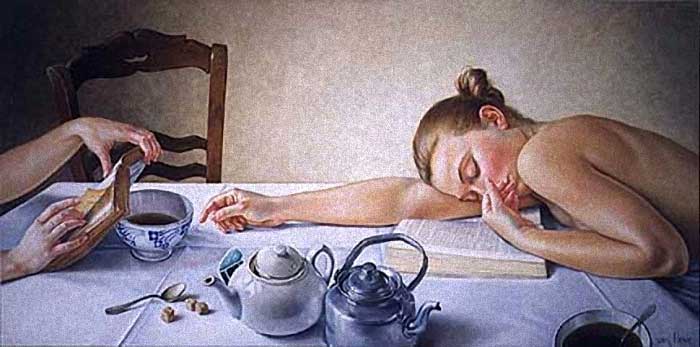
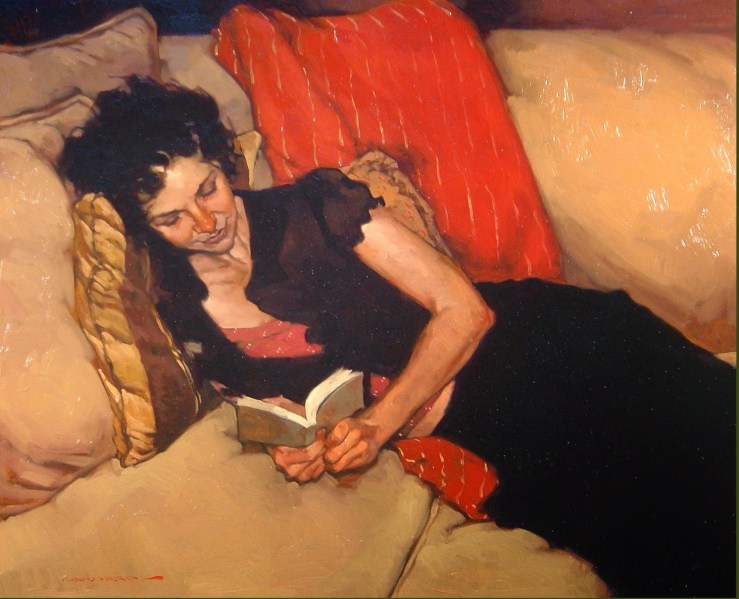
The Small Kettle — Francine Van Hove

fvp

Reviving Álvaro Mutis, Who Died One Year Ago Today

Homenaje-Alvaro-Mutis

The Colombian writer Álvaro Mutis died one year ago today.

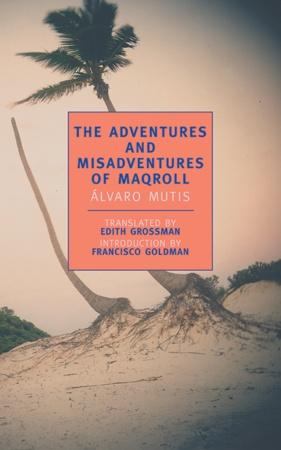
Mutis wasn’t on my radar until a few years ago, when a friend of mine, Dave Cianci, urged me to read the author’s opus, The Adventures and Misadventures of Maqroll, a collection of seven novellas that speak to each other in a loose, rich, intertextual poetics of adventure, romance, and loss. My friend Cianci was so enthusiastic about the book that he reviewed it for this blog (the review convinced me to read it). I’ll crib from that review:

The Adventures and Misadventures of Maqroll is difficult to categorize. It’s an outlaw adventure story populated by men and women who live where and how they must; these are the people who work near shipyards and the banks of unexplored river tributaries, people who value candor and honesty but for whom strict adherence to the law is often inconvenient. The book is a philosophical rumination on friendship and creation, romance and deception, obstinance and poverty.

Later in his review, Cianci characterizes the titular Maqroll—the Gaviero, the “lookout” —as “who we all dream of being when we contemplate throwing everything away.” In one of my own pieces on Maqroll, I described the world that Mutis offers, part fantasy, part nightmare, as

a life of picaresque adventures (and titular misadventures), of loss and gain, of love and despair, drinking, sailing, scheming and plotting—a life full of allusions and hints and digressions. Mutis’s technique is marvelous (literally; he made this reader marvel): he gives us an aging (anti-)hero, a hero whose life is overstuffed with stories and mishaps and feats and enterprises and hazards; he gives us one strand of that life at a time in each novella—but then he points to the other adventures, the other serials of Maqroll that we would love to tune into if only we could.

maq

John Updike explained the attraction to Mutis and Maqroll in his 2003 New Yorker review of NYRB’s Maqroll collection:

The problem of energy, in this enervated postmodern era, keeps arising in Mutis’s pursuit of a footloose, offhandedly erudite, inexplicably attractive shady character. A lowly seaman with some high-flying acquaintances on land, Maqroll is a drifter who tends to lose interest in his adventures before the dénouement is reached. Readers even slightly acquainted with Latin-American modernism will hear echoes of Borges’s cosmic portentousness, of Julio Cortázar’s fragmenting ingenuities, of Machado De Assis’s crisp pessimism, and of the something perversely hearty in Mutis’s fellow-Colombian and good friend Gabriel García Márquez—a sense of genial amplitude, as when a ceremonious host sits us down to a lunch provisioned to stretch into evening. Descriptions of food consumed and of drinks drunk, amid flourishes of cosmopolitan connoisseurship, are frequent in Mutis, even as the ascetic Maqroll goes hungry. North Americans may be reminded of Melville—more a matter, perhaps, of affinity than of influence.

Updike’s review is one of the only prominent and long English-language pieces about Álvaro Mutis that I’ve come across. There’s a good 2001 interview with Mutis in Bomb by Francisco Goldman (who wrote the NYRB edition’s introduction), and a few translated poems of Mutis’s can be found online, but on the whole, despite accolades throughout the Spanish-reading world, his reputation among English-readers seems relegated to “friend of Gabriel Garcia Marquez” (who called Mutis “one of the greatest writers of our time”).

Álvaro Mutis deserves a bigger English-reading audience. NYRB’s collection of his novellas in Edith Grossman’s translation bristles with energy. At once accessible and confounding, these tales that ask us to read them again, like Borges’s puzzles Bolaño’s labyrinths.

Is it tactless to name Bolaño here? Maybe—he’s perhaps too-easy an example: A Spanish-language author whose readership radically expanded after his death. Anyone who follows literary trends (ach!) will see how quickly a writer’s currency elevates after his or her death. (Ach! again). But I think that Mutis should attract fans of Bolaño, whose currency still spends (and will spend in the future, I think). Another comparison I would like to be able to make though would be John Williams’s sad novel Stoner, which, as any one who follows literary trends (ach!) could tell you became an unexpected best seller last year. Stoner—also published by the good people at NYRB—had to wait half a century to get its due. I don’t see why the English-reading world should wait that long to embrace Mutis.

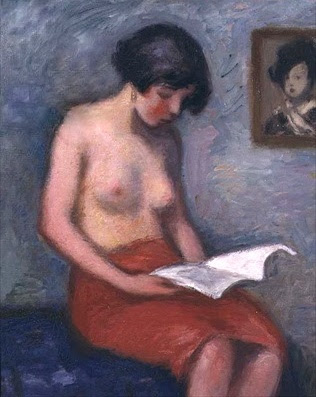
Nude Looking at Pictures — Georges d’Espagnat

Espagnat, George d' (1870-1950) Nude looking at pictures

A Conversation about Ben Lerner’s Novel 10:04 (Part 2)

IMG_20140920_084354

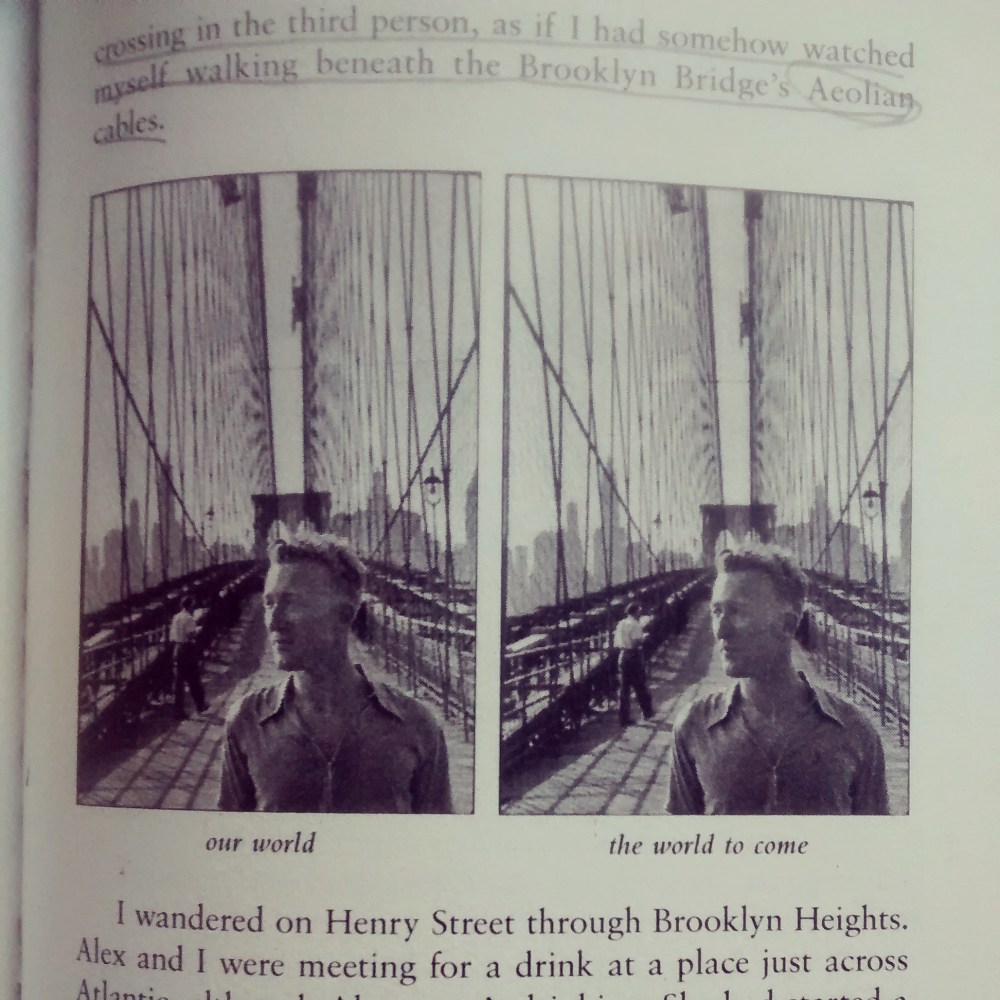
[Context/editorial note: This is the second and final part of a discussion between Biblioklept contributor Ryan Chang and myself about Ben Lerner’s new novel 10:04. You can read the first part of the discussion here, if you like—the gist of that conversation is that I am kinda sorta hating the book, while Ryan makes a strong case for my finishing it. Which I did. — ET].

Edwin Turner: Okay, Ryan, so I’m still having a hard time with the book, and I think that Hari Kunzru pins down why in his (diplomatic) review at The New York Times:

Does [the novel’s] ironic tone (which often feels like a reflex, a tic) preclude sincerity? Is all this talk of community no more than an artful confection, the purest kind of cynicism? The question is impossible to resolve, so each of these episodes — and indeed the book as a whole — takes on a sort of hermetic undecidability.

I find the “hermetic undecidability” not so much unsettling—the proper rhetorical gambit to match the novel’s themes—but rather a dodge, an escape hatch even, to avoid adequately answering to the model that the narrator wants to find in Whitman. There’s this wonderful moment where the narrator says “Art has to offer something other than stylized despair” — and I take this to be something like the mission of the book — but the archness, the cleverness of the book, its frequent retreats away from (what I take to be) Whitman’s project (the kosmos, the roughneck with the unstopped throat) — I just don’t see much but a kind of stylized ennui (if not despair) about the “bad forms of collectivity” our narrator is forced (forces himself) to partake in.

My favorite moments of the book continue to be the essay passages, the art or literary theory that he spackles in—the riff on Peggy Noonan writing Reagan’s Challenger-explosion speech, the elements of borrowed language, etc. (Again, I’m almost the same age as Lerner. I was in Young Astronauts, and our field trip to Cape Canaveral was canceled because of inclement weather, so we watched it in the cafeteria—live. I did not understand what happened, but I remember my teachers crying).

Ryan Chang: Hey man, I just skimmed the NYT review—per the excerpt you provided—because I don’t want Kunzru clouding any of my response. It’s certainly a question I too grapple with, and I think Kunzru is right insofar that the question is “undecidable” but not for the reason(s) he suggests. I agree with you that he dodges the question, whether or not from editorial pressure or a reticence to actually address “hermetic undecidability.”

For one, I’m not sure myself if The Author ever arrives at the Whitmanic model of democracy he posits. I’m also not sure if he is supposed to “arrive” in the sense that a finality is set. I guess I also want to riff a bit on how finality might be described. Is finality then something static; as in, somehow 10:04 transmits–electrocutes, reverberates–through its readership, now coeval (the when negligent, the position of the reader enmeshed in the text is the same at 10 PM here as it is at 5 AM there), the novel’s theses and everything is suddenly Whitmanic? Community successfully reimagined and cemented? That sounds too easy, too convenient, too short-sighted. Or is it a kind of arrival into an embodiment of time that exists outside of conventional literary clocks, which is also a Market-based clock — it’s my sense that the kind of democracy Whitman envisions in his work is one constantly in flux, a “reality in process” and thus in opposition to the capitalist clock? That is, we know we are supposed to “stop” working at 5, the embodiment of the currency-based clock disappears after 5, but it’s a contrasting relationship. Our time outside of the currency then absorbs a negative value (I think The Author only mentions once or twice how we are all connected by our debt, a negativity projected into the future), though the illusion of the clock is that we are “free” in our time. OK: in a literary sense, wouldn’t this be a sense of a text’s world stopping, a suspension that retroactively pauses the whole book? That 10:04 ends not only with a dissolution of prose into poetry, but also The Author into Whitman and thus recasting the first-/third-person narrator into a lyric-poet mode suggests the book’s integration into our, the reader’s, time (and also, retroactively, the entirety of the text). In that sense, for me, the issue whether or not The Author of 10:04 integrates the book fully into a Whitmanic model is not necessarily the point — it is that he, and also we hopefully through him — actively participate in remaking a “bad form of collectivity” less so. Continue reading “A Conversation about Ben Lerner’s Novel 10:04 (Part 2)” →

Reading the Sonnet — Joseph Lorusso

Lorusso, Joseph (1966-...) Reading the sonnet

Day-Dreaming — Conrad Kiesel

day-dreaming-conrad-kiesel-1352183696_b

Hollander — Yoshitora Utagawa

Lesender Mann — Albert Anker

Girl in Red with Parasol — Max Pechstein

Emmanuelle Guattari’s Memoir (Book Acquired, 9.15.2014)

IMG_3322

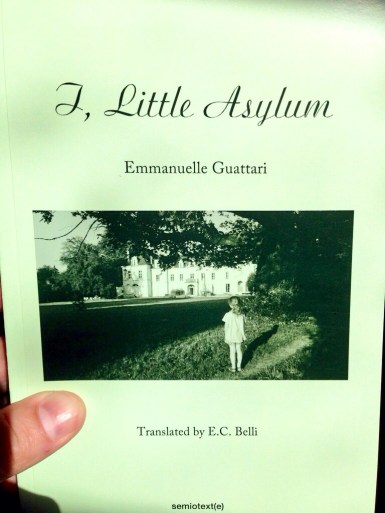
I read about half of this yesterday. I, Little Asylum by Emmanuelle Guattari. Publisher Semiotext(e)/MIT’s blurb:

A moment later, Lacan is chattering with me, and giving me some crayons to draw with.
—from I, Little Asylum

Founded in 1951 and renowned in the world of psychiatry, the experimental psychiatric clinic of La Borde sought to break with the traditional internment of the mentally ill and to have them participate in the material organization of collective life. The clinic owed much of its approach to psychoanalyst and philosopher Félix Guattari, who was its codirector with Jean Oury until 1992. In this lyrical chronicle of a childhood at La Borde, Félix Guattari’s daughter Emanuelle Guattari offers a series of impressionistic vignettes drawn from her own experiences.

As a child whose parents worked in the clinic, Emanuelle Guattari (“Manou”) experienced La Borde–which is housed in a castle in the middle of a spacious park–as a place not of confinement but of imagination and play. She evokes a landscape that is surreal but also mundane, describing the fat monkey named Boubou her father kept at the clinic, interactions between the “La Borde kids” and the “Residents” (aka, the “Insane,” feared by the locals), the ever fascinating rainbow-hued “shit pit” on the grounds, and prank-calls to the clinic switchboard. And, of course, there is Félix Guattari himself, at the dinner table, battling a rat, and in his daughter’s dreams. Emmanuelle Guattari’s tale of childlike wonder offers a poetic counterpoint to the writings of her father and his intellectual circle.

The Music Master — Edmund Dulac

Grandmother Reading the Bible — Albert Anker

The Magician — Claudio Bravo

magician

Wouldn’t It Be Deadly? (Book Acquired, Like Last Week or the Week Before)

IMG_3228

Wouldn’t It Be Deadly by D.E. Ireland. PW’s write up:

Set in London in 1913, this tongue-in-cheek series kickoff from the pseudonymous Ireland picks up where the musical My Fair Lady left off. Eliza Doolittle has left her irascible mentor, Henry Higgins, to work for a rival elocution teacher, Emil Nepommuck. Nepommuck features her transformation from street flower-seller to someone who passed for a duchess prominently in his advertising, and manages to steal some of Higgins’s students. When someone fatally stabs Nepommuck in the back outside his apartment, Higgins, who confronted the man earlier, becomes Scotland Yard’s prime suspect. Higgins turns out to be hiding a secret, which is out of character with his stage and film personae. Some readers may find character names like Harrison and Shaw a bit heavy-handed, though others may smile when Higgins describes Eliza as a “fair lady” or wonders why anyone would care about the “rain in Spain.” A

The Reader — Wyndham Lewis

Roman Muradov’s Enigmatic Graphic Novella (In a Sense) Lost and Found Reviewed

If you regularly read The New York Times or The New Yorker, you’ve probably already seen Roman Muradov’s compelling illustrations. If you’re a fan, you also know about his strange and wonderful Yellow Zine comics (and if you don’t know them, check out his adaptation of Italo Calvino).

Muradov’s début graphic novella (In a Sense) Lost and Found was released recently by Nobrow Press, and it’s a beauty—rich, imaginative, playful, and rewarding. And it smells good.

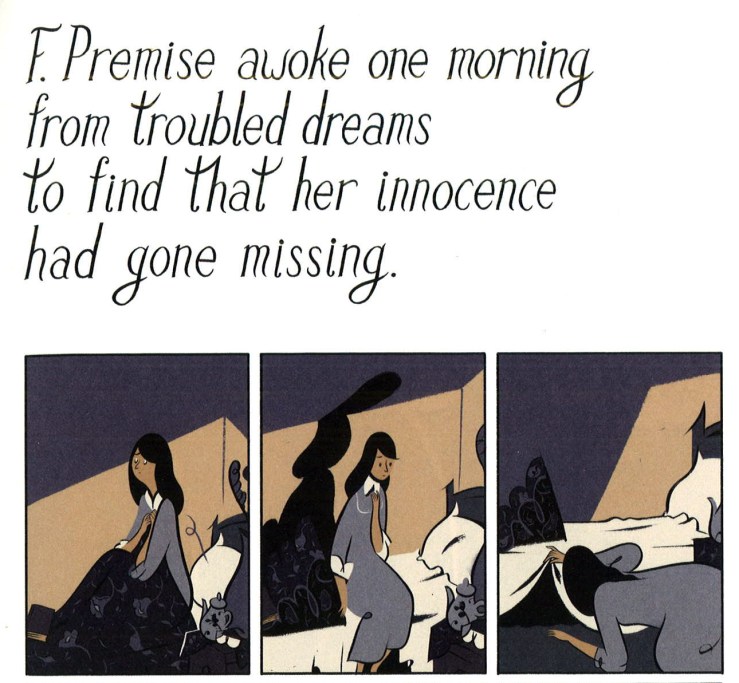
(In a Sense) Lost and Found begins with a nod to Kafka’s Metamorphosis:
8

Although we’re told by the narrative script that our heroine F. Premise (faulty premise?) “awoke,” the surreal world Muradov creates in Lost and Found suggests that those “troubled dreams” continue far into waking hours. The story runs on its own internal dream-logic, shifting into amorphous spaces without any kind of exposition to guide the reader who is, in a sense, as lost as the protagonist becomes at times on her Kafkaesque quest.

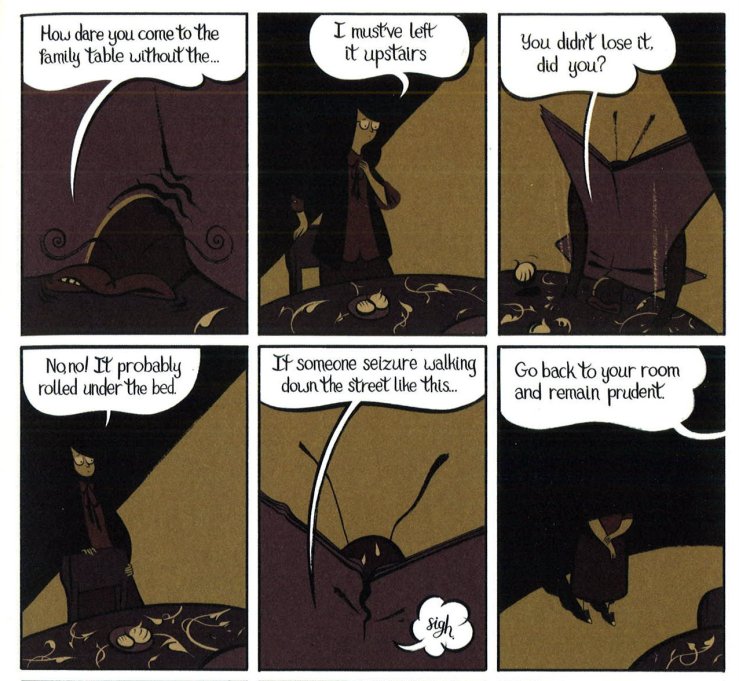
What is F. Premise’s mission? To regain her innocence, perhaps, although only the initial narrative script and the punning title allude to “innocence.” The characters seem unable or unwilling to name this object; each time they mention it, their speech trails off elliptically, as we see when Premise’s father (?) confronts her at the breakfast table:
6

Muradov’s imagery suggests Kafka’s bug again—the father’s antennae poke over the broadsheet he’s reading (the book is larded with readers), his strange mouth sagging out under it. Even more Kafkaesque though is Muradov’s refusal to reveal the father’s face, the face of authority, who sends his daughter back up to her room where she must remain locked away.

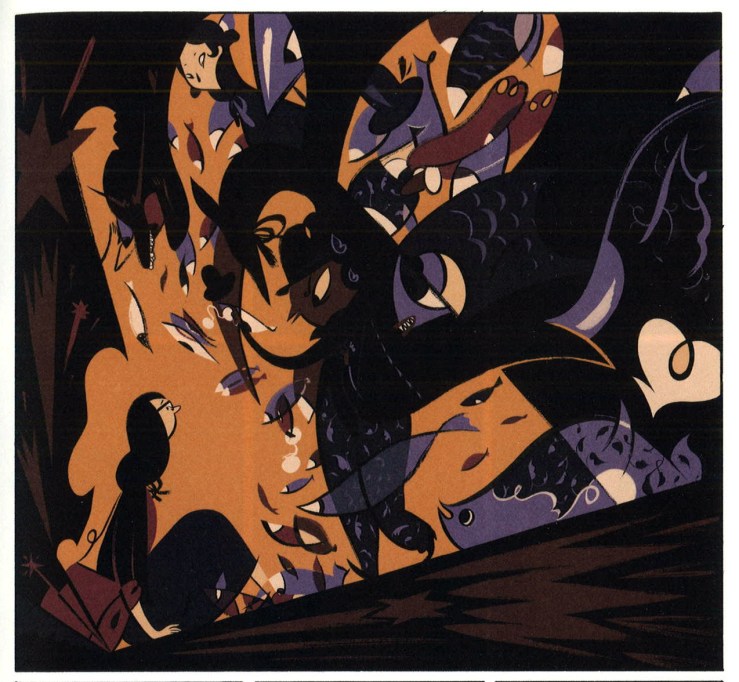
She sneaks out of course—would there be an adventure otherwise?—and it turns out that faceless father is right: F. Premise falls (literally) under the intense gaze of the community. F. Premise is startlingly present to others now by virtue of her absent virtue.
5

Muradov uses traditional nine-panel grids to tell his story, utilizing large splashes sparingly to convey the intensity of key moments in the narrative. The book brims with beautiful, weird energy, rendered in intense color and deep shadow. Muradov’s abstractions—pure shapes—cohere into representative objects only to fragment again into abstraction. (Perhaps I should switch “cohere” and “fragment” here—I may have the verbs backwards).

The art here seems as grounded in a kind of post-cubism as it does in the work of Muradov’s cartooning forebears. In the remarkable passage below, for example, our heroine moves from one world to another, her form nearly disappearing into complete abstraction by the fifth panel (an image that recalls Miró), before stabilizing again (if momentarily) in the sixth panel.

2

It’s in that last panel that F. Premise returns to her adopted home (of sorts)—a bookstore, of course. Earlier, the kindly owner of the bookstore loans her a pair of old plus-fours, and all of a sudden her identity shifts—or rather, the community shifts her identity, their penetrating gaze no longer trying to screw her to a particular preconception. Identity in Lost and Found is as fluid and changeable as the objects in Muradov’s haunting illustrations.

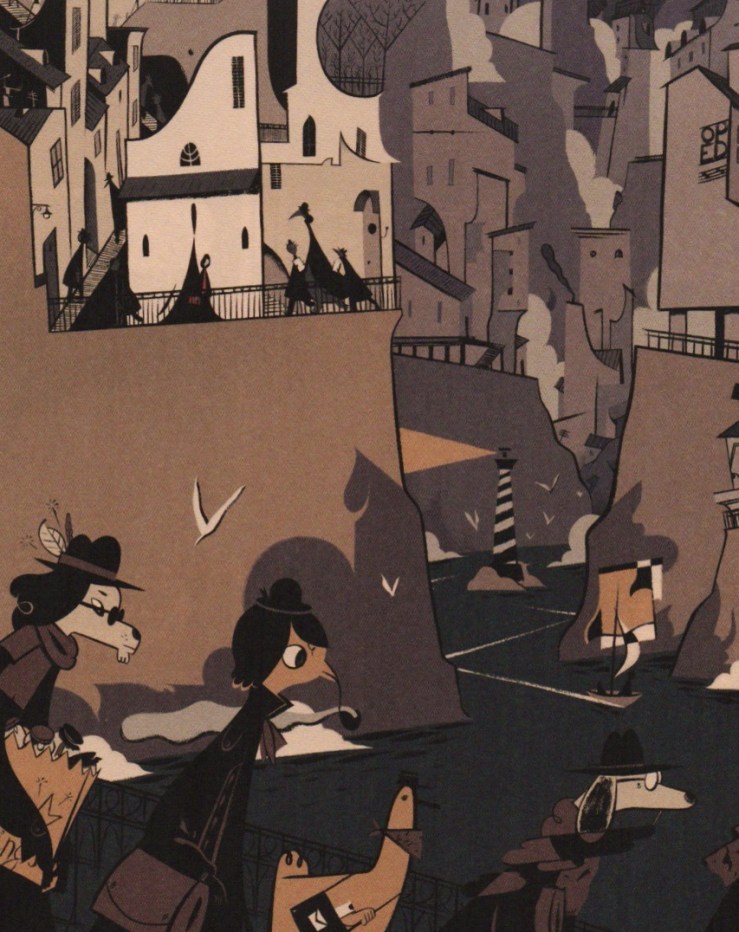
I have probably already belabored too much of the plot. Suffice to say that our heroine’s quest takes strange turns, makes radical shifts, she descends up and down and into other worlds. Embedded in the journey is a critique of nostalgia, of the commodification of memory (or, more accurately, the memory of memory). Is our innocence what we thought it was? Can we buy it back like some mass-produced object?
IMG_3292

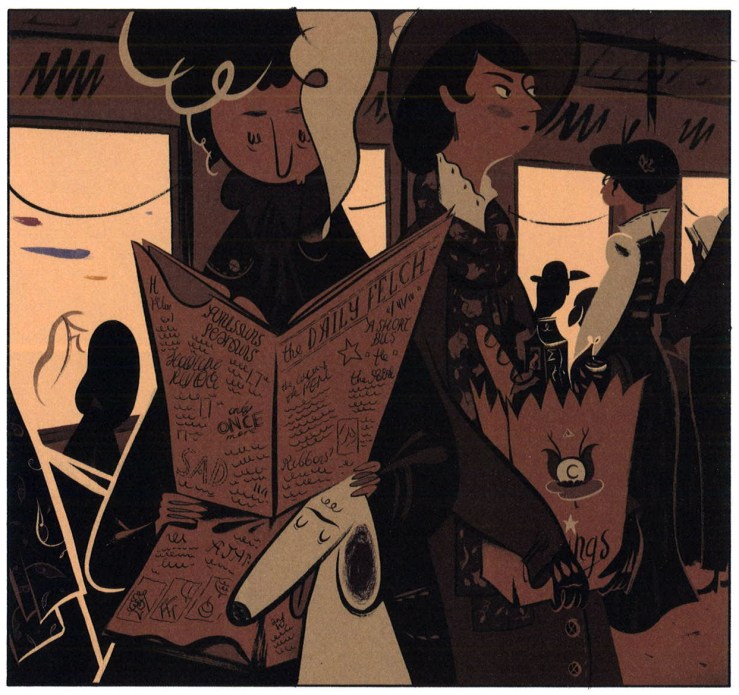
As I noted before, Lost and Found is stuffed with images of readers. There’s something almost Borgesian in the gesture, as if each background character might be on the threshold (if not right in the middle of) their own adventures.
3

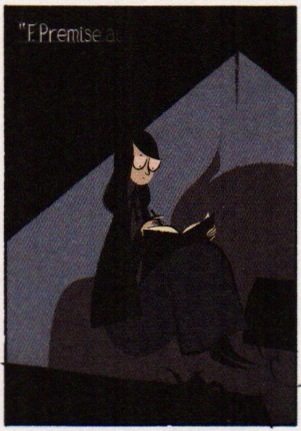
It’s in the book’s final moments though that we see a move from reading to writing: Our heroine F. Premise picks up the pen and claims agency, writes her own life. She is indeed the narrative voice after all, the imposing script that, like some all-knowing hand, guided us into the narrative in the first place, only to disappear until the end.
IMG_3293

I loved Lost and Found, finding more in its details, shadowy corners, and the spaces between the panels with each new reading. My only complaint is that I wish it were longer. The book is probably not for everyone—readers looking for a simple comic with an expository voice that will guide them through a traditional plot should probably look elsewhere. But readers willing to engage in Muradov’s ludic text will be rewarded—and even folks left scratching their heads will have to admit that the book is gorgeous, an aesthetic experience unto itself. And it smells good. Highly recommended.


Reading — Claudio Bravo

reading