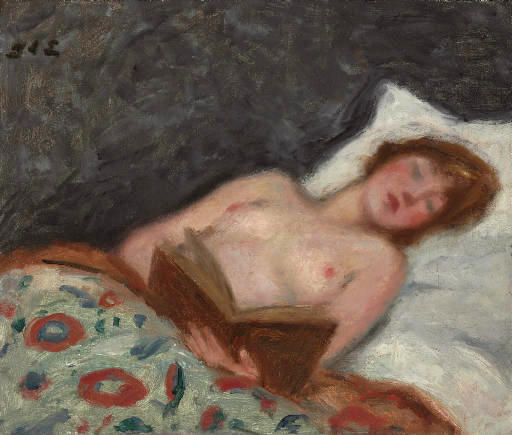
Woman Reading — Georges d’Espagnat

Espagnat, Georges d' (1870-1950)

This Is Not A Review Of Thomas Bernhard’s The Lime Works

“Amazon, the so-called bookseller Amazon” makes a grave mistake.

The real world plainly bores us (William H. Gass)

Books whose blueness penetrates the pages between their covers are books which, without depriving us of the comfort of our own commode or the sight of our liberal selves, place us inside a manufactured privacy. This privacy is really not that of someone else. It must be artificial because the real world plainly bores us. Impatient, we can’t wait for nature to take its course.

When we take our textual tour through the slums, we want crime, violence, starvation, disease, not hours of just sitting around. We want the world to be the world we read about in the papers; all news. What good is my ring if the couple I am using it to spy on make love in darkness once a month, and then are quick, inept, and silent? Better rob banks. The money is always there. What good is my peek at her pubic hair if I must also see the red lines made by her panties, the pimples on her ramp, broken veins like the print of a lavender thumb, the stepped-on look of a day’s-end muff? I’ve that at home. No. Vishnu is blue in all his depictions. Lord Krishna too. Yes. The blue we bathe in is the blue we breathe. The blue we breathe, I fear, is what we want from life and only find in fiction. For the voyeur, fiction is what’s called going all the way.

The privacy which a book makes public is nevertheless made public very privately—not like the billboard which shouts at the street, or the movie whose image is so open we need darkness to cover the clad-ass and naked face that’s settled in our seat. A fictional text enters consciousness so discreetly it is never seen outdoors . . . from house to house it travels like a whore . . . so even on a common carrier I can quite safely fill my thoughts with obscene adjectives and dirty verbs although the place I occupy is thigh-sided by a parson.

We like that.

Thus between the aesthetically irrelevant demands of the reader and the aesthetically crippling personal worries of the writer, sexuality reaches literature as an idee fixe, an artifically sweetened distortion or an outright lie, while the literature itself leaks quality like a ruptured pipe.

From William H. Gass’s On Being Blue: A Philosophical Inquiry.

Woman Reading on a Bench — Henri Bouchet-Doumenq

femme lisant

It is difficult in life to be good, and difficult in art to portray goodness (Iris Murdoch)

INTERVIEWER

You’ve said that “one constantly takes prototypes from literature who may actually influence one’s conduct.” Could you give specific examples?

MURDOCH

Did I say that? Good heavens, I can’t remember the context. Of course, one feels affection for, or identifies with, certain fictional characters. My two favorites are Achilles and Mr. Knightley. This shows the difficulty of thinking of characters who might influence one. I could reflect upon characters in Dickens, Dostoyevsky, Tolstoy; these writers particularly come to mind—wise moralistic writers who portray the complexity of morality and the difficulty of being good.

Plato remarks in The Republic that bad characters are volatile and interesting, whereas good characters are dull and always the same. This certainly indicates a literary problem. It is difficult in life to be good, and difficult in art to portray goodness. Perhaps we don’t know much about goodness. Attractive bad characters in fiction may corrupt people, who think, So that’s OK. Inspiration from good characters may be rarer and harder, yet Alyosha in The Brothers Karamazov and the grandmother in Proust’s novel exist. I think one is influenced by the whole moral atmosphere of literary works, just as we are influenced by Shakespeare, a great exemplar for the novelist. In the most effortless manner he portrays moral dilemmas, good and evil, and the differences and the struggle between them. I think he is a deeply religious writer. He doesn’t portray religion directly in the plays, but it is certainly there, a sense of the spiritual, of goodness, of self-sacrifice, of reconciliation, and of forgiveness. I think that is the absolutely prime example of how we ought to tell a story—invent characters and convey something dramatic, which at the same time has deep spiritual significance.

From Irish Murdoch’s Paris Review interview.

The End of the Story — Marcus Stone

marcus

She-Hulk Reading — Regina Bautista

shehulk

The Library of the Palais Lanckoronski, Vienna — Rudolf von Alt

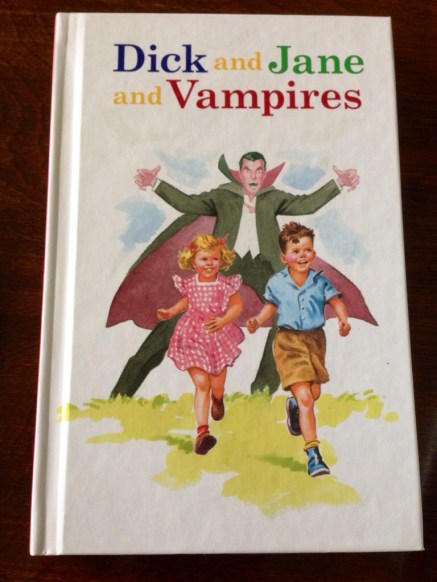
Dick and Jane and Vampires (Book Acquired, 6.30.2014)

20140707-150319-54199418.jpg

Look, I usually hate novelty books, but a few weeks ago I took my kids to the book store and I saw this there in the children’s section and it’s just so on-the-nose in its Dick and Jane style that I had to pick it up. My daughter read it to my son. It scared him.

20140707-150317-54197704.jpg

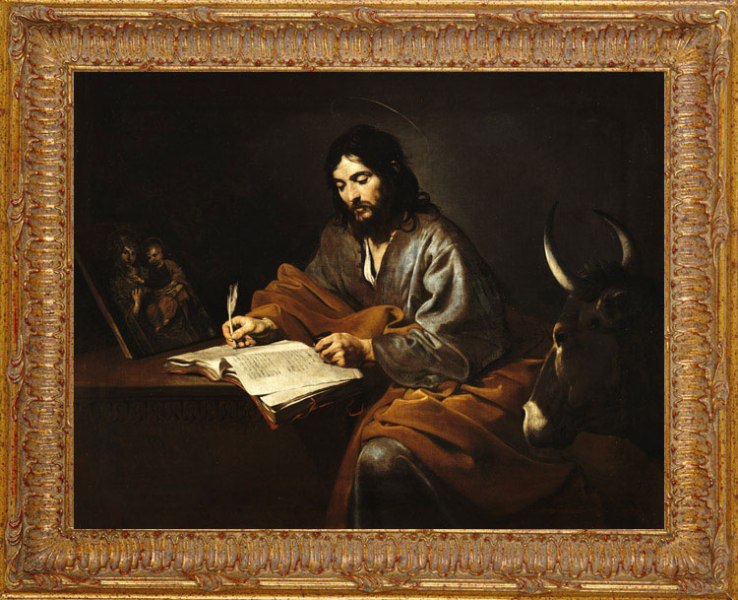
Saint Luke the Evangelist — Valentin de Boulogne

TG-69BX

Complaint to God (Alasdair Gray’s Lanark)

The more he worked the more the furious figure of God kept popping in and having to be removed: God driving out Adam and Eve for learning to tell right from wrong, God preferring meat to vegetables and making the first planter hate the first herdsman, God wiping the slate of the world clean with water and leaving only enough numbers to start multiplying again, God fouling up language to prevent the united nations reaching him at Babel, God telling a people to invade, exterminate and enslave for him, then letting other people do the same back. Disaster followed disaster to the horizon until Thaw wanted to block it with the hill and gibbet where God, sick to death of his own violent nature, tried to let divine mercy into the world by getting hung as the criminal he was. It was comical to think he achieved that by telling folk to love and not hurt each other. Thaw groaned aloud and said, “I don’t enjoy hounding you like this, but I refuse to gloss the facts. I admire most of your work. I don’t even resent the ice ages, even if they did make my ancestors carnivorous. I’m astonished by your way of leading fertility into disaster, then repairing the disaster with more fertility. If you were a busy dung beetle pushing the sun above the skyline, if you had the head of a hawk or the horns and legs of a goat I would understand and sympathize. If you headed a squabbling committee of Greek departmental chiefs I would sympathize. But your book claims you are a man, the one perfect man of whom we are imperfect copies. And then you have the bad taste to put yourself in it. Only the miracle of my genius stops me feeling depressed about this, and even so my brushes are clogged by theology, that bastard of the sciences. Let me remember that a painting, before it is anything else, is a surface on which colours are arranged in a certain order.

From Alasdair Gray’s novel Lanark.

“Read a Book, Ugly.”


Poster by Cole Closser for Foxing.

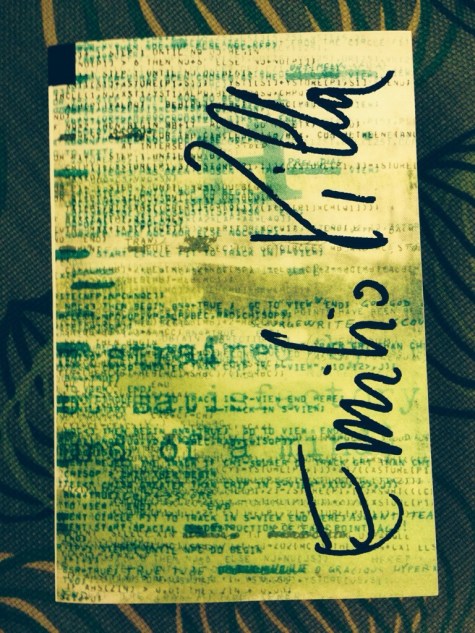
The Selected Poetry of Emilio Villa (Book Acquired, 6.27.2014)

20140707-150232-54152226.jpg

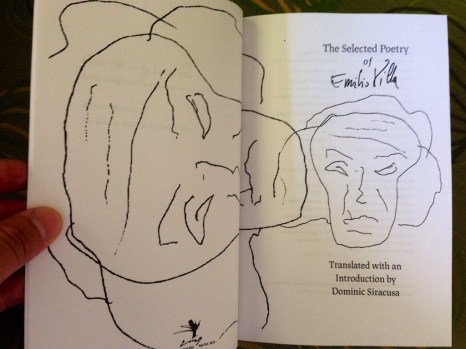
I had never heard of Emilio Villa until the kind people at Contra Mundum forwarded me some digital excerpts from their new collection, The Selected Poetry of Emilio Villa. Those excerpts were fascinating, but they don’t—can’t—capture how big and strange and beautiful the finished book is.
20140707-150237-54157430.jpg

Dominic Siracusa translates; he also provides a lengthy introduction, an essay that primes the reader to better understand Villa, a “a biblicist who composed experimental verse in over ten different languages.”
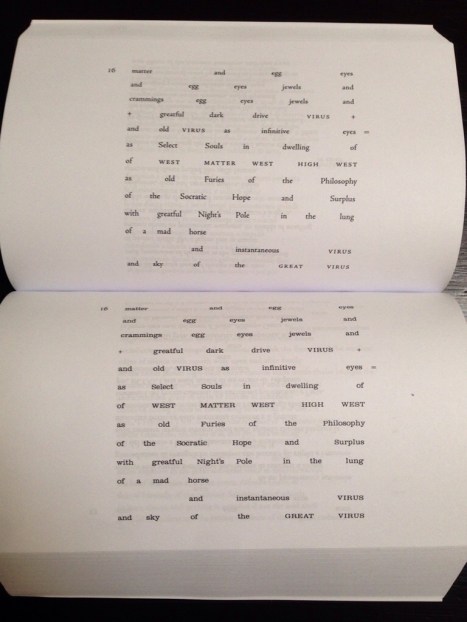
20140708-101510-36910695.jpg

The variety of languages Villa composed in is complicated by his experimental techniques including fragmentation, the blending and splitting of morphemes, his use of graphemes, and other corruptions and disruptions.
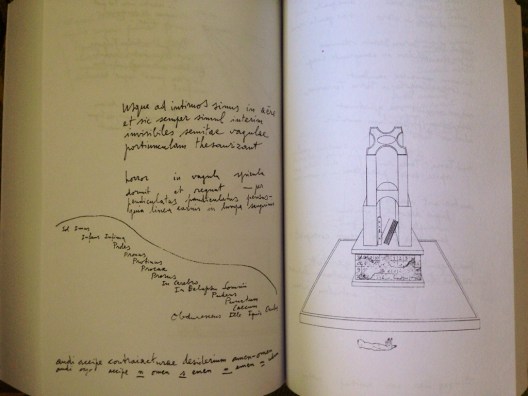
20140707-150235-54155513.jpg

Villa’s poetry seems simultaneously to be a rich linguistic ooze, generative and messy, blending through myth and time, but also a refinement, a collection of criticism even. The book is really damn puzzling in a really fun way.
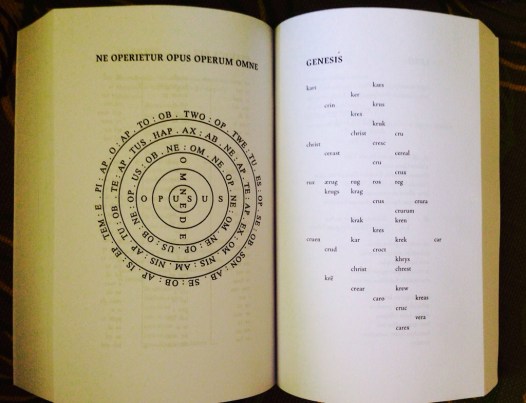
20140707-150233-54153921.jpg

More to come, for now, the lengthy jacket copy:

While Emilio Villa (1914–2003) was referred to as Zeus because of his greatness and Rabelais because of his mental voracity, for decades his work remained in oblivion, only recently surfacing to reveal him to be one of the most formidable figures of the Italian Novecento, if not of world culture. His marginalization was in part self-inflicted, due to his sibylline nature if not to his great erudition, which gave rise to a poetics so unconventional that few knew what to make of it: a biblicist who composed experimental verse in over ten different languages, including tongues from Milanese dialect and Italian to French, Portuguese, ancient Greek, and even Sumerian and Akkadian. As Andrea Zanzotto declared, “From the very beginning, Villa was so advanced that, even today, his initial writings or graphemes appear ahead of the times and even the future, suspended between a polymorphous sixth sense and pure non-sense.”

In merging his background as a scholar, translator, and philologist of ancient languages with his conception of poetics, Villa creates the sensation that, when reading his work, we are coming into contact with language at its origins, spoken as if for the first time, with endless possibilities. Whether penning verse, translating Homer’s Odyssey, or writing on contemporary or primordial art, Villa engages in a paleoization of the present and a modernization of the past, wherein history is abolished and interpretation suspended, leaving room only for the purely generative linguistic act, one as potent today as it was eons ago.

This volume of Villa’s multilingual poetry ranges across his entire writing life and also includes selections from his translation of the Bible, his writings on ancient and modern art, and his visual poetry. Presented in English for the very first time, The Selected Poetry of Emilio Villa also contains material that is rare even to Italian readers. In adhering to the original notion of poetry as making, Villa acts as the poet-faber in tandem with his readers, creating une niche dans un niche for them to enter and create within, as if language itself were an eternal and infinite void in which creation remains an ever possible and continuously new event.

The Library in the Palais Dumba — Rudolf von Alt

Miruna, A Tale (Book Acquired, 6.24.2014)

20140707-150427-54267363.jpg

I had hoped to read Bogdan Suceavă’s Miruna, A Tale (translated from the Romanian by Alistair Ian Blyth and new from Twisted Spoon Press) over the July 4th weekend—it was the only physical book I took with me out of town—but alas swimming and sun and sand and booze and food and fireworks &c. blocked me.

Very cool little book—and beautiful. (My iPhone pic does no justice to the simple, gorgeous design).

Publisher’s blurb; more to come:

A village in the Carpathian Mountains, one of the last outposts of pre-modernity, an elderly man, sensing his time is short, tells his young grandchildren tales that weave a family saga covering the real history from the 1870s to the time of the telling. One of the children, now grown, is the re-teller of these tales, while the other, Miruna, perhaps has the gift of second sight. Incorporating elements of fantasy common to the storytelling traditions of the Balkans, historical characters mix with imaginary beings in a landscape that recreates the world of an isolated village bearing an unusual name : Evil Vale. Ancestors are talked about as if ancient heroes, and the novel shifts focus between telling about their lives and the storyteller’s own experiences through the prism of the village during both world wars. As past tragedies are presented in a way that the grandchildren might picture and remember them, the novel has been called a kind of meta-fairy tale, a story about the lost tradition of oral storytelling itself, the conveyance of a family history from one generation to the next via the spoken word. With the death of the grandfather, the children realize that confronted with the ubiquitous hand of modernity, which the village has managed to frustrate over a succession of regimes, a whole world of stories and the entire memory of a family and of its idiosyncratic way of life in the village might have been irrevocably lost.

The BFG — Quentin Blake

20140706-210704-76024020.jpg

On the Beach — Edouard Manet