Beach Scene with Pink Hat — Eric Fischl

The Inattentive Reader — Henri Matisse

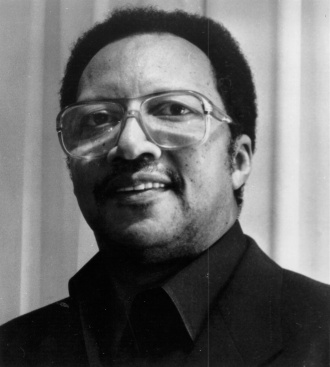
RIP Walter Dean Myers

21712_myers_walter_dean

RIP Walter Dean Myers, 1937-2014

Books transmit values. They explore our common humanity. What is the message when some children are not represented in those books? Where are the future white personnel managers going to get their ideas of people of color? Where are the future white loan officers and future white politicians going to get their knowledge of people of color? Where are black children going to get a sense of who they are and what they can be?

–From a March, 2014 piece Myers published in The New York Times entitled “Where Are the People of Color in Children’s Books?”

I taught for seven years in an inner city high school. I cannot overstate how important Myers’s books were to my students. His novel Monster—a classic—was one of the first books I wrote about on Biblioklept. I love the book, and I loved reading it with my students. Monster was an especially effective bridge to others by Myers–Slam!, HoopsBad BoyThe Beast—and one of my favorites, Fallen Angels—but I also saw it turn kids who hated reading into voracious readers. I read Myers myself as a young teen (his book Scorpions is especially good), but reading them again with my students revealed a depth and precision I hadn’t detected as a kid. Those books are all true, even the ones that are made up. RIP Walter Dean Myers.

The Syndics — Rembrandt

A Riff on Stuff I Wish I’d Written About In the First Half of 2014

1. Leaving the Sea, Ben Marcus: A weird and (thankfully) uneven collection that begins with New Yorkerish stories of a post-Lish stripe (like darker than Lipsyte stuff) and unravels (thankfully) into sketches and thought experiments and outright bizarre blips. Abjection, abjection, abjection. The final story “The Moors” is a minor masterpiece.

2. Novels and stories, Donald Barthelme: A desire to write something big and long on Barthelme seems to get in the way of my writing anything about Barthelme. Something short then? Okay: Barthelme is all about sex. He posits sex as the solution (or at least consolation) for the problems of language, family, identity, etc.

3. Enormous Changes at the Last Minute and The Little Disturbances of Man by Grace Paley: I gorged on these precise, sad, funny stories, probably consuming too many at once (by the end of Little Disturbances I had the same stomach ache I got after eating too much of Barthelme’s Sixty Stories at once).

4. Concrete by Thomas Bernhard: Unlike the other novels I’ve read by Bernhard, Concrete seems to offer some kind of vision of moral capability, one which the narrator is unable to fully grasp, but which is nevertheless made available to the reader in the book’s final moments, accessible only through the novel’s layers of storytelling. Continue reading “A Riff on Stuff I Wish I’d Written About In the First Half of 2014”

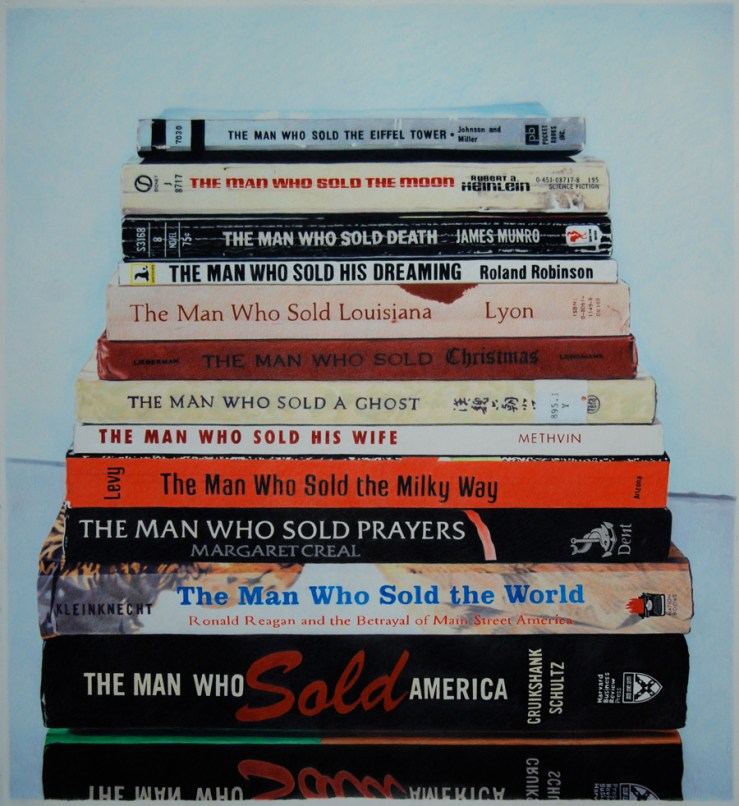
The Sell Out — Eric Yahnker

2012_TheSellOut_79x72

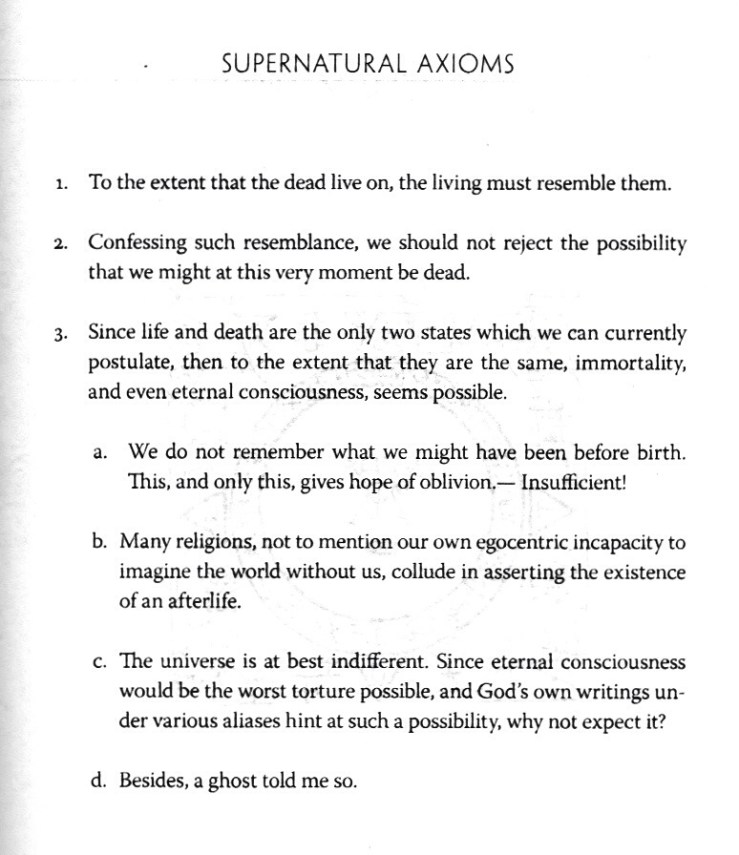
“Supernatural Axioms” — William T. Vollmann

20140629-115848-43128982.jpg

From William T. Vollmann’s forthcoming collection, Last Stories and Other Stories.

The Hammock — Thomas Theodor Heine

Where the artist is still trusted, he will not be looked to for assurance (Flannery O’Connor)

Unless we are willing to accept our artists as they are, the answer to the question, “Who speaks for America today?” will have to be: the advertising agencies. They are entirely capable of showing us our unparalleled prosperity and our almost classless society, and no one has ever accused them of not being affirmative. Where the artist is still trusted, he will not be looked to for assurance. Those who believe that art proceeds from a healthy, and not from a diseased, faculty of the mind will take what he shows them as a revelation, not of what we ought to be but of what we are at a given time and under given circumstances; that is, as a limited revelation but revelation nevertheless.

From Flannery O’Connor’s essay “The Fiction Writer and His Country,” collected in Mystery and Manners.


Peace — William H. Johnson

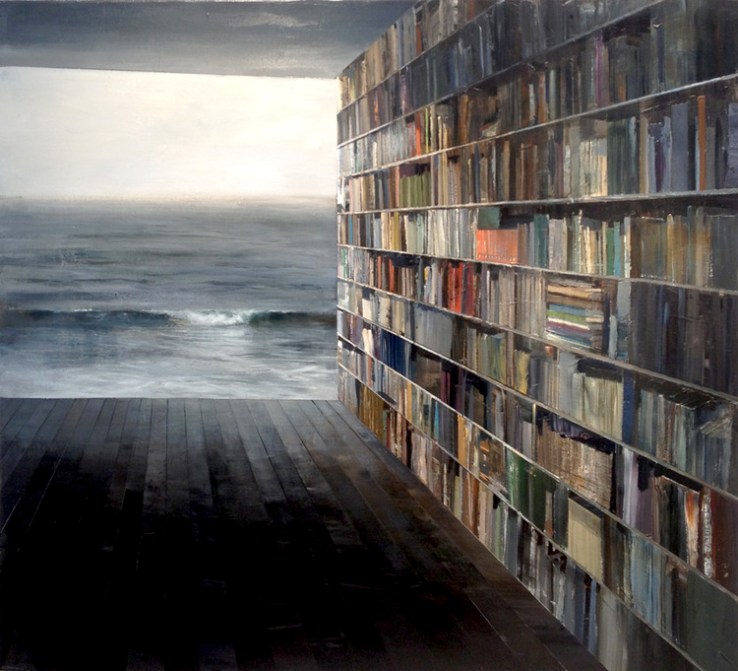
Library with Grey Sea — Jeremy Miranda

library with grey sea

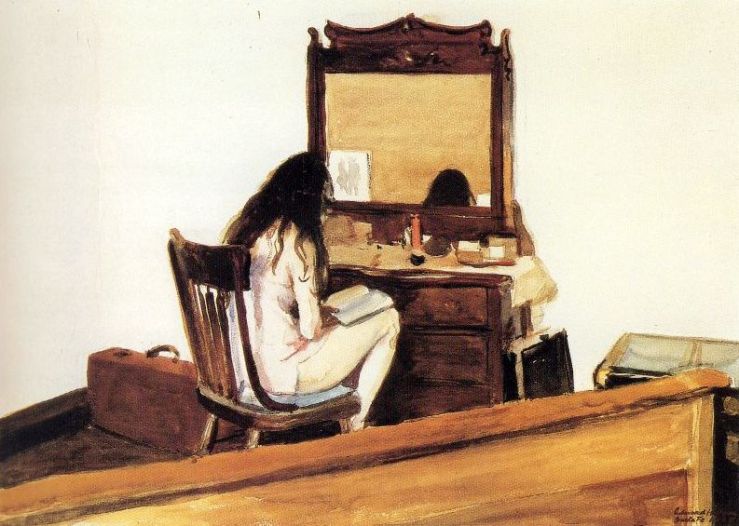
Interior (Model Reading) — Edward Hopper

edward-hopper-interior-model1

German Cases — Jörg Immendorff

Girl Reading (Thinking of Edward Hopper) — Kiko Esperilla

kiko esperilla

Self Portrait with Charlie Brown — Chris Ware

ware brown

Portrait of a Bishop — Pontormo

Portraits of Serafino and Francesco Falzacappa — Pier Leone Ghezzi