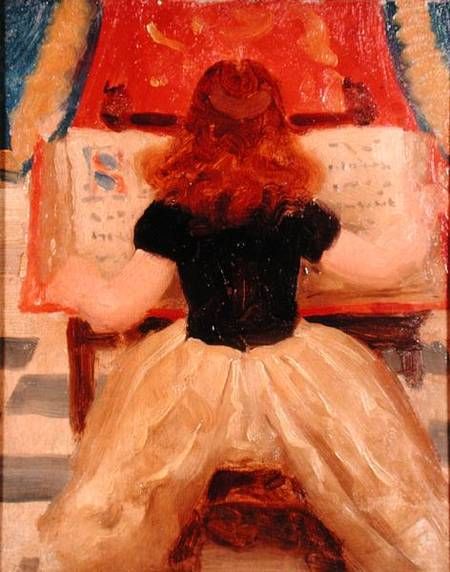
The Model — Jacek Malczewski

Winter — Norman Rockwell

If a man wants to read good books, he must make a point of avoiding bad ones (Schopenhauer)

As regards reading, to require that a man shall retain everything he has ever read, is like asking him to carry about with him all he has ever eaten. The one kind of food has given him bodily, and the other mental, nourishment; and it is through these two means that he has grown to be what he is. The body assimilates only that which is like it; and so a man retains in his mind only that which interests him, in other words, that which suits his system of thought or his purposes in life.

If a man wants to read good books, he must make a point of avoiding bad ones; for life is short, and time and energy limited.

Repetitio est mater studiorum. Any book that is at all important ought to be at once read through twice; partly because, on a second reading, the connection of the different portions of the book will be better understood, and the beginning comprehended only when the end is known; and partly because we are not in the same temper and disposition on both readings. On the second perusal we get a new view of every passage and a different impression of the whole book, which then appears in another light.

A man’s works are the quintessence of his mind, and even though he may possess very great capacity, they will always be incomparably more valuable than his conversation. Nay, in all essential matters his works will not only make up for the lack of personal intercourse with him, but they will far surpass it in solid advantages. The writings even of a man of moderate genius may be edifying, worth reading and instructive, because they are his quintessence—the result and fruit of all his thought and study; whilst conversation with him may be unsatisfactory.

So it is that we can read books by men in whose company we find nothing to please, and that a high degree of culture leads us to seek entertainment almost wholly from books and not from men.

From The Art of Literature by Arthur Schopenhauer.

Lisbeth Reading — Carl Larsson

Some Really Lovely Books Acquired, 1.21.2014 (Thanks Ryan!)

20140124-140145.jpg

I was pleasantly surprised to get a box of great stuff in the mail from Ryan Mihaly, a frequent contributor to this blog (check out the second part of his interview with translator Ilan Stavans). Inside the handsome Penguin Classics Goethe was this little card:

20140124-140153.jpg

20140124-140201.jpg

I had never even heard of The Thoughtbook, Fitzgerald’s boyhood diary. Sample:

20140124-140208.jpg

20140124-140218.jpg

Tom Clark is The Best.

20140124-140225.jpg

20140124-140235.jpg

And always Hell.

20140124-140241.jpg

Thanks again, Ryan!

The Convalescent — Gwen John

Portrait of Wladyslaw Reymont — Jacek Malczewski

Latitudes — Natalie Andrewson

Latitudes_Natalieandrewson_web

“Reading is thinking with someone else’s head” (Schopenhauer)

Reading is thinking with someone else’s head instead of one’s own. To think with one’s own head is always to aim at developing a coherent whole—a system, even though it be not a strictly complete one; and nothing hinders this so much as too strong a current of others’ thoughts, such as comes of continual reading. These thoughts, springing every one of them from different minds, belonging to different systems, and tinged with different colors, never of themselves flow together into an intellectual whole; they never form a unity of knowledge, or insight, or conviction; but, rather, fill the head with a Babylonian confusion of tongues. The mind that is over-loaded with alien thought is thus deprived of all clear insight, and is well-nigh disorganized. This is a state of things observable in many men of learning; and it makes them inferior in sound sense, correct judgment and practical tact, to many illiterate persons, who, after obtaining a little knowledge from without, by means of experience, intercourse with others, and a small amount of reading, have always subordinated it to, and embodied it with, their own thought.

From The Art of Literature by Arthur Schopenhauer.

Portrait of Mstislav Dobuzhinsky — Osip Braz

“By the by, a pretty riddle or fable might be made” | More Notes From Nathaniel Hawthorne

  1. Dandelions and blue flowers are still growing in sunny places. Saw in a barn a prodigious treasure of onions in their silvery coats, exhaling a penetrating perfume.
  2.  How exceeding bright looks the sunshine, casually reflected from a looking-glass into a gloomy region of the chamber, distinctly marking out the figures and colors of the paper-hangings, which are scarcely seen elsewhere. It is like the light of mind thrown on an obscure subject.
  3.  Man’s finest workmanship, the closer you observe it, the more imperfections it shows; as in a piece of polished steel a microscope will discover a rough surface. Whereas, what may look coarse and rough in Nature’s workmanship will show an infinitely minute perfection, the closer you look into it. The reason of the minute superiority of Nature’s work over man’s is, that the former works from the innermost germ, while the latter works merely superficially.
  4. Standing in the cross-road that leads by the Mineral Spring, and looking towards an opposite shore of the lake, an ascending bank, with a dense border of trees, green, yellow, red, russet, all bright colors, brightened by the mild brilliancy of the descending sun; it was strange to recognize the sober old friends of spring and summer in this new dress. By the by, a pretty riddle or fable might be made out of the changes in apparel of the familiar trees round a house adapted for children. But in the lake, beneath the aforesaid border of trees,–the water being not rippled, but its grassy surface somewhat moved and shaken by the remote agitation of a breeze that was breathing on the outer lake,–this being in a sort of bay,–in the slightly agitated mirror, the variegated trees were reflected dreamily and indistinctly; a broad belt of bright and diversified colors shining in the water beneath. Sometimes the image of a tree might be almost traced; then nothing but this sweep of broken rainbow. It was like the recollection of the real scene in an observer’s mind,–a confused radiance.
  5. A whirlwind, whirling the dried leaves round in a circle, not very violently.
  6.  To well consider the characters of a family of persons in a certain condition,–in poverty, for instance,–and endeavor to judge how an altered condition would affect the character of each.
  7.  The aromatic odor of peat-smoke in the sunny autumnal air is very pleasant.

Notations from Nathaniel Hawthorne’s American Note-Books.

William H. Gass Reading From Middle C

Young Girl Reading a Manuscript — Thomas Cooper Gotch

gotch

Mary Cassatt at the Louvre — Edgar Degas

I Slept with the Starlight on My Face — Ivan Albright

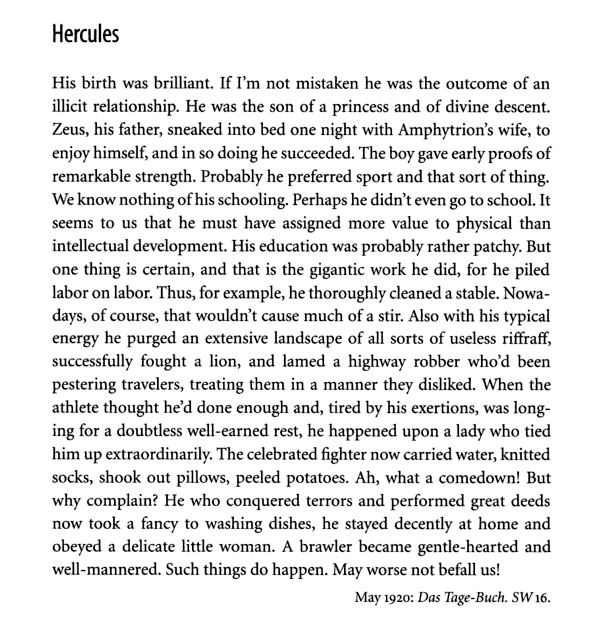
“Hercules” — Robert Walser

herc

Children — Balthus