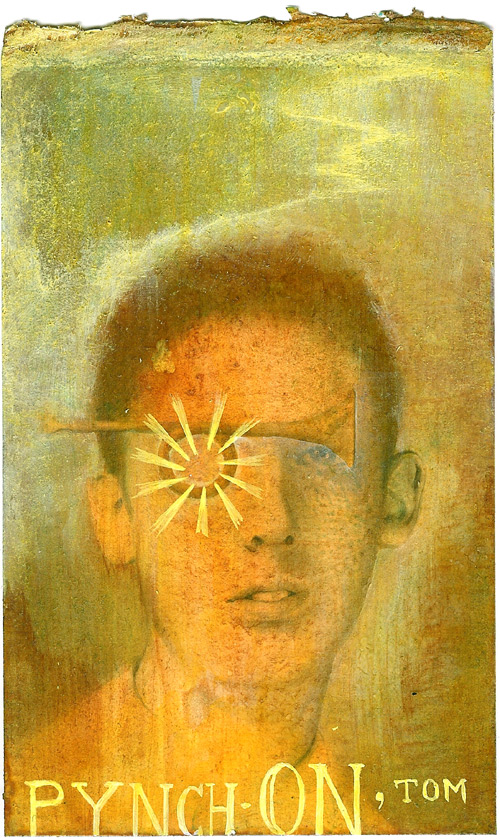
James Jean does Thomas Pynchon. (Via Hey Oscar Wilde!).
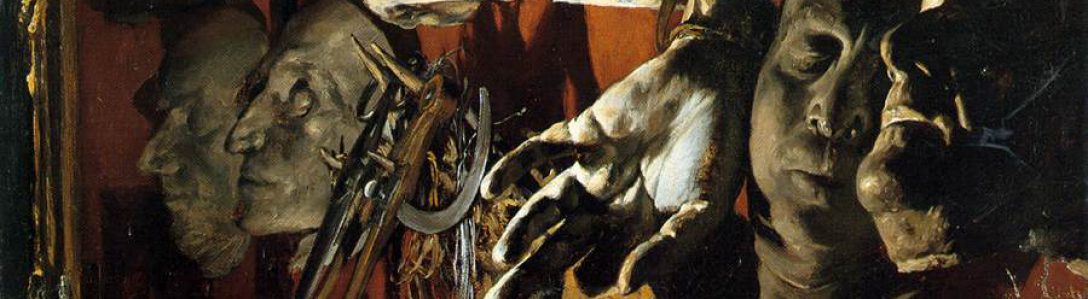
James Jean does Thomas Pynchon. (Via Hey Oscar Wilde!).
“An Ideal Family” by Katherine Mansfield
That evening for the first time in his life, as he pressed through the swing door and descended the three broad steps to the pavement, old Mr. Neave felt he was too old for the spring. Spring—warm, eager, restless—was there, waiting for him in the golden light, ready in front of everybody to run up, to blow in his white beard, to drag sweetly on his arm. And he couldn’t meet her, no; he couldn’t square up once more and stride off, jaunty as a young man. He was tired and, although the late sun was still shining, curiously cold, with a numbed feeling all over. Quite suddenly he hadn’t the energy, he hadn’t the heart to stand this gaiety and bright movement any longer; it confused him. He wanted to stand still, to wave it away with his stick, to say, “Be off with you!” Suddenly it was a terrible effort to greet as usual—tipping his wide-awake with his stick—all the people whom he knew, the friends, acquaintances, shopkeepers, postmen, drivers. But the gay glance that went with the gesture, the kindly twinkle that seemed to say, “I’m a match and more for any of you”—that old Mr. Neave could not manage at all. He stumped along, lifting his knees high as if he were walking through air that had somehow grown heavy and solid like water. And the homeward-looking crowd hurried by, the trams clanked, the light carts clattered, the big swinging cabs bowled along with that reckless, defiant indifference that one knows only in dreams…
It had been a day like other days at the office. Nothing special had happened. Harold hadn’t come back from lunch until close on four. Where had he been? What had he been up to? He wasn’t going to let his father know. Old Mr. Neave had happened to be in the vestibule, saying good-bye to a caller, when Harold sauntered in, perfectly turned out as usual, cool, suave, smiling that peculiar little half-smile that women found so fascinating.
Ah, Harold was too handsome, too handsome by far; that had been the trouble all along. No man had a right to such eyes, such lashes, and such lips; it was uncanny. As for his mother, his sisters, and the servants, it was not too much to say they made a young god of him; they worshipped Harold, they forgave him everything; and he had needed some forgiving ever since the time when he was thirteen and he had stolen his mother’s purse, taken the money, and hidden the purse in the cook’s bedroom. Old Mr. Neave struck sharply with his stick upon the pavement edge. But it wasn’t only his family who spoiled Harold, he reflected, it was everybody; he had only to look and to smile, and down they went before him. So perhaps it wasn’t to be wondered at that he expected the office to carry on the tradition. H’m, h’m! But it couldn’t be done. No business—not even a successful, established, big paying concern—could be played with. A man had either to put his whole heart and soul into it, or it went all to pieces before his eyes… Continue reading ““An Ideal Family” — Katherine Mansfield”


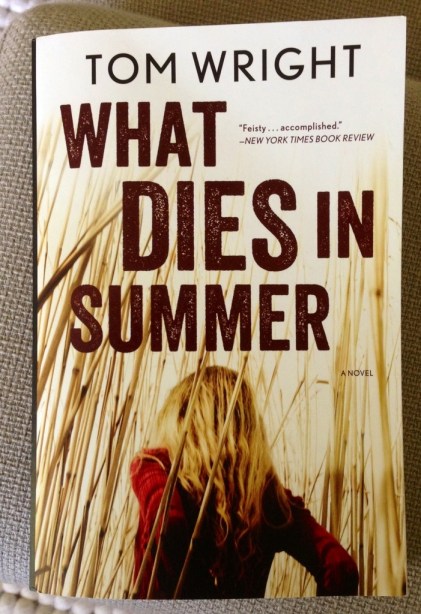
Tom Wright’s What Dies in Summer is new in trade paperback. Pub’s blurb:
A riveting Southern Gothic coming-of-age debut by major new talent.
“I did what I did, and that’s on me.” From that tantalizing first sentence, Tom Wright sweeps us up in a tale of lost innocence. Jim has a touch of the Sight. It’s nothing too spooky and generally useless, at least until the summer his cousin L.A. moves in with him and their grandmother. When Jim and L.A. discover the body of a girl, brutally raped and murdered in a field, an investigation begins that will put both their lives in danger. In the spirit of The Lovely Bones and The Little Friend, What Dies in Summer is a novel that casts its spell on the very first page and leaves an indelible mark.
And the lede from Julie Myerson’s review last year in the NYT:
Why do teenagers make such ideal protagonists? Maybe it’s because they’re doing just what novels do: struggling to make sense of a troubling and imperfect world. And at first, Jim, called Biscuit, and L. A. (Lee Ann), the teenage cousins at the heart of Tom Wright’s feisty first novel, are exactly what you hope they’ll be: funny, frank, mouthy and more than a touch off kilter. Both are forced to live with their grandmother because their mothers aren’t up to the task of child rearing. Their homes are haunted by alcoholism and violence, but Gram takes a simple, affectionate, responsibility for them — though it’s almost inevitable that certain questions, if not the answers, will push their ugly way to the surface sooner or later.






Quantin followed the procession for a few minutes out of morbid curiosity. The choice of narrower side streets, where it was easier to enlist the wall’s support, was probably deliberate, he thought, but then a long notice stuck to the stone exactly at eye level arrested his attention and, with it, his progress. The notice—in the manner of a proper, not overly pushy advertisement—listed the advantages ofso-called heavy dreams. Having come across the subject once before, Quantin read the fine print carefully, line by line: “The main advantage of the heavy industry of nightmares over the light industry of golden threads plunged into brain fibrils, over the production of so-called sweet dreams, is that in marketing our nightmares we can guarantee that they will come true, we can hand our customers ‘turnkey dreams.’ Sweet dreams cannot withstand reality, sleepy reveries wear out faster than socks; whereas a heavy dream, a simple but well-made nightmare, is easily assimilated by life. Where dreams unburdened by anything disappear like drops of water in the sand, dreams containing a certain harshness will, as they evaporate in the sun, leave a hard kernel on the roof of Plato’s famous cave: these dposits will collect and accrue, eventually forming a swordlike stalactite.
“Speaking in more modern terms,” the fine print went on, “our nightmares, weighing as they do on the brain, gradually form a sort of moral ceiling that is always about to come crashing down on one’s head: some of our customer’s call this ‘world history.’ But that’s not the point. The point is the durability, unwakeability, high depressiveness, and wide availability of our nightmares: mass-market products good for all eras and classes, nighttime and daytime, moonlight and sunlight, closed eyes and open.”
From Sigizmund Krzhizhanovsky’s short story “The Branch Line,” collected in NYRB’s Memories of the Future (translation by Joanne Turnbull).

Needing another book the same way I need another hole in the head, I nevertheless dropped by my local used bookstore to browse—the place is huge, and a day of grading term papers made me feel zapped and perhaps depressed. Anyway. Spotted a beautiful Penguin edition of Henry Miller’s The Colossus of Maroussi and had to have it. Here’s a passage some soul saw fit to dogear:

I had never heard of Georg Büchner or his novella fragment Lenz, but it was shelved next to Blake Butler’s Scorch Atlas and both stood out because of their odd shapes.

Here are the blurbs for Lenz, which more or less sold me:

Finally, I did not buy yet another edition of Moby-Dick, despite this midcentury Rinheart cover—but I had to snap it to share:


 Biblioklept