
A few weekends ago, I spent several days primitive camping on a tiny, rocky island off Cape Canaveral. The weather was miserable and the fishing was poor, but the company and bourbon offered cheer. Still, by the time I got home I was terribly sore, thoroughly damp, and inhabited by one of those hangovers that sets up shop inside one’s soul as a kind of second-consciousness, coloring the world a dreadful surreal blue. I wanted to see my family, but they were out playing tennis. There was a small stack of packages waiting for me though—review copies for this blog—with Jon McNaught’s Birchfield Close neatly nestled atop. After showering, I lay on my soft soft bed in the afternoon, read through the brief poem-novel-comic, and drifted into a gentle warm hazy nap. It was the most marvelous medicine. Sublime.
I read Birchfield Close again later that night and then every night for a week. McNaught’s work—see his longer novel Dockwood—is its own aesthetic experience: Minimal, gentle, tranquil, but also evocative and complex. Birchfield Close is (maybe) the (non-)story of two lads who climb upon a roof and spend the day observing (or not observing) their neighborhood.

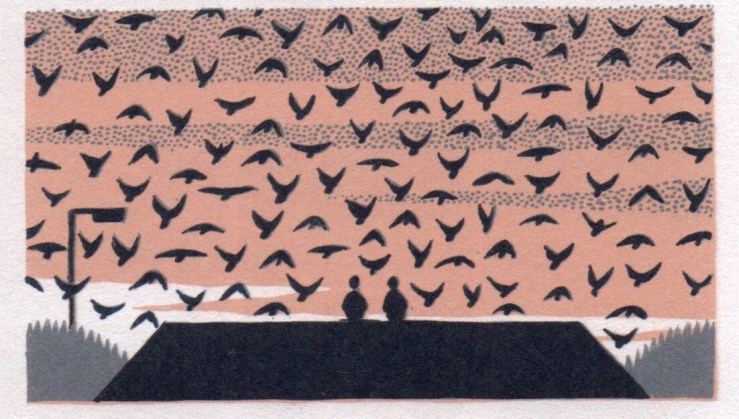
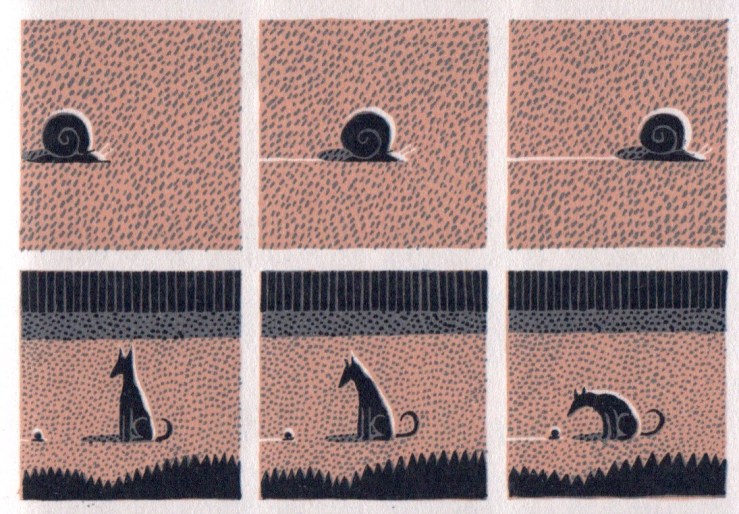
They see birds and people, dogs and snails, balloons and bikes (etc.), all rendered in gentle gradations of orange-pink and grey-blue and black-black.
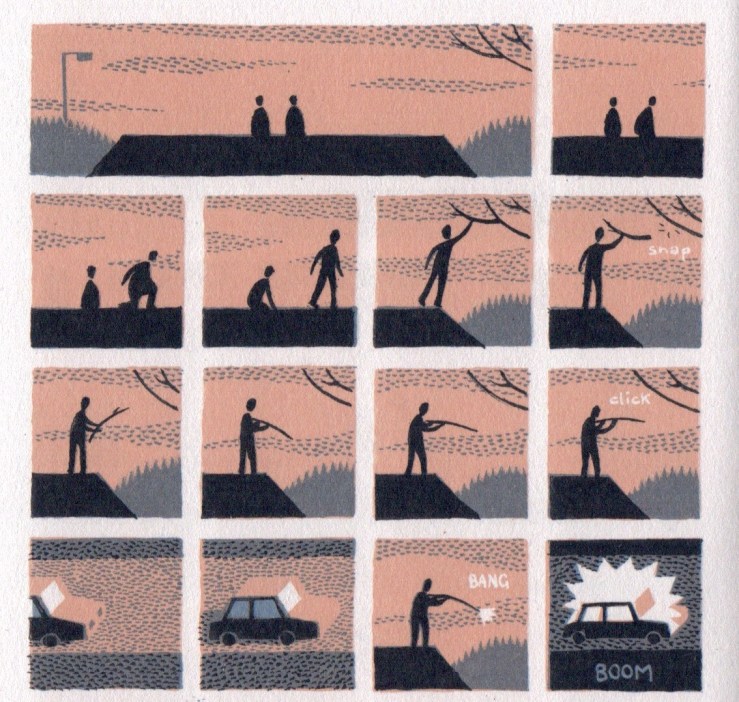
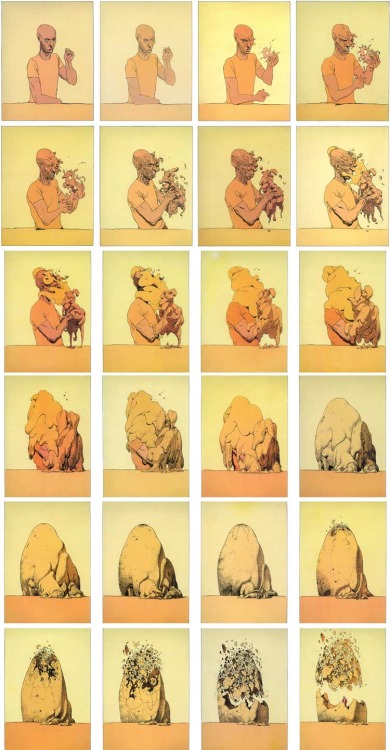
In one of my favorite little episodes, one boy reaches for a branch. His imagination transmutes the branch into a rifle, and a play-shooting spree ensues.
Birchfield Close is comprised entirely of such moments, yet none of its episodes feel discrete. Rather, each panel pushes (pushes? That’s not the right verb!) into the next, a miniature gesture that creates—that somehow is—the entire work. The effect is soothing.
I’ve read Birchfield Close a dozen times now (read? Is that the right verb?), and I’m still (happily) unsure what commentary McNaught might be making on media. The story is full of images of “entertainments” that may or may not be at odds with the neighborhood’s ambiance: a handheld video game, a banal soap opera, a pop song on the radio. In another favorite episode, we move from rooftop to an airplane flying through the sky to the actual inside of the airplane, where a passenger watches Nemo’s reunion with his overprotective father. On the next page, we are treated to the imaginative forms that the clouds might take—formations that the airplane passenger, wrapped up in viewing Finding Nemo on a tiny headrest screen, perhaps misses. But if there’s a judgment here, McNaught seems to leave it to the viewer to suss out. As we pan back down to the boys on the roof, we see that one remains watching the clouds, shaping them in his imagination (or perhaps he’s sharing an imaginative vision with the airplane passenger), while the other boy has returned to his own tiny screen to play a fighting game. He misses the sunset.
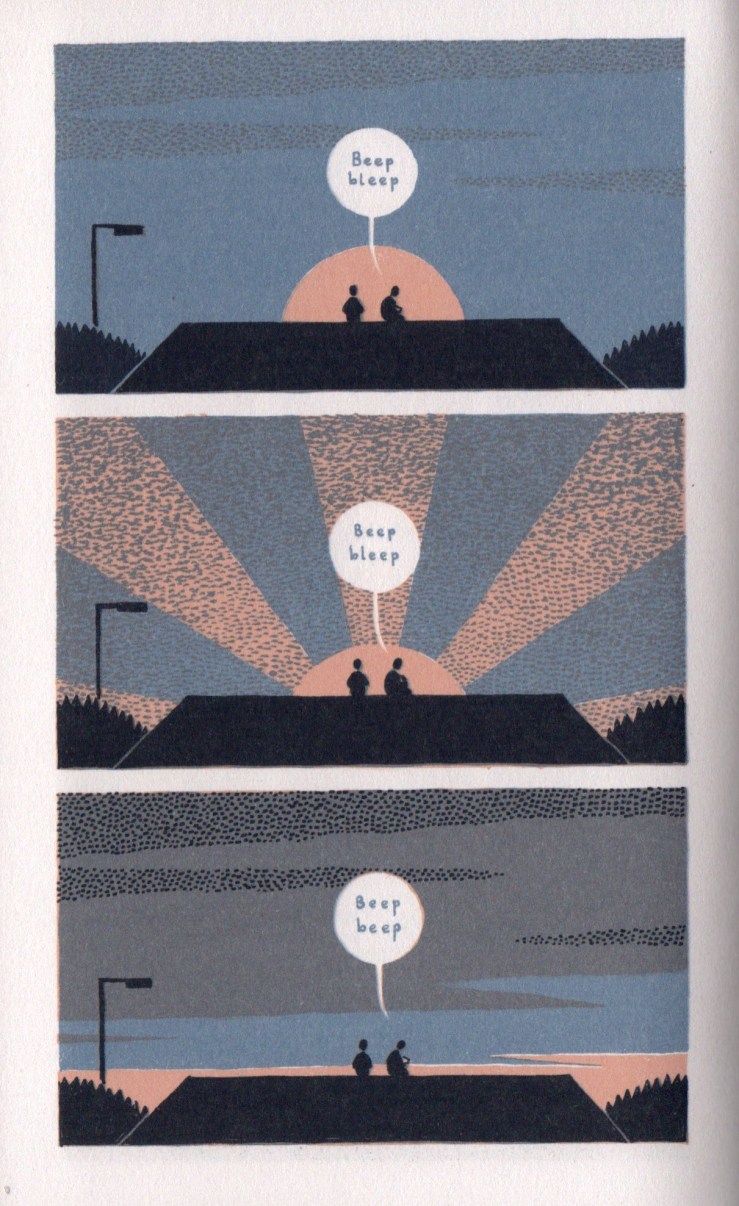
Or does he miss the sunset? Maybe it’s simply part of his own aesthetic experience with the game, a peripheral, environmental occurrence, one he enjoys as transitory and ambient, an event promised to repeat again and again. I like this second reading more, as it fits neatly with my own reading experience of Birchfield Close—the book is an ambient aesthetic experience, calming but quizzical, deeply enjoyable—physical: light, color, the touch of the fine thick paper. I’ve tried to capture some of that reading experience here but have undoubtedly failed. Better you read see think feel for yourself.
Birchfield Close and other books by Jon McNaught are available from the good people at Nobrow Press.







 Biblioklept