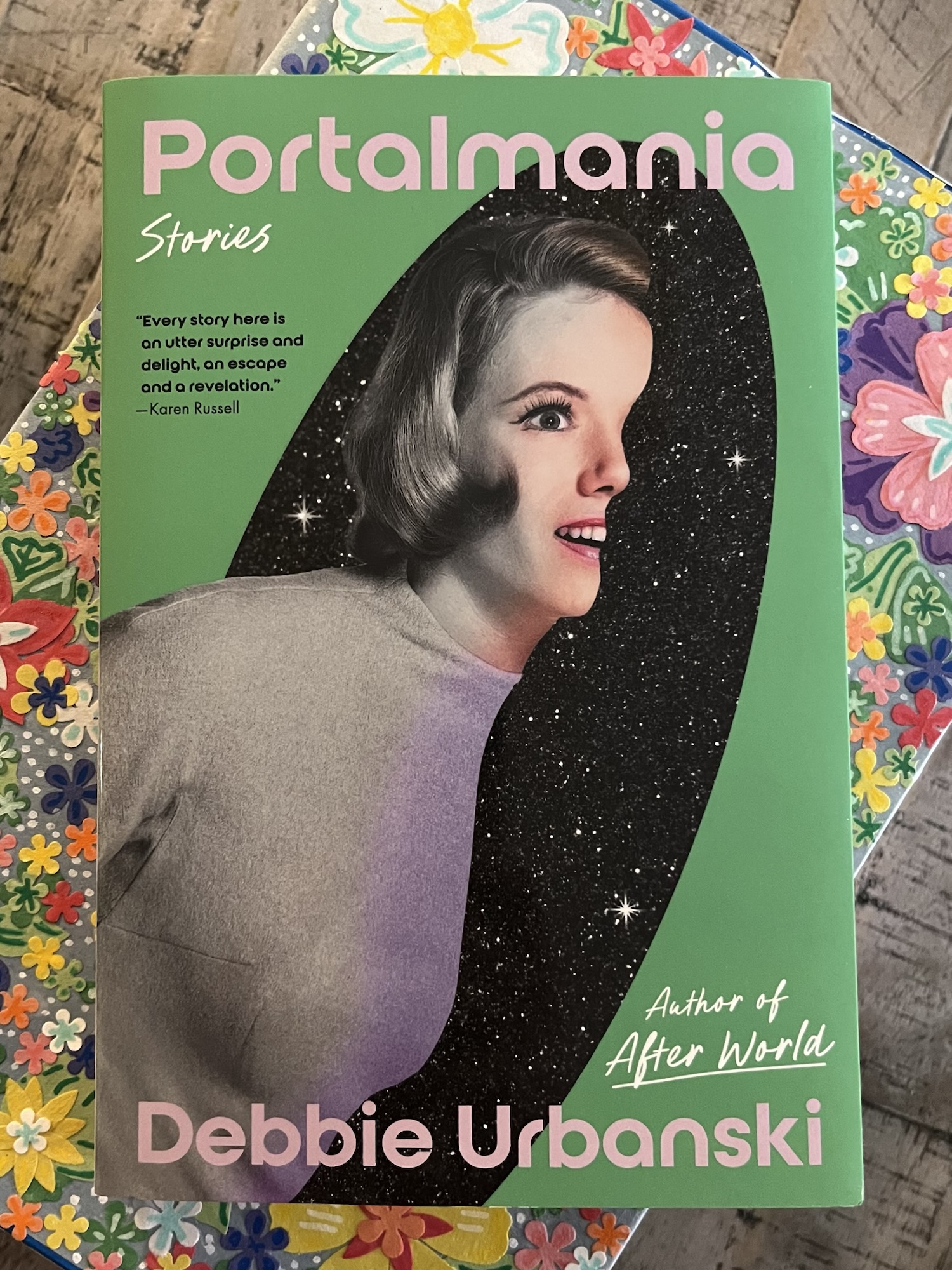
Thirteen ways of looking at a portal | A review of Debbie Urbanski’s Portalmania

Debbie Urbanski’s new collection Portalmania is a metatextual tangle of science fiction, fantasy, and horror where portals don’t offer escape so much as expose the fractures beneath family, love, and identity. Her characters navigate asexuality, neurodivergence, and the quiet violence of domestic life against an uneasy backdrop of porous reality. At any moment a portal might appear, or a mutation might take hold, or, a wife might sell her daughter to a witch to assassinate her husband. Nothing is stable in Portalmania.

There are nine stories in Portalmania. Or maybe there are ten stories. Or eleven. Or maybe thirteen. If there are thirteen stories, maybe I could riff on that Wallace Stevens poem for my review titles (that would be too fucking precious and obnoxious though, wouldn’t it).

There are nine or ten or eleven or thirteen discrete “stories” in Portalmania, depending on how you want to count or what you want to count as a discrete story. But this need to count, or, more precisely, to pin down what-something-is-and-is-not, runs counter to the spirit of Portalmania, whose heroes push back on the definitions that are literal placeholders, linguistic lines that bind identities.

Perhaps the biggest through-line of the nineteneleventhirteen stories in Portalmania is the big ole question: What is love? In the story “How to Kiss a Hojacki,” a character puts the problem succinctly, writing a note to her husband: “We need to redefine love.

The opening story, “The Promise of a Portal,” helps to establish a realistic world punctured by magical sci-fi. In “Promise,” we come to understand portals as personal escape hatches away from the humdrum domesticity of family life. “I think you can love people–children, mothers–and still want to leave them,” the hero of the story muses. These same portals pop up throughout the collection, creating continuity so that the nine (or are we saying thirteen? I misremember) stories here read more like a loose, discontinuous novel.

The second story, “How to Kiss a Hojacki,” also introduces a sci-fi conceit that repeats in the collection. In this story women transform into “Wonderfuls” — “Hojackis,” “Smith-Smiths,” or “Tangers” — asexual beings who must fight for their autonomy against a reactionary Trumpian politician who campaigns on interring them in camps.

“Hojacki” hovers around the viewpoint of a husband who is becoming increasingly resentful and sexually frustrated with his changing wife. He is unwilling to even try to redefine love: “having sex is how people love each other,” he contends. “Hojacki” is most fascinating when set in context against the stories at the back end of Portalmania, which deal far more directly with themes of asexuality, sexual coercion, and marital rape. While it would be a stretch to say Urbanski depicts the husband sympathetically, her rendering is nevertheless nuanced enough to be later deconstructed in far more visceral detail in stories like “The Dirty Golden Yellow House,” “Hysteria,” and “Some Personal Arguments in Support of the BetterYou (Based on Early Interactions).”

“The Dirty Golden Yellow House” is the strongest piece in Portalmania. It rewrites “How to Kiss a Hojacki” (and reimagines Charlotte Perkins Gilman’s “The Yellow Wall-Paper”) from the perspective of an asexual writer trapped in a marriage marked by marital rape and emotional coercion. “Yellow House” combines elements of fairy tales and Gothic horror with the more prosaic forms of the essay and the internet forum to yield a harrowing story. “Yellow House” also quickly registers as a metatextual tale, a self-deconstructing narrative that pauses early to take would-be critics to task:

Certain reviewers and readers have already started complaining about my recent stories, both their thematic similarities and their very specific view of relationships. I have examples. From one reviewer: Other than the overt political addition to the obvious social metaphors which helps extend this to novelette length, this [one of my stories] is exactly like the same author’s [another one of my stories] in being an overlong underplotted offputtingly narrated story of a repugnant asexual wife and a repugnant husband and their repugnant relationship. From another reviewer: It [one of my stories] is probablsending a message about something—menopause maybe?… I have no clue what the ending is supposed to mean.From a reader: My takeaway is that the story [one of my stories] was an exercise in catharsis for the author, and has no real value as a morality tale beyond—

My past self slams her (our?) body against the window glass. Has she not been clear enough. Here is what she expects in my writing: revenge, on me, on him, on them, on the structure of the story itself, and if I ever consider not placing her at the bloody heart of whatever I write, she will do this to me. She acts out what she will do to me. There is so much blood.

Angry, self-aware, and emotionally scorching, “Yellow House” nevertheless offers sparks of mean humor. The narrator observes that her “neighbors staked colorful rainbow signs into their front yard: WE BELIEVE LOVE IS LOVE AND KINDNESS IS EVERYTHING.” While the sentiment of the sign might be progressive, the tautology “love is love” is reductive and unhelpful in a book where redefining what love is is the (de)central problem. 

Another highlight of the collection is “LK-32-C,” a triptych of stories about a troubled child’s fantasy world. (We might count “LK-32-C” as three stories, not one; each section has its own title.) The narratives in “LK-32-C” seem to run in concurrent yet divergent directions, where fantasy punctures reality or vice versa. In one such topsy-turvy moment, a distraught mother dreams up a magical totem of familial security: “if anyone questioned whether or not there was some love here, she could have pointed to that sphere.”

And again, in “The Portal,” fantasy punctures reality and metatextuality punctures the narrative. Our narrator interrupts building her fantasy world to tell us that,

I do realize that, as an author, I’m not supposed to let my other worlds become utopias. At least, that was one successful writer’s advice to me when I told him I was working on this story. He explained that when portal worlds are utopias, it’s like a flashing neon sign that says lazy writing. If we want such fantastic places to be believable (and who doesn’t want their writing to be believed?), they have to possess a substantial dark side.

Our author-hero’s rejoinder points out that the dark side is the absence of the utopia: “What if I’m trying to create an untroubled and pleasant world that might haunt someone for as long as they could remember it?” We’re always looking for that perfect portal.

Not everything in Portalmania works. “How to Kiss a Hojacki” has a great premise but its collapse into a political satire is dissatisfying. “Long May My Land Be Bright” is the weakest link in the collection. Its central conceit is that there are literal rifts in the USA, which create two separate antithetical political-cultural realities. It’s not that I’m not sympathetic to the sentiment here, it’s just that I think the metaphor should be pushed even further, to more absurd places.

I’m also not sure how I feel about Urbanski’s decision to include a tenth chapter in her book titled “Story Notes.” By the time I got to the (ostensibly)-last story “The Portal,” I was having a really hard time keeping all the New Criticism, death-of-the-author, grad-school reading training stuff out of my head. With its constant metatextual interruptions and its deeply– personal themes, it became very, very difficult not to read Portalmania as in part a work of autofiction. So the notion of “Story Notes” both intrigued and repelled me. Here is how “Story Notes” begins:

One of the indisputably vital roles of the modern reader is to tease out what is autobiographically true for the fiction writer versus what that writer made up in their stories. What is fiction after all if not a porthole into the author’s private life? So allow me to get this out of the way: Everything you’ve read in Portalmania (or will read, depending on your preferred order) actually happened to me. The portals, the lack of portals, the witches, the monsters, the ghosts, the murders, the space travel of beloved family members—every story in this collection is a factual account of my own experience. And now that you know this, I can spend the remaining space of these notes discussing whatever I want.

And I suppose she does discuss whatever she wants in the notes.

If we are counting “Story Notes” as a story, there are ten stories in Portalmania. If we keep reading after “Story Notes,” there is a final piece, “Coda” an unlisted hidden track of sorts. I love the decision to put this last, brief, and strong piece after “Story Notes.” “Coda” revisits the themes of Portalmania and concludes by pointing to “a terrifying and wide-open future,” which is what I suppose we can all expect as we fumble toward our own redefinition of love, storytelling, and escape. Good stuff.
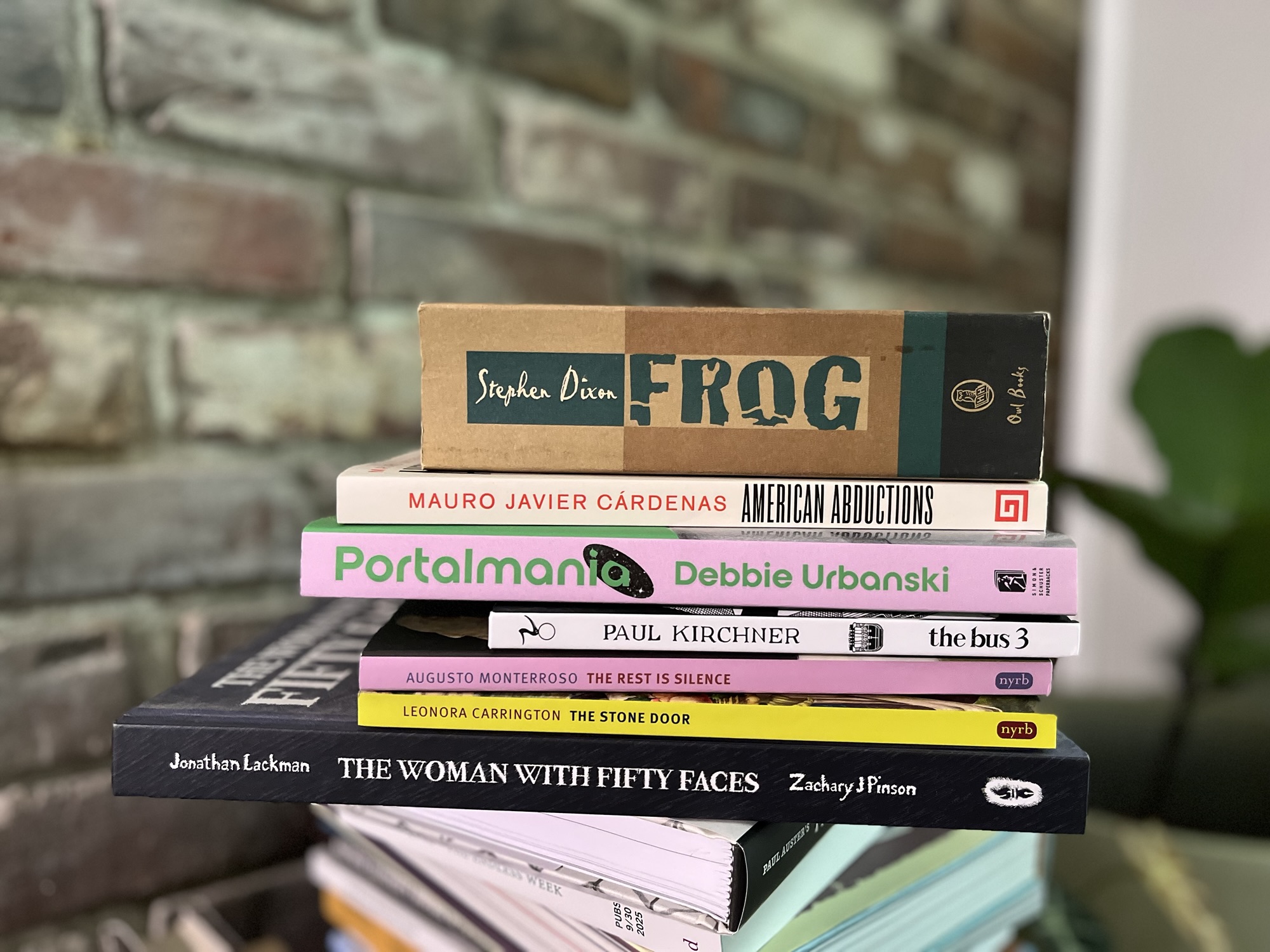
Blog about recent (non)reading

I read one novel in May 2025, the historical graphic biography The Woman with Fifty Faces: Maria Lani and the Greatest Art Heist That Never Was, by Jon Lackman and Zack Pinson. I think it was the only book I’ve read in full in the past two months. It was excellent and I owe it a full review.

I’ve read so so so many Wikipedia pages lately, tunneling down there almost every night (even all night) over the last six weeks. Last night I think I started, for some reason I can’t recall, on Julia Lennon’s page, maybe around eleven pm, and a few hours later I was reading about the visual systems of cuttlefish (this is when my wife woke up and told me to go to sleep). I didn’t start Leonora Carrington’s The Stone Door and I didn’t finish Augusto Monterroso’s The Rest Is Silence, even though they were on my cute little night stand.

I read a big chunk of The Rest Is Silence last Monday at the beach. I took my son and his friends there; despite their claims to being “goth” (or whatever, false claims) they wanted to hang out all day at Hannah Park. So we did that. I walked for a few miles and then discreetly drank a carton of sauvignon blanc and almost finished The Rest Is Silence and then promptly forgot all of the feeling of having read it, having replaced that feeling with the blazing Florida heat (a heat obscured by a heavy gray Atlantic breeze). There was a camp of young musicians wading in the water. I don’t know how I recognized them as teenage musicians, other than years of recognizing such persons in public — the same way I can recognize, say, college football coaches out for barbecue on a Saturday afternoon or late Friday. Some people just look like some people. I chatted with one of the music camp coaches. A lot of these kids hadn’t ever been to the ocean, he assured me, which he didn’t have to. Their movements against the waves showed it. I’m sure they are all graceful with their chosen instruments. Like I said, the slim novella was gone. The sand covered it over (this is a stupid metaphor; I am all rotten inside lately).

I have also not finished Paul Kirchner’s The Bus 3, mostly because I wanted to not finish it, to save it for a different shade of my disposition that is sure to arrive any day now. I love what Paul Kirchner has done, and I have never felt the strips whimsical; or, rather, their whimsy struck me as wise, a sharper whimsy. I’m having a hard time laughing lately.

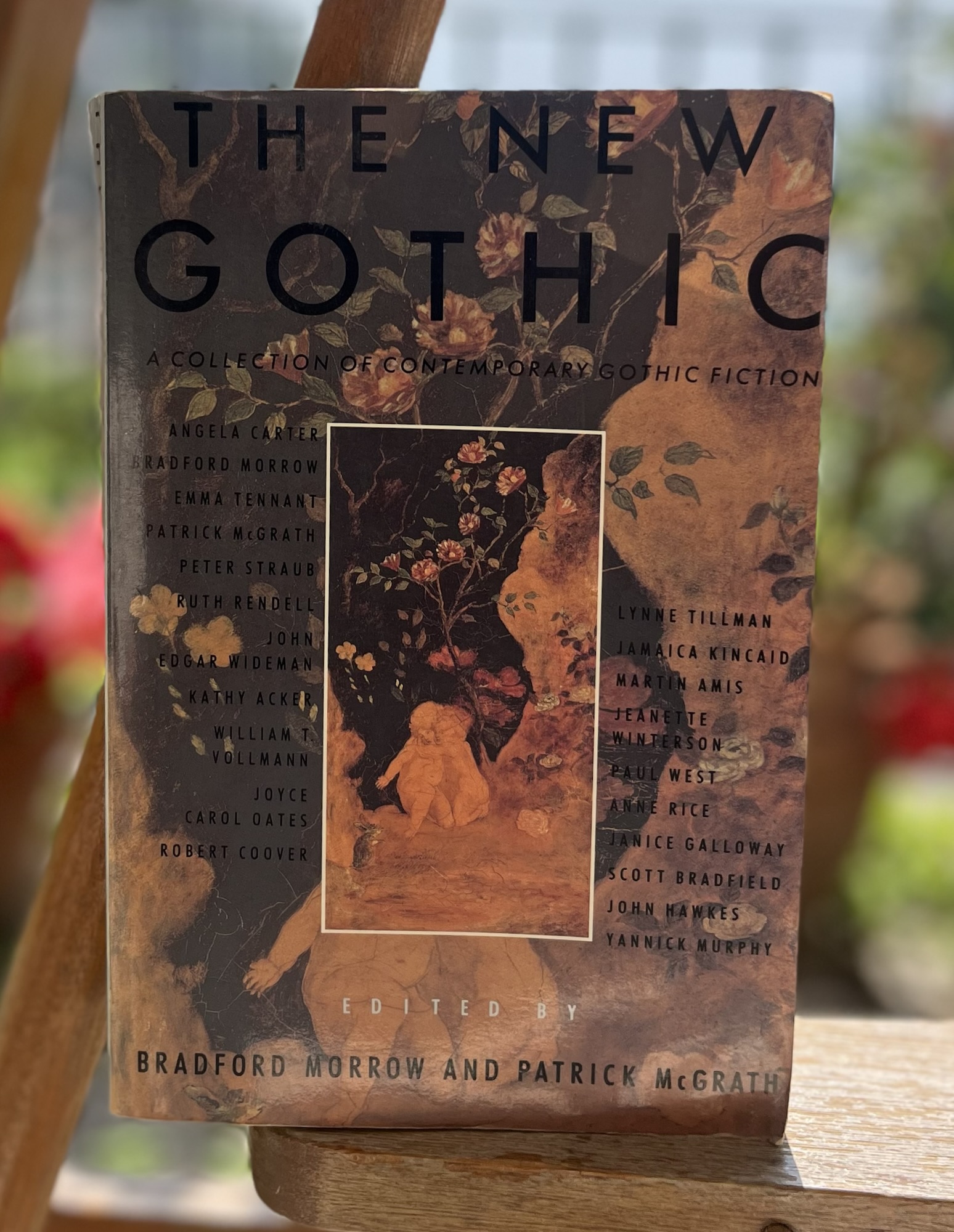
I read a big chunk of an anthology called The New Gothic about three weeks ago. It was in the house we — we my family, my wife and kids — were staying at in Minori, a smallish town in the Amalfi Coast of Italy. We spent the first fifteen days of June in Italy to celebrate my daughter’s 18th birthday and high school graduation. In a lovely little house on the side of a mountain (maybe it was a big hill, I’m a Florida boy), in a small shelf of mostly non-English language books, I picked out The New Gothic and read tales by Coover, Carter, Vollmann and others. The book is a love letter to Poe, really, with a wonderful introductory essay by editors Bradford Morrow and Patrick McGrath.

The story that really stood out though was Lynne Tillman’s “A Dead Summer.” This particular paragraph made me cry:

The Mets were doing better, but with so many new players on the team, she didn’t have the same relationship to them. Her dead friend had loved the Mets too. Sometimes she watched a game just for him, as if he could use her as a medium. She was sure his spirit was hovering near her, especially at those times. But she did not speak of this to her boyfriend who was talking about breaking up. That night she let him gag her. She didn’t have anything to say anyway, not anything worthwhile. She read that the Ku Klux Klan had marched in Palm Beach.

The story is about grief and bad dreams set against a terrifying American political backdrop. The notion of witnessing something so that one’s dead friend might use your eyes as a medium is what did me in. I’ve had such thoughts a few times in the last two months after my best friend died unexpectedly, moments where I thought I might somehow channel his spirit to, say, listen to the new Pulp record. But I don’t think he’s haunting me.

(I didn’t steal The New Gothic from the house in Minori, although I thought about it for two or three minutes.)

I have almost finished reading the stories in Debbie Urbanski’s collection Portalmania (it is a “collection” but I suspect it is a stealth novel — about escapes, transitions, aesexuality, monsters, uh, portals, etc.). Review to come. (I will absolutely get might shit together, any day now.)

I read and reviewed Mauro Javier Cárdenas’s American Abductions back in March. It’s only in this stack — this organizing picture that I use as an outline — because it is the most timely novel in America right now. It is a novel I read, loved, and highly recommend. Its narrative power surpasses the timeliness I’ve imposed upon it.

I was, what?, maybe 200, 225 pages? into Stephen Dixon’s massive novel Frog before I abandoned it. I was really loving it, its tics, repetitions, its noisy monotonous howl, its droll jabs at normal fucking people. It could have been one of my favorite novels ever, I think, but I’m not sure I’ll ever wade back in. I tried a few times, but it’s all enmeshed with some bad intense feelings I felt in early May.

Which is what? I guess? another way of saying that reading is just a series of feelings for me now. Maybe at some point I thought of reading novels as an intellectual exercise, and maybe at one point I turned that into an ideal of an aesthetics of reading — but I don’t care about any of that shit now.

I believe in reading for

pleasure

pain

other feelings, in between and otherwise.

Debbie Urbanski’s Portalmania (Book acquired, 5 May 2025)

I really dug Debbie Urbanski’s debut novel After World, writing about it,

Debbie Urbanski’s debut novel After World reimagines the end of humanity—or perhaps the beginning of a new digital existence. The narrator, [storyworker] ad39-393a-7fbc, reconstructs the life of Sen Anon, the last human archived in the Digital Human Archive Project, using sources like drones, diaries, and other materials. Drawing on tropes from dystopian and post-apocalyptic literature, this metatextual novel references authors like Octavia Butler and Margaret Atwood while nodding to works such as House of Leaves and Station Eleven. Urbanski’s spare, post-postmodern approach also reminded me of David Markson’s Wittgenstein’s Mistress—good stuff.

Publisher Simon & Schuster’s blurb:

In Portalmania, Debbie Urbanski wields sci-fi, fantasy, horror, and realism to build a dark mirror that she holds up to the ordinary world. Within the sharply imagined landscape of this collection, portals appear in linen closets, planetary gateways materialize in boarding schools, monsters wait in bathroom vents, and transformations of women’s bodies are an everyday occurrence. Political division causes physical rifts that break apart the Earth’s crust. A son on another planet sends dispatches home to the mother who failed him, and a wife turns to the supernatural to escape her abusive marriage. Portals are not only doorways found in children’s classics, but separations, escapes, dead ends, desertions, and choices that will change these characters’ lives forever.

Blog about some recent reading

A few weeks ago, I picked up Anthony Kerrigan’s translation of Miguel de Unamuno’s Abel Sanchez and Other Stories based on its cover and the blurb on its back. I wound up reading the shortest of the three tales, “The Madness of Dr. Montarco,” that night. The story’s plot is somewhat simple: A doctor moves to a new town and resumes his bad habit of writing fiction. He slowly goes insane as his readers (and patients) query him about the meaning of his stories, and he’s eventually committed to an asylum. The tale’s style evokes Edgar Allan Poe’s paranoia and finds an echo in Roberto Bolaño’s horror/comedy fits. The novella that makes up the bulk of the collection is Abel Sanchez, a Cain-Abel story that features one of literature’s greatest haters, a doctor named Joaquin who grows to hate his figurative brother, the painter Abel. Sad and funny, this 1917 novella feels contemporary with Kafka and points towards the existentialist novels of Albert Camus. (I’m saving the last tale, “Saint Manuel Bueno, Martyr,” for a later day.)

I’m near the end of Iain Banks’s second novel, Walking on Glass (1985), which so far follows three separate narrative tracks: one focusing on an art student pining after an enigmatic beauty; one following an apparent paranoid-schizophrenic who believes himself to be a secret agent of some sort from another galaxy, imprisoned on earth; and one revolving around a fantastical castle where two opposing warriors, trapped in ancient bodies, play bizarre table top games while they try to solve an unsolvable riddle. I should finish later tonight, I think, and while there are some wonderful and funny passages, I’m not sure if Banks will stick the landing here. My gut tells me his debut novel The Wasp Factory is a stronger effort.

I’ve been soaking in Sorokin lately, thanks to his American translator Max Lawton, with whom I’ve been conducting an email-based interview over the past few months. Max had kindly shared some of his manuscripts with me, including an earlier draft of the story collection published as Red Pyramid. I’ve found myself going through the collection again now that it’s in print from NYRB—skipping around a bit (but as usual with most story collections, likely leaving at least one tale for the future.)

I very much enjoyed Gerhard Rühm’s Cake & Prostheses (in translation by Alexander Booth)—sexy, surreal, silly, and profound. Lovely little thought experiments and longer meditations into the weird.

I really enjoyed Debbie Urbanski’s debut novel After World. The novel’s “plot,” such as it is, addresses the end of the world: Or not the end of the world, but the end of the world of humans: Or the beginning of a new world, where consciousness might maybe could who the fuck actually can say be uploaded to a virtual after world. After World is a pastiche of forms, but dominated by the narrator [storyworker] ad39-393a-7fbc whose task is to reimagine the life of Sen Anon, one of the final humans to live and die on earth—and the last human to be archived/translated/transported into the Digital Human Archive Project. This ark will carry humanity…somewhere. [storyworker] ad39-393a-7fbc creates Sen’s archive through a number of sources, including drones, cameras, Sen’s own diary, and a host of ancillary materials. [storyworker] ad39-393a-7fbc also crafts the story, drawing explicitly on the tropes and forms of dystopian and post-apocalyptic literature. After World is thus explicitly and formally metatextual; [storyworker] ad39-393a-7fbc archives the life of Sen Anon, last witness to the old world and Urbanski archives the dystopian and post-apocalyptic pop narratives that populate bestseller lists and serve as the basis for Hollywood hits. [storyworker] ad39-393a-7fbc namechecks a number of these authors and novels, including Octavia Butler, Margaret Atwood, and Ann Leckie, while Sen Anon holds tight to two keystone texts: Mark Z. Danielewski’s House of Leaves and Emily St. John Mandel’s Station Eleven. But the end-of-the-world novel it most reminded me of was David Markson’s Wittgenstein’s Mistress. Even as it works to a truly human finale, Urbanski’s novel is spare: post-postmodern, post-apocalyptic, and post-YA. Good stuff.

Speaking of: Carole Masso’s 1991 novel Ava also strongly reminded me of Markson’s Wittgenstein’s Mistress. Its controlling intelligence is the titular Ava, dying too young of cancer. The novel is an elliptical assemblage of quips, quotes, observations, dream thoughts, and other lovely sad beautiful bits. Masso creates a feeling, not a story; or rather a story felt, intuited through fragmented language, experienced.

I continue to pick my way through Frederick Karl’s American Fictions. He is going to make me buy Joseph McElroy’s 1974 novel Lookout Cartridge. 

Debbie Urbanski’s After World (Book acquired, Dec. 2023)

I plan to start into Debbie Urbanski’s debut After World this weekend. Here’s publisher Simon & Schuster’s blurb:

Sen Anon is assigned to be a witness for the Department of Transition, recording the changes in the environment as the world begins to rewild. Abandoned by her mother in a cabin somewhere in Upstate New York, Sen will observe the monumental ecological shift known as the Great Transition, the final step in Project Afterworld. Around her drones buzz, cameras watch, microphones listen, digitizing her every move. Privately she keeps a journal of her observations, which are then uploaded and saved, joining the rest of humanity on Maia, a new virtual home. Sen was seventeen years old when the Digital Human Archive Project (DHAP) was initiated. 12,000,203,891 humans have been archived so far. Only Sen remains.

[storyworker] ad39-393a-7fbc’s assignment is to capture Sen’s life, and they set about doing this using the novels of the 21st century as a roadmap. Their source files: 3.72TB of personal data, including images, archival records, log files, security reports, location tracking, purchase histories, biometrics, geo-facial analysis, and feeds. Potential fatal errors: underlying hardware failure, unexpected data inconsistencies, inability to follow DHAP procedures, empathy, insubordination, hallucinations. Keywords: mothers, filter, woods, road, morning, wind, bridge, cabin, bucket, trying, creek, notebook, hold, future, after, last, light, silence, matches, shattered, kitchen, body, bodies, rope, garage, abandoned, trees, never, broken, simulation, gone, run, don’t, love, dark, scream, starve, if, after, scavenge, pieces, protect.

As Sen struggles to persist in the face of impending death, [storyworker] ad39-393a-7fbc works to unfurl the tale of Sen’s whole life, offering up an increasingly intimate narrative, until they are confronted with a very human problem of their own.