“Flaubert me no Flauberts, Bovary me no Bovarys” — Thomas Wolfe Writes to F. Scott Fitzgerald

Dear Scott:

I don’t know where you are living and I’ll be damned if I’ll believe anyone lives in a place called “The Garden of Allah,” which was what the address on your envelope said. I am sending this on to the old address we both know so well.

The unexpected loquaciousness of your letter struck me all of a heap. I was surprised to hear from you but I don’t know that I can truthfully say I was delighted. Your bouquet arrived smelling sweetly of roses but cunningly concealing several large-sized brick-bats. Not that I resented them. My resenter got pretty tough years ago; like everybody else I have at times been accused of “resenting criti[ci]sm” and although I have never been one of those boys who break out in a hearty and delighted laugh when someone tells them everything they write is lousy and agree enthusiastically, I think I have taken as many plain and fancy varieties as any American citizen of my age now living. I have not always smiled and murmured pleasantly “How true,” but I have listened to it all, tried to profit from it where and when I could and perhaps been helped by it a little. Certainly I don’t think I have been pig-headed about it. I have not been arrogantly contemptuous of it either, because one of my besetting sins, whether you know it or not, is a lack of confidence in what I do.

So I’m not sore at you or sore about anything you said in your letter. And if there is any truth in what you say— any truth for me—you can depend upon it I shall probably get it out. It just seems to me that there is not much in what you say. You speak of your “case” against me, and frankly I don’t believe you have much case. You say you write these things because you admire me so much and because you think my talent unmatchable in this or any other country and because you are ever my friend. Well Scott I should not only be proud and happy to think that all these things are true but my respect and admiration for your own talent and intelligence are such that I should try earnestly to live up to them and to deserve them and to pay the most serious and respectful attention to anything you say about my work.

I have tried to do so. I have read your letter several times and I’ve got to admit it doesn’t seem to mean much. I don’t know what you are driving at or understand what you expect or hope me to do about it. Now this may be pig-headed but it isn’t sore. I may be wrong but all I can get out of it is that you think I’d be a good writer if I were an altogether different writer from the writer that I am.

This may be true but I don’t see what I’m going to do about it. And I don’t think you can show me and I don’t see what Flaubert and Zola have to do with it, or what I have to do with them. I wonder if you really think they have anything to do with it, or if this is just something you heard in college or read in a book somewhere. This either—or kind of criticism seems to me to be so meaningless. It looks so knowing and imposing but there is nothing in it. Why does it follow that if a man writes a book that is not like Madame Bovary it is inevitably like Zola. I may be dumb but I can’t see this. You say that Madame Bovary becomes eternal while Zola already rocks with age. Well this may be true—but if it is true isn’t it true because Madame Bovary may be a great book and those that Zola wrote may not be great ones? Wouldn’t it also be true to say that Don Quixote or Pickwick or Tristram Shandy “become eternal” while already Mr. Galsworthy “rocks with age.” I think it is true to say this and it doesn’t leave much of your argument, does it? For your argument is based simply upon one way, upon one method instead of another. And have you ever noticed how often it turns out that what a man is really doing is simply rationalizing his own way of doing something, the way he has to do it, the way given him by his talent and his nature, into the only inevitable and right way of doing everything—a sort of classic and eternal art form handed down by Apollo from Olympus without which and beyond which there is nothing. Now you have your way of doing something and I have mine, there are a lot of ways, but you are honestly mistaken in thinking that there is a “way.” I suppose I would agree with you in what you say about “the novel of selected incident” so far as it means anything. I say so far as it means anything because every novel, of course, is a novel of selected incident. There are no novels of unselected incident. You couldn’t write about the inside of a telephone booth without selecting. You could fill a novel of a thousand pages with a description of a single room and yet your incidents would be selected. And I have mentioned Don Quixote and Pickwick and The Brothers Karamazov and Tristram Shandy to you in contrast to The Silver Spoon or The White Monkey as examples of books that have become “immortal” and that boil and pour. Just remember that although Madame Bovary in your opinion may be a great book, Tristram Shandy is indubitably a great book, and that it is great for quite different reasons. It is great because it boils and pours—for the unselected quality of its selection. You say that the great writer like Flaubert has consciously left out the stuff that Bill or Joe will come along presently and put in. Well, don’t forget, Scott, that a great writer is not only a leaver-outer but also a putter-inner, and that Shakespeare and Cervantes and Dostoevsky were great putter-inners—greater putter-inners, in fact, than taker-outers and will be remembered for what they put in—remembered, I venture to say, as long as Monsieur Flaubert will be remembered for what he left out.

As to the rest of it in your letter about cultivating an alter ego, becoming a more conscious artist, my pleasantness or grief, exuberance or cynicism, and how nothing stands out in relief because everything is keyed at the same emotional pitch—this stuff is worthy of the great minds that review books nowadays—the Fadimans and De Votos—but not of you. For you are an artist and the artist has the only true critical intelligence. You have had to work and sweat blood yourself and you know what it is like to try to write a living word or create a living thing. So don’t talk this foolish stuff to me about exuberance or being a conscious artist or not bringing things into emotional relief, or any of the rest of it. Let the Fadimans and De Votos do that kind of talking but not Scott Fitzgerald. You’ve got too much sense and you know too much. The little fellows who don’t know may picture a man as a great “exuberant” six-foot-six clodhopper straight out of nature who bites off half a plug of apple tobacco, tilts the corn liquor jug and lets half of it gurgle down his throat, wipes off his mouth with the back of one hairy paw, jumps three feet in the air and clacks his heels together four times before he hits the floor again and yells “Whoopee, boys I’m a rootin, tootin, shootin son of a gun from Buncombe County—out of my way now, here I come!”—and then wads up three-hundred thousand words or so, hurls it back at a blank page, puts covers on it and says “Here’s my book!” Now Scott, the boys who write book reviews in New York may think it’s done that way; but the man who wrote Tender Is the Night knows better. You know you never did it that way, you know I never did, you know) no one else who ever wrote a line worth reading ever did. So don’t give me any of your guff, young fellow. And don’t think I’m sore. But I get tired of guff—I’ll take it from a fool or from a book reviewer but I won’t take it from a friend who knows a lot better. I want to be a better artist. I want to be a more selective artist. I want to be a more restrained artist. I want to use such talent as I have, control such forces as I may own, direct such energy as I may use more cleanly, more surely and to better purpose. But Flaubert me no Flauberts, Bovary me no Bovarys. Zola me no Zolas. And exuberance me no exuberances. Leave this stuff for those who huckster in it and give me, I pray you, the benefits of your fine intelligence and your high creative faculties, all of which I so genuinely and profoundly admire. I am going into the woods for another two or three years. I am going to try to do the best, the most important piece of work I have ever done. I am going to have to do it alone. I am going to lose what little bit of reputation I may have gained, to have to hear and know and endure in silence again all of the doubt, the disparagement and ridicule, the post-mortems that they are so eager to read over you even before you are dead. I know what it means and so do you. We have both been through it before. We know it is the plain damn simple truth. Well, I’ve been through it once and I believe I can get through it again. I think I know a little more now than I did before, I certainly know what to expect and I’m going to try not to let it get me down. That is the reason why this time I shall look for intelligent understanding among some of my friends. I’m not ashamed to say that I shall need it. You say in your letter that you are ever my friend. I assure you that it is very good to hear this. Go for me with the gloves off if you think I need it. But don’t De Voto me. If you do I’ll call your bluff.

I’m down here for the summer living in a cabin in the country and I am enjoying it. Also I’m working. I don’t know how long you are going to be in Hollywood or whether you have a job out there but I hope I shall see you before long and that all is going well with you. I still think as I always thought that Tender Is the Night had in it the best work you have ever done. And I believe you will surpass it in the future. Anyway, I send you my best wishes as always for health and work and success. Let me hear from you sometime. The address is Oteen, North Carolina, just a few miles from Asheville, Ham Basso, as you know, is not far away at Pisgah Forest and he is coming over to see me soon and perhaps we shall make a trip together to see Sherwood Anderson. And now this is all for the present—unselective, you see, as usual. Good bye Scott and good luck.

Ever yours,
Tom Wolfe

(July 26, 1937; republished in New Directions’ edition of The Crack Up).
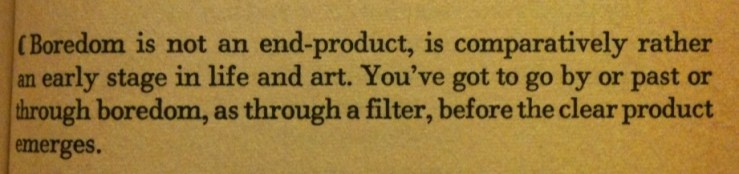
Boredom // F. Scott Fitzgerald

20130211-213526.jpg

T.S. Eliot Writes to F.Scott Fitzgerald

FABER AND GWYER LTD. Publishers 24 Russell Square, London, W.C.1. 31st December, 1925
F. Scott Fitzgerald, Esqre., % Charles Scribners & Sons, New York City.

Dear Mr. Scott Fitzgerald,
The Great Gatsby with your charming and overpowering inscription arrived the very morning that I was leaving in some haste for a sea voyage advised by my doctor. I therefore left it behind and only read it on my return a few days ago. I have, however, now read it three times. I am not in the least influenced by your remark about myself when I say that it has interested and excited me more than any new novel I have seen, either English or American, for a number of years.

When I have time I should like to write to you more fully and tell you exactly why it seems to me such a remarkable book. In fact it seems to me to be the first step that American fiction has taken since Henry James….

By the way, if you ever have any short stories which you think would be suitable for the Criterion I wish you would let me see them.

With many thanks, I am,
Yours very truly, T. S. Eliot

P.S. By a coincidence Gilbert Seldes in his New York Chronicle in the Criterion for January 14th has chosen your book for particular mention.


“Suicide and wife arrive in Cuba” and Other Wise Cracks from F. Scott Fitzgerald

From the “Epigrams, Wise Cracks and Jokes” section ofd  F. Scott Fitzgerald’s Noteboooks:

Suicide and wife arrive in Cuba.

Let’s all live together.

Debut—the first time a young girl is seen drunk in public.

He repeated to himself an old French proverb he had made up that morning.

A sleeping porch is a back room with no pictures on the walls. It should contain at least one window.

Kill the scrub sire is our slogan.

Why can’t you be square? Well, when I was young I used to play with old automobile tires.

Forgotten is forgiven.

If all your clothes are worn to the same state it means you go out too much.

American actresses now use European convents as a sort of female Muldoon’s.

You must stoop a little in order to jump.

For a car—Excuse my lust.

Andre Gide lifted himself by his own jockstrap so to speak—and one would like to see him hoisted on his own pedarasty.

Creditors’ jokes


“The Four Fists” — F. Scott Fitzgerald

“The Four Fists” — F. Scott Fitzgerald

At the present time no one I know has the slightest desire to hit Samuel Meredith; possibly this is because a man over fifty is liable to be rather severely cracked at the impact of a hostile fist, but, for my part, I am inclined to think that all his hitable qualities have quite vanished. But it is certain that at various times in his life hitable qualities were in his face, as surely as kissable qualities have ever lurked in a girl’s lips.

I’m sure every one has met a man like that, been casually introduced, even made a friend of him, yet felt he was the sort who aroused passionate dislike—expressed by some in the involuntary clinching of fists, and in others by mutterings about “takin’ a poke” and “landin’ a swift smash in ee eye.” In the juxtaposition of Samuel Meredith’s features this quality was so strong that it influenced his entire life.

What was it? Not the shape, certainly, for he was a pleasant-looking man from earliest youth: broad-bowed with gray eyes that were frank and friendly. Yet I’ve heard him tell a room full of reporters angling for a “success” story that he’d be ashamed to tell them the truth that they wouldn’t believe it, that it wasn’t one story but four, that the public would not want to read about a man who had been walloped into prominence.

It all started at Phillips Andover Academy when he was fourteen. He had been brought up on a diet of caviar and bell-boys’ legs in half the capitals of Europe, and it was pure luck that his mother had nervous prostration and had to delegate his education to less tender, less biassed hands.

At Andover he was given a roommate named Gilly Hood. Gilly was thirteen, undersized, and rather the school pet. From the September day when Mr. Meredith’s valet stowed Samuel’s clothing in the best bureau and asked, on departing, “hif there was hanything helse, Master Samuel?” Gilly cried out that the faculty had played him false. He felt like an irate frog in whose bowl has been put goldfish. Continue reading ““The Four Fists” — F. Scott Fitzgerald”

Enjoy Thanksgiving with Our Literary Recipes Roundup

Fat Kitchen, Jan Steen

***

Enjoy Thanksgiving with our menu of literary recipes:

F. Scott Fitzgerald’s Turkey Twelve Ways

Zora Neale Hurston’s Mulatto Rice

Ian McEwan’s Fish Stew

James Joyce’s Burnt Kidney Breakfast

Herman Melville’s Whale Steaks

Ernest Hemingway’s Absinthe Cocktail, Death in the Afternoon

Vladimir Nabokov’s Eggs à la Nabocoque

Thomas Pynchon’s Banana Breakfast

Cormac McCarthy’s Turtle Soup

Robert Crumb’s Macaroni Casserole

Truman Capote’s Caviar-Smothered Baked Potatoes with 80-Proof Russian Vodka

Emily Dickinson’s Cocoanut Cake

Thomas Jefferson’s Vanilla Ice Cream

Charles Dickens’s Own Punch

Ben Jonson’s Egg Wine

Christmas Bonus:  George Orwell’s Recipes for Plum Cake and Christmas Pudding

“Hot Springs” — F. Scott Fitzgerald


Hot Springs:
In a Spring vacation hotel the rain is bad news indeed. The hundred French windows of the great galleries led the eye out to ink-and-water pines snivelling listlessly on to raw brown tennis courts, to desolate hills against soiled white sky. There was “nothing to do” for hotel and resort were one and the same and no indoor activity was promised on the bulletin board until the concert of the Princeton Glee Club Easter Monday. Women who had come to breakfast in riding clothes rushed to the hairdresser instead; at eleven the tap-k’tap of ping-pong balls was the only sound of life in the enormous half empty hotel.
The girl was one of a pair in white skirts and yellow sweaters who walked down the long gallery after breakfast. Her face reflected the discontent of the weather, reflected darkly and resentfully. Looking at her Deforrest Colman thought: “Bored and fierce,” and then as his eyes continued to follow her, “No, proud and impatient. Not that either, but what a face—vitality and hand cuffs—where’s this getting me—liver and bacon, Damon and Pythias, Laurel and Hardy.

A fragment from F. Scott Fitzgerald’s Notebooks.


“This Schedule In Effect July 5th, 1922” — The Great Gatsby’s House Guests

In Chapter 4 of F. Scott Fitzgerald’s The Great Gatsby, narrator Nick Carraway recounts the names of the rich, shallow, parasitic guests who attended Gatsby’s parties. Nick tells us the list comes from “an old time-table” of names he originally recorded in July 5th—significantly, the day after Independence Day: the day after the hopes and dreams of a new country. From the chapter—-

Once I wrote down on the empty spaces of a time-table the names of those who came to Gatsby’s house that summer. It is an old time-table now, disintegrating at its folds, and headed “This schedule in effect July 5th, 1922.” But I can still read the gray names, and they will give you a better impression than my generalities of those who accepted Gatsby’s hospitality and paid him the subtle tribute of knowing nothing whatever about him.

From East Egg, then, came the Chester Beckers and the Leeches, and a man named Bunsen, whom I knew at Yale, and Doctor Webster Civet, who was drowned last summer up in Maine. And the Hornbeams and the Willie Voltaires, and a whole clan named Blackbuck, who always gathered in a corner and flipped up their noses like goats at whosoever came near. And the Ismays and the Chrysties (or rather Hubert Auerbach and Mr. Chrystie’s wife), and Edgar Beaver, whose hair, they say, turned cotton-white one winter afternoon for no good reason at all.

Clarence Endive was from East Egg, as I remember. He came only once, in white knickerbockers, and had a fight with a bum named Etty in the garden. From farther out on the Island came the Cheadles and the O. R. P. Schraeders, and the Stonewall Jackson Abrams of Georgia, and the Fishguards and the Ripley Snells. Snell was there three days before he went to the penitentiary, so drunk out on the gravel drive that Mrs. Ulysses Swett’s automobile ran over his right hand. The Dancies came, too, and S. B. Whitebait, who was well over sixty, and Maurice A. Flink, and the Hammerheads, and Beluga the tobacco importer, and Beluga’s girls.

From West Egg came the Poles and the Mulreadys and Cecil Roebuck and Cecil Schoen and Gulick the state senator and Newton Orchid, who controlled Films Par Excellence, and Eckhaust and Clyde Cohen and Don S. Schwartze (the son) and Arthur McCarty, all connected with the movies in one way or another. And the Catlips and the Bembergs and G. Earl Muldoon, brother to that Muldoon who afterward strangled his wife. Da Fontano the promoter came there, and Ed Legros and James B. (“Rot-Gut.”) Ferret and the De Jongs and Ernest Lilly — they came to gamble, and when Ferret wandered into the garden it meant he was cleaned out and Associated Traction would have to fluctuate profitably next day.

A man named Klipspringer was there so often and so long that he became known as “the boarder.”— I doubt if he had any other home. Of theatrical people there were Gus Waize and Horace O’donavan and Lester Meyer and George Duckweed and Francis Bull. Also from New York were the Chromes and the Backhyssons and the Dennickers and Russel Betty and the Corrigans and the Kellehers and the Dewars and the Scullys and S. W. Belcher and the Smirkes and the young Quinns, divorced now, and Henry L. Palmetto, who killed himself by jumping in front of a subway train in Times Square.

Benny McClenahan arrived always with four girls. They were never quite the same ones in physical person, but they were so identical one with another that it inevitably seemed they had been there before. I have forgotten their names — Jaqueline, I think, or else Consuela, or Gloria or Judy or June, and their last names were either the melodious names of flowers and months or the sterner ones of the great American capitalists whose cousins, if pressed, they would confess themselves to be.

In addition to all these I can remember that Faustina O’brien came there at least once and the Baedeker girls and young Brewer, who had his nose shot off in the war, and Mr. Albrucksburger and Miss Haag, his fiancee, and Ardita Fitz-Peters and Mr. P. Jewett, once head of the American Legion, and Miss Claudia Hip, with a man reputed to be her chauffeur, and a prince of something, whom we called Duke, and whose name, if I ever knew it, I have forgotten.

All these people came to Gatsby’s house in the summer.

“Jimber-jawed Serge” and Other Names from F. Scott Fitzgerald’s Notebooks

A grand duke—“Jimber-jawed Serge.”
Name: Umphadel Piluski
Gangster Salve Spitale—Saliva Spit.
Gooshoofenstein Von Beasinghausen
Meglomania McCarthy
English clubman named Cumbersom
Names Lee Spurgeon, Stoner, Mortimer, Flieshhacker, Henry P. Jacques. Borre.
Bryon Appledeck
Name for movie house “What’s at the Dementia?”
Mr. Schlchgd from Notre Dame in novel.
Beauty boy Johnston
Name Howya Bartlett
Joe Crusoe
Hummer for name
The Marquise de la Close d’Hirondelle
Tookey Ledoux
Harry Fantum
George Gratteciel
Marylyn Miller Swann, Sherlock Holmes Swann
Futility Trust Company
Name of “La Paix” changed to “Thropaca”
Grandfather called Mo’papa

—F. Scott Fitzgerald, The Notebooks

I Review the Trailer for Baz Luhrmann’s Adaptation of The Great Gatsby

There’s a part in William Gaddis’s big novel The Recognitions where Basil Valentine talks about how forged paintings are always outed as fakes over time because they ultimately illustrate not the original genius of the artist, but instead show how the current zeitgeist interprets the artist. Film adaptations of books aren’t painted forgeries, but they are highly susceptible to the same critical limitations that Valentine discusses. We can see this plainly in Baz Luhrmann’s 1996 adaptation of Romeo & Juliet, a messy, vibrant, flaky film thoroughly shot-through with the aesthetic spirit of the nineties. I like Luhrmann’s R&J, despite its many, many faults. One of its great saving graces is that it seems aware of its own spectacle—it unselfconciously acknowledges itself as a product of its time, as just one of many, many adaptations of Shakespeare’s deathless work.

Lurhmann has taken a stab at F. Scott Fitzgerald’s The Great Gatsby. He’s not the first. Others attempted to turn Fitzgerald’s classic novel of the jazz age into a movie in 1926 (the film is lost), 1949 (there’s a reason you never saw it in high school), and 1974 (I’ll come back to the Redford Gatsby in a moment). Most recently, a 2000 anemic TV production featured Mira Sorvino as Daisy and Paul Rudd as a terribly miscast Nick Carraway. Up until now, high school teachers across the country who wanted to foist an adaptation on their students (and maybe free up a day or two of lesson planning) have had to choose between the 2000 A&E production or Jack Clayton’s 1974 Francis Ford Coppola-penned debacle—this is the one I was subjected to in high school. It features Robert Redford as Gatsby, Sam Waterston as Nick, and Mia Farrow as Daisy, and none of them are terrible, but the movie is dull, overly-reverential of its source material, and heavy-handed. It also looks incredibly dated now, its evocations of the 1920’s jazz age petrified in gauzy ’70s soft-focus shots. It just looks and feels very 1970s.

Judging by its trailer, Lurhmann’s Gatsby is making absolutely no play at all for timelessness. Just as his earlier mashup, 2001’s Moulin Rouge!, essentially uses the Belle Époque as a sounding board for transgenerational spectacle, Lurhmann’s Gatsby looks like another thoroughly interpretative gesture, a hyperkinetic, hyperstylized film that makes no bid at realism. This is what 2012 thinks 1922 should look like (or at least this is 2012’s ideal, shimmering, sexy version of 1922.) Here’s the trailer:

Overwrought, frenetic spectacle is exactly what I would expect from Luhrmann. There’s a transposition of meaning here, where Gatsby’s famous party turns into a rave of sorts, where Daisy’s phrasing of “You always look so cool” takes on anachronistic dimensions. But the trailer seems faithful (if hyperbolic) to images described in the book. By way of comparison, let’s look at the first shot in the trailer, the car full of young black people treating said car as a party scene. Here’s the text:

As we crossed Blackwell’s Island a limousine passed us, driven by a white chauffeur, in which sat three modish Negroes, two bucks and a girl. I laughed aloud as the yolks of their eyeballs rolled toward us in haughty rivalry.

“Anything can happen now that we’ve slid over this bridge,” I thought; “anything at all. . . .”

Even Gatsby could happen, without any particular wonder.

The energy of the scene is expressed—and magnified—in Luhrmann’s shot, but it’s impossible to say yet whether or not the invocation to change expressed in this citation will transfer to film.

It’s also obviously too early to make any pronouncements on the casting, although I’ll submit that you could find a worse Jay Gatsby than Leonardo DiCaprio (who I think, for the record, was great as petulant, whiny Romeo in Luhrmann’s breakthrough film). I’m not sure about Tobey Maguire as Nick Carraway, but there’s a certain, I don’t know, emptiness to him that may work well in our unreliable narrator. My big concern is Carey Mulligan, who I think is very sweet and I will admit to having a mild crush on—is she right for Daisy Buchanan, one of the meanest, most selfish creatures in literature? The other Buchanan, husband Tom, is portrayed by Joel Edgerton with a kind of seething rage here in the clip. Dude looks positively evil—cartoonishly so (which is really saying something, because Luhrmann seems to turn everything into a cartoon). Edgerton’s Tom presents as the glowering obstacle to the pure, positive love between Daisy and Gatsby. And here might be the biggest trip up with the film: The trailer seems to be advertising a love story.

Now, of course reading is an act of interpretation, a highly subjective experience dependent on any number of factors (see also: the opening paragraph to this riff). But good reading and good interpretation is generally supported by textual evidence, and the textual evidence in Gatsby reveals not so much a love story, but a bunch of nefarious creeps and awful liars who ruin the lives of the people around them with little thought or introspection. I mean, really, the principal characters are basically vile people (hence the reason your high school English teacher loved to point out Nick Carraway’s signature unreliability as a narrator—he glosses over so much evil). But again, it’s just a trailer, and trailers are made to make people buy tickets to movies, and people will pay to see a love story. We’ll have to wait for the film to assess Lurhmann’s interpretation. For now, it’s enough to suggest that the trailer achieved what it needed to—as of now, The Great Gatsby is still trending on Twitter. This is buzz; this is what a trailer is supposed to create. And if a byproduct of that buzz is to get more people reading or rereading, that can’t be a bad thing.

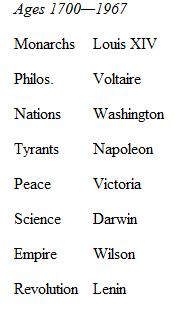
“Ages 1700-1967” — F. Scott Fitzgerald

From F. Scott Fitzgerald’s Notebooks.

Birdseed Anecdote — F. Scott Fitzgerald

Once there was a whole lot of bird seed around the room because an author had adopted a chicken. It was impossible to explain to anyone just why he had adopted the chicken but still more impossible to know why he had bought the bird seed for the chicken. The chicken was later broiled and the bird seed thrown out, but the question of whether the man was an author or a lunatic was still unsolved in the minds of the hotel servants who had to deal with the situation. The hotel servants didn’t understand it. They didn’t understand how months later the author could write a story about it but they all bought the magazine.

—F. Scott Fitzgerald, The Notebooks

F. Scott Fitzgerald’s “Dyed Siberian Horse” (And Twelve Other Descriptions of Things and Atmosphere)

More from F. Scott Fitzgerald’s magical Notebooks

143 Days of this February were white and magical, the nights were starry and crystalline. The town lay under a cold glory.

144 Dyed Siberian horse.

145 As thin as a repeated dream.

146 The sea was coming up in little intimidating rushes.

147 The island floated, a boat becalmed, upon the almost perceptible curve of the world.

148 Lost in the immensity of surfaceless blue sky like air piled on air.

151 On the great swell of the Blue Danube, the summer ball rocked into motion.

152 A circus ring for ponies in country houses.

153 The tense, sunny room seemed romantic to Becky, with its odor of esoteric gases, the faint perfumes of future knowledge, the low electric sizz in the glass cells.

154 A rambling frame structure that had been a residence in the 80’s, the country poorhouse in the 1900’s, and now was a residence again.

155 The groans of moribund plumbing.

156 The silvery “Hey!” of a telephone.

161 Whining, tinkling hoochie-coochie show.

“Seen in a Junk Yard” — F. Scott Fitzgerald

From F. Scott Fitzgerald’s Notebooks

Dogs, chickens with few claws, brass fittings, T’s elbow, rust everywhere, bales of metal 1800 lbs., plumbing fixtures, bathtubs, sinks, water pumps, wheels, Fordson tractor, Acetylene lamps for tractors, sewing machine, bell on dingy, box of bolts, No. 1 van, stove, auto stuff (No. 2), army trucks, cast iron, body hot dog stand, dinky engines, sprockets like watch parts, hinge all taken apart on building side, motorcycle radiators, George on the high army truck.

“List of Troubles” — F. Scott Fitzgerald

F. Scott Fitzgerald’s “List of Troubles” (from his Notebooks)—

 List of troubles

  • Heart burn
  • Eczema
  • Piles
  • Flu
  • Night sweats
  • Alcoholism
  • Infected Nose
  • Insomnia
  • Ruined Nerves
  • Chronic Cough
  • Aching teeth
  • Shortness of Breath
  • Falling Hair
  • Cramps in Feet
  • Tingling Feet
  • Constipation
  • Cirocis of the liver
  • Stomach ulcers
  • Depression and Melancholia

Enjoy Thanksgiving with Our Literary Recipes Roundup

Happy Thanksgiving! Enjoy Turkey Day with Biblioklept’s menu of literary recipes:

F. Scott Fitzgerald’s Turkey Twelve Ways

Zora Neale Hurston’s Mulatto Rice

Ian McEwan’s Fish Stew

James Joyce’s Burnt Kidney Breakfast

Herman Melville’s Whale Steaks

Ernest Heminway’s Absinthe Cocktail, Death in the Afternoon

Vladimir Nabokov’s Eggs à la Nabocoque

Thomas Pynchon’s Banana Breakfast

Cormac McCarthy’s Turtle Soup

Robert Crumb’s Macaroni Casserole

Christmas Bonus:  George Orwell’s Recipes for Plum Cake and Christmas Pudding

“Turkey Remains and How to Inter Them with Numerous Scarce Recipes” — A Thanksgiving Treat from F. Scott Fitzgerald

We celebrated Thanksgiving last year by offering up various literary recipes (don’t worry, we’re fond of leftovers, so we’ll be reheating those posts for second helpings). And even though we had a diverse range of meals on the menu, we didn’t come up with a turkey recipe.

Thankfully, F. Scott Fitzgerald shares some turkey tips in his Notebooks, and although he presents his recipes as a way to handle leftovers, it never hurts to plan ahead. Turkey thirteen ways—

TURKEY REMAINS AND HOW TO INTER THEM WITH NUMEROUS SCARCE RECIPES by F. Scott Fitzgerald
At this post holiday season the refrigerators of the nation are overstuffed with large masses of turkey, the sight of which is calculated to give an adult an attack of dizziness. It seems, therefore, an appropriate time to give the owners the benefit of my experience as an old gourmet, in using this surplus material. Some of the recipes have been in my family for generations. (This usually occurs when rigor mortis sets in.) They were collected over years, from old cook books, yellowed diaries of the Pilgrim Fathers, mail order catalogues, golfbags and trash cans. Not one but has been tried and proven—there are headstones all over America to testify to the fact.
Very well then: Here goes:

1. Turkey Cocktail
To one large turkey add one gallon of vermouth and a demijohn of angostura bitters. Shake.

2. Turkey at la Francais.
Take a large ripe turkey, prepare as for basting and stuff with old watches and chains and monkey meat. Proceed as with cottage-pudding.

3. Turkey and Water
Take one turkey and one pan of water. Heat the latter to the boiling point and then put in the refrigerator When it has jelled drown the turkey in it. Eat. In preparing this recipe it is best to have a few ham sandwiches around in case things go wrong.

4. Turkey Mongole
Take three butts of salami and a large turkey skeleton from which the feathers and natural stuffing have been removed. Lay them out on the table and call up some Mongole in the neighborhood to tell you how to proceed from there.

5. Turkey Mousee
Seed a large prone turkey, being careful to remove the bones, flesh, fins, gravy, etc. Blow up with a bicycle pump. Mount in becoming style and hang in the front hall.

6. Stolen Turkey
Walk quickly from the market and if accosted remark with a laugh that it had just flown into your arms and you hadn’t noticed it. Then drop the turkey with the white of one egg-well, anyhow, beat it.

7. Turkey a la Creme.
Prepare the creme a day in advance, or even a year in advance. Deluge the turkey with it and cook for six days over a blast furnace. Wrap in fly paper and serve.

8. Turkey Hash
This is the delight of all connoisseurs of the holiday beast, but few understand how really to prepare it. Like a lobster it must be plunged alive into boiling water, until it becomes bright red or purple or something, and then before the color fades, placed quickly in a washing machine and allowed to stew in its own gore as it is whirled around.
Only then is it ready for hash. To hash, take a large sharp tool like a nail-file or if none is handy, a bayonet will serve the purpose—and then get at it! Hash it well! Bind the remains with dental floss and serve.
And now we come to the true aristocrat of turkey dishes:

9. Feathered Turkey.
To prepare this a turkey is necessary and a one pounder cannon to compell anyone to eat it. Broil the feathers and stuff with sage brush, old clothes, almost anything you can dig up. Then sit down and simmer. The feathers are to be eaten like artichokes (and this is not to be confused with the old Roman custom of tickling the throat).

10. Turkey at la Maryland
Take a plump turkey to a barber’s and have him shaved, or if a female bird, given a facial and a water wave. Then before killing him stuff with with old newspapers and put him to roost. He can then be served hot or raw, usually with a thick gravy of mineral oil and rubbing alcohol. (Note: This recipe was given me by an old black mammy.)

11. Turkey Remnant
This is one of the most useful recipes for, though not, “chic”, it tells what to do with the turkey after the holiday, and extract the most value from it.
Take the remants, or if they have been consumed, take the various plates on which the turkey or its parts have rested and stew them for two hours in milk of magnesia. Stuff with moth-balls.

12. Turkey with Whiskey Sauce.
This recipe is for a party of four. Obtain a gallon of whiskey, and allow it to age for several hours. Then serve, allowing one quart for each guest.
The next day the turkey should be added, little by little, constantly stirring and basting.

13. For Weddings or Funerals. Obtain a gross of small white boxes such as are used for bride’s cake. Cut the turkey into small squares, roast, stuff, kill, boil, bake and allow to skewer. Now we are ready to begin. Fill each box with a quantity of soup stock and pile in a handy place. As the liquid elapses, the prepared turkey is added until the guests arrive. The boxes delicately tied with white ribbons are then placed in the handbags of the ladies, or in the men’s side pockets.

There I guess that’s enough turkey to talk. I hope I’ll never see or hear of another until—well, until next year.