Because he needed the money Peterson answered an ad that said “We’ll pay you to be on TV if your opinions are strong enough or your personal experiences have a flavor of unusual.” He called the number and was told to come to Room 1551 in the Graybar Building on Lexington. This he did and after spending twenty minutes with a Miss Arbor who asked him if he had ever been in analysis was okeyed for a program called Who Am I? “What do you have strong opinions about?” Miss Arbor asked. “Art,” Peterson said, “life, money.” “For instance?” “I believe,” Peterson said, “that the learning ability of mice can be lowered or increased by regulating the amount of serotonin in the brain. I believe that schizophrenics have a high incidence of unusual fingerprints, including lines that make almost complete circles. I believe that the dreamer watches his dream in sleep, by moving his eyes.” “That’s very interesting!” Miss Arbor cried. “It’s all in the World Almanac,” Peterson replied.
“I see you’re a sculptor,” Miss Arbor said, “that’s wonderful.” “What is the nature of the program?” Peterson asked. “I’ve never seen it.” “Let me answer your question with another question,” Miss Arbor said. “Mr. Peterson, are you absurd?” Her enormous lips were smeared with a glowing white cream. “I beg your pardon?” “I mean,” Miss Arbor said earnestly, do you encounter your existence as gratuitous? Do you feel de trop? Is there nausea?” “I have enlarged liver,” Peterson offered. “That’s excellent!” Miss Arbor exclaimed. “That’s a very good beginning. Who Am I? tries, Mr. Peterson, to discover what people really are. People today, we feel, are hidden away inside themselves, alienated, desperate, living in anguish, despair and bad faith. Why have we been thrown here, and abandoned? That’s the question we try to answer, Mr. Peterson. Man stands alone in a featureless, anonymous landscape, in fear and trembling and sickness unto death. God is dead. Nothingness everywhere. Dread. Estrangement. Finitude. Who Am I? approaches these problems in a root radical way.” “On television?” “We’re interested in basics, Mr. Peterson. We don’t play around.” “I see,” Peterson said, wondering about the amount of the fee. “What I wanted to know now, Mr. Peterson, is this: are you interested in absurdity?” “Miss Arbor,” he said, “to tell you the truth, I don’t know. I’m not sure I believe in it.” “Oh, Mr. Peterson!” Miss Arbor said, shocked. “Don’t say that! You’ll be …” “Punished?” Peterson suggested. “You may not be interested in absurdity,” she said, “but absurdity is interested in you.” “I have a lot of problems, if that helps,” Peterson said. “Existence is problematic for you,” Miss Arbor said, relieved. “The fee is two hundred dollars.”
Don’t tell me that it wasn’t a knocker. I had seen it often enough, and I ought to know. So ought the three-o’clock beer, in dirty high-lows, swinging himself over the railing, or executing a demoniacal jig upon the doorstep; so ought the butcher, although butchers as a general thing are scornful of such trifles; so ought the postman, to whom knockers of the most extravagant description were merely human weaknesses, that were to be pitied and used. And so ought for the matter of that, etc., etc., etc.
But then it was such a knocker. A wild, extravagant, and utterly incomprehensible knocker. A knocker so mysterious and suspicious that policeman X 37, first coming upon it, felt inclined to take it instantly in custody, but compromised with his professional instincts by sharply and sternly noting it with an eye that admitted of no nonsense, but confidently expected to detect its secret yet. An ugly knocker; a knocker with a hard human face, that was a type of the harder human face within. A human face that held between its teeth a brazen rod. So hereafter, in the mysterious future should be held, etc., etc. Continue reading ““‘The Haunted Man’ by Ch_r__s D_i_ck_n_s: A Christmas Story” — Bret Harte”→
In the summer of 1874 I was in Liverpool, whither I had gone on business for the mercantile house of Bronson & Jarrett, New York. I am William Jarrett; my partner was Zenas Bronson. The firm failed last year, and unable to endure the fall from affluence to poverty he died.
Having finished my business, and feeling the lassitude and exhaustion incident to its dispatch, I felt that a protracted sea voyage would be both agreeable and beneficial, so instead of embarking for my return on one of the many fine passenger steamers I booked for New York on the sailing vessel Morrow, upon which I had shipped a large and valuable invoice of the goods I had bought. The Morrow was an English ship with, of course, but little accommodation for passengers, of whom there were only myself, a young woman and her servant, who was a middle-aged negress. I thought it singular that a traveling English girl should be so attended, but she afterward explained to me that the woman had been left with her family by a man and his wife from South Carolina, both of whom had died on the same day at the house of the young lady’s father in Devonshire – a circumstance in itself sufficiently uncommon to remain rather distinctly in my memory, even had it not afterward transpired in conversation with the young lady that the name of the man was William Jarrett, the same as my own. I knew that a branch of my family had settled in South Carolina, but of them and their history I was ignorant. Continue reading ““A Psychological Shipwreck,” a story by Ambrose Bierce”→
MASHENKA PAVLETSKY, a young girl who had only just finished her studies at a boarding school, returning from a walk to the house of the Kushkins, with whom she was living as a governess, found the household in a terrible turmoil. Mihailo, the porter who opened the door to her, was excited and red as a crab.
Loud voices were heard from upstairs.
“Madame Kushkin is in a fit, most likely, or else she has quarrelled with her husband,” thought Mashenka.
In the hall and in the corridor she met maid-servants. One of them was crying. Then Mashenka saw, running out of her room, the master of the house himself, Nikolay Sergeitch, a little man with a flabby face and a bald head, though he was not old. He was red in the face and twitching all over. He passed the governess without noticing her, and throwing up his arms, exclaimed:
“Oh, how horrible it is! How tactless! How stupid! How barbarous! Abominable!”
On the evening of Thanksgiving day, John Inglefield, the blacksmith, sat in his elbow-chair, among those who had been keeping festival at his board. Being the central figure of the domestic circle, the fire threw its strongest light on his massive and sturdy frame, reddening his rough visage, so that it looked like the head of an iron statue, all aglow, from his own forge, and with its features rudely fashioned on his own anvil. At John Inglefield’s right hand was an empty chair. The other places round the hearth were filled by the members of the family, who all sat quietly, while, with a semblance of fantastic merriment, their shadows danced on the wall behind then. One of the group was John Inglefield’s son, who had been bred at college, and was now a student of theology at Andover. There was also a daughter of sixteen, whom nobody could look at without thinking of a rosebud almost blossomed. The only other person at the fireside was Robert Moore, formerly an apprentice of the blacksmith, but now his journeyman, and who seemed more like an own son of John Inglefield than did the pale and slender student.
Only these four had kept New England’s festival beneath that roof. The vacant chair at John Inglefield’s right hand was in memory of his wife, whom death had snatched from him since the previous Thanksgiving. With a feeling that few would have looked for in his rough nature, the bereaved husband had himself set the chair in its place next his own; and often did his eye glance thitherward, as if he deemed it possible that the cold grave might send back its tenant to the cheerful fireside, at least for that one evening. Thus did he cherish the grief that was dear to him. But there was another grief which he would fain have torn from his heart; or, since that could never be, have buried it too deep for others to behold, or for his own remembrance. Within the past year another member of his household had gone from him, but not to the grave. Yet they kept no vacant chair for her.
While John Inglefield and his family were sitting round the hearth with the shadows dancing behind them on the wall, the outer door was opened, and a light footstep came along the passage. The latch of the inner door was lifted by some familiar hand, and a young girl came in, wearing a cloak and hood, which she took off, and laid on the table beneath the looking-glass. Then, after gazing a moment at the fireside circle, she approached, and took the seat at John Inglefield’s right hand, as if it had been reserved on purpose for her. Continue reading “Read “John Inglefield’s Thanksgiving,” a short story by Nathaniel Hawthorne”→
There was a sad heart in the low-storied, dark little house that stood humbly by the roadside under some tall elms. Small as her house was, old Mrs. Robb found it too large for herself alone; she only needed the kitchen and a tiny bedroom that led out of it, and there still remained the best room and a bedroom, with the low garret overhead.
There had been a time, after she was left alone, when Mrs. Robb could help those who were poorer than herself. She was strong enough not only to do a woman’s work inside her house, but almost a man’s work outside in her piece of garden ground. At last sickness and age had come hand in hand, those two relentless enemies of the poor, and together they had wasted her strength and substance. She had always been looked up to by her neighbors as being independent, but now she was left, lame-footed and lame-handed, with a debt to carry and her bare land, and the house ill-provisioned to stand the siege of time.
For a while she managed to get on, but at last it began to be whispered about that there was no use for any one so proud; it was easier for the whole town to care for her than for a few neighbors, and Mrs. Robb had better go to the poorhouse before winter, and be done with it. At this terrible suggestion her brave heart seemed to stand still. The people whom she cared for most happened to be poor, and she could no longer go into their households to make herself of use. The very elms overhead seemed to say, “Oh, no!” as they groaned in the late autumn winds, and there was something appealing even to the strange passer-by in the look of the little gray house, with Mrs. Robb’s pale, worried face at the window. Continue reading ““The Night Before Thanksgiving” — Sarah Orne Jewett”→
He was very restless. He does not like to stand while he picks flowers. He does not smell flowers. He has a reasonable liking for herbs. He likes their smell. He is not able to see storms. He can see anything running. He has been able to be praised.
SCENE I.
Polybe and seats.
Straw seats which are so well made that they resemble stools. They are all of straw and thick. They are made with two handles.
Genevieve and cotton.
I do not like cotton drawers. I prefer wool or linen. I admit that linen is damp. Wool is warm. I believe I prefer wool.
Minorca and dogs.
I like a dog which is easily understood as I have never had the habit of going out except on Sunday. Now I go out every day.
Anthony and coal.
I believe that coal is better than wood. If coal is good it burns longer. In any case it is very difficult to get here.
Felix and a letter.
I do not wish to reply to a telegram, not because I find it difficult to explain in it that I wished to see you. I did wish to see you.
Mr. Clement.
It gives me great pleasure to meet you. I am feeling well today and I see that you are enjoying the mild weather. It will continue so. I hope you will be pleased. I will present myself to you in saying that I am certain that you are deriving pleasure from your winter. I am certainly eager.
Illustration to Wells’s “The Star” by Ludek Marold
“The Star”
by
H.G. Wells
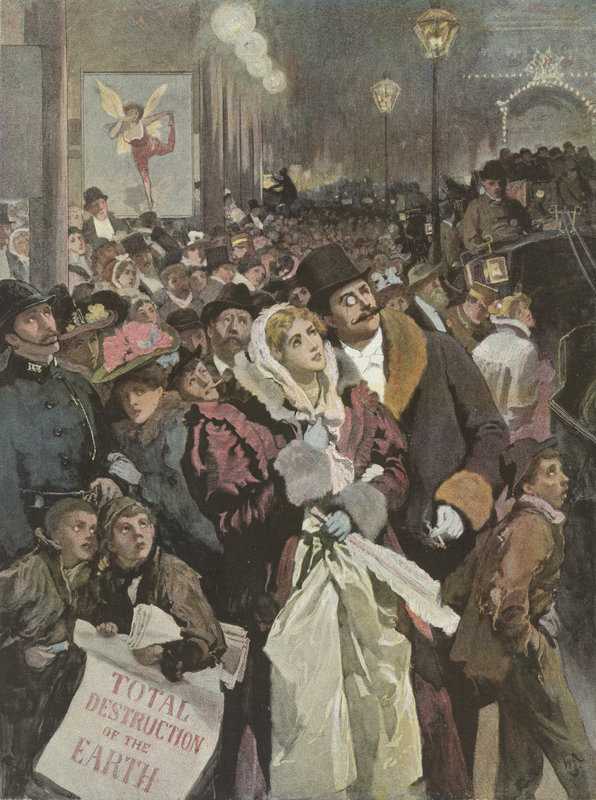
It was on the first day of the New Year that the announcement was made, almost simultaneously from three observatories, that the motion of the planet Neptune, the outermost of all the planets that wheel about the sun, had become very erratic. Ogilvy had already called attention to a suspected retardation in its velocity in December. Such a piece of news was scarcely calculated to interest a world the greater portion of whose inhabitants were unaware of the existence of the planet Neptune, nor outside the astronomical profession did the subsequent discovery of a faint remote speck of light in the region of the perturbed planet cause any very great excitement. Scientific people, however, found the intelligence remarkable enough, even before it became known that the new body was rapidly growing larger and brighter, that its motion was quite different from the orderly progress of the planets, and that the deflection of Neptune and its satellite was becoming now of an unprecedented kind.
Few people without a training in science can realise the huge isolation of the solar system. The sun with its specks of planets, its dust of planetoids, and its impalpable comets, swims in a vacant immensity that almost defeats the imagination. Beyond the orbit of Neptune there is space, vacant so far as human observation has penetrated, without warmth or light or sound, blank emptiness, for twenty million times a million miles. That is the smallest estimate of the distance to be traversed before the very nearest of the stars is attained. And, saving a few comets more unsubstantial than the thinnest flame, no matter had ever to human knowledge crossed this gulf of space, until early in the twentieth century this strange wanderer appeared. A vast mass of matter it was, bulky, heavy, rushing without warning out of the black mystery of the sky into the radiance of the sun. By the second day it was clearly visible to any decent instrument, as a speck with a barely sensible diameter, in the constellation Leo near Regulus. In a little while an opera glass could attain it.
On the third day of the new year the newspaper readers of two hemispheres were made aware for the first time of the real importance of this unusual apparition in the heavens. “A Planetary Collision,” one London paper headed the news, and proclaimed Duchaine’s opinion that this strange new planet would probably collide with Neptune. The leader writers enlarged upon the topic; so that in most of the capitals of the world, on January 3rd, there was an expectation, however vague of some imminent phenomenon in the sky; and as the night followed the sunset round the globe, thousands of men turned their eyes skyward to see–the old familiar stars just as they had always been. Continue reading ““The Star” — H.G. Wells”→
The night was hot and overcast, the sky red, rimmed with the lingering sunset of mid-summer. They sat at the open window, trying to fancy the air was fresher there. The trees and shrubs of the garden stood stiff and dark; beyond in the roadway a gas-lamp burnt, bright orange against the hazy blue of the evening. Farther were the three lights of the railway signal against the lowering sky. The man and woman spoke to one another in low tones.
“He does not suspect?” said the man, a little nervously.
“Not he,” she said peevishly, as though that too irritated her. “He thinks of nothing but the works and the prices of fuel. He has no imagination, no poetry.”
“None of these men of iron have,” he said sententiously.
“They have no hearts.”
“He has not,” she said. She turned her discontented face towards the window. The distant sound of a roaring and rushing drew nearer and grew in volume; the house quivered; one heard the metallic rattle of the tender. As the train passed, there was a glare of light above the cutting and a driving tumult of smoke; one, two, three, four, five, six, seven, eight black oblongs—eight trucks—passed across the dim grey of the embankment, and were suddenly extinguished one by one in the throat of the tunnel, which, with the last, seemed to swallow down train, smoke, and sound in one abrupt gulp. Continue reading ““The Cone” — H.G. Wells”→
There are two tortoises on the patio: a male and a female. Zlack! Zlack! Their shells strike each other. It is their mating season.
The male pushes the female sideways, all around the edge of the paving. The female seems to resist his attack, or at least she opposes it with inert immobility. The male is smaller and more active; he seems younger. He tries repeatedly to mount her, from behind, but the back of her shell is steep and he slides off.
Now he must have succeeded in achieving the right position: he thrusts with rhythmic, cadenced strokes; at every thrust he emits a kind of gasp, almost a cry. The female has her foreclaws flattened against the ground, enabling her to raise her hind part. The male scratches with his foreclaws on her shell, his neck stuck out, his mouth gaping. The problem with these shells is that there’s no way To get a hold; in fact, the claws can find no purchase.
Now she escapes him; he pursues her. Not that she is faster or particularly determined to run away: to restrain her he gives her some little nips on a leg, always the same one. She does not rebel. Every time she stops, the male tries to mount her; but she takes a little step forward and he topples off, slamming his member on the ground. This member is fairly long, hooked in a way that apparently makes it possible for him to reach her even though the thickness of the shells and their awkward positioning separates them. So there is no telling how many of these attacks achieve their purpose or how many fair, or how many are theater, play-acting.
It is summer; the patio is bare, except for one green jasmine in a corner. The courtship consists of making so many turns around the little patch of grass, with pursuits and flights and skirmishing not of the claws but of the shells, which strike in a dull clicking. The female tries to find refuge among the stalks of the jasmine; she believes—or wants to make others believe—that she does this to hide; but actually this is the surest way to remain blocked by the male, held immobile with no avenue of escape. Now he has most likely managed to introduce his member properly; but this time they are both completely still, silent.
The sensations of the pair of mating tortoises are something Mr. Palomar cannot imagine. He observes them with a cold attention, as if they were two machines: two electronic tortoises programmed to mate. What does eros become if there are plates of bone or horny scales in the place of skin? But what we call eros—is it perhaps only a program of our corporeal bodies, more complicated because the memory receives messages from every cell of the skin, from every molecule of our tissues, and multiplies them and combines them with the impulses transmitted by our eyesight and with those aroused by the imagination? The difference lies only in the number of circuits involved: from our receptions billions of wires extend, linked with the computer of feelings, conditionings, the ties between one person and another. . . . Eros is a program that unfolds in the electronic clusters of the mind, but the mind is also skin: skin touched, seen, remembered. And what about the tortoises, enclosed in their insensitive casing? The poverty of their sensorial stimuli perhaps drives them to a concentrated, intense mental life, leads them to a crystalline inner awareness. . . . Perhaps the eros of tortoises obeys absolute spiritual laws, whereas we are prisoners of a machinery whose functioning remains unknown to us, prone to clogging up, stalling, exploding in uncontrolled automatisms. . . .
Do the tortoises understand themselves any better? After about ten minutes of mating, the two shells separate. She ahead, he behind, they resume their circling of the grass. Now the male remains more distanced; every now and then he scratches his claw against her shell, he climbs on her for a little, but without much conviction. They go back under the jasmine. He gives her a nip or two on a leg, always in the same place.
Illustration for Poe’s “The Sphinx,” Fritz Eichenberg
“The Sphinx”
by
Edgar Allan Poe
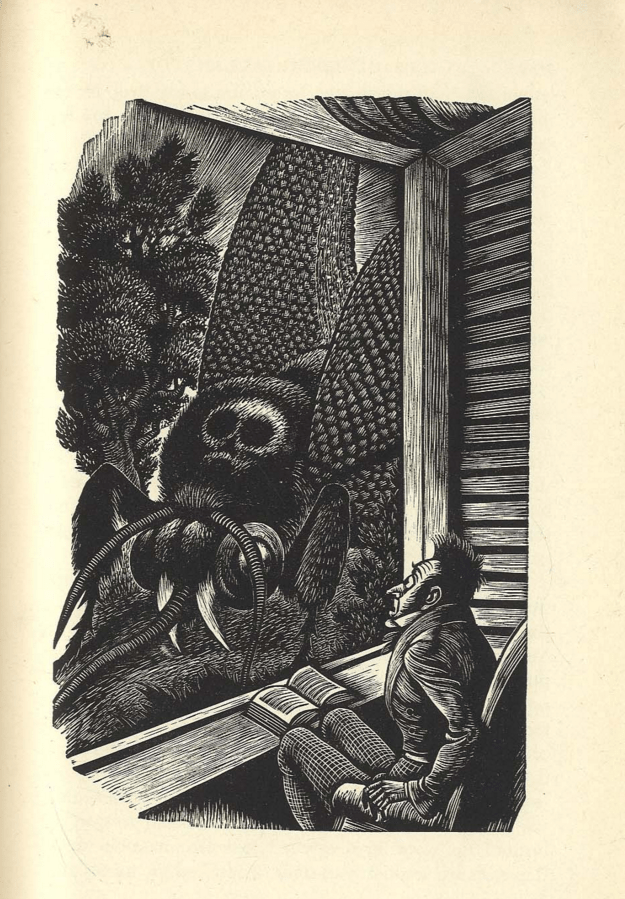
DURING the dread reign of the Cholera in New York, I had accepted the invitation of a relative to spend a fortnight with him in the retirement of his cottage ornee on the banks of the Hudson. We had here around us all the ordinary means of summer amusement; and what with rambling in the woods, sketching, boating, fishing, bathing, music, and books, we should have passed the time pleasantly enough, but for the fearful intelligence which reached us every morning from the populous city. Not a day elapsed which did not bring us news of the decease of some acquaintance. Then as the fatality increased, we learned to expect daily the loss of some friend. At length we trembled at the approach of every messenger. The very air from the South seemed to us redolent with death. That palsying thought, indeed, took entire possession of my soul. I could neither speak, think, nor dream of any thing else. My host was of a less excitable temperament, and, although greatly depressed in spirits, exerted himself to sustain my own. His richly philosophical intellect was not at any time affected by unrealities. To the substances of terror he was sufficiently alive, but of its shadows he had no apprehension.
His endeavors to arouse me from the condition of abnormal gloom into which I had fallen, were frustrated, in great measure, by certain volumes which I had found in his library. These were of a character to force into germination whatever seeds of hereditary superstition lay latent in my bosom. I had been reading these books without his knowledge, and thus he was often at a loss to account for the forcible impressions which had been made upon my fancy.
A favorite topic with me was the popular belief in omens—a belief which, at this one epoch of my life, I was almost seriously disposed to defend. On this subject we had long and animated discussions—he maintaining the utter groundlessness of faith in such matters,—I contending that a popular sentiment arising with absolute spontaneity- that is to say, without apparent traces of suggestion—had in itself the unmistakable elements of truth, and was entitled to as much respect as that intuition which is the idiosyncrasy of the individual man of genius.
The fact is, that soon after my arrival at the cottage there had occurred to myself an incident so entirely inexplicable, and which had in it so much of the portentous character, that I might well have been excused for regarding it as an omen. It appalled, and at the same time so confounded and bewildered me, that many days elapsed before I could make up my mind to communicate the circumstances to my friend. Continue reading ““The Sphinx” — Edgar Allan Poe”→
Illustration for “The Flowering of the Strange Orchid,” Tatsuya Morino
“The Flowering of the Strange Orchid”
by
H.G. Wells
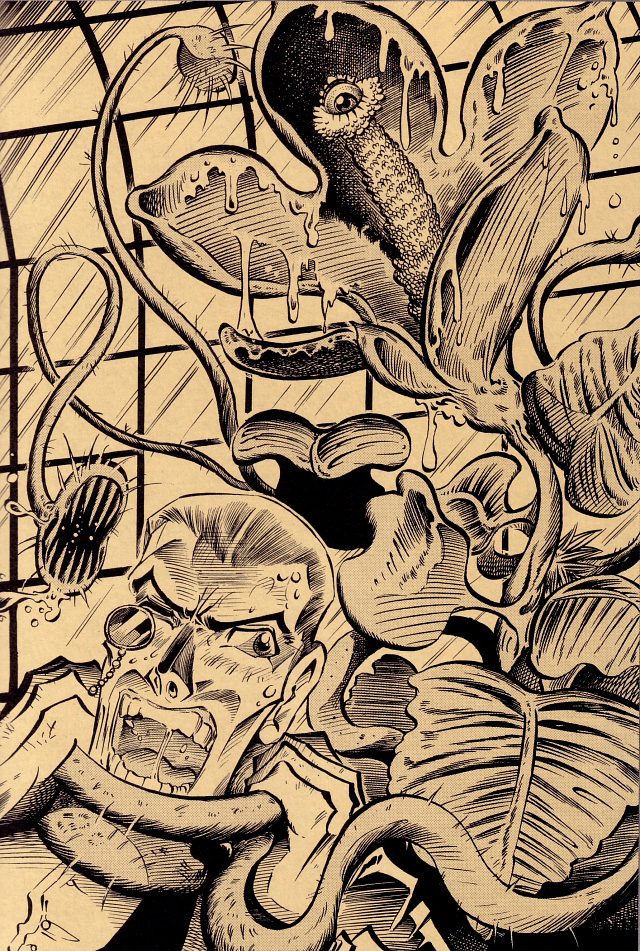
The buying of orchids always has in it a certain speculative flavour. You have before you the brown shrivelled lump of tissue, and for the rest you must trust your judgment, or the auctioneer, or your good-luck, as your taste may incline. The plant may be moribund or dead, or it may be just a respectable purchase, fair value for your money, or perhaps – for the thing has happened again and again – there slowly unfolds before the delighted eyes of the happy purchaser, day after day, some new variety, some novel richness, a strange twist of the labellum, or some subtler coloration or unexpected mimicry.
Pride, beauty, and profit blossom together on one delicate green spike, and it may be, even immortality. For the new miracle of Nature may stand in need of a new specific name, and what so convenient as that of its discoverer? “Johnsmithia!” There have been worse names.
It was perhaps the hope of some such happy discovery that made Winter-Wedderburn such a frequent attendant at these sales – that hope, and also, maybe, the fact that he had nothing else of the slightest interest to do in the world. He was a shy, lonely, rather ineffectual man, provided with just enough income to keep off the spur of necessity, and not enough nervous energy to make him seek any exacting employments. He might have collected stamps or coins, or translated Horace, or bound books, or invented new species of diatoms. But, as it happened, he grew orchids, and had one ambitious little hothouse. Continue reading ““The Flowering of the Strange Orchid” — H.G. Wells”→
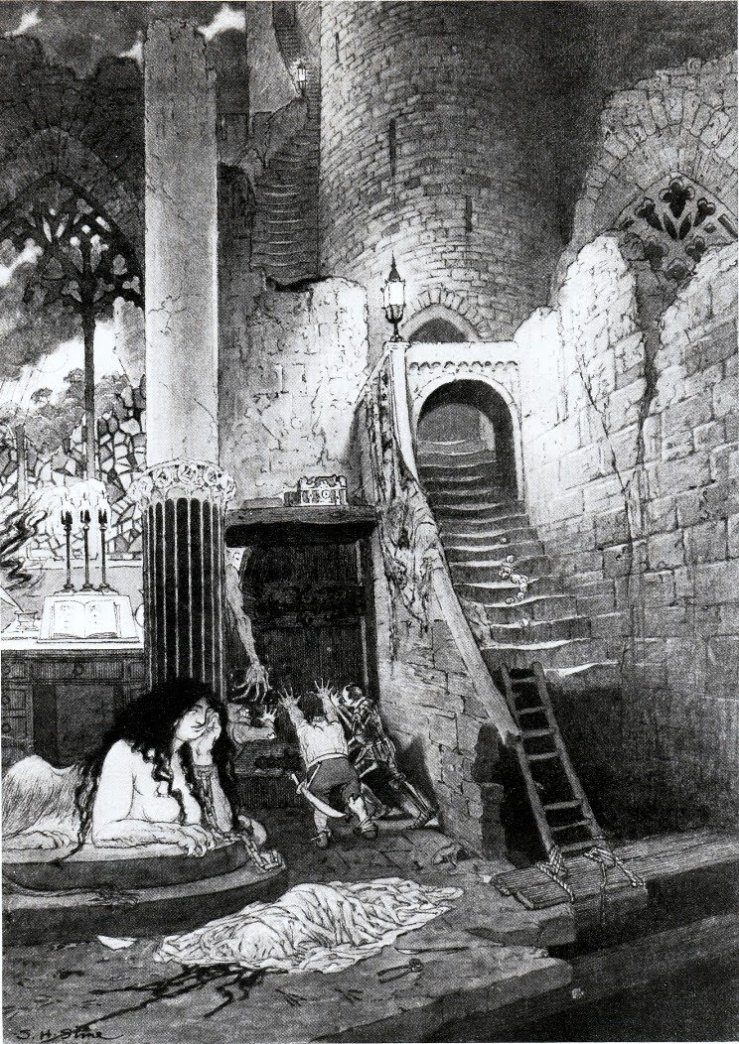
“The House of the Sphinx” illustration by Sidney Sime
“The House of the Sphinx”
by
Lord Dunsany
When I came to the House of the Sphinx it was already dark. They made me eagerly welcome. And I, in spite of the deed, was glad of any shelter from that ominous wood. I saw at once that there had been a deed, although a cloak did all that a cloak may do to conceal it. The mere uneasiness of the welcome made me suspect that cloak.
The Sphinx was moody and silent. I had not come to pry into the secrets of Eternity nor to investigate the Sphinx’s private life, and so had little to say and few questions to ask; but to whatever I did say she remained morosely indifferent. It was clear that either she suspected me of being in search of the secrets of one of her gods, or of being boldly inquisitive about her traffic with Time, or else she was darkly absorbed with brooding upon the deed.
I saw soon enough that there was another than me to welcome; I saw it from the hurried way that they glanced from the door to the deed and back to the door again. And it was clear that the welcome was to be a bolted door. But such bolts, and such a door! Rust and decay and fungus had been there far too long, and it was not a barrier any longer that would keep out even a determined wolf. And it seemed to be something worse than a wolf that they feared.
A little later on I gathered from what they said that some imperious and ghastly thing was looking for the Sphinx, and that something that had happened had made its arrival certain. It appeared that they had slapped the Sphinx to vex her out of her apathy in order that she should pray to one of her gods, whom she had littered in the house of Time; but her moody silence was invincible, and her apathy Oriental, ever since the deed had happened. And when they found that they could not make her pray, there was nothing for them to do but to pay little useless attentions to the rusty lock of the door, and to look at the deed and wonder, and even pretend to hope, and to say that after all it might not bring that destined thing from the forest, which no one named.
It may be said I had chosen a gruesome house, but not if I had described the forest from which I came, and I was in need of any spot wherein I could rest my mind from the thought of it.
I wondered very much what thing would come from the forest on account of the deed; and having seen that forest—as you, gentle reader, have not—I had the advantage of knowing that anything might come. It was useless to ask the Sphinx—she seldom reveals things, like her paramour Time (the gods take after her), and while this mood was on her, rebuff was certain. So I quietly began to oil the lock of the door. And as soon as they saw this simple act I won their confidence. It was not that my work was of any use—it should have been done long before; but they saw that my interest was given for the moment to the thing that they thought vital. They clustered round me then. They asked me what I thought of the door, and whether I had seen better, and whether I had seen worse; and I told them about all the doors I knew, and said that the doors of the baptistry in Florence were better doors, and the doors made by a certain firm of builders in London were worse. And then I asked them what it was that was coming after the Sphinx because of the deed. And at first they would not say, and I stopped oiling the door; and then they said that it was the arch-inquisitor of the forest, who is investigator and avenger of all silverstrian things; and from all that they said about him it seemed to me that this person was quite white, and was a kind of madness that would settle down quite blankly upon a place, a kind of mist in which reason could not live; and it was the fear of this that made them fumble nervously at the lock of that rotten door; but with the Sphinx it was not so much fear as sheer prophecy.
The hope that they tried to hope was well enough in its way, but I did not share it; it was clear that the thing that they feared was the corollary of the deed—one saw that more by the resignation upon the face of the Sphinx than by their sorry anxiety for the door.
The wind soughed, and the great tapers flared, and their obvious fear and the silence of the Sphinx grew more than ever a part of the atmosphere, and bats went restlessly through the gloom of the wind that beat the tapers low.
Then a few things screamed far off, then a little nearer, and something was coming towards us, laughing hideously. I hastily gave a prod to the door that they guarded; my finger sank right into the mouldering wood—there was not a chance of holding it. I had not leisure to observe their fright; I thought of the back-door, for the forest was better than this; only the Sphinx was absolutely calm, her prophecy was made and she seemed to have seen her doom, so that no new thing could perturb her.
But by mouldering rungs of ladders as old as Man, by slippery edges of the dreaded abyss, with an ominous dizziness about my heart and a feeling of horror in the soles of my feet, I clambered from tower to tower till I found the door that I sought; and it opened on to one of the upper branches of a huge and sombre pine, down which I climbed on to the floor of the forest. And I was glad to be back again in the forest from which I had fled.
And the Sphinx in her menaced house—I know not how she fared—whether she gazes for ever, disconsolate, at the deed, remembering only in her smitten mind, at which the little boys now leer, that she once knew well those things at which man stands aghast; or whether in the end she crept away, and clambering horribly from abyss to abyss, came at last to higher things, and is wise and eternal still. For who knows of madness whether it is divine or whether it be of the pit?
Illustration for E.T.A. Hoffmann’s “The Sandman” — Mario Laboccetta
“The Sandman”
by
E.T.A. Hoffmann
English translation by John Oxenford
NATHANIEL TO LOTHAIRE.
Certainly you must all be uneasy that I have not written for so long—so very long. My mother, I am sure, is angry, and Clara will believe that I am passing my time in dissipation, entirely forgetful of the fair angel-image that is so deeply imprinted in my heart and mind. Such, however, is not the case. Daily and hourly I think of you all, and in my sweet dreams the kindly form of my lovely Clara passes before me, and smiles upon me with her bright eyes as she was wont when I appeared among you. Alas, how could I write to you in the distracted mood which has hitherto disturbed my every thought! Something horrible has crossed my path of life. Dark forebodings of a cruel, threatening, fate spread themselves over me like dark clouds, which no friendly sunbeam can penetrate. Now will I tell you what has befallen me. I must do so, that I plainly see—but if I only think of it, it will laugh out of me like mad. Ah, my dear Lothaire, how shall I begin it? How shall I make you in any way sensible that that which occurred to me a few days ago could really have such a fatal effect on my life? If you were here you could see for yourself, but now you will certainly take me for a crazy ghost-seer. In a word, the horrible thing which happened to me, and the painful impression of which I in vain endeavour to escape, is nothing more than this; that some days ago, namely on the 30th of October, at twelve o’clock at noon, a barometer-dealer came into my room and offered me his wares. I bought nothing, and threatened to throw him down stairs, upon which he took himself off of his own accord.
You suspect that only relations of the most peculiar kind, and exerting the greatest influence over my life can give any import to this occurrence, nay, that the person of that unlucky dealer must have a hostile effect upon me. So it is, indeed. I collect myself with all my might, that patiently and quietly I may tell you so much of my early youth as will bring all plainly and clearly in bright images before your active mind. As I am about to begin I fancy that I hear you laughing and Clara saying: “Childish stories indeed!” Laugh at me I beseech you, laugh with all your heart. But, heavens, my hair stands on end, and it seems as if I am asking you to laugh at me, in mad despair, as Franz Moor asked Daniel.But to my story.
Excepting at dinner time I and my brothers and sisters saw my father very little during the day. He was, perhaps, busily engaged at his ordinary occupation. After supper, which, according to the old custom was served up at seven o’clock, we all went with my mother into my father’s work-room, and seated ourselves at the round table. My father smoked tobacco and drank a large glass of beer. Often he told us a number of wonderful stories, and grew so warm over them that his pipe continually went out. I had to light it again, with burning paper, which I thought great sport. Often, too, he would give us picture-books, and sit in his arm-chair silent and thoughtful, puffing out such thick clouds of smoke that we all seemed to be swimming in the clouds. On such evenings as these my mother was very melancholy, and immediately the clock struck nine, she would say: “Now children, to bed—to bed! The Sandman is coming, I can see.” And certainly on all these occasions I heard something with a heavy, slow step go bouncing up the stairs. That I thought must be the Sandman. Once that dull noise and footstep were particularly fearful, and I asked my mother, while she took us away: “Eh, mamma, who is this naughty Sandman, who always drives us away from papa? What does he look like?” “There is no Sandman, dear child,” replied my mother. “When I say the Sandman comes, I only mean that you are sleepy and cannot keep your eyes open,—just as if sand had been sprinkled into them.” This answer of my mother’s did not satisfy me—nay, in my childish mind the thought soon matured itself that she only denied the existence of the Sandman to hinder us from being terrified at him. Certainly I always heard him coming up the stairs. Full of curiosity to hear more of this Sandman, and his particular connection with children, I at last asked the old woman who tended my youngest sister what sort of man he was. “Eh, Natty,” said she, “do you not know that yet? He is a wicked man, who comes to children when they will not go to bed, and throws a handful of sand into their eyes, so that they start out bleeding from their heads. These eyes he puts in a bag and carries them to the half-moon to feed his own children, who sit in the nest up yonder, and have crooked beaks like owls with which they may pick up the eyes of the naughty human children.” Continue reading ““The Sandman” — E.T.A. Hoffmann”→
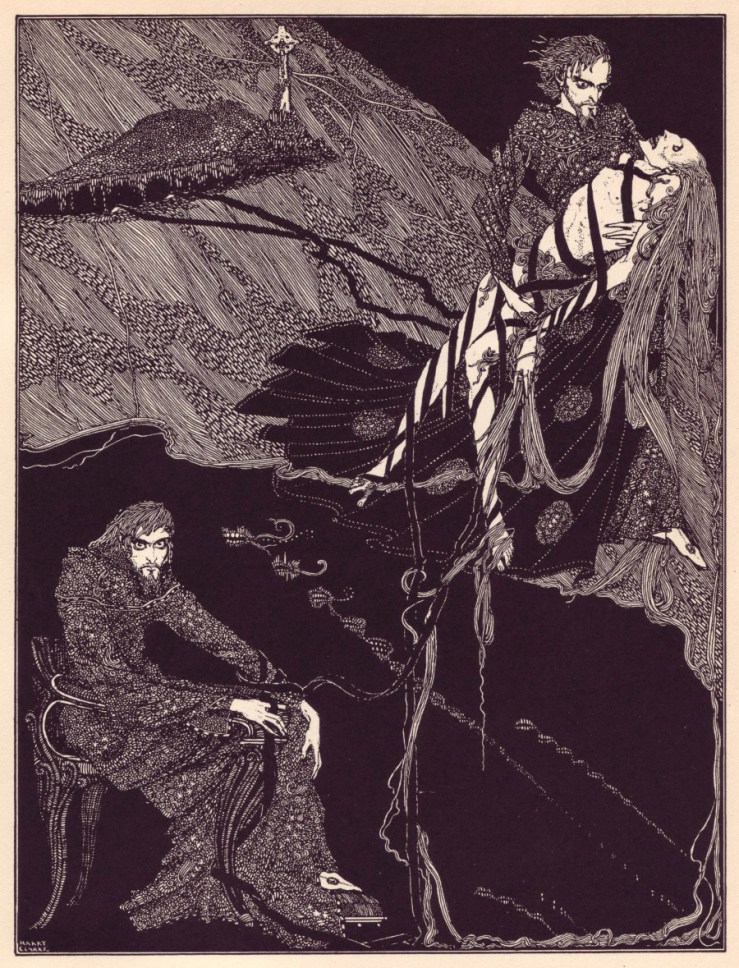
MISERY is manifold. The wretchedness of earth is multiform. Overreaching the wide horizon as the rainbow, its hues are as various as the hues of that arch—as distinct too, yet as intimately blended. Overreaching the wide horizon as the rainbow! How is it that from beauty I have derived a type of unloveliness?—from the covenant of peace, a simile of sorrow? But as, in ethics, evil is a consequence of good, so, in fact, out of joy is sorrow born. Either the memory of past bliss is the anguish of to-day, or the agonies whichare, have their origin in the ecstasies which might have been.
My baptismal name is Egaeus; that of my family I will not mention. Yet there are no towers in the land more time-honored than my gloomy, gray, hereditary halls. Our line has been called a race of visionaries; and in many striking particulars—in the character of the family mansion—in the frescos of the chief saloon—in the tapestries of the dormitories—in the chiselling of some buttresses in the armory—but more especially in the gallery of antique paintings—in the fashion of the library chamber—and, lastly, in the very peculiar nature of the library’s contents—there is more than sufficient evidence to warrant the belief.
The recollections of my earliest years are connected with that chamber, and with its volumes—of which latter I will say no more. Here died my mother. Herein was I born. But it is mere idleness to say that I had not lived before—that the soul has no previous existence. You deny it?—let us not argue the matter. Convinced myself, I seek not to convince. There is, however, a remembrance of aerial forms—of spiritual and meaning eyes—of sounds, musical yet sad—a remembrance which will not be excluded; a memory like a shadow—vague, variable, indefinite, unsteady; and like a shadow, too, in the impossibility of my getting rid of it while the sunlight of my reason shall exist.
In that chamber was I born. Thus awaking from the long night of what seemed, but was not, nonentity, at once into the very regions of fairy land—into a palace of imagination—into the wild dominions of monastic thought and erudition—it is not singular that I gazed around me with a startled and ardent eye—that I loitered away my boyhood in books, and dissipated my youth in reverie; but it is singular that as years rolled away, and the noon of manhood found me still in the mansion of my fathers—it is wonderful what stagnation there fell upon the springs of my life—wonderful how total an inversion took place in the character of my commonest thought. The realities of the world affected me as visions, and as visions only, while the wild ideas of the land of dreams became, in turn, not the material of my every-day existence, but in very deed that existence utterly and solely in itself.
Berenice and I were cousins, and we grew up together in my paternal halls. Yet differently we grew—I, ill of health, and buried in gloom—she, agile, graceful, and overflowing with energy; hers, the ramble on the hill-side—mine the studies of the cloister; I, living within my own heart, and addicted, body and soul, to the most intense and painful meditation—she, roaming carelessly through life, with no thought of the shadows in her path, or the silent flight of the raven-winged hours. Berenice!—I call upon her name—Berenice!—and from the gray ruins of memory a thousand tumultuous recollections are startled at the sound! Ah, vividly is her image before me now, as in the early days of her light-heartedness and joy! Oh, gorgeous yet fantastic beauty! Oh, sylph amid the shrubberies of Arnheim! Oh, Naiad among its fountains! And then—then all is mystery and terror, and a tale which should not be told. Disease—a fatal disease, fell like the simoon upon her frame; and, even while I gazed upon her, the spirit of change swept over her, pervading her mind, her habits, and her character, and, in a manner the most subtle and terrible, disturbing even the identity of her person! Alas! the destroyer came and went!—and the victim—where is she? I knew her not—or knew her no longer as Berenice. Continue reading ““Berenice” — Edgar Allan Poe”→
The town was a little one, worse than a village, and it was inhabited by scarcely any but old people who died with an infrequency that was really annoying. In the hospital and in the prison fortress very few coffins were needed. In fact business was bad. If Yakov Ivanov had been an undertaker in the chief town of the province he would certainly have had a house of his own, and people would have addressed him as Yakov Matveyitch; here in this wretched little town people called him simply Yakov; his nickname in the street was for some reason Bronze, and he lived in a poor way like a humble peasant, in a little old hut in which there was only one room, and in this room he and Marfa, the stove, a double bed, the coffins, his bench, and all their belongings were crowded together.
Yakov made good, solid coffins. For peasants and working people he made them to fit himself, and this was never unsuccessful, for there were none taller and stronger than he, even in the prison, though he was seventy. For gentry and for women he made them to measure, and used an iron foot-rule for the purpose. He was very unwilling to take orders for children’s coffins, and made them straight off without measurements, contemptuously, and when he was paid for the work he always said:
“There is a wild beast in your woods,” said the artist Cunningham, as he was being driven to the station. It was the only remark he had made during the drive, but as Van Cheele had talked incessantly his companion’s silence had not been noticeable.
“A stray fox or two and some resident weasels. Nothing more formidable,” said Van Cheele. The artist said nothing.
“What did you mean about a wild beast?” said Van Cheele later, when they were on the platform.
“Nothing. My imagination. Here is the train,” said Cunningham.
That afternoon Van Cheele went for one of his frequent rambles through his woodland property. He had a stuffed bittern in his study, and knew the names of quite a number of wild flowers, so his aunt had possibly some justification in describing him as a great naturalist. At any rate, he was a great walker. It was his custom to take mental notes of everything he saw during his walks, not so much for the purpose of assisting contemporary science as to provide topics for conversation afterwards. When the bluebells began to show themselves in flower he made a point of informing every one of the fact; the season of the year might have warned his hearers of the likelihood of such an occurrence, but at least they felt that he was being absolutely frank with them.
What Van Cheele saw on this particular afternoon was, however, something far removed from his ordinary range of experience. On a shelf of smooth stone overhanging a deep pool in the hollow of an oak coppice a boy of about sixteen lay asprawl, drying his wet brown limbs luxuriously in the sun. His wet hair, parted by a recent dive, lay close to his head, and his light-brown eyes, so light that there was an almost tigerish gleam in them, were turned towards Van Cheele with a certain lazy watchfulness. It was an unexpected apparition, and Van Cheele found himself engaged in the novel process of thinking before he spoke. Where on earth could this wild-looking boy hail from? The miller’s wife had lost a child some two months ago, supposed to have been swept away by the mill-race, but that had been a mere baby, not a half-grown lad. Continue reading ““Gabriel-Ernest” — Saki”→


 Biblioklept