Hawthorne is a writer | From Kathy Acker’s Blood and Guts in High School

Hawthorne is a writer

Writers create what they do out of their own frightful agony and blood and mushed-up guts and horrible mixed-up insides. The more they are in touch with their insides the better they create. If you like a writer’s books read his books, the books aren’t pure suffering; if you want to publish/help the writer, do it business-like, but don’t get into the writer’s personal life thinking if you like the books you’ll like the writer. A writer’s personal life is horrible and lonely. Writers are queer so keep away from them. I live in pain, but one day, Hawthorne said, I’m going to be happy I’m going to be so happy even if I’m not alive anymore. There’s going to be a world where the imagination is created by joy not suffering, a man and a woman can love each other again they can kiss and fuck again (a woman’s going to come along and make this world for me even though I’m not alive anymore).

From Kathy Acker’s novel Blood and Guts in High School.

The American novel starts off with Hawthorne, Melville, Poe—and it’s not a novel, it’s a reaction to the novel | Kathy Acker

BODDY: In In Memoriam you speak of Faulkner as “the American writer.” What is it about Faulkner that makes him “the American”?

ACKER: First of all, there weren’t any novelists around then who weren’t just realists. The way I see it is that it starts off with Hawthorne and Melville—you have Cooper on one side, the realist telling fairy tales (realism has always looked like fairy tales, even Dickens). For me, the American novel starts off with Hawthorne, Melville, Poe—and it’s not a novel, it’s a reaction to the novel, it’s a romance. The novel, as Roland Barthes would say, is deeply about bourgeois life. Hawthorne and Melville and Poe are revolutionaries in lots of ways. So you have the novel in America starting off being radical, not being real. Just in literary terms, the fight is against realism. Moby Dick is not a realist novel, and Pierre just makes fun of the whole idea—it’s the first genre-fuck novel. But then you don’t really have the tradition continuing. You go through a lot of radical writing that is mainly poetry. And nobody is that interesting until Faulkner, who just shines. He does something interesting—he does a novel that is both realist and radical. He keeps narrative, and yet it’s absolutely radical. What I take to be radical is that interest in America in something called guts—a heart. What does Poe say? That if you wrote the truth of the heart you’d set the whole world on fire. It’s like fuck you, the rules, that’s what you do. That’s what Faulkner did.

From a 1997 interview with Kathy Acker, conducted by Kasia Boddy.

Three Books

2019-10-13_181512

Don Quixote by Kathy Acker. Grove Press trade paperback, 1986. Cover design by Neil Stuart. Cover illustration by Catherine Denvir.

A messy punkpostmodern cartoon, a big long jazz howl at the moon.

2019-11-03_163857

The Egghead Republic by Arno Schmidt; English translation by Michael Horowitz. Marion Boyars trade paperback, 1982. Cover design by Imre Reiner, who likely drew the illustration (although he is not explicitly credited).

I found the first 50 pages utterly exhausting, and there were 100 more. I tried. The cover designer Imre Reiner is most famous for his font designs, but he also illustrated many many books, including a 1941 edition of Cervantes’ Don Quixote.

2019-11-03_163857_1

Sanatorium under the Sign of the Hourglass by Bruno Schulz; English translation by Celina Wieniewska. Cover design by Neil Stuart. Cover illustration by Bruno Schultz. (The novel includes thirty black and white illustrations by Schultz.)

A gross, surreal, dispiriting nightmare. I recall “enjoying” it.

Blog about acquiring some books (Books acquired, 3 May 2019)

img_2751

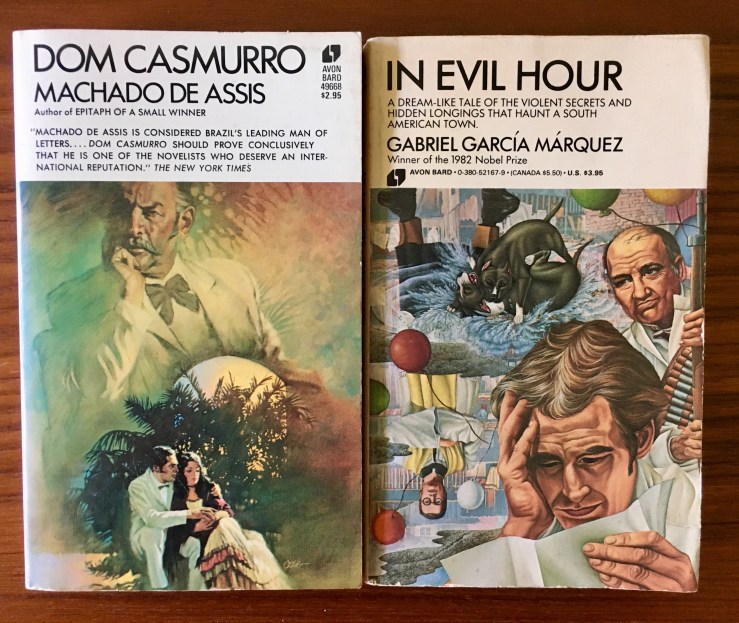
Yesterday marked both my wedding anniversary and the end of my spring semester, so I celebrated by spending a spare hour browsing my beloved used bookshop. I had dropped by last week to drop off a box of trade books—mostly old instructor editions of textbooks no longer in use—but I didn’t pick anything up. I did, however, snap a few photographs of the covers of the old 1980s Latin American authors series that Avon Bard put out. I love these covers, and have bought a few over the years.

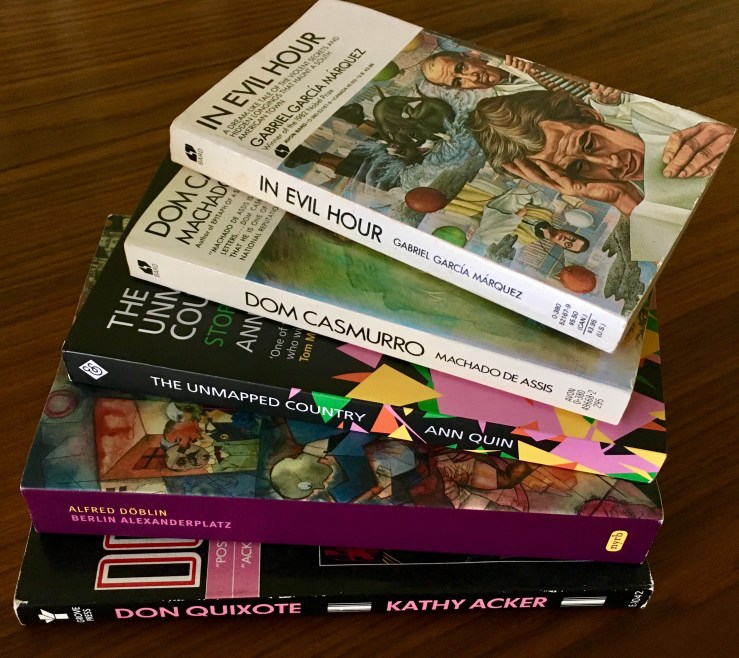
I ended up picking up two yesterday: Gabriel Garcia Marquez’s In Evil Hour and Machado de Assis’s Dom Casmurro. The cover for Dom Casmurro is pretty bad, actually, but I want to read it.

img_2752

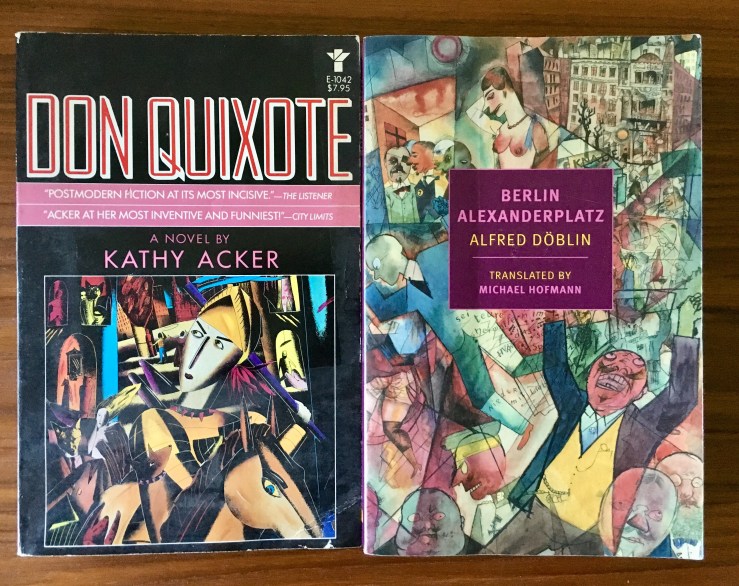
Near the Machado de Assis, I found a used copy of Berlin Alexanderplatz by Alfred Döblin, which I couldn’t resist. I also found a Grove edition of Kathy Acker’s Don Quixote, which I haven’t read since college.

img_2753

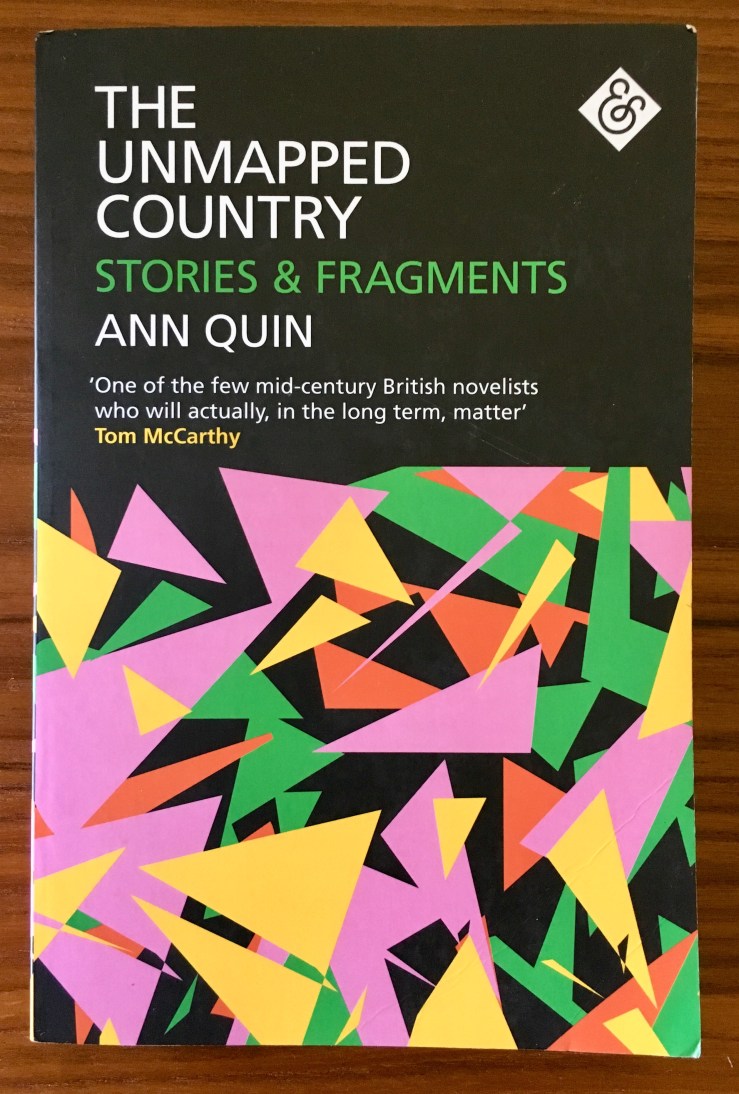
I also got a book in the mail. I loved Ann Quin’s novel Berg so much that I had to get more Quin, so I ordered The Unmapped Country from publisher And Other Stories. Very excited for this one.

img_2754

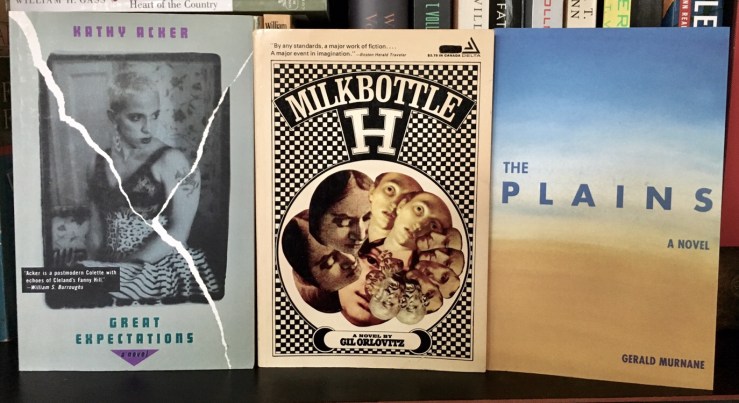
Novels by Acker, Orlovitz, and Murnane (Books acquired 1 and 6 Aug. 2018)

img_0786-1

I went by my favorite used bookshop to purge a bunch of books I’ll never read again and order Gerald Murane’s 1982 novel The Plains. I had finished most of Murnane’s collection Stream System, leaving only the longest story in the collection (“Velvet Waters”) unread.

I browsed the store a bit too, of course, and found a used copy of Kathy Acker’s Great Expectations, which I’ve never read. Years ago, this particular book store had almost every Acker book used and I didn’t pick any up, which I’ve regretted for awhile. So.

I also picked up Gil Orlovitz’s 1967 novel Milkbottle H, which I’d never heard of until I saw @PierreMenard tweet about it last month—

The book is 500+ pages. I found the first 10 utterly bewildering. You can read more about Milkbottle H here.

My copy of The Plains came in a few days later so my son and I went and picked it up (he got an Asterix comic). I read Part I this week and really got a strange thrill out of it. The Plains is a kind of speculative fiction with mythological touches. The slim novel reimagines an Australia the plainsmen of the interior define themselves (aesthetically, above all else) against the coastal areas of “Outer Australia.” The narrator is a (would-be) film director who wants to a make a movie called The Interior that will capture the essence of the plains (a task that is plainly impossible). The Plains is a very strange and I’m really digging it so far.

Books Acquired (1.8.2015)

_20150108_212440

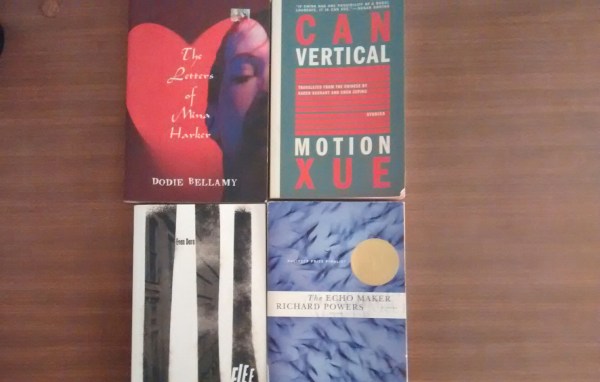
I am taking a class titled 21st-Century Fiction: What Is The Contemporary? and three of the books in this photograph are part of the reading list. Absent titles are by Dan Chaon, Kathryn Davis, Ben Marcus, Blake Butler, Sheila Heti. Some others. Wanted titles: Tao Lin’s Taipei (which I am reading now, which is surprisingly good).

I don’t know anything about Dodie Bellamy beyond the fact that she is often grouped with Kathy Acker, who are both often grouped with Dennis Cooper, who are all New Narrative people. New Narrators make the author present, her body and sexuality usually the prime subject. Letters of Mina Harker is a “sequel” to Dracula, except Mina Harker is a young woman who lives in 1980s San Francisco. On conceit alone, it reminds me of Kathy Acker’s Don Quixote: Which Was a Dream.

Richard Powers and Evan Dara are often grouped together, mainly because Powers blurbed his first book, The Lost Scrapbook, and that both of them write books that weave disparate discourses into their fiction. Also, there is speculation that Powers is Dara (Or Dara is Powers). Flee is, according to its publisher Aurora Books, about “in which a New England town does just that.” I’ve read the first chapter, titled “38,839,” and it reeks of Gaddis (in a good way). Disembodied voices colliding into each other, a cacophonous plot; the absurd & banal drama of everyday, throwaway conversation. An Australian book show on Triple R Radio, who have a good and very rare interview with Gerald Murnane (whose book Inland I was really, really jazzed on), also really loves Dara. I’m pretty excited to read this one.

Evan Dara and Richard Powers are often grouped together, mainly because Dara’s first book was blurbed by Richard Powers, and that both of them write books that weave disparate discourses into their fiction. Dara might be Powers (or Powers might be Dara?), but that doesn’t really matter. The Echo Maker is supposed to be one of those Big, Important American Books (as noted by the shallow, embossed seal on my used copy of the book). As I write this, I am listening to Powers read from The Echo Maker from an old Lannan Foundation talk (who also really love Gass) and I am really intrigued. I haven’t flipped through this, so I will reproduce the back copy.

On a winter night on a remote Nebraska road, twenty-seven-year-old Mark Schluter has a near-fatal car accident. His older sister, Karin, returns reluctantly to their hometown to nurse Mark back from a traumatic head injury. But when Mark emerges fro a coma, he believes that this woman–who looks, acts, and sounds just like his sister–is really an imposter. When Karin contacts the famous cognitive neurologist Gerald Weber for help, he diagnoses Mark as having Capgras syndrome. The mysterious nature of the disease, combined with the strange circumstances surrounding Mark’s accident, threaten to change all of their lives beyond recognition.


Can Xue (which roughly translates from Chinese, according to my mother, to “persistent & dirty snow”) is hailed by western critics to be the Chinese avant-garde heir to Kafka and Borges. Can Xue is a pen name for Deng Xiaohua. She is of my mother’s generation and her class, which means she grew up persecuted during the Cultural Revolution, which means she was sent to a “re-education camp” in the Chinese sticks and learned to farm. She taught herself English, has written criticism on Kafka and Borges. The strangeness of Kafka echoes in Xue. While the former’s strangeness arrives in the narrative with a kind of grim inevitability, the discovery of a debilitating truth lands like an obvious punchline that the reader stupidly forgets (or realizes too late, like the classic Seinfeld episode “The Comeback“), Xue’s arrives with a kind of startling innocence against the backdrop of dramatic irony. It is like watching, in Michael Haneke’s words in his great interview in The Paris Review,  a tragedy from the perspective of an idiot. The title story, “Vertical Motion,” can be read here.
Who’s Afraid of Kathy Acker? (Film Trailer)