Walt Whitman, Unsurprisingly, Was Not a Prescriptive Grammarian

More from Walt Whitman’s essay “Slang in America”:

Language, be it remember’d, is not an abstract construction of the learn’d, or of dictionary-makers, but is something arising out of the work, needs, ties, joys, affections, tastes, of long generations of humanity, and has its bases broad and low, close to the ground. Its final decisions are made by the masses, people nearest the concrete, having most to do with actual land and sea. It impermeates all, the Past as well as the Present, and is the grandest triumph of the human intellect.

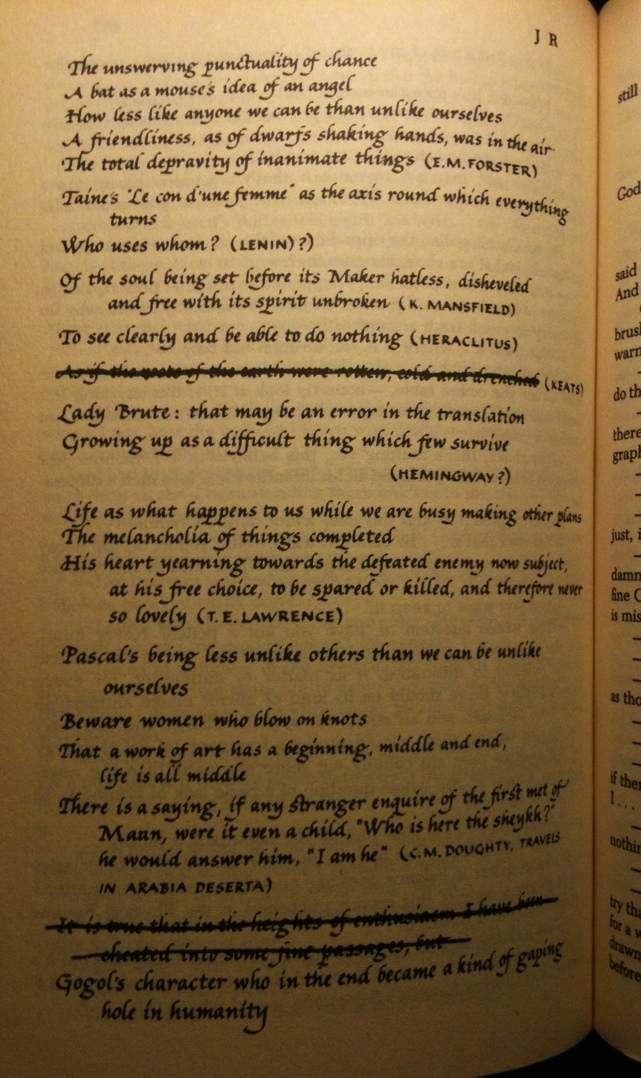
“The Unswerving Punctuality of Chance” (And Other Citations from William Gaddis’s Novel JR)

20120128-185406.jpg

In JR, the sprawling novel of capitalism and art by William Gaddis, Jack Gibbs loads his pockets with crumpled newspaper clippings, racing forms, and citations for a book he’s working on. “More trash,” he mutters about this list (which appears on page 486 of my Penguin Twentieth Century Classics Edition).

Gordon Lish on Beckett’s Boils and Other Matters of Literary Import

Hey. Do yourself a favor and listen to Iambik’s first podcast, a raucous, rambling conversation with legendary editor/short story author Gordon Lish. I finally got around to listening to the discussion between Lish and his publisher John Oakes. (Why the delay? I’ve been listening to and very much enjoying another Iambik recording, an audiobook of Lydia Millet’s Oh Pure and Radiant Heart, and I needed to get to a decent stopping place before the Lish (review of the Millet forthcoming)) . I had already listened to Lish reading a selection of his own stories which was nine kinds of awesome (thanks again to the good folks at Iambik, whose hooking me up with the sweet mp3age has in no way affected my fondness for their operation (review of the Lish selections forthcoming)).

Hearing Lish in this conversational, easy manner is revelatory. Wise and funny, erudite and crafty, you’ll learn something and be entertained:

Iambikcast #1a (mp3)
Iambikcast #1b (mp3)

What does he talk about? I’ll crib from Iambikist Miette’s write-up, which hardly sums it up but does a nice job of surveying the discussion–

In the first part of the conversation, Lish covers Beckett’s boils and other afflictions of our literary heroes, remembrances of Neal Cassady, and the writer as witch doctor.

The second part focuses on Lish’s (as always, uncensored) assertions on the state of contemporary American letters, in which we’re imparted with opinions on Allen Ginsberg and Philip Roth, achieving religious experience through DeLillo, the finer points of book blurbing, and encouraging the further crimes of Tao Lin.

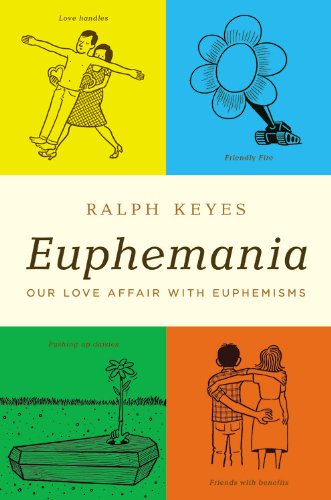
Euphemania — Ralph Keyes


In his new book Euphemania, a cultural history of euphemisms, Ralph Keyes takes a frank and often bawdy look at why we use euphemisms in social and political discourse, even when such evasions can degrade communication. “We all rely on euphemisms to tiptoe around what makes us uneasy, and have done so for most of recorded history,” writes Keyes, adding that “Euphemisms are a function of their times.” As such, Euphemania surveys different euphemisms throughout different cultures and times, from ancient Greece to the Roman republic, to Shakespeare’s England and the Victorian era (a treasure trove of euphemisms), to our modern age–which Keyes argues is not nearly as frank and open as we might like to think; indeed, one of his most intriguing arguments points out that modern discourse has simply opened up more topics to euphemism, including medicine, politics, and advertising.

Keyes doesn’t intend his book to be a straightforward history or dictionary of euphemisms; rather, he writes “it’s a consideration of the ways euphemisms enter our conversations and how they reflect their time and place. Euphemizing most often results from an excess of politeness and prudery, but it can also demonstrate creativity and high good humor.” Although Keyes always has a keen eye on the prudish mores of which ever age he’s discussing, he balances this analysis with plenty of humorous examples. His tone is fun and earthy, drawing examples from literature, film, TV, advertising, and political rhetoric. Between discussions of the Bowdlerization of Shakespeare, W.C. Fields’s difficulties with censors, or dialog from The Wire, Keyes also holds forth on the strange etymologies of our words. The root of the word bear (the mammal, not the verb) simply means “brown” or “the brown one” — the word bear is an unexpected euphemism, a refusal to name a lethal wild animal. Such examples can often magnify one’s awareness of how indebted our language is to euphemisms. Even when we reach for one of those Latinate technical words, we’ve really just picked up another culture’s euphemism. Our medical standby penis, for example, comes from the Latin word for “tail.” Vagina was a Roman synonym too–it means “sheath” or “scabbard.”

Euphemania is best when Keyes is riffing on naughty bits like these–or sex, or excretions, or violence, or all those things we’d like to otherwise gloss over. Most readers will likely gravitate to chapters like “Anatomy Class” or “Speaking of Sex.” Although Keyes is never dull (if anything, he’s at times too effervescent), his book is less convincing when discussing why we use euphemisms, simply because, at least to this reader, the answers are so obvious–euphemisms are part of the intrinsic codes of our culture. They make it easier to discuss unpleasant things; they build a sense of shared knowledge; they alleviate anxieties of race, place, and gender. At the same time, the cost of euphemisms–particularly in contemporary political discourse–can be astounding, leading to the evasion or outright denial of dramatic problems. Keyes doesn’t offer a pat solution to this problem, which is really better, if one thinks about it, because after all, wouldn’t an overly simplified, self-satisfied answer be just another dodge, another evasion, another euphemism? Good stuff.

Euphemania is new in hardback from Hatchette/Little, Brown and Company.

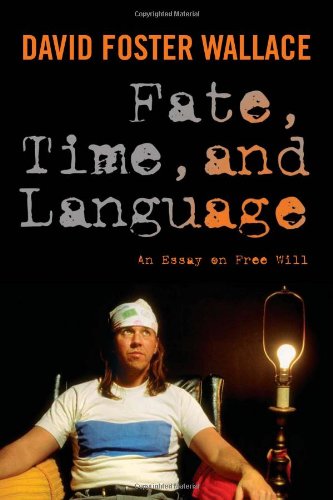
Fate, Time, and Language: An Essay on Free Will — David Foster Wallace

Sometime last year, during a rare visit to a big chain bookstore, I was disgusted to see what had happened to David Foster Wallace’s amazing Kenyon College commencement speech, “This Is Water.” Wallace’s speech, about 3,815 words, give or take (maybe twelve standard typed pages), was being sold as a 144 page hardback volume with only a sentence or two printed per page. The book was (and is) a nakedly commercial attempt to turn a text that is widely available on the web into the sort of thing that well-meaning uncles give to their nephews or nieces as graduation gifts. Of course, hardcore Wallace fans might want such a book — and I’d never begrudge them that — but it’s hard to imagine that Wallace would have been comfortable with how his book was marketed.

Which brings us to Fate, Time, and Language: An Essay on Free Will, new from Columbia University Press this week. The book publishes the 1985 honors thesis that Wallace submitted to the Amherst College’s Department of Philosophy, “Richard Taylor’s ‘Fatalism’ and the Semantics of Physical Modality.” The essay’s title alone signals a prohibitive level of academic specialization. In his introductory essay to the volume, “A Head That Throbbed Heartlike,” New York Times Magazine editor James Ryerson points out, “Its obscurity is easy to appreciate. A highly specialized, seventy-six page work of logic, semantics, and metaphysics, it is not for the philosophically faint of heart.” Ryerson then warns his reader to “Brace yourself for a sample sentence,” before offering a sample from Wallace’s essay that I do not have the patience or fortitude to type out (it would take me too long to locate all the diacritical marks and special logic symbols). Ryerson concludes the paragraph with this wry remark: “There are reasons that he’s better known for an essay about a cruise ship.”

Fortunately, the editors of Fate, Time, and Language make every effort to contextualize Wallace’s essay in a way that explains its aims, strengths, and even shortcomings. There’s Ryerson’s lengthy introduction, which provides an overview to Wallace’s life in philosophy. Then there’s Taylor’s “Fatalism” of course, a short, provocative argument combining six presuppositions that led Taylor to declare that humans have no control — none, whatsoever — over any future event. The volume collects four other essays by Taylor on fatalism, as well as eight other essays responding to his arguments, before delivering Wallace’s essay (the longest in the collection). Here’s Wallace—

So Taylor’s central claim, the Taylor problem, is that just a few basic logical and semantic presuppositions, regarded as uncontroversially true by most philosophers, lead directly to the metaphysical conclusion that human beings, agents, have no control over what is going to happen.

I ain’t even gonna front–pretty much everything that Wallace says after this was lost on me; if you want to read and comprehend the details of his argument you will need to have a grasp on the basics of Montague grammar and tensed modal logic. If you lack these skills, there will be skimming. Lots and lots of skimming. So, in short, I have no ideawhether Wallace’s logic is sound, although I find his conclusion (minus all the modal evidence) quite compelling—

This essay’s semantic analysis has shown that Taylor’s proof doesn’t “force” fatalism on us at all. We should now recall that Taylor was offering a very curious sort of argument: a semantic argument for ametaphysical conclusion. In light of what we’ve seen about the semantics of physical modality, I hold that Taylor’s semantic argument does not in fact yield his metaphysical conclusion.

After Wallace’s honors thesis, there’s a wonderful little memoir essay by his adviser on the project, Jay L. Garfield, who offers up this nugget—

I knew at the time, as I mention above, that David was also writing a novel as a thesis in English. But I never took that seriously. I though of David as a very talented young philosopher with a writing hobby, and did not realize that he was instead one of the most talented fiction writers of his generation who had a philosophy hobby.

These little pockets of insight appeal to me most in Fate, Time, and Language, and as such, Ryerson’s essay “A Head That Throbbed Heartlike” is the highpoint of the book. It weaves together Wallace’s personal life, writing career, and academic pursuits into a moving elegy of sorts, although one more rooted in ideas than feelings. He also spells out the book’s mission quite clearly—

For all its seeming inscrutability, though, the thesis is lucidly argued and–with some patience and industry on the part of the lay reader–ultimately accessible, which is welcome news for those looking to deepen their understanding of Wallace. The paper offers a point of entry into an overlooked aspect of his intellectual life: a serious early engagement with philosophy that would play a lasting role in his work and thought, including his ideas about the purpose and possibilities of fiction.

Many of us might shudder at the idea of our college essays being published posthumously. Of course, most of us aren’t Wallace, but there are undoubtedly critics out there who will cry foul at this publication. Fortunately, the team behind Fate, Time, and Language has produced a book of remarkable integrity, one that understands why it exists, readily acknowledges its obscurity without trying to gloss over that obscurity, and makes every effort to communicate with and engage its readers without sacrificing erudition. To return to my opening anecdote, this is not the naked commercialism that motivated a gimmicky edition This Is Water; rather, this is a book delivered by people who genuinely care about Wallace and his ideas. Make no mistake–it’s very dry and very specialized, but fanatics will no doubt want it.

Language, Politics, Elitism, and Sarah Palin’s Horrendous Pronunciation

It wasn’t so much Governor Palin’s fumbling toward a semblance of specificity in her recent Katie Couric interview that made me cringe. It wasn’t her misapprehension that Putin is still the president of Russia (an honest mistake, I’m sure) that raised my hackles. It wasn’t her neocon-lite reduction of global politics to “good guys” vs “bad guys” that so irritated me. Even her ignorance of Henry Kissinger’s foreign policy philosophy re: Iran didn’t bother me. If anything, I delighted in watching Gov. Palin blather incoherently, especially after this fiasco two weeks ago. No, what really raised the hairs on the back of my neck was this exchange:

Couric: You recently said three times that you would never, quote, “second guess” Israel if that country decided to attack Iran. Why not?

Palin: We shouldn’t second guess Israel’s security efforts because we cannot ever afford to send a message that we would allow a second Holocaust, for one. Israel has got to have the opportunity and the ability to protect itself. They are our closest ally in the Mideast. We need them. They need us. And we shouldn’t second guess their efforts.

But, you see, it wasn’t what she said so much as it was how she said it. Or mispronounced it, rather.

Let me admit it. I’m an elitist, something of a snob I guess. I can’t help it. Although I didn’t go to five colleges, I did attend two universities to earn two degrees–nothing as prestigious as Palin’s hard-earned MS in communications, of course–but I do have some linguistic standards and expectations for our executive leadership. You see, Gov. Palin didn’t say “second guess,” as the CBS News transcript so generously credits her. No, Gov. Palin distinctly says “second guest.”

Now, we already know that Palin has had some difficulty with one of Bush’s biggest stumbling blocks, that oh-so daunting word “nuclear” (as in “nü-klē-ər” not “nyoo-kyoo-lar”). Observe:

Unfortunately, as of right now there’s no full footage of tonight’s interview up on a site that WordPress will allow me to embed here, and most of the posted clips focus on Palin’s rambling knowledge of basic geography (even Miss Teen South Carolina still managed to get more specific than Palin — “They don’t have maps”).

VIDEO UPDATE–Palin mispronounces “second guess” as “second guest” at 00:17:

If you go to CBS News and wait patiently, Palin’s redneck phrasing pops up at 8:55, wedged neatly amid a vague heap of rhetorically empty catchphrases that the neo-cons and Bush administration have been excreting for the past decade.

In the best assessment I’ve read on Palin yet, Roger Ebert points out that most middle-class Americans would brag if their kids went to Harvard on scholarship; that most of us honor travel as a form of education and the signal of intellectual curiosity. How did we get here? When, exactly, did we decide that our president needs to have the qualities of a good drinking buddy? In short, why do we think that provincialism and ignorance, so summarily captured in Palin’s groan-inducing “second guest,” are the signs of a “real,” “true” American? If we’re going to elect smug, hypocritical leaders, is it too much to ask that they exhibit a modicum of intelligence, or, at the very least, don’t trip over their words?