A visit to Cormac McCarthy’s “enormous and chaotically disorganized personal library”

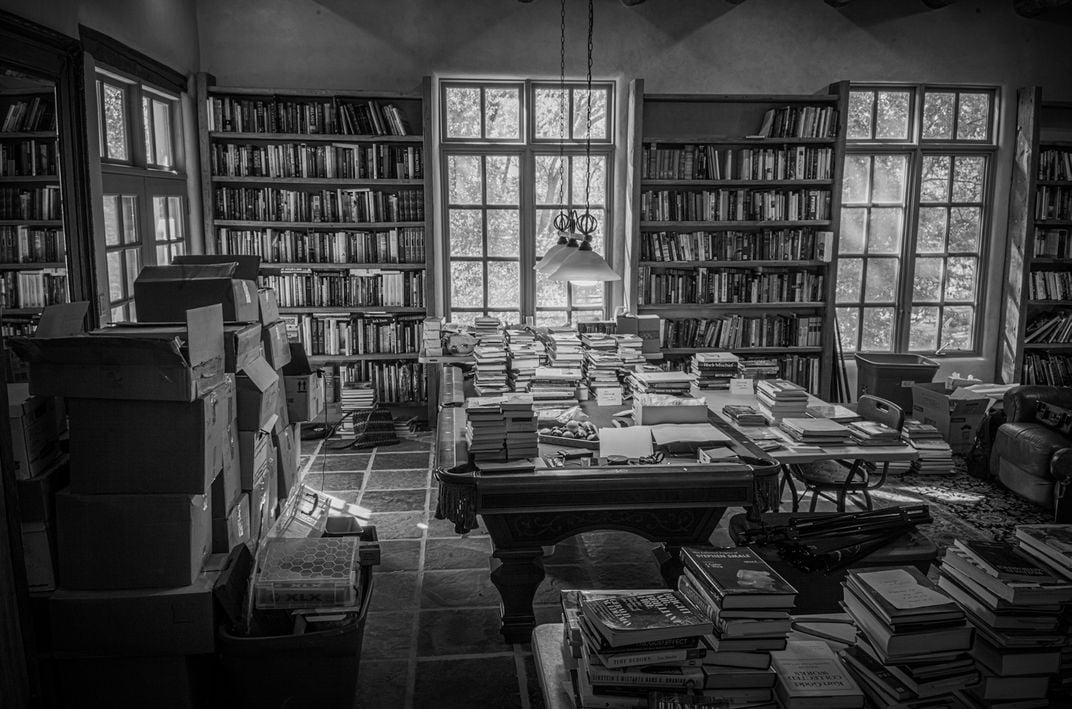
Photograph of Cormac McCarthy’s living room by Wayne Martin Belger

The September/October issue of Smithonian Magazine includes a visit to the late Cormac McCarthy’s house in New Mexico. The piece is by Richard Grant, who explains how the visit came about:

I was invited to the house by two McCarthy scholars who were embroiled in a herculean endeavor. Working unpaid, with help from other volunteer scholars and occasional graduate students, they had taken it upon themselves to physically examine and digitally catalog every single book in McCarthy’s enormous and chaotically disorganized personal library. They were guessing it contained upwards of 20,000 volumes. By comparison, Ernest Hemingway, considered a voracious book collector, left behind a personal library of 9,000.

It’s a long feature and contributes more information to McCarthy’s biography than I would have thought (please, Josh Brolin, give us McCarthy’s full story about “drinking wine with André the Giant in Paris”). Grant also focuses heavily on the scholarship going into cataloging McCarthy’s library. Grant describes “looking through a batch [of books to be cataloged] about Cistercian abbeys, violin makers, metaphysics, meta-ontology, the incest taboo and the material foundations of ancient Mesopotamian civilization.” We learn that McCarthy owned at least thirteen editions of Moby-Dick. Scholars found uncashed royalty checks to the tune of ten grand bookmarking William Faulkner’s niece’s memoir. Grant also shares some of McCarthy’s annotations, like this one:

In his copy of The Suit: A Machiavellian Approach to Men’s Style, McCarthy penciled his opinion of slip-on dress shoes: ‘disgusting.’ Further down the same page, next to a sentence praising shiny-buckled monk-strap shoes, he wrote, ‘yet more horror.’

The photographs by Wayne Martin Belger are likely to particularly interest McCarthy nerds. My favorite of the batch is a slip of paper in McCarthy’s handwriting, posed atop a Wittgenstein volume. The slip includes what appears to be a rough budget, notes on “Spengler’s number,” and a short grocery list:

“TARTAR SAUCE

CELERY SALT.”

I also dig Belger’s photograph of McCarthy’s gun barrel schematic; check out the piece for more:
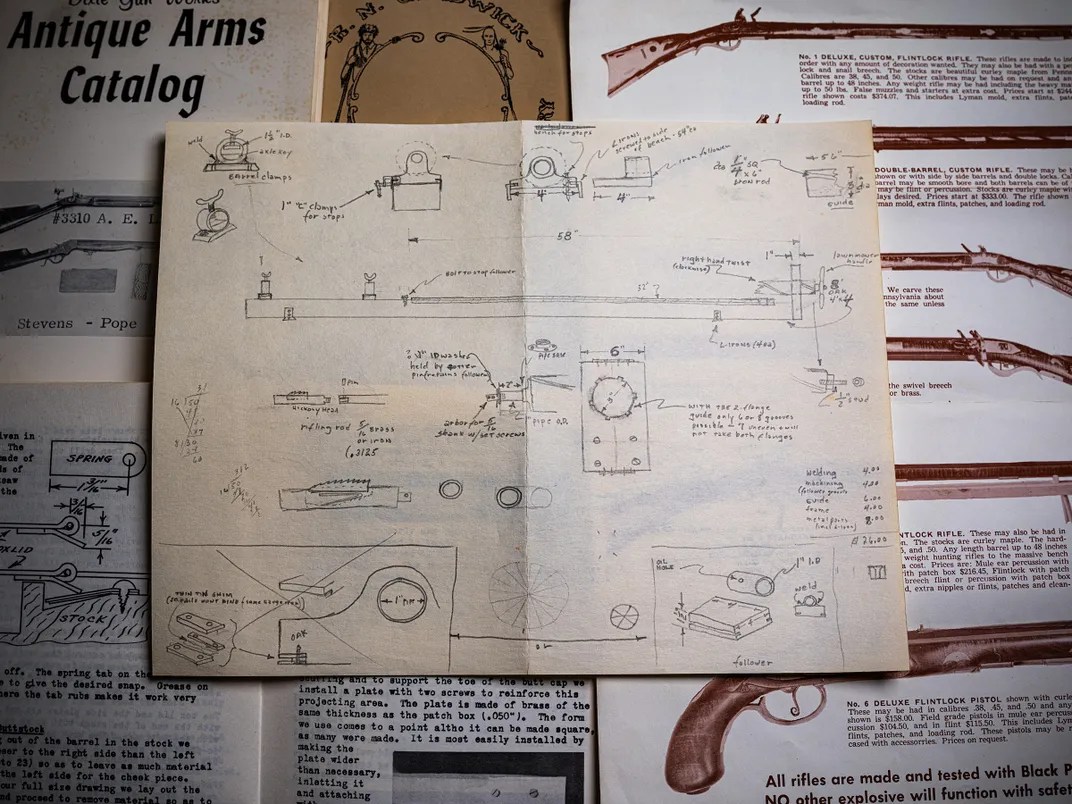
Photograph of “Gun books and catalogs including a schematic, hand-drawn by McCarthy, of a plan to make a gun barrel” by Wayne Martin Belger

Private Conversation — Felix Vallotton

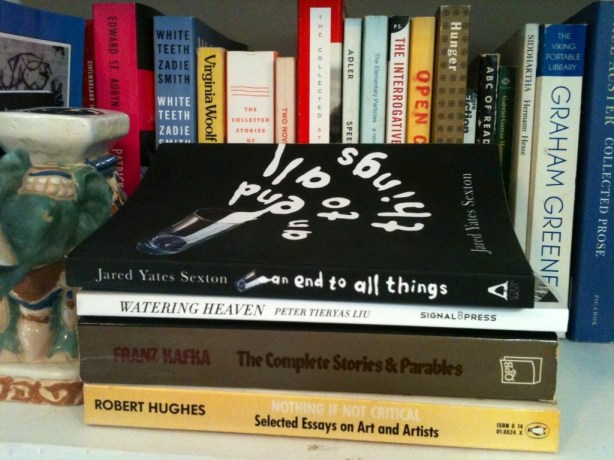
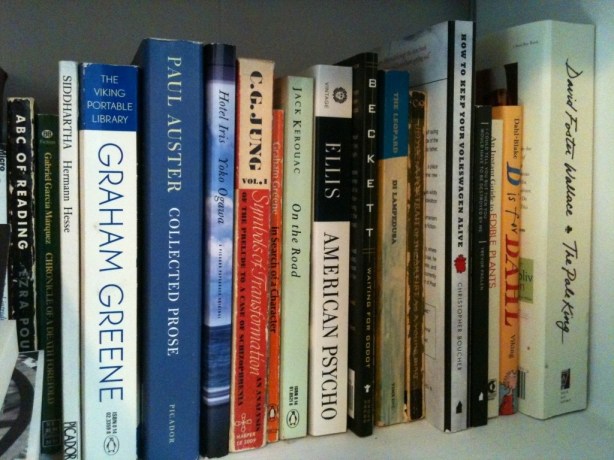
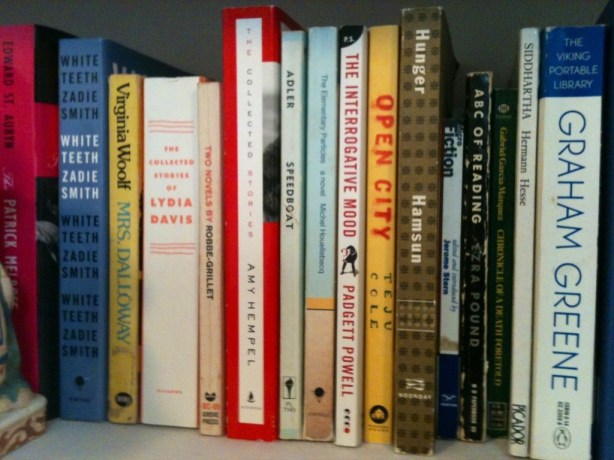
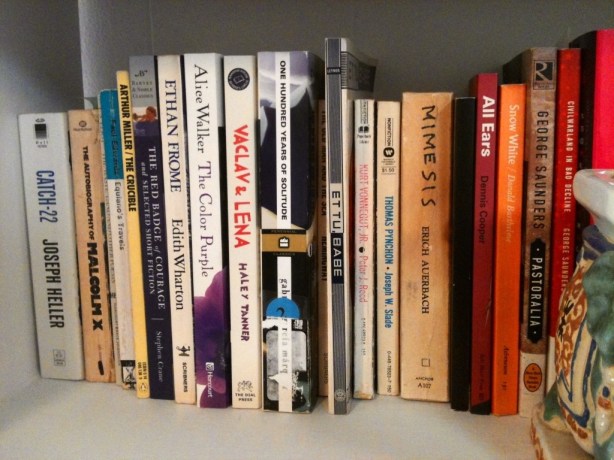
Book Shelves #51, 12.16.2012


Book shelves series #51, fifty-first Sunday of 2012

20121216-092447.jpg

I am very ready for this project to be over. Two more weeks.

At this point, I’ve photographed all book shelves (and other bookbearing surfaces) in the house, but clearly the book shelves aren’t stable.

I mean, structurally, sure, they’re stable.

But their content shifts.

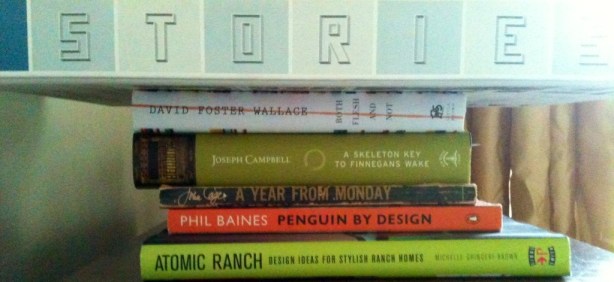
So this week (having three weeks left to fill), I go back to a sitting room in the front of the house where I like to read.

Above, resting on this cabinet, some current reading, including the latest DFW collection and Chris Ware’s Building Stories.

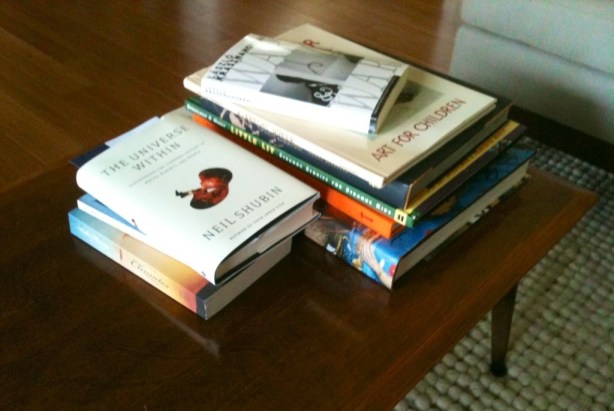
Below, a coffee table (first photographed in #7 of this series):


20121216-092518.jpg

As usual, a few coffee table books, plus several review copies that I need to look at sometime next week:

20121216-092535.jpg

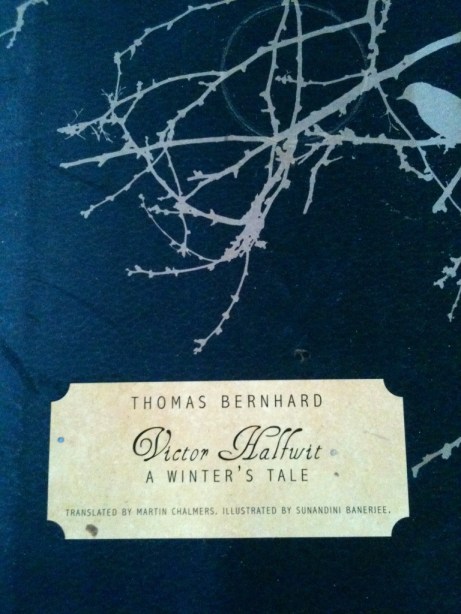
One of the coffee table books is by Thomas Bernhard:

20121216-092544.jpg

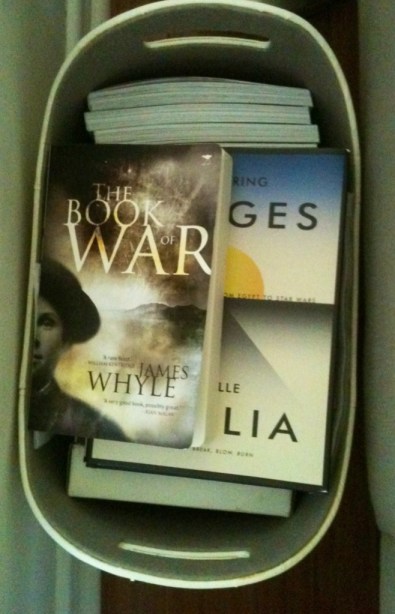
To the right of the case, a bin of books—mostly review copies that come in that I plan to write more about:

20121216-092558.jpg


Book Shelves #46, 11.11.2012

20121111-111049.jpg

Book shelves series #46, forty-sixth Sunday of 2012

Another double-stacked shelf. This one even has a stack of drifters.

This shelf is at my eye/arm level, and looking at it this way, I see that it gets a lot of shuffling—I can see where I started certain projects for the site.

I can see books that are in line, so to speak, for either proper shelving or for reading.

The mounding stack on the shelf below is a bit out of control, although most of what sits there comes from other places (I kinda sorta wrote about those here).

Below: Unsorted stuff that I’ve been reading of an afternoon:

20121111-111057.jpg

This is the front stack—books that need proper shelving elsewhere, books that I’ve read (and sometimes reviewed here) in the past few months, or meant to read, or in some other way consulted or read from:

20121111-111105.jpg

The far right side of the shelf—again, a very mixed bag. I think I originally intended to properly shelf everything here and then got sidetracked:

20121111-111113.jpg

Moving left:

20121111-111124.jpg

And here’s what’s behind the front stack—okay, I can see now the edges of an idea I had for shelving; I also see where I just abandoned that idea:

20121111-111133.jpg

This whole project I blame on an essay by Georges Perec, collected in this one:

20121111-111157.jpg

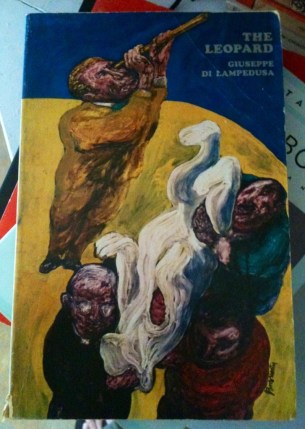
This is one of my favorite book covers:

20121111-111149.jpg

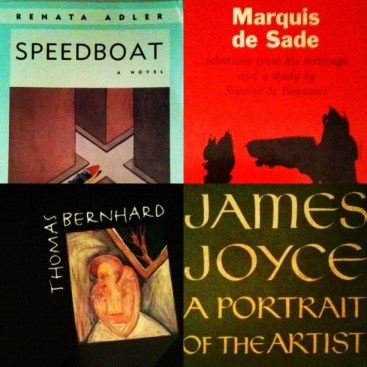
More covers I like from this shelf:

20121111-111204.jpg

Visit to a Library — Pietro Longhi

Little Libraries, Guerrilla Libraries, Ad Hoc Libraries and More

Read Shannon Mattern’s great essay “Marginalia: Little Libraries in the Urban Margins” (published at Places). From the essay:

These new library projects might seem to emerge from a common culture and uphold a common mission — a flurry of press coverage in late 2011 represented them as a coherent “little library” movement. But in fact they don’t. They have varied aims and politics and assumptions about what a library is and who its publics are; their collections and services differ significantly; and their forms and functions vary from one locality to another. I want to attempt here to identify a loose, and inevitably leaky, typology of “little libraries” — to figure out where they’re coming from, how they relate to existing institutions that perform similar roles, and what impact they’re having on their communities.

David Foster Wallace’s Papers, Annotations, and More

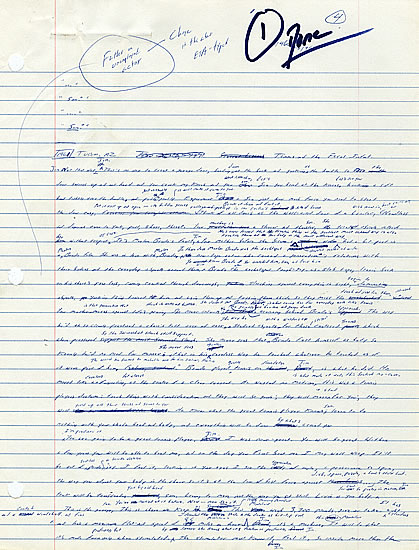
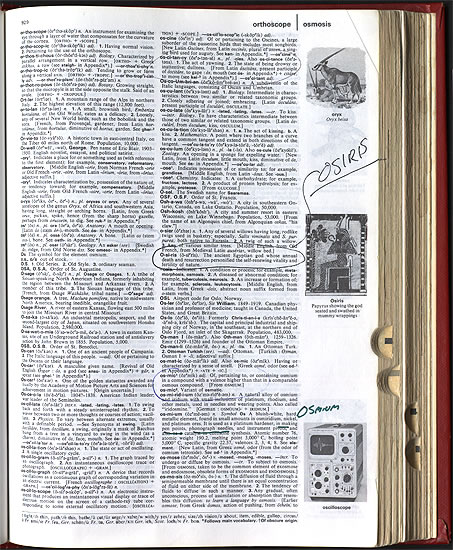
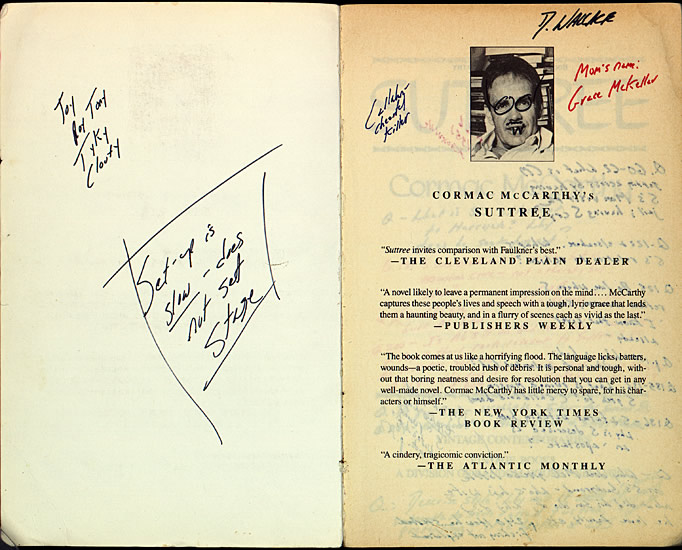
The New York Times and dozens of other sources reported yesterday that the University of Texas acquired David Foster Wallace’s papers, including his personal library. The Harry Ransom Center at UT already has lots of Wallace’s stuff up at their site and it’s frankly astounding. There are handwritten pages from Infinite Jest, images from annotated copies of some of Wallace’s novels, including Cormac McCarthy’s Suttree and Don DeLillo’s Players, and pictures of Wallace’s dictionary with words circled like neroli, cete, and suint. Begin exploring Wallace’s archive here.

First page of a handwritten draft of Infinite Jest
DFW's dictionary
Inside cover of David Foster Wallace's annotated copy of Players by Don DeLillo.
Inside cover of David Foster Wallace's annotated copy of Suttree by Cormac McCarthy.