“He’s a good editor. Maybe he’s a great editor.” — Raymond Carver on Gordon Lish

We continue to raid The Paris Review’s vault of interviews. Here’s Raymond Carver on Gordon Lish–

INTERVIEWER: Where does Gordon Lish enter into this? I know he’s your editor at Knopf.

CARVER: Just as he was the editor who began publishing my stories at Esquire back in the early 1970s. But we had a friendship that went back before that time, back to 1967 or 1968, in Palo Alto. He was working for a textbook publishing firm right across the street from the firm where I worked. The one that fired me. He didn’t keep any regular office hours. He did most of his work for the company at home. At least once a week he’d ask me over to his place for lunch. He wouldn’t eat anything himself, he’d just cook something for me and then hover around the table watching me eat. It made me nervous, as you might imagine. I’d always wind up leaving something on my plate, and he’d always wind up eating it. Said it had to do with the way he was brought up. This is not an isolated example. He still does things like that. He’ll take me to lunch now and won’t order anything for himself except a drink and then he’ll eat up whatever I leave in my plate! I saw him do it once in the Russian Tea Room. There were four of us for dinner, and after the food came he watched us eat. When he saw we were going to leave food on our plates, he cleaned it right up. Aside from this craziness, which is more funny than anything, he’s remarkably smart and sensitive to the needs of a manuscript. He’s a good editor. Maybe he’s a great editor. All I know for sure is that he’s my editor and my friend, and I’m glad on both counts.

“It was a lone tree burning on the desert” — Blood Meridian’s Moral Core

Cormac McCarthy’s Blood Meridian begins as a strange, violent picaresque bildungsroman, detailing the adventures of a teenage runaway known only as “the kid.” When the Kid falls in with John Glanton’s marauders, the narrative lens expands and pulls back; Glanton’s gang essentially envelopes the Kid’s personality. The pronoun “they” dominates the Kid’s own agency, for the most part, and the massive figure of Judge Holden usurps the narrative’s voice. The effect is that the Glanton gang’s killing, raping, and scalping spree becomes essentially de-personalized, and, to a certain extent, amoralized.

The Kid, and perhaps the ex-priest Tobin and the Kid’s erstwhile partner Toadvine, are the only major characters who bear any semblance of conventional morality in the narrative. The Kid exhibits a willingness to help others early on when he agrees to stitch one of Tobin’s wounds; later, he removes an arrowhead from a wounded man when no other member of the company will (Tobin chides him for caring, declaring that the wounded man would have killed the Kid had the Kid’s efforts been unsuccessful). For most of the central narrative though, the Kid’s individual actions are consumed into the gang’s “they.” However, at the beginning of chapter 15 the narrative focuses again on the Kid, who is charged with killing a wounded man named Shelby to “spare” him from the approaching Mexican army (this is a bizarre version of mercy in Blood Meridian). Shelby pleads to live and the Kid allows it, even giving the man some water from his own canteen. After he leaves he catches up with a man named Tate whose horse is wounded. Tate remarks on the boy’s foolishness for helping him, but the Kid does so nonetheless, sharing Tate’s burden as they try to make their way back to the rest of their party. Tate is soon killed by Mexican scouts. In both cases, the outcome of the Kid’s moral actions–the will to help, to save, to preserve life–are negated by the book’s narrative outcomes, but I would argue that his intentions in the face of violence somehow secure his humanity.

His journey alone to rejoin the Glanton gang is figured as a kind of vision quest, a strange echo of Christ in the desert, perhaps. At its core–and perhaps the moral core of the book–is the following strange passage–

It was a lone tree burning on the desert. A herladic tree that the passing storm had left afire. The solitary pilgrim drawn up before it had traveled far to be here and he knelt in the hot sand and held his numbed hands out while all about in that circle attended companies of lesser auxiliaries routed forth into the inordinate day, small owls that crouched silently and stood from foot to foot and tarantulas and solpugas and vinegarroons and the vicious mygale spiders and beaded lizards with mouths black as a chowdog’s, deadly to man, and the little desert basilisks that jet blood from their eyes and the small sandvipers like seemly gods, silent and the same, in Jedda, in Babylon. A constellation of ignited eyes that edged the ring of light all bound in a precarious truce before the torch whose brightness had set back the stars in their sockets.

The burning tree alludes to YHWH’s appearance to Moses as a burning bush, and also the tree of smoke that led the Israelites through the desert. Significantly, all the strange, terrible creatures of the desert come to meet around it in a “precarious truce.” The burning tree inverts the natural, inescapable violence that dominates the novel and turns it into a solitary, singular moment of peace. When the Kid awakes–alone–the tree is merely a “smoldering skeleton of a blackened scrog.” God is not in the permanence of the object but rather in the witnessing of the event–Blood Meridian locates (a version of a) god in the natural violence of burning and consumption. There is a strong contrast here, I believe, with the book’s other version of god, the Judge’s proclamation that “War is god.” The Judge, a cunning, devilish trickster, wants to reduce (or enlarge) war to all contest of wills, to pure violence–to divorce it from any ideological structure. Yet the burning tree episode reveals natural violence divorced from ideology. The animals (and the man, the Kid) suspend their Darwinian animosities in order to witness the sublime. The episode is silent, outside of language, order, ideology. This silence is echoed in the novel’s final confrontation between the Judge and the Kid, who retorts simply “You ain’t nothin'” to the Judge’s barrage of grandiose language. While the rejoinder may not save the Kid, its rejection perhaps saves his soul (if such a thing exists in the novel, which I believe it does). So, while larger-than-life Judge Holden may dominate the novel, Cormac McCarthy has nonetheless given us another moral road to follow, should we choose to.

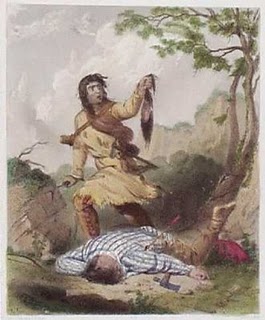
“. . . and seizing them up by their hair and passing their blades about the skulls of the living and the dead alike and snatching aloft the bloody wigs”

Blood Meridian week continues–more jolly times.

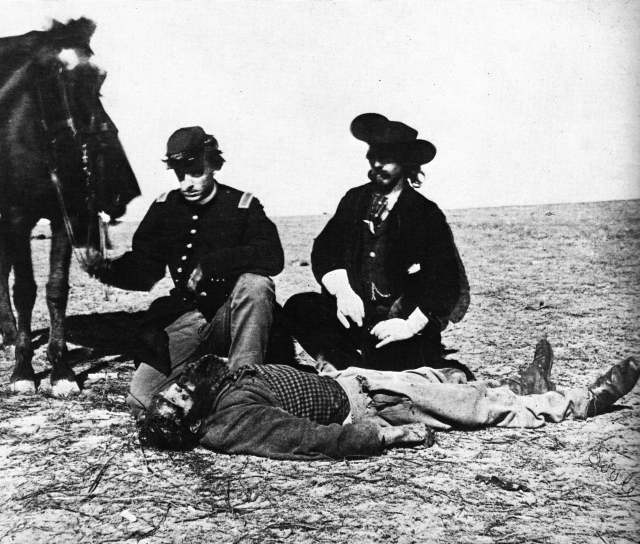
Buffalo hunter Ralph Morrison killed and scalped by Cheyennes in December 1868, near Fort Dodge, Kansas. Photographer: William S. Soule (1836-1908).
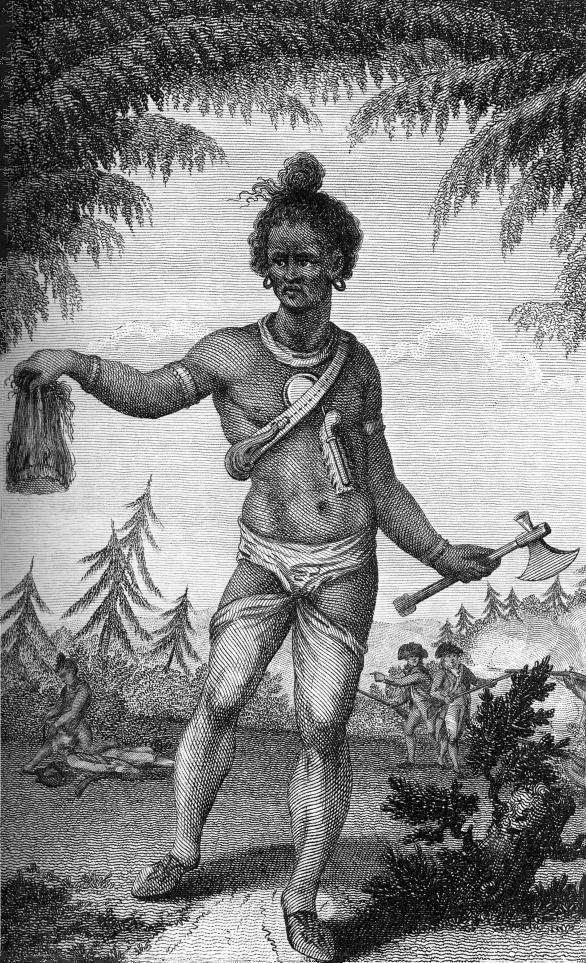
Indian Warrior with Scalp, 1789, by Barlow.
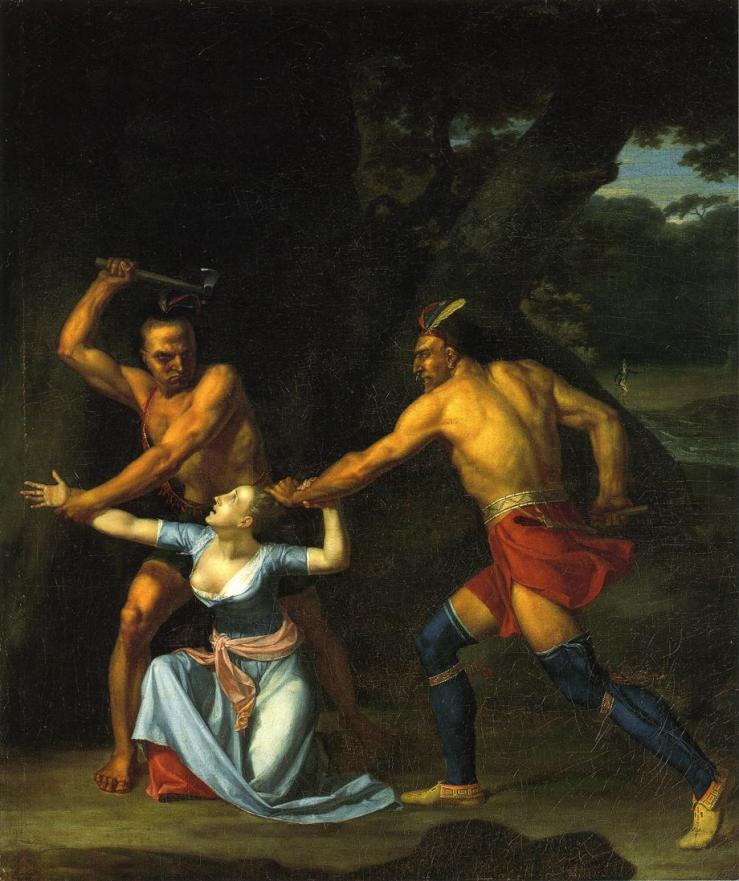
The Death of Jane McCrea, by John Vanderlyn, 1804.
Robert McGee, circa 1861.
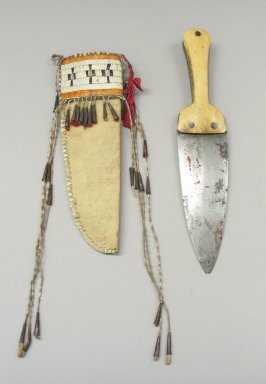
Eastern, Sioux (Native American). Scalping Knife and Sheath, 1801-1833
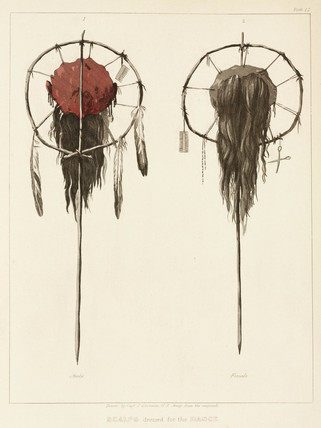
Engraving after Captain Seth Eastman, US Army, of a male and female scalp strung on frames, with combs, feathers and a pair of scissors. Circa 1847.
Hannah Duston
Death Whoop by Seth Eastman. Late nineteenth century.
"A scene on the frontiers as practiced by the 'humane' British and their 'worthy' allies," attributed to William Charles, 1812.

“The Authentic American Apocalyptic Novel” — Harold Bloom on Blood Meridian

The Triumph of Death, Pieter Bruegel the Elder, c. 1562

Harold Bloom’s esteem for Blood Meridian may have done much to advance the novel’s reputation over the past decade. His essay on the book, first published in his 2000 collection How to Read and Why and later included as the preface to Random House’s Modern Library editions, makes a strong case for Blood Meridian’s canonical status. Bloom begins, in typical Bloomian fashion–the anxiety of influence is always at work–by situating McCarthy’s book against other heavies–

Blood Meridian (1985) seems to me the authentic American apocalyptic novel, more relevant even in 2000 than it was fifteen years ago. The fulfilled renown of Moby-Dick and of As I Lay Dying is augmented by Blood Meridian, since Cormac McCarthy is the worthy disciple both of Melville and of Faulkner. I venture that no other living American novelist, not even Pynchon, has given us a book as strong and memorable as Blood Meridian . . .

The Garden of Earthly Delights — Hell, Hieronymus Bosch, 1503-1504

Bloom goes  on to rate Blood Meridian over DeLillo’s Underworld, several books by Philip Roth, and even McCarthy’s own All the Pretty Horses. Indeed, Bloom proclaims Blood Meridian “the ultimate Western, not to be surpassed.” This doesn’t mean that Bloom is at home with the book’s violence; he confesses that it took him two attempts to read through its “overwhelming carnage.” Still, he makes a case for reading it in spite of its gore–

Nevertheless, I urge the reader to persevere, because Blood Meridian is a canonical imaginative achievement, both an American and a universal tragedy of blood. Judge Holden is a villain worthy of Shakespeare, Iago-like and demoniac, a theoretician of war everlasting. And the book’s magnificence–its language, landscape, persons, conceptions–at last transcends the violence, and converts goriness into terrifying art, an art comparable to Melville’s and to Faulkner’s.

Bloom repeatedly invokes Melville and Faulkner in his essay, arguing that Blood Meridian’s “high style” is one of its key strengths (unlike fellow aesthetic critic James Wood, who seems to think that McCarthy is a windbag). The trajectory of Bloom’s essay follows Melville and Shakespeare, finding in Judge Holden both a white whale (and not so much an Ahab) and an Iago. He writes–

Since Blood Meridian, like the much longer Moby-Dick, is more prose epic than novel, the Glanton foray can seem a post-Homeric quest, where the various heroes (or thugs) have a disguised god among them, which appears to be the Judge’s Herculean role. The Glanton gang passes into a sinister aesthetic glory at the close of chapter 13, when they progress from murdering and scalping Indians to butchering the Mexicans who have hired them.

I think that Bloom’s great insight here is to read the book as a prose epic as opposed to a linear novel; to see that Blood Meridian foregrounds a deeply tragic and ironic reworking of the great American myth of Manifest Destiny. While hardly a pastiche, the book is somehow a collage; a massive, deafening collage that numbs, stuns, and overwhelms with its layers of thick, bloody prose. The effect is akin to the apocalyptic paintings of Hieronymus Bosch and Pieter Bruegel. Dense and full of allusion, paintings like The Triumph of Death and The Garden of Earthly Delights surge over the senses, destabilizing narrative logic. Like Blood Meridian, these paintings employ a graphic grammar that disorients and then reorients. They are apocalyptic in all senses of the word: both revelatory and portentously conclusive. And like Blood Meridian, they showcase “a sinister aesthetic glory” (to use Bloom’s term), a terrible, awful, awesome ugliness that haunts us with repulsive beauty.

A Map of Blood Meridian

John Sepich's Map of Blood Meridian

John Sepich created this map of the geographic terrain covered in Cormac McCarthy’s Blood Meridian for his companion piece, Notes On Blood Meridian. Blogger The Brooklyn added color.

“Books Are Made out of Books” — Blood Meridian and Samuel Chamberlain

In his 1992 interview with The New York Times, Cormac McCarthy said, “The ugly fact is books are made out of books. The novel depends for its life on the novels that have been written.” McCarthy’s masterpiece Blood Meridian, as many critics have noted, is made of some of the finest literature out there–the King James Bible, Moby-Dick, Dante’s Inferno, Paradise Lost, Faulkner, and Shakespeare. While Blood Meridian echoes and alludes to these authors and books thematically, structurally, and linguistically, it also owes much of its materiality to Samuel Chamberlain’s My Confession: The Recollections of a Rogue.

Chamberlain, much like the Kid, Blood Meridian’s erstwhile protagonist, ran away from home as a teenager. He joined the Illinois Second Volunteer Regiment and later fought in the Mexican-American War. Confession details Chamberlain’s involvement with John Glanton’s gang of scalp-hunters. The following summary comes from the University of Virginia’s American Studies webpage

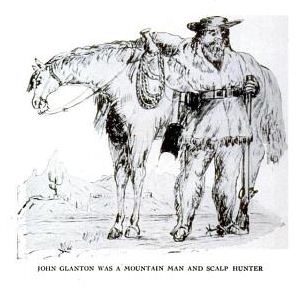
According to Chamberlain, John Glanton was born in South Carolina and migrated to Stephen Austin’s settlement in Texas. There he fell in love with an orphan girl and was prepared to marry her. One day while he was gone, Lipan warriors raided the area scalping the elderly and the children and kidnapping the women- including Glanton’s fiancee. Glanton and the other settlers pursued and slaughtered the natives, but during the battle the women were tomahawked and scalped. Legend has it, Glanton began a series of retaliatory raids which always yielded “fresh scalps.” When Texas fought for its independence from Mexico, Glanton fought with Col. Fannin, and was one of the few to escape the slaughter of that regiment at the hands of the Mexican Gen. Urrea- the man who would eventually employ Glanton as a scalp hunter. During the Range Wars, Glanton took no side but simply assassinated individuals who had crossed him. He was banished, to no avail, by Gen. Sam Houston and fought as a “free Ranger” in the war against Mexico. Following the war he took up the Urrea’s offer of $50 per Apache scalp (with a bonus of $1000 for the scalp of the Chief Santana). Local rumor had it that Glanton always “raised the hair” of the Indians he killed and that he had a “mule load of these barbarous trophies, smoke-dried” in his hut even before he turned professional.
Chamberlain’s Confession also describes a  figure named Judge Holden. Again, from U of V’s summary–

Glanton’s gang consisted of “Sonorans, Cherokee and Delaware Indians, French Canadians, Texans, Irishmen, a Negro and a full-blooded Comanche,” and when Chamberlain joined them they had gathered thirty-seven scalps and considerable losses from two recent raids (Chamberlain implies that they had just begun their careers as scalp hunters but other sources suggest that they had been engaged in the trade for sometime- regardless there is little specific documentation of their prior activities). Second in command to Glanton was a Texan- Judge Holden. In describing him, Chamberlain claimed, “a cooler blooded villain never went unhung;” Holden was well over six feet, “had a fleshy frame, [and] a dull tallow colored face destitute of hair and all expression” and was well educated in geology and mineralogy, fluent in native dialects, a good musician, and “plum centre” with a firearm. Chamberlain saw him also as a coward who would avoid equal combat if possible but would not hesitate to kill Indians or Mexicans if he had the advantage. Rumors also abounded about atrocities committed in Texas and the Cherokee nation by him under a different name. Before the gang left Frontreras, Chamberlain claims that a ten year old girl was found “foully violated and murdered” with “the mark of a large hand on her throat,” but no one ever directly accused Holden.

It’s fascinating to note how much of the Judge is already there–the pedophilia, the marksmanship, the scholarship, and, most interesting of all, the lack of hair. Confession goes on to detail the killing, scalping, raping, and raiding spree that comprises the center of Blood Meridian. Chamberlain even describes the final battle with the Yumas, an event that signals the dissolution of the Glanton gang in McCarthy’s novel.

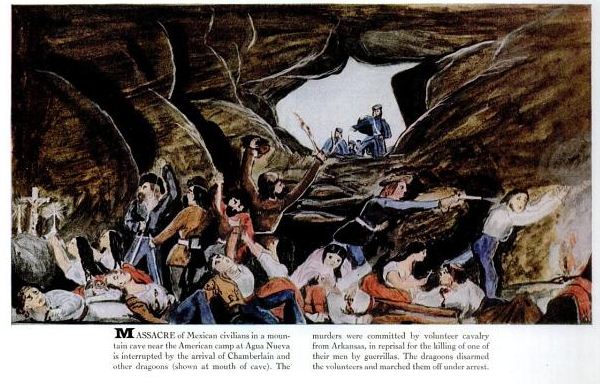
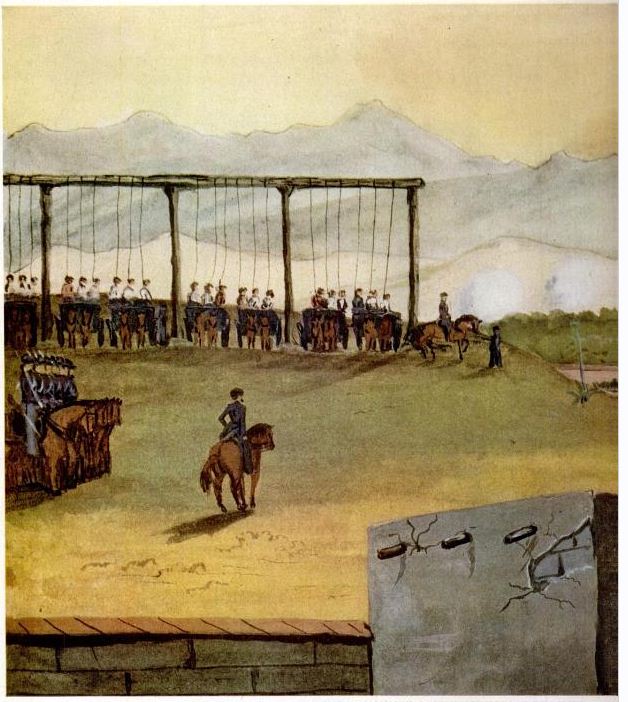
Content aside, Chamberlain’s prose also seems to presage McCarthy’s prose. In his book Different Travelers, Different Eyes, James H. Maguire notes that, “Both venereal and martial, the gore of [Chamberlain’s] prose evokes Gothic revulsion, while his unschooled art, with its stark architectural angles and leaden, keen-edged shadows, can chill with the surreal horrors of the later Greco-Italian painter Giorgio de Chirico.” Yes, Chamberlain was an amateur painter (find his paintings throughout this post), and undoubtedly some of this imagery crept into Blood Meridian.

You can view many of Chamberlain’s paintings and read an edit of his Confession in three editions of Life magazine from 1956, digitally preserved thanks to Google Books–here’s Part I, Part II, and Part III. Many critics have pointed out that Chamberlain’s narrative, beyond its casual racism and sexism, is rife with factual and historical errors. He also apparently indulges in the habit of describing battles and other events in vivid detail, even when there was no way he could have been there. No matter. The ugly fact is that books are made out of books, after all, and if Chamberlain’s Confession traffics in re-appropriating the adventure stories of the day, at least we have Blood Meridian to show for his efforts.
Blood Meridian — Judge Holden on the Raising of Children

Cormac McCarthy’s Blood Meridian is larded with strange little pockets of the black humor, humor so black that it’s hard to catch on the first or second reading. Re-reading the book again this week, I was struck by how funny a passage in Chapter XI is. The passage comes immediately after one of the more confounding moments of the book. Judge Holden, the giant, malevolent, Mephistophelean antagonist who dominates the narrative, has just told a puzzling parable about a harness maker who commits a murder and then begs for his son’s forgiveness. It’s a strange story and I’m not sure exactly what it means. Anyway, after he tells this story, Tobin, the ex-priest asks the Judge, “So what is the way of raising a child?” Here’s the reply–

At a young age, said the judge, they should be put in a pit with wild dogs. They should be set to puzzle out from their proper clues the one of three doors that does not harbor wild lions. They should be made to run naked in the desert until…

Hold on now, said Tobin. The questions was put in all earnestness.

And the answer, man, said the judge. If God meant to interfere in the degeneracy of mankind, would he not have done so by now? Wolves cull themselves, man. What other creature could? And is the race of man not more predacious yet?

The humor of the Judge’s initial, concrete answer rests on the fact that it is wholly earnest: even in his bizarre, hyperbolic surrealism, the judge is serious. Pits, wild dogs, wild lions. Running naked in the desert. That’s how kids should be raised. The move to the abstract–to highlight humanity’s predatory instincts–is a retreat from humor to philosophy, a pattern that McCarthy repeats in the novel. The effect stuns the impulse to find humor in the language. Humor cannot sustain throughout the narrative, even though it is present.

Blood Meridian — The Open Yale Lectures

Dr. Amy Hungerford’s lectures on Cormac McCarthy’s Blood Meridian are part of Yale University’s “Open Yale” series. The lectures were originally presented as part of ENGL 291, The American Novel Since 1945. From the course description–

In this first of two lectures on Blood Meridian, Professor Hungerford walks us through some of the novel’s major sources and influences, showing how McCarthy engages both literary tradition and American history, and indeed questions of origins and originality itself. The Bible, Moby-Dick, Paradise Lost, the poetry of William Wordsworth, and the historical narrative of Sam Chamberlain all contribute to the style and themes of this work that remains, in its own right, a provocative meditation on history, one that explores the very limits of narrative and human potential.

And again–

In this second lecture on Blood Meridian, Professor Hungerford builds a wide-ranging argument about the status of good and evil in the novel from a small detail, the Bible the protagonist carries with him in spite of his illiteracy. This detail is one of many in the text that continually lure us to see the kid in the light of a traditional hero, superior to his surroundings, developing his responses in a familiar narrative structure of growth. McCarthy’s real talent, and his real challenge, Hungerford argues, is in fact to have invoked the moral weight of his sources–biblical, literary, and historical–while emptying them of moral content. Much as the kid holds the Bible an object and not a spiritual guide, McCarthy seizes the material of language–its sound, its cadences–for ambiguous, if ambitious, ends.

David Foster Wallace on Blood Meridian

David Foster Wallace on Cormac McCarthy’s Blood Meridian: “Don’t even ask.” From his 1999 piece in Salon, “Five direly underappreciated U.S. novels > 1960.”

Win a Copy of Blood Meridian

Biblioklept wants to give you a copy of Random House’s new 25th anniversary edition of Cormac McCarthy’s Blood Meridian. But you’ll have to earn it because if Blood Meridian teaches us anything (beyond spitting and scalping and riding on), it’s that existence costs. So, if you’d like one to win a handsome new hardback, send us a postcard–the most Blood Meridianish one you can muster. (Do not put blood or anything like blood on the postcard. Seriously). If you’re a fan of the book, include a favorite quote. If you’ve never read it before, let us know why you want to read it. Email us at biblioklept.ed at gmail dot com to get our snail mail address (please make “Blood Meridian contest” the subject of your email). The sender of our favorite postcard will receive a copy of the book, courtesy Biblioklept and Random House. Contest closes October 12, 2010 and is limited to addresses in the continental US.

James Wood (Is Wrong) on Blood Meridian

Critic James Wood wrote extensively about Cormac McCarthy’s Blood Meridian in his 2005 essay for The New Yorker, “Red Planet.” Here’s his lede–

To read Cormac McCarthy is to enter a climate of frustration: a good day is so mysteriously followed by a bad one. McCarthy is a colossally gifted writer, certainly one of the greatest observers of landscape. He is also one of the great hams of American prose, who delights in producing a histrionic rhetoric that brilliantly ventriloquizes the King James Bible, Shakespearean and Jacobean tragedy, Melville, Conrad, and Faulkner.

Wood later details McCarthy’s gift as “one of the greatest observers of landscape”–

“Blood Meridian” is a vast and complex sensorium, at times magnificent and at times melodramatic, but nature is almost always precisely caught and weighed: in the desert, the stars “fall all night in bitter arcs,” and the wolves trot “neat of foot” alongside the horsemen, and the lizards, “their leather chins flat to the cooling rocks,” fend off the world “with thin smiles and eyes like cracked stone plates,” and the grains of sand creep past all night “like armies of lice on the move,” and “the blue cordilleras stood footed in their paler image on the sand like reflections in a lake.”

Wood then goes about attempting to explain his problems with McCarthy the “ham” who produces “histrionic rhetoric” —

[McCarthy’s] prose opens its lungs and bellows majestically, in a concatenation of Melville and Faulkner (though McCarthy always sounds more antique, and thus antiquarian, than either of those admired predecessors).  . . .

It is a risky way of writing, and there are times when McCarthy, to my ear, at least, sounds merely theatrical. He has a fondness for what could be called analogical similes, in which the linking phrase “like some” introduces not a visual likeness but a hypothetical and often abstract parallel: “And he went forth stained and stinking like some reeking issue of the incarnate dam of war herself.” . . .

The danger is not just melodrama but imprecision and, occasionally, something close to nonsense. . . .

The inflamed rhetoric of “Blood Meridian” is problematic because it reduces the gap between the diction of the murderous judge and the diction of the narration itself: both speak with mythic afflatus. “Blood Meridian” comes to seem like a novel without internal borders.

So, Blood Meridian doesn’t meet the standard of Wood’s cherished “free indirect style,” where an author subtly shifts into a character’s voice. Wood craves these delicate internal borders. He can’t bear the idea that the towering figure of Judge Holden might come to ventriloquize the novel. It is worth noting here that Wood frequently extols the free indirect styles of Marcel Proust and Henry James–two authors McCarthy dismissed in a 1992 interview with The New York Times, saying “I don’t understand them . . . that’s not literature.”  Wood values a mannered precision of realism that McCarthy openly professes little interest in; rather, McCarthy uses a mythic, amplified, and at times grandiose style in Blood Meridian to explore issues of life and death. And Wood is perhaps not wrong here. At times Blood Meridian edges into bombast, although I believe McCarthy controls his language more than Wood allows. In either case, McCarthy’s language is ripe for parody, as exemplified in this clip from Wes Anderson’s 2001 film The Royal Tenenbaums

I would be happy to leave Wood’s criticism of Blood Meridian and McCarthy alone at this point. Fine, Wood doesn’t like it when McCarthy goes balls-to-the-wall; whatever. But at the end of “Red Planet” Wood turns to attacking McCarthy’s perceived failure to vindicate God’s goodness in the face of evil. Wood here (and elsewhere, always elsewhere) shows his deep conservatism. Wood necessitates that all literature reveal a platonic center, a stable, beating heart that must also be a platonic good. Here he is, griping about McCarthy’s “metaphysical cheapness”–

Like most writers committed to pessimism, McCarthy is never very far from theodicy. Relentless pain, relentlessly displayed, has a way of provoking metaphysical complaint. . . .

But McCarthy stifles the question of theodicy before it can really speak. His myth of eternal violence—his vision of men “invested with a purpose whose origins were antecedent to them”—asserts, in effect, that rebellion is pointless because this is how it will always be. Instead of suffering, there is represented violence; instead of struggle, death; instead of lament, blood.

If Wood finds only a nihilism in Blood Meridian (and the rest of McCarthy’s oeuvre) that he fundamentally disagrees with, he should simply say so. Instead, Wood demands that Blood Meridian be a theodicy and then condemns it for not being one. He shamefully attempts to hold the work to a radically subjective rubric that cannot be answered. Put another way, the failure that Wood finds in Blood Meridian is a failure to answer to a version of God–and God’s judgment–that Wood would like to believe in (or, more accurately, be comforted by).

Wood is a bully (of both authors and readers) whose criticisms rarely enlarge the works they seek to address. We see his program at work in “Red Planet,” where his aim is to deflate Blood Meridian’s giant language and not appraise it on its own terms. That the book survives–and thrives–despite Wood’s criticism is hardly surprising; that a critical conversation of Blood Meridian should include Wood is depressing.

Blood Meridian — Cormac McCarthy

Blood Meridian is a blood-soaked, bloodthirsty bastard of a book, and certainly the most violent piece of literature I’ve read outside of the Bible and certain Greek tragedies. Cormac McCarthy’s 1985 novel passes itself off as a Western–and it is a Western, to be sure–but more than anything, it’s a brutal horror story.

Set predominantly in the 1850s, Blood Meridian chronicles the westward journey of a protagonist we know only as “the kid.” After a few false starts (including getting shot, robbed, arrested, and surviving a Comanche massacre) the kid eventually meets up with John Joel Glanton‘s “expedition”–a group of men of mixed backgrounds hired by Mexican authorities to kill–and scalp–the nomadic Apache who prey upon Mexican villages. However, led by the nefarious, larger-than-life Judge Holden, Glanton’s gang quickly descends into a relentless robbing, raping, and killing spree; they savagely massacre peaceful Indian settlements along with the Mexican villages they were contracted to protect.

I could keep summarizing the book, but I don’t see the point, honestly–a mere description of the plot could never do real justice to the weight of this book. The narrative is taut and fast-paced–in fact, at points the action is so radically condensed that I had to go back and re-read sections–and there’s no shortage of the “men doing men stuff” that McCarthy is so good at detailing–but it’s really the combination of the book’s evocative imagery and philosophical pondering that hook the reader.

Most of that philosophical pondering comes from the Judge, who waxes heavy on everything from space aliens to metallurgy. In his parables and aphorisms, the Judge comes across as part-Mephistophelean, part-Nietzschean, all dark wisdom and irreverent chaos. I found myself re-reading the Judge’s speeches several times and chewing them over, trying to digest them; for me, they were the best part of a great book.

Blood Meridian, like most excellent things, is simply not for everyone, and I don’t mean that in any snobbish, elitist sense. Any reader turned off by its freewheeling violence would be justified, and I’m sure plenty of folks out there would take issue with its ambiguous conclusion. Depictions of genocidal mania that seem to end inconclusively are not for everyone, particularly when they are rife with archaisms, untranslated Spanish, and McCarthy’s signature apostrophe-free punctuation. I had two false starts with the novel, including one where, at about exactly half way through, I realized I had to go back and start the novel again. I owed it that much. And it was worth it.

Blood Meridian is literally stunning; perhaps the best analogy I can think of is going to see a really, really good band that plays really, really brutal and strange music that sorta melts your face off. After the show you’re sweaty and exhilarated and even unnerved; your ears are ringing and your chest is pounding. And then the band packs up, and the house lights go on, and they pump in music from a CD, of all things, and the music just sounds tinny and pale and blanched of life after the raw power you’ve witnessed. Reading anything else right after finishing Cormac McCarthy’s Blood Meridian, or the Evening Redness in the West is sort of like that. Highly recommended.

[Editorial note–Biblioklept originally published this review on April 6th, 2008. We’re running it again as part of a week of coverage celebrating Blood Meridian’s 25th anniversary].

“The Dungeon Master” — Sam Lipsyte

Read “The Dungeon Master,” a new story from Biblioklept fave Sam Lipsyte (from The New Yorker). From the story–

The Dungeon Master has detention. We wait at his house by the county road. The Dungeon Master’s little brother Marco puts out corn chips and orange soda.

Marco is a paladin. He fights for the glory of Christ. Marco has been many paladins since winter break. They are all named Valentine, and the Dungeon Master makes certain they die with the least possible amount of dignity.

It’s painful enough when he rolls the dice, announces that a drunken orc has unspooled some Valentine’s guts for sport. Worse are the silly accidents. One Valentine tripped on a floor plank and cracked his head on a mead bucket. He died of trauma in the stable.

“Take it!” the Dungeon Master said that time. Spit sprayed over the top of his laminated screen. “Eat your fate,” he said. “Your thread just got the snippo!”

The Dungeon Master has a secret language that we don’t quite understand. They say he’s been treated for it.

Blood Meridian — 25th Anniversary Edition

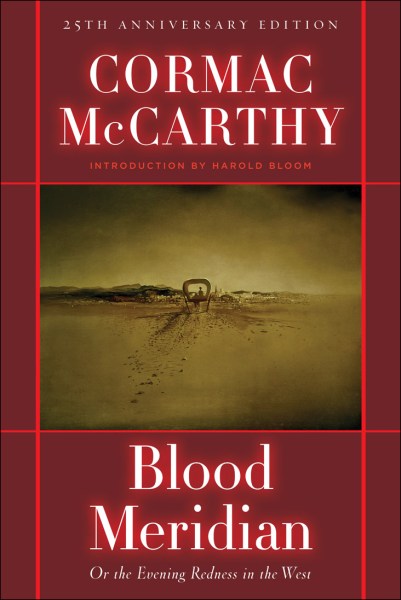
This week, Random House celebrates the 25th anniversary of Cormac McCarthy’s masterpiece Blood Meridian by releasing a new hardback edition of the book. This new Modern Library version retains Harold Bloom’s now-oft-cited introductory essay and features a new cover design by Richard Adelson that echoes the first edition and restores its original art work, The Phantom Cart by Salvador Dali. Here is the new cover–

The release of this new edition and the book’s anniversary give us a great excuse to declare the next five days Blood Meridian Week on Biblioklept. (Yes, we know that it’s also Banned Books Week this week. But celebrating Blood Meridian seems to gel with that). We’ll re-run our original review, take a look at what different critics have had to say about the book, quote some of our favorite passages at length, share some of the better resources at large for tackling this often difficult book, examine some of the history behind it, and generally laud it for its horrifying excellence. We’ll also be giving away a copy of the new 25th anniversary edition to one lucky reader, so keep your eyes peeled for details.

Leo Tolstoy’s Death Mask

William Burroughs’s Blowdarts

(Via).

JG Ballard on William Burroughs

We continue to raid The Paris Review’s interview archive. Here’s J.G. Ballard on William Burroughs, in a 1984 interview–

INTERVIEWER: Burroughs wrote an eccentric and laudatory, in its way, introduction to the American edition of Atrocity Exhibition. Do you know him?

BALLARD: Burroughs, of course, I admire to the other side of idolatry, starting with Naked Lunch, then Ticket, Soft Machine, and Nova Express. I’m less keen on his later books. In his way he’s a genius. It’s a pity that his association with drugs and homosexuality has made him a counterculture figure, but I suppose his real links are with Jack Kerouac, Allen Ginsberg, and the Beats. Still, I think he’s much more of an establishment figure, like Dean Swift, with a despairing disgust for the political and professional establishments of which he is a part. I have met Burroughs quite a few times over the last fifteen years, and he always strikes me as an upper-class Midwesterner, with an inherent superior attitude towards blacks, policemen, doctors, and small-town politicians, the same superior attitude that Swift had to their equivalents in his own day, the same scatological obsessions and brooding contempt for middle-class values, thrift, hard work, parenthood, et cetera, which are just excuses for petit-bourgeois greed and exploitation. But I admire Burroughs more than any other living writer, and most of those who are dead. It’s nothing to do with his homosexual bent, by the way. I’m no member of the “homintern,” but a lifelong straight who prefers the company of women to most men. The few homosexual elements in Crash and Atrocity Exhibition, fucking Reagan, et cetera, are there for reasons other than the sexual—in fact, to show a world beyond sexuality, or, at least beyond clear sexual gender