Book Acquired, 8.25.11

20110825-023856.jpg

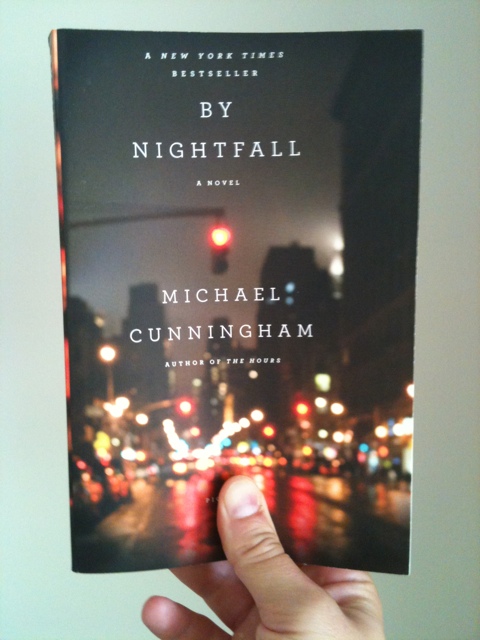
In the mail today: Michael Cunningham’s By Nightfall, in trade paperback from the good folks at Picador. From novelist Jeanette Winterson’s review of the hardback edition, printed last year in the NYT

Cunningham has taken on the classic plot of the uninvited or unexpected stranger or guest whose arrival brings chaos, self-knowledge, tragedy, the ruin of one kind of life that may or may not lead to something better. It’s a story we know from variants as classic as Shakespeare’s “Twelfth Night” to Mark Twain’s “Mysterious Stranger” to contemporary versions like “The Accidental” by Ali Smith. Cunningham is drawn to simple, potent plots (think of the triptych in “The Hours”), saving his energy for the hearts and minds, the groins and guts, of his characters. Yet he makes you turn the pages. He tells a story here, but not too much of a story. You aren’t deadened by detail; you’re eager to know what happens next.

Cunningham writes so well, and with such an economy of language, that he can call up the poet’s exact match. His dialogue is deft and fast. The pace of the writing is skilled — stretched or contracted at just the right time. And if some of the interventions on art are too long — well, too long for whom? For what? Good novels are novels that provoke us to argue with the writer, not just novels that make us feel magically, mysteriously at home.A novel in which everything is perfect is a waxwork. A novel that is alive is never perfect.

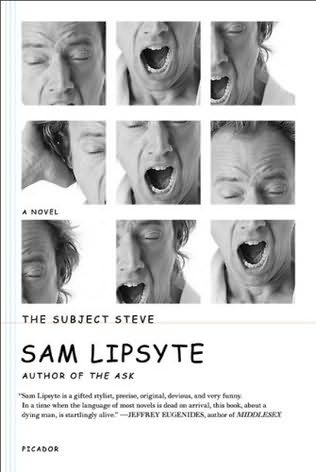
Win a Copy of Sam Lipsyte’s Debut Novel The Subject Steve

To promote their new edition of Sam Lipsyte’s first novel The Subject Steve, Picador will give away two copies of the book to two lucky Biblioklept readers (U.S. addresses only). What do you have to do to win? Simply post your favorite line (0r consecutive lines) from a Lipsyte novel in the comments section of this post (limit yourself to one response of one cohesive quotation, please). An Esteemed Panel of Honorable Judges will select their favorites. We’ll announce winners next week.

Roberto Bolaño’s 2666 Revisited

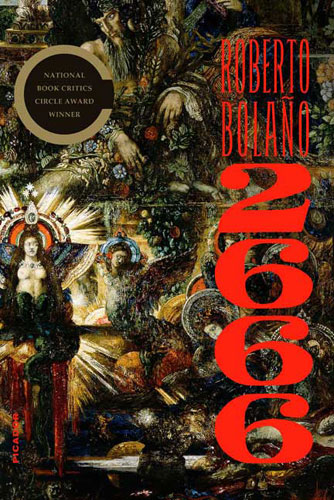
2666

Any bibliophile can attest that one of the greatest pleasures of re-reading a favorite book is that it doesn’t change. You change, but it doesn’t, and somehow, you can measure your own change against it. So when Picador’s new single-volume trade paperback edition of Roberto Bolaño’s magnum opus 2666 (out today) showed up at my doorstep a week or two ago, I was thrilled. I already own the book, but having another copy of it, for some reason–no logical reason, of course–seemed really important. It also puts 2666 in good company: I own two (or more) copies of Moby-Dick and Ulysses, and I’ve had to buy at least three copies of David Foster Wallace’s Infinite Jest (damn biblioklepts don’t return books). I bought FS&G’s triple trade paperback edition of the book at the end of last year, and I loved it loved it loved it (review here if you don’t believe me). So how does the new single-volume edition differ, you ask? Well, first off, it’s important to note the gracious similarities–Picador’s edition retains the same pagination, a trend that I hope will always continue with this book (editions of Infinite Jest have managed to keep cohesive to date as well). The new trade paperback is surprisingly supple and portable, with wider margins than the FS&G triple-job. With more room for marginalia in the cohesive package of a single volume, Picador’s edition will likely be the go-to for scholars and book clubs (it’s also about half the retail price of the FS&G editions, but just as attractive).

So, anyway, why should you read 2666 if you haven’t already? I’m going to be lazy and refer again to my original review, but I’ll also be generous and direct you to Macmillan’s resource site for 2666. The site already has plenty of great links to full reviews and interviews with Bolaño, and Picador’s publicists have assured me that they will be updating the site frequently with additional content to aid readers, including artwork and images. Also really cool — the folks at The Morning News, who host Infinite Summer, the Infinite Jest reading project, will launch a similar site for 2666 on January 1st of next year. Even though I’m pointing out all of these resource sites, I think it’s also important to note that 2666 is an incredibly readable book. Which leads back to my current re-reading–and, hopefully, to an argument why you should re-read 2666.

So I bought my original copy in San Francisco last year, on vacation, and began digging into it on the plane ride home. I read most of Part I, “The Part about the Critics” in something of a dazed post-hangover travel stupor. I was familiar with Bolaño’s epic sentences from The Savage Detectives, but I instantly liked this book better. It also seemed to defy all of my expectations–wasn’t this supposed to be an unremitting catalog of horrific murders? Anyway, I got to that part later. Fast forward ten months or so. Again, I’m on a plane, again, coming home, returning from Las Vegas, more dazed, more hungover than before, and I pick up 2666, and again, I dig into Part I. The book is a different book. Lines that made me crack up before seem sinister. I see murder where I’d seen academic squabbling. But there’s also that hope, that possibility, that force of humanity that might be Bolaño’s signature rhetorical move, and I see it too now. Upon a first reading, 2666 might seem impossibly incomplete: a book that could never end, a book that would have to keep going. And it is. It’s a cycle; it returns to itself, a series of calls and responses far richer than can be puzzled out over one, or two, (or three, or four . . . ) readings. But best of all, it’s great, greater than before. What might have seemed a fortunate fluke of a forceful voice reveals itself to be profound and measured control–Bolaño’s themes are layered like a labyrinth, but what a joyful labyrinth to traverse! Re-reading 2666 on the plane was a strange echo, doubled in the myriad echoes that I found on my re-reading. I finished most of Part I (skipping occasionally into sections of Part V, and then Part III, and so on, liberated all of a sudden), and when I got home, despite the paramount exhaustion of a long Las Vegas weekend with a few dozen friends, I collapsed in my bed and into the book, not wanting to put it down, staying up far too late reading. Again. Great stuff. Go get it if you haven’t yet, and if you’ve got it, read it again.
Chris Adrian, 9/11 Lit, Thomas Pynchon, Beach Reading and More

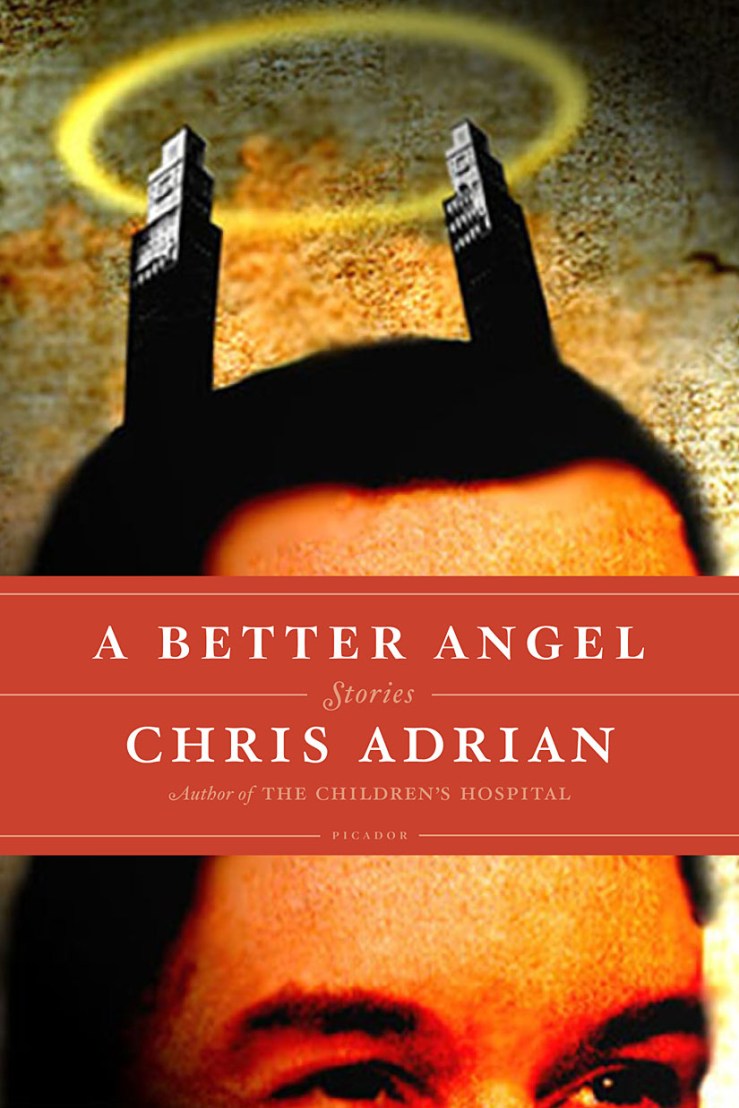
I’m about half way through two books right now: Chris Adrian’s A Better Angel, and Thomas Pynchon’s Inherent Vice. Pynchon’s latest novel–I’ll talk a little bit about it in a sec–comes out in hardback from Penguin August 4th. Picador will release the first trade paperback edition of Chris Adrian’s latest collection of short stories on August 3rd. I’m really digging A Better Angel so far, but before I talk about it, I just wanna shill for Picador. They put out really cool, great-looking books from really cool authors like Roberto Bolaño, J.G. Ballard, Denis Johnson, William Burroughs, and DJ Kool Herc, and they also have a sexy little imprint called BIG IDEAS//small books that puts out some killer jams. They’re also really nice about sending review copies. Shill shill shill. I’m a whore, but I’m an earnest whore.

Better Angel

Anyway. Back to Adrian. Just finished “The Vision of Peter Damien,” a 9/11 story set in what seems to be nineteenth century rural Ohio. Damien, and then the other children of his small rural community, catch an illness that gives them unexplained, vivid hallucinations of the 9/11 attacks on the World Trade Center towers. Adrian works in a mode of distortion throughout most of these stories so far, repeatedly employing metaphysical disruptions as well as playing with time and setting as a way of alienating his characters from each other and the reader. Adrian uses the temporal/metaphysical disruptions of “The Vision of Peter Damien” to respond to 9/11, creating an uncanny milieu for his readers. The cognitive dissonance here reminds me of other responses to 9/11, like DeLillo’s Falling Man, David Foster Wallace’s short story “The Suffering Channel,” and even Art Spiegelman’s In the Shadow of No Towers. Actually, Wallace’s essay “The View from Mrs. Thompson’s” does a really good job of capturing all the problems of witnessing to, understanding, reacting to (etc.) spectacular disaster. Adrian’s story recapitulates the same paradoxes, injecting a motif of illness and brotherhood, contagious decay and redemption that seems to run through all of the stories collected here. I don’t have a larger comment about literature’s response to 9/11 yet, but I think that it’s fascinating to watch such stories emerge and evolve. We’re still seeing the various shapes, tropes, strategies, etc. that authors will employ to tackle (or chip at, or remark upon, or even elide) such a big historical marker. Full review of A Better Angel at the end of this month.

inherent_vice

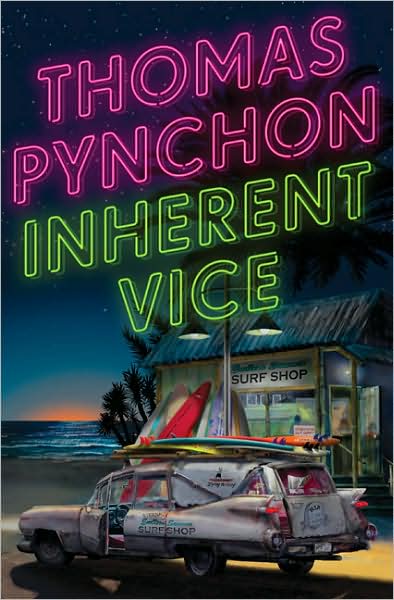
Far less serious is Pynchon’s new novel, Inherent Vice, a detective noir painted in day-glo psychedelic swirls. Doc Sportello, at the behest of his ex-, is searching for a missing real-estate billionaire in the dope-haze of late 60s/early 70s LA (it appears to be set in 1969, as there are repeated references to “living in the sixties and seventies”). Pynchon’s new novel is a hard-boiled detective mystery, a psychedelic caper, an LA story, a comment on the decline of idealism and the emergence of media-unreality at the end of the 60s (because we needed another story about the 60s!), and probably a shaggy dog tale. The cover has gotten some criticism for its decidedly unliterary look, and last March I called it “horrendous.” I take it back: the campy cover, with its neon shock and beach-as-pastoral-idyll is lovingly ironic, satire that does not announce itself as satire and is thus always open to a straight-reading. Just like Pynchon’s novel, the cover can be read as an homage to both Dashiell Hammett and Elmore Leonard (with a sly nod to all the Leonard ripoffs out there (glancing your way, Jimmy Buffett). As its cover suggests, this is a Pynchon book you can read breezily on a beach or airplane. Sure, it’s got the usual Pynchon trademarks–it’s overcrowded with zany, one-dimensional characters, it operates on a Looney Toons system of logic, it’s full of linguistic goofs–but it’s also incredibly easy to read (unlike, say, just about everything else Pynchon has ever written). It’s also a lot of fun. And to prove it’s a beach read, I’ll finish it this week at St.Augustine Beach, inebriated by strong margaritas and even stronger sun. Full review when I get back.

Tree of Smoke — Denis Johnson

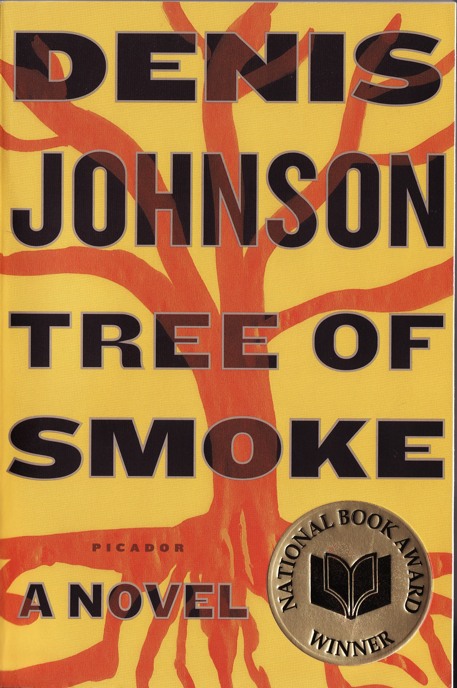
One year after it topped book critics’ best-of 2007 lists everywhere (including ours), Denis Johnson’s Vietnam War epic Tree of Smoke is finally available in a handsome trade-paperback. Picador’s edition retains the original orange and yellow cover, only now affixed with the proud blazon “National Book Award Winner.” However, that Tree of Smoke won this prestigious award no doubt ruffled a few feathers. It still remains an urgently divisive work.

Although plenty of critics and readers loved the novel, including The New York Times‘s Jim Lewis (who cautiously called it “something like a masterpiece”) and Michiko Kakutani, it has had more than its fair share of haters. Consider B.R. Myers’s downright mean review, “A Bright Shining Lie” in The Atlantic. Here, Myers displays the worst kind of vitriol. He’s the critic who feels the need not only to trumpet his hatred of the work he’s assessing, but also to lambaste the dignity, taste, and intellect of anyone who would disagree with him. Myers specifically attacks Johnson’s rhetorical style, his diction and syntax, and concludes that those idiots who would praise such inane, base, and clichéd language (idiots like me, that is) are clearly the cause of all current social and political problems and “have no right to complain about incoherent government.” Uh, sure. Myers’s baseless zealotry aside, it’s worth looking at the popular reception of Tree of Smoke, and what better place to do so than scouring Amazon reviews, right?

A cynic might say that Amazon reviews are the bottom-barrel of literary criticism, yet it’s still worth considering the almost perfectly mathematical split between 5- and 4-starred reviews of the book and 1- and 2-starred reviews (although none of the negative reviews I read on Amazon suggested that praising Johnson’s novel disenfranchised one from political opinions). Put simply, most people tend to either hate or love Tree of Smoke, which, I believe, is a sign of great art. And, were I inclined to inflate my rhetoric to a grandiose level like Myers, I might here wax philosophical about opinion, perspective, history, and the value of great art to ignite debate and discussion within the marketplace of ideas. However, I don’t think a book review is necessarily the best venue to make grand sweeping statements. At best, such writing presents a shallow or hollow endorsement of a collective truth (e.g. “Everyone assesses literature from their own perspective and therefore everyone values books differently”); at worst–in the case of Myers’s grotesque review–we get a pompous, overblown, self-important declaration (here, praising Tree of Smoke = losing the ability to authoritatively comment on society or politics) that can only be supported within the limited rhetorical bounds created the sophist has constructed (i.e. Myers’s review). But I’ve made a long digression, and, worse, I’ve failed to really discuss the book at all.

My initial review of Tree of Smoke last year was really a review of Will Patton’s masterful audio-recording of the novel (I was reading Ulysses for graduate school at the time and simply did not have the time to read both). I loved the experience; Patton did a great job, and I found myself wholly addicted to the narrative. When the advance copy of Tree showed up in the mail earlier this week, I immediately re-read the coda of the book in a single sitting. I would say the measure of a great narrative is not its core, its climax, or its beginning, but how well the conclusion is able to deliver the promises established throughout the book. Tree of Smoke delivers, and its ending continues to haunt the reader well after the book has been set aside. Readers like Myers may not get the payoff–he claims that “Johnson’s failure to understand [his character’s] faith is such that when he uses it to end the novel on an uplifting note, the reader feels nothing.” However, I hardly think that a watery Hallmark-word like “uplifting” properly connotes the weight, pathos, and sheer pain that Johnson conveys and addresses at the end of the book (Myers’s shallow diagnosis leads me to believe he merely skimmed the novel). Ethics of literary criticism aside, the real triumph of Tree of Smoke is simply that Johnson manages to comment in a new way on a subject that, by 2007, had been done to death. Who knew that we needed another story about the Vietnam War? Denis Johnson, apparently. Read the book for yourself. Very highly recommended.

Tree of Smoke is available in paperback from Picador on 2 September, 2008.

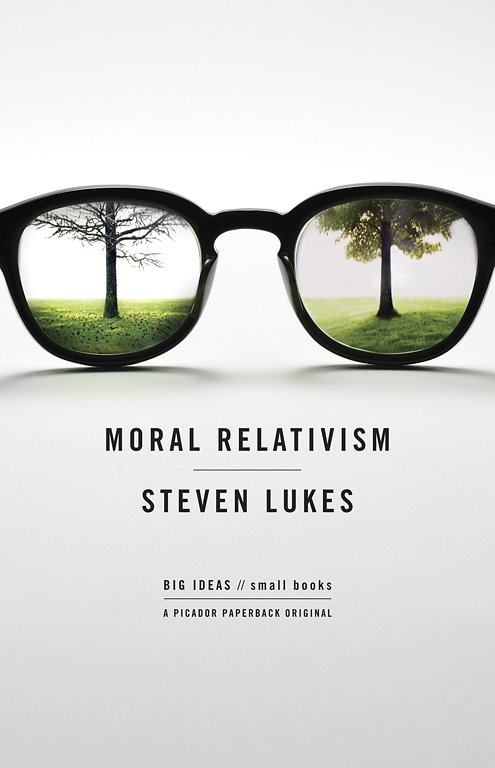
Moral Relativism — Steven Lukes

Moral relativism is the belief that ideals of right and wrong and good and bad are contextually determined by one’s local culture, as opposed to a theory of morality that holds that good and bad exist as absolute, metaphysical values existing cross-culturally, values intrinsic to one’s humanness. At the same time, individuals, even those (sometimes especially those) who see moral relativism as the overwhelmingly rational, sensical position, nonetheless are inextricably tied to their own sense of right and wrong, and this sense often leads them into a position of judgment–and perhaps action–against, over, and/or in reaction to the perceived wrongs of other cultures and societies.

In his new book Moral Relativism, NYU sociology professor Steven Lukes employs an interdisciplinary approach to tackle one of the biggest sticking points of contemporary thought. Using a variety of methods including philosophy, anthropology, history, and literature, Lukes addresses the fundamental conflict of moral relativism: that what’s right and good in one’s own culture may not be right and good in another’s culture, yet a will remains to believe in ideals of universal human rights. Lukes uses a number of timely concrete examples, including female genital circumcision, Islamic fundamentalism, and mass immigration, to assess the costs and payoffs of holding a view that says that no absolute morality exists. Perhaps the most fascinating part of Moral Relativism is Lukes’s negotiation of Western (or globally Northern, as he saliently points out) human rights actions as an extension of colonialism, with the one-time colonists imposing their values–again–upon the one-time colonized.

Lukes concludes that “the question Who are we to judge other cultures? is a bad question.” Arguing that the “postcolonial and multicultural contexts of our time do not require us to see the discourse and practice of human rights as ethnocentric,” Lukes takes up a position–well-argued–that a moral fundamentalist might claim is simply a liberal humanist wanting to have his cake and eat it too. Which, of course, is the problem with the book. It’s a fantastic argument for moral relativism, one that points out that no one–no one–is absolutely relativist, and that, in fact, being a moral relativist entails recognizing that within cultures certain perceived absolutes exist. The idea that right and wrong are relative doesn’t mean that right and wrong are arbitrary or don’t exist–it simply means that ideals of right and wrong have to be reconstituted within different systems of social and cultural order. Yet Lukes’s book isn’t going to convince the types that need convincing. Still, those of us who think that moral relativism is simple common sense will find plenty of concrete, contemporary, real world ammunition here in case we feel like arguing with a–gasp–moral fundamentalist.

Moral Relativism, available now, is part of the new BIG IDEAS // small books series from Picador Books.