Tag: Poetry
“Dirge for Two Veterans” — Walt Whitman

“Prayer to Persephone” — Edna St. Vincent Millay

Robert Frost’s Handwritten Manuscript for “Stopping by Woods on a Snowy Evening”
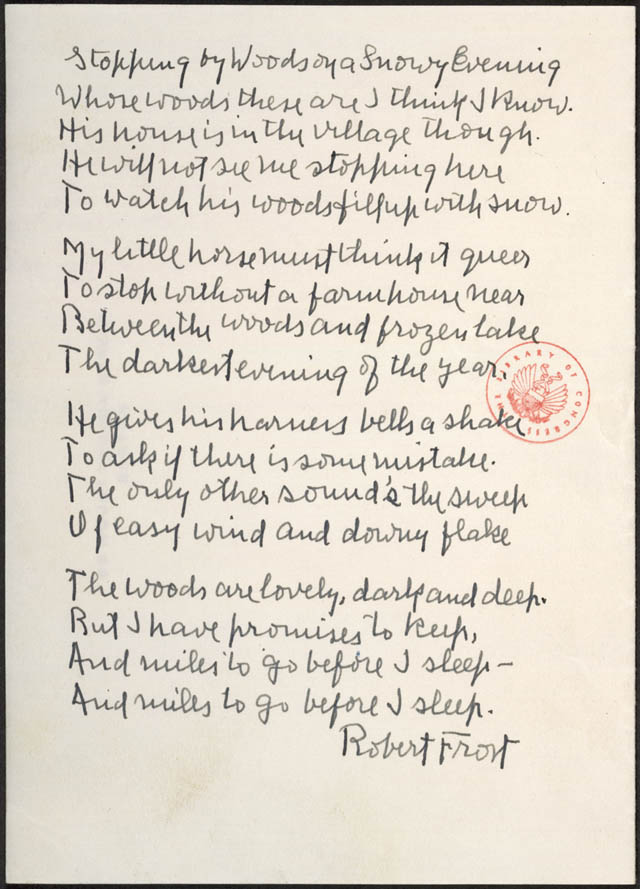
Whose woods these are I think I know.
His house is in the village though;
He will not see me stopping here
To watch his woods fill up with snow.My little horse must think it queer
To stop without a farmhouse near
Between the woods and frozen lake
The darkest evening of the year.He gives his harness bells a shake
To ask if there is some mistake.
The only other sound’s the sweep
Of easy wind and downy flake.The woods are lovely, dark and deep.
But I have promises to keep,
And miles to go before I sleep,
And miles to go before I sleep.
Document via the Library of Congress.
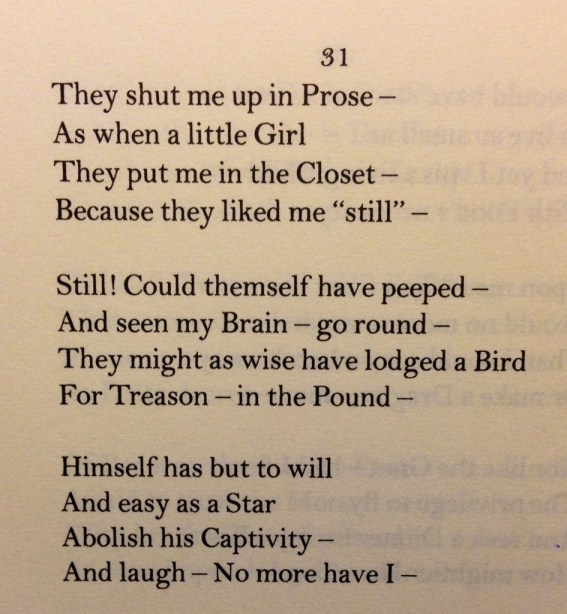
“They shut me up in Prose–” — Emily Dickinson
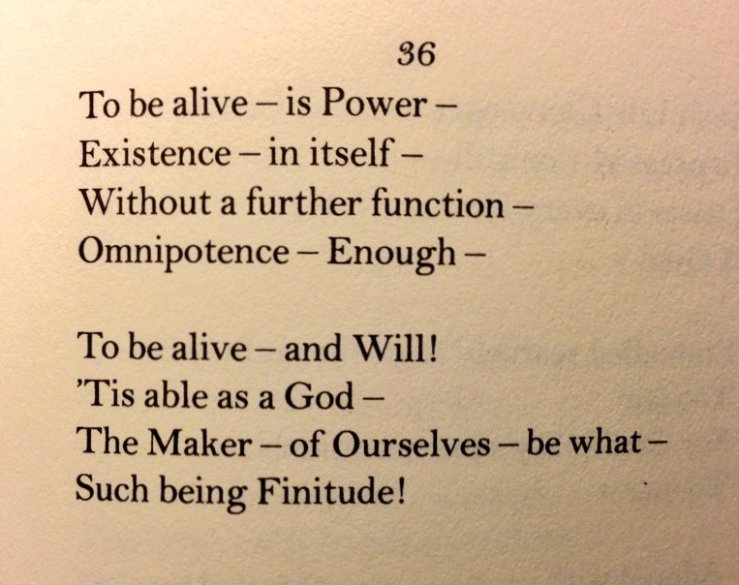
To be alive — is Power — (Emily Dickinson)
The Inferno, Canto 13 — Gustave Doré

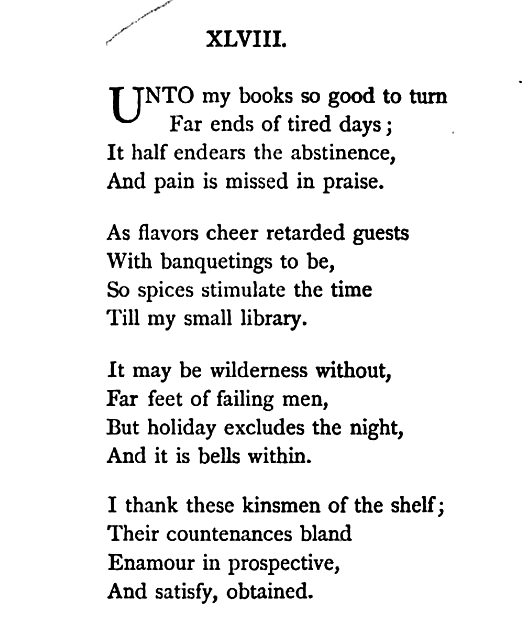
“Unto my books so good to turn” — Emily Dickinson
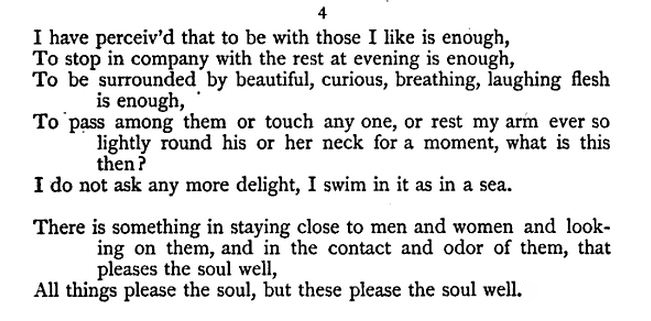
“I do not ask any more delight” (Walt Whitman)
“Walt Whitman” — Willa Cather
“Walt Whitman” by Willa Cather
Speaking of monuments reminds one that there is more talk about a monument to Walt Whitman, “the good, gray poet.” Just why the adjective good is always applied to Whitman it is difficult to discover, probably because people who could not understand him at all took it for granted that he meant well. If ever there was a poet who had no literary ethics at all beyond those of nature, it was he. He was neither good nor bad, any more than are the animals he continually admired and envied. He was a poet without an exclusive sense of the poetic, a man without the finer discriminations, enjoying everything with the unreasoning enthusiasm of a boy. He was the poet of the dung hill as well as of the mountains, which is admirable in theory but excruciating in verse. In the same paragraph he informs you that, “The pure contralto sings in the organ loft,” and that “The malformed limbs are tied to the table, what is removed drop horribly into a pail.” No branch of surgery is poetic, and that hopelessly prosaic word “pail” would kill a whole volume of sonnets. Whitman’s poems are reckless rhapsodies over creation in general, some times sublime, some times ridiculous. He declares that the ocean with its “imperious waves, commanding” is beautiful, and that the fly-specks on the walls are also beautiful. Such catholic taste may go in science, but in poetry their results are sad. The poet’s task is usually to select the poetic. Whitman never bothers to do that, he takes everything in the universe from fly-specks to the fixed stars. His “Leaves of Grass” is a sort of dictionary of the English language, and in it is the name of everything in creation set down with great reverence but without any particular connection.
But however ridiculous Whitman may be there is a primitive elemental force about him. He is so full of hardiness and of the joy of life. He looks at all nature in the delighted, admiring way in which the old Greeks and the primitive poets did. He exults so in the red blood in his body and the strength in his arms. He has such a passion for the warmth and dignity of all that is natural. He has no code but to be natural, a code that this complex world has so long outgrown. He is sensual, not after the manner of Swinbourne and Gautier, who are always seeking for perverted and bizarre effects on the senses, but in the frank fashion of the old barbarians who ate and slept and married and smacked their lips over the mead horn. He is rigidly limited to the physical, things that quicken his pulses, please his eyes or delight his nostrils. There is an element of poetry in all this, but it is by no means the highest. If a joyous elephant should break forth into song, his lay would probably be very much like Whitman’s famous “song of myself.” It would have just about as much delicacy and deftness and discriminations. He says:
“I think I could turn and live with the animals. They are so placid and self-contained, I stand and look at them long and long. They do not sweat and whine about their condition. They do not lie awake in the dark and weep for their sins. They do not make me sick discussing their duty to God. Not one is dissatisfied nor not one is demented with the mania of many things. Not one kneels to another nor to his kind that lived thousands of years ago. Not one is respectable or unhappy, over the whole earth.” And that is not irony on nature, he means just that, life meant no more to him. He accepted the world just as it is and glorified it, the seemly and unseemly, the good and the bad. He had no conception of a difference in people or in things. All men had bodies and were alike to him, one about as good as another. To live was to fulfil all natural laws and impulses. To be comfortable was to be happy. To be happy was the ultimatum. He did not realize the existence of a conscience or a responsibility. He had no more thought of good or evil than the folks in Kipling’s Jungle book.
And yet there is an undeniable charm about this optimistic vagabond who is made so happy by the warm sunshine and the smell of spring fields. A sort of good fellowship and whole-heartedness in every line he wrote. His veneration for things physical and material, for all that is in water or air or land, is so real that as you read him you think for the moment that you would rather like to live so if you could. For the time you half believe that a sound body and a strong arm are the greatest things in the world. Perhaps no book shows so much as “Leaves of Grass” that keen senses do not make a poet. When you read it you realize how spirited a thing poetry really is and how great a part spiritual perceptions play in apparently sensuous verse, if only to select the beautiful from the gross.
Nebraska State Journal, January 19, 1896
“The Philosophy of Composition” — Edgar Allan Poe
“The Philosophy of Composition” by Edgar Allan Poe
Charles Dickens, in a note now lying before me, alluding to an examination I once made of the mechanism of Barnaby Rudge, says—”By the way, are you aware that Godwin wrote his Caleb Williams backwards? He first involved his hero in a web of difficulties, forming the second volume, and then, for the first, cast about him for some mode of accounting for what had been done.”
I cannot think this the precise mode of procedure on the part of Godwin—and indeed what he himself acknowledges is not altogether in accordance with Mr. Dickens’s idea—but the author of Caleb Williams was too good an artist not to perceive the advantage derivable from at least a somewhat similar process. Nothing is more clear than that every plot, worth the name, must be elaborated to its dénouement before anything be attempted with the pen. It is only with the dénouement constantly in view that we can give a plot its indispensable air of consequence, or causation, by making the incidents, and especially the tone at all points, tend to the development of the intention.
There is a radical error, I think, in the usual mode of constructing a story. Either history affords a thesis—or one is suggested by an incident of the day—or, at best, the author sets himself to work in the combination of striking events to form merely the basis of his narrative—-designing, generally, to fill in with description, dialogue, or autorial comment, whatever crevices of fact or action may, from page to page, render themselves apparent.
I prefer commencing with the consideration of an effect. Keeping originality always in view—for he is false to himself who ventures to dispense with so obvious and so easily attainable a source of interest—I say to myself, in the first place, “Of the innumerable effects or impressions of which the heart, the intellect, or (more generally) the soul is susceptible, what one shall I, on the present occasion, select?” Having chosen a novel first, and secondly, a vivid effect, I consider whether it can be best wrought by incident or tone—whether by ordinary incidents and peculiar tone, or the converse, or by peculiarity both of incident and tone—afterwards looking about me (or rather within) for such combinations of events or tone as shall best aid me in the construction of the effect.
I have often thought how interesting a magazine paper might be written by any author who would—that is to say, who could—detail, step by step, the processes by which any one of his compositions attained its ultimate point of completion. Why such a paper has never been given to the world, I am much at a loss to say—but perhaps the autorial vanity has had more to do with the omission than any one other cause. Most writers—poets in especial—prefer having it understood that they compose by a species of fine frenzy—an ecstatic intuition—and would positively shudder at letting the public take a peep behind the scenes, at the elaborate and vacillating crudities of thought—at the true purposes seized only at the last moment—at the innumerable glimpses of idea that arrived not at the maturity of full view—at the fully-matured fancies discarded in despair as unmanageable—at the cautious selections and rejections—at the painful erasures and interpolations,—in a word, at the wheels and pinions, the tackle for scene-shifting, the step-ladders and demon-traps, the cock’s feathers, the red paint, and the black patches, which, in ninety-nine cases out of the hundred, constitute the properties of the literary histrio. Continue reading ““The Philosophy of Composition” — Edgar Allan Poe”
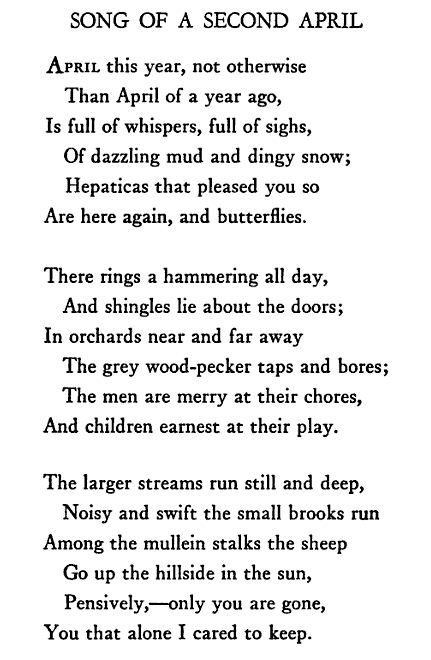
“Song of a Second April” — Edna St. Vincent Millay
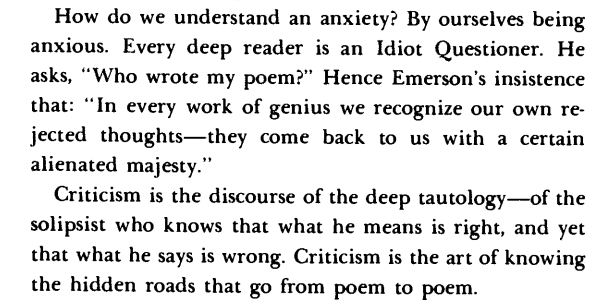
Every deep reader is an Idiot Questioner (Harold Bloom)
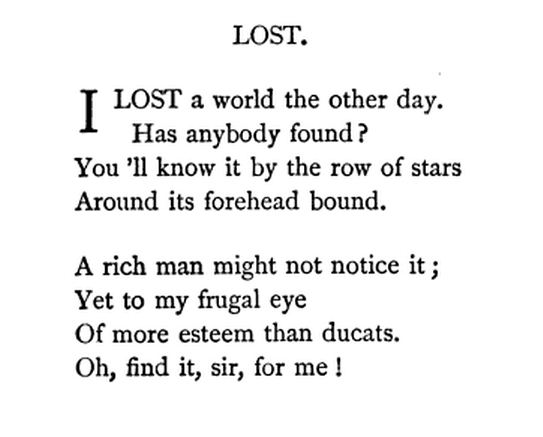
“I lost a World the other day” — Emily Dickinson
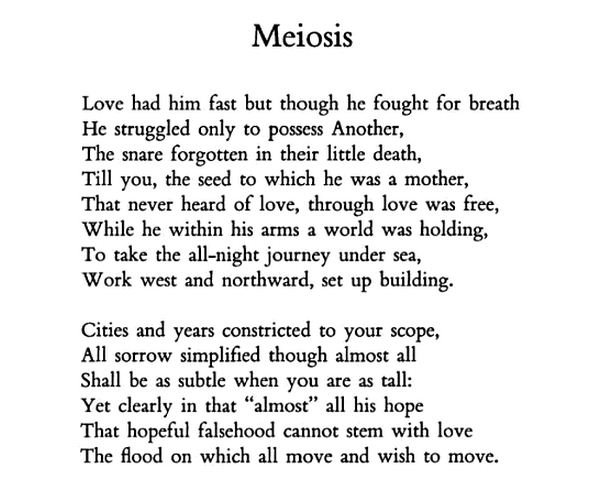
“Meiosis” — W.H. Auden
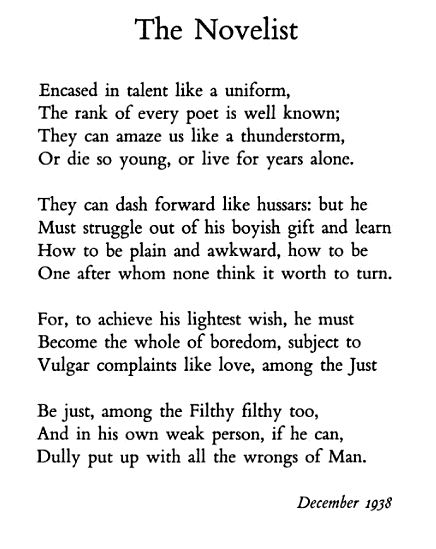
“The Novelist” — W.H. Auden
“I like a look of agony” — Emily Dickinson

 Biblioklept