They’re a bunch of bloodsucking bastards | Check out this longassed profile of Alan Moore

“Why’d you fall out with DC comics?”

“Because they’re a bunch of bloodsucking bastards, quite frankly,” is the kinda thing he tends to say. He’ll clarify that the comic book medium is “perfect,” it is “sublime,” whereas the comics industry is “a dysfunctional hellhole” that “hasn’t had any new ideas in 20 or 30 years,” that it’s run by “sub-human” thieves who employ the same “gangster ethics” by which DC “bought” the rights for Superman off its teen creators, Jerry Siegel and Joe Schuster, for $130.

“I pretty much detest the comics industry” is the gist, most recently for what they’ve done to popular culture and democracy with the Marvel Cinematic Universe and . . . whatever it is that DC’s up to. Moore’s been saying for years that he sees a harbinger of fascism in how young adults flock to see these “franchised übermenschen” zipping across the screen, and yes, he’s also mindful of the fact that he’s basically the cause of all this.

There were a lot of quotes I could’ve pulled from Alexander Sorondo’s new profile of Alan Moore at The Metropolitan Review — getting expelled for selling acid, falling in love with David Foster Wallace, accidentally conjuring the Persian math demon Asmodeus, etc. — but this is the one I chose. Check it out.

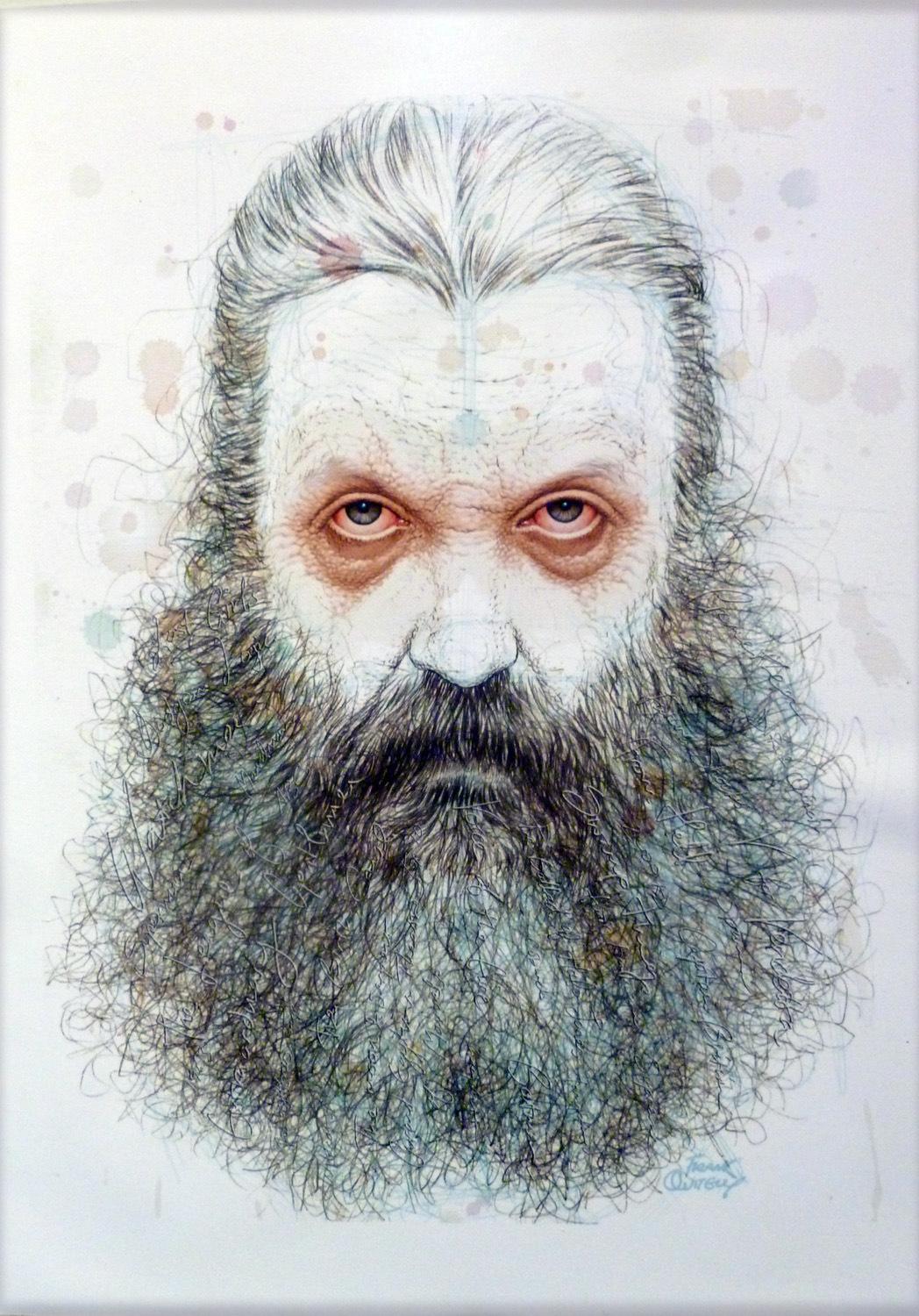
Portrait of Alan Moore, 2011, by Frank Quitely (b. 1968)

“The Last Untamed Writer in America,” another William T. Vollmann profile

Photograph of William Vollmann in his studio by Ian Bates

Late last week, The Wall Street Journal published “The Last Untamed Writer in America,” a profile of William T. Vollmann. The piece begins with its author Alexander Nazaryan politely refusing breakfast scotch from Vollmann, who is hosting Nazaryan at his studio (a converted Mexican restaurant):

It was breakfast time at the Sacramento, Calif., home of the novelist William T. Vollmann, which meant time for scotch. Out came two gold-colored shot glasses, modeled after 50-caliber rounds, a gift from a relative to the gun-loving writer. Despite gentle pressure, I stuck to my coffee, so Vollmann poured himself only a perfunctory nip of the Balvenie DoubleWood 12. “This will get me buzzed up,” Vollmann said. Then he added, ruefully, “I can hardly drink at all anymore.”

The piece has some interesting quips from Vollmann, but it doesn’t really expand on Alexander Sorondo’s long essay “The Last Contract: William T. Vollmann’s Battle to Publish an American Epic,” from this spring–notes on Vollmann’s cancer, getting dropped by his publisher Viking, and finding a home for his epic A Table for Fortune with Skyhorse, an iffy group that has published books by RF Kennedy Jr. and Alex Jones. A lot of the notes will be familiar with those tuned into the myth of the Vollmann (guns, drugs, sex, volume, etc.), but it’s kinda sorta interesting to see how the conservative Wall Street Journal frames Vollmann. They play up Vollmann’s enthusiasm for guns and note that he is not an author to be “cowed by sensitivity readers”; they even get a quote from him decrying “people who want trigger warnings.” And yet even when Vollmann professes a tinge of patriotism, he deflates it immediately:

“I love America because it’s my homeland, and I love Americans,” Vollmann says. “What I dislike is the whole hypocritical American exceptionalism. We do all these dirty, crummy things.”

There are some cool photos by Ian Bates accompanying the article, which you can read unpaywalled here.

Recognizing Gaddis

I first came to know William Gaddis at a writers’ conference in the Soviet Union in 1985. I had heard that he was shy and averse to publicity, but I found that this reputation was based only on his belief that a writer’s life and personality should be as little as possible associated with his work. As a conferee, he was both eloquent and precise.

Perhaps the most amusing contrast in our group was between him and Allen Ginsberg. Allen, shaggy and bearded, chanted his verse in loud, emotional tones as he pounded a species of accordion that he always carried with him. Will, on the other hand, reserved and quiet, impeccably clad, with the patient composure of a man of the world and the piercing eye of a wit, spoke in measured tones of the small sales that the serious novelist might expect.

If Danielle Steele counted her sales in the millions while he had to make do with a few thousands, he said, it was because she wrote books and he wrote ‘”literature.” Asked for pointers as to future conferences, he glanced obliquely down the table at Allen and suggested that the novelists and poets be separated, so that the accordion would be heard only “down a long corridor, through a closed door.”

Gaddis, who is considered by some critics to be the nearest thing to Herman Melville that our century has produced, who is almost a cult figure among students of English, is nonetheless not well-known to the wider reading public. His first two novels, The Recognitions and JR, published 20 years apart, in 1955 and 1975, frightened off many readers by their length, erudition and supposed ”difficulty.” But this difficulty is much exaggerated by symbol and ambiguity hunters (“What can I do if people insist I’m cleverer than I think I am?” Gaddis asks with a shrug), and length and erudition become virtues when the stories are as interesting as his.

Gaddis has more to say to American readers today than any other novelist I can think of. Take just three fields in which his knowledge is significant: theology, painting and corporate finance. Then consider the space devoted by the press in the 1980’s to religious strife and revivalism, to art sales and art frauds, to stock-market chicanery and insider trading. Some critics have credited me as a novelist with a degree of familiarity in the last-named field, but I have treated it only in broad outlines and with a minimum of legal details. Gaddis could almost qualify as an expert witness in the trial of a malefactor.

From “Recognizing Gaddis,” a longish profile of William Gaddis by novelist (and lawyer) Louis Auchincloss. “Recognizing Gaddis” was published in the 15 Nov. 1987 issue of The New York Times.

In which I read Playboy for the Thomas Pynchon article

A few years ago I posted a brief excerpt from Jules Siegel’s March 1977 Playboy profile “Who is Thomas Pynchon… And Why Did He Take Off With My Wife?” The excerpt came from an excerpt posted on the Pynchon-L forum, but most of the article had been removed at the (apparent) request by Siegel. A few people sent me the whole article though (thanks!) and I read it.
Screenshot 2015-05-01 at 8.54.40 AM

Jules Siegel was briefly a Cornell classmate of Pynchon’s in 1954, and they remained friends (in Siegel’s recollection) for at least two decades after. During this time, Siegel claims that Pynchon wrote him dozens of letters, which were ultimately sold at auction (along with much of Siegel’s property) to help pay for a hip replacement. Material from the letters soak into Siegel’s sketch of Pynchon’s progress, along with several stoned/drunken adventures that would not be out of place in V. or Mason & Dixon or Gravity’s Rainbow, or really, any person’s young life.

A competitive anxiety reverberates under the piece. “We were friends, maybe at some points best friends, very much alike in some important ways,” Siegel writes. “We were both writers,” he boldly writes. Siegel reminds us that “In Mortality and Mercy in Vienna, Pynchon’s first published short story, the protagonist is one Cleanth Siegel,” but protests he doesn’t see himself in that hero.

The competitive anxieties culminate in the big reveal that (spoiler!) Thomas Pynchon had an affair with Siegel’s second wife Chrissie. There’s probably a Freudian reading we can append to the details that Siegel offers about Pynchon’s sexual prowess: “He was a wonderful lover, sensitive and quick, with the ability to project a mood that turned the most ordinary surroundings into a scene out of a masterful film—the reeking industrial slum of Manhattan Beach would become as seen through the eye of Antonioni, for example.”

Or maybe these unsexy details are just a sign of Playboy’s editorial hand. Wedged gracelessly between ads for vibrators and nude greeting cards, Siegel’s lines often reek of 1970’s Playboy’s rhetorical house style, a kind of frank-but-(attempted)-sensual glossiness that contrasts heavily with Pynchon’s own sex writing. At times I found myself reading Siegel’s prose in one of Will Ferrell’s more pompous accents.

Even worse is the casual sexism of the piece—which again, may be attributable to Playboy’s editors. Siegel, on his first wife (sixteen when he married her): “She was so wonderful a lover, generous and easily aroused, but I was too callow then to appreciate her.” Of his second wife: “It is easy to underestimate her intelligence, but it is a mistake. She is obviously too pretty to be serious, conventional wisdom would have you believe.” Of one of Pynchon’s girlfriends: “Susan has red hair and is breathtakingly beautiful, with the voluptuous body of a showgirl. Like Chrissie, she is much brighter than she looks.”

More interesting, obviously, are the (supposedly) real-life details that inform Pynchon’s fiction. Siegel notes some of the contents of Pynchon’s Manhattan Beach apartment: “A built-in bookcase had rows of piggy banks on each shelf and there was a collection of books and magazines about pigs.” Pigs, of course, are a major motif of Gravity’s Rainbow. Another detail that seems to connect to GR: “On the desk, there was a rudimentary rocket made from one of those pencil-like erasers with coiled paper wrappers that you unzip to expose the rubber. It stood on a base twisted out of a paper clip.” Siegel lets us know that he knocked the rocket down. Pynchon puts it back together; Siegel knocks it down again.

(Parenthetically: Siegel’s evocation of Pynchon’s Manhattan Beach days fits neatly into my picture of Inherent Vice).

In accounting details of Pynchon’s alleged affair with his wife, Chrissie, Siegel shares the following:

Once, out on the freeway, she told him that we had all gone naked at the commune, he professed to find that incredible and dared her to take off her blouse right there. She did. A passing truck hooted its horn in lewd applause. He loved her Shirley Temple impersonations—On the Good Ship Lollipop sung and danced like a kid at a birthday party. They talked about running away together.

It is hardly possible here not to recall the episode early in Gravity’s Rainbow wherein Jessica Swanlake removes her blouse in the car on a dare from Roger Mexico. Is Siegel daring the reader to extrapolate further? Extrapolation, paranoid connections—isn’t this part of Pynchonian fun?

In that spirit, I’ll close with my favorite moment from the article.

“You know the W.A.S.T.E. horn in The Crying of Lot 49? The symbol of the secret message service? Every weirdo in the world is on my wave length. You cannot understand the kind of letters I get. Someone wrote to tell me that the very same horn was the symbol of a private mail system in medieval times. I checked it out at the library. It’s true. But I made it up myself before the book was ever published, before I ever got that letter.”

The lines are supposedly from Pynchon himself. Siegel even puts them in quotation marks—so they must be real, right?

[Ed. note: Biblioklept ran a version of this post in 2015].

In which I read Playboy for the Thomas Pynchon article

A couple of days ago I posted a brief excerpt from Jules Siegel’s March 1977 Playboy profile “Who is Thomas Pynchon… And Why Did He Take Off With My Wife?” The excerpt came from an excerpt posted on the Pynchon-L forum, but most of the article had been removed at the (apparent) request by Siegel. Several folks sent me the whole article though (thanks!) and I read it.

Screenshot 2015-05-01 at 8.54.40 AM
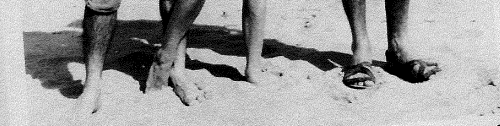
Some of these feet may or may not belong to Thomas Pynchon

Siegel was briefly a Cornell classmate of Pynchon’s in 1954, and they remained friends (in Siegel’s recollection) for at least two decades after. During this time, Siegel claims that Pynchon wrote him dozens of letters, which were ultimately sold at auction (along with much of Siegel’s property) to help pay for a hip replacement. Material from the letters soak into Siegel’s sketch of Pynchon’s progress, along with several stoned/drunken adventures that would not be out of place in V. or Mason & Dixon or Gravity’s Rainbow, or really, any person’s young life.

A competitive anxiety reverberates under the piece. “We were friends, maybe at some points best friends, very much alike in some important ways,” Siegel writes. “We were both writers,” he boldly writes. Siegel reminds us that “In Mortality and Mercy in Vienna, Pynchon’s first published short story, the protagonist is one Cleanth Siegel,” but protests he doesn’t see himself in that hero.

The competitive anxieties culminate in the big reveal that (spoiler!) Thomas Pynchon had an affair with Siegel’s second wife Chrissie. There’s probably a Freudian reading we can append to the details that Siegel offers about Pynchon’s sexual prowess: “He was a wonderful lover, sensitive and quick, with the ability to project a mood that turned the most ordinary surroundings into a scene out of a masterful film—the reeking industrial slum of Manhattan Beach would become as seen through the eye of Antonioni, for example.”

Or maybe these unsexy details are just a sign of Playboy’s editorial hand. Wedged gracelessly between ads for vibrators and nude greeting cards, Siegel’s lines often reek of 1970’s Playboy’s rhetorical house style, a kind of frank-but-(attempted)-sensual glossiness that contrasts heavily with Pynchon’s own sex writing. At times I found myself reading Siegel’s prose in one of Will Ferrell’s more pompous accents.

Even worse is the casual sexism of the piece—which again, may be attributable to Playboy’s editors. Siegel, on his first wife (sixteen when he married her): “She was so wonderful a lover, generous and easily aroused, but I was too callow then to appreciate her.” Of his second wife: “It is easy to underestimate her intelligence, but it is a mistake. She is obviously too pretty to be serious, conventional wisdom would have you believe.” Of one of Pynchon’s girlfriends: “Susan has red hair and is breathtakingly beautiful, with the voluptuous body of a showgirl. Like Chrissie, she is much brighter than she looks.”

More interesting, obviously, are the (supposedly) real-life details that inform Pynchon’s fiction. Siegel notes some of the contents of Pynchon’s Manhattan Beach apartment: “A built-in bookcase had rows of piggy banks on each shelf and there was a collection of books and magazines about pigs.” Pigs, of course, are a major motif of Gravity’s Rainbow. Another detail that seems to connect to GR: “On the desk, there was a rudimentary rocket made from one of those pencil-like erasers with coiled paper wrappers that you unzip to expose the rubber. It stood on a base twisted out of a paper clip.” Siegel lets us know that he knocked the rocket down. Pynchon puts it back together; Siegel knocks it down again.

(Parenthetically: Siegel’s evocation of Pynchon’s Manhattan Beach days fits neatly into my picture of Inherent Vice).

In accounting details of Pynchon’s alleged affair with his wife, Chrissie, Siegel shares the following:

Once, out on the freeway, she told him that we had all gone naked at the commune, he professed to find that incredible and dared her to take off her blouse right there. She did. A passing truck hooted its horn in lewd applause. He loved her Shirley Temple impersonations—On the Good Ship Lollipop sung and danced like a kid at a birthday party. They talked about running away together.

It is hardly possible here not to recall the episode early in Gravity’s Rainbow wherein Jessica Swanlake removes her blouse in the car on a dare from Roger Mexico. Is Siegel daring the reader to extrapolate further? Extrapolation, paranoid connections—isn’t this part of Pynchonian fun?

In that spirit, I’ll close with my favorite moment from the article.

“You know the W.A.S.T.E. horn in The Crying of Lot 49? The symbol of the secret message service? Every weirdo in the world is on my wave length. You cannot understand the kind of letters I get. Someone wrote to tell me that the very same horn was the symbol of a private mail system in medieval times. I checked it out at the library. It’s true. But I made it up myself before the book was ever published, before I ever got that letter.”

The lines are supposedly from Pynchon himself. Siegel even puts them in quotation marks—so they must be real, right?

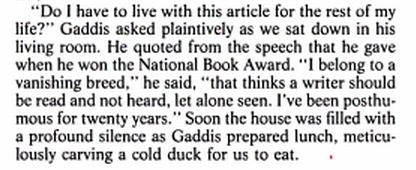
Read a William Gaddis Profile (New York Magazine 1994)


Read the New York Magazine profile via Google Books.

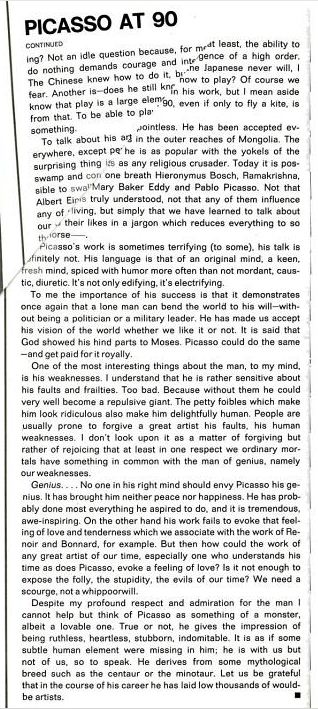
“Picasso at 90” — Henry Miller (1971 LIFE Magazine Profile)

“Picasso at 90” is an October, 1971 profile on the artist by Henry Miller, presented here via Google Books. In a felicitous cubist twist, the second page of the article (featuring the full portrait of Picasso and, on its back, the column of text) seems to have been cut (or ripped) and then repaired.

“An Archeology of Literature” — The Guardian Profiles Tom McCarthy

The Guardian published a great profile of Tom McCarthy today. Topics include Freud, the avant-garde, archeology, and his forthcoming novel C. From the article, here’s McCarthy on his book’s setting:

“It’s the great period of emergent technology,” McCarthy explains. “The book is set between 1898 – when Marconi was doing some of his earliest experiments – and 1922, which is the year the BBC was founded, and also the great year of modernism: The Waste Land and Ulysses. I wanted C to be a kind of archaeology of literature. But I think all ‘proper’ literature always has been an archaeology of other literature. The task for contemporary literature is to deal with the legacy of modernism. I’m not trying to be modernist, but to navigate the wreckage of that project.”

The Guardian has also run a review of C. Biblioklept’s review runs tomorrow. It was a struggle to write–it’s always a struggle to review a book you absolutely love. You always end up sounding a bit too breathless.