Read “Markheim,” a dark Christmas tale by Robert Louis Stevenson

“Markheim”

by

Robert Louis Stevenson


“Yes,” said the dealer, “our windfalls are of various kinds. Some customers are ignorant, and then I touch a dividend on my superior knowledge. Some are dishonest,” and here he held up the candle, so that the light fell strongly on his visitor, “and in that case,” he continued, “I profit by my virtue.”

Markheim had but just entered from the daylight streets, and his eyes had not yet grown familiar with the mingled shine and darkness in the shop. At these pointed words, and before the near presence of the flame, he blinked painfully and looked aside.

The dealer chuckled. “You come to me on Christmas Day,” he resumed, “when you know that I am alone in my house, put up my shutters, and make a point of refusing business. Well, you will have to pay for that; you will have to pay for my loss of time, when I should be balancing my books; you will have to pay, besides, for a kind of manner that I remark in you to-day very strongly. I am the essence of discretion, and ask no awkward questions; but when a customer cannot look me in the eye, he has to pay for it.” The dealer once more chuckled; and then, changing to his usual business voice, though still with a note of irony, “You can give, as usual, a clear account of how you came into the possession of the object?” he continued. “Still your uncle’s cabinet? A remarkable collector, sir!”

And the little pale, round-shouldered dealer stood almost on tip- toe, looking over the top of his gold spectacles, and nodding his head with every mark of disbelief. Markheim returned his gaze with one of infinite pity, and a touch of horror.

Continue reading “Read “Markheim,” a dark Christmas tale by Robert Louis Stevenson”

“Columbus in Chains” — Jamaica Kincaid

“Columbus in Chains”

by

Jamaica Kincaid


Outside, as usual, the sun shone, the trade winds blew; on her way to put some starched clothes on the line, my mother shooed some hens out of her garden; Miss Dewberry baked the buns, some of which my mother would buy for my father and me to eat with our afternoon tea; Miss Henry brought the milk, a glass of which I would drink with my lunch, and another glass of which I would drink with the bun from Miss Dewberry; my mother prepared our lunch; my father noted some perfectly idiotic thing his partner in housebuilding, Mr. Oatie, had done, so that over lunch he and my mother could have a good laugh.

The Anglican church bell struck eleven o’clock—one hour to go before lunch. I was then sitting at my desk in my classroom. We were having a history lesson—the last lesson of the morning. For taking first place over all the other girls, I had been given a prize, a copy of a book called Roman Britain, and I was made prefect of my class. What a mistake the prefect part had been, for I was among the worst-behaved in my class and did not at all believe in setting myself up as a good example, the way a prefect was supposed to do. Now I had to sit in the prefect’s seat—the first seat in the front row, the seat from which I could stand up and survey quite easily my classmates. From where I sat I could see out the window. Sometimes when I looked out, I could see the sexton going over to the minister’s house. The sexton’s daughter, Hilarene, a disgusting model of good behavior and keen attention to scholarship, sat next to me, since she took second place. The minister’s daughter, Ruth, sat in the last row, the row reserved for all the dunce girls. Hilarene, of course, I could not stand. A girl that good would never do for me. I would probably not have cared so much for first place if I could be sure it would not go to her. Ruth I liked, because she was such a dunce and came from England and had yellow hair. When I first met her, I used to walk her home and sing bad songs to her just to see her turn pink, as if I had spilled hot water all over her.

Our books, A History of the West Indies, were open in front of us. Our day had begun with morning prayers, then a geometry lesson, then it was over to the science building for a lesson in “Introductory Physics” (not a subject we cared much for), taught by the most dingy-toothed Mr. Slacks, a teacher from Canada, then precious recess, and now this, our history lesson. Recess had the usual drama: this time, I coaxed Gwen out of her disappointment at not being allowed to join the junior choir. Her father—how many times had I wished he would become a leper and so be banished to a leper colony for the rest of my long and happy life with Gwen—had forbidden it, giving as his reason that she lived too far away from church, where choir rehearsals were conducted, and that it would be dangerous for her, a young girl, to walk home alone at night in the dark. Of course, all the streets had lamplight, but it was useless to point that out to him. Oh, how it would have pleased us to press and rub our knees together as we sat in our pew while pretending to pay close attention to Mr. Simmons, our choirmaster, as he waved his baton up and down and across, and how it would have pleased us even more to walk home together, alone in the “early dusk” (the way Gwen had phrased it, a ready phrase always on her tongue), stopping, if there was a full moon, to lie down in a pasture and expose our bosoms in the moonlight. We had heard that full moonlight would make our breasts grow to a size we would like. Poor Gwen! When I first heard from her that she was one of ten children, right on the spot I told her that I would love only her, since her mother already had so many other people to love.

Our teacher, Miss Edward, paced up and down in front of the class in her usual way. In front of her desk stood a small table, and on it stood the dunce cap. The dunce cap was in the shape of a coronet, with an adjustable opening in the back, so that it could fit any head. It was made of cardboard with a shiny gold paper covering and the word “DUNCE” in shiny red paper on the front. When the sun shone on it, the dunce cap was all aglitter, almost as if you were being tricked into thinking it a desirable thing to wear. As Miss Edward paced up and down, she would pass between us and the dunce cap like an eclipse. Each Friday morning, we were given a small test to see how well we had learned the things taught to us all week. The girl who scored lowest was made to wear the dunce cap all day the following Monday. On many Mondays, Ruth wore it—only, with her short yellow hair, when the dunce cap was sitting on her head she looked like a girl attending a birthday party in The Schoolgirl’s Own Annual.

It was Miss Edward’s way to ask one of us a question the answer to which she was sure the girl would not know and then put the same question to another girl who she was sure would know the answer. The girl who did not answer correctly would then have to repeat the correct answer in the exact words of the other girl. Many times, I had heard my exact words repeated over and over again, and I liked it especially when the girl doing the repeating was one I didn’t care about very much. Pointing a finger at Ruth, Miss Edward asked a question the answer to which was “On the third of November 1493, a Sunday morning, Christopher Columbus discovered Dominica.” Ruth, of course, did not know the answer, as she did not know the answer to many questions about the West Indies. I could hardly blame her. Ruth had come all the way from England. Perhaps she did not want to be in the West Indies at all. Perhaps she wanted to be in England, where no one would remind her constantly of the terrible things her ancestors had done; perhaps she had felt even worse when her father was a missionary in Africa. I could see how Ruth felt from looking at her face. Her ancestors had been the masters, while ours had been the slaves. She had such a lot to be ashamed of, and by being with us every day she was always being reminded. We could look everybody in the eye, for our ancestors had done nothing wrong except just sit somewhere, defenseless. Of course, sometimes, what with our teachers and our books, it was hard for us to tell on which side we really now belonged—with the masters or the slaves—for it was all history, it was all in the past, and everybody behaved differently now; all of us celebrated Queen Victoria’s birthday, even though she had been dead a long time. But we, the descendants of the slaves, knew quite well what had really happened, and I was sure that if the tables had been turned we would have acted differently; I was sure that if our ancestors had gone from Africa to Europe and come upon the people living there, they would have taken a proper interest in the Europeans on first seeing them, and said, “How nice,” and then gone home to tell their friends about it. Continue reading ““Columbus in Chains” — Jamaica Kincaid”

Thirteen ways of looking at a portal | A review of Debbie Urbanski’s Portalmania

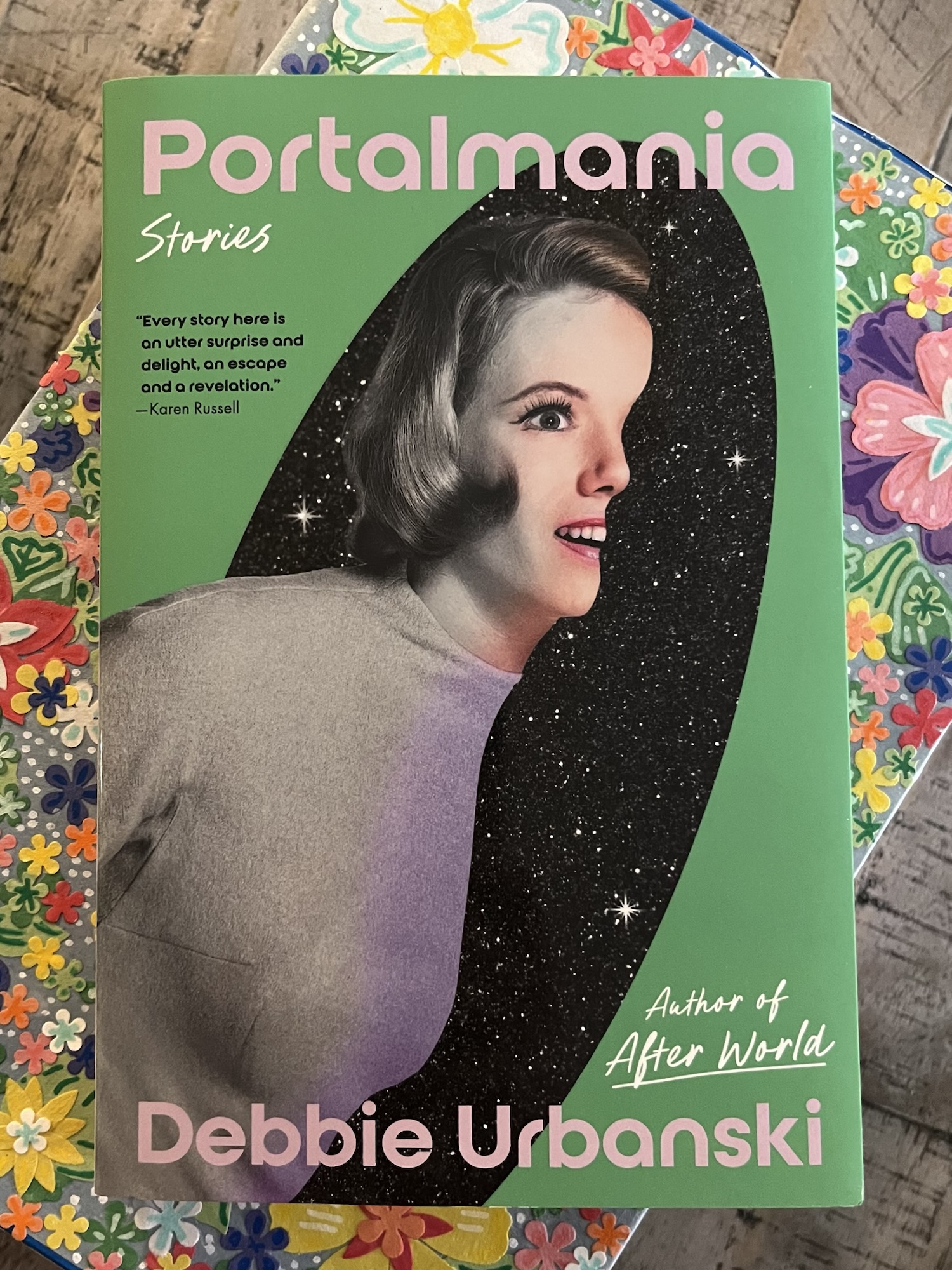
Debbie Urbanski’s new collection Portalmania is a metatextual tangle of science fiction, fantasy, and horror where portals don’t offer escape so much as expose the fractures beneath family, love, and identity. Her characters navigate asexuality, neurodivergence, and the quiet violence of domestic life against an uneasy backdrop of porous reality. At any moment a portal might appear, or a mutation might take hold, or, a wife might sell her daughter to a witch to assassinate her husband. Nothing is stable in Portalmania.

There are nine stories in Portalmania. Or maybe there are ten stories. Or eleven. Or maybe thirteen. If there are thirteen stories, maybe I could riff on that Wallace Stevens poem for my review titles (that would be too fucking precious and obnoxious though, wouldn’t it).

There are nine or ten or eleven or thirteen discrete “stories” in Portalmania, depending on how you want to count or what you want to count as a discrete story. But this need to count, or, more precisely, to pin down what-something-is-and-is-not, runs counter to the spirit of Portalmania, whose heroes push back on the definitions that are literal placeholders, linguistic lines that bind identities.

Perhaps the biggest through-line of the nineteneleventhirteen stories in Portalmania is the big ole question: What is love? In the story “How to Kiss a Hojacki,” a character puts the problem succinctly, writing a note to her husband: “We need to redefine love.

The opening story, “The Promise of a Portal,” helps to establish a realistic world punctured by magical sci-fi. In “Promise,” we come to understand portals as personal escape hatches away from the humdrum domesticity of family life. “I think you can love people–children, mothers–and still want to leave them,” the hero of the story muses. These same portals pop up throughout the collection, creating continuity so that the nine (or are we saying thirteen? I misremember) stories here read more like a loose, discontinuous novel.

The second story, “How to Kiss a Hojacki,” also introduces a sci-fi conceit that repeats in the collection. In this story women transform into “Wonderfuls” — “Hojackis,” “Smith-Smiths,” or “Tangers” — asexual beings who must fight for their autonomy against a reactionary Trumpian politician who campaigns on interring them in camps.

“Hojacki” hovers around the viewpoint of a husband who is becoming increasingly resentful and sexually frustrated with his changing wife. He is unwilling to even try to redefine love: “having sex is how people love each other,” he contends. “Hojacki” is most fascinating when set in context against the stories at the back end of Portalmania, which deal far more directly with themes of asexuality, sexual coercion, and marital rape. While it would be a stretch to say Urbanski depicts the husband sympathetically, her rendering is nevertheless nuanced enough to be later deconstructed in far more visceral detail in stories like “The Dirty Golden Yellow House,” “Hysteria,” and “Some Personal Arguments in Support of the BetterYou (Based on Early Interactions).”

“The Dirty Golden Yellow House” is the strongest piece in Portalmania. It rewrites “How to Kiss a Hojacki” (and reimagines Charlotte Perkins Gilman’s “The Yellow Wall-Paper”) from the perspective of an asexual writer trapped in a marriage marked by marital rape and emotional coercion. “Yellow House” combines elements of fairy tales and Gothic horror with the more prosaic forms of the essay and the internet forum to yield a harrowing story. “Yellow House” also quickly registers as a metatextual tale, a self-deconstructing narrative that pauses early to take would-be critics to task:

Certain reviewers and readers have already started complaining about my recent stories, both their thematic similarities and their very specific view of relationships. I have examples. From one reviewer: Other than the overt political addition to the obvious social metaphors which helps extend this to novelette length, this [one of my stories] is exactly like the same author’s [another one of my stories] in being an overlong underplotted offputtingly narrated story of a repugnant asexual wife and a repugnant husband and their repugnant relationship. From another reviewer: It [one of my stories] is probablsending a message about something—menopause maybe?… I have no clue what the ending is supposed to mean.From a reader: My takeaway is that the story [one of my stories] was an exercise in catharsis for the author, and has no real value as a morality tale beyond—

My past self slams her (our?) body against the window glass. Has she not been clear enough. Here is what she expects in my writing: revenge, on me, on him, on them, on the structure of the story itself, and if I ever consider not placing her at the bloody heart of whatever I write, she will do this to me. She acts out what she will do to me. There is so much blood.

Angry, self-aware, and emotionally scorching, “Yellow House” nevertheless offers sparks of mean humor. The narrator observes that her “neighbors staked colorful rainbow signs into their front yard: WE BELIEVE LOVE IS LOVE AND KINDNESS IS EVERYTHING.” While the sentiment of the sign might be progressive, the tautology “love is love” is reductive and unhelpful in a book where redefining what love is is the (de)central problem. 

Another highlight of the collection is “LK-32-C,” a triptych of stories about a troubled child’s fantasy world. (We might count “LK-32-C” as three stories, not one; each section has its own title.) The narratives in “LK-32-C” seem to run in concurrent yet divergent directions, where fantasy punctures reality or vice versa. In one such topsy-turvy moment, a distraught mother dreams up a magical totem of familial security: “if anyone questioned whether or not there was some love here, she could have pointed to that sphere.”

And again, in “The Portal,” fantasy punctures reality and metatextuality punctures the narrative. Our narrator interrupts building her fantasy world to tell us that,

I do realize that, as an author, I’m not supposed to let my other worlds become utopias. At least, that was one successful writer’s advice to me when I told him I was working on this story. He explained that when portal worlds are utopias, it’s like a flashing neon sign that says lazy writing. If we want such fantastic places to be believable (and who doesn’t want their writing to be believed?), they have to possess a substantial dark side.

Our author-hero’s rejoinder points out that the dark side is the absence of the utopia: “What if I’m trying to create an untroubled and pleasant world that might haunt someone for as long as they could remember it?” We’re always looking for that perfect portal.

Not everything in Portalmania works. “How to Kiss a Hojacki” has a great premise but its collapse into a political satire is dissatisfying. “Long May My Land Be Bright” is the weakest link in the collection. Its central conceit is that there are literal rifts in the USA, which create two separate antithetical political-cultural realities. It’s not that I’m not sympathetic to the sentiment here, it’s just that I think the metaphor should be pushed even further, to more absurd places.

I’m also not sure how I feel about Urbanski’s decision to include a tenth chapter in her book titled “Story Notes.” By the time I got to the (ostensibly)-last story “The Portal,” I was having a really hard time keeping all the New Criticism, death-of-the-author, grad-school reading training stuff out of my head. With its constant metatextual interruptions and its deeply– personal themes, it became very, very difficult not to read Portalmania as in part a work of autofiction. So the notion of “Story Notes” both intrigued and repelled me. Here is how “Story Notes” begins:

One of the indisputably vital roles of the modern reader is to tease out what is autobiographically true for the fiction writer versus what that writer made up in their stories. What is fiction after all if not a porthole into the author’s private life? So allow me to get this out of the way: Everything you’ve read in Portalmania (or will read, depending on your preferred order) actually happened to me. The portals, the lack of portals, the witches, the monsters, the ghosts, the murders, the space travel of beloved family members—every story in this collection is a factual account of my own experience. And now that you know this, I can spend the remaining space of these notes discussing whatever I want.

And I suppose she does discuss whatever she wants in the notes.

If we are counting “Story Notes” as a story, there are ten stories in Portalmania. If we keep reading after “Story Notes,” there is a final piece, “Coda” an unlisted hidden track of sorts. I love the decision to put this last, brief, and strong piece after “Story Notes.” “Coda” revisits the themes of Portalmania and concludes by pointing to “a terrifying and wide-open future,” which is what I suppose we can all expect as we fumble toward our own redefinition of love, storytelling, and escape. Good stuff.

“The Wheel,” a short story by John Wyndham

“The Wheel”

by

John Wyndham


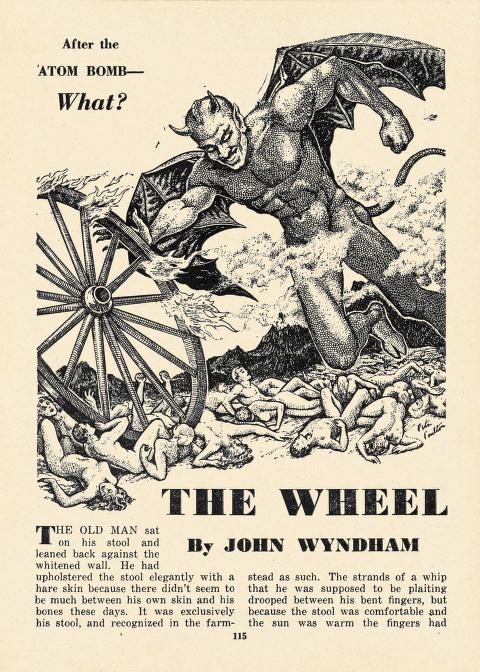
THE OLD MAN sat on his stool and leaned back against the whitened wall. He had upholstered the stool elegantly with a bare skin because there didn’t seem to be much between his own skin and his bones these days. It was exclusively his stool, and recognized in the farmstead as such. The strands of a whip that he was supposed to be plaiting drooped between his bent fingers, but because the stool was comfortable and the sun was warm the fingers had stopped moving, and his head was nodding.

The yard was empty save for a few hens that pecked more inquisitively than hopefully in the dust, but there were sounds that told of others who had not the old man’s leisure for siesta. From round the corner of the house came the occasional plonk of an empty bucket as it hit the water, and its scrape on the side of the well as it came up full. In the shack across the yard a dull pounding went on rhythmically and soporifically.

The old man’s head fell further forward as he drowsed.

Presently, from beyond the rough, enclosing wall there came another sound, slowly approaching. A rumbling and a rattling, with an intermittent squeaking. The old man’s ears were no longer sharp, and for some minutes it failed to disturb him. Then he opened his eyes and, locating the sound, sat staring incredulously toward the gateway.

The sound drew closer, and a boy’s head showed above the wall. He grinned at the old man, an expression of excitement in his eyes. He did not call out, but moved a little faster until he came to the gate. There he turned into the yard, proudly towing behind him a box mounted on four wooden wheels.

The old man got up suddenly from his seat, alarm in every line. He waved both arms at the boy as though he would push him back. The boy stopped. His expression of gleeful pride faded into astonishment. He stared at the old man who was waving him away so urgently. While he still hesitated the old man continued to shoo him off with one hand as he placed the other on his own lips, and started to walk towards him.

Reluctantly and bewilderedly the boy turned, but too late. The pounding in the shed stopped. A middle-aged woman appeared in the doorway. Her mouth was open to call, but the words did not come. Her jaw dropped slackly, her eyes seemed to bulge, then she crossed herself, and screamed….

Continue reading ““The Wheel,” a short story by John Wyndham”

“The Little Berliner” — Robert Walser

“The Little Berliner”

by

Robert Walser

Translated by Harriett Watts


PAPA boxed my ears today, in a most fond and fatherly manner, of course. I had used the expression: “Father, you must be nuts.” It was indeed a bit careless of me. “Ladies should employ exquisite language,” our German teacher says. She’s horrible. But Papa won’t allow me to ridicule her, and perhaps he’s right. After all, one does go to school to exhibit a certain zeal for learning and a certain respect. Besides, it is cheap and vulgar to discover funny things in a fellow human being and then to laugh at them. Young ladies should accustom themselves to the fine and the noble—I quite see that. No one desires any work from me, no one will ever demand it of me; but everyone will expect to find that I am refined in my ways. Shall I enter some profession in later life? Of course not! I’ll be an elegant young wife; I shall get married. It is possible that I’ll torment my husband. But that would be terrible. One always despises oneself whenever one feels the need to despise someone else. I am twelve years old. I must be very precocious—otherwise, I would never think of such things. Shall I have children? And how will that come about? If my future husband isn’t a despicable human being, then, yes, then I’m sure of it, I shall have a child. Then I shall bring up this child. But I still have to be brought up myself. What silly thoughts one can have!

Berlin is the most beautiful, the most cultivated city in the world. I would be detestable if I weren’t unshakably convinced of this. Doesn’t the Kaiser live here? Would he need to live here if he didn’t like it here best of all? The other day I saw the royal children in an open car. They are enchanting. The crown prince looks like a high-spirited young god, and how beautiful seemed the noble lady at his side. She was completely hidden in fragrant furs. It seemed that blossoms rained down upon the pair out of the blue sky. The Tiergarten is marvelous. I go walking there almost every day with our young lady, the governess. One can go for hours under the green trees, on straight or winding paths. Even Father, who doesn’t really need to be enthusiastic about anything, is enthusiastic about the Tiergarten. Father is a cultivated man. I’m convinced he loves me madly. It would be horrible if he read this, but I shall tear up what I have written. Actually, it is not at all fitting to be still so silly and immature and, at the same time, already want to keep a diary. But, from time to time, one becomes somewhat bored, and then one easily gives way to what is not quite right. The governess is very nice. Well, I mean, in general. She is devoted and she loves me. In addition, she has real respect for Papa—that is the most important thing. She is slender of figure. Our previous governess was fat as a frog. She always seemed to be about to burst. She was English. She’s still English today, of course, but from the moment she allowed herself liberties, she was no longer our concern. Father kicked her out.

The two of us, Papa and I, are soon to take a trip. It is that time of the year now when respectable people simply have to take a trip. Isn’t it a suspicious sort of person who doesn’t take a trip at such a time of blossoming and blooming? Papa goes to the seashore and apparently lies there day after day and lets himself be baked dark brown by the summer sun. He always looks healthiest in September. The paleness of exhaustion is not becoming to his face. Incidentally, I myself love the suntanned look in a man’s face. It is as if he had just come home from war. Isn’t that just like a child’s nonsense? Well, I’m still a child, of course. As far as I’m concerned, I’m taking a trip to the south. First of all, a little while to Munich and then to Venice, where a person who is unspeakably close to me lives—Mama. For reasons whose depths I cannot understand and consequently cannot evaluate, my parents live apart. Most of the time I live with Father. But naturally Mother also has the right to possess me at least for a while. I can scarcely wait for the approaching trip. I like to travel, and I think that almost all people must like to travel. One boards the train, it departs, and off it goes into the distance. One sits and is carried into the remote unknown. How well-off I am, really! What do I know of need, of poverty? Nothing at all. I also don’t find it the least bit necessary that I should experience anything so base. But I do feel sorry for the poor children. I would jump out the window under such conditions. Continue reading ““The Little Berliner” — Robert Walser”

“Frog in Prague” — Stephen Dixon

“Frog in Prague”

by

Stephen Dixon


They stand still. “And Kafka?” Howard says.

“Kafka is not buried here.”

“No? Because I thought—what I mean is the lady at my hotel’s tourist information desk—the Intercontinental over there—and also the one who sold me the ticket now, both told me—”

The man’s shaking his head, looks at him straight-faced. It’s up to you, his look says, if you’re going to give me anything for this tour. I won’t ask. I won’t embarrass you if you don’t give me a crown. But I’m not going to stand here all day waiting for it.

“Here, I want to give you something for all this.” He looks in his wallet. Smallest is a fifty note. Even if he got three-to-one on the black market, it’s still too much. He feels the change in his pocket. Only small coins. This guy’s done this routine with plenty of people, that’s for sure, and he’d really like not to give him anything.

“Come, come,” the man said.

“You understand?” Howard said. “For Kafka’s grave. Just as I told the lady at the ticket window, I’m sure the other parts of this ticket for the Old Synagogue and the Jewish Museum are all very interesting—maybe I’ll take advantage of it some other time—but what I really came to see—”

“Yes, come, come. I work here too. I will show you.”

Howard followed him up a stone path past hundreds of gravestones on both sides, sometimes four or five or he didn’t know how many of them pressed up or leaning against one another. The man stopped, Howard did and looked around for Kafka’s grave, though he knew one of these couldn’t be it. “You see,” the man said, “the governor at the time—it was the fourteenth century and by now there were twelve thousand people buried here. He said no when the Jewish elders of Prague asked to expand the cemetery. So what did the Jews do? They built down and up, not outwards, not away. They kept inside the original lines of the cemetery permitted them. Twelve times they built down and up till they had twelve of what do you call them in English, plateaus? Places?” and he moved his hand up in levels.

“Levels?”

“Yes, that would be right. Twelve of them and then the ground stopped and they also couldn’t go any higher up without being the city’s highest cemetery hill, so they couldn’t make any levels anymore.”

“So that accounts for these gravestones being, well, the way they are. All on top of one another, pressed togetherlike. Below ground there’s actually twelve coffins or their equivalents, one on top of—”

“Yes, yes, that’s so.” He walked on about fifty feet, stopped. “Another governor wouldn’t let the Jews in this country take the names of son-of anymore. Son of Isaac, Son of Abraham. They had to take, perhaps out of punishment, but history is not clear on this, the names of animals or things from the earth and so on.” He pointed to the stone relief of a lion at the top of one gravestone. “Lion, you see.” To a bunch of grapes on another stone: “Wine, this one. And others, if we took the time to look, all around, but of that historical era.”

“So that’s why the name Kafka is that of a bird if I’m not mistaken. Jackdaw, I understand it means in Czech. The Kafka family, years back, must have taken it or were given it, right? Which?”

“Yes, Kafka. Kafka.” Howard didn’t think by the man’s expression he understood. “Come, please.” They moved on another hundred feet or so, stopped. “See these two hands on the monument? That is the stone of one who could give blessings—a Cohen. No animal there, but his sign. Next to it,” pointing to another gravestone, “is a jaw.”

“A jaw?” The stone relief of this one was of a pitcher. “Jar, do you mean?”

“Yes. Jaw, jaw. That is a Levi, one who brings the holy water to wash the hands of a Cohen. That they are side by side is only a coincidence. On the next monument you see more berries but of a different kind than wine. Fertility.”

“Does that mean a woman’s buried here? Or maybe a farmer?”

“Yes. Come, come.” They went past many stones and sarcophagi. All of them seemed to be hundreds of years old and were crumbling in places. Most of the names and dates on them couldn’t be read. The newer section of the cemetery, where Kafka had to be buried, had to be in an area one couldn’t see from here. He remembered the photograph of the gravestone of Kafka and his parents. Kafka’s name on top—he was the first to go—his father’s and mother’s below his. It was in a recent biography of him he’d read, or at least read the last half of, not really being interested in the genealogical and formative parts of an artist’s life, before he left for Europe. The stone was upright, though the photo could have been taken many years ago, and close to several upright stones but not touching them. The names and dates on it, and also the lines in Hebrew under Kafka’s name, could be read clearly. It looked no different from any gravestone in an ordinary relatively old crowded Jewish cemetery. The one a couple of miles past the Queens side of the Fifty-ninth Street Bridge where some of his own family were buried.

The man walked, Howard followed him. “Here is the monument of Mordecai Maisel. It is much larger than the others because he was a very rich important man. More money than even the king, he had. The king would borrow from him when he needed it for public matters. Later, after he paid it back, he would say to him ‘Mordecai, what can I give you in return for this great favor?’ Mordecai would always say ‘Give not to me but to my people,’ and that did help to make life better in Prague for the Jews of that time. He was a good wealthy man, Mordecai Maisel. Come, come.”

They stopped at another sarcophagus. Hundreds of little stones had been placed on the ledges and little folded-up pieces of paper pushed into the crevices of it. “Here is Rabbi Low. As you see, people still put notes inside his monument asking for special favors from him.”

“Why, he was a mystic?”

“You don’t know of the famous Rabbi Löw?”

“No. I mean, his name does sound familiar, but I’m afraid my interest is mostly literature. Kafka. I’ve seen several of his residences in this neighborhood. Where he worked for so many years near the railroad station, and also that very little house on Golden Lane, I think it’s translated as, across the river near the castle. A couple of places where Rilke lived too.”

“So, literature, what else am I talking of here? The Golem. A world famous play. Well? Rabbi Low. Of the sixteenth century. He started it. He’s known all over.”

“I’ve certainly heard of the play. It was performed in New York City—in a theater in Central Park—last summer. I didn’t know it was Rabbi Low who started the legend.”

“Yes, he, he. The originator. Others may say other rabbis might have, but it was only Rabbi Low, nobody else. Then he knocked the Golem to pieces when it went crazy on him. Come, come.”

They went on. The man showed him the grave of the only Jewish woman in medieval Prague who had been permitted to marry nobil
ity. “Her husband buried here too?” Howard said. “No, of course not. It was out-of-religion. The permission she got to marry was from our elders. He’s somewhere else.” The stone of one of the mayors of the Jewish ghetto in seventeenth-century Prague. The stone of a well-known iron craftsman whose name the man had to repeat several times before Howard gave up trying to make it out but nodded he had finally understood. Then they came to the entrance again. After the man said Kafka wasn’t buried here and Howard said he wanted to give him something for all this, he finally gives him the fifty note, the man pockets it and Howard asks if he might know where Kafka is buried.

“Oh, in Strašnice cemetery. The Jewish part of it, nothing separate anymore. It isn’t far from here. You take a tube. Fifteen minutes and you are there,” and he skims one hand off the other to show how a train goes straight out to it. “It’s in walking distance from the station. On a nice day unlike today the walk is a simple and pleasant one. And once you have reached it you ask at the gate to see Kafka’s grave and someone there will show you around.”
“The Christmas Banquet” — Nathaniel Hawthorne

“The Christmas Banquet”

by

Nathaniel Hawthorne

from Mosses from an Old Manse


In a certain old gentleman’s last will and testament there appeared a bequest, which, as his final thought and deed, was singularly in keeping with a long life of melancholy eccentricity. He devised a considerable sum for establishing a fund, the interest of which was to be expended, annually forever, in preparing a Christmas Banquet for ten of the most miserable persons that could be found. It seemed not to be the testator’s purpose to make these half a score of sad hearts merry, but to provide that the stern or fierce expression of human discontent should not be drowned, even for that one holy and joyful day, amid the acclamations of festal gratitude which all Christendom sends up. And he desired, likewise, to perpetuate his own remonstrance against the earthly course of Providence, and his sad and sour dissent from those systems of religion or philosophy which either find sunshine in the world or draw it down from heaven.

The task of inviting the guests, or of selecting among such as might advance their claims to partake of this dismal hospitality, was confided to the two trustees or stewards of the fund. These gentlemen, like their deceased friend, were sombre humorists, who made it their principal occupation to number the sable threads in the web of human life, and drop all the golden ones out of the reckoning. They performed their present office with integrity and judgment. The aspect of the assembled company, on the day of the first festival, might not, it is true, have satisfied every beholder that these were especially the individuals, chosen forth from all the world, whose griefs were worthy to stand as indicators of the mass of human suffering. Yet, after due consideration, it could not be disputed that here was a variety of hopeless discomfort, which, if it sometimes arose from causes apparently inadequate, was thereby only the shrewder imputation against the nature and mechanism of life. Continue reading ““The Christmas Banquet” — Nathaniel Hawthorne”

Read “Nackles,” Donald E. Westlake’s horror story about the Anti-Claus

“Nackles”

by

Donald E. Westlake


Did God create men, or does Man create gods? I don’t know, and if it hadn’t been for my rotten brother-in-law the question would never have come up. My late brother-in-law? Nackles knows.

It all depends, you see, like the chicken and the egg, on which came first. Did God exist before Man first thought of Him, or didn’t He? If not, if Man creates his gods, then it follows that Man must create the devils, too.

Nearly every god, you know, has his corresponding devil. Good and Evil. The polytheistic ancients, prolific in the creation (?) of gods and goddesses, always worked up nearly enough Evil ones to cancel out the Good, but not quite. The Greeks, those incredible supermen, combined Good and Evil in each of their gods. In Zoroaster, Ahura Mazda, being Good is ranged forever against the Evil one, Ahriman. And we ourselves know God and Satan.

But of course it’s entirely possible I have nothing to worry about. It all depends on whether Santa Claus is or is not a god. He certainly seems like a god. Consider: He is omniscient; he knows every action of every child, for good or evil. At least on Christmas Eve he is omnipresent, everywhere at once. He administers justice tempered with mercy. He is superhuman, or at least non-human, though conceived of as having a human shape. He is aided by a corps of assistants who do not have completely human shapes. He rewards Good and punishes Evil. And, most important, he is believed in utterly by several million people, most of them under the age of ten. Is there any qualification for godhood that Santa Claus does not possess?

And even the non-believers give him lip-service. He has surely taken over Christmas; his effigy is everywhere, but where are the manger and the Christ child? Retired rather forlornly to the nave. (Santa’s power is growing, too. Slowly but surely he is usurping Chanukah as well.)

Santa Claus is a god. He’s no less a god than Ahura Mazda, or Odin, or Zeus. Think of the white beard, the chariot pulled through the air by a breed of animal which doesn’t ordinarily fly, the prayers (requests for gifts) which are annually mailed to him and which so baffle the Post Office, the specially-garbed priests in all the department stores. And don’t gods reflect their creators’ society? The Greeks had a huntress goddess, and gods of agriculture and war and love. What else would we have but a god of giving, of merchandising, and of consumption? Secondary gods of earlier times have been stout, but surely Santa Claus is the first fat primary god.

And wherever there is a god, mustn’t there sooner or later be a devil?

Which brings me back to my brother-in-law, who’s to blame for whatever happens now. My brother-in-law Frank is – or was – a very mean and nasty man. Why I ever let him marry my sister I’ll never know. Why Susie wanted to marry him is an even greater mystery. I could just shrug and say Love is Blind, I suppose, but that wouldn’t explain how she fell in love with him in the first place.

Frank is – Frank was – I just don’t know what tense to use. The present, hopefully. Frank is a very handsome man in his way, big and brawny, full of vitality. A football player; hero in college and defensive line-backer for three years in pro ball, till he did some sort of irreparable damage to his left knee, which gave him a limp and forced him to find some other way to make a living.

Ex-football players tend to become insurance salesmen; I don’t know why. Frank followed the form, and became and insurance salesman. Because Susie was then a secretary for the same company, they soon became acquainted.

Was Susie dazzled by the ex-hero, so big and handsome? She’s never been the type to dazzle easily, but we can never fully know what goes on inside the mind of another human being. For whatever reason, she decided she was in love with him.

So they were married, and five weeks later he gave her her first black eye. And the last, though it mightn’t have been, since Susie tried to keep me from finding out. I was to go over for dinner that night, but at eleven in the morning she called the auto showroom where I work, to tell me she had a headache and we’d have to postpone the dinner. But she sounded so upset that I knew immediately something was wrong, so I took a demonstration car and drove over, and when she opened the front door there was the shiner.

I got the story out of her slowly, in fits and starts. Frank, it seemed, had a terrible temper. She wanted to excuse him because he was forced to be an insurance salesman when he really wanted to be out there on the gridiron again, but I want to be President and I’m an automobile salesman and I don’t go around giving women black eyes. So I decided it was up to me to let Frank know he wasn’t to vent his pique on my sister any more.

Unfortunately, I am five feet seven inches tall and weigh one hundred thirty-four pounds, with the Sunday Times under my arm. Were I just to give Frank a piece of my mind, he’d surely give me a black eye to go with my sister’s. Therefore, that afternoon I bought a regulation baseball bat, and carried it with me when I went to see Frank that night.

He opened the door himself and snarled, “What do you want?”

In answer, I poked him with the end of the bat, just above the belt, to knock the wind out of him. Then, having unethically gained the upper hand, I clouted him five or six times more, and then stood over him to say, “The next time you hit my sister I won’t let you off so easy.” After which I took Susie home to my place for dinner.

And after which I was Frank’s best friend.

People like that are so impossible to understand. Until the baseball bat episode, Frank had nothing for me but undisguised contempt. But once I’d knocked the stuffing out of him, he was my comrade for life. And I’m sure it was sincere; he would have given me the shirt off his back, had I wanted it, which I didn’t.

(Also, by the way, he never hit Susie again. He still had the bad temper, but he took it out on throwing furniture out windows or punching dents in walls or going downtown to start a brawl in some bar. I offered to train him out of maltreating the house and furniture as I had trained him out of maltreating his wife, but Susie said no, that Frank had to let off steam and it would be worse if he was forced to bottle it all up inside him, so the baseball bat remained in retirement.)

Then came the children, three of them in as many years. Frank Junior came first, and then Linda Joyce, and finally Stewart. Susie had held the forlorn hope that fatherhood would settle Frank to some extent, but quite the reverse was true. Shrieking babies, smelly diapers, disrupted sleep, and distracted wives are trials and tribulations to any man, but to Frank they were – like everything else in his life – the last straw.

He became, in a word, worse. Susie restrained him I don’t know how often from doing some severe damage to a squalling infant, and as the children grew toward the age of reason Frank’s expressed attitude toward them was that their best move would be to find a way to become invisible. The children, of course, didn’t like him very much, but then who did? Continue reading “Read “Nackles,” Donald E. Westlake’s horror story about the Anti-Claus”

Read “Red Rubber Gloves,” a short story by Christine Brooke-Rose

“Red Rubber Gloves”

by

Christine Brooke-Rose


From this position on my high balcony, the semi-detached beyond the garden looks more squat than it ought to in such a prosperous suburb, forming with its Siamese twin a square inverted U that faces me and boxes a wide inverted T of a back-yard, neatly divided by a hedge of roses and hydrangeas. On the left of the hedge there is a bit of lawn. On the right, only a small paved yard. The house on the left seems devoid of life, devoid, that is, of the kind of life liable to catch the eye and stop it in its casual round, mutating its idle curiosity through momentary fascination and hence, inexorably, by the mere process of reiteration, to a mild but fixed obsessiveness. As does the right-hand house.

In the angle of the square U, outside the french windows of the right-hand house, the girl sits on the edge of the red canvas bed in a pale pink bikini, carefully oiling inch after inch of her thin white body. She looks, from up here, totally naked, the pink bikini being so pale, and she sits on the edge of the red canvas bed which is set obliquely in the paved yard to face the morning sun. She has oiled the arms, the shoulders, the chest and the long midriff. Now she is doing the right leg, starting with the foot, the ankle, then the shin, as if to meet her upper oily self half way. She is oiling the right thigh. Inside the thigh. The left foot. If the heat-wave holds out she will perhaps become brown enough to contrast with the pink and so look less totally naked on the red canvas bed. The inside of the left thigh. She lies now framed in the red canvas bed, chin up, eyes closed to face the hot June sun. Round the corner from her naked body, at the square end of the inverted U, the red rubber gloves lie quiet on the kitchen window-sill.

In the morning the large rectangular windows of the house tend to reflect the sun in some at least of their thirty-two small black squares framed in cream-painted wood. And in the afternoon they are quite cast into the shade as the sun moves round to face me on my high balcony, immobilised in convalescence. I cannot therefore see much further than the beginning of the pink wash-basin in the bathroom or, in the kitchen below it, the long and gleaming double-sink unit. And the red rubber gloves, moving swiftly apart and together, vanishing and reappearing, moving apart and down. All the windows of both houses, those of the kitchen and of the bathroom above it, at each end of the square inverted U, and those of each bedroom inside the U above the french windows, are rectangular and divided into four panels, each of eight black squares, two over two over two over two, all in cream-painted frames.

The thin girl has melted away into the sun, the red canvas bed is empty. Continue reading “Read “Red Rubber Gloves,” a short story by Christine Brooke-Rose”

Read “The Pedestrian,” a short story by Ray Bradbury

“The Pedestrian”

by

Ray Bradbury

To enter out into that silence that was the city at eight o’clock of a misty evening in November, to put your feet upon that buckling concrete walk, to step over grassy seams and make your way, hands in pockets, through the silences, that was what Mr Leonard Mead most dearly loved to do. He would stand upon the corner of an intersection and peer down long moonlit avenues of sidewalk in four directions, deciding which way to go, but it really made no difference; he was alone in this world of 2053 A.D., or as good as alone, and with a final decision made, a path selected, he would stride off, sending patterns of frosty air before him like the smoke of a cigar. Continue reading “Read “The Pedestrian,” a short story by Ray Bradbury”

Read “What a Thought,” a short story by Shirley Jackson

“What a Thought”

by

Shirley Jackson


Dinner had been good. Margaret sat with her book on her lap and watched her husband digesting, an operation to which he always gave much time and thought. As she watched he put his cigar down without looking and used his free hand to turn the page of his paper. Margaret found herself thinking with some pride that unlike many men she had heard about, her husband did not fall asleep after a particularly good dinner.

She flipped the pages of her book idly; it was not interesting. She knew that if she asked her husband to take her to a movie, or out for a ride, or to play gin rummy, he would smile at her and agree; he was always willing to do things to please her, still, after ten years of marriage. An odd thought crossed her mind: she would pick up the heavy glass ashtray and smash her husband over the head with it.

“Like to go to a movie?” her husband asked.

“I don’t think so, thanks,” Margaret said. “Why?”

“You look sort of bored,” her husband said.

“Were you watching me?” Margaret asked. “I thought you were reading.”

“Just looked at you for a minute.” He smiled at her, the smile of a man who is still, after ten years of marriage, very fond of his wife.

The idea of smashing the glass ashtray over her husband’s head had never before occurred to Margaret, but now it would not leave her mind. She stirred uneasily in her chair, thinking: what a terrible thought to have, whatever made me think of such a thing? Probably a perverted affectionate gesture, and she laughed. Continue reading “Read “What a Thought,” a short story by Shirley Jackson”

Read “The White People,” a supernatural tale by Arthur Machen

“The White People”

by

Arthur Machen


PROLOGUE

‘Sorcery and sanctity,’ said Ambrose, ‘these are the only realities. Each is an ecstasy, a withdrawal from the common life.’

Cotgrave listened, interested. He had been brought by a friend to this mouldering house in a northern suburb, through an old garden to the room where Ambrose the recluse dozed and dreamed over his books.

‘Yes,’ he went on, ‘magic is justified of her children. There are many, I think, who eat dry crusts and drink water, with a joy infinitely sharper than anything within the experience of the “practical” epicure.’

‘You are speaking of the saints?’

‘Yes, and of the sinners, too. I think you are falling into the very general error of confining the spiritual world to the supremely good; but the supremely wicked, necessarily, have their portion in it. The merely carnal, sensual man can no more be a great sinner than he can be a great saint. Most of us are just indifferent, mixed-up creatures; we muddle through the world without realizing the meaning and the inner sense of things, and, consequently, our wickedness and our goodness are alike second-rate, unimportant.’

‘And you think the great sinner, then, will be an ascetic, as well as the great saint?’

‘Great people of all kinds forsake the imperfect copies and go to the perfect originals. I have no doubt but that many of the very highest among the saints have never done a “good action” (using the words in their ordinary sense). And, on the other hand, there have been those who have sounded the very depths of sin, who all their lives have never done an “ill deed.”‘

He went out of the room for a moment, and Cotgrave, in high delight, turned to his friend and thanked him for the introduction.

‘He’s grand,’ he said. ‘I never saw that kind of lunatic before.’

Ambrose returned with more whisky and helped the two men in a liberal manner. He abused the teetotal sect with ferocity, as he handed the seltzer, and pouring out a glass of water for himself, was about to resume his monologue, when Cotgrave broke in—

‘I can’t stand it, you know,’ he said, ‘your paradoxes are too monstrous. A man may be a great sinner and yet never do anything sinful! Come!’

‘You’re quite wrong,’ said Ambrose. ‘I never make paradoxes; I wish I could. I merely said that a man may have an exquisite taste in Romanée Conti, and yet never have even smelt four ale. That’s all, and it’s more like a truism than a paradox, isn’t it? Your surprise at my remark is due to the fact that you haven’t realized what sin is. Oh, yes, there is a sort of connexion between Sin with the capital letter, and actions which are commonly called sinful: with murder, theft, adultery, and so forth. Much the same connexion that there is between the A, B, C and fine literature. But I believe that the misconception—it is all but universal—arises in great measure from our looking at the matter through social spectacles. We think that a man who does evil to us and to his neighbours must be very evil. So he is, from a social standpoint; but can’t you realize that Evil in its essence is a lonely thing, a passion of the solitary, individual soul? Really, the average murderer, quâ murderer, is not by any means a sinner in the true sense of the word. He is simply a wild beast that we have to get rid of to save our own necks from his knife. I should class him rather with tigers than with sinners.’

‘It seems a little strange.’

‘I think not. The murderer murders not from positive qualities, but from negative ones; he lacks something which non-murderers possess. Evil, of course, is wholly positive—only it is on the wrong side. You may believe me that sin in its proper sense is very rare; it is probable that there have been far fewer sinners than saints. Yes, your standpoint is all very well for practical, social purposes; we are naturally inclined to think that a person who is very disagreeable to us must be a very great sinner! It is very disagreeable to have one’s pocket picked, and we pronounce the thief to be a very great sinner. In truth, he is merely an undeveloped man. He cannot be a saint, of course; but he may be, and often is, an infinitely better creature than thousands who have never broken a single commandment. He is a great nuisance to us, I admit, and we very properly lock him up if we catch him; but between his troublesome and unsocial action and evil—Oh, the connexion is of the weakest.’

It was getting very late. The man who had brought Cotgrave had probably heard all this before, since he assisted with a bland and judicious smile, but Cotgrave began to think that his ‘lunatic’ was turning into a sage.

‘Do you know,’ he said, ‘you interest me immensely? You think, then, that we do not understand the real nature of evil?’ Continue reading “Read “The White People,” a supernatural tale by Arthur Machen”

“Columbus in Chains” — Jamaica Kincaid

“Columbus in Chains”

by

Jamaica Kincaid


Outside, as usual, the sun shone, the trade winds blew; on her way to put some starched clothes on the line, my mother shooed some hens out of her garden; Miss Dewberry baked the buns, some of which my mother would buy for my father and me to eat with our afternoon tea; Miss Henry brought the milk, a glass of which I would drink with my lunch, and another glass of which I would drink with the bun from Miss Dewberry; my mother prepared our lunch; my father noted some perfectly idiotic thing his partner in housebuilding, Mr. Oatie, had done, so that over lunch he and my mother could have a good laugh.

The Anglican church bell struck eleven o’clock—one hour to go before lunch. I was then sitting at my desk in my classroom. We were having a history lesson—the last lesson of the morning. For taking first place over all the other girls, I had been given a prize, a copy of a book called Roman Britain, and I was made prefect of my class. What a mistake the prefect part had been, for I was among the worst-behaved in my class and did not at all believe in setting myself up as a good example, the way a prefect was supposed to do. Now I had to sit in the prefect’s seat—the first seat in the front row, the seat from which I could stand up and survey quite easily my classmates. From where I sat I could see out the window. Sometimes when I looked out, I could see the sexton going over to the minister’s house. The sexton’s daughter, Hilarene, a disgusting model of good behavior and keen attention to scholarship, sat next to me, since she took second place. The minister’s daughter, Ruth, sat in the last row, the row reserved for all the dunce girls. Hilarene, of course, I could not stand. A girl that good would never do for me. I would probably not have cared so much for first place if I could be sure it would not go to her. Ruth I liked, because she was such a dunce and came from England and had yellow hair. When I first met her, I used to walk her home and sing bad songs to her just to see her turn pink, as if I had spilled hot water all over her.

Our books, A History of the West Indies, were open in front of us. Our day had begun with morning prayers, then a geometry lesson, then it was over to the science building for a lesson in “Introductory Physics” (not a subject we cared much for), taught by the most dingy-toothed Mr. Slacks, a teacher from Canada, then precious recess, and now this, our history lesson. Recess had the usual drama: this time, I coaxed Gwen out of her disappointment at not being allowed to join the junior choir. Her father—how many times had I wished he would become a leper and so be banished to a leper colony for the rest of my long and happy life with Gwen—had forbidden it, giving as his reason that she lived too far away from church, where choir rehearsals were conducted, and that it would be dangerous for her, a young girl, to walk home alone at night in the dark. Of course, all the streets had lamplight, but it was useless to point that out to him. Oh, how it would have pleased us to press and rub our knees together as we sat in our pew while pretending to pay close attention to Mr. Simmons, our choirmaster, as he waved his baton up and down and across, and how it would have pleased us even more to walk home together, alone in the “early dusk” (the way Gwen had phrased it, a ready phrase always on her tongue), stopping, if there was a full moon, to lie down in a pasture and expose our bosoms in the moonlight. We had heard that full moonlight would make our breasts grow to a size we would like. Poor Gwen! When I first heard from her that she was one of ten children, right on the spot I told her that I would love only her, since her mother already had so many other people to love.

Our teacher, Miss Edward, paced up and down in front of the class in her usual way. In front of her desk stood a small table, and on it stood the dunce cap. The dunce cap was in the shape of a coronet, with an adjustable opening in the back, so that it could fit any head. It was made of cardboard with a shiny gold paper covering and the word “DUNCE” in shiny red paper on the front. When the sun shone on it, the dunce cap was all aglitter, almost as if you were being tricked into thinking it a desirable thing to wear. As Miss Edward paced up and down, she would pass between us and the dunce cap like an eclipse. Each Friday morning, we were given a small test to see how well we had learned the things taught to us all week. The girl who scored lowest was made to wear the dunce cap all day the following Monday. On many Mondays, Ruth wore it—only, with her short yellow hair, when the dunce cap was sitting on her head she looked like a girl attending a birthday party in The Schoolgirl’s Own Annual.

It was Miss Edward’s way to ask one of us a question the answer to which she was sure the girl would not know and then put the same question to another girl who she was sure would know the answer. The girl who did not answer correctly would then have to repeat the correct answer in the exact words of the other girl. Many times, I had heard my exact words repeated over and over again, and I liked it especially when the girl doing the repeating was one I didn’t care about very much. Pointing a finger at Ruth, Miss Edward asked a question the answer to which was “On the third of November 1493, a Sunday morning, Christopher Columbus discovered Dominica.” Ruth, of course, did not know the answer, as she did not know the answer to many questions about the West Indies. I could hardly blame her. Ruth had come all the way from England. Perhaps she did not want to be in the West Indies at all. Perhaps she wanted to be in England, where no one would remind her constantly of the terrible things her ancestors had done; perhaps she had felt even worse when her father was a missionary in Africa. I could see how Ruth felt from looking at her face. Her ancestors had been the masters, while ours had been the slaves. She had such a lot to be ashamed of, and by being with us every day she was always being reminded. We could look everybody in the eye, for our ancestors had done nothing wrong except just sit somewhere, defenseless. Of course, sometimes, what with our teachers and our books, it was hard for us to tell on which side we really now belonged—with the masters or the slaves—for it was all history, it was all in the past, and everybody behaved differently now; all of us celebrated Queen Victoria’s birthday, even though she had been dead a long time. But we, the descendants of the slaves, knew quite well what had really happened, and I was sure that if the tables had been turned we would have acted differently; I was sure that if our ancestors had gone from Africa to Europe and come upon the people living there, they would have taken a proper interest in the Europeans on first seeing them, and said, “How nice,” and then gone home to tell their friends about it. Continue reading ““Columbus in Chains” — Jamaica Kincaid”

Read “Bitterness for Three Sleepwalkers,” a short story by Gabriel García Márquez

“Bitterness for Three Sleepwalkers”

by

Gabriel García Márquez

translated by Gregory Rabassa


Now we had her there, abandoned in a corner of the house. Someone told us, before we brought her things – her clothes which smelled of newly cut wood, her weightless shoes for the mud – that she would be unable to get used to that slow life, with no sweet tastes, no attraction except that harsh, wattled solitude, always pressing on her back. Someone told us – and a lot of time had passed before we remembered it – that she had also had a childhood. Maybe we didn’t believe it then. But now, seeing her sitting in the corner with her frightened eyes and a finger placed on her lips, maybe we accepted the fact that she’d had a childhood once, that once she’d had a touch that was sensitive to the anticipatory coolness of the rain, and that she always carried an unexpected shadow in profile to her body.

All this – and much more – we believed that afternoon when we realized that above her fearsome subworld she was completely human. We found it out suddenly, as if a glass had been broken inside, when she began to give off anguished shouts; she began to call each one of us by name, speaking amidst tears until we sat down beside her; we began to sing and clap hands as if our shouting could put the scattered pieces of glass back together. Only then were we able to believe that at one time she had had a childhood. It was as if her shouts were like a revelation somehow; as if they had a lot of remembered tree and deep river about them. When she got up, she leaned over a little and, still without covering her face with her apron, still without blowing her nose, and still with tears, she told us:

‘I’ll never smile again.’

We went out into the courtyard, the three of us, not talking: maybe we thought we carried common thoughts. Maybe we thought it would be best not to turn on the lights in the house. She wanted to be alone – maybe – sitting in the dark corner, weaving the final braid which seemed to be the only thing that would survive her passage toward the beast.

Outside, in the courtyard, sunk in the deep vapor of the insects, we sat down to think about her. We’d done it so many times before. We might have said that we were doing what we’d been doing every day of our lives.

Yet it was different that night: she’d said that she would never smile again, and we, who knew her so well, were certain that the nightmare had become the truth. Sitting in a triangle, we imagined her there inside, abstract, incapacitated, unable even to hear the innumerable clocks that measured the marked and minute rhythm with which she was changing into dust. ‘If we only had the courage at least to wish for her death,’ we thought in a chorus. But we wanted her like that: ugly and glacial, like a mean contribution to our hidden defects.

We’d been adults since before, since a long time back. She, however, was the oldest in the house. That same night she had been able to be there, sitting with us, feeling the measured throbbing of the stars, surrounded by healthy sons. She would have been the respectable lady of the house if she had been the wife of a solid citizen or the concubine of a punctual man. But she became accustomed to living in only one dimension, like a straight line, perhaps because her vices or her virtues could not be seen in profile. We’d known that for many years now. We weren’t even surprised one morning, after getting up, when we found her face down in the courtyard, biting the earth in a hard, ecstatic way. Then she smiled, looked at us again; she had fallen out of the second-story window onto the hard clay of the courtyard and had remained there, stiff and concrete, face down on the damp clay. But later we learned that the only thing she had kept intact was her fear of distances, a natural fright upon facing space. We lifted her up by the shoulders. She wasn’t as hard as she had seemed to us at first. On the contrary, her organs were loose, detached from her will, like a lukewarm corpse that hadn’t begun to stiffen.

Her eyes were open, her mouth was dirty with that earth that already must have had a taste of sepulchral sediment for her when we turned her face up to the sun, and it was as if we had placed her in front of a mirror. She looked at us all with a dull, sexless expression that gave us – holding her in my arms now – the measure of her absence. Someone told us she was dead; and afterward she remained smiling with that cold and quiet smile that she wore at night when she moved about the house awake. She said she didn’t know how she got to the courtyard. She said that she’d felt quite warm, that she’d been listening to a cricket, penetrating, sharp, which seemed – so she said – about to knock down the wall of her room, and that she had set herself to remembering Sunday’s prayers, with her cheek tight against the cement floor.

We knew, however, that she couldn’t remember any prayer, for we discovered later that she’d lost the notion of time when she said she’d fallen asleep holding up the inside of the wall that the cricket was pushing on from outside and that she was fast asleep when someone, taking her by the shoulders, moved the wall aside and laid her down with her face to the sun.

That night we knew, sitting in the courtyard, that she would never smile again. Perhaps her inexpressive seriousness pained us in anticipation, her dark and willful living in a corner. It pained us deeply, as we were pained the day we saw her sit down in the corner where she was now; and we heard her say that she wasn’t going to wander through the house any more. At first we couldn’t believe her. We’d seen her for months on end going through the rooms at all hours, her head hard and her shoulders drooping, never stopping, never growing tired. At night we would hear her thick body noise moving between two darknesses, and we would lie awake in bed many times hearing her stealthy walking, following her all through the house with our ears. Once she told us that she had seen the cricket inside the mirror glass, sunken, submerged in the solid transparency, and that it had crossed through the glass surface to reach her. We really didn’t know what she was trying to tell us, but we could all see that her clothes were wet, sticking to her body, as if she had just come out of a cistern. Without trying to explain the phenomenon, we decided to do away with the insects in the house: destroy the objects that obsessed her.

We had the walls cleaned; we ordered them to chop down the plants in the courtyard and it was as if we had cleansed the silence of the night of bits of trash. But we no longer heard her walking, nor did we hear her talking about crickets any more, until the day when, after the last meal, she remained looking at us, she sat down on the cement floor, still looking at us, and said: ‘I’m going to stay here, sitting down,’ and we shuddered, because we could see that she had begun to look like something already almost completely like death.

That had been a long time ago and we had even grown used to seeing her there, sitting, her braid always half wound, as if she had become dissolved in her solitude and, even though she was there to be seen, had lost her natural faculty of being present. That’s why we now knew that she would never smile again; because she had said so in the same convinced and certain way in which she had told us once that she would never walk again. It was as if we were certain that she would tell us later: ‘I’ll never see again,’ or maybe ‘I’ll never hear again,’ and we knew that she was sufficiently human to go along willing the elimination of her vital functions and that spontaneously she would go about ending herself, sense by sense, until one day we would find her leaning against the wall, as if she had fallen asleep for the first time in her life. Perhaps there was still a lot of time left for that, but the three of us, sitting in the courtyard, would have liked to hear her sharp and sudden broken-glass weeping that night, at least to give us the illusion that a baby … a girl baby had been born in the house. In order to believe that she had been born renewed.

“Ordinary Nudes,” a very short story by Stuart Dybek

“Ordinary Nudes”

by

Stuart Dybek


  She stands before the full-length mirror that’s framed by the bedroom door, observing how her nipples, navel, and the delta of copper hair, which has grown back at the confluence of her thighs, shimmer in the dusky light. Her reflection dimples and ripples like the surface of a pond where fish rise to feed on a mayfly hatch. Imagine his wonder when in the years to come he’ll realize that she was not to be confused with ordinary nudes—not some nymph frolicking along the shore, or goddess ascending from sea foam, or ballerina poised to wade into her morning bath. Those photographs she let him take, kept in a drawer, beneath his underwear as if hidden in the depths, will age as she does.

“In the Woods,” a very short story by Ron Loewinsohn

“In the Woods” by Ron Loewinsohn
The woodsman plods up the hill with his axe on his shoulder. He works for a lumber company and never sees the man who signs his checks, but his knowledge of the trees he euts down is their smells in the air become suddenly dusty around him, the squirrels and small birds who live in their branches, the squeak his axe makes as he pulls it out of the tree, the feel of his shoulders and arms as he swings, with his feet planted firmly and widely. This morning he saw the lovers lying on a bed of moss in the clearing behind him, but he didn’t stop. They were fully clothed and as they slept he saw the naked sward between them rusted to a sliver. They have been there forever, he knew, tho he’d never seen them before, with the light coming down thru the branches playing on them there as if they slept at the bottom of a lake. He will think of them once or twice as he climbs into the truck with the others, or just before he lifts a french fry to his mouth. Then someone will speak to him and he’ll answer with his mouth full, while we are haunted by the image, the two bodies filled with repose like a lake in the mountains. The two young people with perfect features fill our dreams, fill them to overflowing, even before we reach sleep, plodding toward it, shaking our heads on the pillow, reaching out to the watch, running our fingers thru our hair again, and hearing in the darkness the sound of our swallowing. And they the two lovers asleep on the mossy bank—what do they dream of? They dream of us. Their dreams are haunted by us straining our eyes in the dim light, our stomachs knotted with anxiety, spilling the drink and wiping it up, sweating and reaching for the branch, feeling the bark and smelling the sap, wanting each other in the empty room and letting our face fall into our hands, aching and hanging on. They dream of the woodsman, the actual woodsman and the dust be raises.  

Read “Among the Beanwoods,” a short story by Donald Barthelme

“Among the Beanwoods”

by

Donald Barthelme


The already-beautiful do not, as a rule, run.

I am, at the moment, seated.

Ireland and Scotland are remote; Wales fares little better. Here in this forest of tall, white beanwoods, the already-beautiful saunter. Some of them carry plump red hams, already cooked.

I am, at the moment, seated. On a chair in the forest, listening. I will rise, shortly, to hold the ladder for you. Every beanwood will have its chandelier scattering light on my exercise machine, which is made of cane. The beans you have glued together are as nothing to the difficulty of working with cane, at night, in the dark, in the wind, watched by insects. I will not allow my exercise machine to be photographed. It sings, as I exercise, like an unaccompanied cello. I will not allow my exercise machine to be recorded.

Tombs are scattered through the beanwoods, made of perfectly ordinary gray stone. All are empty. The chandeliers, at night, scatter light over the tombs, little houses in which I sleep, from time to time, with the already-beautiful, and they with me. We call to each other, at night, saying “Hello, hello” and “Who, who, who?” That one has her hips exposed, for rubbing.

Holding the ladder, I watch you glue additional chandeliers to appropriate limbs. You are tiring, you have worked very hard. Iced beanwater will refresh you, and these wallets made of ham. I have been meaning to speak to you. I have set bronze statues of alert, crouching Indian boys around the periphery of the forest, for ornamentation. Each alert, crouching Indian boy is accompanied by a large, bronze, wolf-like dog, finely polished.

I have been meaning to speak to you. I have many pages of notes. I have a note about cameras, a note about recorders, a note about steel wool, a note about the invitations. On weightier matters I will speak without notes, freely and passionately, as if inspired, at night, in a rage, slapping myself, great tremendous slaps to the brow which will fell me to the earth. The already-beautiful will stand and watch, in a circle, cradling, each, an animal in mothering arms — green monkey, meadow mouse, tucotuco. That one has her hips exposed, for study. I make careful notes. You snatch the notebook from my hands.

The pockets of your smock swinging heavily with the lights of chandeliers. Your light-by-light, bean-by-bean career.

I am, at this time, prepared to dance. The already-beautiful have, historically, danced. The music made by my exercise machine is, we agree, danceable. The women partner themselves with large bronze hares, which have been cast in the attitudes of dancers. The beans you have glued together are as nothing to the difficulty of casting hares in the attitudes of dancers, at night, in the foundry, the sweat, the glare. Thieves have been invited to dinner, along with the deans of the great cathedrals. The thieves will rest upon the bosoms of the deans, at dinner, among the beanwoods. Soft benedictions will ensue.

I am privileged, privileged, to be able to hold your ladder.

Pillows are placed in the tombs, together with pot holders and dust cloths. The already-beautiful strut. England is far away, and France is scarcely nearer. I am, for the time being, reclining. In a warm tomb, with Concordia, who is beautiful. Mad with bean wine she has caught me by the belt buckle and demanded that I hear her times tables. Her voice enchants me. Tirelessly you glue. The forest will soon exist on some maps, a tribute to the quickness of the world’s cartographers. This life is better than any life I have lived, previously. I order more smoke, which is delivered in heavy glass demi-johns, twelve to a crate. Beautiful hips abound, bloom. Your sudden movement toward red kidney beans has proved, in the event, masterly. Everywhere we see formal gowns of red kidney beans, which have been polished to the fierceness of carnelians. No ham hash does not contain two beans, polished to the fierceness of carnelians.

Spain is distant, Portugal wrapped in an impenetrable haze. These noble beans, glued by you, are mine. Thousand-pound sacks are off-loaded at the quai, against our future needs. The thieves are willing workers, the deans, straw bosses of extraordinary tact. I polish hares, dogs, Indian boys in the chill of early morning. Your weather reports have been splendid. The fall of figs you predicted did in fact occur. There is nothing like ham in fig sauce, or almost nothing. I am, at the moment, feeling very jolly. Hey hey, I say. It is remarkable how well human affairs can be managed, with care.