“Fear” — Guy de Maupassant

“Fear” by Guy de Maupassant

We went up on deck after dinner. Before us the Mediterranean lay without a ripple and shimmering in the moonlight. The great ship glided on, casting upward to the star-studded sky a long serpent of black smoke. Behind us the dazzling white water, stirred by the rapid progress of the heavy bark and beaten by the propeller, foamed, seemed to writhe, gave off so much brilliancy that one could have called it boiling moonlight.

There were six or eight of us silent with admiration and gazing toward far-away Africa whither we were going. The commandant, who was smoking a cigar with us, brusquely resumed the conversation begun at dinner.

“Yes, I was afraid then. My ship remained for six hours on that rock, beaten by the wind and with a great hole in the side. Luckily we were picked up toward evening by an English coaler which sighted us.”

Then a tall man of sunburned face and grave demeanor, one of those men who have evidently traveled unknown and far-away lands, whose calm eye seems to preserve in its depths something of the foreign scenes it has observed, a man that you are sure is impregnated with courage, spoke for the first time.

“You say, commandant, that you were afraid. I beg to disagree with you. You are in error as to the meaning of the word and the nature of the sensation that you experienced. An energetic man is never afraid in the presence of urgent danger. He is excited, aroused, full of anxiety, but fear is something quite different.”

The commandant laughed and answered: “Bah! I assure you that I was afraid.”

Then the man of the tanned countenance addressed us deliberately as follows:

“Permit me to explain. Fear—and the boldest men may feel fear—is something horrible, an atrocious sensation, a sort of decomposition of the soul, a terrible spasm of brain and heart, the very memory of which brings a shudder of anguish, but when one is brave he feels it neither under fire nor in the presence of sure death nor in the face of any well-known danger. It springs up under certain abnormal conditions, under certain mysterious influences in the presence of vague peril. Real fear is a sort of reminiscence of fantastic terror of the past. A man who believes in ghosts and imagines he sees a specter in the darkness must feel fear in all its horror.

“As for me I was overwhelmed with fear in broad daylight about ten years ago and again one December night last winter.

“Nevertheless, I have gone through many dangers, many adventures which seemed to promise death. I have often been in battle. I have been left for dead by thieves. In America I was condemned as an insurgent to be hanged, and off the coast of China have been thrown into the sea from the deck of a ship. Each time I thought I was lost I at once decided upon my course of action without regret or weakness.

“That is not fear. Continue reading ““Fear” — Guy de Maupassant”

“Letter of Advice and Apology to a Young Burglar” — Hilaire Belloc

“Letter of Advice and Apology to a Young Burglar” — Hilaire Belloc


My dear Ormond,

Nothing was further from my thoughts. I had imagined you knew me well enough—and, for the matter of that, all your mother’s family—to judge me better. Believe me, no conception of blaming your profession entered my mind for a moment. Whether there be such a thing as “property” in the abstract I should leave it to metaphysicians to decide: in practical affairs everything must be judged in its own surroundings.

It was not upon any musty theological whimsy that I wrote; the definition of stealing or “theft”—I care not by what name you call it—is not for practical men to discuss. Nor was I concerned with the ethical discussion of burglary (to give the matter its old legal and technical title); it was lack of judgment, sudden actions due to nothing but impulse, and what I think I may call “the speculative side” of a burglar’s life.

You have not, as yet, any great responsibilities. No one is dependent upon you—you have but yourself to provide for; but you must remember that such responsibilities will arrive in their natural course, and that if you form habits of rashness or obstinacy now they will cling to you through life. We are all looking forward to a certain event when Anne is free again; in plain English, my boy, we know your loyal heart, and we shall bless the union; but I should feel easier in my mind if I saw you settled into one definite branch of the profession before you undertook the nurture of a family.

Adventure tempts you because you are brave, and something of a poet in you leads you to unusual scenes of action. Well, Youth has a right to its dreams, but beware of letting a dangerous Quixotism spoil your splendid chances.

Take, for example, your breaking into Mr. Cowl’s house. You may say Mr. Cowl was not a journalist, but only a reviewer; the distinction is very thin, but let it pass. You know and I know that the houses of none in any way connected with the daily Press should ever be approached. It is plain common sense. The journalist comes home at all hours of the night. His servant (if he keeps one) is often up before he is abed. Do you think to enter such houses unobserved? Continue reading ““Letter of Advice and Apology to a Young Burglar” — Hilaire Belloc”

“A Dry Spell” — Einar Hjörleifsson Kvaran

“A Dry Spell” by Einar Hjörleifsson Kvaran

It had rained for a fortnight—not all the time heavily, but a fog had sullenly hung about the mountain tops, clinging to the atmosphere and rendering the whole of existence a dull gray colour. Every little while it would discharge a fine drizzle of rain or a heavy shower down upon the hay and everything else on earth, so that only the stones would occasionally be dry—but the grass never.

We were tired of the store—indeed, I should like to know who would have enjoyed it. It dated back to the beginning of the last century, a tarred, coal-black, ramshackle hut. The windows were low and small, the windowpanes diminutive. The ceiling was low. Everything was arranged in such a way as to exclude the possibility of lofty flights of thought or vision.

Just now, not a living soul looked in—not even those thriftless fellows who lived by chance jobs in the village and met in daily conclave at the store. We had often cursed their lengthy visits, but now that they had hired themselves out during the haymaking, we suddenly realized that they had often been entertaining. They had made many amusing remarks and brought us news of the neighbourhood. And now we cursed them for their absence.

We sat there and smoked, staring vacantly at the half-empty shelves, and all but shivering in the damp room. There was no heater in the store at any season, and the one in the office, if used, emitted spurts of smoke through every aperture except the chimney. It had not been cleaned since sometime during winter, and we were not ambitious enough for such an undertaking in the middle of the summer.

We tried to transfer our thoughts from the store to the world outside. We made clever comments to the effect that the farmers were now getting plenty of moisture for the hay-fields, and that it would be a pity if rain should set in now, right at the beginning of the haying season. We had nothing further to say on the subject, but this we repeated from day to day. In short, we were depressed and at odds with things in general. Until the dry spell.

One morning, about nine o’clock, the bank of fog began to move. First, there appeared an opening about the size of your hand, and through it the eastern sky showed a bright blue. Then another opening, and through it shone the sun. Continue reading ““A Dry Spell” — Einar Hjörleifsson Kvaran”

“The Hollow of the Three Hills” — Nathaniel Hawthorne

“The Hollow of the Three Hills” by Nathaniel Hawthorne

In those strange old times when fantastic dreams and madmen’s reveries were realized among the actual circumstances of life, two persons met together at an appointed hour and place. One was a lady graceful in form and fair of feature, though pale and troubled and smitten with an untimely blight in what should have been the fullest bloom of her years; the other was an ancient and meanly-dressed woman of ill-favored aspect, and so withered, shrunken and decrepit that even the space since she began to decay must have exceeded the ordinary term of human existence. In the spot where they encountered no mortal could observe them. Three little hills stood near each other, and down in the midst of them sunk a hollow basin almost mathematically circular, two or three hundred feet in breadth and of such depth that a stately cedar might but just be visible above the sides. Dwarf pines were numerous upon the hills and partly fringed the outer verge of the intermediate hollow, within which there was nothing but the brown grass of October and here and there a tree-trunk that had fallen long ago and lay mouldering with no green successor from its roots. One of these masses of decaying wood, formerly a majestic oak, rested close beside a pool of green and sluggish water at the bottom of the basin. Such scenes as this (so gray tradition tells) were once the resort of a power of evil and his plighted subjects, and here at midnight or on the dim verge of evening they were said to stand round the mantling pool disturbing its putrid waters in the performance of an impious baptismal rite. The chill beauty of an autumnal sunset was now gilding the three hill-tops, whence a paler tint stole down their sides into the hollow. Continue reading ““The Hollow of the Three Hills” — Nathaniel Hawthorne”

“Extracts From Adam’s Diary” — Mark Twain

MONDAY — This new creature with the long hair is a good deal in the way. It is always hanging around and following me about. I don’t like this; I am not used to company. I wish it would stay with the other animals. . . . Cloudy today, wind in the east; think we shall have rain. . . . WE? Where did I get that word-the new creature uses it.

TUESDAY — Been examining the great waterfall. It is the finest thing on the estate, I think. The new creature calls it Niagara Falls-why, I am sure I do not know. Says it LOOKS like Niagara Falls. That is not a reason, it is mere waywardness and imbecility. I get no chance to name anything myself. The new creature names everything that comes along, before I can get in a protest. And always that same pretext is offered — it LOOKS like the thing. There is a dodo, for instance. Says the moment one looks at it one sees at a glance that it “looks like a dodo.” It will have to keep that name, no doubt. It wearies me to fret about it, and it does no good, anyway. Dodo! It looks no more like a dodo than I do.

WEDNESDAY — Built me a shelter against the rain, but could not have it to myself in peace. The new creature intruded. When I tried to put it out it shed water out of the holes it looks with, and wiped it away with the back of its paws, and made a noise such as some of the other animals make when they are in distress. I wish it would not talk; it is always talking. That sounds like a cheap fling at the poor creature, a slur; but I do not mean it so. I have never heard the human voice before, and any new and strange sound intruding itself here upon the solemn hush of these dreaming solitudes offends my ear and seems a false note. And this new sound is so close to me; it is right at my shoulder, right at my ear, first on one side and then on the other, and I am used only to sounds that are more or less distant from me.

FRIDAY — The naming goes recklessly on, in spite of anything I can do. I had a very good name for the estate, and it was musical and pretty — GARDEN OF EDEN. Privately, I continue to call it that, but not any longer publicly. The new creature says it is all woods and rocks and scenery, and therefore has no resemblance to a garden. Says it LOOKS like a park, and does not look like anything BUT a park. Consequently, without consulting me, it has been new-named NIAGARA FALLS PARK. This is sufficiently high-handed, it seems to me. And already there is a sign up:

KEEP OFF THE GRASS

My life is not as happy as it was. Continue reading ““Extracts From Adam’s Diary” — Mark Twain”

“The Battle of Sempach” — Robert Walser

“The Battle of Sempach” by Robert Walser

One day, in the middle of high summer, a military expedition was advancing slowly down the dusty country road that led towards a district of Luzern. The bright, actually more than bright, sun dazzled down over swaying armour serving to cover human bodies, over prancing horses, over helmets and parts of faces, over equine heads and tails, over ornaments and plumes and stirrups as big as snowshoes. To the right and to the left of the shining military expedition spread out meadows with thousands of fruit trees in them up as far as hills that, looming up out of the blue-smelling, half-hazy distance, beckoned and had the same effect as light and carefully painted window dressing. It was before noon and the heat was already oppressive. It was a meadowy heat, a heat contained in grass, hay and dust, for thick clouds of dust were being thrown up that sometimes descended like a veil over parts and sections of the army. Sluggishly, ploddingly, carelessly the long cavalcade moved forward. Sometimes it looked like a shimmering and elongated snake, sometimes like a lizard of enormous girth, sometimes like a large piece of cloth, richly embroidered with figures and colourful shapes and ceremoniously trailed as with ladies, elderly and domineering ones as far as I’m concerned, accustomed to dragging trains behind them. In all this military might’s method and way of doing things, in the stamping of feet and the clinking of weapons, in this rough and ready clatter lurked an “as far as I’m concerned” that was uniform, something impudent, full of confidence, something upsetting, slowly pushing to one side. All these knights were conversing, as far as their iron-clad mouths would allow them, in joyful verbal banter with each other. Peals of laughter rang out and this sound was admirably suited to the bright tones emitted by weapons and chains and golden belts. The morning sun still appeared to caress a good deal of brass and finer metal. The sounds of tin whistles flew sunward. Now and again one of the many footmen walking as if on stilts would tender to his mounted lord a delicate titbit, stuck on a silver fork, right up to his swaying saddle. Wine was drunk on the move, poultry consumed and nothing edible spat out, with an easy-going, carefree amiability, for this was no earnest war involving chivalry they were riding to, but more of a punitive expedition, a statutory rape, bloody, scornful, histrionic things. Everybody there thought so and everybody saw already the heap of cut-off heads that would redden the meadow. Among the leaders of the expedition was many a wonderful noble young man splendidly attired, sitting on horseback like a male angel flown down from a blue uncertain heaven. Many a one had taken off his helmet to make things more comfortable for himself and given it to an attendant to carry. By doing so he displayed to the air a peculiarly finely drawn face that was a mixture of innocence and exuberance. They were telling the latest jokes and discussing the most up-to-date stories of courtly women. The serious ones in their company they tolerated as best they could; it seemed today as if a pensive expression was deemed to be improper and unchivalrous. The hair of the young knights who had taken their helmets off, shone and smelt of oil and unguents and sweet-smelling water that they had poured on it as if it had been a matter of riding to visit a coquette to sing her charming love songs. Their hands, from which the iron gauntlets had been taken off, did not look like those of warriors, but manicured and pampered, slender and white like the hands of young girls. Continue reading ““The Battle of Sempach” — Robert Walser”

“My Favorite Murder” — Ambrose Bierce

“My Favorite Murder” — Ambrose Bierce

Having murdered my mother under circumstances of singular atrocity, I was arrested and put upon my trial, which lasted seven years. In charging the jury, the judge of the Court of Acquittal remarked that it was one of the most ghastly crimes that he had ever been called upon to explain away.

At this, my attorney rose and said:

“May it please your Honor, crimes are ghastly or agreeable only by comparison. If you were familiar with the details of my client’s previous murder of his uncle you would discern in his later offense (if offense it may be called) something in the nature of tender forbearance and filial consideration for the feelings of the victim. The appalling ferocity of the former assassination was indeed inconsistent with any hypothesis but that of guilt; and had it not been for the fact that the honorable judge before whom he was tried was the president of a life insurance company that took risks on hanging, and in which my client held a policy, it is hard to see how he could decently have been acquitted. If your Honor would like to hear about it for instruction and guidance of your Honor’s mind, this unfortunate man, my client, will consent to give himself the pain of relating it under oath.”

The district attorney said: “Your Honor, I object. Such a statement would be in the nature of evidence, and the testimony in this case is closed. The prisoner’s statement should have been introduced three years ago, in the spring of 1881.”

“In a statutory sense,” said the judge, “you are right, and in the Court of Objections and Technicalities you would get a ruling in your favor. But not in a Court of Acquittal. The objection is overruled.”

“I except,” said the district attorney.

“You cannot do that,” the judge said. “I must remind you that in order to take an exception you must first get this case transferred for a time to the Court of Exceptions on a formal motion duly supported by affidavits. A motion to that effect by your predecessor in office was denied by me during the first year of this trial. Mr. Clerk, swear the prisoner.”

The customary oath having been administered, I made the following statement, which impressed the judge with so strong a sense of the comparative triviality of the offense for which I was on trial that he made no further search for mitigating circumstances, but simply instructed the jury to acquit, and I left the court, without a stain upon my reputation:

“I was born in 1856 in Kalamakee, Mich., of honest and reputable parents, one of whom Heaven has mercifully spared to comfort me in my later years. In 1867 the family came to California and settled near Nigger Head, where my father opened a road agency and prospered beyond the dreams of avarice. He was a reticent, saturnine man then, though his increasing years have now somewhat relaxed the austerity of his disposition, and I believe that nothing but his memory of the sad event for which I am now on trial prevents him from manifesting a genuine hilarity. Continue reading ““My Favorite Murder” — Ambrose Bierce”

theNewerYork #2 Reviewed

20130106-104720.jpg

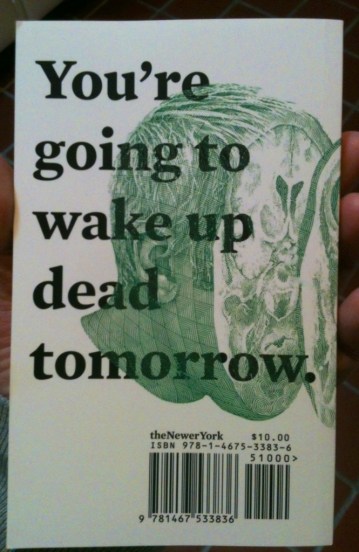
TheNewerYork is a new little magazine or journal or whatever you want to call it, featuring short fiction, poetry, art, lists, labels, fake reviews, and other stuff. Issue #2, clocking in at just over 80 pages fits neatly into a man’s jacket pocket and can be read in queues or at red lights or in between other readings or discreetly during end of semester faculty meetings. (I’m pretty sure you could read it in other occasions but I didn’t). You can see the front cover above; here’s the back cover, featuring this worrisome promise:

20130106-105947.jpg

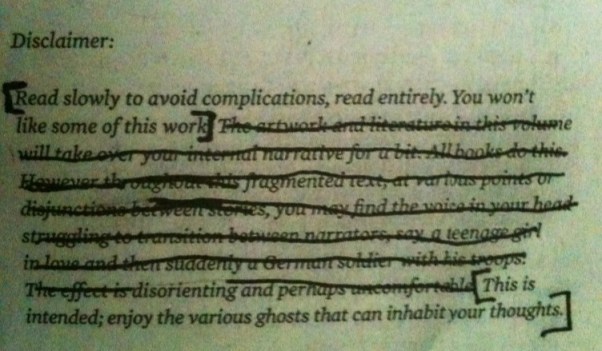
Maybe the best way to summarize (what I take to be) theNewerYork’s aesthetic/literary mission is to show off the issue’s disclaimer (which is preceded by a fancy Foucault quote):

20130106-105653.jpg

“You won’t like some of this work” seems like a fair warning, but theNewerYork is more hit than miss, starting with its excellent opener, ‘The Thank You War” by Elliot L. Ackerman, a four-paragraph flash that tackles how would-be patriotic citizens bungle human relationships with returning soldiers. Also very good is Jamie Grefe’s list “Over Thirteen,” which is a lovely little horror story that makes meaningful use of the reader’s imagination. Another list, Bruce Harris’s “Nearly A Dozen Things Sherlock Holmes Never Said” made me laugh (sample: “Watson, you’re right.”)

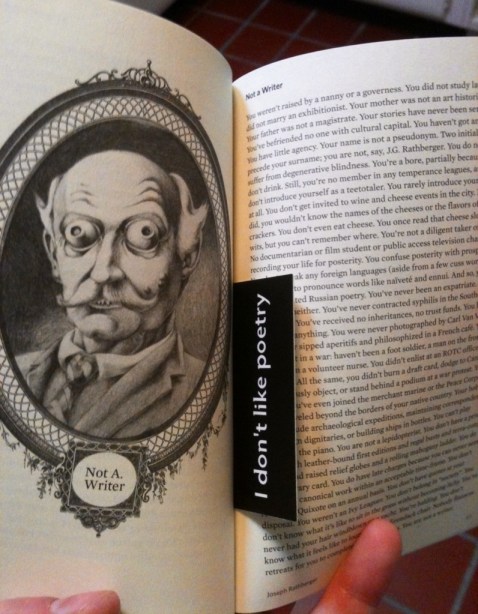
One of my favorite pieces in the volume is “Not a Writer” by Joseph Rathberger (indexed as “A Put Down”). You can see it below, filling up a page; you can also see the art that precedes it and the nifty bookmark that comes with the issue:

20130106-104746.jpg

Most of the art in the issue is black and white and all of it is varied (in style and in quality). Here is Food Poop by Shaina Yang:

20130106-104753.jpg

TheNewerYork’s willingness to showcase experimentation in what goes on paper for people to look at and read is both a strength and a weakness. Most of the pieces succeed, even when they shouldn’t (why is a Google translation from “Baby Got Back” from English to Latin and then back into English so funny?). The pieces in the issue that don’t succeed fail on their own terms: half-formed or poorly executed ideas, the occasionally gimmicky experiment, and, thankfully more rarely, pieces that feel too imitative. But like I said, most of the texts in theNewerYork’s second issue succeed, which is to say they entertain or amuse or baffle or occasionally move the reader. What I like most about theNewerYork is its spirit, which is daring and experimental without the heavy robes of irony that often cloak these sorts of operations. A promising beginning.

“The Four Fists” — F. Scott Fitzgerald

“The Four Fists” — F. Scott Fitzgerald

At the present time no one I know has the slightest desire to hit Samuel Meredith; possibly this is because a man over fifty is liable to be rather severely cracked at the impact of a hostile fist, but, for my part, I am inclined to think that all his hitable qualities have quite vanished. But it is certain that at various times in his life hitable qualities were in his face, as surely as kissable qualities have ever lurked in a girl’s lips.

I’m sure every one has met a man like that, been casually introduced, even made a friend of him, yet felt he was the sort who aroused passionate dislike—expressed by some in the involuntary clinching of fists, and in others by mutterings about “takin’ a poke” and “landin’ a swift smash in ee eye.” In the juxtaposition of Samuel Meredith’s features this quality was so strong that it influenced his entire life.

What was it? Not the shape, certainly, for he was a pleasant-looking man from earliest youth: broad-bowed with gray eyes that were frank and friendly. Yet I’ve heard him tell a room full of reporters angling for a “success” story that he’d be ashamed to tell them the truth that they wouldn’t believe it, that it wasn’t one story but four, that the public would not want to read about a man who had been walloped into prominence.

It all started at Phillips Andover Academy when he was fourteen. He had been brought up on a diet of caviar and bell-boys’ legs in half the capitals of Europe, and it was pure luck that his mother had nervous prostration and had to delegate his education to less tender, less biassed hands.

At Andover he was given a roommate named Gilly Hood. Gilly was thirteen, undersized, and rather the school pet. From the September day when Mr. Meredith’s valet stowed Samuel’s clothing in the best bureau and asked, on departing, “hif there was hanything helse, Master Samuel?” Gilly cried out that the faculty had played him false. He felt like an irate frog in whose bowl has been put goldfish. Continue reading ““The Four Fists” — F. Scott Fitzgerald”

“The Witch” — Anton Chekhov

“The Witch” — Anton Chekhov

IT was approaching nightfall. The sexton, Savely Gykin, was lying in his huge bed in the hut adjoining the church. He was not asleep, though it was his habit to go to sleep at the same time as the hens. His coarse red hair peeped from under one end of the greasy patchwork quilt, made up of coloured rags, while his big unwashed feet stuck out from the other. He was listening. His hut adjoined the wall that encircled the church and the solitary window in it looked out upon the open country. And out there a regular battle was going on. It was hard to say who was being wiped off the face of the earth, and for the sake of whose destruction nature was being churned up into such a ferment; but, judging from the unceasing malignant roar, someone was getting it very hot. A victorious force was in full chase over the fields, storming in the forest and on the church roof, battering spitefully with its fists upon the windows, raging and tearing, while something vanquished was howling and wailing…. A plaintive lament sobbed at the window, on the roof, or in the stove. It sounded not like a call for help, but like a cry of misery, a consciousness that it was too late, that there was no salvation. The snowdrifts were covered with a thin coating of ice; tears quivered on them and on the trees; a dark slush of mud and melting snow flowed along the roads and paths. In short, it was thawing, but through the dark night the heavens failed to see it, and flung flakes of fresh snow upon the melting earth at a terrific rate. And the wind staggered like a drunkard. It would not let the snow settle on the ground, and whirled it round in the darkness at random.

Savely listened to all this din and frowned. The fact was that he knew, or at any rate suspected, what all this racket outside the window was tending to and whose handiwork it was.

“I know!” he muttered, shaking his finger menacingly under the bedclothes; “I know all about it.” Continue reading ““The Witch” — Anton Chekhov”

“The Right Eye of the Commander” — Bret Harte

“The Right Eye of the Commander” — Bret Harte

The year of grace 1797 passed away on the coast of California in a southwesterly gale. The little bay of San Carlos, albeit sheltered by the headlands of the blessed Trinity, was rough and turbulent; its foam clung quivering to the seaward wall of the Mission garden; the air was filled with flying sand and spume, and as the Senor Commandante, Hermenegildo Salvatierra, looked from the deep embrasured window of the Presidio guardroom, he felt the salt breath of the distant sea buffet a color into his smoke-dried cheeks.

The Commander, I have said, was gazing thoughtfully from the window of the guardroom. He may have been reviewing the events of the year now about to pass away. But, like the garrison at the Presidio, there was little to review; the year, like its predecessors, had been uneventful—the days had slipped by in a delicious monotony of simple duties, unbroken by incident or interruption. The regularly recurring feasts and saints’ days, the half-yearly courier from San Diego, the rare transport ship and rarer foreign vessel, were the mere details of his patriarchal life. If there was no achievement, there was certainly no failure. Abundant harvests and patient industry amply supplied the wants of Presidio and Mission. Isolated from the family of nations, the wars which shook the world concerned them not so much as the last earthquake; the struggle that emancipated their sister colonies on the other side of the continent to them had no suggestiveness. In short, it was that glorious Indian summer of California history around which so much poetical haze still lingers—that bland, indolent autumn of Spanish rule, so soon to be followed by the wintry storms of Mexican independence and the reviving spring of American conquest.

The Commander turned from the window and walked toward the fire that burned brightly on the deep ovenlike hearth. A pile of copybooks, the work of the Presidio school, lay on the table. As he turned over the leaves with a paternal interest, and surveyed the fair round Scripture text—the first pious pothooks of the pupils of San Carlos—an audible commentary fell from his lips: “‘Abimelech took her from Abraham’—ah, little one, excellent!—’Jacob sent to see his brother’—body of Christ! that upstroke of thine, Paquita, is marvelous; the Governor shall see it!” A film of honest pride dimmed the Commander’s left eye—the right, alas! twenty years before had been sealed by an Indian arrow. He rubbed it softly with the sleeve of his leather jacket, and continued: “‘The Ishmaelites having arrived—'”

He stopped, for there was a step in the courtyard, a foot upon the threshold, and a stranger entered. With the instinct of an old soldier, the Commander, after one glance at the intruder, turned quickly toward the wall, where his trusty Toledo hung, or should have been hanging. But it was not there, and as he recalled that the last time he had seen that weapon it was being ridden up and down the gallery by Pepito, the infant son of Bautista, the tortilla-maker, he blushed and then contented himself with frowning upon the intruder. Continue reading ““The Right Eye of the Commander” — Bret Harte”

“Wakefield” — Nathaniel Hawthorne

“Wakefield” by Nathaniel Hawthorne

In some old magazine or newspaper, I recollect a story, told as truth, of a man – let us call him Wakefield – who absented himself for a long time, from his wife. The fact, thus abstractedly is not very uncommon, nor – without a proper distinction of circumstances – to be condemned either as naughty or nonsensical. Howbeit, this, though far from the most aggravated, is perhaps the strangest instance, on record, of marital delinquency; and, moreover, as remarkable a freak as may be found in the whole list of human oddities. The wedded couple lived in London. The man, under presence of going a journey, took lodgings in the next street to his own house, and there, unheard of by his wife or friends, and without the shadow of a reason for such self-banishment, dwelt upwards of twenty years. During that period, he beheld his home every day, and frequently the forlorn Mrs. Wakefield. And after so great a gap in his matrimonial felicity – when his death was reckoned certain, his estate settled, his name dismissed from memory, and his wife, long, long ago, resigned to her autumnal widowhood – he entered the door one evening, quietly, as from a day’s absence, and became a loving spouse till death.

This outline is all that I remember. But the incident, though of the purest originality, unexampled, and probably never to be repeated, is one, I think, which appeals to the general sympathies of mankind. We know, each for himself, that none of us would perpetrate such a folly, yet feel as if some other might. To my own contemplations, at least, it has often recurred, always wonder, but with a sense that the story must be true, and a conception of its hero’s character. Whenever any subject so forcibly affects the mind, time is well spent in thinking of it. If the reader choose, let him do his own meditation; or if he prefer to ramble with me through the twenty years of Wakefield’s vagary, I bid him welcome; trusting that there will be a pervading spirit and a moral, even should we fail to find them, done up neatly, and condensed into the final sentence. Thought has always its efficacy, and every striking incident its moral. Continue reading ““Wakefield” — Nathaniel Hawthorne”

“The Lagoon” — Joseph Conrad

“The Lagoon” by Joseph Conrad

The white man, leaning with both arms over the roof of the little house in the stern of the boat, said to the steersman–

‘We will pass the night in Arsat’s clearing. It is late.’

The Malay only grunted, and went on looking fixedly at the river. The white man rested his chin on his crossed arms and gazed at the wake of the boat. At the end of the straight avenue of forests cut by the intense glitter of the river, the sun appeared unclouded and dazzling, poised low over the water that shone smoothly like a band of metal. The forests, somber and dull, stood motionless and silent on each side of the broad stream. At the foot of big, towering trees, trunkless nipa palms rose from the mud of the bank, in bunches of leaves enormous and heavy, that hung unstirring over the brown swirl of eddies. In the stillness of the air every tree, every leaf, every bough, every tendril of creeper and every petal of minute blossoms seemed to have been bewitched into an immobility perfect and final. Nothing moved on the river but the eight paddles that rose flashing regularly, dipped together with a single splash; while the steersman swept right and left with a periodic and sudden flourish of his blade describing a glinting semicircle above his head. The churnedup water frothed alongside with a confused murmur. And the white man’s canoe, advancing up stream in the short-lived disturbance of its own making, seemed to enter the portals of a land from which the very memory of motion had for ever departed.

The white man, turning his back upon the setting sun, looked along the empty and broad expanse of the sea-reach. For the last three miles of its course the wandering, hesitating river, as if enticed irresistibly by the freedom of an open horizon, flows straight into the sea, flows straight to the east – to the east that harbors both light and darkness. Astern of the boat the repeated call of some bird, a cry discordant and feeble, skipped along over the smooth water and lost itself, before it could reach the other shore, in the breathless silence of the world.

     The steersman dug his paddle into the stream, and held hard with stiffened arms, his body thrown forward. The water gurgled aloud; and suddenly the long straight reach seemed to pivot on its center, the forests swung in a semicircle, and the slanting beams of sunset touched the broadside of the canoe with a fiery glow, throwing the slender and distorted shadows of its crew upon the streaked glitter of the river. The white man turned to look ahead. The course of the boat had been altered at right-angles to the stream, and the carved dragon-head of its prow was pointing now at a gap in the fringing bushes of the bank. It glided through, brushing the overhanging twigs, and disappeared from the river like some slim and amphibious creature leaving the water for its lair in the forests. Continue reading ““The Lagoon” — Joseph Conrad”

Read “The Honored Dead,” a Story by Breece D’J. Pancake

“The Honored Dead” by Breece D’J. Pancake

Watching little Lundy go back to sleep, I wish I hadn’t told her about the Mound Builders to stop her crying, but I didn’t know she would see their eyes watching her in the dark. She was crying about a cat run down by a car—her cat, run down a year ago, only today poor Lundy figured it out. Lundy is turned too much like her momma. Ellen never worries because it takes her too long to catch the point of a thing, and Ellen doesn’t have any problem sleeping. I think my folks were a little too keen, but Lundy is her momma’s girl, not jumpy like my folks.

My grandfather always laid keenness on his Shawnee blood, his half-breed mother, but then he was hep on blood. He even had an oath to stop bleeding, but I don’t remember the words. He was a fair to sharp woodsman, and we all tried to slip up on him at one time or another. It was Ray at the sugar mill finally caught him, but he was an old man by then, and his mind wasn’t exactly right. Ray just came creeping up behind and laid a hand on his shoulder, and the old bird didn’t even turn around; he just wagged his head and said, “That’s Ray’s hand. He’s the first fellow ever slipped on me.” Ray could’ve done without that because the old man never played with a full deck again, and we couldn’t keep clothes on him before he died.

I turn out the lamp, see no eyes in Lundy’s room, then it comes to me why she was so scared. Yesterday I told her patches of stories about scalpings and murders, mixed up the Mound Builders with the Shawnee raids, and Lundy chained that with the burial mound in the back pasture. Tomorrow I’ll set her straight. The only surefire thing I know about Mound Builders is they must have believed in a god and hereafter or they never would have made such big graves.

Continue reading “Read “The Honored Dead,” a Story by Breece D’J. Pancake”

“The Mouse” — Saki

“The Mouse” — Saki

Theodoric Voler had been brought up, from infancy to the confines of middle age, by a fond mother whose chief solicitude had been to keep him screened from what she called the coarser realities of life. When she died she left Theodoric alone in a world that was as real as ever, and a good deal coarser than he considered it had any need to be. To a man of his temperament and upbringing even a simple railway journey was crammed with petty annoyances and minor discords, and as he settled himself down in a second-class compartment one September morning he was conscious of ruffled feelings and general mental discomposure.

He had been staying at a country vicarage, the inmates of which had been certainly neither brutal nor bacchanalian, but their supervision of the domestic establishment had been of that lax order which invites disaster. The pony carriage that was to take him to the station had never been properly ordered, and when the moment for his departure drew near, the handyman who should have produced the required article was nowhere to be found. In this emergency Theodoric, to his mute but very intense disgust, found himself obliged to collaborate with the vicar’s daughter in the task of harnessing the pony, which necessitated groping about in an ill-lighted outbuilding called a stable, and smelling very like one – except in patches where it smelled of mice. Without being actually afraid of mice, Theodoric classed them among the coarser incidents of life, and considered that Providence, with a little exercise of moral courage, might long ago have recognised that they were not indispensable, and have withdrawn them from circulation.

As the train glided out of the station Theodoric’s nervous imagination accused himself of exhaling a weak odour of stable yard, and possibly of displaying a mouldy straw or two on his unusually well-brushed garments. Fortunately the only other occupation of the compartment, a lady of about the same age as himself, seemed inclined for slumber rather than scrutiny; the train was not due to stop till the terminus was reached, in about an hour’s time, and the carriage was of the old-fashioned sort that held no communication with a corridor, therefore no further travelling companions were likely to intrude on Theodoric’s semiprivacy. And yet the train had scarcely attained its normal speed before he became reluctantly but vividly aware that he was not alone with the slumbering lady; he was not even alone in his own clothes. Continue reading ““The Mouse” — Saki”

Read “Second Variety,” a Story by Philip K. Dick

The Russian soldier made his way nervously up the ragged side of the hill, holding his gun ready. He glanced around him, licking his dry lips, his face set. From time to time he reached up a gloved hand and wiped perspiration from his neck, pushing down his coat collar.

Eric turned to Corporal Leone. “Want him? Or can I have him?” He adjusted the view sight so the Russian’s features squarely filled the glass, the lines cutting across his hard, somber features.

Leone considered. The Russian was close, moving rapidly, almost running. “Don’t fire. Wait.” Leone tensed. “I don’t think we’re needed.”

The Russian increased his pace, kicking ash and piles of debris out of his way. He reached the top of the hill and stopped, panting, staring around him. The sky was overcast, drifting clouds of gray particles. Bare trunks of trees jutted up occasionally; the ground was level and bare, rubble-strewn, with the ruins of buildings standing out here and there like yellowing skulls.

The Russian was uneasy. He knew something was wrong. He started down the hill. Now he was only a few paces from the bunker. Eric was getting fidgety. He played with his pistol, glancing at Leone.

“Don’t worry,” Leone said. “He won’t get here. They’ll take care of him.”

“Are you sure? He’s got damn far.”

“They hang around close to the bunker. He’s getting into the bad part. Get set!”

The Russian began to hurry, sliding down the hill, his boots sinking into the heaps of gray ash, trying to keep his gun up. He stopped for a moment, lifting his fieldglasses to his face.

“He’s looking right at us,” Eric said.

The Russian came on. They could see his eyes, like two blue stones. His mouth was open a little. He needed a shave; his chin was stubbled. On one bony cheek was a square of tape, showing blue at the edge. A fungoid spot. His coat was muddy and torn. One glove was missing. As he ran his belt counter bounced up and down against him.

Leone touched Eric’s arm. “Here one comes.”

Across the ground something small and metallic came, flashing in the dull sunlight of mid-day. A metal sphere. It raced up the hill after the Russian, its treads flying. It was small, one of the baby ones. Its claws were out, two razor projections spinning in a blur of white steel. The Russian heard it. He turned instantly,  firing. The sphere dissolved into particles. But already a second had emerged and was following the first. The Russian fired again.

A third sphere leaped up the Russian’s leg, clicking and whirring. It jumped to the shoulder. The spinning blades disappeared into the Russian’s throat.

Eric relaxed. “Well, that’s that. God, those damn things give me the creeps. Sometimes I think we were better off before.”

“If we hadn’t invented them, they would have.” Leone lit a cigarette shakily. “I wonder why a Russian would come all this way alone. I didn’t see anyone covering him.”

Lt. Scott came slipping up the tunnel, into the bunker. “What happened? Something entered the screen.”

“An Ivan.”

“Just one?”

Eric brought the view screen around. Scott peered into it. Now there were numerous metal spheres crawling over the prostrate body, dull metal globes clicking and whirring, sawing up the Russian into small parts to be carried away.

“What a lot of claws,” Scott murmured.

“They come like flies. Not much game for them any more.”

Scott pushed the sight away, disgusted. “Like flies. I wonder why he was out there. They know we have claws all around.”

A larger robot had joined the smaller spheres. It was directing operations, a long blunt tube with projecting eyepieces. There was not much left of the soldier. What remained was being brought down the hillside by the host of claws.

“Sir,” Leone said. “If it’s all right, I’d like to go out there and take a look at him.”

“Why?”

“Maybe he came with something.”

Scott considered. He shrugged. “All right. But be careful.”

“I have my tab.” Leone patted the metal band at his wrist. “I’ll be out of bounds.”

(Read the rest of “Second Variety” at Project Gutenberg).


Read “The Lady’s Maid,” a Short Story by Katherine Mansfield

“The Lady’s Maid” by Katherine Mansfield

Eleven o’clock. A knock at the door … I hope I haven’t disturbed you, madam. You weren’t asleep – were you? But I’ve just given my lady her tea, and there was such a nice cup over, I thought, perhaps …

… Not at all, madam. I always make a cup of tea last thing. She drinks it in bed after her prayers to warm her up. I put the kettle on when she kneels down and I say to it, “Now you needn’t be in too much of a hurry to say your prayers.” But it’s always boiling before my lady is half through. You see, madam, we know such a lot of people, and they’ve all got to be prayed for – every one. My lady keeps a list of the names in a little red book. Oh dear! whenever some one new has been to see us and my lady says afterwards, “Ellen, give me my little red book,” I feel quite wild, I do. “There’s another,” I think, “keeping her out of her bed in all weathers.” And she won’t have a cushion, you know, madam; she kneels on the hard carpet. It fidgets me something dreadful to see her, knowing her as I do. I’ve tried to cheat her; I’ve spread out the eiderdown. But the first time I did it – oh, she gave me such a look – holy it was, madam. “Did our Lord have an eiderdown, Ellen?” she said. But – I was younger at the time – I felt inclined to say, “No, but our Lord wasn’t your age, and he didn’t know what it was to have your lumbago.” Wicked – wasn’t it? But she’s too good, you know, madam. When I tucked her up just now and seen – saw her lying back, her hands outside and her head on the pillow – so pretty – I couldn’t help thinking, “Now you look just like your dear mother when I laid her out!”

… Yes, madam, it was all left to me. Oh, she did look sweet. I did her hair, soft-like, round her forehead, all in dainty curls, and just to one side of her neck I put a bunch of most beautiful purple pansies. Those pansies made a picture of her, madam! I shall never forget them. I thought to-night, when I looked at my lady, “Now, if only the pansies was there no one could tell the difference.”

 … Only the last year, madam. Only after she’d got a little – well – feeble as you might say. Of course, she was never dangerous; she was the sweetest old lady. But how it took her was – she thought she’d lost something. She couldn’t keep still, she couldn’t settle. All day long she’d be up and down, up and down; you’d meet her everywhere, – on the stairs, in the porch, making for the kitchen. And she’d look up at you, and she’d say – just like a child, “I’ve lost it, I’ve lost it.” “Come along,” I’d say, “come along, and I’ll lay out your patience for you.” But she’d catch me by the hand – I was a favourite of hers – and whisper, “Find it for me, Ellen. Find it for me.” Sad, wasn’t it? Continue reading “Read “The Lady’s Maid,” a Short Story by Katherine Mansfield”