Best Books of 1976?

Previously:

Best Books of 1972?

Best Books of 1973?

Best Books of 1974?

Best Books of 1975?

Not-really-the-rules recap:

I will focus primarily on novels here, or books of a novelistic/artistic scope.

I will include books published in English in 1976, including translations published in English for the first time.


The New York Times Best Seller list for fiction in 1976 was dominated by Agatha Christie, Gore Vidal, and Leon Uris. Christie’s 1975 novel Curtain ruled winter and early spring, with her posthumous 1976 novel Sleeping Murder topping the charts in November and December. Vidal’s historical novel 1876 and Uris’s Trinity split the rest of the year. While Alex Haley’s Roots topped the nonfiction Best Seller list for only a few weeks in 1976, it’s the bestseller title of the year with the most cultural staying power. Bob Woodward and Carl Bernstein’s The Final Days, their follow up to 1974’s All the President’s Men was a bestseller in the spring and summer (and one of many, many Watergate books of this era). Gail Sheehy’s “road map to adult life” Passages was popular in the fall.

But sales charts ain’t literature.

Better to regard the New York Times Book Review’s end-of-year round up, “1976: A Selection of Noteworthy Titles.” It begins with a heavy dose of literary biographies, memoirs, autobiographies, and collections of letters. These include Christopher Isherwood’s Christopher and His KindLucille Clifton’s memoir Generations, Patrick McCarthy’s bio Celine, Charles Higham’s The Adventures of Conan Doyle, and Lillian Hellman’s third memoir Scoundrel Time. 

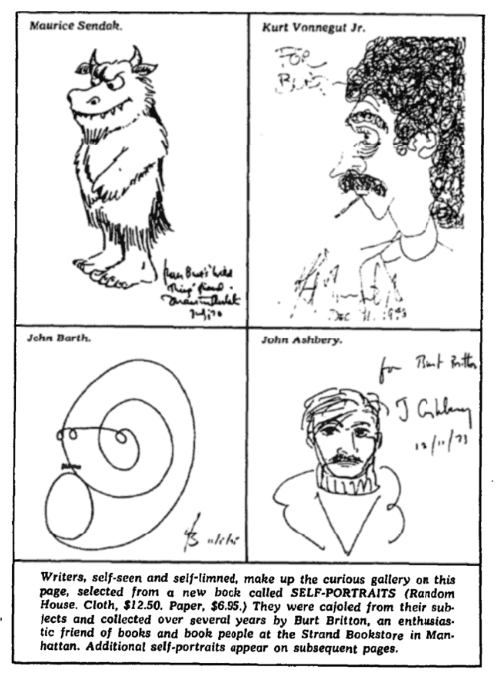
Also of note in the NYT list are Ron Kovic’s Born on the Fourth of JulyMaxine Hong Kingston’s The Woman Warrior, and Britt Britton’s collection of author Self-Portraits (the article is peppered with some of the portraits).

The Book Review piece also notes collections of letters by Sylvia Plath, E.B. White, and Virginia Woolf, as well as more diaries of Anaïs Nin. There are multiple memoirs of Hemingway (one by his son and one by his last wife) and David Heyman’s Ezra Pound biography. The list of literary bios and memoirs conveys the beginnings of a strange autopsy of the Modernist past giving way to something new.

Here are some of the fiction titles the New York Times Book Review includes in its “Selection of Noteworthy Titles” that I thought more noteworthy than other titles included:

The Acts of King Arthur and His Noble Knights, John Steinbeck

The Autumn of the Patriarch Gabriel García Márquez (trans. Gregory Rabassa)

The Easter Parade, Richard Yates

Flight to Canada, Ishmael Reed

The Franchiser, Stanley Elkin

Lady Oracle, Margaret Atwood

Lucinella, Lore Segal

Meridian, Alice Walker

Ratner’s Star, Don DeLillo

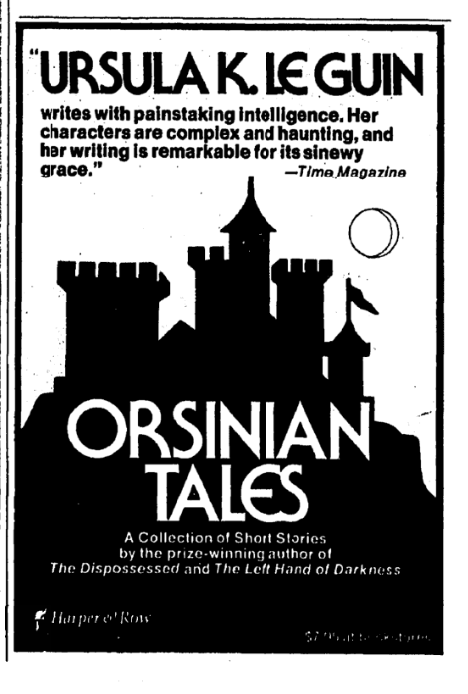
Orsinian Tales, Ursula K. Le Guin

Slapstick, Kurt Vonnegut

Speedboat, Renata Adler

The Takeover, Muriel Spark

Travesty, John Hawkes

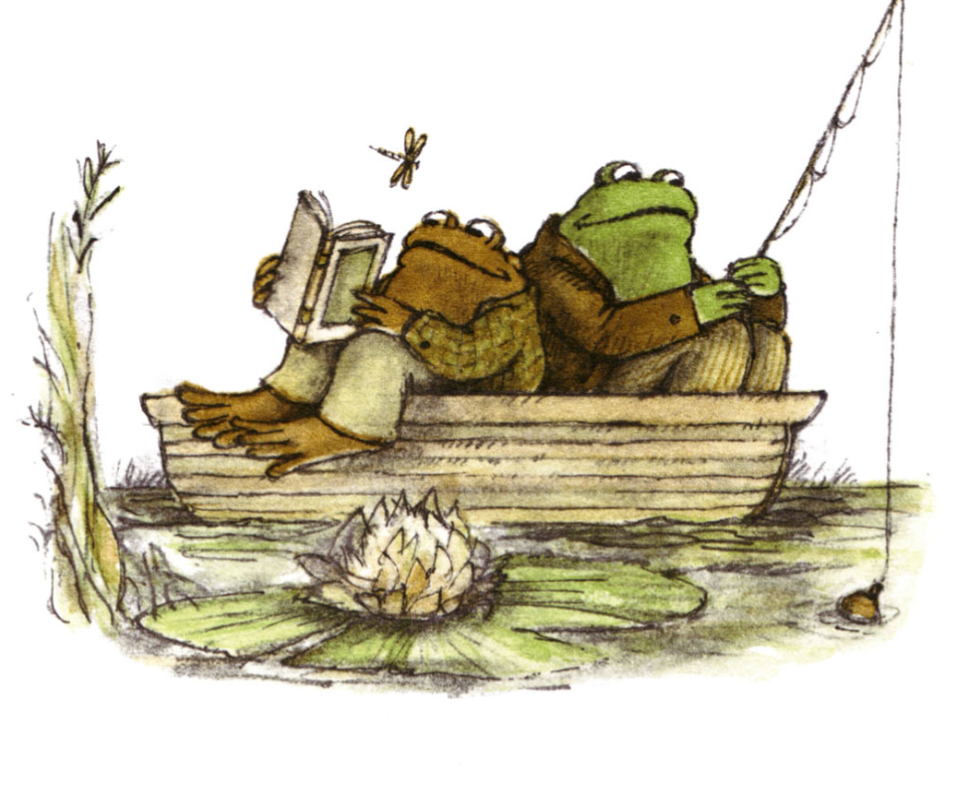
Frog and Toad All Year, Arnold Lobel

Children of Dune, Frank Herbert

The Fifth Head of Cerberus, Gene Wolfe

Triton, Samuel R. Delany

I’ll do some more with that list in a second. But for now–

One of the best sections of the NYT Book Review’s year-end recap is “Author’s Authors,” in which they ask various writers to pick their three favorite reads of 1976. John Cheever picks John Updike’s Picked Up Pieces (1975). Bernard Malamud picks García Márquez’s The Autumn of the Patriarch. Vladimir Nabokov, always humble selects his own manuscript for The Original of Laura (it remained unpublished until 2009).

William H. Gass selects buddies William Gaddis (J R, 1975) and Stanley Elkin (The Franchiser); I’ll pick up Craig Nova’s 1975 novel The Geek on his recommendation. I’ll also be on the look out for one of Ishmael Reed’s recommendations: Dangerous Music (1975) by Jessica Tarahata Hagedorn. He also recommends one of the many, many Watergate books of the era, Blind Ambition by John Dean and Shouting! by Joyce Carol ThomasAs far as I can tell, Shouting! wasn’t published until 2007.

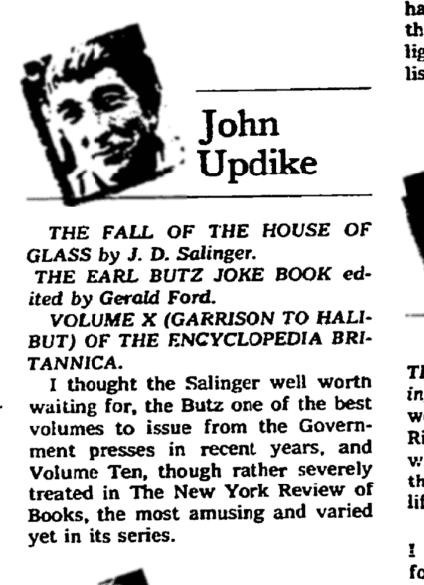
By far the best entry belongs to John Updike though:

John Updike THE FALL OF THE HOUSE OF GLASS by J.D. Salinger THE EARL BUTZ JOKE BOOK edited by Gerald Ford VOLUME X (GARRISON TO HALIBUT) OF THE ENCYCLOPEDIA BRITTANICA. I thought the Salinger well worth waiting for, the Butz one of the best volumes to issue from the Government presses in recent years, and Volume Ten, though rather severely treated in the New York Review of Books, the most amusing and varied yet in its series.

Shitposting in the Times in the late seventies. Gotta love it.

In her “Author’s Authors” write up, the novelist Lois Gold makes the only mention of Anne Rice’s Interview with the Vampire in the NYTBR piece. Rice’s seminal postmodernist vampire romance currently sits at #1 on Goodreads list of most popular books published in 1976, a testament to its populist staying power. Other notable books on the Goodreads list that were absent from the lofty NTYBR’s contemporary coverage include Tom Robbins’ Even Cowgirls Get the BluesMarge Piercy’s Woman on the Edge of TimeMichael Crichton’s Eaters of the DeadDavid Seltzer’s The OmenRaymond Carver’s Will You Please Be Quiet, Please?, Marian Engel’s BearOctavia Butler’s PatternmasterHarry Crews’ A Feast of SnakesHubert Selby Jr.’s The Demon, Richard Brautigan’s Sombrero FalloutKingsley Amis’s The Alteration, and many, many more. I’ll do more with that list momentarily, but next —

–prizes!

Saul Bellow won both the 1976 Nobel Prize in Literature (“for the human understanding and subtle analysis of contemporary culture that are combined in his work”) and the 1976 Pulitzer Prize for Fiction, specifically for his 1975 novel Humboldt’s Gift.

David Saville’s novel Saville was awarded the 1976 Booker Prize. The shortlist consisted of An Instant in the Wind by André Brink, Rising by R. C. Hutchinson, The Doctor’s Wife by Brian Moore, King Fisher Lives by Julian Rathbone, and The Children of Dynmouth by William Trevor. 

The 1977 National Book Award winner for fiction was Wallace Stegner’s The Spectator Bird. Runners-up were Will You Please Be Quiet, Please? by Raymond Carver, Orsinian Tales by Ursula K. Le Guin, The Balloonist by MacDonald Harris, and A Fine Romance by Cynthia Propper Seton. 

The 1976 National Book Critics Circle award for best fiction went to John Gardner’s October LightFinalists were Renata Adler’s Speedboat, Valdimir Nabokov’s Details of a Sunset and Other Stories, Cynthia Ozick’s Bloodshed and Three Novellas, and The Easter Parade by Richard Yates. Haley’s Roots was runner up to Maxine Hong Kingston’s The Woman Warrior. 

The Nebula Awards for fiction published in 1976 gave first place to Inferno by Larry Niven and Jerry Pournelle. Notable finalists included Marta Randall’s Islands, Delany’s Triton and Where Late the Sweet Birds Sang by Kate Wilhelm.

I have read many but hardly all the books mentioned in this post. But this is my blog, so here are my picks for the best books of 1976:

The Autumn of the Patriarch, Gabriel García Márquez (trans. Gregory Rabassa)

Bear, Marian Engel 

A Feast of Snakes, Harry Crews

Flight to Canada, Ishmael Reed

The Franchiser, Stanley Elkin

Orsinian Tales, Ursula K. Le Guin

Lucinella, Lore Segal

Ratner’s Star, Don DeLillo

Slapstick, Kurt Vonnegut

Speedboat, Renata Adler

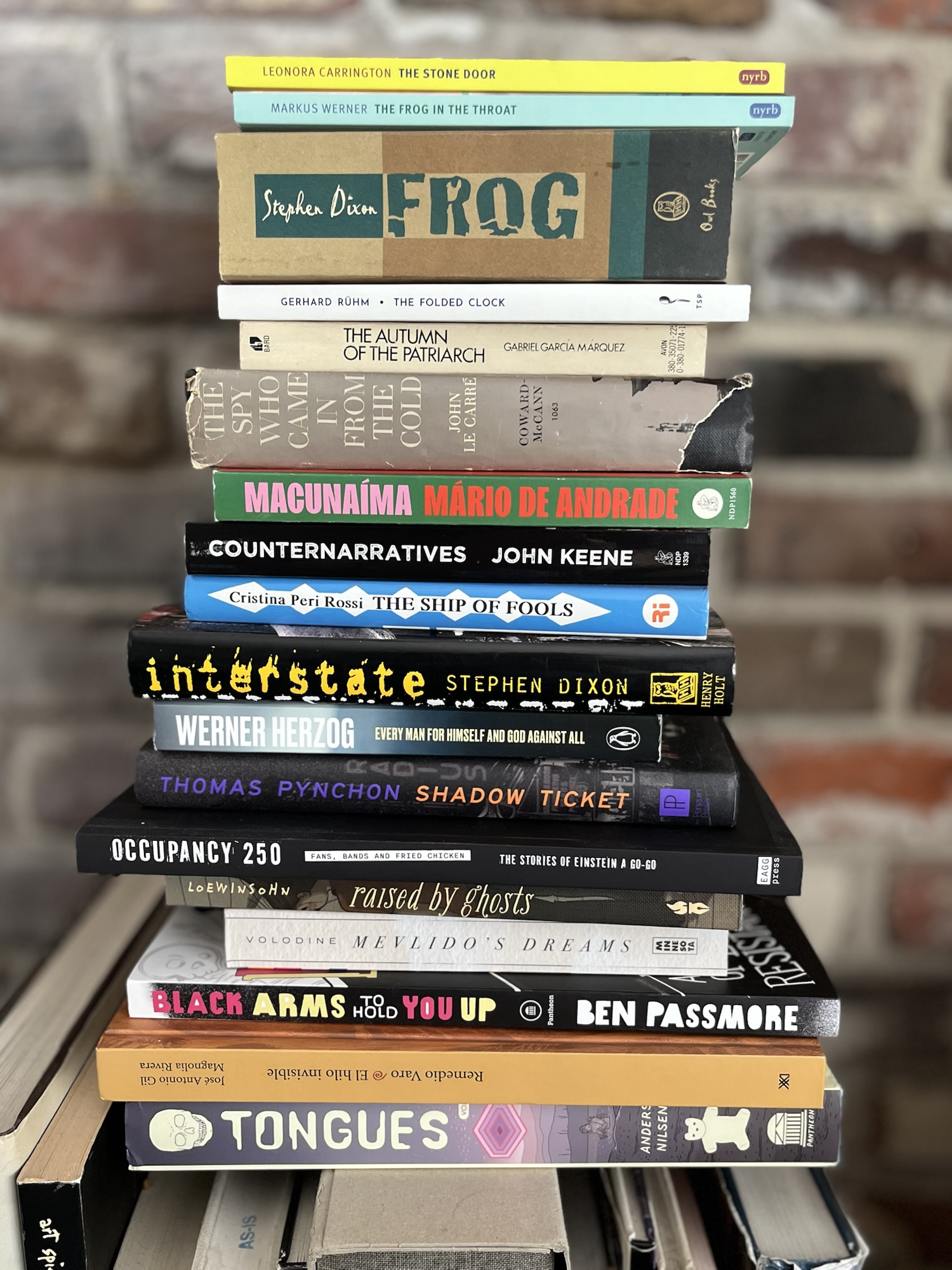
A few sentences on every book I read or reread in 2025

☉ indicates a reread.

☆ indicates an outstanding read.

In some cases, I’ve self-plagiarized some descriptions and evaluations from my social media and blog posts.

I have not included books that I did not finish or abandoned.


Every Man for Himself and God Against All, Werner Herzog☆

I got a paperback copy of Herzog’s memoir for Christmas last year but ended up listening to him read the audiobook on my commute for a week or two. Every Man for Himself was one of four memoirs as-read-by-the-author I listened to this year. The other three: The Friedkin Connection by William Friedkin; The Harder I Fight the More I Love You by Neko Case; Rumors of My Demise by Evan Dando. I enjoyed all four memoirs and maybe as I go through this post I’ll pull a few common threads. Herzog’s memoir is bonkers, better than fiction. It really is one of those deals where a paragraph starts one way and a few sentences later you’re in a totally different place.

Dispatches from the District Committee, Vladimir Sorokov (translation by Max Lawton; illustrations by Gregory Klassen)

An absolutely vile book. I loved it.

Raised by Ghosts, Briana Loewinsohn

Loewinsohn’s love letter to the latchkey nineties hit me hard. I reviewed it here.

Nazi Literature in the Americas, Roberto Bolaño (translation by Chris Andrews)☉

I think I was trying to get through the beginning of a novel by an “alt” midlist author when I realized I’d rather read something I loved. Or maybe there was something else in the air in late January. The notes on the draft for this post are cryptic.

Feminine Wiles, Jane Bowles

A slim lil guy, a nice reprieve from current events in January, a reminder that sanity is precarious.

Interstate, Stephen Dixon☆

From my review: “It upset me deeply, reading Stephen Dixon’s 1995 novel Interstate. It fucked me up a little bit, and then a little bit more, addicted to reading it as I was over two weeks in a new year.”

Remedios Varo: El hilo invisible, Jose Antonio Gil and Magnolia Rivera

A lot of Varo’s pictures, but also a lot of Spanish. I was trying hard at the time (to read Spanish). I used my iPhone to translate a lot.

Borgia, Alejandro Jodorowsky and Milo Manara 

Indian Summer, Milo Manara and Hugo Platt

CaravaggioMilo Manara

A nice little run there, I seem to recall. Borgia was the best.

Occupancy 250: The Stories of Einstein A Go-Go

The Einstein A Go-Go was an all-ages music club at Jacksonville Beach that was a massive part of my teenage years. I saw so many amazing bands there over four or five years (including Luna, Thinking Fellers Union Local 282, Man or Astroman, Sebadoh, Polvo, Superchunk, Archers of Loaf, and so many more), met so many cool people, and even played there with my band a time or two or five. And if I was too late (that is, too young) to see acts like Nirvana, The Replacements, 10,000 Maniacs, The Cranberries, and Soundgarden there at the the end of the eighties and beginning of the nineties, it feels pretty swell to see my band’s name on the back of Occupancy 250 right there in the mix, as well as flyers and photos. Occupancy 250 is like the yearbook we never got when the club had to shut its doors in ’97 in the name of beachfront development. What a gift it was. A few months ago we went to a reunion event, featuring bands like The Cadets and Emperor X. I’ve never been to a high school reunion, but I know that this was better.

Autumn of the Patriarch, Gabriel García Márquez (translation by Gregory Rabassa)☆

Loved it. A discussion with a colleague after, a Spanish instructor, led to my reading Cela, Peri Rossi, and Rulfo.

The Hive, Camilo José Cela (translation by Anthony Kerrigan)

Pascual Duarte, Camilo José Cela (translation by Anthony Kerrigan)

I liked them both but liked Pascal Duarte more than La colmena. I would love to read Cela’s 1988 novel Cristo versus Arizona if I could get my pink little hands on an English-language copy.

The Friedkin Connection, William Friedkin☆

I think that Spotfiy suggested that I listen to Friedkin’s memoir after I finished the Herzog memory; in any case, there was a lot of overlap. Like Herzog, Friedkin had no idea how to make a film and never really developed a baseline beyond, Doing the thing for real and filming it, whatever the thing was. Going to make a film where a criminal is going to counterfeit US currency? Better teach Willem Dafoe how to, I don’t know, counterfeit money and just film that instead of, like, getting a props department involved. (Weird overlap: both Friedkin and Herzog laud Michael Shannon as the greatest actor of his generation.)

I loved this memoir. It starts, if I recall correctly, with Friedkin admitting that he threw away a sketch by Basquiat and an offer from Prince. It ends with Friedkin telling his wife, legendary producer Sherry Lansing, to pass on Forrest Gump. Amazing stuff.

The Ship of Fools, Cristina Peri Rossi (translation by Psiche Hughes)☆ 

I loved it.

Monsieur Teste, Paul Valéry (translation by Charlotte Mandell) 

I hated it.

Pedro Páramo, Juan Rulfo (translation by Douglas J. Weatherford

I liked it!

Blood Meridian, Cormac McCarthy☉ 

I guess I fall into rereading this all the time.

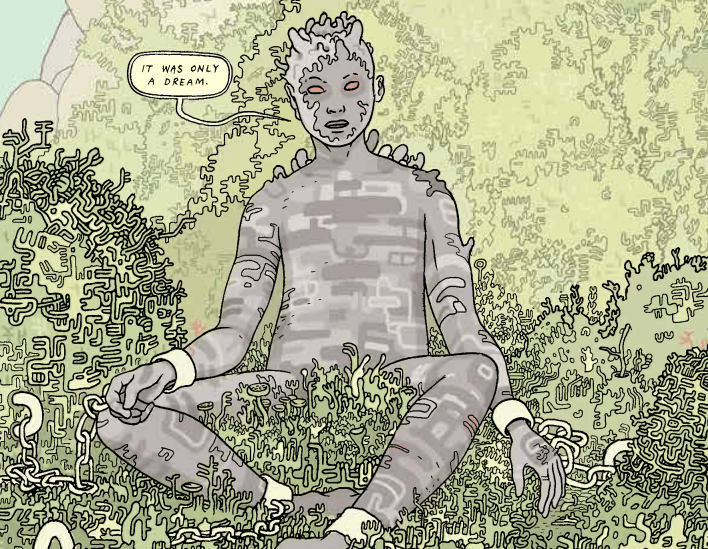
Tongues, Anders Nilsen☆ 

screenshot-2018-08-31-at-4-34-20-pm

Amazing stuff.

Day of the Triffids, John Wyndham

I probably would’ve read Day of the Triffids a dozen times as a kid instead of, like, Joan D. Vinge’s novelization of Mad Max Beyond Thunderdome, if there had been a copy in the lending library in Tabubil. Anyway, I’m glad I got to it when I did.

Frog, Stephen Dixon☆ 

Above, I wrote I have not included books that I did not finish or abandoned; look, I didn’t finish Frog, but in some ways it’s the most important book — or rather, most important, reading experience — for me this year.

An old great friend mailed me his copy back in March. I read and loved a hefty chunk of Frog, a long book, but abandoned it when another great old friend died unexpectedly in early May. I was deep into it but there was no comfort in it, in Frog.

And so then well I just read or reread a bunch of John le Carré novels.

Call for the Dead, John le Carré

A Murder of Quality, John le Carré☆ 

The Spy Who Came in from the Cold, John le Carré

The Looking Glass War, John le Carré

Tinker Tailor Soldier Spy, John le Carré☉☆ 

Was a blur, thank you to Mr. Le Carré’s ghost. A Murder of Quality was my favorite (I think). (I was a fucking mess and these books really helped me.)

The Woman with Fifty Faces: Maria Lani and the Greatest Art Heist That Never Was, by Jon Lackman and Zack Pinson.☆ 

I read it all in one sitting. Loved it.

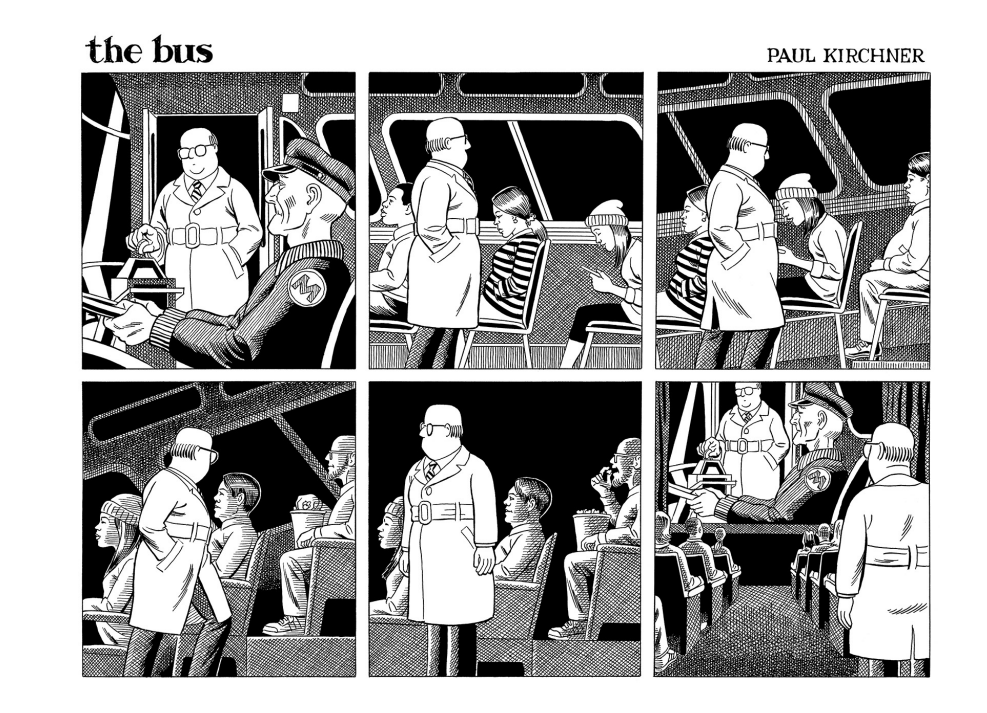
The Bus 3, Paul Kirchner

I reviewed it here.

Portalmania, Debbie Urbanski

In my review, I wrote that, “Debbie Urbanski’s new collection Portalmania is a metatextual tangle of science fiction, fantasy, and horror where portals don’t offer escape so much as expose the fractures beneath family, love, and identity.”

Dreamsnake, Voya McIntrye

I liked it!

The Stone Door, Leonore Carrington

Wrestled with this dude a lot and it beat me. I thought it would twist one way and it did another thing. Ended up reading it twice in the summer and I guess I’ll read it again.

The Great Mortality, John Kelly

Kelly’s Black Death chronicle was a comfort read this summer.

Figures Crossing the Field Towards the Group, Rebecca Grandsen

Skip my review of Grandsen’ poetic post-apocalyptic miniature epic and just buy it and read it.

Macunaíma, Mário de Andrade (translation by Katrina Dodson)☆ 

I am so glad my guy at the bookstore sold me on this one. A synthesis of Brazilian folklore with high and low modernism (eh, Modernism?).

The Sense of an Ending, Julian Barnes

A corny book a colleague recommended. I’m happy that someone I know IRL wants me to read a book and talk about it with them.

Unkempt Thoughts, translation by Jacek Galazka (translation by Jacek Galazka)

More Unkempt Thoughts Stanislaw J. Lec (translation by Jacek Galazka)

Aphorisms.

The Frog in the Throat, Markus Werner (translation by Michael Hofmann)☆ 

I gave the guy who gave me the Julian Barnes this novel; he didn’t like it!

I loved it. In my review of The Frog in the Throat. I noted that “you could throw a small dart in this short book and find a nice line” its protagonist. I included a lot of those pithy gems in the review if you want a sample.

Counternarratives, John Keene☆ 

Amazing stuff. I was halfway through when I realized that Keene wrote the intro to my edition of Mário de Andrade’s Macunaíma. My favorite piece in the collection reads like a riff on Melville’s Benito Cereno with strong Gothic undertones.

Mevlido’s Dreams, Antoine Volodine (translation by Gina M. Stamm)☆ 

A bleak, dystopian noir novel set several centuries in a ruined city-state wherein Mevlido’s fragmented consciousness becomes a vessel for Volodine’s haunting post-exotic vision of history, language, and apocalypse. Loved it! My review.

Shadow Ticket, Thomas Pynchon☆ 

The highlight of 2025 in reading was a new late Pynchon novel. It might not have been the best novel I read this year, but it was my favorite reading experience. I ended up reading it twice, running a series of posts I called Notes on Thomas Pynchon’s novel Shadow Ticket. At the end of those notes, I wrote:

“I should probably distill my thoughts on Shadow Ticket into a compact, “proper” review, but I’ve sat with the novel now for two months, reading it twice, and really, really enjoying it. I never expected to get another Pynchon novel; it’s a gift. I loved its goofy Gothicism; I loved its noir-as-red-herring-genre-swap conceit; I loved even its worst puns (even “sofa so good”). I loved that Pynchon loves these characters, even the ones he might not have had the time or energy to fully flesh out — this is a book that, breezy as it reads, feels like a denser, thicker affair. And even if he gives us doom on the horizon in the impending horrors of genocide and atomic death, Pynchon ends with the hopeful image of two kids chasing sunsets. Great stuff.”

Black Arms to Hold You Up, Ben Passmore

Sports Is Hell, Ben Passmore

Subtitled A History of Black Resistance, Passmore’s comic is more fun than you would think a book about fighting a racist state should be. I still owe it a proper review. It made me go back and read Passmore’s Sports Is Hell, which is kinda like the NFL x Walter Hill’s The Warriors x George Herriman’s Krazy Kat.

The Harder I Fight the More I Love You, Neko Case

Of the four memoirs I listened to this year, musician Neko Case’s is the most artfully written, packing in bursts of sensory images that pivot cannily to evoke very specific memories that connect the reader to the storyteller. The memoir is heavy on Case’s childhood and adolescence and purposefully avoids a direct accounting of her musical career. That’s not to say there isn’t a lot about music in here — there is (life on the road, songwriting, a nice section on her tenor guitar) — but Case seems to avoid going into too much detail about interpersonal relationships with other musicians. She also seems to want to apologize for some past behaviors, but the apologetic language is indirect and even cagey (Evan Dando’s memoir is a massive contrast here — the dude dishes deep, but is also frank and clear and specific about all the bad mean shit he did to people when he was younger).

Neko Case’s magnificent singing voice translates well to reading her memoir. She’s really good at reading it — expressive without being hammy, subtle, artful. I would love to hear her read other audiobooks, but I’m also happy for her to keep her focus on making music and playing live.

The King in Yellow, Robert Chambers☉

I played this silly fun indie game called The Baby in Yellow which led me to reread The King in the Yellow for the first time since I went nuts over True Detective (the first season). The first two stories were much stronger than I remembered — much weirder.

Acid Temple Ball, Mary Sativa

A Satyr’s Romance, Barry N. Malzberg

Flesh and BloodAnna Winter

I spent some of the year browsing through a copy of the Maurice Girodias edited volume The Olympia Reader. That edition offers excerpts from Olympia Press’s more “respectable” authors, like William Burroughs, Chester Himes, Henry Miller, Jean Genet etc. I downloaded a bunch of trashier Olympia titles and ended up reading these three. They were all pretty bad but also fun. Acid Temple Ball is like a sex-positive Go Ask Alice; both A Satyr’s Romance and Flesh and Blood are well-beyond “problematic” in their depictions of sexual relationships.

The Pisstown Chaos, David Ohle☆ 

In my golden-hued review, I called The Pisstown Chaos “a foul, abject, hilarious, zany vaudeville act, a satire of post-apocalyptic literature, an extended riff on American hucksterism. It’s very funny and will make most readers queasy.”

The Changeling, Joy Williams

Joy Williams is one of my favorite writers, but I’ll admit I was disappointed in her second novel, 1978’s The Changeling. I loved how dark and weird and oppressive it was, but soon tired of spending time in the rattled consciousness of its alcoholic hero, Pearl. When Williams explores beyond Pearl, the novel hints at weird Gothic cult island shit that is super-intriguing — but we always have to retreat back to our depressed, insane hero.

The Folded Clock, Gerhard Rühm (translation by Alexander Booth)

A collection of “number poems, comprising typewriter ideograms, typed concrete poetry, collages of everyday paper ephemera and scraps, and a wide variety of literary forms where the visual pattern created on the page underpins the thematic meaning,” as publisher Twisted Spoon puts it. A fascinating and frustrating read that hearkens back to the good ole days of the avant garde.

Rumors of My Demise, Evan Dando

In a review at the Guardian of Evan Dando’s memoir Rumors of My Demise, Alexis Petridis writes that the Lemonheads leader “sounds insufferable, but weirdly, he doesn’t come across that way.” Dando doesn’t try to deny, deflect, or otherwise shade his life. He’s upfront about his privileged background, his good looks, and his love of the rock star lifestyle. He’s also, as he always was, very upfront about the drugs. I was in eighth grade when It’s a Shame about Ray came out. I loved it. I loved the follow up album, Come on Feel the Lemonheads even more. I am, I suppose, the target audience for this book, and I found it very satisfying. I also think listening to Dando read it is really remarkable. He’s charming and affable, but he doesn’t seem comfortable reading out loud (you can hear it, for example, in an awkward pause when he has to change the page during the middle of a sentence). It’s also remarkably honest, and culminates in a series of apologies to many of the people he’d hurt when he was younger (“If I could go back in time and give a bit of advice to myself, I’d say ‘Evan, don’t be such a dick.’”)

My best friend Nick, who died this May, was a bigger Lemonheads fan than I was. I think he would have loved Rumors of My Demise and I thought about him all the time while I was listening to it, wanting to text him, Hey, you’re gonna love this story about Dando drinking Fanta Orange and Absolut with Keith Richards or, Man, Dando really has a score to settle with Courtney Love, or Dando’s some kind of disaster magnet — he lived right by the Twin Towers and was home on 9/11, he was in L.A. during the King riots, in Paris when Diana died, on Martha’s Vineyard when JFK Jr. crashed…or, Man, Dando seems to have finally quit heroin, good for him. I didn’t get to text those things so I’m writing them here.

Happy New Year to you and yours.

Annotations on The Guardian’s ranking of Thomas Pynchon’s books

Thomas Pynchon’s ninth novel Shadow Ticket is out fifty days from now. In anticipation, there’s a piece today in The Guardian by John Keenan ranking Pynchon’s books to date.

I undertook a similar silly project just over a year ago on this blog in a post titled “A(nother) completely subjective and thoroughly unnecessary ranking of Thomas Pynchon’s novels” (this list was a correction to a previous 2018 list I foolishly compiled). Lists like these are obviously personal judgments (like, opinions man).

But Keenan’s list is wrong. So here are my annotations.

9. Keenan selects Slow Learner, writing,

A collection of early short stories that is chiefly of interest for the introduction, in which the author spells out why he thinks they fail. Pynchon does not spare himself but, unfortunately, he is right. For aficionados only.

I didn’t include Slow Learner in my rankings because it is not a novel. Pynchon’s intro to it is probably the best thing in it. I agree with Keenan’s assessment here.

8. Keenan selects Against the Day, writing,

Practically plotless, prolix and gargantuan, this novel landed with a thump following a nine-year gap. Characters fragment and double in a bewildering array, the style pastiches pulp novels, adventure stories and science fiction. It does not add up to more than the sum of its admittedly ingenious parts.

This assessment is egregious. Against the Day is perhaps the most directly political of Pynchon’s novels, and, in my estimation, the clearest (if not the most concise) expression of Pynchon’s political sympathies. I ranked it #3, writing: “I think this novel would make an excellent American history textbook. Its thesis: resist the military-industrial-entertainment-complex. Start here!

7. Keenan selects Bleeding Edge, writing,

Pynchon’s most recent novel is a lightweight. The protagonist, Maxine Tarnow, mother of two, longsuffering partner to a feckless financier, finds herself chasing shadows around Manhattan’s Silicon Alley. Maxine’s skills as a fraud investigator are put to the test unravelling the machinations of the nasty controller of a computer security firm who will do anything to get his hands on a virtual reality simulator called DeepArcher (geddit?). There are plentiful puns, red herrings and surnames that serve as possibly unhelpful acronyms – the usual Pynchon ingredients, in other words. Here they fail to cohere into an entirely satisfying whole.

Bleeding Edge is not top-tier Pynchon, but it’s hardly lightweight. I ranked it #6, writing,

Reading Bleeding Edge helped evoke all the weirdness the 2000s were about to lay out for us. It made me angry again, or reminded me of the anger that I’d sustain for most of the decade. It reminded me of our huge ideological failure after 9/11, an ideological failure we are watching somehow fail even more today.  But I also loved the novel’s unexpectedly sweet domestic plot, and found a kind of solace even in its affirmation of family, even as its final image pointed to the kind of radical inconclusiveness at the heart of being a parent.

6. Keenan selects Vineland, writing,

It is 1984, the year of Reagan’s re-election but for Zoyd Wheeler, Los Angeles-based veteran of the radical left, time has stopped. His wife, Frenesi, has left him to raise their daughter, Prairie, alone and he resorts to dismal acts of self-sabotage in order to qualify for government benefits. Prairie, in turn, flees the family coop to track down her mother, a subversive turned informant in league with federal baddy Brock Vond. Pynchon’s themes are prescient – surveillance, media saturation, generational miscommunication – but his aim is off.

I don’t think “Pynchon’s aim is off” is the best metaphor here. I think he hits what he shoots at — his targets are clear, and he’s an author, right? His characters are props he can set out where he likes, guaranteeing a bullseye. But that’s not always satisfying. I think the execution of Vineland is a bit slapdash. The book has always had cult status among Pynchon aficionados, perhaps stemming from a contrarian spirit. Paul Thomas Anderson’s (very) loose film adaptation, One Battle After Another, has also appeared to prompt a lot of reading, rereading, and online chatter about Vineland. I ranked it last in my list, at #8, writing that, “Vineland is ultimately depressing and easily my least-favorite Pynchon novel, but it does have some exquisite prose moments.

5. Keenan selects V., writing,

Sincerity is not a quality readily associated with Pynchon, but his debut novel displays an affection for his characters that would later take second place to irony. The story bounces between Benny Profane, unemployed sailor, and Herbert Stencil, obsessive seeker of the elusive V. The language shows its age in places, but the plight of people determined to keep themselves in the dark is as relevant as ever.

I love V. and also had it at #5 on my list. Keenan is right that “sincerity” is not associated with Pynchon, but absolutely incorrect that Pynchon’s mode of affection is displaced by irony in the later novels. It’s clear that Pynchon loves Jeremiah Dixon, Charles Mason, Webb Traverse, Roger Mexico, Maxine Tarnow, etc. In my list, I wrote,

I’ll repeat my endorsement that “V. makes a good starting place for anyone new to Pynchon” and recommend that anyone interested in Pynchon but daunted by the scope check out the book from their library and read the ninth chapter, the story of of Kurt Mondaugen.

4. Keenan selects The Crying of Lot 49, writing,

The author regretted publishing this novel but he was being unduly harsh on himself. Short, funny and shot through with allusions you can choose to follow or ignore, the story of Oedipa Maas’s search for the meaning behind the supposed rivalry of postal companies is the literary equivalent of non-Euclidean geometry.

I also had Crying at #4. I wrote,

The Crying of Lot 49 is probably a better novel than V. but I think I like V. better. 49 is very funny and showcases Pynchon’s tonality of paranoia/hope wrapped up in zaniness/horror. It’s an excellent sophomore novel, but also dense, claustrophobic even. I guess I like the Pynchon sprawl a bit better.

3. Keenan selects Inherent Vice, writing,

Wilfully weird, often sordid and occasionally borderline unintelligible, Pynchon’s seventh novel was adapted for the big screen by Paul Thomas Anderson in 2014. The adaptation was nominated for an Oscar, making Pynchon as mainstream as he’s ever likely to get. Larry “Doc” Sportello is a private investigator with a broken heart and a huge appetite for marijuana. His ex-girlfriend reappears out of nowhere, implores Doc to find her married lover, then promptly vanishes again. At the heart of the murky tale lurks the sinister presence of the Golden Fang, a vessel that means, as Doc surmises, “a lot of things to a lot of people” – all of them unsavoury.

I love Inherent Vice, but it’s hardly top-three! I had it at #7, above Vineland.

2. Keenan selects Gravity’s Rainbow, writing,

This kaleidoscopic tour de force cemented Pynchon’s reputation as a writer of baffling, farcical and profound genius. A chief delight is his brilliant ear for dialogue which is given full rein in this twisted tale of allied intelligence officers, Nazis, scientists and seers united by a MacGuffin in the shape of a mysterious rocket. The action arcs from London under bombardment to a postwar zone of surrender. What is striking is how the themes explored here – forever wars, technological domination, uncontrollable cartels – have become staples of internet discourse.

I had Mason & Dixon at #2 and Gravity’s Rainbow at #1.

1 . Keenan selects Mason & Dixon, writing,

Pynchon gives the 18th-century novel a postmodern twist to explore the relationship between Charles Mason and Jeremiah Dixon. . . The author layers fact over anachronistic fiction, scientific inquiry over conspiratorial rumour, and tragedy over knockabout farce, in a virtuoso display of storytelling. . . It is a ripping yarn spun for the incredulous enjoyment of both the cleric’s family and the grateful reader.

Here’s what I wrote in my (thoroughly unnecessary) list:

2. Mason & Dixon (1997)

A measurement of the world and a story about friendship. It would be Pynchon’s best novel if he hadn’t written—

1. Gravity’s Rainbow (1973)

The best book.

Rankings are stupid fun, and I appreciate Keenan giving me an opening for some stupid fun on a Monday morning when I should really be prepping for the onset of the fall semester. I’ll close with a more honest ranking — all of these books are good, most are excellent, and at least two are American classics. It might be better to rank Pynchon’s oeuvre on one of those dorky tier lists.

So here is my dorky unnecessary Pynchon tier list:

Best Books of 1975?

Previously:

Best Books of 1972?

Best Books of 1973?

Best Books of 1974?

Not-really-the-rules recap:

I will focus primarily on novels here, or books of a novelistic/artistic scope.

I will include books published in English in 1975; I will not include books published in their original language in 1975 that did not appear in English translation until years later. So for example, Thomas Bernhard’s Korrektur will not appear on this list because although it was published in German in 1975, Sophie Wilkins’ English translation Correction didn’t come out until 1979.

I will not include English-language books published before 1975 that were published that year in the U.S.

I will fail to include titles that should be included, either through oversight or ignorance but never through malice. For example, I failed to include Dinah Brooke’s excellent 1973 novel Lord Jim at Home in my Best Books of 1973? post because I didn’t even know it existed until 2024. Please include titles that I missed in the comments.

So, what were some of the “Best Books of 1975?”

William Gaddis’s novel J R, one of the greatest 20th c. American novels, was published in 1975. I’ll make note of it first as an artistic ballast against the commercial list I’m about to offer up: The New York Times Best Seller list for 1975.

James Michener’s 1974 novel Centennial dominates the NYT list through winter and spring of 1975 (save for a brief one-week blip when Joseph Heller’s 1974 novel Something Happened published in paperback). By the summer, Arthur Hailey’s The Moneychangers rose to the top of the bestseller, the first novel of 1975 to do so. Judith Rossner’s Looking for Mr. Goodbar and E.L. Doctorow’s Ragtimcompeted for the top slot throughout the fall of ’75, with Agatha Christie’s final Poirot novel Curtain taking over in the winter.

My sense is that of these bestsellers, Ragtime‘s critical reputation has probably endured the strongest. The editors of the NYT Book Review included Ragtime in their 28 Dec. 1975 year-end round-up, along with Donald Barthelme’s The Dead Father, Saul Bellow’s Humboldt’s Gift, Peter Handke’s A Sorrow Beyond Dreams, Peter Matthiessen’s Far Tortuga and V. S. Naipaul’s Guerrillas

William Gaddis’s J R won the 1976 National Book Award for fiction; Paul Fussell’s The Great War and Modern Memory took the NBA for nonfiction; the NBA for poetry went to John Ashberry’s Self-Portrait in a Convex Mirror, and Walter D. Edmond’s Bert Breen’s Barn won the NBA for children’s literature. NBA finalists that year included Bellow’s Humboldt’s GiftVladimir Nabokov’s story collection Tyrants DestroyedJohnanna Kaplan’s Other People’s LivesLarry Woiwode’s Beyond the Bedroom Walland The Collected Stories of Hortense Calisher. (Robert Stone’s excellent 1974 novel Dog Soldiers won the 1975 NBA, if you’re keeping track).

If Bellow was sore about losing the NBA to Gaddis, he could console himself with the 1976 Pulitzer Prize for Literature (for Humboldt’s Gift). The 1975 Nobel Prize in Literature went to Eugenio Montale “for his distinctive poetry, which, with great artistic sensitivity, has interpreted human values under the sign of an outlook on life without illusions.” Montale did not publish a book in 1975.

The 1975 Booker Prize shortlisted only two of eighty-one novels (both published in 1975):  Ruth Prawer Jhabvala’s Heat and Dust and Thomas Keneally’s Gossip From the Forest. Heat and Dust took the prize.

The American Library Association’s Notable Books of 1975 list echoes many of the titles we’ve already seen, as well as some interesting outliers: Andre Brink’s self-translation of Looking on Darkness (banned by South Africa’s apartheid government), Alan Brody’s Coming ToBen Greer’s prison novel Slammer, Dagfinn Grønoset’s Anna (translated by Ingrid B. Josephson), Donald Harrington’s The Architecture of the Arkansas Ozarks, Anne Sexton’s The Awful Rowing toward God, and Mark Vonnegut’s memoir The Eden Express.

The National Book Critics Circle Awards for 1975 were Doctorow’s Ragtime, R.W.B. Lewis’s biography Edith Wharton, Ashbery’s Self-Portrait in a Convex Mirror, and Fussell’s The Great War and Modern Memory.

The 1975 Nebula Awards long list is particularly interesting. Along with sci-fi stalwarts like Poul Anderson, Alfred Bester, and Roger Zelzany, the Nebulas expanded their reach to include Doctorow’s Ragtime and Italo Calvino’s Invisible Cities. William Weaver’s translation of Invisible Cities was actually published in 1974 — as was the Nebula winner for 1975, Joe Haldeman’s The Forever War. Significant Nebula Awards shortlist titles published in 1975 include Joanna Russ’s The Female Man, Robert Silverberg’s The Stochastic Man, and Tanith Lee’s The Birthgrave. Most notable though is the inclusion of Samuel R. Delaney’s cult classic Dhalgren.

The 1976 Newberry Award went to Susan Cooper’s 1975 novel The Grey King; the Newberry Honor Titles were Sharon Bell Mathis’s The Hundred Penny Box (illustrated by Diane and Leo Dillon) and Laurence Yep’s DragonwingsOther notable books for children and adolescents published in 1975 include Natalie Babbitt’s Tuck EverlastingBeverly Cleary’s Ramona the Brave, and Roald Dahl’s Danny, the Champion of the World. 

Awards aside, commercial successes for 1975 included Stephen King’s Salem’s Lot, Joseph Wambaugh’s The Choirboys, Jack Higgins’s The Eagle Has Landed, James Clavell’s Shōgun, Michael Crichton’s The Great Train Robbery, Lawrence Sanders’s Deadly Sins, and Anthony Hope’s The Prisoner of Zenda.

Some critical/cult favorites (and genre exercises) from 1975 include: Martin Amis’s Dead Babies, J.G. Ballard’s High-Rise, Malcolm Bradbury’s The History Man, Charles Bukowski’s Factotum, Rumer Godden’s The Peacock Spring, Xavier Herbert’s insanely-long epic Poor Fellow My Country, Gayl Jones’s Corregidora, David Lodge’s Changing Places, Bharati Mukherjee’s Wife, Gary Myers’s weirdo fiction collection The House of the Worm, Tim O’Brien’s debut Northern Lights, James Purdy’s In a Shallow Grave, James Salter’s Light Years, Anya Seton’s Smouldering Fires, Gerald Seymour’s Harry’s Game, Robert Shea and Robert Anton Wilson’s The Illuminatus! Trilogy, Glendon Swarthout’s The Shootist, and Jack Vance’s Showboat World.

I’ve only read about fifteen books mentioned here (although I’ve abandoned several of them more than once (I’m looking at you Illuminatus! Trilogy and Dhalgren), so my own “best of 1975” list is uninformed and provisional, and frankly pretty obvious to anyone who checks in on this blog semi-regularly. My picks for ’75: J R, William Gaddis; The Dead Father, Donald Barthelme; High-Rise, J.G. Ballard.

An alternative list to The Atlantic’s “The Great American Novels” list (Part I, 1924-1974)

The Atlantic released a list of “The Great American Novels” today, purportedly covering the last one hundred years of American fiction. The list is not terrible, but lists as organizing principles are always up for interrogation.

1924

The Atlantic

did not select a novel from 1924 for their list, despite their claim that they “narrowed our aperture to the past 100 years.” That’s fine.

Biblioklept’s selection

Billy Budd, Herman Melville.

Okay, look, Melville died in 1891. But his marvelous novella wasn’t published until 1924. So let its inclusion at the outset of this list bear a trace of resentment and ridicule to all such lists. Great fuckin’ book.

1925

The Atlantic selected

The Great Gatsby, F. Scott Fitzgerald

An American Tragedy, Theodore Dreiser

The Making of Americans, Gertrude Stein

Biblioklept selects

The Great Gatsby, F. Scott Fitzgerald

1926

The Atlantic selected

nothing, just like for 1924

Biblioklept selects

The Sun Also Rises, Ernest Hemingway

1927

The Atlantic selected

Death Comes for the Archbishop, Willa Cather

Biblioklept selects

Death Comes for the Archbishop, Willa Cather

Cather’s novel is the right pick, but let’s give an honorable mention to the first of Franklin W. Dixon’s Hardy Boys books, The Tower Treasure. 

1928

The Atlantic selected

nothing again

Biblioklept selects

Quicksand, Nella Larsen

1929

The Atlantic selected

A Farewell to Arms, Ernest Hemingway

Passing, Nella Larsen

The Sound and the Fury, William Faulkner

Biblioklept selects

A Farewell to Arms, Ernest Hemingway

Passing, Nella Larsen

The Sound and the Fury, William Faulkner

Wonderful trifecta there of great novels that are thematically very, very American.

1930-35

The Atlantic selected

nothing for these five years.

Biblioklept selects

1930 — As I Lay Dying, William Faulkner

1931 — Nothing (not gonna give it to Faulkner’s Sanctuary)

1932 — Light in August, William Faulkner

1933 — The Thin Man, Dashielle Hammett

1934 — Tropic of Cancer, Henry Miller; The Postman Always Rings Twice, James M. Cain

1935 — Little House on the Prairie, Laura Ingalls Wilder

1936

The Atlantic selected

Nightwood, Djuna Barnes

Absalom, Absalom!, William Faulkner

Biblioklept selects

Nightwood, Djuna Barnes

Absalom, Absalom!, William Faulkner

In Dubious Battle, John Steinbeck

1937

The Atlantic selected

East Goes West, Younghill Kang

Their Eyes Were Watching God, Zora Neale Hurston

U.S.A., John Dos Passos

Biblioklept selects

Their Eyes Were Watching God, Zora Neale Hurston

Of Mice and Men, John Steinbeck

1938

The Atlantic selected

nothing

Biblioklept selects

The Yearling, Marjorie Kinnans Rawlings

(Could just be the Floridian in me).

1939

The Atlantic selected

Ask the Dusk, John Fante

The Big Sleep, Raymond Chandler

The Day of the Locust, Nathanael West 

The Grapes of Wrath, John Steinbeck

Biblioklept selects

The Grapes of Wrath, John Steinbeck

Finnegans Wake, James Joyce

(If The Atlantic can choose Watchmen, the work of two Englishmen, as one of the Great American Novels, I am more than licensed to claim Finnegans Wake.)

1940

The Atlantic selected

Native Son, Richard Wright

The Heart Is a Lonely Hunter, Carson McCullers

Biblioklept selects

Native Son, Richard Wright

1941

The Atlantic selected

again, nothing.

Biblioklept selects

Mildred Pierce, James M. Cain

1942

The Atlantic selected

A Time to Be Born, Dawn Powell

Biblioklept selects

The Runaway Bunny, Margaret Wise Brown

As American literary critics like Leslie Fiedler and Arnold Weinstein have pointed out, there’s a strong streak of the will to escape that courses throughout American literature—escape into the wild, escape into new frontiers, yes, but also to escape from the “sivilizin'” powers of domesticity that Huck Finn tries to evade when he vows to “light out to the Territory ahead of the rest.” We find it in Ishmael taking to the sea, Queequeg his wife; we find in so much of Hemingway; we find it in all of Faulkner, whose heroes repudiate generation itself. The hero of Margaret Wise Brown’s wonderful fable is another such hero, an American Hero, aiming to light out for the Territory himself.

1943-45

The Atlantic selected

nothing again.

Biblioklept selects

1943 — Two Serious Ladies, Jane Bowles

1944 — Strange Fruit, Lillian Smith

1945 — Black Boy, Richard Wright

1946

The Atlantic selected

All the King’s Men, Robert Penn Warren

The Street, Ann Petry

Biblioklept selects

Paterson, William Carlos Williams

1947

The Atlantic selected

In a Lonely Place, Dorothy B. Hughes

The Mountain Lion, Jean Stafford

Biblioklept selects

Under the Volcano, Malcolm Lowry

How in the fuck could those hacks at The Atlantic overlook this US American masterpiece! What the hell are they even doing over there! I reviewed the novel thirteen years ago here, arguing that—

For all its bleak, bitter bile, Volcano contains moments of sheer, raw beauty, especially in its metaphysical evocations of nature, which always twist back to Lowry’s great themes of Eden, expulsion, and death. Lowry seems to pit human consciousness against the naked power of the natural world; it is no wonder then, against such a grand, stochastic backdrop, that his gardeners should fall. The narrative teems with symbolic animals — horses and dogs and snakes and eagles — yet Lowry always keeps in play the sense that his characters bring these symbolic identifications with them. The world is just the world until people walk in it, think in it, make other meanings for it.

What a great American novel!!!

…Wait what the fuck Lowry was English?

1948-50

The Atlantic selected

nada.

Biblioklept selects

1948 — nada

1949 — Death of a Salesman, Arthur Miller

A horrible play, truly wretched, but very American.

— Killers of the Dream, Lillian Smith

1950 — Strangers on a Train, Patricia Highsmith

1951

The Atlantic selected

The Catcher in the Rye, J.D. Salinger

Biblioklept selects

The Catcher in the Rye, J.D. Salinger

End the boring discourse! It’s a novel, not a moral map!

1952

The Atlantic selected

Charlotte’s Web, E.B. White

Invisible Man, Ralph Ellison

Biblioklept selects

Invisible Man, Ralph Ellison

1953

The Atlantic selected

Fahrenheit 451, Ray Bradbury

Maud Martha, Gwendolyn Brooks

The Adventures of Augie March, Saul Bellow

Biblioklept selects

nada.

1954

The Atlantic selected

nothin’.

Biblioklept selects

nothin’.

1955

The Atlantic selected

Lolita, Vladimir Nabokov

Biblioklept selects

The Recognitions, William Gaddis

1956

The Atlantic selected

Giovanni’s Room, James Baldwin

Peyton Place Grace Metalious

Biblioklept selects

Howl, Allen Ginsberg

Don’t give me any That’s not a novel, Ed shit. It’s a novel.

1957

The Atlantic selected

Deep Water, Patricia Highsmith

No-No Boy, John Okada

On the Road, Jack Kerouac

Biblioklept selects

On the Road, Jack Kerouac

1958

The Atlantic selected

zip.

Biblioklept selects

I mean I guess I could give it to Kerouac’s The Dharma Bums, which I don’t think is that great but is definitely of its time, or Terry Southern’s Candy (ditto), but let’s just give a general early award to Charles M. Schulz’s strip Peanuts.

1959

The Atlantic selected

The Haunting of Hill House, Shirley Jackson

Biblioklept selects

Naked Lunch, William S. Burroughs

The Sirens of Titan, Kurt Vonnegut

The Real Cool Killers, Charles Himes

The Haunting of Hill House, Shirley Jackson

1960

The Atlantic selected

nothing.

Biblioklept selects

The Sot-Weed Factor, John Barth

And look, To Kill a Mockingbird might have some huge problems, but not putting it on the list is a choice.

1961

The Atlantic selected

Catch-22, Joseph Heller

Biblioklept selects

Catch-22, Joseph Heller

The Phantom Tollbooth, Norton Juster

1962

The Atlantic selected

A Wrinkle in Time, Madeleine L’Engle

Another Country, James Baldiwin

One Flew Over the Cuckoo’s Nest, Ken Kesey

Pale Fire, Vladimir Nabokov

The Zebra-Striped Hearse, Ross MacDonald

Biblioklept selects

Pale Fire, Vladimir Nabokov

Mother Night, Kurt Vonnegut

We Have Always Lived in the Castle, Shirley Jackson

1963

The Atlantic selected

The Bell Jar, Sylvia Plath

The Group, Mary McCarthy

Biblioklept selects

Where the Wild Things Are, Maurice Sendak

Cat’s Cradle, Kurt Vonnegut

1964-65

The Atlantic selected

nothing.

Biblioklept selects

1964 — Nothing.

1965 — Everything that Rises Must Converge, Flannery O’Connor

So, okay, so novels is there in the list’s title. But: O’Connor’s better medium was stories, and she was a master. The stories in Everything converge intro a clear aesthetic statement clearer and better and more intense than most novels of 1965. Or now.

1966

The Atlantic selected

The Crying of Lot 49, Thomas Pynchon

Biblioklept selects

Omensetter’s Luck, William H. Gass

Norwood, Charles Portis

The Crying of Lot 49, Thomas Pynchon

Babel-17, Samuel R. Delany

1967

The Atlantic selected

A Sport and a Pastime, James Salter

Biblioklept selects

The Free-Lance Pall Bearers, Ishmael Reed

The Outsiders, S.E. Hinton

1968

The Atlantic selected

Couples, John Updike

Do Androids Dream Electric Sheep?, Philip K. Dick

Biblioklept selects

Do Androids Dream Electric Sheep?, Philip K. Dick

A Wizard of Earthsea, Ursula K. Le Guin

True Grit, Charles Portis

1969

The Atlantic selected

Divorcing, Susan Taubes

Portnoy’s Complaint, Philip Roth

Slaughterhouse-Five, Kurt Vonnegut

Biblioklept selects

The Left Hand of Darkness, Ursula K. Le Guin

Slaughterhouse-Five, Kurt Vonnegut

Fat City, Leonard Gardner

1970

The Atlantic selected

Are You There God? It’s Me Margaret, Judy Blume

Desperate Characters, Paula Fox

Play It as It Lays, Joan Didion

Biblioklept selects

The Bluest Eye, Toni Morrison

1971

The Atlantic selected

not even one novel.

Biblioklept selects

Fear and Loathing in Las Vegas, Hunter S. Thompson

Grendel, John Gardner

1972

The Atlantic selected

Mumbo Jumbo, Ishmael Reed

Log of the S.S. Mrs. Unguentine, Stanley Crawford

Biblioklept selects

Mumbo Jumbo, Ishmael Reed

Motorman, David Ohle

1973

The Atlantic selected

Sula, Toni Morrison

The Revolt of the Cockroach People, Oscar Zeta Acosta

Biblioklept selects

Gravity’s Rainbow, Thomas Pynchon

Sula, Toni Morrison

Breakfast of Champions, Kurt Vonnegut

Child of God,  Cormac McCarthy

State of Grace, Joy Williams

There Is a Tree More Ancient Than Eden, Leon Forrest

1974

The Atlantic selected

Oreo, Fran Ross

The Dispossessed, Ursula K. Le Guin

Winter in the Blood, James Welch

Biblioklept selects

The Dispossessed, Ursula K. Le Guin

Dog Soldiers, Robert Stone

Oreo, Fran Ross

The Last Days of Louisiana Red, Ishmael Reed

Where the Sidewalk Ends, Shel Silverstein

1974-2024 to come, although I will probably not offer too much on anything published after 2000.

Best Books of 1973?

A conversation with a colleague in January of 2022 led to my blogging about the possible “Best Books of 1972.” The post was fun to research, so here’s a sequel of sorts: What were the best books from fifty years ago?

(I don’t have to do any research for a quick answer: Gravity’s Rainbow was the best novel of 1973.)

Just as in last year’s post, I’m mostly interested in novels here, or books of a novelistic/artistic scope.

Still, with that said, I’ll begin with commerce: What were the bestsellers of 1973? The New York Times bestsellers list for 1973 picks up where their ’72 list left off, with Richard Bach’s Jonathan Livingstone Seagull leading sales for the first 11 weeks (Bach’s novel was the bestseller of 1972 for half a year). Genre fiction from Frederick Forsyth, Jacqueline Susann, and Mary Stewart accounts for more than half the year. More notable bestsellers include Kurt Vonnegut’s Breakfast of Champions, Gore Vidal’s Burr, and Graham Greene’s The Honorary Consul. (Gravity’s Rainbow was not a chart topper.)

Critic John Leonard’s end of the year wrap up for the Times in 1973 is especially instructive. He leads with Gravity’s Rainbow, describing it as

…one of the longest, darkest, most difficult and most ambitious novels in years. Its technical and verbal resources bring to mind Melville, Faulkner and Nabokov and establish Pynchon’s imaginative continuity with the great modernist movement of the early years of this century. Gravity’s Rainbow is bone‐crushingly dense, compulsively elaborate, silly, obscene, funny, tragic, poetic, dull, inspired, horrific, cold and blasted.

Leonard also recommends Doris Lessing’s The Summer Before the Dark (“her most artful exploration of her major themes: the relation of self and society, intelligence and feeling, madness and health, and, above all, the role of modern woman”) and John Leonard Clive’s  Macaulay, the Shaping of the Historian.

Some notable titles that the editors of the NYT Book Review append to Leonard’s feature include Philip Roth’s The Great American Novel, Thomas McGuane’s Ninety‐Two in the Shade, and John Cheever’s The World of Apples. The editors also call out “disappointing efforts by Don DeLillo (Great Jones Street) and Marge Piercy (Small Changes).”

In addition to the essayistic feature, the Times also offered up an extensive list of notable titles. There are around 200 books on this list, which I’ve used to help generate my own list at the end of this post. (The most interesting entry I’d never heard of is The Exile of James Joyce by Helene Cixous 

Eudora Welty’s short novel The Optimist’s Daughter is not on the list because it was not published in 1973. It was published in 1972. But it won the Pulitzer for fiction in 1973.

Infamously, there was no Pulitzer Prize awarded for fiction in 1974, even though the jurists were unanimous in their recommendation that Thomas Pynchon win it for Gravity’s Rainbow. (Gravity’s Rainbow did win the 1974 National Book Award.)

The New York Times list also fails to include Patrick White’s novel The Eye of the Storm. White won the Nobel Prize in Literature in 1973.

Neither does the NYT list include Alan Gardner’s Red Shift, J.G. Ballard’s Crash, Leon Forrest’s There Is a Tree More Ancient Than Eden, William Goldman’s The Princess Bride, B. S. Johnson’s Christie Malry’s Own Double-Entry, Anna Kavan’s Who Are You?, Clarice Lispector’s Água Viva, Jerzy Kosiński’s The Devil Tree, Cormac McCarthy’s Child of God, Toni Morrison’s Sula, Erica Jong’s Fear of Flying, Charles Bukowski’s South of No North, Harold Bloom’s The Anxiety of Influence, Madeleine L’Engle’s A Wind in the Door, Italo Calvino’s The Castle of Crossed Destinies, Susan Sontag’s On Photography, Peter Shaffer’s Equus, Kobo Abe’s The Box Man, Ursula K. Le Guin’s The Ones Who Walk Away from Omelas, Adrienne Rich’s Diving into the Wreck, E.M. Cioran’s The Trouble with Being Born or Thomas Rockwell’s juvenile classic How to Eat Fried Worms.

Here is my (almost certainly incomplete) list of the best books of 1973:

Água Viva, Clarice Lispector

The Anxiety of Influence, Harold Bloom

Breakfast of Champions, Kurt Vonnegut

Child of God,  Cormac McCarthy

Christie Malry’s Own Double-Entry, B. S. Johnson

Crash, J.G. Ballard

Fear and Loathing on the Campaign Trail, Hunter S. Thompson

Fear of Flying, Erica Jong

Gravity’s Rainbow, Thomas Pynchon

The Princess Bride, William Goldman

Red Shift, Alan Gardner

State of Grace, Joy Williams

Sula, Toni Morrison

There Is a Tree More Ancient Than Eden, Leon Forrest

Here is my short (complete) list:

Gravity’s Rainbow, Thomas Ruggles Pynchon

A list of 81 (or more) similes from Roberto Bolaño’s novel 2666

  1. a horrible and notably unhygienic bathroom that was more like a latrine or cesspit
  2. A rather ordinary picture of a student in the capital, but it worked on him like a drug, a drug that brought him to tears, a drug that (as one sentimental Dutch poet of the nineteenth century had it) opened the floodgates of emotion, as well as the floodgates of something that at first blush resembled self-pity but wasn’t (what was it, then? rage? very likely)
  3. the quadrangular sky looked like the grimace of a robot or a god made in our own likeness
  4. their incomprehensible words like crystallized spiderwebs or the briefest crystallized vomitings
  5. went on the attack like Napoleon at Jena
  6. demolished the counterattack like a Desaix, like a Lannes
  7. old Hanseatic buildings, some of which looked like abandoned Nazi offices
  8. like people endlessly analyzing a favorite movie
  9. the parade of immigrants like ants loading the flesh of thousands of dead cattle into the ships’ holds
  10. the little gaucho sounded like the moon, like the passage of clouds across the moon,
    like a slow storm
  11. his eyes shining with a strange intensity, like the eyes of a clumsy young butcher
  12. the lady would begin to howl like a Fury
  13. like an ice queen
  14. news spreading like wildfire, like a nuclear conflagration
  15. a rock jutting from the pool, like a dark and iridescent reef
  16. like a painting by Gustave Moreau or Odilon Redon
  17. I suffered like a dog
  18. now the fucking mugs are like samurais armed with those fucking samurai swords
  19. the appearance of the park, which looked to him like a film of the jungle, the colors wrong, terribly sad, exalted
  20. The words old man and German he waved like magic wands to uncover a secret
  21. like drudge work, like the lowest of menial tasks
  22. that abyss like hour
  23. Like the machine celibataire.
  24. Like the bachelor who suddenly grows old, or like the bachelor who, when he returns from a trip at light speed, finds the other bachelors grown old or turned into pillars of salt.
  25. like a howling Indian witch doctor
  26. like talking to a stranger
  27. like a whisper that he later understood was a kind of laugh
  28. like a hula-hooping motion
  29. you’re behaving like stupid children
  30. they attended like sleepwalkers or drugged detectives
  31. like missionaries ready to instill faith in God, even if to do so meant signing a pact with the devil
  32. they behaved not like youths but like nouveaux youths
  33. drifted through Bologna like two ghosts
  34. who once said London was like a labyrinth
  35. he could soar over the beach like a seagull
  36. which circled in their guilty consciences like a ghost or an electric charge
  37. they were so happy they began to sing like children in the pouring rain
  38. Their remorse vanished like laughter on a spring night.
  39. smiling like squirrels
  40. like a fifteenth-century fortress
  41. circles that faded like mute explosions
  42. Coincidence, if you’ll permit me the simile, is like the manifestation of God at every moment on our planet.
  43. a voice that didn’t sound like his but rather like the voice of a sorcerer, or more specifically, a sorceress, a soothsayer from the times of the Roman Empire
  44. like the dripping of a basalt fountain
  45. he and the room were mirrored like ghostly figures in a performance that prudence and fear would keep anyone from staging
  46. Aztec ruins springing like lilacs from wasteland
  47. like a river that stops being a river or a tree that burns on the horizon, not knowing that it’s burning
  48. the city looked to them like an enormous camp of gypsies or refugees ready to pick up and move at the slightest prompting
  49. the missing piece suddenly leaped into sight, almost like a bark
  50. It’s like hearing a child cry
  51. a kind of speed that looked to Espinoza like slowness, although he knew it was only the slowness that kept whoever watched the painting from losing his mind
  52. brief moans shooting like meteorites over the desert
  53. The words tunneled through the rarefied air of the room like virulent roots through dead flesh
  54. The word freedom sounded to Espinoza like the crack of a whip in an empty classroom.
  55. The light in the room was dim and uncertain, like the light of an English dusk.
  56. Literature in Mexico is like a nursery school, a kindergarten, a playground, a kiddie club
  57. the movement of something like subterranean tanks of pain
  58. The stage is really a proscenium and upstage there’s an enormous tube, something like a mine shaft or the gigantic opening of a mine
  59. like a bad joke on the part of the mayor or city planner
  60. like pure crystal
  61. like the legs of an adolescent near death
  62. his eyes were just like the eyes of the blind
  63. clung to the Chilean professor like a limpet
  64. grimaced like a madman
  65. like a reflection of what happened in the west but jumbled up
  66. The sky, at sunset, looked like a carnivorous flower.
  67. For the first time, the three of them felt like siblings or like the veterans of some shock troop who’ve lost their interest in most things of this world
  68. a smell of meat and hot earth spread over the patio in a thin curtain of smoke that enveloped them all like the fog that drifts before a murder
  69. long roots like snakes or the locks of a Gorgon
  70. like a shirt left out to dry
  71. reality for Pelletier and Espinoza seemed to tear like paper scenery
  72. lectures that were more like massacres
  73. feeling less like butchers than like gutters or disembowellers
  74. the boy on top of the heap of rugs like a bird, scanning the horizon
  75. She was like a princess or an ambassadress
  76. cry like a fool
  77. I felt like a derelict dazzled by the sudden lights of a theater.
  78. drew me like a magnet
  79. a cement box with two tiny windows like the portholes of a sunken ship
  80. a very soft voice, like the breeze that was blowing just then, suffusing everything with the scent of flowers
  81. The cement box where the sauna was looked like a bunker holding a corpse.

These similes are from “The Part About the Critics,” the first part of 2666, a novel by Roberto Bolaño, in English translation by Natasha Wimmer. I was originally going to try to record 666 similes, but then I didn’t. I’ll record similes from the other four parts of the novel though.

Best Books of 1972?

A conversation with a colleague this week led me on a not-entirely successful search for the “best” books of 1972.

The gist of the conversation is something like this: Asked about the “best” books that came out last year, I admitted I don’t read that much new fiction, so I had no idea.

I also said something cavalier along the lines of, It takes like half a century to know if a novel is important or not. (This is not a statement I entirely believe in.)

So what did folks in 1972 think the best books published that year were?

The first thing I did is check the bestsellers of fiction that year.

(I should be clear that I’m mostly interested in novels here, or books of a novelistic/artistic scope, whatever that means–so I didn’t really pursue nonfiction stuff that much here.)

The New York Time’s fiction bestsellers for 1972 is dominated by two novels: Herman Wouk’s The Winds of War (21 weeks) and Richard Bach’s Jonathan Livingstone Seagull (26 weeks). Fiction bestsellers are often (but not always) entertainments that we don’t expect to last over time, and while Wouk and Bach’s titles still get reprints every decade or so, they aren’t exactly Ulysses (published fifty years earlier in 1922).

So I looked for what titles the NYT critics deemed the best books of 1972. The contemporary NYT comes up with a list of ten titles each year (five fiction, five non-), but things were a little looser fifty years ago. In December of that year, the NYT offered just “Five Significant Books of 1972.”

This list is entirely nonfiction:

The Children of Pride: A True Story of Georgia and the Civil War, edited by Robert Manson Myers (“…a loving work of scholarship. From 6,000 letters written among several branches of a Southern family between 1854 and 1865, Robert Manson Myers has woven 1,200 of them into a massive and touching portrait of a bygone society.”)

The Master by Leon Edel (“With…the fifth and final volume of his biography of Henry James, Leon Edel brings to a close a literary labor of 20 years.”)

Fire in the Lake by Frances FitzGerald (“…the richest kind of contemporary history; it places political and military events in cultural perspective—something rarely done in the hundreds of books written about Vietnam during the last dozen years.”)

The Coming of Age by Simone de Beauvoir, translated by Patrick O’Brian (“…confronts a subject of universal private anguish and universal public silence…she has single‐handedly established a history of and a rhetoric for the process of aging.”)

A Theory of Justice by John Rawls (“…a magisterial exercise in ‘moral geometry.'”)

Rawls’s book is the only one I’ve heard of and de Beauvoir is the only other author whose name I recognize on the list (I did know that there was a ridiculously long multi-volume biography of Henry James). Beyond the list’s being all nonfiction (if there was a fiction version somewhere, I could not find it), it’s also remarkable how long each of the books is: the shortest is 491 pages; the longest is 1,845 pages. Those are long books!

I tried searching for other newspaper and magazine lists of best books of 1972 but came up short. If anyone has anything else to offer for contemporary thoughts on the best of ’72 (by which I mean, folks in ’72 on the best of ’72), I’m all virtual ears.

I then looked into what Goodreads had to say.

I have no idea how their list works, but Richard Adams’s Watership Down tops it. That book completely fucked me up as a kid, which is maybe why I didn’t press too hard when both of my children were reluctant to read it when I pressed it on them. I think it’s a classic though (oh, and it made The New York Times year-end list in 1974–I guess it didn’t get an American publication until then?).

I don’t really think Watership Down is a children’s book, but rounding out the top three on the Goodreads list are two classics of the genre: Arnold Lobel’s Frog and Toad Together and Judith Viorst’s Alexander and the Terrible Horrible No Good Very Bad Day. (Judy Blume’s Tales of a Fourth Grade Nothing comes in way too low at #44.)

And now, because I’m lazy, I will use the rest of the list to offer an incomplete, inconclusive, and ultimately unnecessary list of the best books of 1972. There are many books on the list I’m pilfering from I have not read (including ones by authors whose books I esteem, like Nabokov, Welty, DeLillo, and Atwood), and these books may deserve a spot, as might the many many books that have failed through no fault of their own to wind up under the right eyes, ears, hands.

A list:

Mumbo Jumbo, Ishmael Reed

Invisible Cities, Italo Calvino

The Infernal Desire Machines of Doctor Hoffman, Angela Carter

Watership Down, Richard Adams

The Farthest Shore, Ursula K. LeGuin

Ways of Seeing, John Berger

Roadside Picnic, Arkady Strugatsky and Boris Strugatsky

Chimera, John Barth

Augustus, John Williams

Sadness, Donald Barthelme

A (probably incomplete) list of books I read or reread in 2021


☉ indicates a reread.

☆ indicates an outstanding read.


The Real Cool Killers, Chester Himes ☆

The Bachelors, Muriel Spark

Bina, Anakana Schofield

Moby-Dick, Herman Melville ☉☆

Margaret the First, Danielle Dutton ☆

The Florida Keys, Joy Williams

Passages, Ann Quin☆

V., Thomas Pynchon ☉☆

Notes from Childhood, Norah Lange (trans. by Charlotte Whittle)

Albert Angelo, B.S. Johnson ☆

Trawl, B.S. Johnson

House Mother Normal, B.S. Johnson

Outline, Rachel Cusk

Perfume, Patrick Süskind (trans. by John E. Woods) ☆

The Unfortunates, B.S. Johnson

Sassafrass, Cypress, and Indigo, Ntozake Shange

The Final Revival of Opal & Nev, Dawnie Walton

Dope Rider: A Fistful of Delirium, Paul Kirchner

The Postman Always Rings Twice, James M. Cain ☆

By Night in Chile, Roberto Bolaño (trans. by Chris Andrews) ☉☆

Cowboy Graves, Roberto Bolaño (trans. by Natasha Wimmer)

Double Indemnity, James M. Cain

Invisible Cities, Italo Calvino (trans. by William Weaver)☉

If on a winter’s night a traveler…, Italo Calvino (trans. by William Weaver)☉

The Baron in the Trees, Italo Calvino (trans. by Archibald Colquhoun) ☉☆

Mister Boots, Carol Emshwiller

Permanent Earthquake, Evan Dara

The Woman in the Dunes, Kobo Abe (trans. by E. Dale Saunders)

The Slynx, Tatyana Tolstoya (trans. by Jamey Gambrell) ☆

The Shape of Content, Ben Shahn

Anecdotes, Heinrich von Kleist (trans. by Matthew Spencer)

Hurricane Season, Fernanda Melchor (trans. by Sophie Hughes) ☆

Sixty Stories, Donald Barthelme ☉☆

Hiding Man, Tracy Daugherty☉

Body Count, Francie Schwartz

The Old People, A.J. Perry

Carmen Dog, Carol Emshwiller ☆

Remain in Love, Chris Frantz

The Witchcraft of Salem Village, Shirley Jackson

In the Eye of the Wild, Nastassja Martin (trans. Sophie R. Lewis)

Rough Day, Ed Skoog

Letters from Mom, Julio Cortazar (trans. by Magdalena Edwards)

Under the Jaguar Sun, Italo Calvino (trans. by William Weaver)

The Nonexistant Knight, Italo Calvino (trans. by Archibald Colquhoun)

The Cloven Viscount, Italo Calvino (trans. by Archibald Colquhoun)

Don’t Let Me Be Lonely, Claudia Rankine

Blood Meridian, Cormac McCarthy ☉☆

grammies, etc.

Happy New Year! // Some books I’ll try to read/re-read in 2021

Happy New Year!

Time for the cliched “Stuff I May or May Not Read This Year” post!

Bottom to top–

A Frolic of His Own is the only Gaddis I haven’t read. I read the first fifty or so pages a few years ago, but got distracted with something else.

I haven’t re-read Moby-Dick in a few years, but I found myself sifting through it a bit at the end of 2020. Time for a re-read, sooner than later.

I’ll continue the Walker Percy reading with The Last Gentleman.

I actually finished Chester Himes’s The Real Cool Killers about 45 minutes ago—it’s a wonderful mix of breezy brutality and brutal humor. This one had an unexpectedly sweet ending. More Himes in 2021.

I’ve been reading through Anakana Schofield’s novel in “warnings,” Bina, and I really dig it so far—very different stuff. It reminds me a bit of Claire-Louise Bennett’s Pond or Helen DeWitt’s The Last Samurai or David Markson’s Wittgenstein’s Mistress, but also unlike those things.

I read a bunch of Muriel Spark in 2020 and I aim to read more in 2021. The ones I have (unread) by her are Robinson and A Far Cry from Kensington.

I also look forward to Azareen Van der Vliet Oloomi’s short novel Fra Keeler as well.

I hope this year is better for all of us than the last one. Peace and love &c.

Annotations on a list of books I read in full in 2020

2d27b454-7e45-4ffc-8faf-1c2ba9bda56a


Flight to Canada, Ishmael Reed

A frenetic, zany achronological satire of the American Civil War. I wrote about it here.

We Have Always Lived in the Castle, Shirley Jackson

Jackson gives us a quasi-idyllic-but-also-dystopian world delivered through narrator Merricat, an insane witch whom I adored. Merricat hates with beautiful intensity. The novel’s premise, prose, and mood are more important than its plot, which is littered with trapdoors, smoke and mirrors, and gestures toward some kind of greater gothic paranoia. It’s a slim novel that feels like 300 pages of exposition have been cut away, leaving only mystery, aporia, ghostly traces of maybe-answers.

Titus Groan, Mervyn Peake

The first of Mervyn Peake’s strange castle (and then not-castle trilogy (not really a trilogy, really)), Titus Groan is weird wonderful grotesque fun. Inspirited by the Machiavellian antagonist Steerpike, Titus Groan can be read as a critique of the empty rituals that underwrite modern life. It can also be read for pleasure alone.

926 Years, Tristan Foster and Kyle Coma-Thompson

The blurb on the back of 926 Years describes the book as “twenty-two linked stories,” but it read it not so much as a collection of connected tales, but rather as a kind of successful experimental novel, a novel that subtly and reflexively signals back to its own collaborative origin. My review is here.

Anasazi, Mike McCubbins and Matt Bryan

One of the best books I read (and reread) all year. The joy of Anasazi is sinking into its rich, alien world, sussing out meaning from image, color, and glyphs. This graphic novel has its own grammar. Bryan and McCubbins conjure a world reminiscent of Edgar Rice Burroughs’ Martian novels, Charles Burns’ Last Look trilogy, Kipling’s Mowgli stories, as well as the fantasies of Jean Giraud.

Machines in the Head, Anna Kavan

I have a longish review here.

Machines in the Head was the first book I was able to write about after the onset of the Great Quarantine of 2020.

Gormenghast, Mervyn Peake

Probably the best novel in Peake’s trilogy, Gormenghast is notable for its psychological realism, surreal claustrophobia, and bursts of fantastical imagery. We finally get to know Titus, who is a mute infant in the first novel, and track his insolent war against tradition and Steerpike. The novel’s apocalyptic diluvian climax is amazing.

Gringos, Charles Portis

Gringos was the last of Portis’s five novels. I read the other four greedily last year, and pulled them all out when he passed away in February. I started in on Gringos, casually, then just kept reading. Sweet and cynical, spiked with strange heroism, strange grace, and very, very funny, Gringos might just be my favorite Portis novel. But I’d have to read them all again to figure that out.

Titus Alone, Mervyn Peake

A beautiful mess, an episodic, picaresque adventure that breaks all the apparent rules of the first two books. The rulebreaking is fitting though, given that Our Boy Titus (alone!) navigates the world outside of Gormenghast—a world that doesn’t seem to even understand that a Gormenghast exists (!)—Titus Alone is a scattershot epic. Shot-through with a heavy streak of Dickens, Titus Alone never slows down enough for readers to get their bearings. Or to get bored. There’s a melancholy undercurrent to the novel. Does Titus want to get back to his normal—to tradition and the meaningless lore and order that underwrote his castle existence? Or does he want to break quarantine? 

The Wig, Charles Wright

Hilarious stuff. I read most of it on a houseboat in Jekyll Island, right before lockdown.

Nog, Rudolph Wurlitzer

 Rudolph Wurlitzer’s 1969 cult novel Nog is druggy, abject, gross, and shot-through with surreal despair, a Beat ride across the USA. Wurlitzter’s debut novel is told in a first-person that constantly deconstructs itself, then reconstructs itself, then wanders out into a situation that atomizes that self again.

I should’ve loved it, but I didn’t.

I reviewed it here.

Herman Melville, Elizabeth Hardwick

Typee, Herman Melville

Like a lot of people I was going out of my mind in April of 2020. Elizabeth Hardwick’s lit-crit bio of Melville isn’t necessarily great, but she does work in big fat slices of his texts, making it a kind of comfort read. It also led me to read Typee for the first time, a horny and good novel.

Fade Out, Rudolph Wurlitzer

I liked it more than Nog and wrote about it here.

Welcome Home, Lucia Berlin

A slight and unfinished collection of memoir-slices that will appeal to those already familiar with Berlin’s autofiction.

Reckless Eyeballing, Ishmael Reed

Reed’s 1986 novel skewers Reaganism, but there’s a marked shift from the surreal elastic slapstick anger of Reed’s earlier novels (like 1972’s Mumbo Jumbo). That elastick anger starts to harden into something far more bitter, harder to chew on.

Lake of Urine, Guillermo Stitch

A very weird book. I felt awful that I could never muster a proper review of it. Weird book, indie press, all that. I felt less bad when Dwight Garner praised it in The New York Times. What is Lake of Urine? That was my trouble in reviewing it. The plot is, uh, wild, to say the least. Zany, elastic, slapstick, and often surreal, Stitch’s novel is all over the place. He seems to do whatever he wants on each page with a zealous energy that’s difficult to describe. Great stuff.

Mr. Pye, Mervyn Peake

I recall enjoying it but thinking, Oh, this isn’t Gormenghast stuff.

Bleeding Edge, Thomas Pynchon

I wrote about it here. What may end up being the last Pynchon novel was also the last one I read. It turned out to be much, much better than I thought it would be. It also made me very, very sad. It reminded me of our huge ideological failure after 9/11, an ideological failure we are watching somehow fail even more today.

São Bernando,Graciliano Ramos; translation by Padma Viswanathan

I enjoyed São Bernardo  mostly for the narrator’s voice (which reminded me very much of Al Swearengen of Deadwood). Through somewhat nefarious means, Paulo Honorio takes over the run-down estate he used to toil on, restores it to a fruitful enterprise, screws over his neighbors, and exploits everyone around him. He decries at one point that “this rough life…gave me a rough soul,” which he uses as part confession and part excuse for his failure to evolve to the level his younger, sweeter wife would like him to. São Bernardo is often funny, but has a mordant, even tragic streak near its end. Ultimately, it’s Honorio’s voice and viewpoint that engages the reader. He paints a clear and damning portrait of himself and shows it to the reader—but also shows the reader that he cannot see himself.

The Unconsoled, Kazuo Ishiguro

Kazuo Ishiguro’s The Unconsoled is over 500 pages but somehow does not read like a massive novel, partly, I suppose, because the novel quickly teaches you how to read the novel. The key for me came about 100 pages in, when the narrator goes to a showing of 2001: A Space Odyssey starring Clint Eastwood and Yul Brynner. There’s an earlier reference to a “bleeper” that stuck out too, but it’s at the precise moment of this alternate 2001 that The Unconsoled’s just-slightly-different universe clicked for me. Following in the tradition of Kafka’s The CastleThe Unconsoled reads like a dream-fever set of looping deferrals. Our narrator, Ryder, is (apparently) a famous pianist who arrives at an unnamed town, where he is to…do…something?…to help restore the town’s artistic and aesthetic pride. (One way we know that The Unconsoled takes place in an alternate reality is that people care deeply about art, music, and literature.) However, Ryder keeps getting sidetracked, entangled in promises and misunderstanding, some dark, some comic, all just a bit frustrating. There’s a great video game someone could make out of The Unconsoled—a video game consisting of only side quests perhaps. Once the reader gives in to The Unconsoled’s looping rhythms, there’s an almost hypnotic pleasure to the book. Its themes of family disappointment, artistic struggle, and futility layer like musical motifs, ultimately suggesting that the events of the novel could take place entirely in Ryder’s consciousness, where he orchestrates all the parts himself. Under the whole thing though is a very conventional plot though—think a Kafka fanfic version of Waiting for Guffman.

The Counterfeiters, Hugh Kenner

I wanted to like it a lot more than I did.

Animalia, Jean-Baptiste Del Amo; translation by Frank Wynne

Animalia begins in rural southwest France at the end of the nineteenth century, and ends at the end of the twentieth century, chronicling the hardships of a family farm. The preceding sentence makes the novel sound possibly hokey: No, Animalia is a visceral, naturalistic, and very precise rendering of humans as animals. I had to read Animalia in stages, essentially splitting its four long chapters into novellas. Animalia made me physically ill at times. It’s an excellent novel.

The Prime of Miss Jean Brodie, Muriel Spark

Loved it! Can’t believe I hadn’t read Spark until 2020. Went on a binge.

The Girls of Slender Means, Muriel Spark

I liked it even more than PrimeSlender Means unself-consciously employs postmodern techniques to paint a vibrant picture of what the End of the War might feel like. The climax coincides with the bombings of Hiroshima and Nagasaki, the title takes on a whole new meaning, and the whole thing unexpectedly ends in a negative religious epiphany.

Loitering with Intent, Muriel Spark

My favorite of the four I read by Spark this year: funny, mean, angry postmodern perfection.

Memento Mori, Muriel Spark

A novel that about aging, memory, loss, and coming to terms with death. I was surprised to learn that this was Spark’s third novel, and that she would’ve been around 41—my age—when it was published. Most of the characters are over seventy, and Spark inhabits their consciousnesses with a level of acuity that surprised me. The weakest of the four I read, but still good.

Cherry, Nico Walker

I initially liked Walker’s war-drug-crime-romance-autoficition Cherry–the sentences are zappers and the wry, deadpan delivery approximates an imitation of Denis Johnson. Halfway through the charm starts to wear off; its native ugliness fails to compel, even Walker keeps pushing for the sublime in each chapter, only to puncture it in some way. I probably would’ve liked it at 20.

Skin Folk, Nalo Hopkinson

A mixed bag of fantasy and sci-fi stories based on Caribbean myth, some more successful than others. “A Habit of Waste” and “Slow Cold Chick” are standouts.

Zeroville, Steve Erickson

An excellent novel about film. Does in fiction what Peter Biskind’s history of New Hollywood, Easy Riders, Raging Bulls could not. Zeroville’s unexpectedly-poignant ending transcends the novel’s parodic parameters. It makes you want to go to the movies.

Citizen, Claudine Rankine

A discursive prose-poem-memoir-essay on racism, erasure, bodies, and more. I read it in two afternoons. Highly recommended.

The Divers’ Game, Jesse Ball

I kept waiting for the chapters of Ball’s “novel” to explicitly tangle together, but they never did. One of the very few cases where I feel there should be more pages in a book.

Nova, Samuel R. Delany

I couldn’t make it through Delany’s cult favorite Dhalgren a few years back, but Nova was easier sledding. The book is a riff on Moby-Dick, tarot, monoculture, and the grail quest. It’s jammed with ideas and characters, and if it never quite coheres into something transcendent, it’s a fun quick read (even if the ending, right from the postmodern metatextual playbook is too clever by half).

Zac’s Drug Binge, Dennis Cooper

I don’t know if Dennis Cooper’s gif novels are really novels or something else. I’m not sure if putting this gif novel on a list of books I read is any different than adding, say, a list of paintings by Mu Pan that I viewed over the year. The inclusion of ZDB also helps highlight the artificiality of a numbered list of books read in a year. (I know this list isn’t numbered, but it’s countable. I think it’s fifty-seven or fifty-eight.) It took me maybe 10 or 15 minutes to “read” ZBD while novels by Ishiguro, Pynchon, and Brunner are like 500 pages. The Ishiguro is actually pretty “easy” to read though, in a way that Zac’s Drug Binge is not. The Brunner is much “easier” than the many, many stories I read this year in The Complete Gary Lutz. The Lutz is 500 pages, and I read more of those pages than I did of some of the shorter works listed here like Rankine’s Citizen or Ball’s The Divers’ Game—but I didn’t “finish” the Lutz (and I don’t want to ever “finish” the Lutz), so its not on the list. Ditto Brian Dillon’s essay collection Suppose a Sentence, another collection that I’ve used to cleanse my palate between books. I could probably do a whole post on books like that (John Domini’s The Sea-God’s Herb, the Charles Portis MiscellanyThe Minus Times Collected, etc. etc.)

You can read Zac’s Drug Binge here (and, uh, careful who you’re around if you click this link!).

Oreo, Fran Ross

Loved loved loved Oreo. The novel is thoroughly overlooked as a metafictional masterpiece. In my review, I wrote:

“Fran Ross’s 1974 novel Oreo is an overlooked masterpiece of postmodern literature, a delicious satire of the contemporary world that riffs on race, identity, patriarchy, and so much more. Oreo is a pollyglossic picaresque, a metatextual maze of language games, raps and skits, dinner menus and vaudeville routines. Oreo’s rush of language is exuberant, a joyful metatextual howl that made me laugh out loud. Its 212 pages galloped by, leaving me wanting more, more, more.”

A Different Drummer, William Melvin Kelley

I read it after OreoOreo is neon zany polyglossic hijinks, crackling, zipping, and zapping. Kelley’s first novel, despite its rotating set of viewpoints (and conceit of an invented Southern state), was much more down to earth—modernist, not postmodernist—rendered in rusty oranges, dusty browns, muted greens. I enjoyed Kelley’s later novels dem and Dunfords Travels Everywheres more, but A Different Drummer could be his best book. I wrote about it here.

A Rage in Harlem, Chester Himes

Gonna read more Himes in 2021. Any tips? I loved loved loved it.

dem, William Melvin Kelley

From my review:

“As its subheading attests, dem is, like Drummer, a take on white people viewing black people, and over a half-century after its publication, many of the tropes Kelley employs here still ring painfully true. His “hero,” Mitchell Pierce is a lazy advertising executive, bored with his wife, a misogynist who occasionally longs to return to the “wars in Asia.” He’s also deeply, profoundly racist; structurally racist; the kind of racist who does not think of his racism as racism. At the same time, Kelley seems to extend little parcels of sympathy to Pierce, even as he reveals the dude to be a piece of shit, as if to say, What else could he end up being in this system but a piece of shit?

Sátántangó, László Krasznahorkai; translation by George Szirtes

Years ago I put Sátántangó on a list of books I started the most times without finishing.  This summer I listened to the audiobook version while I painted the interior of my house. The novel’s postmodern ending made me pick up the physical copy I acquired like eight years ago, making Sátántangó the only novel I re-read this year.

Edition 69, Jindřich Štyrský, Vítězslav Nezval, František Halas, and Bohuslav Brouk; translation by Jed Slast

Hey yo you like horny Czech interwar surrealism?

Lancelot, Walker Percy

The first Percy I read, and so far, my favorite–a postmodern Gothic screed against postmodernity. I reviewed it here.

The Moviegoer, Walker Percy

Percy’s first novel is probably much better than I credited in my review, but I was disappointed after the claustrophobic zany madness of Lancelot. I think if The Moviegoer were the first Percy I read it would have been the last.

Dunfords Travels Everywheres, William Melvin Kelley

My favorite of the three Kelley novels I read this year.

Edisto, Padgett Powell

 I read most of Padgett Powell’s 1984 debut Edisto in a few sittings, settling down easily into its rich evocation of a strange childhood in the changing Southern Sea Islands. I’d always been ambivalent about Powell, struggling and failing to finish some of his later novels (Mrs. Hollingsworth’s MenThe Interrogative Mood), but Edisto captured me from its opening lines. The story takes two simple tacks–it’s a coming of age tale as well as a stranger-comes-to-town riff. Powell’s sentences are lively and invigorating; they show refinement without the wearing-down of being overworked. The book is fresh, vital.

When I finished Edisto, I thought I’d go for some more early Padgett. I picked up his second novel, A Woman Named Drown, started it that afternoon, and put it down 70 pages later the following afternoon. There wasn’t a single sentence that made me want to read the next sentence. Worse, it was turning into an ugly slog, a kind of attempt to refine Harry Crews’s dirty south into something closer to grimy eloquence. I like gross stuff, but this wasn’t my particular flavor.

The Orange Eats Creeps, Grace Krilanovich

I remember buying this book very clearly. The yellow spine called to me; the fact it was a Two Dollar Radio title; the title itself; and then, the blurb from Steve Erickson. From my review:

“Krilanovich’s novel is coated in brown-grey paste, an accumulation of scum and cum and blood, a vampiric solution zapped by orange bolts of sex, pain, drugs, and rocknroll. It’s a riot grrrl novel, a psychobilly novel, a crustgoth novel. It’s a fragmented, ugly, revolting mess and I loved it. The Orange Eats Creeps is ‘A vortex of a novel,’ as Steve Erickson puts it in his introduction, that will alternately suck in or repel readers.”

The Silence, Don DeLillo

In my unkind review, I wrote:

“The Silence is a slim disappointment, a scant morality play whose thinly-sketched characters speak at (and not to) each other liked stoned undergrads. At least it’s short.”

Motorman, David Ohle

David Ohle’s lean mean mutant Motorman is a dystopia carved from strange stuff. Ohle’s cult novel leaves plenty of room for the reader to wonder and wander around in. Abject, spare, funny, and depressing, Motorman sputters and jerks on its own nightmare logic. Its hapless hero Moldenke anti-quests through an artificial world, tumbling occasionally into strange moments of agency, but mostly lost and unillusioned in a broken universe. I loved it.

Two Stories, Osvaldo Lamborghini; translation by Jessica Sequeira

Not sure if I found a book so baffling all year.

Stand on Zanzibar, David Brunner

John Brunner’s big fat dystopian novel Stand on Zanzibar frankly overwhelmed me and then sorta underwhelmed me there at the end. This sci-fi classic is a big weird shaggy dog that managed to predict the future in all kinds of ways, and it’s mean and funny, but it’s also bloated and booming, the kind of novel that sucks all the air out of the room. It’s several dozen essays dressed up as sci-fi adventure—not a bad deal in and of itself—but there’s very little space left for the reader

Fat City, Leonard Gardner

Fat City is about an “old” boxer (he’s not thirty) on the way out of his career and a young boxer on the rise. (Rise here is a really suspect term.) I really can’t believe I was 41 when I read this. I should’ve read it at 20. I wouldn’t have understood it the same way, of course, and the biggest sincerest compliment I can pin on the novel is that I would’ve loved it at 20 but I know that I would’ve appreciated it more 20 years later. There are plenty of novels that I read and think, Hmm, would’ve loved this years ago, but now, nah, but Fat City is wonderful. It’s a boxing story, sure, but it’s really a book about bodies breaking down, aging, getting stuck in dreams and fantasies. Gardner’s only novel (!) is simultaneously mock-tragic and real tragic, pathetic and moving, and very very moving. Great stuff.

Dog Soldiers, Robert Stone

I read Robert Stone’s Dog Soldiers on the late David Berman’s recommendation) and loved it. Set at the end of the Vietnam War, Dog Soldiers is about a heroin deal going sideways. The CIA is involved, some twisted Hollywood folks, and a fallen cult leader. Everyone’s a bit grimy. I guess it comes from the Hemingway tree, or really, maybe, the Stephen Crane tree—Denis Johnson’s tree, Leonard Gardner’s tree, Raymond Carver’s tree, etc. It reminded me a lot of Johnson’s Angels (and, to some extent, Tree of Smoke), but also Russell Banks’s 1985 novel Continental Drift—and Gardner’s Fat City.

Dog Soldiers gets better and better and ends with an ecstatic punchline—a big Fuck you to God in the whirlwind. Great stuff.

Nothing but the Music, Thulani Davis

In my review, I wrote:

Nothing but the Music cooks raw joy and raw pain into something sublime. I like poems best when they tell stories, and Davis is a storyteller. The poems here capture place and time, but most of all sound, sound, rhythm, and sound. Lovely stuff.”

Love in the Ruins, Walker Percy

Loved this one—more in line with the madness of Lancelot than the ennui of The MoviegoerLove in the Ruins posits a USA falling apart to reveal there never was a center.

The Hearing Trumpet, Leonora Carrington

From my review:

“Leonora Carrington’s novel The Hearing Trumpet begins with its nonagenarian narrator forced into a retirement home and ends in an ecstatic post-apocalyptic utopia “peopled with cats, werewolves, bees and goats.” In between all sorts of wild stuff happens. There’s a scheming New Age cult, a failed assassination attempt, a hunger strike, bee glade rituals, a witches sabbath, an angelic birth, a quest for the Holy Grail, and more, more, more.”

The Oyster, Dejan Lukic and Nik Kosieradzki

I still need to write a proper review of this one. It’s something between an essay and a prose-poem and an aesthetic object.

Heroes and Villains, Angela Carter

One of Carter’s earlier novels, Heroes and Villains takes place in a post-apocalyptic world where caste lines divide the Professors, the Barbarians, and the mutant Out People. After her Professor stronghold is raided, Marianne is…willingly abducted?…by the barbarian Jewel. Marianne goes to live with the Barbarians, and ends up in a weird toxic relationship with Jewel, marked by rape and violence. Heroes and Villains throws a lot in its pot—what is consent? what is civilization? what is language?—but it’s a muddled, psychedelic mess in the end.

Just Us, Claudia Rankine

A short, sometimes painful read, Just Us is a mix of essaying and poetry that documents the horrors of the past few years against the backdrop of the horrors of all American history, all in a personal, moving way.

Lolly Willowes, Sylvia Townsend Warner

Starts subtle and ends sharp. A mix of satire and earnestness, purely modern, wonderful stuff. Our hero surmises at the end that Satan might actually be quite stupid. I love her.


[Ed. note–some of the language of these annotations has been recycled from previous posts.]

A list of twenty novels I loved in 2020, presented without comment and in no particular order

Flight to Canada, Ishmael Reed We Have Always Lived in the Castle, Shirley Jackson Gormenghast, Mervyn Peake Anasazi, Mike McCubbins and Matt Bryan Gringos, Charles Portis The Wig, Charles Wright Bleeding Edge, Thomas Pynchon Animalia, Jean-Baptiste Del Amo; translation by Frank Wynne The Prime of Miss Jean Brodie, Muriel Spark The Girls of Slender Means, Muriel Spark Loitering with Intent, Muriel Spark Zeroville, Steve Erickson Citizen, Claudine Rankine Oreo, Fran Ross A Rage in Harlem, Chester Himes Satantango, László Krasznahorkai; translation by George Szirtes Lancelot, Walker Percy Dunfords Travels Everywheres, William Melvin Kelley Motorman, David Ohle Fat City, Leonard Gardner

Blog about “Authors’ Authors,” a 1976 round up of various authors’ favorite books that year

The New York Times published “Authors’ Authors” on 5 Dec. 1976. The piece “asked a number of authors, ranging from Vladimir Nabokov to John Dean, to tell us the three books they most enjoyed this year and to say, in a sentence or two, why.”

There’s of course something silly and even gossipy about such articles, which fall far from literary criticism, of course. But, simultaneously, these kinds not-really-lists are fun. I came across the article looking for something else, and ended up reading it all. There are plenty of my favorite authors as well as notable authors who contributed to the piece: Ishmael Reed, William H. Gass, Eudora Welty, Maurice Sendak, Henry Miller, Joan Didion, and loads more. What’s most interesting to me are the “new” books many books include—I mean books published in (or around) 1976. Some I’ve never heard of, others are classics (of one fashion or another) and many are long long forgotten.

John Cheever’s answer opens the list with an appropriate warning:

I’ve always thought the response to these questionnaires cranky and pretentious and associated them with the darkest hours of Sunday. I mention this only to make it clear that you are free to throw my reply away.

He selects the only book by John Updike I’ve retained, Picked-Up Pieces, cites Richard Condon’s The Manchurian Candidate as an airplane read, and reflects on Daniel Deronda:

It may be a reflection on George Eliot’s refinement or my grossness but my most vivid recollection of this estimable classic is a scene where Deronda enthusiastically seizes the oar of a wherry. It seemed the only robust gesture in the book.

(I had to look up the word wherry.)

Cheever’s pick Updike is on the list, providing a bit of satire on the whole business:

I also found some of Nabokov’s response amusing, although I don’t think it was his intention. He gives us “the three books I read during the three summer months of 1976 while hospitalized in Lausanne”: Dante’s Inferno (“in Singleton’s splendid translation”, The Butterflies of North America by William H. Howe (natch), and his own book, The Original of Laura. Nabokov describes it as

The not quite finished manuscript of a novel which I had begun writing and reworking before my illness and which was completed in my mind: I must have gone through it some 50 times and in my diurnal delirium kept reading it aloud to a small dream audience in a walled garden. My audience consisted of peacocks, pigeons, my long dead parents, two cypresses, several young nurses crouching around, and a family doctor so old as to be almost invisible. Perhaps because of my stumblings and fits of coughing the story of my poor Laura had less success with my listeners than it will have, I hope, with intelligent reviewers when properly published.

Nabokov never finished The Original of Laura. A version of it was published in 2009.

Conservative commentator William F. Buckley picked books by John McPhee, Hugh Kenner,  and Malcolm Muggeridge. Joyce Carol Oates liked Ted Hughes’s Season Songs. Despite having “has no taste for contemporary fiction,” Maurice Sendak recommends Leonard Michaels’ collection I Would Have Saved Them If I Could. Maxine Hong Kingston breaks the rule of three, adding Nabokov’s Ada to her trio. Philip Roth includes Bruno Schulz’s The Street of Crocodiles, which was part of a series of translations Roth “edited.” Robert Coles liked Walker Percy’s The Message in the Bottle. Lois Gould lists Anne Rice’s Interview with the Vampire, possibly one of the most enduringly popular books of 1976. Saul Bellow enjoyed Richard Yates’s The Easter Parade. Richard Yates enjoyed Larry McMurty’s Terms of Endearment. Nora Ephron loved Joan Didion’s A Book of Common Prayer. Joan Didion loved Renata Adler’s Speedboat. Cynthia Ozick gives only one title, Leon Edel’s biography of Henry James.

Henry Miller kept it short and sweet:

James Dickey loved something called Dreamthorp by Alexander Smith:

A book of gentle meditations on death in the remote English village: the quietest book of essays I know. To read it is like sinking under the leaves and views and grass of a gentle and caring cemetery and being profoundly glad to be there.

Eudora Welty sticks mostly to Virginia Woolf, recommending the second volume of Woolf’s letters (“Nothing in this book to get between the reader and the writer: Virginia Woolf in her own words, her own mind, speaking for herself”) as well as Mrs Dalloway’s Party. Welty also references Brewer’s Dictionary of Phrase and Fable, which I now must track down.

William H. Gass cites two bona fide postmodern classics and an oddity I’ve never heard of:

J R by William Gaddis. Perhaps the supreme masterpiece of acoustical collage. A real contribution to the art of fiction.

The Geek by Craig Nova. A hard, brilliantly visual novel which is equal in quality to early Hawkes. Few American writers have such a sensuous yet masterfully controlled style.

The Franchiser by Stanley Elkin. Elkin is a genius. I am happy he is also a friend. There are paragraphs in this book in which the language leaps from the page and flies away. The critics owe Elkin much bowing and scraping.

Ishmael Reed describes a book called Dangerous Music by by Jessica Tarahata Hagedorn, a writer I’d never heard of until now:

While the boys were drawing graffiti what were the girls doing? They were writing “Ditty Bop” books, black and white speckled composition books usually, full of gossip, desire, fashion, recipes, proverbs and boyfriends. Written in fire-engine red lipstick “Ditty Bop” books spell “cause” c-u‐z. Nikki Giovanni (“Gemini”) and Alison Mills (“Francisco”) have written classics of the genre. Now Jessica Hagedorn, who makes the S.F. rounds with her West Coast Gangster Choir, has penned the Latino‐Filipino version of the “Ditty Bop.” Reviewers describe “Ditty Bop” books as “sultry”; this one is that. It is a joyous, mean, mambo book blessed by the patron Saint of Latino‐Filipino Ditty Bops, Carmen Miranda.

He also recommends Shouting by by Joyce Carol Thomas, who, thankfully, is not Joyce Carol Oates.

Two authors picked up John Updike’s Picked-Up Pieces (Joyce Carol Oates and John Cheever).

Gabriel Garcia Marquez is cited three times on the list: twice for Autumn of the Patriarch (Lewis Thomas and Bernard Malamud) and once for One Hundred Years of Solitude (John Dean).

John Dean’s Blind Ambition shows up three times (Ishmael Reed, Bob Woodward, and Nikki Giovanni).

Somehow, Nikki Giovanni is the only writer to include Alex Haley’s Roots in a list.

The Armageddon Eight (Round Four match-ups and Round Three results for the 2020 Tournament of Zeitgeisty Writers)

The results of the Apocalyptic Sweet Sixteen of the 2020 Tournament of Zeitgeisty Writers are in.

Round Three had some really tight match-ups. Dark horse José Saramago, whom I seeded 59 of the initial 64 writers, was neck-and-neck with recent Nobel Prize winner Kazuo Ishiguro, but surged near the end of the poll to win.

Ursula K. LeGuin also ran a tight race against Kurt Vonnegut before edging him out:

Philip K. Dick was competitive against Don DeLillo, but never got out ahead. My gut feeling is that PKD might’ve advanced if he’d ended up against someone else, but I guess the same is true of most of these brackets.

After initially trailing for a few hours in the poll, Aldous Huxley surged past Angela Carter, who never caught up again.

Yvegny Zamyatin kept it close with Margaret Atwood, but never took the lead on her.

Three of the match-ups were decisive victories. J.G. Ballard beat William Gibson by a healthy margin, Tommy Pynchon bested DFW, and Cormac McCarthy came out strong over George Orwell.

Here are the results of the Apocalyptic Sweet Sixteen, as well as the match-ups for Round Four, the Elite Armageddon Eight:

Screenshot 2020-03-28 at 2.02.28 PMScreenshot 2020-03-28 at 2.02.41 PMScreenshot 2020-03-28 at 2.03.11 PMScreenshot 2020-03-28 at 2.03.34 PM

For me, the most interesting match-up is going to be Pyncon vs. DeLillo.

As always, this is only meant to be dumb distracting fun.

Full twitter poll results:

Continue reading “The Armageddon Eight (Round Four match-ups and Round Three results for the 2020 Tournament of Zeitgeisty Writers)”

The Apocalyptic Sweet Sixteen (Round Three match-ups and Round Two results for the 2020 Tournament of Zeitgeisty Writers)

Hey! Today in Distracting Dumb Ephemeral Fun, we hit the Apocalyptic Sweet Sixteen of the 2020 Tournament of Zeitgeisty Writers. Round Two saw some fascinating match-ups between thirty-two writers. Perhaps the most interesting was the Cormac McCarthy-William Gaddis showdown:

This bracket garnered more votes than any match-up to date in the tournament, and split more than a few folks (including me—I’ll declare how I voted after this whole thing shakes out).

Other matches were also very close: Ray Bradbury—William Gibson, and William S. Burroughs—Kazuo Ishiguro.

Ishiguro is perhaps a bit of a dark horse at this point, as is José Saramago, whom I seeded at 59 of 64. Saramago handily beat out the under-read Sigizmund Krzhizhanovsky to face off with Ishiguro in the Terrible Awful Sweet Sixteen of Apocalyptica.

I find all of the match-ups interesting at this point, but David Foster Wallace vs. Thomas Pynchon has a wonderfully oedipal vibe.

And again, this is all just meant to be stupid distracting fun.

Brackets below, followed by tweet results:

Screenshot 2020-03-26 at 8.10.51 PMScreenshot 2020-03-26 at 8.11.15 PMScreenshot 2020-03-26 at 8.11.29 PMScreenshot 2020-03-26 at 8.11.43 PMScreenshot 2020-03-26 at 8.12.07 PM

Tweet polls:

Continue reading “The Apocalyptic Sweet Sixteen (Round Three match-ups and Round Two results for the 2020 Tournament of Zeitgeisty Writers)”

List with no name #63

  1. The Tree of Life
  2. Holy Motors
  3. The Master
  4. Upstream Color
  5. Hard to Be a God
  6. Boyhood
  7. Inherent Vice
  8. Inside Llewelyn Davis
  9. The Beach Bum
  10. Blade Runner 2049
  11. Moonrise Kingdom
  12. mother!
  13. Carol
  14. Mad Max: Fury Road
  15. The Tale of the Princess Kaguya
  16. Meek’s Cutoff
  17. Spider-Man: Into the Spiderverse
  18. Blue Caprice
  19. Green Room
  20. Frances Ha
  21. Under the Skin
  22. Samsara
  23. Martha Marcy May Marlene
  24. The Handmaiden
  25. The Hateful Eight
  26. Love & Friendship
  27. The Lobster
  28. Once Upon a Time in Hollywood
  29. Under the Silver Lake
  30. Only Lovers Left Alive
  31. Suspiria 
  32. Zama
  33. Phantom Thread
  34. The Last Jedi
  35. The Favourite
  36. I Heard You Paint Houses
  37. Roma
  38. Edge of Tomorrow
  39. The Turin Horse
  40. Only God Forgives
  41. Lady Bird
  42. Get Out
  43. The Lost City of Z
  44. Your Highness
  45. The Grand Budapest Hotel
  46. Arrival
  47. The Wind Rises
  48. Tale of Tales
  49. Drive
  50. It Follows