It is of the nature of idea to be communicated: written, spoken, done. The idea is like grass. It craves light, likes crowds, thrives on crossbreeding, grows better for being stepped on.
From Ursula K. Le Guin’s 1974 novel The Dispossessed.

It is of the nature of idea to be communicated: written, spoken, done. The idea is like grass. It craves light, likes crowds, thrives on crossbreeding, grows better for being stepped on.
From Ursula K. Le Guin’s 1974 novel The Dispossessed.
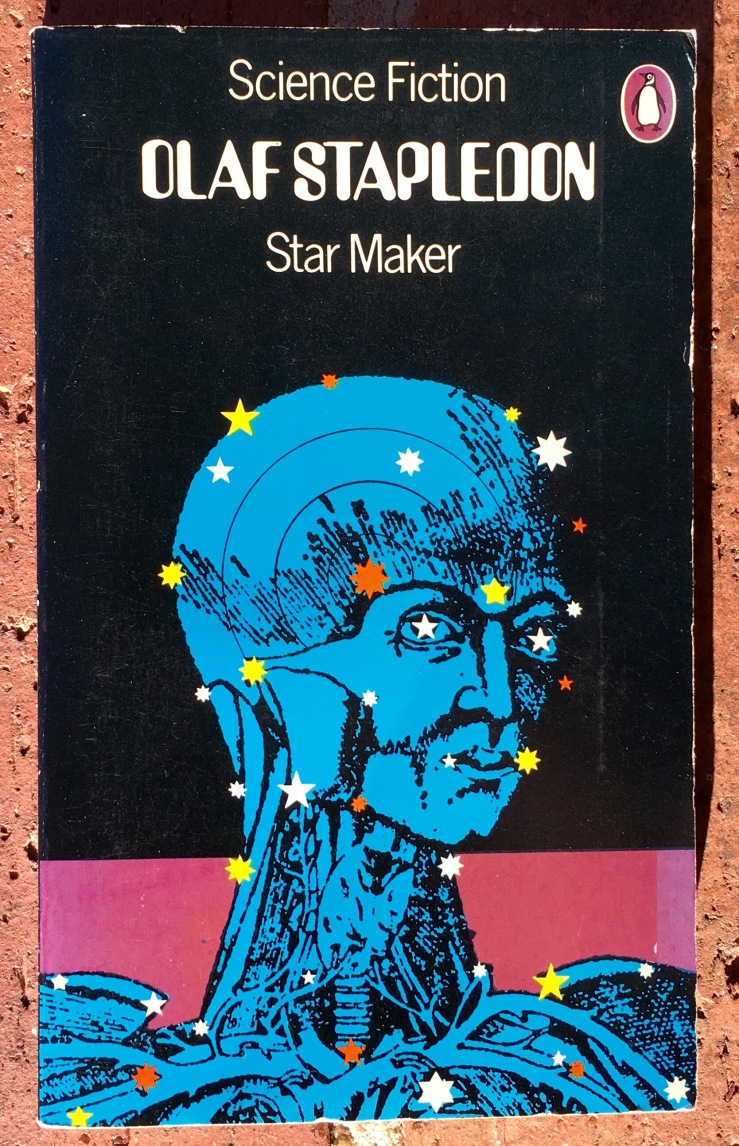
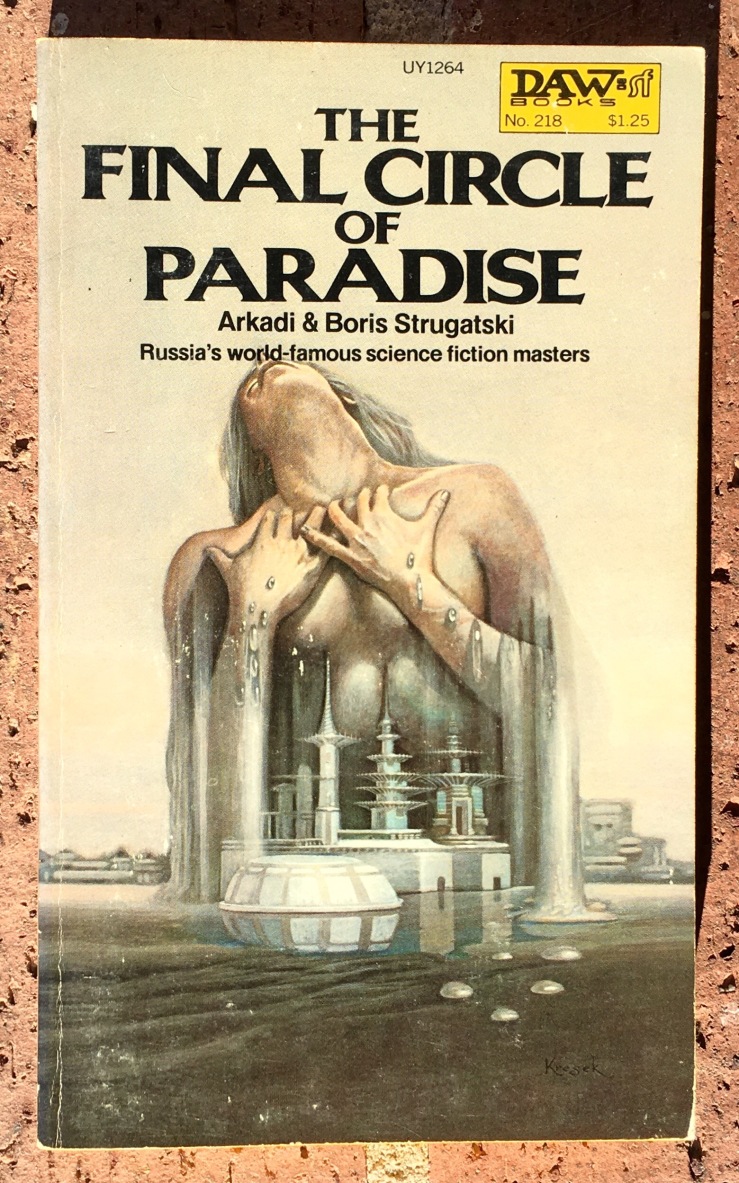
I like to think I know my way around the labyrinthine used bookstore I frequently frequent, but I somehow missed the “Ls” of the Sci-Fi/Fantasy section and wound up in Misc S. I was headed to the “Ls” to pick up another Ursula K. Le Guin novel, after having finished Rocannon’s World this afternoon. (I was looking not-so-specifically for The Word for World Is Forest, which my bookshop somehow didn’t have). Anyway, my eye was drawn to the Penguin edition of Olaf Stapledon’s Star Maker (above), which was one of those yeah, I know, I need to read it books. I also saw another one by the Strugatski bros, which I picked up, even though I still haven’t read Hard to Be a God.
I couldn’t resist this hardback edition of Three Hainish Novels, an Ursula K. Le Guin omnibus, which collects Rocannon’s World with Planet of Exile and City of Illusion. I haven’t read the other two, but I’ll get to them after a rereading of The Dispossessed. 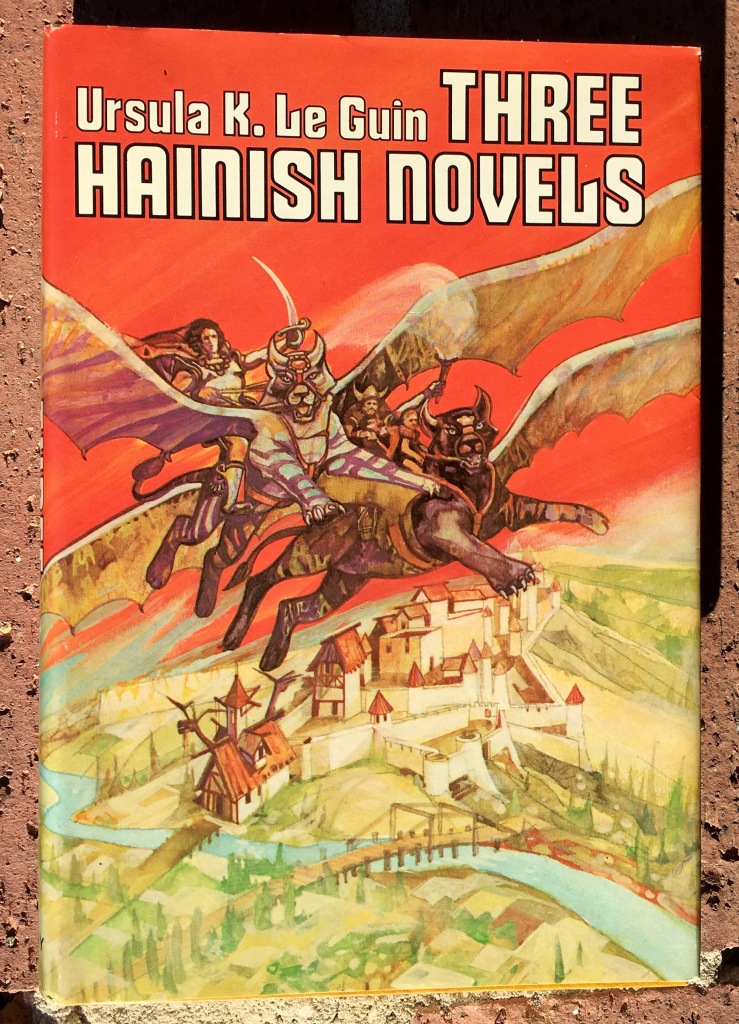
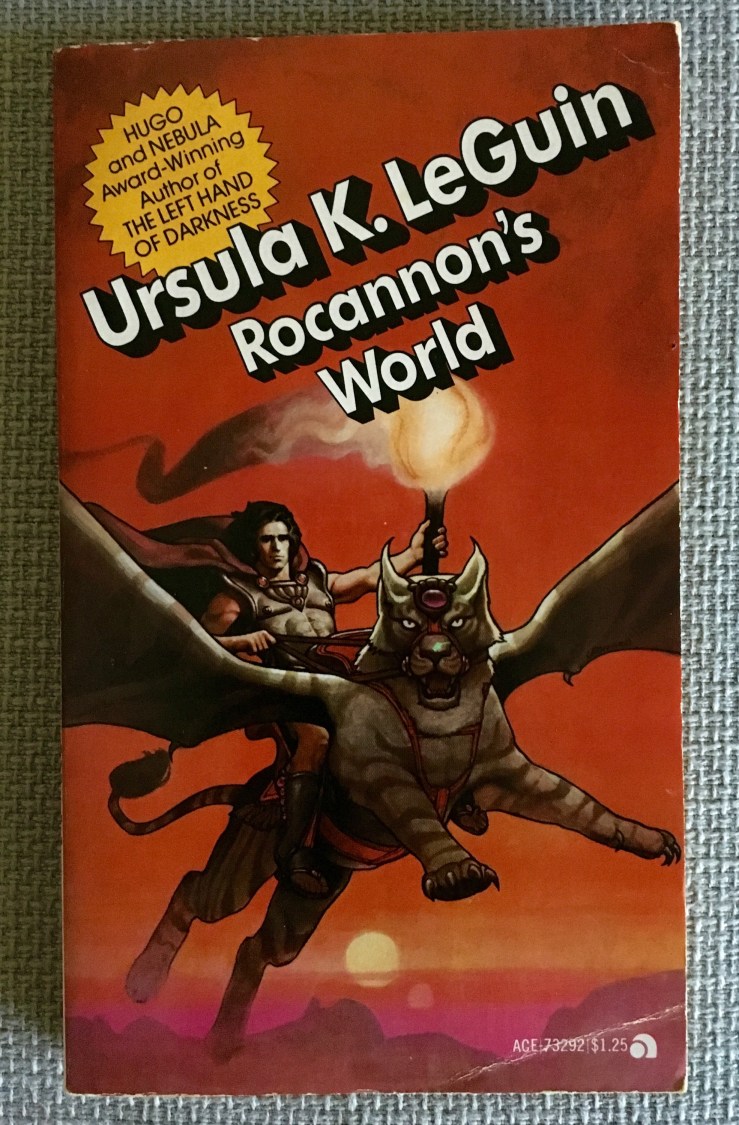
I just picked up Ursula K. Le Guin’s first novel Rocannon’s World on novelist Adam Novy’s recommendation. (Have you read Novy’s novel The Avian Gospels? It’s great).


George Orr is not well. The meek protagonist of Ursula K. Le Guin’s novel The Lathe of Heaven abuses prescription drugs in a desperate and unsuccessful attempt to stop himself from falling asleep. Orr doesn’t want to sleep because he believes that his dreams come true—that they literally alter reality—but in such a way that no one but Orr realizes that the world has changed. Orr gets caught using a “Pharmacy Card” that doesn’t belong to him, and is court-ordered to begin treatment with a sleep research psychiatrist, Dr. William Haber. Although Haber initially doesn’t believe Orr’s claim to be cursed with “effective dreams” that transform reality, he soon realizes that Orr’s dreams somehow do come true. Then, via hypnotic suggestion (and an “Augmentor” device), Haber begins wielding Orr’s gift/curse as a clumsy tool to “better” the world.
The world of The Lathe of Heaven is grim, gray, dystopian. Published in 1971 and set in Portland in the palindromic year of 2002, Le Guin’s novel is depressingly prescient. Not only does she capture the onset of seventies malaise (the ashes of hope that burned out in the sixties), she also points to a future of environmental catastrophe:
Very little light and air got down to street level; what there was was warm and full of fine rain. Rain was an old Portland tradition, but the warmth—70° F on the second of March—was modern, a result of air pollution. Urban and industrial effluvia had not been controlled soon enough to reverse the cumulative trends already at work in the mid-twentieth century; it would take several centuries for the CO2 to clear out of the air, if it ever did. New York was going to be one of the larger casualties of the Greenhouse Effect, as the polar ice kept melting and the sea kept rising…
This is also a world of urban sprawl, overpopulation, malnutrition, and total war (a clusterfuck in the Middle East, wouldn’t you know). The government is a vague and menacing presence here—vaguely totalitarian, vaguely Big Brotheresque. We learn of the “New Federal Constitution of 1984,” one of many references to Orwell’s book. (The most obvious is our passive hero’s name).
So it’s no wonder that Haber sets about to create a utopia, right? Wouldn’t you, like, try to make the world a better place if you could? Haber is repeatedly described as a “benevolent man”—Le Guin withholds the word dictator—but the central theme comes through repeatedly: Is it possible to alter reality for the greater good? Or do we simply exist in nature, a part of everything around us?
Haber’s experiments with Orr’s mind have unintended consequences. How might we, say, cure overpopulation? How about an awful plague. Orr’s “effective dreams” revise history, rewrite reality, remap consciousness. But he’s never quite able to pull off the massive tasks Haber sets for him—end racism, end war, cure the damaged ecosystem (Le Guin is extremely pessimistic on this last front). Orr is burdened with the consciousness of multiple realities, and feels deep guilt for his role in uncreation. He starts to go crazy:
“I am cracking,” he said. “You must see that. You’re a psychiatrist. Don’t you see that I’m going to pieces? Aliens from outer space attacking Earth! Look: if you ask me to dream again, what will you get? Maybe a totally insane world, the product of an insane mind. Monsters, ghosts, witches, dragons, transformations—all the stuff we carry around in us, all the horrors of childhood, the night fears, the nightmares. How can you keep all that from getting loose? I can’t stop it. I’m not in control!”
Continue reading “A review of Ursula K. Le Guin’s novel The Lathe of Heaven”
Daydream, which is to thought as the nebula is to the star, borders on sleep, and is concerned with it as its frontier. An atmosphere inhabited by living transparencies: there’s a beginning of the unknown. But beyond it the Possible opens out, immense. Other beings, other facts, are there. No supernaturalism, only the occult continuation of infinite nature … Sleep is in contact with the Possible, which we also call the improbable. The world of the night is a world. Night, as night, is a universe … The dark things of the unknown world become neighbors of man, whether by true communication or by a visionary enlargement of the distances of the abyss … and the sleeper, not quite seeing, not quite unconscious, glimpses the strange animalities, weird vegetations, terrible or radiant pallors, ghosts, masks, figures, hydras, confusions, moonless moonlights, obscure unmakings of miracle, growths and vanishings within a murky depth, shapes floating in shadow, the whole mystery which we call Dreaming, and which is nothing other than the approach of an invisible reality. The dream is the aquarium of Night.
— VICTOR HUGO, LES TRAVAILLEURS DE LA MER
The Hugo citation comes from Ursula K. Le Guin’s 1971 novel The Lathe of Heaven—Le Guin uses it as a preface to the seventh chapter. It’s beautiful on its own; it also functions as a kind of poetic summary of The Lathe of Heaven.
“I am cracking,” he said. “You must see that. You’re a psychiatrist. Don’t you see that I’m going to pieces? Aliens from outer space attacking Earth! Look: if you ask me to dream again, what will you get? Maybe a totally insane world, the product of an insane mind. Monsters, ghosts, witches, dragons, transformations—all the stuff we carry around in us, all the horrors of childhood, the night fears, the nightmares. How can you keep all that from getting loose? I can’t stop it. I’m not in control!”
“Don’t worry about control! Freedom is what you’re working toward,” Haber said gustily. “Freedom! Your unconscious mind is not a sink of horror and depravity. That’s a Victorian notion, and a terrifically destructive one. It crippled most of the best minds of the nineteenth century, and hamstrung psychology all through the first half of the twentieth. Don’t be afraid of your unconscious mind! It’s not a black pit of nightmares. Nothing of the kind! It is the wellspring of health, imagination, creativity. What we call ‘evil’ is produced by civilization, its constraints and repressions, deforming the spontaneous, free self-expression of the personality. The aim of psychotherapy is precisely this, to remove those groundless fears and nightmares, to bring up what’s unconscious into the light of rational consciousness, examine it objectively, and find that there is nothing to fear.”
“But there is,” Orr said very softly.
From Ursula K. Le Guin’s 1971 novel The Lathe of Heaven.
He rode the Vancouver subway back into Portland. The trains were already jam-packed; he stood out of reach of strap or stanchion, supported solely by the equalizing pressure of bodies on all sides, occasionally lifted right off his feet and floating as the force of crowding (c) exceeded the force of gravity (g). A man next to him holding a newspaper had never been able to lower his arms, but stood with his face muffled in the sports section. The headline, “BIG A-l STRIKE NEAR AFGHAN BORDER,” and the subhead, “Threat of Afghan Intervention,” stared Orr eye to I for six stops. The newspaper holder fought his way off and was replaced by a couple of tomatoes on a green plastic plate, beneath which was an old lady in a green plastic coat, who stood on Orr’s left foot for three more stops.He struggled off at the East Broadway stop, and shoved along for four blocks through the ever-thickening off-work crowd to Willamette East Tower, a great, showy, shoddy shaft of concrete and glass competing with vegetable obstinacy for light and air with the jungle of similar buildings all around it. Very little light and air got down to street level; what there was was warm and full of fine rain. Rain was an old Portland tradition, but the warmth—70° F on the second of March—was modern, a result of air pollution. Urban and industrial effluvia had not been controlled soon enough to reverse the cumulative trends already at work in the mid-twentieth century; it would take several centuries for the CO2 to clear out of the air, if it ever did. New York was going to be one of the larger casualties of the Greenhouse Effect, as the polar ice kept melting and the sea kept rising; indeed all Boswash was imperiled. There were some compensations. San Francisco Bay was already on the rise, and would end up covering all the hundreds of square miles of landfill and garbage dumped into it since 1848. As for Portland, with eighty miles and the Coast Range between it and the sea, it was not threatened by rising water: only by falling water.
It had always rained in western Oregon, but now it rained ceaselessly, steadily, tepidly. It was like living in a downpour of warm soup, forever.
The New Cities—Umatilla, John Day, French Glen—were east of the Cascades, in what had been desert thirty years before. It was fiercely hot there still in summer, but it rained only 45 inches a year, compared with Portland’s 114 inches. Intensive farming was possible: the desert blossomed. French Glen now had a population of 7 million. Portland, with only 3 million and no growth potential, had been left far behind in the March of Progress. That was nothing new for Portland. And what difference did it make? Undernourishment, overcrowding, and pervading foulness of the environment were the norm. There was more scurvy, typhus, and hepatitis in the Old Cities, more gang violence, crime, and murder in the New Cities. The rats ran one and the Mafia ran the other. George Orr stayed in Portland because he had always lived there and because he had no reason to believe that life anywhere else would be better, or different.
From Ursula K. Le Guin’s 1971 novel The Lathe of Heaven.
Current-borne, wave-flung, tugged hugely by the whole might of ocean, the jellyfish drifts in the tidal abyss. The light shines through it, and the dark enters it. Borne, flung, tugged from anywhere to anywhere, for in the deep sea there is no compass but nearer and farther, higher and lower, the jellyfish hangs and sways; pulses move slight and quick within it, as the vast diurnal pulses beat in the moon-driven sea. Hanging, swaying, pulsing, the most vulnerable and insubstantial creature, it has for its defense the violence and power of the whole ocean, to which it has entrusted its being, its going, and its will.
But here rise the stubborn continents. The shelves of gravel and the cliffs of rock break from water baldly into air, that dry, terrible outerspace of radiance and instability, where there is no support for life. And now, now the currents mislead and the waves betray, breaking their endless circle, to leap up in loud foam against rock and air, breaking…
What will the creature made all of seadrift do on the dry sand of daylight; what will the mind do, each morning, waking?
The first three paragraphs of Ursula K. Le Guin’s 1971 novel The Lathe of Heaven.
“The Stars Below”
by
Ursula K. Le Guin
The wooden house and outbuildings caught fire fast, blazed up, burned down, but the dome, built of lathe and plaster above a drum of brick, would not burn. What they did at last was heap up the wreckage of the telescopes, the instruments, the books and charts and drawings, in the middle of the floor under the dome, pour oil on the heap, and set fire to that. The flames spread to the wooden beams of the big telescope frame and to the clockwork mechanisms. Villagers watching from the foot of the hill saw the dome, whitish against the green evening sky, shudder and turn, first in one direction then in the other, while a black and yellow smoke full of sparks gushed from the oblong slit: an ugly and uncanny thing to see.
It was getting dark, stars were showing in the east. Orders were shouted. The soldiers came down the road in single file, dark men in dark harness, silent.
The villagers at the foot of the hill stayed on after the soldiers had gone. In a life without change or breadth, a fire is as good as a festival. They did not climb the hill, and as the night grew full dark they drew closer together. After a while they began to go back to their villages. Some looked back over their shoulders at the hill, where nothing moved. The stars turned slowly behind the black beehive of the dome, but it did not turn to follow them.
About an hour before daybreak a man rode up the steep zigzag, dismounted by the ruins of the workshops, and approached the dome on foot. The door had been smashed in. Through it, a reddish haze of light was visible, very dim, coming from a massive support-beam that had fallen and had smoldered all night inward to its core. A hanging, sour smoke thickened the air inside the dome. A tall figure moved there and its shadow moved with it, cast upward on the murk. Sometimes it stooped, or stopped, then blundered slowly on.
The man at the door said: “Guennar! Master Guennar!”
The man in the dome stopped still, looking towards the door. He had just picked up something from the mess of wreckage and half-burnt stuff on the floor. He put this object mechanically into his coat pocket, still peering at the door. He came towards it. His eyes were red and swollen almost shut, he breathed harshly in gasps, his hair and clothes were scorched and smeared with black ash.
“Where were you?”
The man in the dome pointed vaguely at the ground. Continue reading “Read Ursula K. Le Guin’s short story “The Stars Below””
“Schrödinger’s Cat”
by Ursula K. Le Guin
As things appear to be coming to some sort of climax, I have withdrawn to this place. It is cooler here, and nothing moves fast.
On the way here I met a married couple who were coming apart. She had pretty well gone to pieces, but he seemed, at first glance, quite hearty. While he was telling me that he had no hormones of any kind, she pulled herself together and, by supporting her head in the crook of her right knee and hopping on the toes of her right foot, approached us shouting, “Well what’s wrong with a person trying to express themselves?” The left leg, the arms, and the trunk, which had remained lying in the heap, twitched and jerked in sympathy. “Great legs,” the husband pointed out, looking at the slim ankle. “My wife had great legs.”
A cat has arrived interrupting my narrative. It is a striped yellow tom with white chest and paws. He has long whiskers and yellow eyes. I never noticed before that cats had whiskers above their eyes; is that normal? There is no way to tell. As he has gone to sleep on my knee, I shall proceed.
Where?
Nowhere, evidently. Yet the impulse to narrate remains. Many things are not worth doing, but almost anything is worth telling. In any case, I have a severe congenital case of Ethica laboris puritanica,1 or Adam’s Disease. It is incurable except by total decapitation. I even like to dream when asleep, and to try and recall my dreams: it assures me that I haven’t wasted seven or eight hours just lying there. Now here I am, lying, here. Hard at it.
 Biblioklept