Monarchists, murderers, martyrs, lunatics, perverts (William T. Vollmann)

And now, when it was once again too late for anything, his troops became ever more various, even fabulous: Great Russians, Ukrainians, Mensheviks, monarchists, murderers, martyrs, lunatics, perverts, democrats, escaped slaves from the underground chemical factories, racists, dreamers, patriots, Italians, Serbian Chetniks, turncoat Partisans who’d realized that Comrade Stalin might not reward them after all, peasants who’d naively welcomed the German troops in 1941, and now rightly feared that the returning Communists might remember this against them, dispossessed Tartars, Hiwis from Stalingrad, pickpockets from Kiev, brigands from the Caucasus who raped every woman they could catch, militant monks, groping skeletons, Polish Army men whose cousins had been murdered by the NKVD in 1940, NKVD infiltrators recording names in preparation for the postwar reckoning (they themselves would get arrested first), men from Smolensk who’d never read the Smolensk Declaration and accordingly believed that Vlasov was fighting especially for them, men who knew nothing of Vlasov except his name, and used that name as an excuse—a primal horde, in short, gathered concentrically like trembling distorted ripples around its ostensible leader, breaking outward in expanding, disintegrating circles across the map of war. When the British Thirty-sixth Infantry Brigade entered Forni Avoltri at the Austro-Italian border, they accepted the surrender of a flock of Georgian officers, no less than ten of whom were hereditary princes “in glittering uniforms,” runs the brigade’s war diary. Suddenly pistol-shots were heard. The Englishmen suspected ambush, but it turned out to be two of the princes duelling over an affair of honor. The victors’ bemusement was increased by the arrival of the commander, a beautiful, high-cheeked lady in buckskin leggings who came galloping up to berate her men for having yielded to the enemy without permission. Leaping from the saddle, she introduced herself as the daughter of the King of Georgia. (Needless to say, no kings remain in our Georgian Soviet Socialist Republic, which happens to be the birthplace of Comrade Stalin.) All these worthies considered themselves to be members in good standing of Vlasov’s army. Vlasov, the Princess explained, had guaranteed the independence of Georgia . . .

From William T. Vollmann’s Europe Central. 

I’m a big fan of the list passage, which Vollmann rarely uses, perhaps understanding and valuing its rhetorical force.

I just finished the section on Andrey Vlasov, the Russian general who collaborated with the Nazis. The section was fascinating—strangely sympathetic, balanced, personal—Vollmann explores just how unsure and troubled Vlasov was. Anyway. Reading Europe Central, I’ve come to see just how little I know about the Eastern front of WWII, especially in comparison to the Western front (in particular American involvement).


“The representation of reality can be more real than reality itself” (William T. Vollmann)

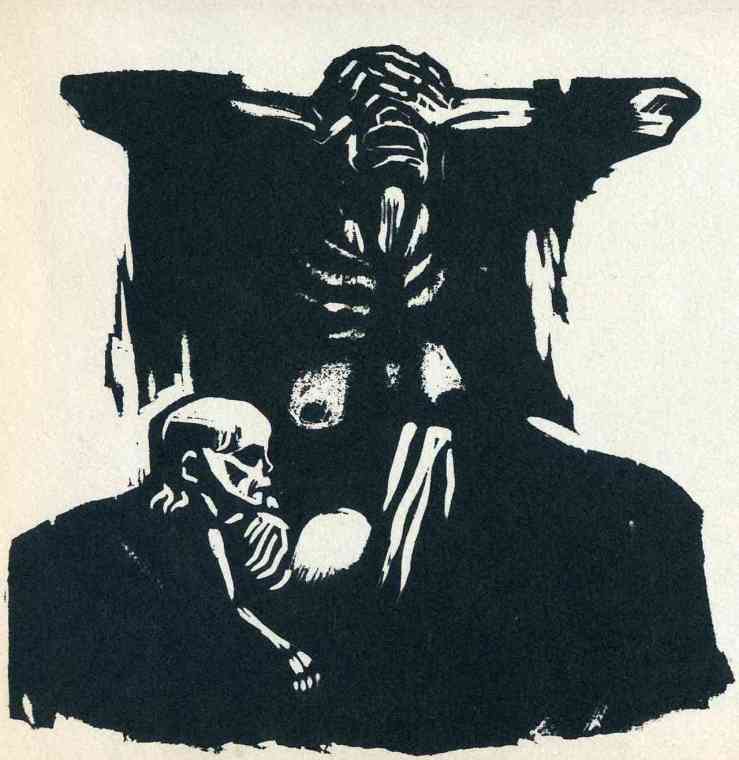
He photographed Lenin’s corpse lying in state, and captured many emotion-laden scenes, but the full power of images first impressed itself upon the young Roman Karmen later on in that same year, 1924, when he passed by an exhibition of German art arranged by Otto Nagel. Amidst the other flotsam hung “The Sacrifice” by Käthe Kollwitz. How can I describe this woodcut? The mother’s black cloak is open to reveal her breasts as she offers up her baby to death.

In the same folio, which was called “War,” Karmen, stunned and riveted, saw “The Parents,” a black woodcut of a man mourning, supporting the hand in which his face is buried upon the back of his wife, who mourns in his lap; this couple comprise a dark mass of mourning, silhouetted against a white background and their outlines printed negatively in white.

These two prints moved him to tears. But when, now scanning the walls almost ferociously in his determination to find every scrap of paper by this artist, he discovered “Hunger,” which would become leaf number two of most versions of her great “Proletariat” folio of 1925, the emotion which overcame him was anger—anger against an order which made people suffer in this way. And how strange it was that he was moved! For he had known hunger himself; and his father had suffered at the hands of the White Guards. This was the moment when he understood that the representation of reality can be more real than reality itself.

From William T. Vollmann’s Europe Central.

The woodcuts here are of course the Kollwitz pieces that inspire young Karmen Roman, who would go on to become one of the most prolific filmmakers of the Soviet era.

hunger


With the assurance of a sleepwalker (William T. Vollmann)

Their slave-sister Guthrún, marriage-chained to Huns on the other side of the dark wood, sent Gunnar and Hogni a ring wound around with wolf’s hair to warn them not to come; but such devices cannot be guaranteed even in dreams. As the two brothers gazed across the hall-fire at the emissary who sat expectantly or ironically silent in the high-seat, Hogni murmured: Our way’d be fairly fanged, if we rode to claim the gifts he promises us! . . .—And then, raising golden mead-horns in the toasts which kingship requires, they accepted the Hunnish invitation. They could do nothing else, being trapped, as I said, in a fatal dream. While their vassals wept, they sleepwalked down the wooden hall, helmed themselves, mounted horses, and galloped through Myrkvith Forest to their foemen’s castle where Guthrún likewise wept to see them, crying: Betrayed!—Gunnar replied: Too late, sister . . .—for when dreams become nightmares it is ever too late.

When on Z-Day 1936 the Chancellor of Germany, a certain Adolf Hitler, orders twenty-five thousand soldiers across six bridges into the Rhineland Zone, he too fears the future. Unlike Gunnar, he appears pale. Frowning, he grips his left wrist in his right. He’s forsworn mead. He eats only fruits, vegetables and little Viennese cakes. Clenching his teeth, he strides anxiously to and fro. But slowly his voice deepens, becomes a snarling shout. He swallows. His voice sinks. In a monotone he announces: At this moment, German troops are on the march.

What will the English answer? Nothing, for it’s Saturday, when every lord sits on his country estate, counting money, drinking champagne with Jews. The French are more inclined than they to prove his banesmen . . .

Here comes an ultimatum! His head twitches like a gun recoiling on its carriage. He grips the limp forelock which perpetually falls across his face. But then the English tell the French: The Germans, after all, are only going into their own back garden.—By then it’s too late, too late.

I know what I should have done, if I’d been the French, laughs Hitler. I should have struck! And I should not have allowed a single German soldier to cross the Rhine!

To his vassals and henchmen in Munich he chants: I go the way that Providence dictates, with the assurance of a sleepwalker.—They applaud him. The white-armed Hunnish maidens scream with joy.

From William Vollmann’s Europe Central. 

For the past 100 pages or so, Vollmann has referred to Hitler as the sleepwalker (I’m almost positive that the word Hitler hasn’t been used in the text up until now), and while context has made it clear that this sleepwalker is Hitler, the source of the moniker is only clarified at this point.

Anna Akhmatova, née Gorenko, is best known for two poems (William T. Vollmann)

Anna Akhmatova, née Gorenko, is best known for two poems, first and foremost the nasty “Requiem,” which attacks the “organs” of state security, and incidentally slanders our prison system. Shostakovich was among that literary effort’s admirers; I wish I had enough space to tell you a few things about that cocksucker. (On the other hand, he did make us laugh from time to time; I don’t mind telling you that my job has its compensations. In 1953 Akhmatova was trying to impress him with some drivel she’d written about his Seventh Symphony, and he thanked her in his usual insincere fashion, then went to the Hotel Sovietskaya and said to his then mistress, G. I. Ustvolskaya, ingenuously assuming the walls don’t have ears: Basically, I can’t bear having poetry written about my music.) Our line on that so-called “work of art” was this: Since she had the good sense not to make a cause out of it, why not let her live out her pathetic little life? We’d already isolated her. Shooting her might have lost us hard currency in the West. Since “Requiem” accuses us, and we already know ourselves, it’s of zero investigative interest.

That leaves the “Poem Without a Hero,” whose publication I for my part have always welcomed. Do you remember when Hitler staged that exhibition of degenerate art? Don’t get me wrong; every time I see a German I want to string him up by the balls; nonetheless, I’m man enough to say this straight: Hitler wasn’t incorrect in that instance. Now, “Poem Without a Hero” is as degenerate as anything the Nazis banned. It portrays the so-called “life” of a clique of a parasites and intellectuals in Leningrad before our Revolution. This was the Symbolist epoch, whose atmosphere N. Berdayev aptly characterized as the putrefied air of a hothouse. My children even studied it in school (I had the teacher arrested). To me the main interest of the poem is this: All the characters are real, in which case have we identified all those bastards and sent them where they belong?

From William Vollmann’s novel Euorpe Central.

You can read “Requiem” here and “Poem without a Hero” here.

How can love be self-ironic? (William T. Vollmann)

I promise you that from the first time she took his hand—the very first time!—he actually believed; she was ready, lonely, beautiful; she wanted someone to love with all her heart and he was the man; she longed to take care of him, knowing even better than he how much he needed to be taken care of—he still couldn’t knot his necktie by himself, and, well, you know. He believed, because an artist must believe as easily and deeply as a child cries. What’s creation but self-enacted belief? —Now for a cautionary note from E. Mravinsky: Shostakovich’s music is self-ironic, which to me implies insincerity. This masquerade imparts the spurious impression that Shostakovich is being emotional. In reality, his music conceals extremely deep lyric feelings which are carefully protected from the outside world. In other words, is Shostakovich emotional or not? Feelings conceal—feelings! Could it be that this languishing longing I hear in Opus 40 actually masks something else? But didn’t he promise Elena that she was the one for him? And how can love be self-ironic? All right, I do remember the rocking-horse sequence, but isn’t that self-mockery simply self-abnegation, the old lover’s trick? Elena believes in me, I know she does! How ticklishly wonderful! Even Glikman can see it, although perhaps I shouldn’t have told Glikman, because . . . What can love be if not faith? We look into each other’s faces and believe : Here’s the one for me! Lyalya, never forget this, no matter how long you live and whatever happens between us: You will always be the one for me. And in my life I’ll prove it. You’ll see. Sollertinsky claims that Elena’s simply lonely. What if Elena’s simply twenty? Well, I’m lonely, too. Oh, this Moscow-Baku train is so boring. I can’t forgive myself for not kidnapping my golden Elenochka and bringing her to Baku with me. Or does she, how shall I put this, want too much from destiny? My God, destiny is such a ridiculous word. I’ll try not to be too, I mean, why not? It’s still early in my life. That nightmare of the whirling red spot won’t stop me! I could start over with Elena and . . . She loves me. Ninusha loves me, but Elena, oh, my God, she stares at me with hope and longing; her love remains unimpaired, like a child’s. I love children. I want to be a father. I’ll tell Nina it’s because she can’t have children. That won’t hurt her as much as, you know. Actually, it’s true, because Nina . . . Maybe I can inform her by letter, so I don’t have to . . . Ashkenazi will do that for me if I beg him. He’s very kind, very kind. Then it will be over! As soon as I’m back in my Lyalka’s arms I’ll have the strength to resolve everything. If I could only protect that love of hers from ever falling down and skinning its knee, much less from growing up, growing wise and bitter! Then when she’s old she’ll still look at me like that; I’ll still be the one for her.

From William T. Vollmann’s big fat historical novel Europe Central, which is so big and fat that I think a comprehensive review of it will be just maybe beyond me by the time I get to the end of it, so maybe some citation, a bit of riffing, yes?

The novel recounts (a version) of the Eastern front of WWII. Polyglossic, discontinuous, musical, mythic, often discordant, Vollmann shifts through a series of narrators, his turns oblique, jarring. And while Vollmann includes political and military leaders, his analsyis/diagnosis focuses on artists, musicians, and writers.  The above passage—which struck me especially for its discussion of the feeling of feeling, the aesthetics of feeling—this passage offers a neat encapsulation of Vollmann’s narrative digressions.

The “I” at the beginning of the citation is one of the “Shostakovich” sections narrators. Although unnamed (as of yet), he seems to be a high-ranking officer in Stalin’s secret police. At times though, this narrator—all of the narrators!—seem to merge consciousness with Vollmann, the novel’s architect, who interposes his own research and readings (or are they the narrators?). We see this in the dash introducing some lines from the conductor Evegny Mravinsky—key lines that I find fascinating—which Vollmann (or Vollmann’s narrator) uses to critique/question the relationship between art, emotion, intention, and authenticity (current subjects of deep fascination for me). Then—then!—without warning, Vollmann enters the consciousness of another “I,” Shostakovich himself, whose elliptical thoughts, muddied and warbling, illustrate, illuminate, and complicate Mravinsky’s critique.

Feelings conceal—feelings!—yes, yes, yes I think so: Here Vollmann (through several layers of complicating narrators, which lets just set aside for a second, or perhaps altogether, at least for now)—here Vollmann offers a fascinating description followed by its problem: If earnest expression can be couched in irony—if we use feelings to hide other feelings in art (etc.)—then what does that mean for love, which I think Vollmann (here, elsewhere) believes to be A Big Important Thing? Is a self-ironic love possible? Likely even?

I’m tempted here to deflect, move to another piece of art, like say, It’s A Wonderful Life, a film that I understand anew every year, a film I found baffling, frightening as a child; a film that bored me as teen; a film that I resented as a young man; a film that I appreciated with a winking ironic cheer a few years later—and then, now, or nowish, as an adult, a film I feel I understand, that its sentiment, raw, affects me more deeply than ever. (I was right as a child to be baffled and frightened). (What if anything self-ironic love?).

So I deflected. And am ranting, trying to set out a few thoughts for Something Bigger—something on Authenticity and Inauthenticity, The Con-Artist vs. The Poseur, the Aesthetics of Feeling the Feeling, of Anesthetizing the Feeling (of Feeling the Feeling). Look at me, I capitalized some of my words. Sorry.

William T. Vollmann and Bernard Radfar Discuss Failure, Prostitution, Hypocrisy, Making the World Better for Others, Etc.

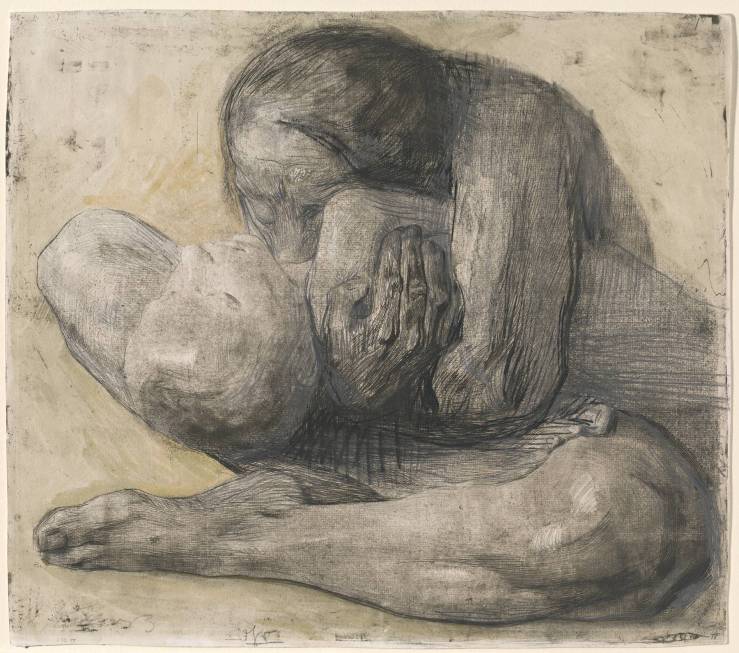
Käthe Kollwitz kept painting poor people (Kollwitz/Vollmann)

kathe-kollwitz4

She worked without reference to the fiery proto-Cubism of those years, the representational, classical past as dead as the Second Reich itself, dead, dead!—as dead as the Tsarist officers who’d now sunk beneath their own weedy mucky parade grounds so that the Party of Lenin and Stalin could march across their moldering faces. Since 1912 she had kept a room on Siegmund-shof for her plastic arts. That was where she would create the mourning woman out of stone. Mostly she carved, etched, and painted in that flat on Weissenbürgerstrasse. Those were the years when the figures in other people’s paintings began to go ever flatter, more garish, more distorted, the colors hurtful to her although she liked some of the galloping calligraphic riders in Kandinsky. Grosz’s desperately angry caricatures, the X-ray bitterness of Otto Dix, not to mention abstract constructivism; she didn’t swim with that tide. Käthe Kollwitz kept painting poor people, starving people (white figures in dark fields, dark chalk on brown Ingres paper), raped women, mothers with dying children, mothers with dead children. In the end she depicted mainly herself, her stricken, simian face thinking and grieving. She too was a mother with a dead child.

From William Vollmann’s Europe Central.

Fiction cannot be reduced to mere falsehood (William T. Vollmann)

Most literary critics agree that fiction cannot be reduced to mere falsehood. Well-crafted protagonists come to life, pornography causes orgasms, and the pretense that life is what we want it to be may conceivably bring about the desired condition. Hence religious parables, socialist realism, Nazi propaganda. And if this story likewise crawls with reactionary supernaturalism, that might be because its author longs to see letters scuttling across ceilings, cautiously beginning to reify themselves into angels. For if they could only do that, then why not us?

From William T. Vollmann’s novel Europe Central.

And doesn’t the parable possess greater integrity? (William T. Vollmann)

And doesn’t the parable possess greater integrity, greater righteousness we might almost say, than any other literary form? For its many conventions weave a holy covenant between the reader, who gets the mystification he craves in a bonbon-sized dose, and the writer, whose absence renders him divine. Granted, those very stringencies sometimes telescope events into dreamlike absurdity.

From William T. Vollmann’s novel Europe Central.

“Finally, feverishly, I read this book that I would love to have written” (Vollmann’s Europe Central in Binet’s HHhH)

I, too, am transfixed—because I’m reading Europe Central by William T. Vollmann, which has just appeared in French. Finally, feverishly, I read this book that I would love to have written, and I wonder, reading the endless first chapter, how long he’ll keep it up, this style, this incredible tone. In fact, it lasts only eight pages, but those eight pages are magical, with phrases streaming past as in a dream, and I understand nothing, and understand everything. This is perhaps the first time that the voice of history has resounded so perfectly, and I am struck by this revelation: history is a prophet who says “We.” The first chapter is entitled “Steel in Motion,” and I read: “In a moment steel will begin to move, slowly at first, like troop trains pulling out of their stations, then more quickly and ubiquitously, the square crowds of steel-helmed men moving forward, flanked by rows of shiny planes; then tanks, planes and other projectiles will accelerate beyond recall.” And, further on: “Serving the sleepwalker’s rapture, Göring promises that five hundred more rocket-powered planes will be ready within a lightning-flash. Then he runs out for a tryst with the film star Lida Baarova.” The Czech. When I quote an author, I must be careful to cut my quotations every seven lines. No longer than seven lines. Like spies on the telephone: no more than thirty seconds, so they can’t track you down. “In Moscow, Marshal Tukhachevsky announces that operations in a future war will unfold as broad maneuver undertakings on a massive scale. He’ll be shot right away. And Europe Central’s ministers, who will also be shot, appear on balconies supported by nude marble girls, where they utter dreamy speeches, all the while listening for the ring of the telephone.” In the newspaper, somebody explains to me that this is an account of “slow-burning intensity,” a novel that is “more fantastical than historical,” the reading of which “requires a psychoanalytic listening.” I understand. I will remember. So … where was I?

From Laurent Binet’s novel HHhH.

I need to slam out a review of HHhH, which I loved.

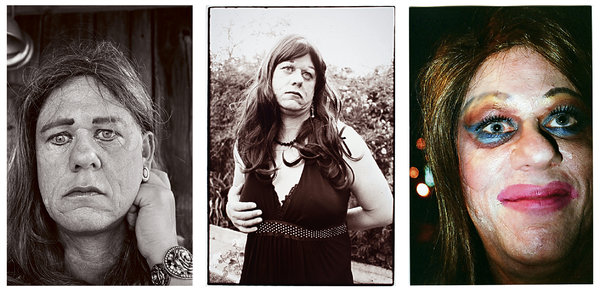
“I looked like this horrible Elizabethan courtier” | William Vollmann, Cross-Dresser

14zVOLLMAN4-articleLarge

Mr. Vollmann is 54, heterosexual and married with a daughter in high school. He began cross-dressing seriously about five years ago. Sometimes he transforms himself into a woman as part of a strange vision quest, aided by drugs or alcohol, to mind-meld with a female character in a book he’s writing. Other times it’s just because he likes the “smooth and slippery” feel of women’s lingerie.

From another profile on William T. Vollmann, this time in The New York Times. The profile centers around Vollmann’s latest book, The Book of Dolores.

You may recall Vollmann’s previous adventures in cross-dressing.


William T. Vollmann, Profiled at Newsweek, Suggests “We’re a culture of prostitutes”

Newsweek has published a profile/interview of William T. Vollmann by Alexander Nazaryan. It’s a vivid, engaging read. The first two paragraphs of the profile:

If William T. Vollmann ever wins the Nobel Prize in Literature – as many speculate he will – he knows exactly what he will do with the $1.1 million pot the Swedes attach to the award. “It will be fun to give some to prostitutes,” he says, sitting on his futon, chuckling, a half-empty bottle of pretty good bourbon between us.

He is neither flippant nor drunk, though more booze awaits us out there in the temperate Sacramento twilight. Vollmann became famous for fiction that treated the sex worker as muse – especially the street stalker of those days in the Tenderloin of San Francisco when AIDS was just coming to haunt the national psyche and the yuppie invasion was a nightmare not yet hatched. His so-called prostitution trilogy – Whores for GloriaButterfly Stories, and The Royal Family – is overflowing with life and empathy, nothing like the backcountry machismo of Raymond Carver or fruitless experimentation of Donald Barthelme, both oh-so-popular with young writers when Vollmann first came on the scene after graduating from Cornell in 1981. He approached the prostitute like an anthropologist, yet did so without condescension, writing in Whores for Gloria, “The unpleasantnesses of her profession are largely caused by the criminal ambiance in which the prostitute must conduct it.”

Read the rest of it.

“He reportedly owns many guns and a flame-thrower” and Other Extracts from William Vollmann’s FBI File

William T. Vollmann has an essay in the newest issue of Harper’s called “Life as a Terrorist.” In the essay, Vollmann details what he finds in his FBI files (after filing a Freedom of Information Act request, an appeal, and a lawsuit to actually get a hold of the thing). He finds out that he was one of the Unabomber suspects:

When I finally received my FBI file, such as it was — namely, two higgledy-piggledy batches of papers, out of order, padded with duplicates, some of which they had forgotten to redact — I learned that I had been Unabomber Suspect Number S-2047:

S-2047 William T. Vollman. Predicated on a referral from a citizen. Investigation has determined that Vollman, a professional author, is widely travelled, however, existing travel records for him do not eliminate him as a viable suspect.

A few more extracts from Vollmann’s FBI file:

  • While VOLLMANN’s appearance varies over the years, New Haven notes strong physical resemblance to UNABOMBER composites. New Haven provided color video prints of book jackets to Sacramento via referenced airtel.
  • UNABOMBER’s moniker FC may correlate with title of VOLLMANN’s largest work, novel Fathers and Crows. That novel reportedly best exemplifies VOLLMANN’s anti-progress, anti-industrialist theme/beliefs/value systems and VOLLMANN, himself, has described it as his most difficult work.
  • [An informant] suggests VOLLMANN has a death wish . . . Reportedly, at age 9, VOLLMANN’s younger sister (age 6) drowned in a backyard pond in New Hampshire while he was supposed to be watching over her. Guilt from that situation may have had a profound effect on VOLLMANN.
  • VOLLMANN’s meticulous nature, as described above, is consistent with manufacture of and presentation on UNABOM devices. Several witnesses have commented that UNABOM packages appeared “seamless” and “too pretty to open.”
  • By all accounts VOLLMANN is exceedingly intelligent and possessed with an enormous ego.
  • He revels in immersing himself in the seamy underside of life. He reportedly has used drugs (crack cocaine) extensively. He reportedly owns many guns and a flame-thrower.

“I would love to own a flamethrower,” Vollmann wryly adds to this last entry. And thus, new entries for the ongoing chronicles of The Myth of the Vollmann!

Vollmann discussed the article on NPR’s NPR’s Morning Edition with David Greene this morning.


Intertexuality and Structure in Roberto Bolaño’s 2666

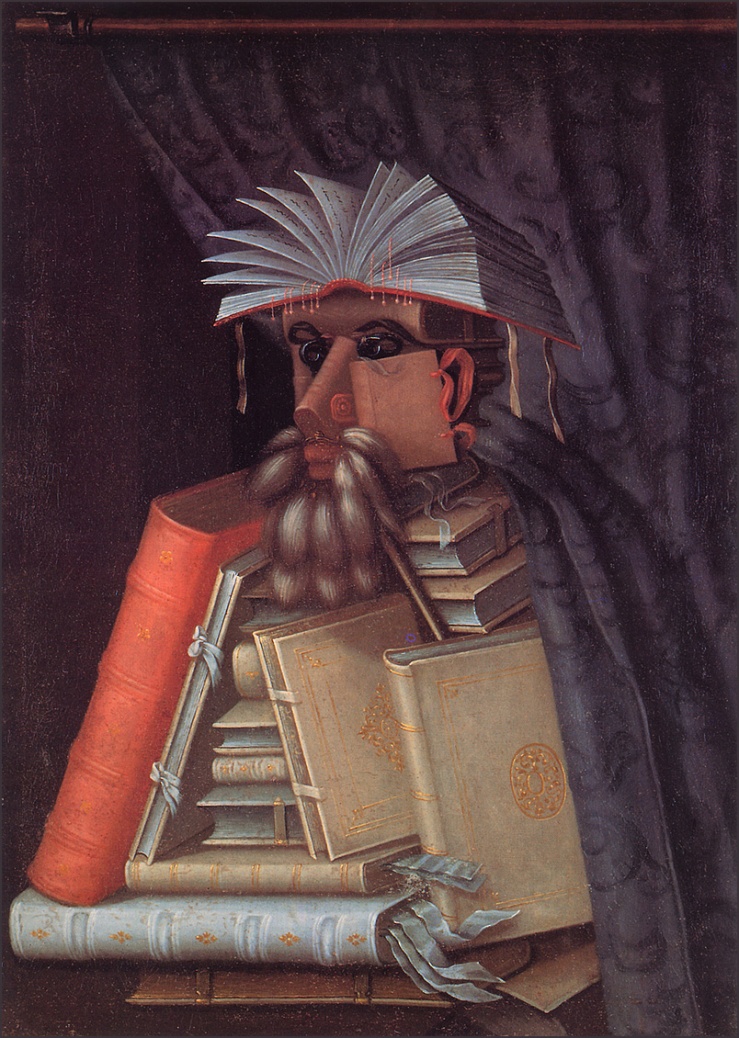
the-librarian1

•I had been reading William T. Vollmann’s enormous book Imperial. I bought the book in paperback and then put an illicit copy on my Kindle (this riff is not about the ethics of that move). It’s just easier to read that way, especially at night. At some point in Imperial, probably at some mention of coyotes or polleros—smugglers of humans—I felt a tug in the back of my brain pan, a tug that wanted to pull up Roberto Bolaño’s big big novel 2666—also on my Kindle (also an illicit copy, although I bought the book twice).

•This is how I ended up rereading 2666 straight through. It was unplanned.

•Like many readers, I aim to reread more than I actually end up rereading.

•Truly excellent novels are always better in rereading: richer, fuller, more resonant. Sometimes we might find we’ve thoroughly misread them. (Imagine my horror rereading Lolita in my twenties to discover the vein of evil throbbing through it). Sometimes we find new tones that seemed impossible on the first run through. (I’ve read Blood Meridian at least once a year since the first time I read it, and it keeps getting funnier and funnier). Most of the time, rereading confirms the greatness of the novel, a greatness inhabiting the smallest details. (I’m looking at you Moby-Dick).

•Even a riff should have a thesis, and here’s mine:  2666 has a reputation for being fragmentary and inconclusive—and in some ways, yes, of course it is—but a second full reading of 2666 reveals a book that is cohesive, densely allusive, and thematically precise.

Rereading is one way of stepping back to see the bigger picture that  Bolaño twists together from smaller fragments. Rereading reveals the intertextual correspondences between the books of 2666 (the five books proper, the “Parts,” of course, but also the texts, invented or real, that those books house).

•2666 is also a book about writing.
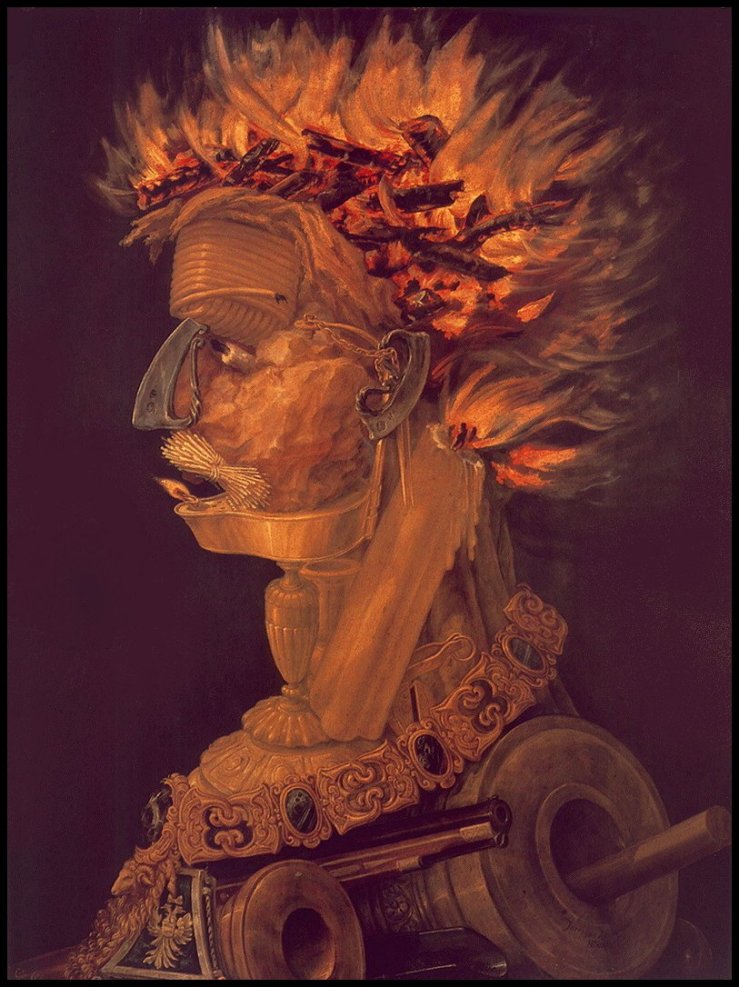
fire-15661

•To wit: “The Part About Archimboldi,” the fifth and final book of 2666, the book that features Benno von Archimboldi, the writer at the heart of 2666—this final chapter sews together many of the book’s (apparently) loose threads.

•Two problems with the above:

A. Benno von Archimboldi (aka Hans Reiter) is not at the heart of 2666 but rather a shadowy trace slipping through the margins, a ghost-presence that’s always there, but not generative or muscular like a heart. (I’m not sure exactly what I mean by this).

B. “The Part About Archimboldi” most decidedly does not sew together all the loose threads: That’s the reader’s job (or task or pleasure or plight or burden).

•And so then also above (“2666 is also a book about writing”): 2666 is also a book about reading: A book about reading as detective work.

•Who are the heroes of 2666?

They are all detectives of some kind, literal or otherwise.

Literary critics. Journalists. Philosophers. Psychologists. Psychics and fortune tellers. Police detectives. Private detectives. An American sheriff. A rogue politician. Poets. Publishers. Parents. Searchers.

•Archimboldi shows up in the first book of 2666, “The Part About the Critics”; the eponymous critics, literary detectives are searching for him.

How does Archimboldi show up?

Inside a story (the Frisian lady’s) inside a story (the Swabian’s) (inside the story of “Critics,” which is inside the story of 2666).

The Frisian lady asks:

“Does anyone know the answer to the riddle? Does anyone understand it? Is there by chance a man in this town who can tell me the solution, even if he has to whisper it in my ear?”

And Archimboldi answers. He’s a reader, a detective.

•Again, 2666 is a book about writing, and it shares the postmodern feature of calling attention to its own style and construction, yet it never does this in an overtly clever or insufferable fashion: It’s far more sly.
water-15661

•What is the construction or shape of 2666?

A straightforward answer: Five books in an intertextual conversation that seem to loop back around, where the last book prefigures the first book in a strange circuit.

Some possible metaphorical answers:

A void (“Voids can’t be filled,” Archimboldi says).

A labyrinth (the word labyrinth appears 14 times in Wimmer’s translation of 2666).

A mirror (61 times).

An abyss (22 times)

An asylum (43 times; madhouse appears 5 times).

•And then, again: How does Bolaño slyly announce or criticize or puncture his style in 2666?

In Ignacio Echevarria’s “Note to the First Edition” of 2666, he tells us that:

Among Bolaño’s notes for 2666 there appears the single line: “The narrator of 2666 is Arturo Belano.” And elsewhere Bolaño adds, with the indication “for the end of 2666”: “And that’s it, friends. I’ve done it all, I’ve lived it all. If I had the strength, I’d cry. I bid you all goodbye, Arturo Belano.”

Belano is Bolaño’s alter ego, a trace who slips and sails and ducks through the Bolañoverse (he also shows up unnamed in 2666 with his partner Ulises Lima; they manage to father a bastard son, Lalo Cura).

So Belano who narrates 2666 (how?!) is Bolaño: Okay: So? Now?

• I suggested earlier on Biblioklept that 2666 is a grand ventriloquist act, a forced possession, a psychic haunting. Bolaño channels Belano who channels detectives, journalists, poets, writers. Readers.

•The channeling is metatextual or intertextual, a series of transpositions between the various narrators and protagonists and readers (detectives all).

•The passage that I see most frequently cited from 2666 points to its intertextuality.

The passage is likely frequently cited because

A) Ignacio Echevarria cites it in his note at the beginning of 2666 and

B) it describes Bolaño’s project in 2666, both internally (the book as a strange beast, with intertextual readings within its five (plus) parts), and also externally (intertextually against the canon). Here is the passage (from “The Part About Amalfitano”):

One night, while the kid was scanning the shelves, Amalfitano asked him what books he liked and what book he was reading, just to make conversation. Without turning, the pharmacist answered that he liked books like The Metamorphosis, Bartleby, A Simple Heart, A Christmas Carol. And then he said that he was reading Capote’s Breakfast at Tiffany’s. Leaving aside the fact that A Simple Heart and A Christmas Carol were stories, not books, there was something revelatory about the taste of this bookish young pharmacist, who in another life might have been Trakl or who in this life might still be writing poems as desperate as those of his distant Austrian counterpart, and who clearly and inarguably preferred minor works to major ones. He chose The Metamorphosis over The Trial, he chose Bartleby over Moby-Dick,he chose A Simple Heart over Bouvard and Pecuchet, and A Christmas Carol over A Tale of Two Cities or The Pickwick Papers. What a sad paradox, thought Amalfitano. Now even bookish pharmacists are afraid to take on the great, imperfect, torrential works, books that blaze paths into the unknown. They choose the perfect exercises of the great masters. Or what amounts to the same thing: they want to watch the great masters spar, but they have no interest in real combat, when the great masters struggle against that something, that something that terrifies us all, that something that cows us and spurs us on, amid blood and mortal wounds and stench.

•At the risk of belaboring or repeating the last point: Bolaño, ever the canon-maker, the list maker, situates 2666, his final work (he knows it’s his final work) along with “the great, imperfect, torrential works, books that blaze paths into the unknown,” a book that struggles “against that something, that something that terrifies us all, that something that cows us and spurs us on, amid blood and mortal wounds and stench.”
air-15661

•So some metatextual moments that, read intertextually, perhaps (perhaps!) work to outline that “unknown,” that “something” of 2666:

•Near the end of “The Part About Crimes,” a culminating moment, where a female journalist (NB: a female journalist is the first murder victim in “Crimes”) reads the work of the poet/journalist Mercado:

Hernandez Mercado’s style wavered between sensationalism and flatness. The story was riddled with clichés, inaccuracies, sweeping statements, exaggerations, and flagrant lies. Sometimes Hernandez Mercado painted Haas as the scapegoat of a conspiracy of rich Sonorans and sometimes Haas appeared as an avenging angel or a detective locked in a cell but by no means defeated, gradually cornering his tormentors solely by dint of intelligence.

A description of the style of “The Part About the Crimes”: “The story was riddled with clichés, inaccuracies, sweeping statements, exaggerations, and flagrant lies.”

•And, from “The Part About Archimboldi,” a moment where some critics read Ansky’s novel Twilight and assess it:

Professor Stanislaw Strumilin read it. It struck him as hard to follow. The writer Aleksei Tolstoy read it. It struck him as chaotic. Andrei Zhdanov read it. He left it half finished. And Stalin read it. It struck him as suspect.

These are internal criticisms of 2666.

• Another moment from Ansky’s journal that seems to describe “The Part About the Crimes,” 2666, and the Bolañoverse in general:

He mentions names Reiter has never heard before. Then, a few pages on, he mentions them again. As if he were afraid of forgetting them. Names, names, names. Those who made revolution and those who were devoured by that same revolution, though it wasn’t the same but another, not the dream but the nightmare that hides behind the eyelids of the dream.

•While I’m using Ansky’s journal as a pseudo key for the intertextual labyrinth of 2666, let me grab this nugget:

Only in chaos are we conceivable.

(I added the note “thesis” in the electronic margin).

•Or another description of the novel, couched in a description of history:

. . . history, which is a simple whore, has no decisive moments but is a proliferation of instants, brief interludes that vie with one another in monstrousness.

•Another description of 2666 can be found in Bubis’s description of Archimboldi’s second novel:

Lüdicke had yet to come off the presses when Mr. Bubis received the manuscript of The Endless Rose, which he read in two nights, after which, deeply shaken, he woke his wife and told her they would have to publish this new book by Archimboldi.

“Is it good?” asked the baroness, half asleep and not bothering to sit up.

“It’s better than good,” said Bubis, pacing the room.

Then he began to talk, still pacing, about Europe, Greek mythology, and something vaguely like a police investigation, but the baroness fell back asleep and didn’t hear him.

The names of the novels here also suggest something about the structure of 2666The Endless Rose suggests an eternal loop, as does Lüdicke, which etymologically suggests ludic, recursively playful . . . (Again, I’m just riffing here).

•Another description of Archimboldi’s writing, which is of course a description of Bolaño’s 2666:

The style was strange. The writing was clear and sometimes even transparent, but the way the stories followed one after another didn’t lead anywhere: all that was left were the children, their parents, the animals, some neighbors, and in the end, all that was really left was nature, a nature that dissolved little by little in a boiling cauldron until it vanished completely.
earth-15701

•Archimboldi’s name is some sort of secret key to the novel. He invents the name, of course, seemingly on the spot. (Invents is not the right word—rather, he synthesizes the name, cobbles it together from his readings. The name is intertextual).

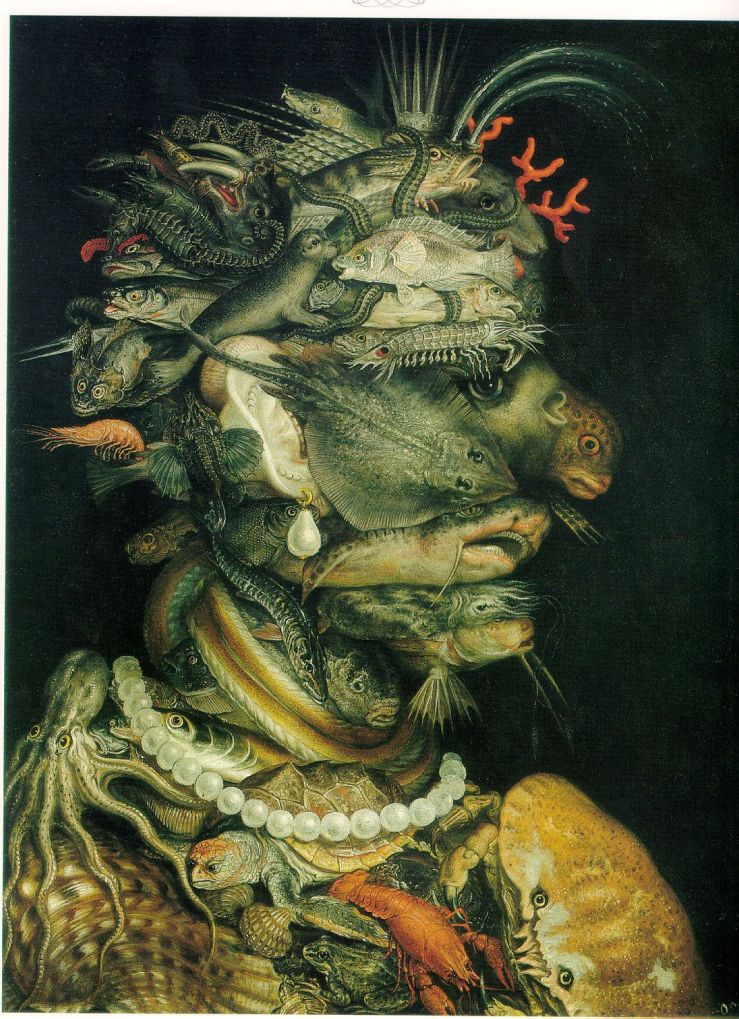
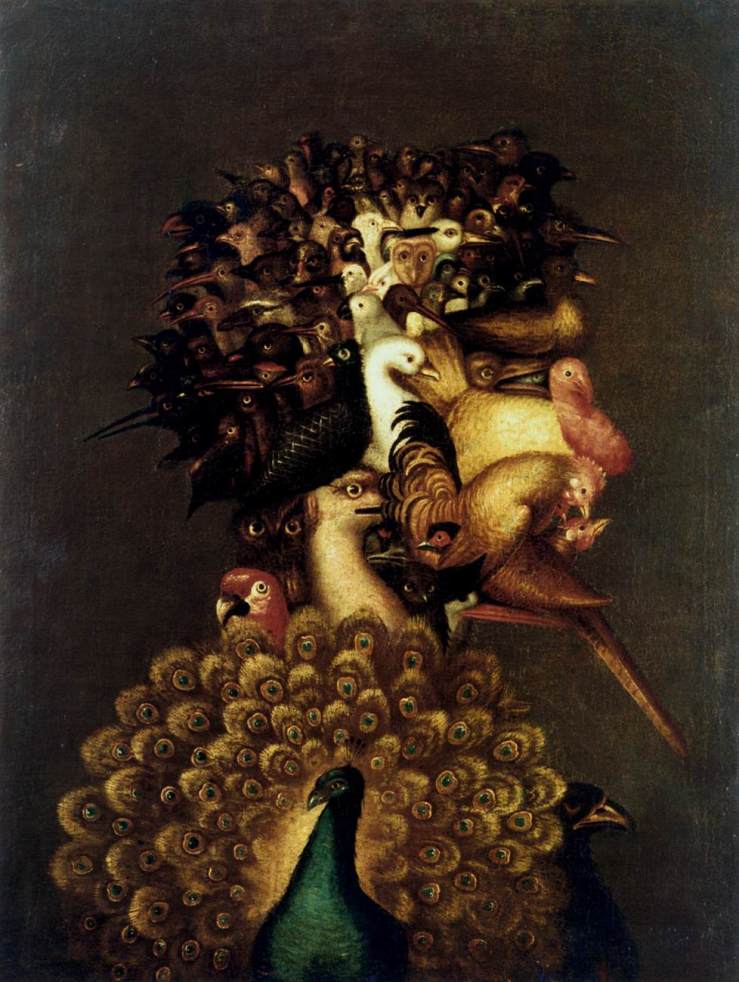
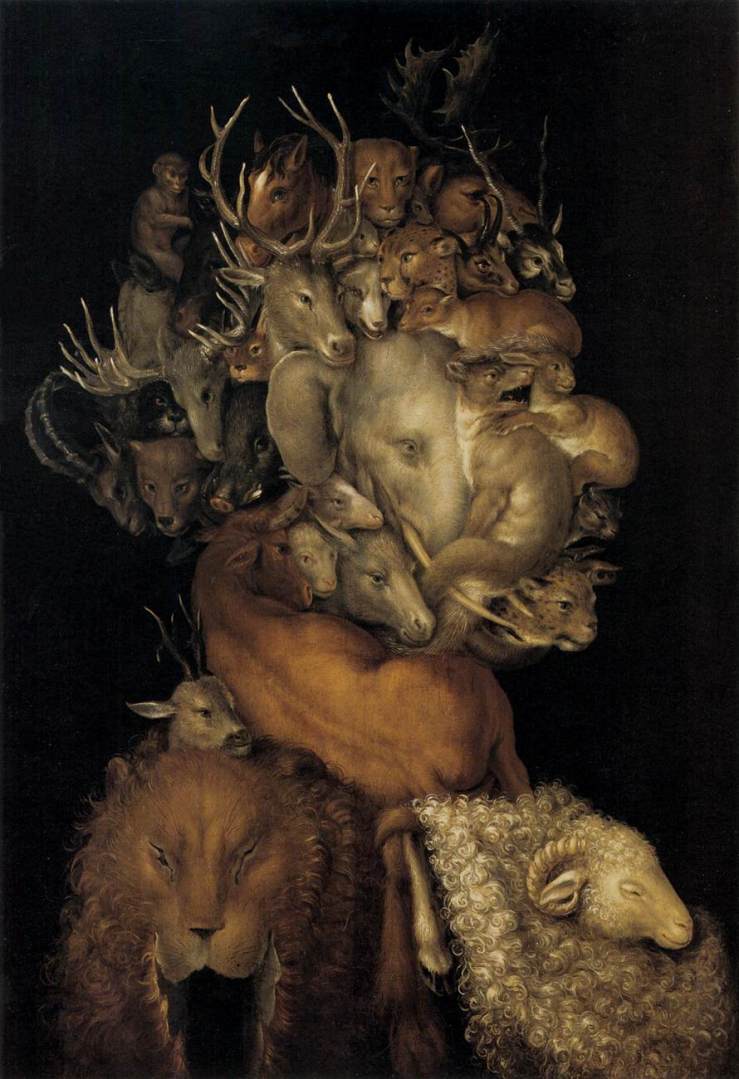
The last name he appropriates from the painter Arcimboldo, whose paintings are instructive in understanding the structure of 2666, a narrative that comprises hundreds of internal discrete narratives that define the shape of the larger picture.  The first name?

“They called me Benno after Benito Juarez,” said Archimboldi, “I suppose you know who Benito Juarez was.”

The dark heart of 2666, site of “Crimes,” is Santa Teresa, a transparent stand-in for Ciudad Juarez.

(Florita Almada, psychic medium and honest detective of “Crimes” channels Benito Juarez, the shepherd boy who became the president of Mexico; I’m tempted to quote here at some length but resist).

•Re: the previous point: I foolishly suggest that Archimboldi’s name is some sort of secret key. I don’t think there is a secret key. Just reading. Rereading.

•I seem to be focusing a lot on “The Part About Archimboldi” in this riff. I riffed about the first three books here, and “The Part About Crimes” here.

•But, still dwelling on “Archimboldi,” there’s a moment in it where an old alpine hermit confesses to murdering his wife by pushing her into a ravine. In some way his confession seems to answer all the puzzles of “Crimes,” all the unresolved abysses, all the falls (literal and metaphorical).  How can I justify this claim? How does a man confessing to a murder in a remote German border town in the 1950s answer the murders in Mexico in the 1990s? Or any of the other murders in the book? I suppose it’s a thematic echo, not a solution. Sweating late at night, reading past midnight, the moment struck me as larded with significance. I’m losing whatever thread I had . . .

•So to end—how to end? Perhaps I’ll raid my first review of 2666, from January, 2009—surely I must have remarked on the end of the book, or on its apparent inconclusiveness—

• —and so I did. And I don’t know if I can do better than this: 

Readers enthralled by the murder-mystery aspects of the novel, particularly the throbbing detective beat of “The Part About The Crimes,” may find themselves disappointed by the seemingly ambiguous or inconclusive or open-ended ending(s) of 2666. While the final moments of “The Part About Archimboldi” dramatically tie directly into the “Crimes” and “Fate” sections, they hardly provide the types of conclusive, definitive answers that many readers demand. However, I think that the ending is perfect, and that far from providing no answers, the novel is larded with answers, bursting at the seams with answers, too many answers to swallow and digest in one sitting. Like a promising, strangely familiar turn in the labyrinth, the last page of the book invites the reader back to another, previously visited corridor, a hidden passage perhaps, a thread now charged with new importance . . . 2666 is a book that demands multiple readings.

It was a good suggestion three years ago and I’ll take it up again.

[Ed. note: Biblioklept originally published this essay in July of 2012; since then, a licit e-book of 2666 has been published].
 

“I’ve got my weird neuroses” — David Foster Wallace on William Vollmann and Bret Easton Ellis

I mean, I’ve got my weird neuroses. Like I’m totally—I had this huge inferiority complex where William Vollmann’s concerned. Because he and I’s first books came out at the same time. And I even once read a Madison Smartt Bell essay, where he used me, and my “slender output,” and the inferiority of it, to talk about, you know, how great Vollmann is. And so I go around, “Oh no, Vollmann’s had another one out, now he’s got like five to my one.” I go around with that stuff. But I think, I’m trying to think of any example that …

Bell himself is an outpourer.

I think just: I haven’t read a lot of the new stuff that’s come out over the last few years. Like Steve Erickson, and Tours of the Black Clock—it’s really fucking good. I thought Bret Ellis’s first book, I thought it was very, very powerful. American Psycho—I thought he was really ill-served by his agent and publisher even letting him publish it, and those are the only two things of his that I read. But that’s, I think this is another danger: you get lavishly rewarded for that first book, and it’s gonna be very difficult for him ever to do anything else. I mean there’s gonna be part of you that just wants to do that over and over and over again, so you continue to get the food pellets of praise. It’s one more way that all this stuff is toxic.

Same risk for you?

Sure. Because whatever I do, the next thing will be very different from this. And if it gets reamed, then I’ll think: “Oh no. Maybe Infinite Jest II.” In which case, somebody needs to come and just put a bullet in my head. To be merciful. David Leavitt noose quote: Reviewers will use my first book as a noose to hang my second. I think it often is. Although the nice thing about having written an essentially shitty first book is that I’m exempt from that problem. There were a lot of people who really liked Broom of the System, but unfortunately they’re all about eleven.

From David Lipsky’s book-length interview/memoir Although Of Course You End Up Becoming Yourself; the italicized interjections are Lipsky’s.


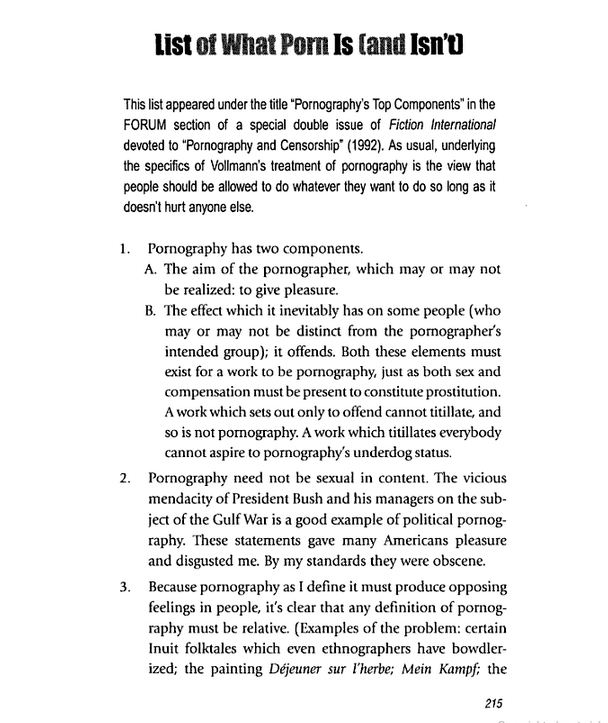
“List of What Porn Is (and Isn’t)” — William T. Vollmann

“Right now I am a pathetic and very confused young man” — Read an Excerpt from the New David Foster Wallace Biography by D.T. Max


The only thing Wallace knew for sure was that he desperately wanted to be a novelist again but some piece of him still felt too fragile to attempt an effort so key to his well-being. The problem, he felt, was not really the words on the page; he had lost confidence not in his ability to write so much as the need to have written. Jonathan Franzen, with whom he had struck up an epistolary friendship, offered to get together that April when he was in Boston. Wallace said fine but stood him up after they made plans. But because one tenet of recovery is to make amends to those you have wronged, he wrote to his friend explaining his behavior. “The bald fact is that I’m a little afraid of you right now,” he wrote. He begged to be allowed to bow out of their embryonic competition, to declare a truce against this writer who was so “irked by my stuff,” because Wallace was no longer “a worthy opponent in some kind of theoretical chess-by-mail game from which we can both profit by combat.”

He went on: “Right now I am a pathetic and very confused young man, a failed writer at 28, who is so jealous, so sickly searingly envious of you and Vollmann and Mark Leyner and even David F–kwad Leavitt and any young man who is right now producing pages with which he can live … that I consider suicide a reasonable—if not at this point a desirable—option with respect to the whole wretched problem.”

From D.T. Max’s forthcoming David Foster Wallace biography Every Love Story Is a Ghost StoryRead the rest of the excerpt.