Jonathan Swift’s Death Mask

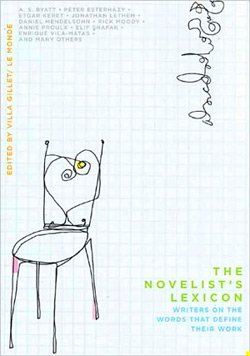
The Novelist’s Lexicon

The Novelist’s Lexicon, new in hardback from Columbia University Press, is an auspicious and at times bewildering project originating from an international literary conference hosted by Le Monde a few years ago. Over seventy authors from more than a dozen countries were asked to write about a “key word that opens the door to his work.” A list of just a few of the authors here is probably more than enough to pique interest: Rick Moody, Helene Cixous, Colum McCann, Jonathan Lethem, Adam Thirlwell, A.S. Byatt, David Peace, Dennis Cooper, and Annie Proulx all contribute pieces, mostly short, somewhere between 100 and 500 words. By nature, The Novelist’s Lexicon is a fragmentary affair, discontinuous, open to multiplicity, and unified only by its authors’ sense of craft, as well as an abiding intelligence.

Some authors take the project in earnest, like Lethem, whose piece “Furniture,” (which we excerpted late last year) pinpoints a fundamental yet largely unremarked upon element of novel-writing. French author Nicholas Fargues taps into etymology, offering a bit of advice in his piece “Novice”–

Don’t ‘make’ literature. Don’t write because that’s what people expect of you now that you’re a ‘writer.’ Don’t write for the beauty of the gesture or the love of art. Beware of fine phrases and well-turned maxims; that’s not your thing. Watch out for words that strike a pose. But do let your memory and your instincts flow; let the aptest words, the words that resemble you most closely, come of their own accord.

Anne Weber’s piece “Waiting/Attention” suggests that a key word — or any key, really — is an impossible dream–

It would be a word that encapsulated my aspirations and expectations, my sadness and my joy, my amazement at the quince’s hairy skin, the wash of the sky, and the delicate pattern of the cyclamen’s leaves. And since everything would be contained in this single, essential word, since it would express everything, I wouldn’t need to write anymore. And good riddance, too!

Swedish author Jonas Hassen Khemiri, who goes with “Un-” also points to language’s simultaneous limitations and possibilities–

Un- as in never being satisfied with the language we have. Un- as in the realization of how difficult it is to communicate with people in a language you have invented yourself. Un- as in doubting whether you will ever succeed. Un- as in continuing to try even so. Un- as in suddenly launching yourself over a coffee table and transforming a dictionary into confetti.

Khemiri’s frustration with language (and paradoxical love) is thematic throughout Lexicon; we see it, for instance in David Peace’s “Plague.” Peace comes off like the crotchety old man in the group–

To be honest or stupid or both, but not churlish or contrary (I hope), I am uncertain I understand the premise of this lexicon. However, I am against the presumption of all premises and, equally, I am against all definitions and dictionaries, lexicons and lists, which, in their commodification and exclusivity, are the preserve and the territory of fascists and shoppers.

After this radical caveat, including the claim that he is under “duress” (did the folks at Le Monde put guns to these authors’ heads?), Peace goes on to discuss the word “plague,” tracing it through Western lit and showing how it evinces in his novel Occupied City (which we reviewed here, by the way).

Perhaps Peace should’ve just ignored the assignment, like Dennis Cooper, whose piece is “Signed D.C.” is simply a work of microfiction, imagining what would happen if Olive Oyl and Popeye who “peel like decals from the TV and live in the world.” The story is a clever, short five paragraphs, and ends with at least a trace of insight into Cooper’s writing process: “I am heavier than my constructions understand.” Maybe he didn’t ignore the assignment.

Cooper is not the only writer to let fiction reign — there are poems and meditations and strange riffs here, largely divorced of discussion from technique or craft. In any case, those interested in getting into the heads of some of the 21st century’s most prominent (and skillful) writers will wish to take notice of The Novelist’s Lexicon, a fun and repeatedly rewarding book. Recommended.

“Twain Is the Day, Melville the Night” — Roberto Bolaño on U.S. Writers

The following excerpt comes from Raul Schenardi’s 2003 interview with Roberto Bolaño, conducted at the Turin Book Fair just months before the author’s death. The interview is written in Italian (although I’m not sure if it was conducted in Italian). The translation work is the result of two programs (Google Translate and Babel Fish) and a few dictionaries; I also used this Spanish translation as a second source for comparison.

. . .  in all Latin American writers is an influence that comes from two main lines of the American novel, Melville and Twain. [The Savage] Detectives no doubt owes much to Mark Twain. Belano and Lima are a transposition of Huckleberry Finn and Tom Sawyer. It’s a novel that follows the constant movement of the Mississippi. . . . I also read a lot of Melville, which fascinates me. Indeed, I flirt with the belief that I have a greater debt to Melville than Twain, but unfortunately I owe more to Mark Twain. Melville is an apocalyptic author. Twain is the day, Melville  the night — and always much more impressive at night. In regard to modern American literature, I know it poorly. I know just up to the generation previous to Bellow. I have read enough of Updike, but do not know why; surely it was a masochistic act, as each page Updike brings me to the edge of hysteria. Mailer I like better than Updike, but I think as a writer, a prose writer, Updike is more solid. The last American writers I’ve read thoroughly and I know well are those of the “Lost Generation,” Hemingway, Faulkner, Scott Fitzgerald, Thomas Wolff.

Thomas Paine’s Death Mask

Hegel’s Death Mask

Alexander Pushkin’s Death Mask

Amy Hempel on Gordon Lish and Barry Hannah

Amy Hempel talks Gordon Lish and Barry Hannah (among other things) in a new interview with Vice. A taste–

Do you think about readers when you’re writing? Do you personify them?
I do. I always have, and it’s always been a handful of other writers. Sometimes it has changed, but yes, I really do think of a few actual people. It makes it a little bit easier since I know them, and I know that, well, if this person will find it funny, then I’ve succeeded, or some such thing. It makes it more like trading confidences. I think it’s daunting to think of writing for one’s readers, whoever they may be, so I bring it down to something manageable—a few people whose standards I know and whose work I very much admire—and that makes it more like, almost, a letter to the person. That helps me set the course.

So do you think like, “I’m going to change this here. I’m sure Gordon Lish would love it”?
[laughs] Well, I often have in mind Barry Hannah, and in fact when you phoned me just now, I was working on some remarks I’m going to make at a sort of memorial tribute to Barry, who died last March. This is something that will be held just outside Boston, two nights from now. A bunch of writers who adored him, just paying tribute to him. Barry Hannah was always on my list of people I knew, writers I admired immensely, and just thinking, you know, Barry Hannah might read this, it seemed to focus me when I was writing.

Writing is an extremely solitary activity, but at the same time it’s also very intense. One analogy that I always think of is swimming—it’s something that you do on your own, and the only standard of success you have is your last lap.
I agree 100 percent. And yet there are writers who hold themselves up and compare themselves to other writers. I think that’s useless. As you say, you’re only trying to beat your own best time. That’s the only relevant competition as far as I’m concerned.

Is your past with Lish something that still has an influence on you?
You know, it was a long time ago. I was a student of his at Columbia and then privately and then his author back in the early 80s. I did two books with him. Working with him was a crucial formative experience, but it was a long time ago. There are other writers who have sort of stepped in. Interestingly, Barry Hannah was one and Mary Robison is another, and they are both his authors, too, and were at the time that I was being published by him. So, yes, [Lish] had a terrific impact on my writing very early on. I don’t think he’s writing any more, but he’s still present among writers who really do care about writing at the sentence level. His impact there has certainly endured.

What about the so-called golden age of American short stories? I don’t really know if it’s accurate, or even intelligent, to define it that way.
Well, I think it was a phenomenon in publishing, with a lot of critics rightly going to Raymond Carver—who was also Gordon’s author—and people like Mary Robison. You know—some of the story writers who really, really opened things up again for stories as a commercially viable kind of writing as well as something that was important to a lot of readers.

Gustave Flaubert’s Death Mask

Fyodor Dostoevsky’s Death Mask

“The Joycelin Shrager Story” — Tom Disch

From The Paris Review’s vaults, “The Joycelin Shrager Story” by Tom Disch–

When people asked what he did, Donald Long’s standard riposte was, “I’m a mechanic of the dream.” Meaning, he was a projectionist. Actually few people had to ask, since Donald had been around since the first black-and-white flickerings of the Movement early in the fifties. With the money he earned at the Europa he produced Footage, first as a quarterly and then bi-monthly. For years it was their only magazine, but gradually as success changed the Movement into the Underground, Footage was supplemented and then supplanted by newer, more commercially oriented magazines. Donald Long’s reputation as the Rhadamanthys of the underground film was undiminished, and possibly enhanced, by reason of this failure, but there was one consequence to be regretted—he had to continue full-time at the Europa, from one in the afternoon till the early evening, six days a week.

Continue reading ““The Joycelin Shrager Story” — Tom Disch”

Victor Hugo’s Death Mask

“A Gentleman’s C” — Padgett Powell

“A Gentleman’s C,” a very short story by Padgett Powell

My father, trying to finally graduate from college at sixty-two, came, by curious circumstance, to be enrolled in an English class I taught, and I was, perhaps, a bit tougher on him than I was on the others. Hadn’t he been tougher on me than on other people’s kids growing up? I gave him a hard, honest, low C. About what I felt he’d always given me.

We had a death in the family, and my mother and I traveled to the funeral. My father stayed put to complete his exams–it was his final term. On the way home we learned that he had received his grades, which were low enough in the aggregate to prevent him from graduating, and reading this news on the dowdy sofa inside the front door, he leaned over as if to rest and had a heart attack and died.

For years I had thought that the old man’s passing away would not affect me, but it did.

(From Micro Fiction, edited by Jerome Stern).

Ian McEwan’s Fish Stew

Here’s another entry in our Thanksgiving series of literary recipes–a recipe for fish stew, adapted from Ian McEwan’s novel Saturday. The recipe is Henry Perowne’s, the novel’s protagonist who makes it for dinner on the titular day. The adaptation below comes from journalist Damian Barr, who wrote an excellent article about recipes in literature for The Times.

Into a stockpot of boiling water (a litre or more), put the bones of three skates (or other boned fish), with heads intact. If you have no obliging local fishmonger, use a pound or more of white fish.

Add a dozen or so mussels to the stock. Simmer for 25 minutes.

Meanwhile, strip and chop three onions and eight fat cloves of garlic. Soften over a low heat in a casserole with a lot of olive oil. When they have melted sufficiently, add: a couple of crushed red chillies, a pinch of saffron, some bay leaves, orange-peel gratings, oregano, five anchovy fillets, two cans of peeled tomatoes

When these have blended together in the heat, add a quarter bottle of white wine. Then strain off the stock and add to the casserole. Simmer the mix for 20 minutes.

Rinse and/or scrub the clams and remaining mussels and place in a bowl.

Cut the monkfish tails into chunks and place in a separate bowl.

Wash the tiger prawns and add to the monkfish bowl. Keep both bowls refrigerated until ready to cook. Just before dinner, reheat the casserole.

Simmer the clams, monkfish, mussels and prawns in the casserole for ten minutes.

Eat the stew with brown bread, or garlic bread, salad and a hearty red wine.

Zora Neale Hurston’s Mulatto Rice

[Editorial note: We originally ran a version of this post in November of 2009. We’re republishing it as part of a series celebrating Thanksgiving, featuring recipes and food from some of our favorite books].

At the beginning of Zora Neale Hurston’s novel Their Eyes Were Watching God, Janie returns from the Everglades to Eatonville in ragged overalls to a gossipy and unwelcoming town. The one exception is her best friend Phoeby, who brings Janie a “heaping plate of mulatto rice.” Janie gobbles up the simple, delicious meal, even as Phoeby notes that it “ain’t so good dis time. Not enough bacon grease.” She does however concede that “it’ll kill hongry.” No doubt.

We’ve always been intrigued by mulatto rice. What could it be? Is the dish still around today, but under a new name? Although the term “mulatto” has fallen into disuse, and perhaps distaste (just ask Larry David if you don’t believe us), organizations like mulatto.org have also taken a certain ownership of it. For Hurston, mulatto rice is a positive thing. Hurston could have had Phoeby bring any number of dishes to her friend Janie, so it’s telling that she chooses “mulatto rice” as a homecoming meal. The dish represents a communion, an admixture that reflects Janie’s multiracial identity as well as her resistance to gender-typing. “Mulatto” is also probably etymologically akin to the word “mule,” and if you’ve read Eyes, you know that mules are a major motif in the story. But enough literazin’.

Down to the nitty-gritty–we made up a mess of mulatto rice tonight thanks to a recipe from The Savannah Cook Book by Harriet Ross Colquitt. Not that we found this 1933 cookbook ourselves. No, the real merit here goes to the very cool website Take One Cookbook, which explores the history and culture and sociology behind old, weird cookbooks–all while making the recipes. Colquitt’s recipe, via Wendy at Take One Cookbook (see Wendy’s versionhere):

Mulatto Rice

This is the very chic name given to rice with a touch of the tarbrush.

Fry squares of breakfast bacon and remove from the pan. Then brown some minced onion (one small one) in this grease, and add one pint can of tomatoes. When thoroughly hot, add a pint of rice to this mixture, and cook very slowly until the rice is done. Or, if you are in a hurry, cold rice may be substituted, and all warmed thoroughly together.

The rice is very easy to make and very, very tasty. We substituted green onions for a small onion, and used a hickory-smoked bacon that infused the rice with a lovely sweetness (we also included a tablespoon of brown sugar right after the tomatoes). We served the dish, pictured above, with ham steaks and fried green tomatoes with a spicy yogurt sauce. Hearty and rich and satisfying–just the sort of thing one wants to eat after a soul-searching quest (or maybe just a long day). Recommended.


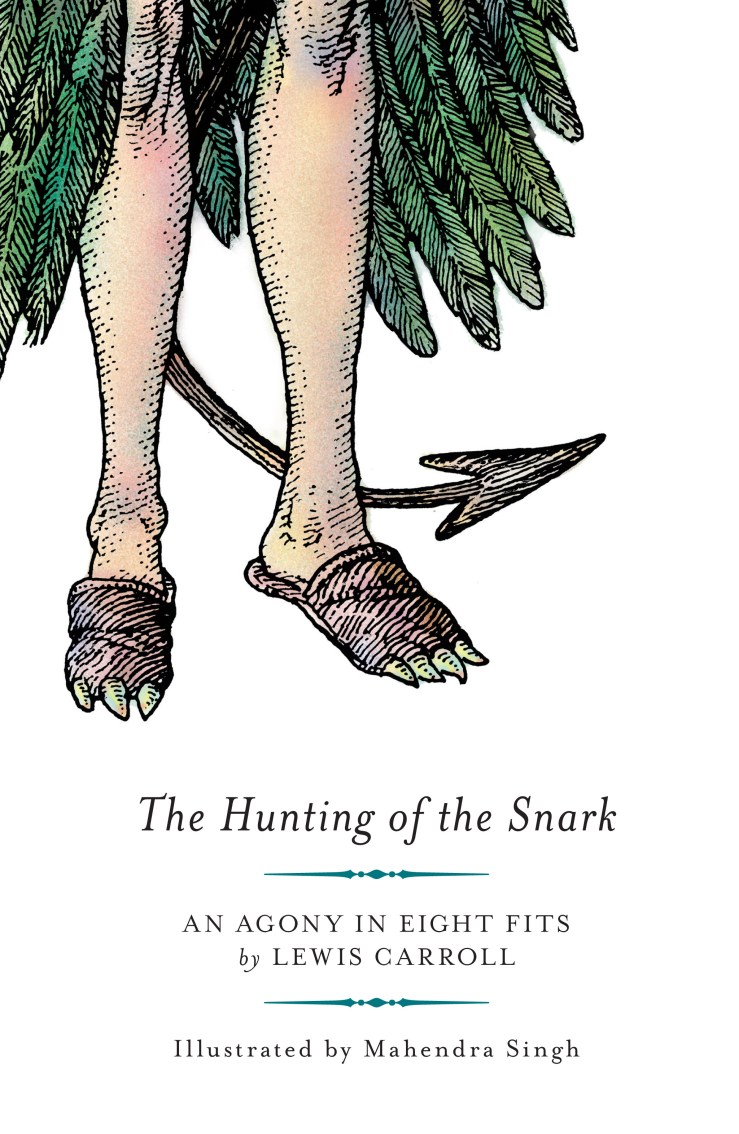
The Hunting of the Snark — Lewis Carroll (with Surreal New Illustrations by Mahendra Singh)

I scrapped my first two drafts for a review of Melville House’s new edition of Lewis Carroll’s The Hunting of the Snark. The problem was that I was struggling to figure out Carroll’s Nonsense poem (subtitled An Agony in Eight Fits) about a ten man crew who take to the sea, to, you know, hunt a Snark. The Bellman seems to lead them. There’s the Banker, Baker, and other guys whose names start with “b” — including enemies the Beaver and the Butcher (who wind up tight allies). The poem is both silly and dense, rippling with weird wordplay and allusions that are, for the most part, beyond me. It’s often hard to follow, and sometimes has the effect of making the reader (or at least this reader) feel like he’s skating on the surface of some deeper profundities — or, alternately, maybe it’s just Nonsense, to use Carroll’s term.

Anyway. I solve my dilemma by retreating to the real occasion for reviewing the book, namely Mahendra Singh’s marvelous and strange illustrations. Singh, a member of the Lewis Carroll Society of North America (and an editor of their journal, Knight Letter), describes his illustrated version as “fitting Lewis Carroll into a proto-Surrealist straitjacket with matching Dada cufflinks.” In both its imagery and heavy, dark lines, Singh’s project readily recalls one of my favorite books, Max Ernst’s proto-graphic novel, Une Semaine de Bonté, as well as Henry Holiday’s original illustrations for the book. Singh lards his illustrations with visual paradoxes, puzzles, and puns, as well as references to artists ranging from de Chirico and Magritte to Dali and Bosch. There are also nods to pop culture (including the Beatles).  And Freud, because, hey, why not. Observe–

Singh’s puzzles, like Lewis’s, do not immediately reveal their meaning, but of course this is part of the joy of the book. In his instructive afterword, Singh tells us that “each drawing should make some sort of sense of the verse it explains or at least, make Nonsense.”  His greater goal though seems to be to share his love of Carroll with his readers (“in particular the younger ones”), who he hopes will “further pursue on their own that immense cultural heritage which silently — and so faithfully — awaits them.” My three year old daughter enjoyed the book very much, and had the good sense (Nonsense?) not to get too flummoxed over what Snark means. This is probably a wise course to follow. As Singh observes in his afterword, “whenever Carroll was asked what the poem meant, he always replied that he did not know. “Of course, just because its creator didn’t know its meaning (or at least claimed not to) doesn’t mean that Snark doesn’t have meaning–it’s just the kind of ambiguous meaning that floats around on dream logic, and Singh’s surrealism, with its playful, amorphous shifts, is the right choice to illustrate the poem. I’m not sure if “illustrate” is the right verb here, though. Certainly these are illustrations, but Singh’s goal isn’t so much to literally render Lewis’s words in pictures as it is to echo their spirit. Singh’s art works in tandem with the poem, accompanying it through symbolic and metaphorical transfers, arriving at times to weird conjunctions and discordances, and, perhaps, generating new meanings. Recommended.

The Hunting of the Snark is new in hardback this month from Melville House. More at Singh’s blog.

“Housewife” — Amy Hempel

“Housewife,” a very short story by Amy Hempel

She would always sleep with her husband and with another man in the course of the same day, and then the rest of the day, for whatever was left to her of that day, she would exploit by incanting, “French film, French film.”

(From Micro Fiction, edited by Jerome Stern).

Jonathan Lethem Talks to Patti Smith