“I Finally Got Tired of Being Angry at Roth” — What Jonathan Franzen’s Been Reading

Time profiles Jonathan Franzen this week (part of the push for his new novel Freedom, out later this month). Franzen also talks about five works that have “inspired him recently.” Here are his comments on those books–

The Charterhouse of Parma by Stendhal

Instead of sitting for years at his writing desk, pulling his hair, Stendhal served with the French diplomatic corps in his favorite country, Italy, and then came home and dictated his novel in less than eight weeks: what a great model for how to be a writer and still have some kind of life! The book is at once deeply cynical and hopelessly romantic, all about politics but also all about love, and just about impossible to put down.

The Greenlanders by Jane Smiley

There’s nothing fancy about the writing in Smiley’s masterpiece, and yet every sentence of its eight hundred pages is clean and necessary. For the two weeks it took me to read it, I didn’t want to be anywhere else but in late-medieval Greenland, following the passions and feuds and farming crises of European settlers trying to survive in the face of ecological doom. It all felt weirdly and plausibly contemporary.
Sabbath’s Theater by Philip Roth

I finally got tired of being angry at Roth for his self-indulgent excesses and weak dialogue and thin female characters and decided to open myself to his genius for invention and his heroic lack of shame. Whole chunks of Sabbath’s Theater can be safely skipped, but the great stuff is truly great: the scene in which Mickey Sabbath panhandles on the New York with a paper coffee cup, for example, or the scene in which Sabbath’s best friend catches him relaxing in the bathtub and fondling his (the friend’s) young daughter’s underpants.

The House of Mirth by Edith Wharton

Wharton’s male characters suffer from some of the deficiencies that Roth’s female characters do, but the heroine of House of Mirth, Lily Bart, is one of the great characters in American literature, a pretty and smart but impecunious New York society woman who can’t quite pull the trigger on marrying for money. Wharton’s love for Lily is equal to the cruelty that Wharton’s story relentlessly inflicts on her; and so we recognize our entire selves in her.

East of Eden by John Steinbeck

A lifelong heavy drinker with his most famous novel well behind him, Steinbeck set out to write a mythic version of his family’s American experience that would embody the whole story of our country’s lost innocence and possible redemption. There are infelicities on almost every page, and the fact that the book succeeds brilliantly anyway is a testament to the power of Steinbeck’s storytelling: to his ferocious will to make sense of his life and his country.

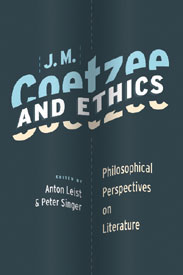
J.M. Coetzee and Ethics — Anton Lesit & Peter Singer

In their introduction to J.M. Coetzee and Ethics, editors Anton Lesit and Peter Singer make the claim that the essays in the new collection “show the folly of Plato’s idea that literature has nothing to contribute to philosophical discussion. Instead they are an invitation to a dialogue that can sharpen the issues that literature raises while making philosophy more imaginative.” Lesit and Singer briefly review the philosophical tradition, from the time of Plato’s call to banish the poets to the current wars between pragmatists and postmodernists, specifically foregrounding the case for Coetzee’s literature as a legitimate source of philosophical inquiry. They identify three specific features of his works — reflectivity, truth seeking, and an exploration of social ethics — that merit critical attention. The essays in the volume address “the psychological and moral phenomenology of personal relationships; the consequences of human suffering, evildoing, and death for human rationality and reason; and the literary methods invoked to open areas of experience beyond the abstract language of philosophers.” The editors also point out that “Unsurprisingly, the ethics of animals looms large in this collection,” a concern that might attract animal ethicists and others interested in animal-human relationships who might not immediately turn to literature for answers (or questions). On the whole, J.M. Coetzee and Ethics, while obviously a specialty volume, strives to appeal to a wider audience, eschewing much of the acadamese that plagues (and obfuscates the arguments of) so many critical volumes. Fans of Coetzee will wish to take note. J.M. Coetzee and Ethics is new in hardback from Columbia University Press.

The AV Club Interviews Terry Zwigoff about His Movie Crumb

The AV Club interviews director Terry Zwigoff about his movie Crumb (and some other stuff). From the interview–

The idea was to do a documentary on the three Crumb brothers. It was never a documentary about Robert Crumb in my head. I had met Charles and Max and liked them both, and I collected artwork from all three brothers. I even spent a night at their parents’ house, and met his father when he was still alive. So it started taking shape in my mind, and it seemed to me like a good idea for a film if Robert would do it. Not so much because I had access to Robert and he was willing to cooperate, but because I felt comfortable knowing that as his friend, I’d been exposed to facts that other people wouldn’t have known. And there were some things Robert never even thought to tell me about, not because he was trying to withhold information from me, but because he couldn’t tell what would be interesting and what wouldn’t. He couldn’t be objective about it.

Here’s a clip from the movie–

The Paris Review Interviews Jonathan Lethem

Spanish-language blog La fortaleza de la soledad has republished The Paris Review’s interview with Jonathan Lethem. Cool interview–Lethem talks about his hippie parents, going to school with Bret Easton Ellis, explains why William Gibson is the new Thomas Pynchon, and discusses his novels at length. From the interview —

I felt I ought to thrive on my fate as an outsider. Being a paperback writer was meant to be part of that. I really, genuinely wanted to be published in shabby pocket-sized editions and be neglected—and then discovered and vindicated when I was fifty. To honor, by doing so, Charles Willeford and Philip K. Dick and Patricia Highsmith and Thomas Disch, these exiles within their own culture. I felt that was the only honorable path.

Thomas Pynchon: Man of Mystery

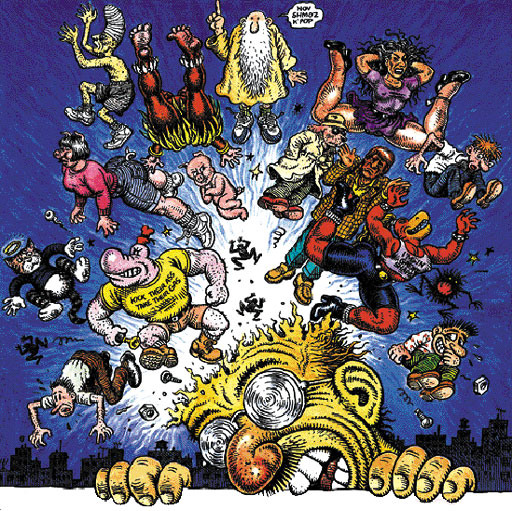
“Thomas Pynchon: Man of Mystery” — Comic by Kelly Shane & Woody Compton, part of their Is This Tomorrow? series.

The Guardian Profiles Don DeLillo; Flubs the Name of One of His Novels

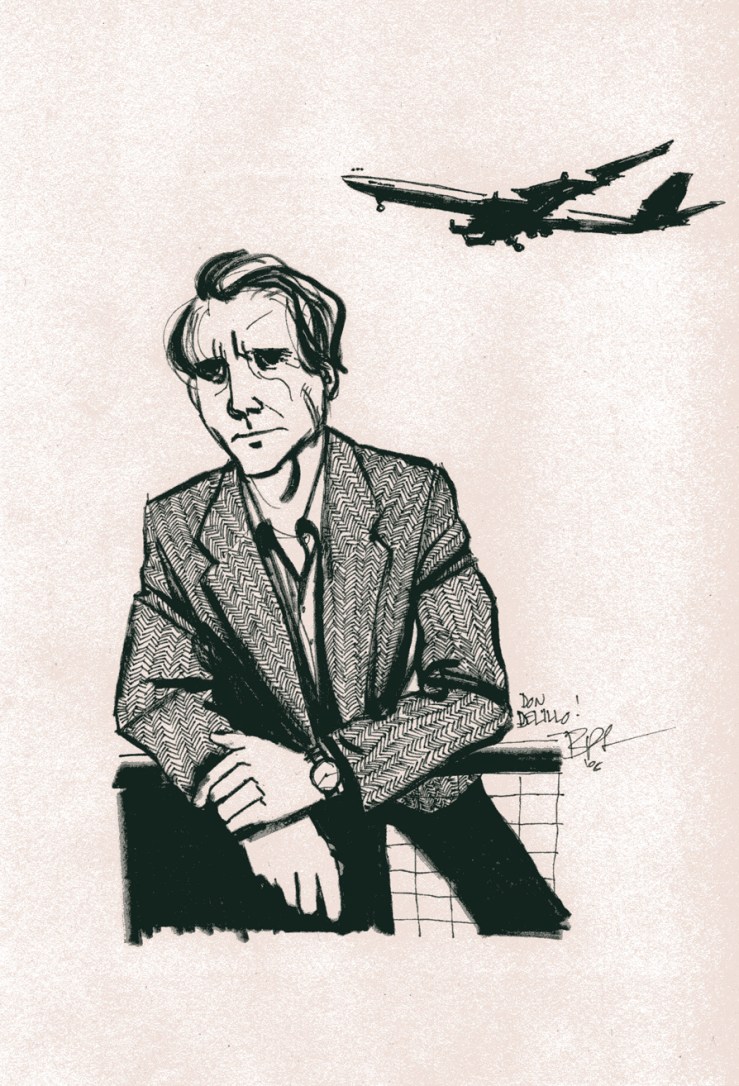
Don DeLillo by Brian Wood

The Guardian profiles Don DeLillo. The profile is pretty silly, referring to DeLillo as an “All-American writer,” and mistakenly referring to his 2007 novel Falling Man as The Falling Man (this reminds me of the way that grandparents love to add a definite article to pretty much anything, e.g. “I have to go to the Wal-Marts”).  Here it is —

After Underworld, an 800-page tour de force, DeLillo’s career turned towards the miniature: The Body Artist (2001), Cosmopolis (2003), The Falling Man (2007) are much slighter books, a rallentando that suggests a writer moving inexorably into the minor key of old age. Not that you’d find this in the demeanour of DeLillo.

The writer makes up for the error by using the word “rallentando,” of course.

(Thanks to A Piece of Monologue for directing our attention this way).

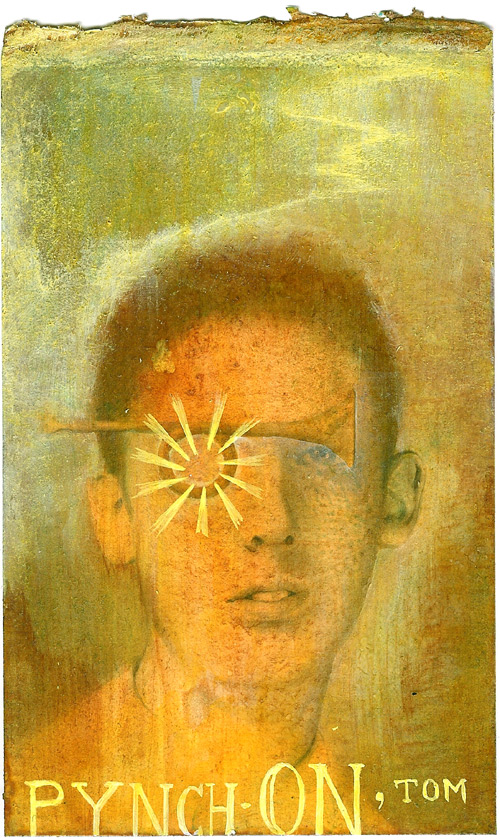
“Thomas Pynchon” — James Jean

James Jean does Thomas Pynchon. (Via Hey Oscar Wilde!).

Drinking Games for Readers

At Jezebel, a list of drinking games for readers. Some witty, some not so witty. Here’s the list:

Thomas Pynchon: Drink every time someone has a stupid name, like “Eigenvalue.”

David Foster Wallace: Drink every time a sentence has three or more conjunctions.

William Faulkner:
Every time a sentence goes on for more than a page, drink the entire bottle. Then make out with your sister.

Joyce Carol Oates: Drink every time there is a home invasion.

Jane Austen: Drink every time someone plays whist, goes riding, or gets married.

J.D. Salinger: Every time there is a symbol of lost innocence, drink a highball. Then spit it all over someone you love.

Emily Bronte: Drink every time you see the word “heath” (Heathcliff counts).

Gabriel García Márquez
: Drink every time someone’s name is “Aureliano.” (Note: this only works for A Hundred Years of Solitude)

Virginia Woolf: First, go buy some flowers. Then, if you have time left over, drink.

Sappho: Drink every time you can’t tell if something is hot or disgusting.

Ernest Hemingway: Drink every time Ernest Hemingway is boring and overrated. Man, I am so wasted right now.

Raymond Chandler: Drink every time someone drinks.

Dashiell Hammett:
Drink every time someone drinks.

Homer:
Drink every time someone drinks gross diluted wine.

Stephenie Meyer: Drink every time someone drinks blood.

Dylan Thomas: Drink until you are in a coma.

I think you can apply the rules for the Chandler and Hammett games to Bukowski if you wanted. Use Kingsley Amis’s signature cocktail the Lucky Jim if you wish. You might also be interested in David Foster Wallace’s drinking game “Hi Bob.”

Robert Crumb on LSD

In his new interview in the Summer 2010 issue of The Paris Review (excerpt here), Robert Crumb describes how taking LSD for the first time affected his art —

I had been working along in this modern adult cartoon trend, very influenced by the modern, expressionistic, arty quality of work by Jules Feiffer, Ronald Searle, Ralph Steadman. Then, on LSD, I got flung back into this cruder forties style, that suddenly became very powerful to me. It was a kind of grotesque interpretation of this forties thing, Popeye kind of stuff. I started drawing like that again. It was bizarre to people who had known my work before. Even Kurtzman said, What the hell are you doing? You’re regressing!

Here’s R. Crumb on LSD again, from the “Crumb on Crumb” section of his website —

A whole new thing was emerging in my drawings, a sort of harkening back, a calling up for what G. Legman had called the “Horror-Squinky” forces lurking in American comics of the 1940s. I had no control over it, the whole time I was in this fuzzy state of mind; the separation, the barrier betwixt the conscious and the subconscious was broken open somehow. A grotesque kaleidoscope, a tawdry carnival of disassociated images kept sputtering to the surface… especially if I was sitting and staring, which I often did. It was difficult to function in this condition, I was certifiably crazy, I sat staring on the couch at Marty’s apartment, or on long aimless bus rides around Chicago. These jerky animated cartoons in my mind were not beautiful, poetic or spiritual, they were like an out-of-tune player piano that you couldn’t shut off… pretty disturbing… this strange interlude ended as abruptly as it had begun in the next time I took a powerful dose of LSD in April ’66. My mind suddenly cleared. The fuzziness was gone, the fog lifted. It was a great relief… a weird drug, that was. But what the heck — “minds are made to be blown.”

If you want to quit using drugs like cocaine or LSD but are having difficulties affording it, you can try to find the best drug rehab at a discount by doing some research online.

The Paris Review Interviews David Mitchell

The Paris Review interviews David Mitchell in their new issue. An excerpt from their free excerpt:

INTERVIEWER I noticed this sentence in Number9Dream: “The cloud atlas turns its pages over.”

MITCHELL Wow, is that in Number9Dream? Then the phrase was haunting me earlier than I realized. “Cloud Atlas” is the name of a piece of music by the Japanese composer Toshi Ichiyanagi, who was Yoko Ono’s first husband. I bought the CD just because of that track’s beautiful title. It pleases me that Number9Dream is named after a piece of music by Yoko’s more famous husband, though I couldn’t duplicate the pattern indefinitely.

INTERVIEWER The epigraph to Number9Dream is from Don DeLillo: “It is so much simpler to bury reality than it is to dispose of dreams.”

MITCHELL The best line in the book and it’s not even mine.

“Hi Bob,” David Foster Wallace’s Drinking Game

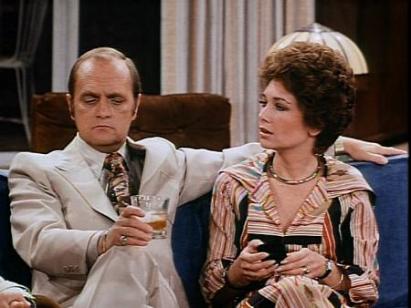
In David Foster Wallace’s first novel The Broom of the System, protagonist Lenore Beadsman’s brother and his friends play a drinking game based on The Bob Newhart Show. Here are the rules–

On television was ”The Bob Newhart Show.” In the big social room with LaVache were three boys who all seemed to look precisely alike. . . . ”Lenore, this is Cat, this is Heat, this is the Breather,” LaVache said from his chair in front of the television. . . .

Heat and the Breather were on a spring-sprung sofa, sharing what was obviously a joint. Cat was on the floor, sitting, a bottle of vodka before him, and he clutched it with his bare toes, staring anxiously at the television screen.

”Hi Bob,” Suzanne Pleshette said to Bob Newhart on the screen. . . . La Vache looked up from his clipboard at Lenore. ”We’re playing Hi Bob. You want to play Hi Bob with us?” He spoke sort of slowly. Lenore made a place to sit on the luggage. ”What’s Hi Bob?” The Breather grinned at her from the sofa, where he now held the bottle of vodka. ”Hi Bob is where, when somebody on ‘The Bob Newhart Show’ says ‘Hi Bob,’ you have to take a drink.”

”And but if Bill Dailey says ‘Hi Bob,’ ” said Cat, tending to the joint with a wet finger, ”that is to say, if the character Howard Borden on the show says ‘Hi Bob,’ it’s death, you have to chug the whole bottle.”

”Hi Bob,” said Bill Dailey on the screen.

This text was originally cited in Caryn James’s 1987 review of The Broom of the System in The New York Times. Here’s our review.

The Broom of the System — David Foster Wallace

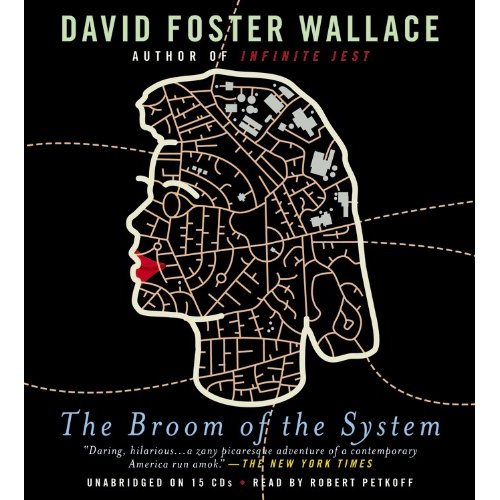
David Foster Wallace’s first novel The Broom of the System obsesses over language, words, storytelling and what it might mean to have our lives circumscribed in another person’s narrative. Hatchette Audio’s new audiobook version of Broom highlights the strength of Wallace’s dialogue, a feature of his writing perhaps overlooked, or at least overshadowed, by his complex diction and syntax and his innovative narrative structures. The Broom audiobook features the considerable talents of reader Robert Petkoff, who brings life to its many characters like protagonist Lenore Stonecipher Beadsman, a switchboard operator looking for her grandmother (and namesake) in the weird nooks and crannies of Wallace’s fictional Cleveland. Gramma Lenore (grammar Lenore; lost Lenore) is a former pupil of Wittgenstein, a conceit that allows Wallace to run wild with his own philosophical-linguistic concerns. I first read Broom as an undergrad–this was almost 15 years ago now–and I was pretty soaked in post-structuralist philosophy at the time, at least enough to think I was getting what many of Wallace’s mouthpieces were saying. There’s an obsession with Self and Other and whatever membrane might keep them separate; there’s the paranoia that language dictates our lives; there’s a sense that the postindustrial landscape has led to the need to engender new means of communion. Politicians create the Great Ohio Desert–or G.O.D. (subtle, I know) as a place for spiritual quests; psychiatrists prescribe bizarre ritual theaters for families to produce in front of a recording of a TV audience; a drugged bird develops speech abilities and is mistaken for a miracle. Broom is a dizzying satire of modernity, or more properly, postmodernity (the book was first published in 1987 but set in 1990).

Journeying through the book years later is a new experience, especially in light of how much Wallace and his literary followers have remapped the terrain of fiction. Many of Broom‘s experimental innovations, like the incorporation of TV transcripts, scholarly articles, medical documents, and other “found footage” are so normalized in contemporary fiction as to be almost clichéd in 2010. While these moments are never glaring or gauche in Broom, their inclusion lacks the finesse that Wallace would later demonstrate in Infinite Jest. Similarly, Wallace’s characters in Broom are too cartoonish to connect with. Read aloud, their punning names become a cavalcade of groans:Wang-Dang Lang, Peter Abbott, Candy Mandible, Judith Prietht, Biff Diggerance, and so on, as if Wallace can’t help himself. The Pynchonesque goofiness gets in the way of the reader-writer relationship that Wallace ultimately wants, the Wittgensteinian language game that would allow for identification beyond words. Purposeful bathos is still bathos. Lenore is an engaging character but, as she frequently worries and suspects, she is just that, a character, never transcending the page like Don Gately of Infinite Jest. But it’s cruel and stupid to fault Broom for not being Infinite Jest, especially when Broom is such a rewarding novel. Published when Wallace was just 24, it shows the grand strains of First Novel Syndrome, of a genius trying to push out too many ideas, too many characters, too many philosophical riffs at once. While Infinite Jest is hardly restrained, it shows Wallace’s powerful control over Too Much; it converts Too Much into Not Enough, into Give Me More.

The highlight of Broom is in its storytelling, in its capacity to explode clichés and expose the truth and energy stored within them. Rick Vigorous, Lenore’s would-be beau with literary aspirations, repeatedly shares stories with Lenore (and us, of course). They can be silly and maudlin and mawkish and downright awful, but also inspiring and sad and horrific, all at the same time, and Wallace engineers and comments on these stories (and the other stories that populate the book) in a way that somehow breaks with or goes past the postmodern tradition he’s otherwise relatively beholden to in Broom. And while Wallace’s first novel never achieves the exquisite sadness of Infinite Jest (although it would clearly like to), it does share the same rap-session humor, the same intimate narrative voice that welcomes the reader to laugh, to ponder, to play the game. Recommended.

C — Tom McCarthy

Tom McCarthy’s marvelous, confounding new novel C tells the life story of Serge Carrefax and his strange adventures at the beginning of the twentieth century. The novel begins with Serge’s birth on his parents’ estate Versoie; he’s born with a caul, a “veil around his head: a kind of web,” a mystic mark that both disconnects and, paradoxically, joins him to the world. At Versoie, Serge’s father Simeon experiments with wireless technology and runs a school for deaf children while Serge’s deaf mother farms bombyx mori moths for silk. Serge and big sis Sophie are left to the care of their tutor Mr. Clair, but they manage to get into trouble with their chemistry set when he’s not looking. In addition to offering the Carrefax kids a classical education, Mr. Clair, a proto-Marxist, teaches them a game akin to Monopoly. In a particularly inspired scene, they soon dispense with the game board to recreate the game on the real-live grounds of Versoie, eventually incorporating the aid of a wireless communication system. Then, when moving from wireless receiver to wireless receiver becomes too much hassle, they simply co-ordinate the game in their collective imagination, managing properties in the pure abstract. The game elegantly emphasizes the siblings’ development from playing via symbolic representation, to enacting those symbols on a one-to-one scale, to finally internalizing and encapsulating the real world. It’s as if they’ve swallowed Versoie into their very beings.

Versoie initiates and enacts its own strange culture and mythology, one that intertwines inextricably with Serge and Sophie’s childhood. It’s a rich, detailed world, at once magical and unsettling, bustling with bizarre pageants (part of Simeon’s curriculum), eclectic experiments, and visitors like Widsun, a British intelligence code-breaker/code-maker who serves as a mentor first to Sophie and later Serge. While Sophie delights in secret codes and chemistry (particularly poison-making), Serge experiments with wireless technology, spending late nights on his homemade wireless set with other “bugs.” In one scene, Serge listens to “an RXer in Lydium who calls himself ‘Wireworm’ [who] is tapping out his thoughts about the Postmaster General’s plans to charge one guinea per station for all amateurs.” Tech geeks with hyperbolic handles griping over minutiae in the wee hours–sound familiar? McCarthy describes Serge’s reaction: “Transcribing his clicks, Serge senses that Wireworm’s not so young: no operator under twenty would bother to tap out the whole word ‘fashion.’ The spacing’s a little awkward also: too studied, too self-conscious.” We get text messaging a century before text messaging, and as Serge searches between news reports and chess games and distress calls, we see that the world wide web is far older than we might have thought. Later in the novel Simeon writes a letter to his son where he describes a proto-internet, claiming his ambition is “to transmit moving pictures over distance, such that life in all its full, vibrant immediacy may be relayed without any delay.” This isn’t steampunk though, it’s simply a reminder that wireless technology isn’t an invention of our own time. C is an historical fiction deeply concerned with technological fact. It’s also a bildungsroman, too, so let’s return to young Serge, who soon ventures to a Bohemian spa with Clair as chaperon.

The adolescent Serge is ill. He perceives the world through a “guazy crepe” that blackens his vision, recalling the amniotic sac that webbed his head at birth. At the spa, Dr. Philip diagnoses Serge’s problem: “You . . . have got blockage. Jam, block, stuck. Instead of transformation, only repetition.” He accuses Serge of enjoying his illness, of enjoying “to feast on the mela chole, on the morbid matter, and to feast on it repeatedly, again, again, again, like it was lovely meat–lovely, black rotten meat.” The Burroughsian image of black meat pops up again and again in C, perhaps suggesting the human limitation to transcend–or in Philip’s words, transform–the mortal condition. However, Serge manages, through his own devices, to break through the blockage; if his epiphany is ultimately negative, at least it is real, a semi-Cronenbergian sexual awakening with a hunchback.

Like Versoie, the Bohemian spa is both a rich and alienating setting; McCarthy’s great gift to the reader is crafting enough detail in his set pieces to make them seem utterly real, yet to withhold enough so that the reader’s imagination fills in the gaps that might exist outside of Serge’s proximity. C is only 300 pages long yet feels much deeper–not longer, but deeper. This is most evident in the novel’s next milieu, the Great War, where Serge serves as a Royal Air Force aerial observer. War novels, histories, and movies have given us so much information about WWI that it would be easy for McCarthy to rely on stock tropes and received wisdom in communicating his set-piece, but instead he gives us something startlingly new. For example, how were the drugs in WWI, McCarthy asks. It’s in the Air Force that Serge first uses cocaine, rubbing it into his retinas to improve his eyesight while he’s spotting for German artillery batteries. He quickly moves to snorting mounds of the stuff before each take off. Here’s a lovely passage, where we see Serge’s nascent addiction blurring his perspective, ultimately leading to an autoerotic climax–

Higher up, the vapour trails of the SE5s form straight white lines against the blue, as though the sky’s surface were a mirror too. Scorch-marks and crater contours on the ground look powdery; it seems that if he swooped above them low enough, then he could breathe them up as well, snort the whole landscape into his head. The three hours pass in minutes. As they dip low to strafe the trenches on the way back, he feels the blood rush to his groin. He whips his belt off, leaps bolt upright and has barely got his trousers down before the seed shoots from him, arcs over the machine’s tail and falls in a fine thread towards the slit earth down below.

“From all the Cs!” he shouts. “The bird of Heaven!”

Serge doesn’t bother to reflect much on this episode and McCarthy’s third-person narrator is so effaced in the novel as to seem almost invisible. McCarthy shows and never tells, even when he allows some insight into Serge’s psyche. We learn that–

Of all the pilots and observers, Serge alone remains unhaunted by the prospect of a fiery airborne end. He’s not unaware of it: just unbothered. The idea that his flesh could melt and fuse with the machine parts pleases him. When they sing their song about taking cylinders out of of kidneys, he imagines the process playing itself out backwards: brain and connecting rod merging to form one, ultra-intelligent organ, his back quivering in pleasure as pumps and pistons plunge into it, heart and liver being spliced with valve and filter to create a whole new, streamlined mechanism.

Serge’s indifference toward death (or life) and his frequent drug-use aren’t the manifestations of a death-wish–although C does pull its hero to a mortal end, as a bildungsroman should–rather, we see in Serge’s cyborg fantasy a wish for transhumanist transcendence. Serge’s job as a flying observer grants him some measure of transcendence, reducing the landscape to a flat two-dimensional perspective that he can easily process and read. At the same time, the novel tropes against the motif of two-dimensional perspective, repeatedly pushing Serge into interior excavations, like a worm or beetle digging in to the earth. This happens in the most literal sense at the end of the Great War, when the Germans capture Serge and hold him as a P.O.W. Serge is fine though, happy to tunnel underground (as long as his morphine hookup remains unimpeded).

Serge’s drug addiction continues into his postwar years in London. Nominally an architecture student, he spends most of his time scoring heroin and coke and partying with would-be actresses. Serge’s inclination to two-dimensional perspective inhibits his architectural aptitude. He can only plan tombs. McCarthy’s evocation of 1920s London is dark and strange, a drug-addled fever dream riddled with ciphers and ghosts. The set-piece comes to a head when Serge’s girlfriend takes him to see a psychic medium who purports to channel the spirits of those who died in the war. An enraged Serge uses wireless technology to reveal the scam, but puncturing the fantasy effectively brings an end to his relationship.

Serge soon reconnects with his father’s friend Wisdun, who sends the young man to Egypt. Serge’s mission is to scout sites for the wireless pylons that will unite the world, but he’d really rather puzzle out the cultural, historical, and linguistic mishmash of Alexandria and explore unopened tombs in the desert with an archeologist’s sexy assistant. I’ve perhaps revealed too much of the book’s plot so far, and while I think I’ve avoided spoilers, I’ll hope that you simply take my word that the Egyptian set-piece at the end of C is a masterful, disturbing climax to a rich and rewarding book. C culminates by tying together its central juxtapositions of sex and death, connection and disconnection, excavation and total, flat perspective with its many motifs: bugs, tombs, art, drugs, language, time, communication, spirit. The book’s final pages are stunning; it’s the kind of linguistic storm that demands immediate rereading.

And you’ll want to reread the book: McCarthy gives us so much to unpack. There’s that enigmatic title, of course. What is the “C” in C for? C is for Carrefax, of course, but that’s too obvious. In his blurb, Luc Sante rightly points out that “C is for carbon and cocaine, Cairo and CQ.” I might also add that C is for see and sí and sea; C is for call and caul; C is for communicate and communion; C is for the c that slips from “insect” to “incest.” (I could go on of course; a third reading of the book will undoubtedly yield more). C seems to call to Thomas Pynchon’s V., a novel littered with historical episodes that dances with a bildungsroman’s structure. C also calls to Voltaire’s satirical bildungsroman Candide. And while I’m lazily name-dropping authors and books, I might as well favorably compare C with Joyce’s Portrait and much of J.G. Ballard and William Burroughs. It’s also thoroughly soaked in Freud and continental philosophy.

C is the best novel I’ve read in a long time, and the first novel I’ve immediately reread in full in a very long time. It will leave many readers cold (or even disgusted, perhaps), but isn’t this always the way for writers who push their audience?  (Consider my lazy name-dropping above). You probably know by now if this is for you, but if I haven’t been clear — very highly recommended.

C is available in hardback in the UK on August 5, 2010 from Jonathan Cape, and available in hardback in the US on September 7, 2010 from Random House.

“An Archeology of Literature” — The Guardian Profiles Tom McCarthy

The Guardian published a great profile of Tom McCarthy today. Topics include Freud, the avant-garde, archeology, and his forthcoming novel C. From the article, here’s McCarthy on his book’s setting:

“It’s the great period of emergent technology,” McCarthy explains. “The book is set between 1898 – when Marconi was doing some of his earliest experiments – and 1922, which is the year the BBC was founded, and also the great year of modernism: The Waste Land and Ulysses. I wanted C to be a kind of archaeology of literature. But I think all ‘proper’ literature always has been an archaeology of other literature. The task for contemporary literature is to deal with the legacy of modernism. I’m not trying to be modernist, but to navigate the wreckage of that project.”

The Guardian has also run a review of C. Biblioklept’s review runs tomorrow. It was a struggle to write–it’s always a struggle to review a book you absolutely love. You always end up sounding a bit too breathless.

Kingsley Amis’s Signature Cocktail, the Lucky Jim

In his 1983 book  Everyday Drinking, Kingsley Amis shares the recipe for his signature cocktail, the Lucky Jim — 12 to 15 parts vodka to one part vermouth with two parts cucumber juice. Yikes. More here and here.

David Foster Wallace on Education

J.D. Salinger Puts On His Socks

Here’s a recently unearthed photo of the famously reclusive author J.D. Salinger putting on his socks. Earth shattering! Now if we could only get a peek of Thomas Pynchon adjusting his bolo . . . (More info here).