Violence — Slavoj Žižek

Slavoj Žižek describes Violence as “six sideways glances” examining how our preoccupation with subjective violence (that is, the personal, material violence that we can see so easily in crime, racism, etc.) masks and occludes our understanding of the systemic and symbolic violence that underwrites our political, economic, and cultural hierarchies. Žižek believes that a dispassionate “step back enables us to identify a violence that sustains our very efforts to fight violence and promote tolerance,” and that a rampant “pseudo-urgency” to act instead of think currently (detrimentally) infects liberal humanitarian efforts to help others. This is where the fun comes in. Žižek delights here in pointing out all the ways in which we fool ourselves, all the ways in which we believe we’ve gained some kind of moral edge through our beliefs and actions.

I use the words “fun” and “delight” above for a reason: Violence is fun and a delight to read. Žižek employs a rapid, discursive method, pulling examples from contemporary politics, psychoanalysis, films, poetry, history, jokes, famous apocryphal anecdotes, and just about every other source you can think of to illustrate his points. And while it would be disingenuous to suggest that it doesn’t help to have some working knowledge of the philosophical tradition and counter-traditions to best appreciate Violence, Žižek writes for a larger audience than the academy. Yet, even when he’s quoting Elton John on religion or performing a Nietzschean reading of Children of Men, Žižek’s dalliances with pop culture always occur within the gravest of backdrops. Within each of Violence‘s six chapters, there’s a profound concern for not only the Big Questions but also the big events: Žižek frequently returns to the Iraq War, the 9/11 attacks, and the Israeli-Palestinian conflict as major points of consideration. This concern for contemporary events, and the materiality of contemporary events, is particularly refreshing in a work of contemporary philosophy. Undoubtedly some will pigeonhole Žižek in the deconstructionist-psychoanalytical-post-modernist camp (as if it were an insult, of course)–he clearly has a Marxist streak and a penchant for Lacanian terminology. Yet, unlike many of the writers of this philosophical counter-tradition, Žižek writes in a very clear, lucid manner. There’s also a great sense of humor here, as well as any number of beautiful articulations, like this description of the “dignity and courage” of atheism:

[A]theists strive to formulate the message of joy which comes not from escaping reality, but from accepting it and creatively finding one’s place in it. What makes this materialist tradition unique is the way it combines the humble awareness that we are not masters of the universe, but just a part of a much larger whole exposed to contingent twists of fate, with a readiness to accept the heavy burden of responsibility for what we make out of our lives. With the threat of unpredictable catastrophe looming from all sides, isn’t this an attitude needed more than ever in our own times?

I’m inclined to answer, “Yes.” Highly recommended.

Violence, part of the new BIG IDEAS // small books series from Picador Books, is available August 1st.

Chemical Chords — Stereolab

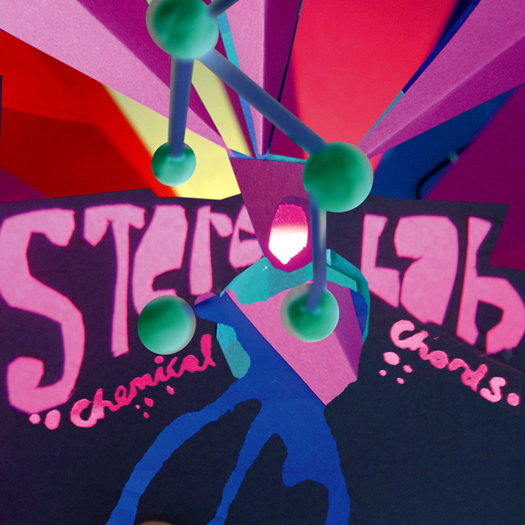
When “Valley Hi!” pops up roughly half way through Chemical Chords, Stereolab’s ninth studio album, the realization sinks in that on just about any new group’s new album the song would be a great achievement, a perfectly constructed pop song, fun, bouncy, a little sly even, with sexy lead vocals, effervescent harmonies, and tight but lush instrumentation. However, wedged into Stereolab’s nearly two-decade-long oeuvre, the song barely stands out, and that’s the problem. The band consistently delivers material like this, to the point that it all kinda sounds the same–a charge that’s been leveled at them by critics and fans alike for a few years now, starting more or less with 1999’s Cobra and Phases Group Play Voltage in the Milky Night, a record that some (maybe many) thought failed to live up to the radical revisionist pop tendencies of 1996’s Emperor Tomato Ketchup (it’s hard to top a perfect album, folks!) or the digital experiments of 1997’s Dots and Loops (my least favorite Stereolab album; sounds like marbles rolling on ice). I happen to like Cobra a lot: it’s warm (and literally fuzzy) and masterfully played–and kinda anonymous, a trend that Stereolab continues with Chemical Chords.

From the outset of the new album, Stereolab establishes a metronomic motortik pop vibe from which they rarely deviate. Opener “Neon Beanbag” flows into first single “Three Women” without much to differentiate the two besides a two second gap and a key change, and the third track, “One Finger Symphony,” only stands out due to its throwaway brevity. It isn’t until Sean O’Hagan’s slinky strings announce the title track that the album grabs onto something new. “Chemical Chords” approaches a ’70s blaxploitation vibe–think Curtis Mayfield or Bobby Womack here–but ends up being (you guessed it) just another Stereolab song, beautifully polished and meticulously executed with little or no risk to band or audience. The next track, “The Ecstatic Static” slides right into the same groove, and it becomes apparent that Stereolab have released yet another perfect ambient soundtrack for any polite social gathering. The rest of the album follows this mode of flawless and ultimately forgettable songwriting.

There are moments of exception, of course, but only moments. The countryfied swagger that initiates the penultimate track, “Daisy Click Clack,” is pretty great, if only for simply hitting a different rhythm and sound, and the song’s lyrics are about making music, which is always cool. It’s on “Pop Molecule (Molecular Pop 1),” where Stereolab employ backmasked drones and triumphant chugging guitars that recall the glory days of tracks like “Crest,” from ’93’s Transient Random-Noise Bursts with Announcements (or anything off of ’92’s dreampop singles collection, Switched On), that the band finally gets its hands a little dirty–with great results. Too bad they only play it out for about two minutes; the old groop would’ve droned those two chords for at least six–the listener doesn’t ever get a chance to get hypnotized.

It seems like I’m bashing the album, but I’m not. I love Stereolab. Really. And Chemical Chords is pretty good — it will hang out in my stereo for a month, maybe two, and then I’ll forget about it. Ultimately, it’s too polished, too precise, and too meticulous to make any long-term impact. We know Stereolab are fantastic arrangers and musicians, and their taste is impeccable, but when bands fail to take risks, the music gets stale.

Chemical Chords is available from 4AD Records in the US on August 19th.

On the Third Beer

I thought this notation, from Toni Morrison’s Song of Solomon, was too beautiful not to share (also, I’ve been too busy to write and appropriating the words of Nobel prize winners seems like an easy alternative to actually, y’know, coming up with original content). Context unimportant:

She was the third beer. Not the first one, which the throat receives with almost tearful gratitude; nor the second, that confirms and extends the pleasure of the first. But the third, the one you drink because it’s there, because it can’t hurt, and because what difference does it make?

The Rough Guide to Conspiracy Theories

There’s something fun-but-not-too-fun about James McConnachie and Robin Tudge’s The Rough Guide to Conspiracy Theories, a lovely little coffee-table encyclopedia that investigates everything from the strange death of playwright Christopher Marlowe to the disputed Apollo 11 moon landings to the sinister happenings at Bohemian Grove to the 9/11 attacks. The book is dubious and skeptical in all the right places, yet never snotty or wholly dismissive of the marginalized ideas it presents. Also, none of the lurid tabloid earnestness that marks the work of lifers like Alex Jones or David Icke can be found here (Icke does get his own five paragraph section, however). For the most part, the 450 or so pages of Conspiracy Theories are evenhanded, concise, and well-researched. A bibliography follows each section, and at the end of the book there’s a “Conspiracy Archive” suggesting books, websites, and films for those who can’t get enough paranoia. Conspiracy Theory devotes a good number of pages to recent events like Hurricane Katrina and the Iraq War, a choice that will perhaps date the book eventually–but of course, by that time we’ll need a new edition to record all the nefarious invisible acts committed by the Bilderberg Group, NWO, Masons, and, uh, reptilian beings posing as European royalty. Good stuff.

The updated U.S. edition of The Rough Guide to Conspiracy Theories is available this fall from Rough Guides.

Abolish No Child Left Behind

I teach at an inner-city school, and I’ve witnessed first hand just how awful NCLB has been: it basically aims to make zombies out of kids. Here’s a personal anecdote that best sums up how NCLB’s rigid testing processes work to attack the fostering of free thought: I was administering an FCAT practice test, and a young lady of about 15 years or so raised her hand for my assistance. Her problem was that the answer box for a short response question was far too small to accommodate her answer (her handwriting was also large). We are teaching kids to literally “think inside the box”; we are also mandating that there is always only “one right” answer to problems, which is plainly false.

Please take a few seconds to sign the online petition to abolish this heinous crime against our young people.

More information–far more salient than my anecdotal ranting–from Stan Karp’s excellent critique of NCLB (via the ANCLB Facebook Group):

Claim: Annual standardized testing is the key to bringing school improvement and accountability to all schools. “For too long,” says the Department of Education, “America’s education system has not been accountable for results, and too many children have been locked in underachieving schools and left behind. … Testing will raise expectations for all students and ensure that no child slips through the cracks.”

Reality: A huge increase in federally mandated testing will not provide the services and strategies our schools and students need to improve. Most states and local districts have dramatically increased the use of standardized tests over the past two decades, but this did not solve the problems of poor schools. Some estimate that the new federal law will require states to give more than 200 additional tests at a cost of more than $7 billion.
Many studies show that standardized testing does not lead to lasting increases in student achievement and may in fact reduce it. Researchers at Arizona State University recently completed the largest study ever done on the issue. They concluded that “rigorous testing that decides whether students graduate, teachers win bonuses and schools are shuttered, an approach already in place in more than half the nation, does little to improve achievement and may actually worsen academic performance and dropout rates.” (New York Times, 12/28/02)

Continue reading “Abolish No Child Left Behind”

“Some Principles of Democracy and Deconstruction—American or Otherwise” by A. S. Kimball

“Some Principles of Democracy and Deconstruction—American or Otherwise” by Sam Kimball.

1. Democracy and deconstruction name the namelessness of a we, the people in relation to this people’s unimaginable possibilities of collective self-identification to come.

2. For this reason democracy and deconstruction locate the we in a future that transcends any possible transcendence of time, and therefore that remains utterly contingent and extinguishable, able to be obliterated in an apocalypse of the name.

3. Democracy and deconstruction attempt to respond to a demand—untraceable to any face or mind, to any consciousness—for absolute justice.

4. To this end, and because “we are all heir, at least, to persons or events marked, in an essential, interior, ineffaceable fashion, by crimes against humanity” (Derrida, Of Cosmopolitanism and Forgiveness, 29), democracy and deconstruction demand of the citizen to come an attitude of radical forgiveness and hospitality.

5. To this same end, and for similar reasons, democracy and deconstruction also entail a radical affirmation—that is, they are ways of saying “Yes?” or “Who’s there?” in the absence of any determinate voicing.

6. This means that democracy and deconstruction respond to a call that comes from an unimaginable and indeterminate future.

7. For all these reasons as well as the fact that “all nation-states are born and found themselves in violence” (Of Cosmopolitanism and Forgiveness, 57), democracy and deconstruction are provisional names for an historically unrealized ideal.

8. Thus, democracy and deconstruction require an incessant work of critique.

9. Democracy and deconstruction are ways of working toward forms of community that must necessarily exceed, transgress, transcend, and therefore remark all political borders, most especially those that define the sovereignty of the nation-state.

10. The spirit of the spirit of democracy and deconstruction has no single emotional marker, cannot be contained within or encompassed by any single emotional apprehension, is not identifiable as an affective state.

11. Democracy and deconstruction are inseparable from the fictionalizing, virtualizing power of literature.

Underworld — Don DeLillo

Don DeLillo’s Underworld explores American culture and psyche throughout–and immediately after–the Cold War era. The book centers loosely on waste management exec Nick Shay, but diverges in constant achronological loops, employing dozens of different voices and viewpoints in order to handle a variety of themes and subjects that are, frankly, too massive to get a grip on. At all times though, Underworld seems aware of this inability to document its subject’s vastness, but, like Ishmael in Moby-Dick who attempts to systemize the unknowable whales, the characters in Underworld nevertheless try and try again to find order and meaning in a paranoid and increasingly disconnected world. The real center of the book is a baseball, the ball pitched by Brooklyn Dodger Ralph Branca to New York Giant Bobby Thomson, who won the game in a hit known as “The Shot Heard ‘Round the World.” However, this ball, this center, is repeatedly transferred, deferred, shifted, and even characters who claim to own the “real” ball understand that the validity or “realness” of the home run ball is always under question. DeLillo seems to suggest that finding fixed, stable meaning is an illusion; the best that people can hope for is to find solace in their family and friends in open, honest relationships.

By the time DeLillo had published Underworld in 1997, he had already established himself as a canonized saint of the American postmodern literary tradition, yet Underworld, in its massive size and scope (it weighs in at over 800 pages) seems primed to be the author’s “big book,” destined to fit neatly in the new canon of large and long American postmodern novels next to John Barth’s The Sot-Weed Factor, Robert Coover’s The Public Burning, Thomas Pynchon’s Gravity’s Rainbow, and David Foster Wallace’s Infinite Jest. Underworld utilizes nearly every postmodernist trope, including a nonlinear plot, myriad, discursive voices, and a willingness to engage historical figures. The novel also manages to contain a bulk of themes and devices DeLillo has employed throughout his body of work: find here the paranoid alienation of The Names, the shadow of assassination-as-spectacle from Libra, the intersection of art, violence, economics, and politics of Mao II, and the exploration of the new American religion, consumerism, that underpinned White Noise.

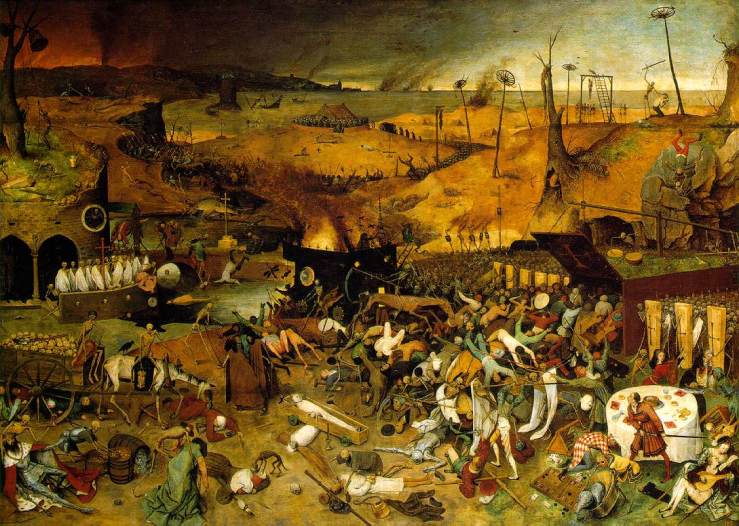
Ultimately, all of Underworld‘s themes–garbage, art, war, insulation, paranoia, drugs, death, secrets, baseball, identity, etc.–threaten to crush the narrative under their sheer weight. Unlike Pynchon, Barth, Coover, and DFW, DeLillo is rarely playful or even fun; most of the humor here serves to alienate rather than connect the reader to the characters. The book is masterfully written, and any number of the little vignettes, like the sad life of the Texas Highway Killer, or the Space-Age compartmentalization of a 1950s suburban family, expertly delineate DeLillo’s handling of concepts and motifs. However, the book’s prologue, “The Triumph of Death” (the title alludes to Bruegel’s painting), an account of the 1951 Dodgers-Giants pennant game is easily the most passionate, intense, and engaging moment of the novel. This assessment isn’t meant to suggest that the remaining 700 pages or so of Underworld aren’t as rewarding, they just aren’t as fun. Underworld is probably a work of genius, and the sum of its many, many parts do add up to more than the corpus, only that sum will probably leave a lot of readers feeling cold.

Great American Heroes

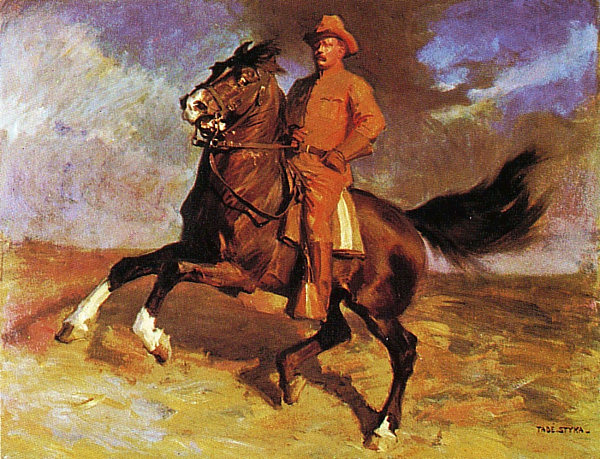
Teddy Roosevelt was the best American president. Just look at this guy. TR: the original rough rider. Painting by Tadé Styka.

Great American Heroes

Biggie Smalls is basically a metaphor for America. This painting is by Kehinde Wiley. We love it.

Great American Heroes

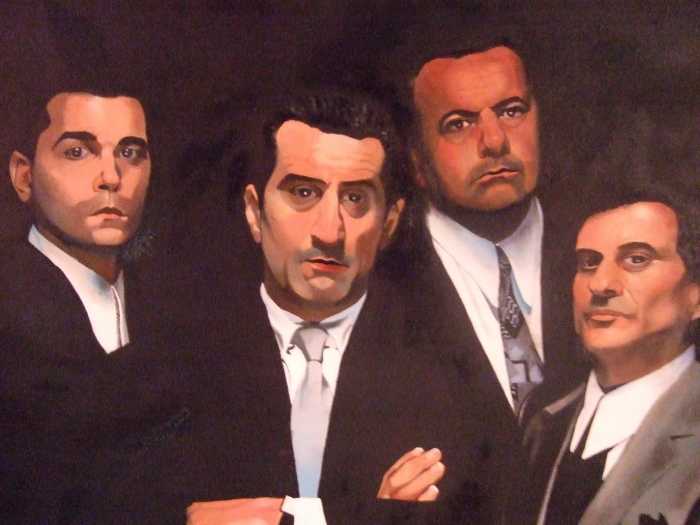
Who is more heroic or more American than Henry Hill, Jimmy Conway, Paulie Cicero, or Tommy DeVito? No
one, that’s who! Also, for that matter, is there anyone more American than Joe Pesci? No way, Jose! Painting by William Parsons.

Great American Heroes

Okay well so, we’re more or less “off” this week, because we love America sooooooooo much that we’re going on vacation. Still, because we are totally American, which is to say totally industrious, and because “the U.S. is the greatest, best country god has ever given man on the face of the Earth,” we’ll be leaving you with a series of fantastic images of great American heroes over the next week, starting with this stunning portrait of Superman himself, Christopher Reeve, by talented painter Adam Brooks. Great stuff.