Suttree — Cormac McCarthy

In his 1992 interview with The New York TimesCormac McCarthy said, “The ugly fact is books are made out of books. The novel depends for its life on the novels that have been written.” McCarthy’s fourth novel, 1979’s Suttree is such a book, a masterful synthesis of the great literature — particularly American literature — that came before it. And like any masterful synthesis, Suttree points to something new, even as it borrows, lifts, and outright steals from the past. But before we plumb its allusions and tropes and patterns, perhaps we should overview the plot, no?

The novel rambles over several years in the life of Cornelius Suttree. It is the early 1950s in Knoxville, Tennessee, and Suttree ekes out a mean existence on the Tennessee River as a fisherman, living in a ramshackle houseboat on the edge of a shantytown. This indigent life is in fact a choice: Suttree is the college-educated son of an established, wealthy family. His choice is a choice for freedom and self-reliance, those virtues we like to think of, in our prejudicial manner, as wholly and intrinsically American. Suttree then is both Emersonian and Huck Finnian, a reflective and insightful man who finds his soul via a claim to agency over his own individuality, an individuality poised in quiet, defiant rebellion against the conforming forces of civilization. These forces manifest most pointedly in the Knoxville police, a brutal, racist organization, but we also see social constraint in the form of familial duty. One thinks of the final lines of Huckleberry Finn: “I reckon I got to light out for the Territory ahead of the rest, because Aunt Sally she’s going to adopt me and sivilize me and I can’t stand it. I been there before.”

Like Huck, Suttree aims to resist all forces that would “sivilize” him. His time on the river and in the low haunts of Tennessee (particularly the vice-ridden borough of McAnally) brings him into close contact with plenty of other outcasts, but also his conscience, which routinely mulls over its place in the world. Suttree is punctuated by–perhaps even organized by–several scenes of hallucination. Some of these psychotrips result from drunkeness, one comes from accidentally ingesting the wrong kind of mushrooms (or, the right kind, if that’s your thing), and the final one, late in the novel, sets in as Suttree suffers from a terrible illness. In his fever dream, a small nun–surely a manifestation of the guilt that would civilize us–accuses him–

Mr. Suttree it is our understanding that at curfew rightly decreed by law in that hour wherein night draws to its proper close and the new day commences and contrary to conduct befitting a person of your station you betook yourself to various low places within the shire of McAnally and there did squander several ensuing years in the company of thieves, derelicts, miscreants, pariahs, poltroons, spalpeens, curmudgeons, clotpolls, murderers, gamblers, bawds, whores, trulls, brigands, topers, tosspots, sots and archsots, lobcocks, smellsmocks, runagates, rakes, and other assorted and felonious debauchees.

The passage is a marvelous example of McCarthy’s stream-of-consciousness technique in Suttree, moving through the various voices that would ventriloquize Suttree, into the edges of madness, strangeness, and the sublimity of language. The tone moves from somber and portentous into bizarre imagery that blends humor and pathos. This is the tone of Suttree, a language that gives voice to transients and miscreants, affirming the dignity of their humanity even as it details the squalor of their circumstance.

It is among these criminals and whores, transvestites and gamblers that Suttree affirms his own freedom and humanity, a process aided by his comic foil, Gene Harrogate. Suttree meets Harrogate on a work farm; the young hillbilly is sent there for screwing watermelons. After his release, Harrogate moves to a shantytown in Knoxville. He’s the country mouse determined to become the city rat, the would-be Tom Sawyer to Suttree’s older and wiser Huck Finn. Through Harrogate’s endless get-rich-quick schemes, McCarthy parodies that most-American of tales, the Horatio Alger story. Simply put, the boy is doomed, on his  “way up to the penitentiary” as Suttree constantly admonishes. In one episode, Harrogate tries to buy arsenic from “a grayhaired and avuncular apothecary” to poison bats he hopes to sell to a hospital (don’t ask)–

May I help you? said the scientist, his hands holding each other.

I need me some strychnine, said Harrogate.

You need some what?

Strychnine. You know what it is dont ye?

Yes, said the chemist.

I need me about a good cupful I reckon.

Are you going to drink it here or take it with you?

Shit fire I aint goin to drink it. It’s poisoner’n hell.

It’s for your grandmother.

No, said Harrogate, craning his neck suspectly. She’s done dead

Suttree, unwilling father-figure, eventually buys the arsenic for the boy against his better judgment. The scene plays out as a wonderful comic inversion of William Faulkner’s “A Rose for Emily,” from which it is so transparently lifted. McCarthy borrows liberally from Faulkner here, of course, most notably in the language and style of the novel, but also in scenes like this one, or a later episode that plays off Faulkner’s comic-romantic story of a man and a woman navigating the aftermath of a flood, “Old Man.” Unpacking the allusions in Suttree surpasses my literary knowledge or skill, but McCarthy is generous, if oblique, with his breadcrumb trail. Take, for example, the following sentence: “Suttree with his miles to go kept his eyes to the ground, maudlin and muttersome in the bitter chill, under the lonely lamplight.” The forced phrase “miles to go” does not immediately present itself as a reference to Robert Frost’s famous poem, yet the direction of the sentence retreats into the history of American poetry; with its dense alliteration and haunted vowels, it leads us into Edgar Allan Poe territory. Only a few dozen pages later, McCarthy boldly begins a chapter with theft: “In just spring the goatman came over the bridge . . .” The reference to e.e. cummings explicitly signifies McCarthy’s intentions to play with literature. Later in the book, while tripping on mushrooms in the mountains, Suttree is haunted by “elves,” the would-be culprits in Frost’s poem “Mending Wall.” The callback is purposeful, but tellingly, McCarthy’s allusions are not nearly as fanciful as their surface rhetoric might suggest: the goatman does not belong in Knoxville–he’s an archaic relic, forced out of town by the police; the elves are not playful spirits but dark manifestations of a tortured psyche.

Once one spots the line-lifting in Suttree it’s hard to not see it. What’s marvelous is McCarthy’s power to convert these lines, these riffs, these stories, into his own tragicomic beast. An early brawl at a roadhouse recalls the “Golden Day” episode of Ralph Ellison’s Invisible Man; a rape victim’s plight echoes Hubert Selby’s “Tralala”; we find the comic hobos of John Steinbeck’s Cannery Row–we even get the road-crossing turtle from The Grapes of Wrath. A later roadhouse chapter replays the “Circe/Nighttown” nightmare in James Joyce’s Ulysses. Ulysses is an easy point of comparison for Suttree, which does for Knoxville what Joyce did for Dublin. Suttree echoes Ulysses’s language, both in its musicality and appropriation of varied voices, as well as its ambulatory structure, its stream-of-consciousness technique, its rude earthiness, and its size (nearly 600 pages). But, as I argued earlier, there’s something uniquely American about Suttree, and its literary appropriations tend to reflect that. Hence, we find Mark Twain, Herman Melville, Ernest Hemingway, Walt Whitman, Emerson and Thoreau, Emily Dickinson, and William Carlos Williams, to name just a few writers whose blood courses through this novel (even elegant F. Scott Fitzgerald is here, in an unexpected Gatsbyish episode late in the novel).

Making a laundry list of writers is weak criticism though, and these sources–all guilty of their own proud plagiarisms–are mentioned only as a means to an end, to an argument that what McCarthy does in Suttree is to synthesize the American literary tradition with grace and humor, while never glossing over its inherent dangers and violence. So, while it appropriates and plays with the tropes of the past, Suttree is still pure McCarthy. Consider the following passage, which arrives at the end of a drunken, awful spree, Suttree locked up for the night–

He closed his eyes. The gray water that dripped from him was rank with caustic. By the side of a dark dream road he’d seen a hawk nailed to a barn door. But what loomed was a flayed man with his brisket tacked open like a cooling beef and his skull peeled, blue and bulbous and palely luminescent, black grots his eyeholes and bloody mouth gaped tonguless. The traveler had seized his fingers in his jaws, but it was not alone this horror that he cried. Beyond the flayed man dimly adumbrate another figure paled, for his surgeons move about the world even as you and I.

Suttree’s dark vision points directly toward the language of McCarthy’s next novel, 1985’s Blood Meridian, roundly considered his masterpiece. Critics who disagree tend to point to Suttree as the pinnacle of McCarthy’s writing. I have no interest at this time in weighing the books against each other, nor do I think that doing so would be especially enlightening. For all of their sameness, they are very different animals: Suttree provides us intense access to its hero’s consciousness, where Blood Meridian always keeps the reader on the outside of its principals’ souls (if those grotesques could be said to have souls). And while Blood Meridian does display some humor, it is the blackest and driest humor I’ve ever read. Suttree is broader and more compassionate; it even has a fart joke. Blood Meridian, at least in my estimation (and many critics will contend this notion) has no flawed episodes; much of this results from the book’s own internal program–it resists love, compassion, and even human dignity. In contrast, Suttree is punctuated by two deaths the audience is meant to read as tragic, yet I found it impossible to do so. The first is the death of Suttree’s child, whom he has abandoned, along with its mother. As such, he is not permitted to take part in the funeral, observing the process rather from its edges. The second tragedy is the death of Suttree’s young lover in a landslide. The book begs us to empathize with Suttree, just as he often empathizes with the marginal figures in the novel, but ultimately these tragedies are a failed ploy. They underwrite a sublime encounter with death for Suttree, an encounter that deepens and enriches his character while paradoxically freeing him from the burdens of social duty and familial order. McCarthy is hardly alone in such a move; indeed, it seems like the signature trope of American masculine literature to me. It’s the move that Huck Finn wishes to make when he promises to light out for the Territory to escape the civilizing body of Aunt Sally; it’s the ending that Hemingway was compelled to give to Frederic Henry at the end of A Farewell to Arms; it’s all of Faulkner, with his mortification of fatherhood and the dramatic responsibility fatherhood entails. It is a cost analysis that neglects any potential benefits.

But these are small criticisms of a large, beautiful, benevolent novel, a book that begs to be reread, a rambling picaresque of comic and tragic proportions. “I learned that there is one Suttree and one Suttree only,” our hero realizes, but this epiphany is set against a larger claim. Near the end of the novel, Suttree goes to check on an old ragman who he keeps a watchful eye on. He finds the man dead, his shack robbed, his body looted. Despairing over the spectacle’s abject lack of humanity, Suttree cries, “You have no right to represent people this way,” for “A man is all men. You have no right to your wretchedness.” Here, Suttree’s painful epiphany is real and true, an Emersonian insight coded in the darkest of Whitman’s language. If there is one Suttree and one Suttree only, he is still beholden to all men; to be anti-social or an outcast is not to be anti-human. Self-hood is ultimately conditional on others and otherness. To experience the other’s wretchedness is harrowing; to understand the other’s wretchedness and thus convert it to dignity is life-affirming and glorious. Suttree is a brilliant, bold, marvelous book. Very highly recommended.
Russell Hoban on What Inspired Riddley Walker

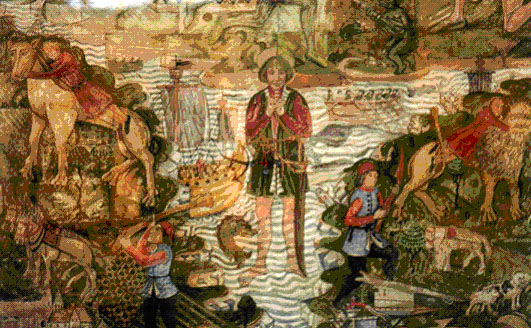
At The Guardian, Russell Hoban writes about how a viewing of The Legend of St. Eustace at Canterbury Cathedral inspired his post-apocalyptic classic Riddley Walker. The anecdote will be familiar to anyone who’s reread the introduction to Riddley Walker, but Hoban’s essay still interesting. From his essay–

The first time I stood in Canterbury Cathedral and tilted my head back to look up, up, up to that numinous fan-vaulting I felt the uprush past me of all the centuries of prayer, of hope and fear and yearning, yearning for answers and, if possible, salvation.

Breathing in this atmosphere I made my way through the nave to those stone steps trodden by successive waves of pilgrims, some with beads, some with cameras. Up those worn- down steps, past the place where the remembered blood of Thomas Becket seethes on the stones, to the north aisle where on one wall remains the faint earth-green tracery ofThe Legend of St Eustace. Facing it on the opposite wall is Professor Tristram’s reconstruction of the 15th-century painting.

Whatever talent I have for writing lies in being friends with my head: I know its vagaries, its twists and turns, its hobo journeys in fast freights, riding the blinds to unknown destinations. Sometimes I get thrown off the train in the middle of nowhere; sometimes I get to the Big Rock Candy Mountain. If you Google for Eustace you’ll find that he has no official standing among the beatified. Perhaps his legend turned up on the back of some Middle-Ages cornflakes box and grew from there. Being thus non-factual, Eustace is quite at home in a work of fiction. According to the legend he was a general in the Roman army to begin with, but one day hunting in the forest, he saw a little crucified Jesus between the antlers of a stag, as vividly shown in the 15th-century painting by Pisanello.


“A Gentleman’s C” — Padgett Powell

“A Gentleman’s C,” a very short story by Padgett Powell

My father, trying to finally graduate from college at sixty-two, came, by curious circumstance, to be enrolled in an English class I taught, and I was, perhaps, a bit tougher on him than I was on the others. Hadn’t he been tougher on me than on other people’s kids growing up? I gave him a hard, honest, low C. About what I felt he’d always given me.

We had a death in the family, and my mother and I traveled to the funeral. My father stayed put to complete his exams–it was his final term. On the way home we learned that he had received his grades, which were low enough in the aggregate to prevent him from graduating, and reading this news on the dowdy sofa inside the front door, he leaned over as if to rest and had a heart attack and died.

For years I had thought that the old man’s passing away would not affect me, but it did.

(From Micro Fiction, edited by Jerome Stern).

Read the Complete Transcript of a 1998 David Foster Wallace Interview

Tom Scocca interviewed David Foster Wallace in 1998. A short version of the interview ran in The Boston Phoenix in February of ’98; Slate published a transcript the entire interview this week. It begins with phones and beards–

Q: For basic reader orientation here, are you doing this from Bloomington?

DFW: Speaking to you? Yes, sir.

Q: What sort of phone?

DFW: What sort of phone? What kind of phone is this? This is a Panasonic Easa-Phone. E-A-S-A, hyphen, P-H-O-N-E. And I don’t see a model number on it. It’s got a little answering machine attached, although the answering machine doesn’t work as often as the average consumer probably would like it to.

Q: OK. Let’s see.

DFW: You’re really going to orient that reader, aren’t you?

Q: Yeah. You have to bring the color in somehow.

DFW: Uh-huh.

Q: Any particular configuration of beard or bandana or glasses? It seems to change over time.

DFW: So what, we’re going to pretend, we’re going to pretend that we’re sitting in the same room?

Q: No.

DFW: I’ve never had a beard. I’ve tried periodically to grow a beard, and when it resembles, you know, the armpit of a 15-year-old girl who hasn’t shaved her armpit, I shave it off. I do not have a head hanky on at this point, although I did recently, ’cause I just got back from running my dogs around the countryside.

There Will Be Blood — The Video Game

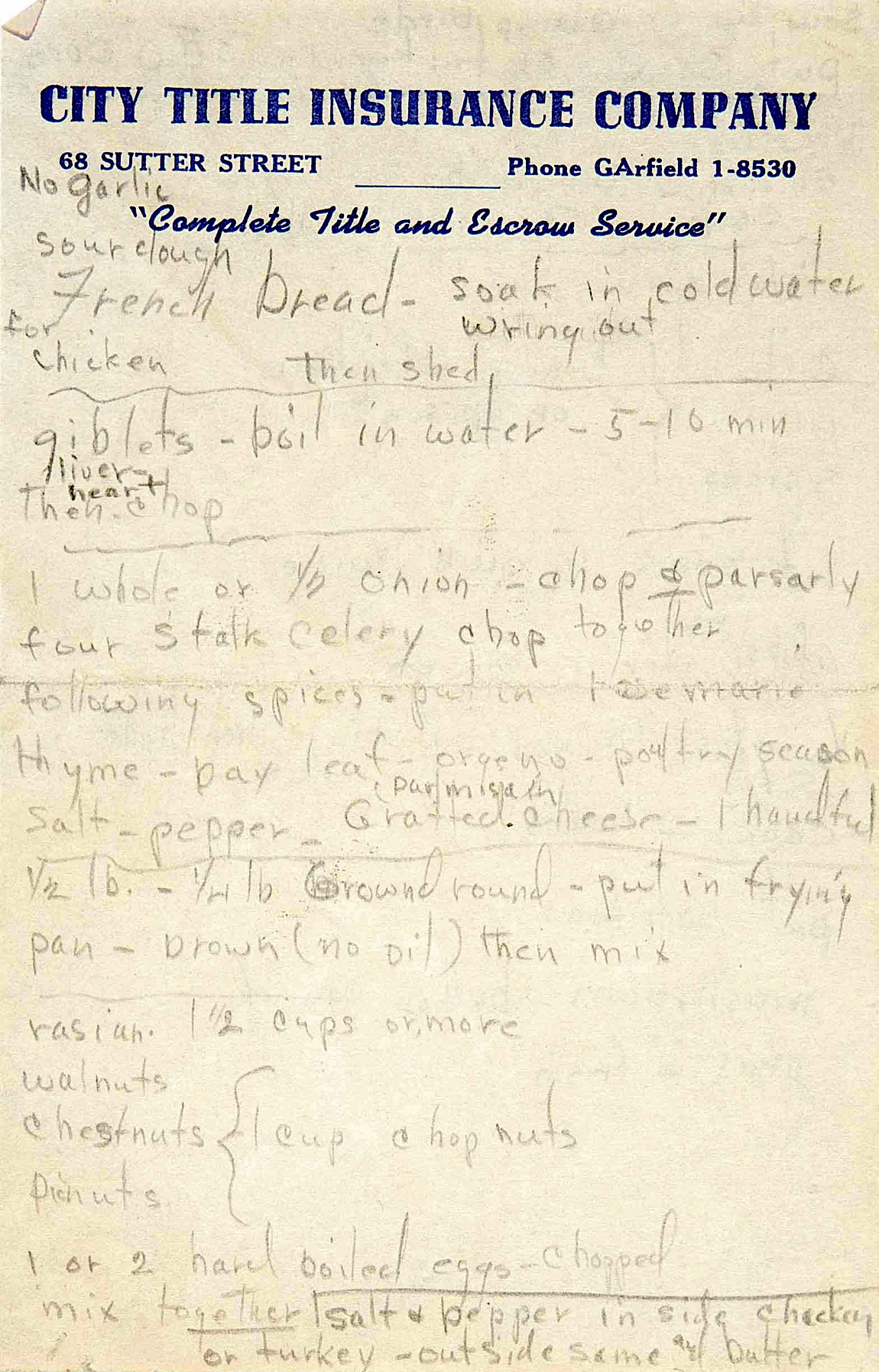
Maryilyn Monroe’s Recipe for Stuffing

Yes, that’s her handwriting. (Via).

Enjoy Thanksgiving with Our Literary Recipes Roundup

Happy Thanksgiving!

Enjoy Turkey Day (sans turkey) with Biblioklept’s menu of literary recipes:

Zora Neale Hurston’s Mulatto Rice

Ian McEwan’s Fish Stew

James Joyce’s Burnt Kidney Breakfast

Herman Melville’s Whale Steaks

Ernest Heminway’s Absinthe Cocktail, Death in the Afternoon

Vladimir Nabokov’s Eggs à la Nabocoque

Thomas Pynchon’s Banana Breakfast

Cormac McCarthy’s Turtle Soup

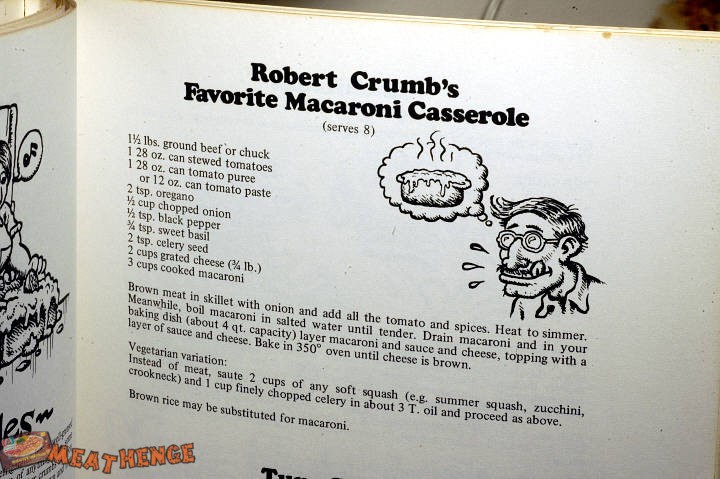
Robert Crumb’s Macaroni Casserole


“A Thanksgiving Prayer” — William S. Burroughs

Robert Crumb’s Favorite Macaroni Casserole

(Via).

Cormac McCarthy’s Turtle Soup

In Cormac McCarthy’s novel Suttree, an Indian named Michael prepares a turtle soup for Suttree. First, catch the turtle. Then, kill the turtle, making sure to discard its head–

The Indian braced his feet and swung it up dripping from the river and onto the rocks and it squatted there watching them, its baleful pig’s eyes blinking. It was tied through the lower jaw with a section of wire and the Indian took hold of the wire and tugged at it. The turtle bated and hissed, its jaws gasped. The Indian had out his pocketknife and now he opened it and he pulled the turtle’s obscene neck out taut and with a quick upward motion of the blade severed the head. Suttree involuntarily drew back. The turtle’s craggy head swung from the wire and what lay between the braced forefeet was a black and wrinkled dog’s cunt slowly pumping gouts of near black blood. The blood ran down over the stones and dripped in the water and the turtle shifted slowly on the rock and started toward the river. The Indian undid the wire and flung the head into the river . .  .

Appetizing, no? Now that you’ve thrown the bloody head in the river (or your garbage can or wherever you throw turtle heads), it’s time to dress the beast–

Suttree laid the turtle on the rock and the Indian scouted about him until he came up with a goodsized stone.

Watch out, he said.

Suttree stepped back.

The Indian raised the stone and brought it down upon the turtle’s back. The shell collapsed with a pulpy buckling sound.

I never saw a turtle dressed before, said Suttree. But the Indian had knelt and was cutting away the broken plates of shell with his pocketknife and pitching them into the river. He pulled the turtle’s meat up off the plastron and gouged away the scant bowels with his thumb. He skinned out the feet. What hung headless in his grip as he raised it aloft was a wet gray foetal mass, a dim atavism limp and dripping.

Plenty of meat there, said the Indian. He laid it out on the rock and bent and swished the blade of his knife in the river.

Okay. Now that you’ve removed the shell and gouged away the scant bowels with your thumbs, it’s time to prepare the wet gray foetal mass.

Put him in a pot and cook him slow. Lots of vegetables. Lots of onions. I got my own things I put in.

Got it? Lots of onions. Slow cook that dim, limp, dripping atavism. The fact that the Indian has his “own things” that he puts in implies a call to the reader to experiment with the recipe. And how did Suttree like his turtle?

He spooned up a piece of the meat and cradled it in his mouth to cool it. He chewed it. It was succulent and rich, a flavor like no other.

Thomas Pynchon’s Banana Breakfast

At the beginning of Thomas Pynchon’s massive tome Gravitys Rainbow, Captain Geoffrey “Pirate” Prentice cooks up a bodacious banana breakfast for a bunch of hung over army officers—

Routine: plug in American blending machine won from some Yank last summer, some poker game, table stakes, B.O.Q. somewhere in the north, never remember now….Chop several bananas into pieces. Make coffee in urn. Get can of milk from cooler. Puree ‘nanas in milk. Lovely. I would coat all the booze-corroded stomachs of England. . . . Bit of marge, still smells all right, melt in the skillet. Peel more bananas, slice lengthwise. Marge sizzling, in go long slices. Light oven whoomp blow us all up someday oh, ha, ha, yes. Peeled whole bananas to go on broiler grill soon as it heats. Find marshmallows. . . .

Here’s how it all turns out–

With a clattering of chairs, upended shell cases, benches, and ottomans, Pirate’s mob gather at the shores of the great refectory table, a southern island well across a tropic or two from chill Corydon Throsp’s mediaeval fantasies, crowded now over the swirling dark grain of its walnut uplands with banana omelets, banana sandwiches, banana casseroles, mashed bananas molded into the shape of a British lion rampant, blended with eggs into batter for French toast, squeezed out a pastry nozzle across the quivering creamy reaches of a banana blancmange to spell out the words C’est magnifique, mais ce n’est pas la guerre (attributed to a French observer during the Charge of the Light Brigade) which Pirate has appropriated as his motto . . . tall cruets of pale banana syrup to pour oozing over banana waffles, a giant glazed crock where diced bananas have been fermenting since the summer with wild honey and muscat raisins, up out of which, this winter morning, one now dips foam mugsfull of banana mead . . . banana croissants and banana kreplach, and banana oatmeal and banana jam and banana bread, and bananas flamed in ancient brandy Pirate brought back last year from a cellar in the Pyrenees also containing a clandestine radio transmitter. . . .

Vladimir Nabokov’s Recipe for Eggs à la Nabocoque

Vladimir Nabokov’s recipe for eggs à la Nabocoque —

Boil water in a saucepan (bubbles mean it is boiling!). Take two eggs (for one person) out of the refrigerator. Hold them under the hot tap water to make them ready for what awaits them.

Place each in a pan, one after the other, and let them slip soundlessly into the (boiling) water. Consult your wristwatch. Stand over them with a spoon preventing them (they are apt to roll) from knocking against the damned side of the pan.

If, however, an egg cracks in the water (now bubbling like mad) and starts to disgorge a cloud of white stuff like a medium in an oldfashioned seance, fish it out and throw it away. Take another and be more careful.

After 200 seconds have passed, or, say, 240 (taking interruptions into account), start scooping the eggs out. Place them, round end up, in two egg cups. With a small spoon tap-tap in a circle and hen pry open the lid of the shell. Have some salt and buttered bread (white) ready. Eat.

V.N.
November 18, 1972

What Kind of Songs Did Johnny Cash Love?

“I love songs about horses, railroads, land, judgment day, family, hard times, whiskey, courtship, marriage, adultery, separation, murder, war, prison, rambling, damnation, home, salvation, death, pride, humor, piety, rebellion, patriotism, larceny, determination, tragedy, rowdiness, heartbreak and love. And Mother and God.”

From the liner notes to American Recordings. I read the quote here.

Ernest Hemingway’s Death in the Afternoon (the Cocktail, Not the Book)

Ernest Hemingway is famous for writing classic novels like For Whom the Bell Tolls, The Old Man and The Sea, and The Sun Also Rises. Apparently, he also liked to imbibe the occasional alcoholic beverage.

A recipe for a drink named after Hemingway’s novel Death in the Afternoon was published in the 1935 cocktail book So Red the Nose, or Breath in the Afternoon by Sterling North and Carl Kroch. Here’s that recipe–

Add one jigger of absinthe to a champagne flute
Add iced champagne until it attains the proper opalescence.
A small amount of sugar or Gomme syrup can be added to round it out, especially when using a verte absinthe.

Here’s Hemingway’s note on the drink’s origin–

This was arrived at by the author and three officers of the H.M.S. Danae after having spent seven hours overboard trying to get Capt. Bra Saunders’ fishing boat off a bank where she had gone with us in a N.W. gale.


Herman Melville’s Whale Steaks

In Chapter LXIV of Herman Melville’s Moby-Dick, Stubb, second mate of the Pequod, demands whale steaks for dinner. He’s not happy with how the cook has prepared the steaks though, complaining they are too tender and overdone — his taste is closer to the sharks who are making a racket outside the ship–

“Cook,” said Stubb, rapidly lifting a rather reddish morsel to his mouth, ” don’t you think this steak is rather overdone? You’ve been beating this steak too much, cook; it’s too tender. Don’t I always say that to be good, a whalesteak must be tough? There are those sharks now over the side, don’t you see they prefer it tough and rare? What a shindy they are kicking up! Cook, go and talk to ’em; tell ’em they are welcome to help themselves civilly, and in moderation, but they must keep quiet. Blast me, if I can hear my own voice. Away, cook, and deliver my message. Here, take this lantern,” snatching one from his sideboard; ” now, then, go and preach to ’em! “

Stubb then instructs the cook on the best way to prepare whale steaks, a process involving a hot live coal. Oh, and he likes his fins pickled and his flukes soused–

“Well then, cook, you see this whale-steak of yours was so very bad, that I have put it out of sight as soon as possible; you see that, don’t you? Well, for the future, when you cook another whale-steak for my private table here, the capstan, I’ll tell you what to do so as not to spoil it by overdoing. Hold the steak in one hand, and show a live coal to it with the other; that done, dish it; d’ye hear? And now to-morrow, cook, when we are cutting in the fish, be sure you stand by to get the tips of his fins; have them put in pickle. As for the ends of the flukes, have them soused, cook. There, now ye may go.”

James Joyce’s Burnt Kidney Breakfast

Leopold Bloom, hero of James Joyce’s Ulysses likes kidneys for breakfast. In fact–

Mr Leopold Bloom ate with relish the inner organs of beasts and fowls. He liked thick giblet soup, nutty gizzards, a stuffed roast heart, liverslices fried with crustcrumbs, fried hencods’ roes. Most of all he liked grilled mutton kidneys which gave to his palate a fine tang of faintly scented urine.

Okay, so there’s not much to this recipe. First, you’ve gotta buy the kidney–

A kidney oozed bloodgouts on the willowpatterned dish: the last. He stood by the nextdoor girl at the counter. Would she buy it too, calling the items from a slip in her hand? Chapped: washingsoda. And a pound and a half of Denny’s sausages.

Then you cook it with some butter in a frying pan (don’t forget to share with the cat, and don’t forget the pepper)–

While he unwrapped the kidney the cat mewed hungrily against him. Give her too much meat she won’t mouse. Say they won’t eat pork. Kosher. Here. He let the bloodsmeared paper fall to her and dropped the kidney amid the sizzling butter sauce. Pepper. He sprinkled it through his fingers ringwise from the chipped eggcup.

Then take your lazy adulterous wife her breakfast that you’ve lovingly prepared for her (she’ll need her strength for later). Oh, and don’t forget about the kidney that’s still cooking for you (unless you’re making some kind of subconscious symbolic burnt offering or something)–

—There’s a smell of burn, she said. Did you leave anything on the fire?

—The kidney! he cried suddenly.

He fitted the book roughly into his inner pocket and, stubbing his toes against the broken commode, hurried out towards the smell, stepping hastily down the stairs with a flurried stork’s legs. Pungent smoke shot up in an angry jet from a side of the pan. By prodding a prong of the fork under the kidney he detached it and turned it turtle on its back. Only a little burnt. He tossed it off the pan on to a plate and let the scanty brown gravy trickle over it.

Enjoy with gravy, toast, and a cup of tea–

Cup of tea now. He sat down, cut and buttered a slice of the loaf. He shore away the burnt flesh and flung it to the cat. Then he put a forkful into his mouth, chewing with discernment the toothsome pliant meat. Done to a turn. A mouthful of tea. Then he cut away dies of bread, sopped one in the gravy and put it in his mouth. What was that about some young student and a picnic? He creased out the letter at his side, reading it slowly as he chewed, sopping another die of bread in the gravy and raising it to his mouth.

He sopped other dies of bread in the gravy and ate piece after piece of kidney.

Ian McEwan’s Fish Stew

Here’s another entry in our Thanksgiving series of literary recipes–a recipe for fish stew, adapted from Ian McEwan’s novel Saturday. The recipe is Henry Perowne’s, the novel’s protagonist who makes it for dinner on the titular day. The adaptation below comes from journalist Damian Barr, who wrote an excellent article about recipes in literature for The Times.

Into a stockpot of boiling water (a litre or more), put the bones of three skates (or other boned fish), with heads intact. If you have no obliging local fishmonger, use a pound or more of white fish.

Add a dozen or so mussels to the stock. Simmer for 25 minutes.

Meanwhile, strip and chop three onions and eight fat cloves of garlic. Soften over a low heat in a casserole with a lot of olive oil. When they have melted sufficiently, add: a couple of crushed red chillies, a pinch of saffron, some bay leaves, orange-peel gratings, oregano, five anchovy fillets, two cans of peeled tomatoes

When these have blended together in the heat, add a quarter bottle of white wine. Then strain off the stock and add to the casserole. Simmer the mix for 20 minutes.

Rinse and/or scrub the clams and remaining mussels and place in a bowl.

Cut the monkfish tails into chunks and place in a separate bowl.

Wash the tiger prawns and add to the monkfish bowl. Keep both bowls refrigerated until ready to cook. Just before dinner, reheat the casserole.

Simmer the clams, monkfish, mussels and prawns in the casserole for ten minutes.

Eat the stew with brown bread, or garlic bread, salad and a hearty red wine.