In the past few years we’ve seen a spate of books where public domain characters and historical figures feature in supernatural tales, usually written in an ironic, or at least parodic mode. It seems like a heavy percentage of these books are mixed up somehow with Jane Austen, whose legacy has become grist for a literary cottage industry, with a new “re-imagining” of Pride and Prejudice or Sense and Sensibility coming out every season. Last year, Michael Thomas Ford offered the public the mix of Jane Austen and vampires we had been so desperately clamoring for, Jane Bites Back. By way of a little more context (and pure laziness), I’ll quote Biblioklept’s review of Ford’s novel–
Jane Bites Back reveres its subject, Jane Austen, even as it blatantly cashes in on the very trend that it satirizes. The book’s program shouldn’t be confused with the absurdity behind Sense and Sensibility and Seamonsters (which we liked) or the wackiness of Pride and Prejudice and Zombies (which we didn’t like), but it does adhere to the same sense of fun. Ford seems to delight in corny, over the top passages, and we’ll take it for granted that his literary tongue is in his cheek . . .
Ford’s inevitable sequel Jane Goes Batty arrives this month, and showcases a willingness to take vamp-camp into new directions. Plot: big time Hollywood folks are out to “sex up” Jane’s latest manuscript; Jane’s editor decides to become an agent and leaves her with Jessica Abernathy (evil nemesis in Batty); Jane has to run constant interference on her wacky/charming friend Lord Byron (also a vampire, of course); etc., etc., etc. The most ridiculous/campiest plot device of all though is that Jane is converting to Judaism to please her boyfriend Walter’s judgmental mom. Yes. That’s right. We also learn that Jane played Magenta in a traveling production of The Rocky Horror Picture Show in the seventies, a minor detail to be sure, but one that seems to reinforce Ford’s whimsical kitsch. Batty aims for a kind of sassy brevity in its scene constructions, and while its certainly not a book for me, I think that those who want to see Jane Austen as a 21st century vampire will probably enjoy it quite a bit. Jane Goes Batty is new in trade paperback from Ballantine.
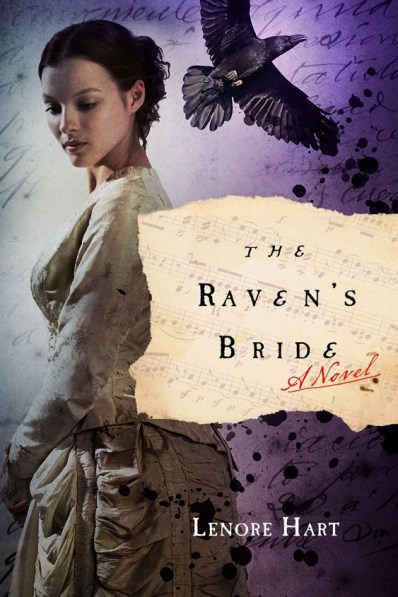
Lenore Hart’s novel The Raven’s Bride tells the story of the marriage of Edgar Allan Poe from the viewpoint of his child-bride/cousin Virginia “Sissy” Clemm. The decidedly tragic arc of their union is set against a supernatural backdrop — and an often morose tone. While The Raven’s Bride takes liberties with history, it seems well-researched and faithful enough to its subject. Compared to Ford’s campy take on the supernatural, Hart’s novel seems a bit too self-serious, but again, I’m hardly the audience for this book. Still, I suppose the tale of an alcoholic horror writer’s incestuous/underage marriage might have been easy fodder to exploit, yet Hart focuses a keen sensitivity on her characters, particularly her narrator Sissy, Poe’s muse demystified. While Poe buffs will know how the story turns out, those interested in reviewing Poe’s marriage through a new perspective may want to check out The Raven’s Bride, new in trade paperback from St. Martin’s Griffin.
“The Moving Waters of Gustav Klimt,” a poem by Lawrence Ferlinghetti —
Who are they then
these women in this painting
seen so deeply long ago
Models he slept with
or lovers or others
he came upon
catching them as they were
back then
dreamt sleepers
on moving waters
eyes wide open
purple hair streaming
over alabaster bodies
in lavender currents
Dark skein of hair blown back
from a darkened face
an arm flung out
a mouth half open
a hand
cupping its own breast
rapt dreamers
or stoned realists
drifting motionless
lost sisters or
women-in-love
with themselves or others –
pale bodies wrapt
in the night of women
lapt in light
in ground swells of
dreamt desire
dreamt delight
Still strangers to us
yet not
strangers
in that first night
in which we lose ourselves
Another passage from Ulysses, this one from “Ithaca”–
Were they indefinitely inactive?
At Stephen’s suggestion, at Bloom’s instigation both, first Stephen, then Bloom, in penumbra urinated, their sides contiguous, their organs of micturition reciprocally rendered invisible by manual circumposition, their gazes, first Bloom’s, then Stephen’s, elevated to the projected luminous and semiluminous shadow.
Similarly?
The trajectories of their, first sequent, then simultaneous, urinations were dissimilar: Bloom’s longer, less irruent, in the incomplete form of the bifurcated penultimate alphabetical letter, who in his ultimate year at High School (1880) had been capable of attaining the point of greatest altitude against the whole concurrent strength of the institution, 210 scholars: Stephen’s higher, more sibilant, who in the ultimate hours of the previous day had augmented by diuretic consumption an insistent vesical pressure.
What different problems presented themselves to each concerning the invisible audible collateral organ of the other?
To Bloom: the problems of irritability, tumescence, rigidity, reactivity, dimension, sanitariness, pilosity.
To Stephen: the problem of the sacerdotal integrity of Jesus circumcised (I January, holiday of obligation to hear mass and abstain from unnecessary servile work) and the problem as to whether the divine prepuce, the carnal bridal ring of the holy Roman catholic apostolic church, conserved in Calcata, were deserving of simple hyperduly or of the fourth degree of latria accorded to the abscission of such divine excrescences as hair and toenails.
“Defending Walt Whitman,” a poem by Sherman Alexie—
Basketball is like this for young Indian boys, all arms and legs
and serious stomach muscles. Every body is brown!
These are the twentieth-century warriors who will never kill,
although a few sat quietly in the deserts of Kuwait,
waiting for orders to do something, to do something.
God, there is nothing as beautiful as a jumpshot
on a reservation summer basketball court
where the ball is moist with sweat,
and makes a sound when it swishes through the net
that causes Walt Whitman to weep because it is so perfect.
A passage from “Circe,” my favorite chapter of Ulysses–
BLOOM: Shoot him! Dog of a christian! So much for M’Intosh!
(A cannonshot. The man in the macintosh disappears. Bloom with his sceptre strikes down poppies. The instantaneous deaths of many powerful enemies, graziers, members of parliament, members of standing committees, are reported. Bloom’s bodyguard distribute Maundy money, commemoration medals, loaves and fishes, temperance badges, expensive Henry Clay cigars, free cowbones for soup, rubber preservatives in sealed envelopes tied with gold thread, butter scotch, pineapple rock, billets doux in the form of cocked hats, readymade suits, porringers of toad in the hole, bottles of Jeyes’ Fluid, purchase stamps, 40 days’ indulgences, spurious coins, dairyfed pork sausages, theatre passes, season tickets available for all tramlines, coupons of the royal and privileged Hungarian lottery, penny dinner counters, cheap reprints of the World’s Twelve Worst Books: Froggy And Fritz (politic), Care of the Baby (infantilic), 50 Meals for 7/6 (culinic), Was Jesus a Sun Myth? (historic), Expel that Pain (medic), Infant’s Compendium of the Universe (cosmic), Let’s All Chortle (hilaric), Canvasser’s Vade Mecum (journalic), Loveletters of Mother Assistant (erotic), Who’s Who in Space (astric), Songs that Reached Our Heart (melodic), Pennywise’s Way to Wealth (parsimonic). A general rush and scramble. Women press forward to touch the hem of Bloom’s robe. The Lady Gwendolen Dubedat bursts through the throng, leaps on his horse and kisses him on both cheeks amid great acclamation. A magnesium flashlight photograph is taken. Babes and sucklings are held up.)
THE WOMEN: Little father! Little father!
THE BABES AND SUCKLINGS:
Clap clap hands till Poldy comes home,
Cakes in his pocket for Leo alone.
(Bloom, bending down, pokes Baby Boardman gently in the stomach.)
BABY BOARDMAN: (Hiccups, curdled milk flowing from his mouth) Hajajaja.
BLOOM: (Shaking hands with a blind stripling) My more than Brother! (Placing his arms round the shoulders of an old couple) Dear old friends! (He plays pussy fourcorners with ragged boys and girls) Peep! Bopeep! (He wheels twins in a perambulator) Ticktacktwo wouldyousetashoe? (He performs juggler’s tricks, draws red, orange, yellow, green, blue, indigo and violet silk handkerchiefs from his mouth) Roygbiv. 32 feet per second. (He consoles a widow) Absence makes the heart grow younger. (He dances the Highland fling with grotesque antics) Leg it, ye devils! (He kisses the bedsores of a palsied veteran) Honourable wounds! (He trips up a fit policeman) U. p: up. U. p: up. (He whispers in the ear of a blushing waitress and laughs kindly) Ah, naughty, naughty! (He eats a raw turnip offered him by Maurice Butterly, farmer) Fine! Splendid! (He refuses to accept three shillings offered him by Joseph Hynes, journalist) My dear fellow, not at all! (He gives his coat to a beggar) Please accept. (He takes part in a stomach race with elderly male and female cripples) Come on, boys! Wriggle it, girls!
Frank Delaney’s new novel The Matchmaker of Kenmare is set against the dramatic backdrop of Europe in 1943. Its narrator is Ben McCarthy (returning from Delaney’s previous novel Venetia Kelly’s Traveling Show), who lets the story unfold in the style of a memoir. Ben’s wife Venetia Kelly has mysteriously disappeared. To assuage his anxiety, Ben begins collecting folklore Irish folklore as part of a government project. In the process, he comes into contact with the titular matchmaker, Kate Begley. The two soon form a close bond, and Kate does everything in her power to aid the grieving narrator. The plot turns when a U.S. intelligence officer named Charles Miller enters the picture. He strikes up a romance with Kate, but their relationship is tested when he asks her — and Ben — to use their country’s neutral status to travel through enemy territory in order to find a man the American’s need before D-Day. Their mission soon turns to finding the man Kate believes she loves, a plot doubled in Ben’s search for his wife Venetia. The Matchmaker of Kenmare, new in hardback from Random House, will appeal to those who enjoy sweeping, richly detailed historical romances with a literary bent.
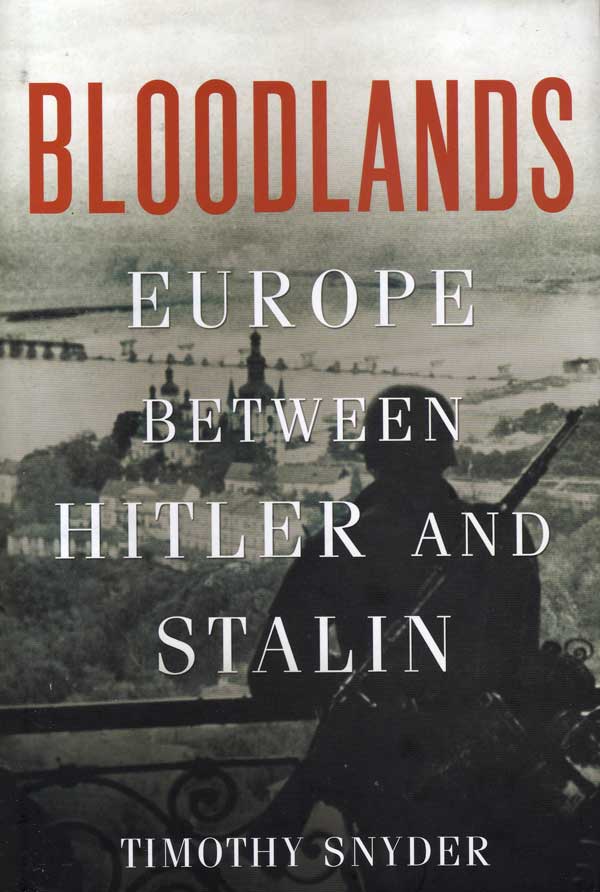
Timothy Snyder’s monumental new history Bloodlands is a staggering work of scholarship. Using primary sources written in at least ten languages, Snyder documents the nightmarish history of that portion of eastern Europe that stretches from Poland north to St. Petersburg and sweeps southwest to the point where Ukraine runs into the Black Sea. In these places, the titular bloodlands, the policies of Adolf Hitler and Josef Stalin converged to kill approximately 14 million people in less than a quarter of a century. Snyder postulates that the eradication of such large numbers of human beings was possible because National Socialism was the perfect foil to Soviet Communism, and vice versa, and because each system allowed totalitarian one-party states to deflect blame for their respective failings onto the other, or onto large groups of relatively powerless national, ethnic, or religious minorities. Rectifying problems required starving, shooting, gassing, or otherwise disappearing hundreds of thousands of the people who inhabited these regions and who had no intention or ability to subvert whichever ruling regime claimed them as subjects at any particular moment. The particular atrocities committed in these areas were largely overlooked in the West at the close of World War II as these victims and their memories disappeared behind the Iron Curtain.
The book begins not in 1941 when Hitler invaded the Soviet Union but a decade earlier. After Lenin’s death, Josef Stalin found himself at the head of the Soviet Union’s security forces as well its sole ruling party. When he recognized that revolutions were not about to sweep over the rest of capitalist Europe, Stalin prioritized ensuring that the U.S.S.R. remained a strong Communist nation and a beacon of hope to committed Marxists across the world. Despite the Communist ethos that capitalist excess would be negated by exploited industrial workers in urban environments, the Bolshevik Revolution had taken place in one of Europe’s most diverse and rural populations. When Stalin took it upon himself to collectivize Soviet agriculture, disaster struck in the Ukraine and Bloodlands’ long and nuanced chronicle of paranoia and death properly begins.
The famine in the Soviet Union’s most fertile land, the Ukraine, caused at least 3 million people to starve in the early part of the 1930s. After the seed needed to plant next year’s crop was requisitioned for the collective, nothing remained to eat and there was no future to look forward to, either. People died where they fell, women prostituted themselves for bread, parents gave their children away to strangers, and villages ceased to exist. Fires in chimneys marked the presence of cannibals. Snyder writes–
In the cities carts would make rounds early in the mornings to remove the peasant dead of the night before. In the countryside the healthier peasants formed brigades to collect the corpses and bury them. They rarely had the inclination or the strength to dig graves very deeply, so that hands and feet could be seen above the earth.
In order to ensure their own corporeal and political survival, the Soviet leadership responsible for collecting the harvest had to steal whatever they could from the hungry.
And so it continued. Hitler rose to power partially on the basis of his powerful condemnation of the popular German Communist parties, and used the famine in the U.S.S.R. to bolster arguments that doomed the opposition to his left and center. Although Stalin argued that all the excesses of capitalism could be seen in the racist and nationalistic rhetoric spewing from the Nazis, these two nations signed a non-aggression pact and started the war in 1939 when they jointly invaded Poland. The Soviet reign of terror commenced and the secret police killed and deported hundreds of thousands of class enemies and nationalists in Poland, Ukraine and the Baltic states. The Germans and the Soviets began to move Poles out of their homes. The Germans designed policies meant to kill educated Poles in order to create a population amenable to slavery. The Soviets killed Polish military officers who were capable of leading uprisings against their new rulers. Both nations instituted their first policies of mass shootings contemporaneously.
When Hitler disregarded the treaty and invaded the Soviet Union (which now included the portions of Poland both nations had agreed to share), already vulnerable populations were decimated. Nazism required that a superior race must take what it needed without regard to rule of law or human empathy. Advancing German forces who came upon obvious signs of recent brutality by the retreating secret police forces of the U.S.S.R. and the Red Army saw “a confirmation of what that had been trained to see: Soviet criminality, supposedly steered by and for the benefit of Jews.” Hundreds of thousands of Soviet prisoners of war were condemned to die of starvation and exposure in makeshift camps. Heinrich Himmler and Hermann Göring implemented a Hunger Plan, which, although unsuccessful, aimed to “transform eastern Europe into an exterminatory agrarian colony” by purposefully starving its inhabitants or deporting them to Siberia. The German plan to achieve victory in Leningrad involved cutting off food supplies to the city’s 3.5 million inhabitants and covering all possible escape routes with landmines which would eliminate potential evacuees. Even before the German security forces began purposefully destroying Jewish populations, a culture of cruelty and privation had been foisted upon innocent civilian populations.
The Jewish populations of cities and regions that had housed their families and their cultures for centuries were then systematically and brutally annihilated. Snyder argues that Western minds have processed the Holocaust in a certain manner because in our history, the accounts of the soldiers who liberated camps in conquered lands to the south and west of the Reich predominate. We have been privileged to hear the stories of survivors from the camps at Auschwitz like Primo Levy and Elie Wiesel, but Snyder points out that the labor and death camps at Auschwitz did not come on-line until near the end of the war and most of those sentenced to labor or die there were brought from German holdings in western Europe. Bloodlands is important because it documents that most of the horrors of the Holocaust were committed in the east. 69,750 of Latvia’s 80,000 Jewish citizens were killed by the end of 1941 by bullets. With the help of Lithuanian conscripts and rifles, the Germans killed at least 114,000 of that nation’s 200,000 Jewish citizens. Estonian volunteers for the S.S. killed all 963 Estonian Jews that could be found. Himmler’s security forces were supposed to “pacify” annexed territories. In Kiev, 33,761 human beings were killed in little more than a day by the concerted efforts of S.S. commandos and conscripted local forces as part of a sustained effort to eradicate Ukrainian Jews. Snyder continues–
Having surrendered their valuables and documents, people were forced to strip naked. Then they were driven by threats or by shots fired overhead, in groups of about ten, to the edge of a ravine known as Babi Yar. Many of them were beaten . . . They had to lie down on their stomachs on the corpses already beneath them, and wait for the shots to come from above and behind. Then would come the next group. Jews came and died for thirty-six hours.
The ghettos were in the east as were the death camps of Treblinka, Sobibor, and Belzec. By invading Poland and the Soviet Union, Hitler conquered the nations with the largest Jewish populations on the planet, and when it became evident that the German army, like Napoleon’s previously, were unable to conquer Moscow and the icy Russian plains, the death camps were opened with the express purpose to kill massive numbers of people in the shortest period of time. Treblinka, Sobibor, and Belzec were well-engineered for their horrible purpose of killing those who remained behind.
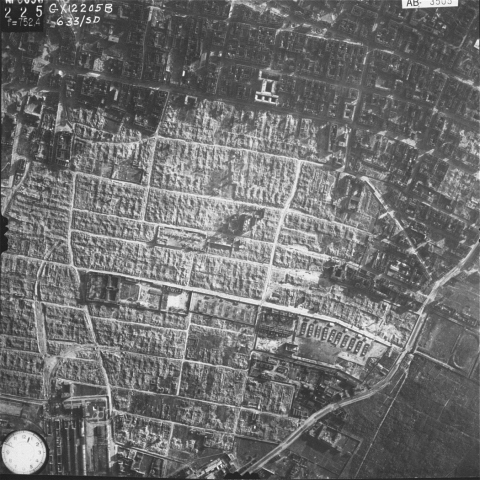
The Jewish Ghetto in Warsaw was burned to the ground.
Snyder asks the readers to remember that the lives he documents died because of policies that existed in the Soviet Union and Nazi German that promoted and committed deliberate mass murder. The act of recording and remembering must be initiated where evidence is so easy to destroy or manipulate. People complicit in the murder of their neighbors will attempt to mitigate their shame. Even those with no connection to such events would probably rather think of something more pleasant. Where the Nazis razed the Warsaw ghetto and dismantled the death camp at Treblinka in a matter of hours, Stalin purposefully changed the course of the historical discussion in the U.S.S.R. in order to promote nationalism. The suffering of Jews and other innocents was sublimated to the overall suffering of the Soviet (mostly Russian) population.
14 million people. Farmers, prisoners, gypsies, peasants, freedom fighters, and the unlucky. Wives, fathers, and children. Everyone died to placate ideologies that a great number of people of good conscience did not discount at the time. Although the historical record is expanding, it seems inconceivable that our knowledge of such events could ever be perfected. Appreciate your loved ones and relish the warmth in your homes and in your bodies. Essential knowledge for every conscious, conscientious person. Absolutely recommended.
The titular figure in Heinrich Böll’s 1963 novel The Clown is Hans Schnier, a man whose personal and professional life is burning down around him as he howls in (often hilarious) despair. During a performance at a third-rate venue, Hans purposefully injures his knee and retreats to Bonn, where he holes up in his small apartment and makes angry desperate phone calls (and tries not to drink too much brandy) as he reflects on his past.
His common-law wife Marie has returned to the conservative Catholicism she was raised on, and subsequently left Hans; even worse, shes’ taken up with a bourgeois hack named Zupfner. Marie and Hans initially came together as teens, sexing it up in their provincial German town. After scandalizing all the decent ex-Nazis in town, they retreat to the comparatively cosmopolitan city of Bonn and begin a life (in sin) together, traveling from venue to venue and performance to performance as Hans’s career grows.
It becomes clear through the course of The Clown — which is essentially Hans’s long, angry rant against complacent conformity — that Marie is merely an object for Hans, a romantic idealization. He repeatedly tells us that she doesn’t get his art–
I don’t believe there is anyone in the world who understands a clown, even one clown doesn’t understand another, envy and jealousy always enter into it. Marie came close to understanding me, but she never quite understood me. She always felt that as a “creative person” I must be “deeply interested in absorbing as much culture as possible.” She was wrong.
Hans is always the outsider, even to the woman he loves. Still, Marie represents both comfort and some sense of continuity for this traveling artist whose life is basically a series of hotels, train rides, and performances. Without her, Hans is lost, adrift without an anchor, pure vitriol aimed at a society he rebukes at every turn. Consider his parents, for instance, rich Protestants with a penchant for providing patronage to middling writers — Hans’s hate for them is almost metaphorical, a hate that extends to their religion and their complicity in the evils of WWII. While The Clown is a highly personal story, the tale of an artistic soul tortured in the absence of his love, it’s also an indictment of postwar Germany, a milieu all-too ready to whitewash its sins in the easy absolution of cheap religion.
At times the nuances of The Clown’s argument against the conformist postwar German culture were lost on me. Hans’s many references to the particular rhythms and contrasts of Teutonic Protestants and Catholics were beyond my ken. Still, this rarely detracted from my enjoyment or involvement in the novel. Its caustic bite and extreme depression is tempered by ironic humor and expansive knowledge. Here’s an early passage in the book that I think shows off these attributes and obsessions while highlighting a bizarre metaphysical conceit that I don’t know how to properly work into this review–
I felt sick. I forgot to say that not only do I suffer from depression and headaches but a I also have another, almost mystical peculiarity: I can detect smells over the telephone. . . . I had to get up and clean my teeth. Then I gargled with some of the cognac that was left, laboriously removed my makeup, got into bed again, and thought of Marie, of Christians, of Catholics, and contemplated the future. I thought of the gutters I would lie in one day. For a clown approaching fifty there are only two alternatives: gutter or palace. I had no faith in the palace, and before reaching fifty I had somehow to get through another twenty-two years.
So we learn that our hero is only in his late twenties, yet already romanticizes a dramatic life of failure; he sees himself as the failed artist down in the gutter, perhaps dreaming of the stars. And he can smell through the phone!
At its core, The Clown is a searing attack on hypocrisy, one grounded in a sense of time and place. And it’s this grounding that gives the book the weight — the concreteness of truth — to transcend its postwar setting and remain relevant today in a world where language, religion, and custom all provide societies and their institutions a kind of metaphysical escape hatch to avoid squarely assessing the gaps between mantra and action. Hans shows us that it takes a jester to truthfully comment on the absurdity of modernity; it’s the trickster whose pantomimes tap into the most mundane gestures to expose the intricate ways these gestures might disguise ugly, banal, or even evil intentions. Great stuff.
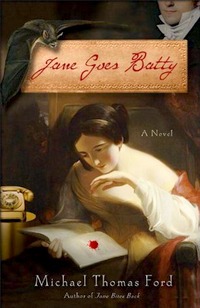 In the past few years we’ve seen a spate of books where public domain characters and historical figures feature in supernatural tales, usually written in an ironic, or at least parodic mode. It seems like a heavy percentage of these books are mixed up somehow with Jane Austen, whose legacy has become grist for a literary cottage industry, with a new “re-imagining” of Pride and Prejudice or Sense and Sensibility coming out every season. Last year, Michael Thomas Ford offered the public the mix of Jane Austen and vampires we had been so desperately clamoring for, Jane Bites Back. By way of a little more context (and pure laziness), I’ll quote Biblioklept’s review of Ford’s novel–
 Jane’s editor decides to become an agent and leaves her with Jessica Abernathy (evil nemesis in Batty); Jane has to run constant interference on her wacky/charming friend Lord Byron (also a vampire, of course); etc., etc., etc. The most ridiculous/campiest plot device of all though is that Jane is converting to Judaism to please her boyfriend Walter’s judgmental mom. Yes. That’s right. We also learn that Jane played Magenta in a traveling production of The Rocky Horror Picture Show in the seventies, a minor detail to be sure, but one that seems to reinforce Ford’s whimsical kitsch. Batty aims for a kind of sassy brevity in its scene constructions, and while its certainly not a book for me, I think that those who want to see Jane Austen as a 21st century vampire will probably enjoy it quite a bit. Jane Goes Batty is new in trade paperback from Ballantine.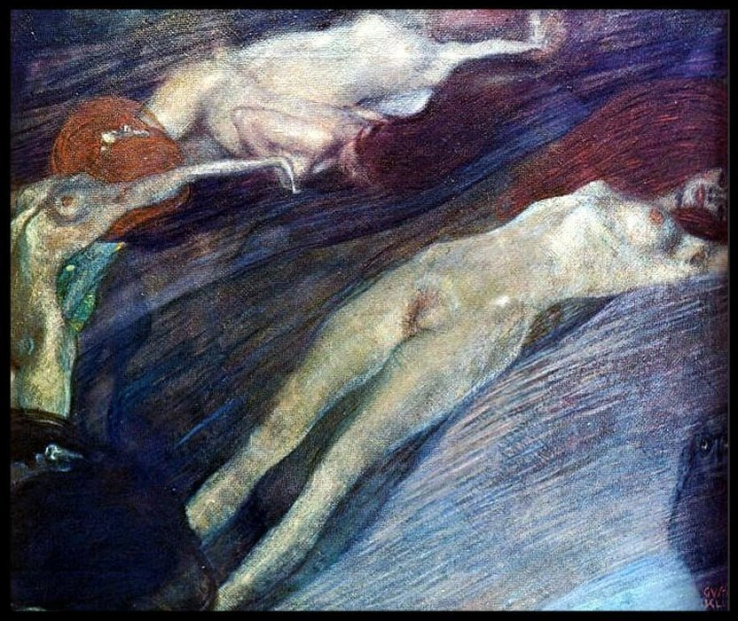
 Chamber Four has a new literary magazine called C4. You can get the inaugural issue in several formats
 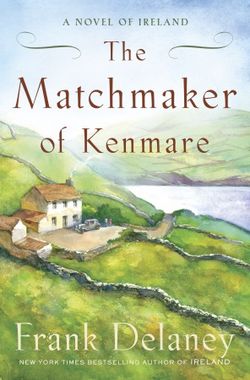 Frank Delaney’s new novel The Matchmaker of Kenmare is set against the dramatic backdrop of Europe in 1943. Its narrator is Ben McCarthy (returning from Delaney’s previous novel Venetia Kelly’s Traveling Show), who lets the story unfold in the style of a memoir. Ben’s wife Venetia Kelly has mysteriously disappeared. To assuage his anxiety, Ben begins collecting folklore Irish folklore as part of a government project. In the process, he comes into contact with the titular matchmaker, Kate Begley. The two soon form a close bond, and Kate does everything in her power to aid the grieving narrator. The plot turns when a U.S. intelligence officer named Charles Miller enters the picture. He strikes up a romance with Kate, but their relationship is tested when he asks her — and Ben — to use their country’s neutral status to travel through enemy territory in order to find a man the American’s need before D-Day. Their mission soon turns to finding the man Kate believes she loves, a plot doubled in Ben’s search for his wife Venetia. The Matchmaker of Kenmare, new in hardback from Random House, will appeal to those who enjoy sweeping, richly detailed historical romances with a literary bent.

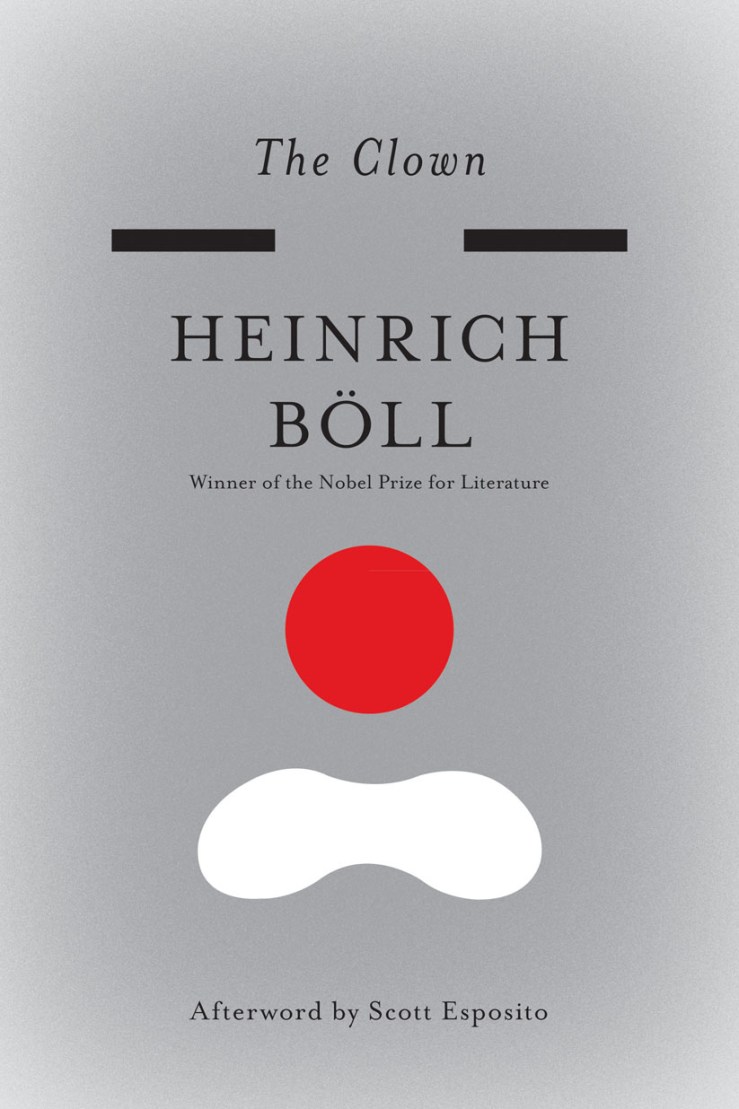 The titular figure in Heinrich Böll’s 1963 novel The Clown is Hans Schnier, a man whose personal and professional life is burning down around him as he howls in (often hilarious) despair. During a performance at a third-rate venue, Hans purposefully injures his knee and retreats to Bonn, where he holes up in his small apartment and makes angry desperate phone calls (and tries not to drink too much brandy) as he reflects on his past.
 Biblioklept
