
Deborah Eisenberg wins the 2011 PEN/Faulkner Award for The Collected Stories of Deborah Eisenberg. Here she is reading—
Month: March 2011
Under the Volcano — Malcolm Lowry
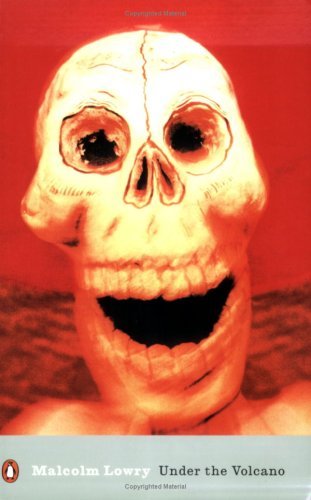
Most of Malcolm Lowry’s dense, depressing novel Under the Volcano takes place over the course of November 2nd, 1938, the Mexican Day of the Dead. Like a reticent, dour Virgil, Lowry guides the reader through the day’s tragic arc, floating between the minds of his novel’s three protagonists: Geoffrey Firmin, his half-brother Hugh, and Geoffrey’s estranged wife Yvonne. Geoffrey is British Consul to Mexico — ex-Consul, really, as British-Mexican relations sour against the backdrop of Spanish fascism and the rise of nationalism in Mexico — but he is almost always referred to as “the Consul,” a blackly ironic title. See, the Consul bears little authority aside from an extreme expertise on how to stay drunk (or “drunkly sober un-drunk”) 24/7. He’s ambassador to bar stools, a manager of mescal and little else (certainly not his own life; certainly not diplomatic affairs). The Consul is a wreck, an alcoholic to put Hemingway and Fitzgerald’s (and even Bukowski’s) alter-egos to shame.
After a first chapter that seems to derail all but the most patient readers, the narrative conflict arrives when Yvonne returns to Quauhnahuac, Mexico, a year after leaving (and divorcing) the Consul. She arrives to find the Consul (“Geoffrey,” as he’s called when the free indirect style inhabits her mind) drinking whiskey in a hotel bar in order to sober up (yep). It’s not immediately clear why Yvonne has returned to the Consul, but it seems that she hopes to save him from drowning in a drunken downward spiral. As the pair walks to the Consul’s house, they pass numerous advertisements for a boxing match; a child’s funeral proceeds down the avenue. These motifs of fighting, death, and futility permeate the novel.
During the walk we learn that Yvonne is not the only one concerned about the Consul’s health; his (much) younger brother Hugh has come to stay with him in the hopes of sobering him up. (Hugh employs a revolting and unsuccessful “strychnine cure”). That Hugh has also returned doubly complicates the plot. Much of Under the Volcano remains implicit, unnamed, hinted at, and this seems especially true of the implication that Yvonne cheated on the Consul with Hugh in the recent past (this implication may have been stated conclusively at some point in the novel, but I’ve only read the book once, which is perhaps like not having read it at all). What’s certainly clear is that Yvonne cheated on the Consul with a French filmmaker, Jacques Laruelle, a man whom the Consul, through sheer bizarre coincidence (but of course it isn’t sheer bizarre coincidence), spent a childhood summer with, and experience which bonded them as brothers in an Edenic holiday that eventually (inevitably) soured.
Despite her infidelities, Yvonne is generally present (I choose the verb “present” over “presented as” to highlight Lowry’s impeccable Modernist style) as a sympathetic character. Still, it is hard not to identify with the Consul (with “Geoffrey,” I suppose, if we are going to be familiar), the dark soul of this novel, and his complicated, painful feelings for Yvonne form the core of Volcano’s tragedy. He longs for her, pines for a complete life with her, yet resents her, cannot forgive her, hates her. For what? For leaving him. For betraying him. But perhaps foremost, he despises her inability to understand his alcoholism (he is particularly upset when she refuses to share a morning libation with him when they meet for the first time in a year). I’ll quote a passage at length now, one that showcases Lowry’s free indirect style, and one that reveals the strange indignities of the Consul’s sense of his own alcoholism. For context, dear reader, you must only know that Yvonne has suggested that she and the Consul might make long-term plans when he is sober “in a day or two”—
The Consul sat perfectly still staring at the floor while the enormity of the insult passed into his soul. As if, as if, he were not sober now! Yet there was some elusive subtlety in the impeachment that still escaped him. For he was not sober. No, he was not, not at this very moment he wasn’t! But what had that to do with a minute before, or half an hour ago? And what right had Yvonne to assume it, assume either that he was not sober now, or that, far worse, in a day or two he would be sober? And even if he were not sober now, by what fabulous stages, comparable indeed only to the paths and spheres of the Holy Cabbala itself, had he reached this stage again, touched briefly once before this morning, this stage at which alone he could, as she put it, “cope,” this precarious precious stage, so arduous to maintain, of being drunk in which alone he was sober! What right had she, when he had sat suffering the tortures of the damned and the madhouse on her behalf for fully twenty-five minutes on end without having a decent drink, even to hint that he was anything but, to her eyes, sober? Ah, a woman could not know the perils, the complications, yes, the importance of a drunkard’s life! From what conceivable standpoint of rectitude did she imagine she could judge what was anterior to her arrival? And she knew nothing whatever of what all too recently he had gone through, his fall in the Calle Nicaragua, his aplomb, coolness, even bravery there—the Burke’s Irish whiskey! What a world! And the trouble was she had now spoiled the moment.
The “fall in the Calle Nicaragua” the Consul references is quite literally a drunkard’s blackout (followed by the aforementioned fortifying whiskey, courtesy of a tourist), but it — falling — is perhaps the dominant motif in a novel crammed with motifs. In allegorical terms, if we want to ruin a good book (I don’t recommend this, of course), Volcano is pure Faust-stuff: end of innocence, fall of man, intractability of the human condition, ethical peril, moral inertia. While the Consul’s fall dominates the novel, Lowry brings this decline into dramatic relief in a late, climactic episode when his (anti-)heroic trio encounter a dying (dead?) man on the side of the road. Hugh tries to help, but the Darwinian venality of Mexican commonplace law makes his attempt impotent. Yvonne and the Consul are basically paralyzed.
Hugh’s attempt to save the man is a desperate call to action, an endeavor to perform some good in a world dominated by war and fascism. Hugh’s character fascinates. We learn of his past in one of the novel’s most intriguing episodes, a mini-bildungsroman that finds young Hugh working in the merchant marine as a calculated ploy to lend romance to his persona — he longs to prevail as a songwriter. He returns to find that no one cares about — has even heard — his guitar compositions; his publicity stunt fails. Although Hugh is only twenty-nine, he already seems himself as a failure, a fallen hero; he obsesses over the Battle of Ebro, daydreaming of helming a ship laden with hidden arms that he will deliver to the Loyalists who oppose the Fascists. Hugh’s greatest pain — and perhaps (only perhaps) Lowry’s greatest cruelty — is the awareness that the idealism of romantic heroism is intrinsically bound to a kind of selfish egoism. Hugh, perhaps with the visceral signal of his half-brother as a kind of radical prescience, can already see his own fall; his parts in Volcano are in a sense a constant meditation on falling. Hugh tries to save the dying man on the road, the cold double of his brother, whom he also tries to save — and yet it is all to little avail.
In Lowry’s world, in the volcano-world, there is only expulsion from the Eden. Lowry spells out this theme near the middle of his novel in a strange episode. The Consul wanders into his neighbor’s garden and reads a sign —
¿LE GUSTA ESTE JARDÍN?
¿QUE ES SUYO?
¡EVITE QUE SUS HIJOS LO DESTRUYAN!The Consul stared back at the black words on the sign without moving. You like this garden? Why is it yours? We evict those who destroy! Simple words, simple and terrible words, words which one took to the very bottom of one’s being, words which, perhaps a final judgement on one, were nevertheless unproductive of any emotion whatsoever, unless a kind of colourless cold, a white agony, an agony chill as that iced mescal drunk in the Hotel Canada on the morning of Yvonne’s departure.
Significantly, either the sign is posted with improper punctuation, or (and?) the Consul’s translation is wrong — in either case a meaningful misreading occurs. We later receive the “proper” version of the sign: “¿Le gusta este jardín, que es suyo? ¡Evite que sus hijos lo destruyan! – “Do you like this garden that is yours? See to it that your children do not destroy it!” The Consul’s first reading is a corruption, a cruel misreading that questions humanity’s right to happiness, and, tellingly, he connects the sign to the end of his relationship with Yvonne. The second version of the sign, while still foreboding, perhaps signals a kernel of hope in Lowry’s bleak work — the idea that a garden might be preserved, might be tended to; that children might be raised who do not kill, cheat, steal, rape, enslave, or otherwise prey on each other. Still, Lowry refuses to imagine what such a world might look like for us. Did I mention that Volcano is really, really sad?
For all its bleak, bitter bile, Volcano contains moments of sheer, raw beauty, especially in its metaphysical evocations of nature, which always twist back to Lowry’s great themes of Eden, expulsion, and death. Lowry seems to pit human consciousness against the naked power of the natural world; it is no wonder then, against such a grand, stochastic backdrop, that his gardeners should fall. The narrative teems with symbolic animals — horses and dogs and snakes and eagles — yet Lowry always keeps in play the sense that his characters bring these symbolic identifications with them. The world is just the world until people walk in it, think in it, make other meanings for it.
In many ways, Under the Volcano is an antipodal response to Joyce’s Ulysses. Both novels stream through a number of consciousnesses over the course of one day; both novels invert and subvert mythical frameworks against diurnal concerns; both novels point to the ways that the smallest meannesses — and kindnesses — can color and affect our lives. And while there are many divergences (chiefest, I believe, the spirit of redemption in Ulysses that seems entirely absent from Volcano), the greatest similarity may be their difficulty. Simply put, Lowry, like Joyce, throws his readers into the deep end. The first chapter of the novel inhabits the mind of Jacques Laruelle and takes place exactly one year after the events of the rest of the novel. It is both overture and context for all that follows, and yet it is radically alienating; indeed, it only fully makes sense after one finishes the novel and goes back and reads it again, realizing it is the rightful coda, the sad epilogue of a sad story. Lowry leads with his conclusion, show us the fall-out up front, the splinters and shards of the narrative to come. Picking up these pieces is hardly easy and never joyful, but it is a rewarding experience. Very highly recommended.
“Murder Is Natural” — A Clip from Peter Brook’s Film Marat/Sade
“The White Fires of Venus” — Denis Johnson
“The White Fires of Venus” by Denis Johnson—
We mourn this senseless planet of regret,
droughts, rust, rain, cadavers
that can’t tell us, but I promise
you one day the white fires
of Venus shall rage: the dead,
feeling that power, shall be lifted, and each
of us will have his resurrected one to tell him,
“Greetings. You will recover
or die. The simple cure
for everything is to destroy
all the stethoscopes that will transmit
silence occasionally. The remedy for loneliness
is in learning to admit
solitude as one admits
the bayonet: gracefully,
now that already
it pierces the heart.
Living one: you move among many
dancers and don’t know which
you are the shadow of;
you want to kiss your own face in the mirror
but do not approach,
knowing you must not touch one
like that. Living
one, while Venus flares
O set the cereal afire,
O the refrigerator harboring things
that live on into death unchanged.”They know all about us on Andromeda,
they peek at us, they see us
in this world illumined and pasteled
phonily like a bus station,
they are with us when the streets fall down fraught
with laundromats and each of us
closes himself in his small
San Francisco without recourse.
They see you with your face of fingerprints
carrying your instructions in gloved hands
trying to touch things, and know you
for one despairing, trying to touch the curtains,
trying to get your reflection mired in alarm tape
past the window of this then that dark
closed business establishment.
The Andromedans hear your voice like distant amusement park music
converged on by ambulance sirens
and they understand everything.
They’re on your side. They forgive you.I want to turn for a moment to those my heart loves,
who are as diamonds to the Andromedans,
who shimmer for them, lovely and useless, like diamonds:
namely, those who take their meals at soda fountains,
their expressions lodged among the drugs
and sunglasses, each gazing down too long
into the coffee as though from a ruined balcony.
O Andromedans they don’t know what to do
with themselves and so they sit there
until they go home where they lie down
until they get up, and you beyond the light years know
that if sleeping is dying, then waking
is birth, and a life
is many lives. I love them because they know how
to manipulate change
in the pockets musically, these whose faces the seasons
never give a kiss, these
who are always courteous to the faces
of presumptions, the presuming streets,
the hotels, the presumption of rain in the streets.
I’m telling you it’s cold inside the body that is not the body,
lonesome behind the face
that is certainly not the face
of the person one meant to become.
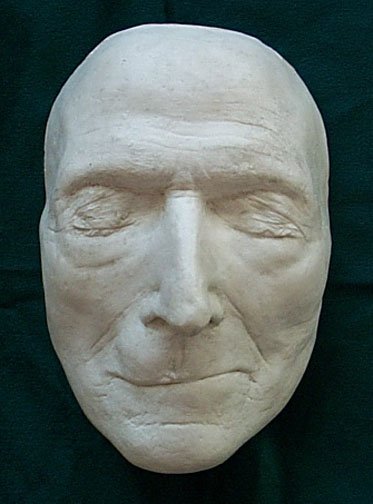
John Wesley’s Death Mask
Swallow It, Dog — Francisco Goya
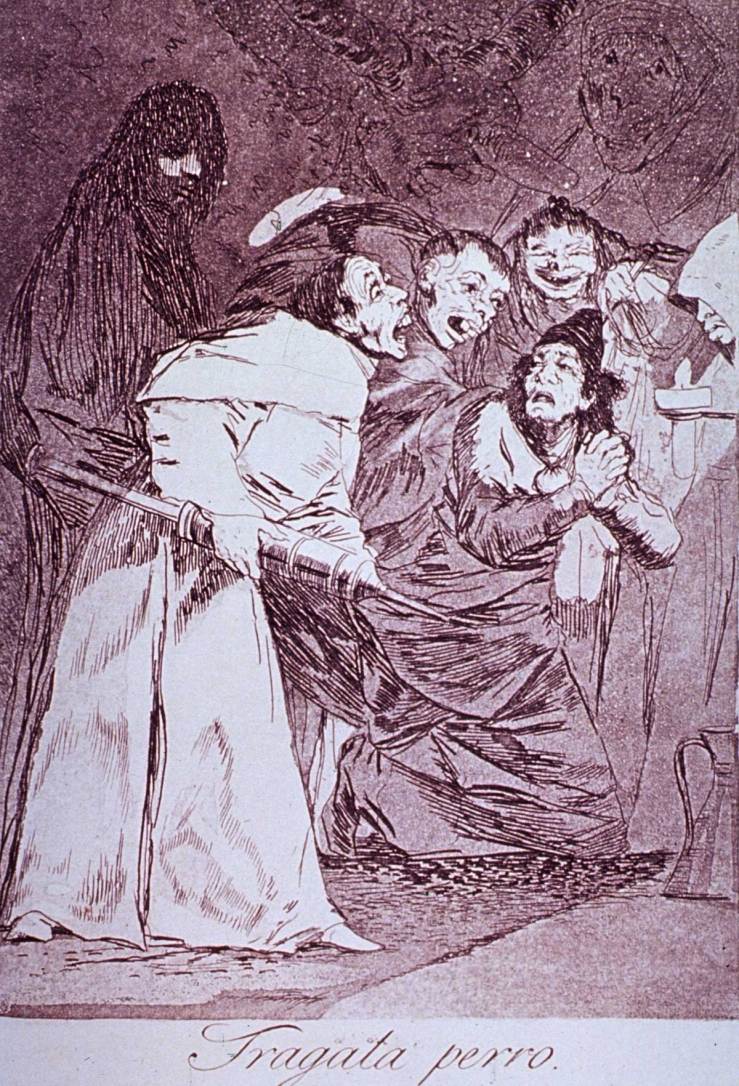
“He who lives amongst men will be irremediably vexed” — Goya
Volcano: An Inquiry into the Life and Death of Malcolm Lowry
Vodpod videos no longer available.
Volcano: An Inquiry into the Life and Death of Malcolm Lowry is a 1976 documentary by directors Donald Brittain and John Kramer. Featuring Richard Burton reading from Lowry’s work. (Via).
“Your Dog Dies” — Raymond Carver
“Your Dog Dies” by Raymond Carver–
It gets run over by a van.
you find it at the side of the road
and bury it.
you feel bad about it.
you feel bad personally,
but you feel bad for your daughter
because it was her pet,
and she loved it so.
she used to croon to it
and let it sleep in her bed.
you write a poem about it.
you call it a poem for your daughter,
about the dog getting run over by a van
and how you looked after it,
took it out into the woods
and buried it deep, deep,
and that poem turns out so good
you’re almost glad the little dog
was run over, or else you’d never
have written that good poem.
then you sit down to write
a poem about writing a poem
about the death of that dog,
but while you’re writing you
hear a woman scream
your name, your first name,
both syllables,
and your heart stops.
after a minute, you continue writing.
she screams again.
you wonder how long this can go on.
Book Trailer: Simon Critchley’s How to Stop Living and Start Worrying
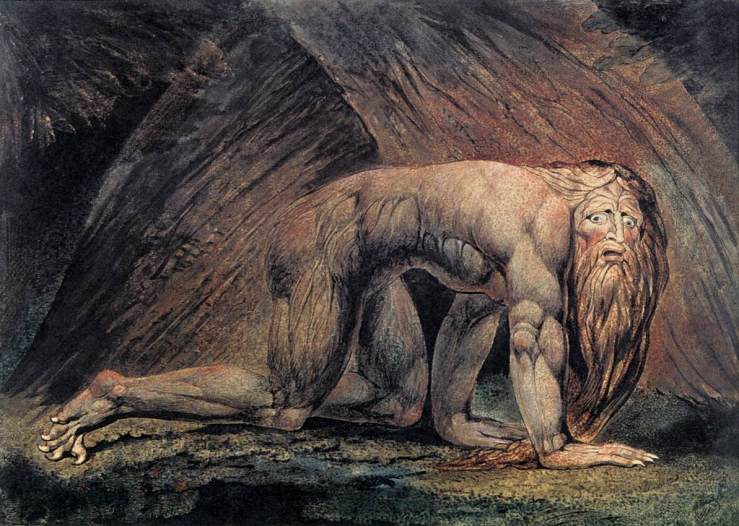
Nebuchadnezzar — William Blake
Hayao Miyazaki Makes Ramen at Studio Ghibli
The Road — Vasily Grossman
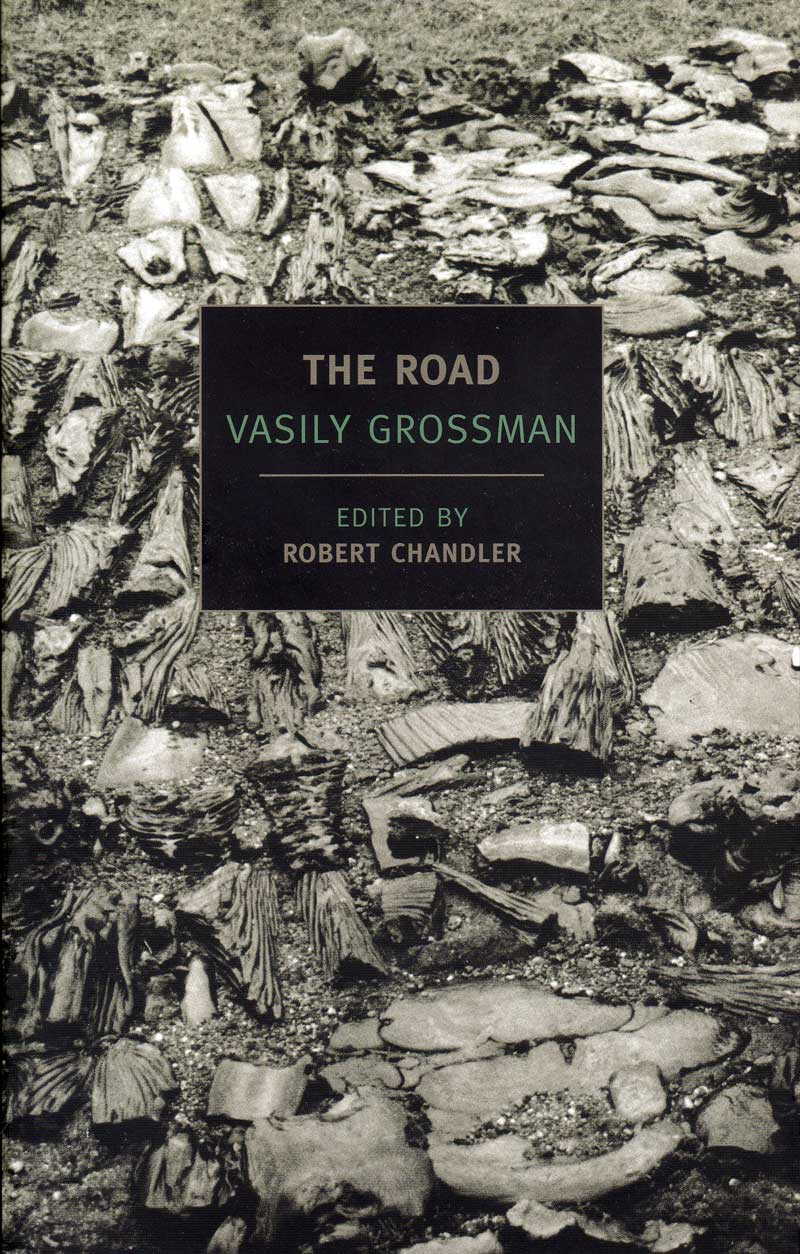 I’d never heard of Vasily Grossman until Timothy Snyder referred to him, briefly, as a Soviet journalist who published some of the first unflinching reports of atrocities committed by Nazi soldiers and Hitler’s secret police during their conquest of eastern Europe. In Bloodlands, Snyder lauded Grossman as a reporter guided by a clear moral vision and a keen understanding of the tenuousness of human life. A Ukrainian Jew who rhapsodized the Red Army’s defense of Stalingrad and then followed it all the way to Berlin, he built a literary career under the Soviet system before passing away with little fanfare. Although his early novels sold in the millions, at the time of his death in 1964 his reputation in his homeland was shattered, his health had deteriorated, and his final novels were blacklisted. He could count himself lucky to have lived through a number of purges of the U.S.S.R.’s literary elite. Edited and compiled by Robert Chandler for the impressive New York Review Books imprint, The Road collects of a number of his short stories, essays, letters, and articles in one well-curated volume, an excellent introduction to an important but neglected voice.
Organized chronologically, Grossman’s stories are separated by brief biographical notes thoughtfully included by Chandler. Although the selections fall into early, middle, and later works, it becomes clear that Grossman’s life as a man and as a writer (at least how it is presented here) can be broken up into distinct periods marked by increasing dissatisfaction with life under Soviet rule. Chandler labels the periods, from earliest to latest: “The 1930s,” The War, The Shoah,” and “Late Stories.” The works in this collection are sad—truly sad—but throughout he returns to remembrances of love and small gestures of tenderness. He is marked by the excesses of the totalitarian regimes he waged war upon and lived under. As a result, his writing demonstrates an appreciation of kindness that could only arise from a true comprehension of both humanity’s potential for cruelty and the limitless power of an autonomous mind.
The first short section, “The 1930s,” collects three concise stories concerning the creation and dissolution of family bonds. “A Small Life” describes a couple that decides to foster a child from their village orphanage who ultimately finds them weird and boring, while in “In the Town of Berdichev” a rough female commander in a military unit must take a forced leave when her pregnancy makes it impossible for her to fulfill her duties to her company. She fondly remembers the father who was shot down in battle, but struggles to balance her duty to protect her child against her duty to protect her county. Perhaps the most striking of the three stories is the last, titled “A Young Woman and an Old Woman.” The title characters are both rewarded by their state employers with a free trip to a seaside resort and share a train cabin as they journey to the coast. They talk. The young woman, enjoying her rise through the Soviet system, befriends the older woman who has been saddened by the surprising detention of her daughter and her own stalled professional ambitions. These two subtly drawn characters never fully understand the hidden mechanisms behind their fleeting instances of happiness. Perhaps these mechanisms have been hidden by the totalitarian state or, maybe because they’re people, they will always be doomed to wonder.
As the book transitions to its second section, Grossman seems torn between his duty as a reporter to inspire his fellow citizens to sacrifice for the greater good and his need to rail against the injustices perpetrated by warring totalitarian regimes. Like “In the Town of Berdichev,” “The Old Man” finds Grossman adopting a tone that might almost be described as propagandistic. A quiet old man, a beekeeper whose livelihood requires patience and silence, overcomes a lifetime of reticence by braining a German soldier with a shovel. Much better is “The Old Teacher,” a story about a village’s elderly teacher, a Jew. Distraught by what he sees as Nazi soldiers advance on his town—long simmering feuds settled by prompt denunciations, families thrown out of houses, all sorts of groveling and obsequiousness—the old man reflects on his failings and his fleeting successes. The teacher and the town’s other Jews are forcefully marched to a ravine. There they are made to lie down and wait for the firing squad, positioned above them on a hill, to reload. The victims, in their last moments, see brave assertions of individual dignity, dole out small kindnesses, and console each other with the hope that others will not suffer similar fates. “The Hell of Treblinka” and “The Sistene Madonna” close this section. The former is Grossman’s terrible and moving account of the discovery of the death camp at Treblinka, written while reporting the westward march of the Soviet Red Army. The latter is an attempt to explain the power of Raphael’s rendering of The Sistene Madonna. The Madonna and her child symbolize the universal mother’s struggle to protect a child — a child she must relinquish to the world. For Grossman, the mother and son are recurring historical figures who reappear wherever human life is reduced to a simple mathematical calculation: at the death camps; in blackened cities throughout Europe; in the famine-ravaged Ukraine; at Hiroshima. Freedom requires individuals to confront existential fears — “Their human strength triumphed over the violence. The Madonna walked toward the gas chamber, treading lightly on small bare feet. She carried her son over the swaying earth of Treblinka.”
The final section contains a number of staggering stories, the type you shove into a stranger’s hand with a wild look in your eye. These are stories that remind you of the masters of the form, writers like Hemingway, Chekov, Eudora Welty, and Cortazar. “The Elk” is a fantastic rumination on illness, love, and political repression. “The Road” is written from the vantage point of an Italian mule conscripted into the war on the side of the Axis powers. As he is forcefully marched through northern Africa and then the Russian steppe strapped to heavy artillery he forgets the pleasure taken from green shoots and visions of young mares. His indifference permits his survival. In “Mama,” one of Stalin’s top advisers adopts the orphaned child of parents he may have had a hand in killing. Grossman gives his readers a glance of the luxurious and precarious lives of those residing at the very top of the Soviet system. Even Isaac Babel makes an appearance (read Red Calvary if you haven’t already).
The Road brings together a number of works by an artist who deserves greater recognition. Grossman witnessed some of worst atrocities of the twentieth century, and his writing demonstrates a need to speak out against a particular brand of cruelty. His writing in The Road is brave not only because a number of these stories could probably have led to his imprisonment, exile, or condemnation, but also because he utilizes terrible situations to illustrate humanity’s best qualities. Without being obvious, he champions mercy, understanding, and unconditional love. Beautiful stuff. Pick it up if you can.
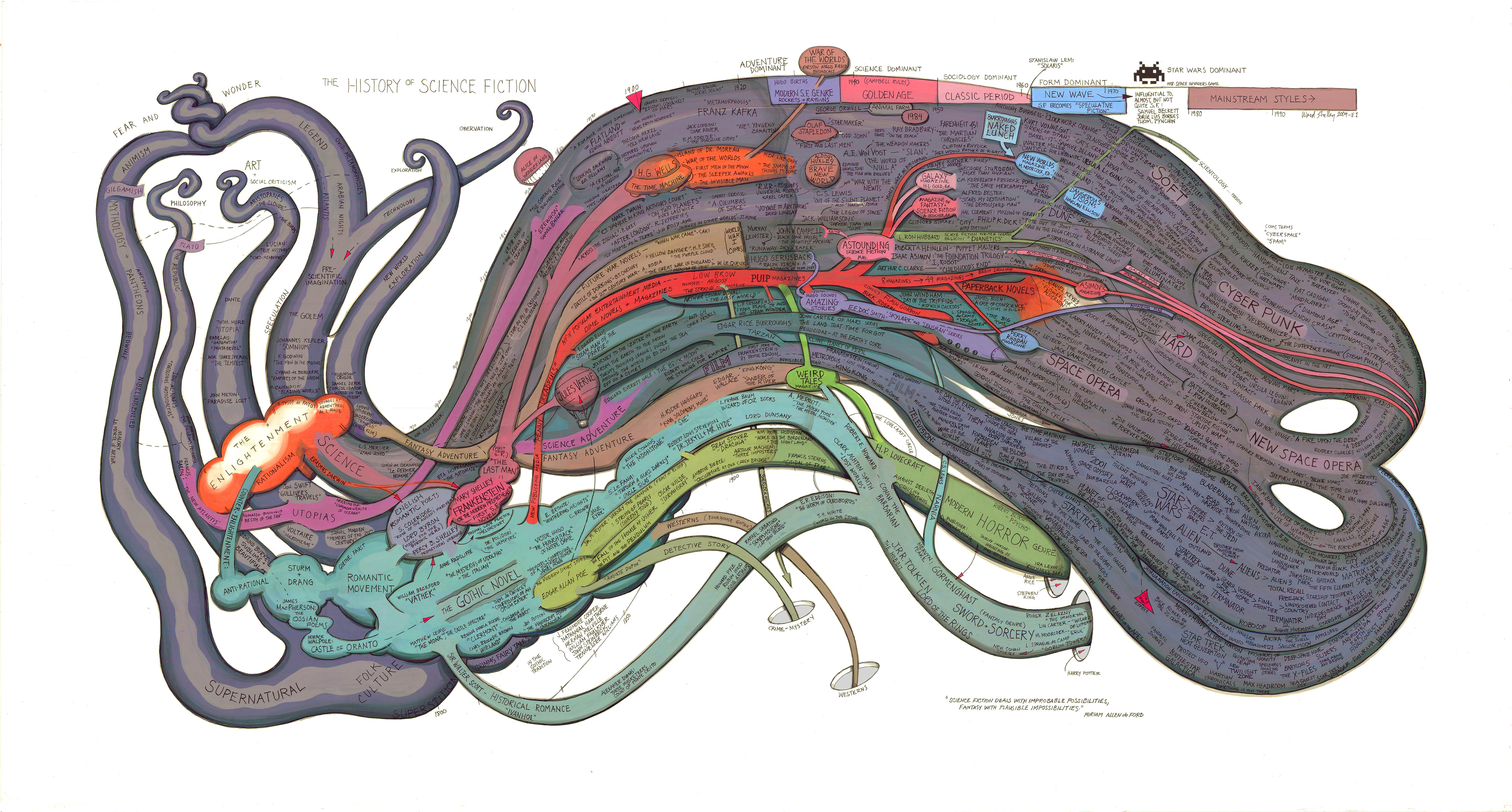
The History of Science Fiction — Ward Shelley
“I Don’t Have a Religious Bone in My Body” — Philip Roth on Religion and God
A Few Thoughts on “Wiggle Room,” an Excerpt from David Foster Wallace’s Novel The Pale King
[Editorial note: Biblioklept originally published this post on March 3rd, 2009. We run it again today in anticipation of the publication of David Foster Wallace’s posthumous novel, The Pale King, which is like, right around the corner].
The New Critics’ biggest contribution to literary criticism was the dictum that analysis was to be applied strictly to the text itself, without the muddying impurities of biography or any other outside knowledge influencing the reader. A context-free reading is pretty hard to come by, though, isn’t it? School syllabi are arranged around era or genre, or both; our teachers preface each novel or poem or story or essay with a nod to its relevance; a friend hands us a book because it’s “good.” We furtively flip through Tropic of Capricorn, knowing its rep; we look down our noses at abstinence vampire novels. In short, it’s hard to get to that pure reading the New Critics favor. Still, I’ve always thought it’s a pretty good strategy to put aside biographical/author psychology, and just stick to a good close reading of the text. Today, reading David Foster Wallace’s “Wiggle Room,” I was completely unable to do that.The context of Wallace’s recentish suicide hung over each page, each sentence. It was a distraction that led to a (necessary) rereading, a distraction that colored the reading–and then the rereading. A strange little voice popped into Wallace’s dense narration that kept whispering, “posthumous, unfinished novel.” But now that I’ve complicated and contextualized and complained, perhaps I should simply comment a bit on the story now.
In dense, thick sentences, Wallace relates a work morning for Lane Dean, an IRS rote examiner who detests his Sisyphean job. Like many cubicle-dwellers, Lane spends much of his day trying not to look at the clock. He also tries to use an inspirational photo of his son sparingly, so that the effect might be more intense. However, the boredom on this particular day overwhelms Lane and he “had the sensation of a great type of hole or emptiness falling through him and continuing to fall and never hitting the floor. Never before in his life up to now had he once thought of suicide.” Trying to truck through it is no good: “Lane Dean summoned all his will and bore down and did three returns in a row, and began imagining different high places to jump off of.” These thoughts of suicide are mixed with a strange humor. As Lane’s depression becomes frantic, Wallace writes, “Unbidden came ways to kill himself with Jell-O.” As Lane becomes more and more anxious, it becomes apparent that–paradoxically–his boredom literally excites him. He gets all worked up about it, about the thought of having to devote a whole lifetime to such meaningless, boring work. The scene culminates in an horrific image:
When he started to see the baby’s photo face melting and lengthening and growing a long cleft jaw and aging years in just seconds and finally caving in from old age and falling away from the grinning yellow skull underneath, he knew he was half asleep and dreaming but did not know his own face was in his hands until he heard a human voice and opened his eyes but couldn’t see who it went with and then smelled the pinkie’s rubber right under his nose.
The “human voice” that wakes up Lane is a strange cyclopean figure, an older man who delivers a weird lecture on the origins of the word “bore.” The scene is pure Wallacian, filled with plenty of erudite references and jostling with a love for etymology. It literally zaps life-force back into the text, and punctuates Lane’s boring day–which Wallace has so expertly made the reader suffer as well–with some strange, frightening fun. Wallace’s narration makes clear that the appearance of this strange man is not simply Lane going crazy from his boredom–Lane clearly cannot understand half of what the man refers to. Instead, we are given this nugget: “The phantom of the hallucination of repetitive concentration held for too long a time, like saying a word over and over until it kind of melted and got foreign.” After philosophical reflection on why the need for a word for a condition like boredom might have arisen, the episode ends with the phantom leaving and Lane looking up to see that “no time had passed at all, again.”
The emphasis on the ways a person’s soul might be bored into, how one might become bored, and what that might mean, proliferates the short text, and perhaps evokes some of the themes we’ll find in the whole of The Pale King. As the quotes I pulled suggest, the idea that boredom might feed a suicidal impulse resonates strongly in light of Wallace’s unfortunate death. But there I go again, letting context color my analysis. But if we’re only left fragments, isn’t it natural to want to pull them together, to frame them–to give them order–context? It’s hard to say and probably not worth guessing if Lane Dean and the phantom will be major parts of The Pale King or not, but as the text progressed, I found myself more and more interested. Apparently, The Pale King will be published with notes and outlines–some bits of context–perhaps giving readers a clue as to how the text was meant to progress. Who knows. A lot of readers felt thatInfinite Jest didn’t have a proper ending (not me, though). While I think that the “Wiggle Room” episode stands well on its own, I’d certainly be happy to read more about the phantom. Still, Infinite Jest was larded with lots of little vignettes that added to the whole, but it’s important to point out that there was a whole to be added to–not just a series of vignettes. I’m really hoping that, even unfinished, Wallace has left us something of substance and depth, something that narrativizes—contextualizes—its themes into a meaningful work of art.
Beckett’s Breath (Directed by Damien Hirst)
Vodpod videos no longer available.
“How Drunkly Sober Un-drunk” — A Passage from Malcolm Lowry’s Novel Under the Volcano
A passage from Malcolm Lowry’s novel Under the Volcano—
The Consul dropped his eyes at last. How many bottles since then? In how many glasses, how many bottles had he hidden himself, since then alone? Suddenly he saw them, the bottles of aguardiente, of anís, of jerez, of Highland Queen, the glasses, a babel of glasses—towering, like the smoke from the train that day—built to the sky, then falling, the glasses toppling and crashing, falling downhill from the Generalife Gardens, the bottles breaking, bottles of Oporto, tinto, bianco, bottles of Pernod, Oxygénée, absinthe, bottles smashing, bottles cast aside, falling with a thud on the ground in parks, under benches, beds, cinema seats, hidden in drawers at Consulates, bottles of Calvados dropped and broken, or bursting into smithereens, tossed into garbage heaps, flung into the sea, the Mediterranean, the Caspian, the Caribbean, bottles floating in the ocean, dead Scotchmen on the Atlantic highlands—and now he saw them, smelt them, all, from the very beginning-bottles, bottles, bottles, and glasses, glasses, glasses, of bitter, of Dubonnet, of Falstaff, Rye, Johnny Walker, Vieux Whisky, blanc Canadien, the aperitifs, the digestifs, the demis, the dobles, the noch ein Herr Obers, the et glas Araks, the tusen taks, the bottles, the bottles, the beautiful bottles of tequila, and the gourds, gourds, gourds, the millions of gourds of beautiful mescal… The Consul sat very still. His conscience sounded muffled with the roar of water. It whacked and whined round the wooden frame-house with the spasmodic breeze, massed, with the thunderclouds over the trees, seen through the windows, its factions. How indeed could he hope to find himself to begin again when, somewhere, perhaps, in one of those lost or broken bottles, in one of those glasses, lay, for ever, the solitary clue to his identity? How could he go back and look now, scrabble among the broken glass, under the eternal bars, under the oceans?
Stop! Look! Listen! How drunk, or how drunkly sober un-drunk, can you calculate you are now, at any rate?
 Biblioklept