There’s a part in William Gaddis’s big novel The Recognitions where Basil Valentine talks about how forged paintings are always outed as fakes over time because they ultimately illustrate not the original genius of the artist, but instead show how the current zeitgeist interprets the artist. Film adaptations of books aren’t painted forgeries, but they are highly susceptible to the same critical limitations that Valentine discusses. We can see this plainly in Baz Luhrmann’s 1996 adaptation of Romeo & Juliet, a messy, vibrant, flaky film thoroughly shot-through with the aesthetic spirit of the nineties. I like Luhrmann’s R&J, despite its many, many faults. One of its great saving graces is that it seems aware of its own spectacle—it unselfconciously acknowledges itself as a product of its time, as just one of many, many adaptations of Shakespeare’s deathless work.
Lurhmann has taken a stab at F. Scott Fitzgerald’s The Great Gatsby. He’s not the first. Others attempted to turn Fitzgerald’s classic novel of the jazz age into a movie in 1926 (the film is lost), 1949 (there’s a reason you never saw it in high school), and 1974 (I’ll come back to the Redford Gatsby in a moment). Most recently, a 2000 anemic TV production featured Mira Sorvino as Daisy and Paul Rudd as a terribly miscast Nick Carraway. Up until now, high school teachers across the country who wanted to foist an adaptation on their students (and maybe free up a day or two of lesson planning) have had to choose between the 2000 A&E production or Jack Clayton’s 1974 Francis Ford Coppola-penned debacle—this is the one I was subjected to in high school. It features Robert Redford as Gatsby, Sam Waterston as Nick, and Mia Farrow as Daisy, and none of them are terrible, but the movie is dull, overly-reverential of its source material, and heavy-handed. It also looks incredibly dated now, its evocations of the 1920’s jazz age petrified in gauzy ’70s soft-focus shots. It just looks and feels very 1970s.
Judging by its trailer, Lurhmann’s Gatsby is making absolutely no play at all for timelessness. Just as his earlier mashup, 2001’s Moulin Rouge!, essentially uses the BelleÉpoque as a sounding board for transgenerational spectacle, Lurhmann’s Gatsby looks like another thoroughly interpretative gesture, a hyperkinetic, hyperstylized film that makes no bid at realism. This is what 2012 thinks 1922 should look like (or at least this is 2012’s ideal, shimmering, sexy version of 1922.) Here’s the trailer:
Overwrought, frenetic spectacle is exactly what I would expect from Luhrmann. There’s a transposition of meaning here, where Gatsby’s famous party turns into a rave of sorts, where Daisy’s phrasing of “You always look so cool” takes on anachronistic dimensions. But the trailer seems faithful (if hyperbolic) to images described in the book. By way of comparison, let’s look at the first shot in the trailer, the car full of young black people treating said car as a party scene. Here’s the text:
As we crossed Blackwell’s Island a limousine passed us, driven by a white chauffeur, in which sat three modish Negroes, two bucks and a girl. I laughed aloud as the yolks of their eyeballs rolled toward us in haughty rivalry.
“Anything can happen now that we’ve slid over this bridge,” I thought; “anything at all. . . .”
Even Gatsby could happen, without any particular wonder.
The energy of the scene is expressed—and magnified—in Luhrmann’s shot, but it’s impossible to say yet whether or not the invocation to change expressed in this citation will transfer to film.
It’s also obviously too early to make any pronouncements on the casting, although I’ll submit that you could find a worse Jay Gatsby than Leonardo DiCaprio (who I think, for the record, was great as petulant, whiny Romeo in Luhrmann’s breakthrough film). I’m not sure about Tobey Maguire as Nick Carraway, but there’s a certain, I don’t know, emptiness to him that may work well in our unreliable narrator. My big concern is Carey Mulligan, who I think is very sweet and I will admit to having a mild crush on—is she right for Daisy Buchanan, one of the meanest, most selfish creatures in literature? The other Buchanan, husband Tom, is portrayed by Joel Edgerton with a kind of seething rage here in the clip. Dude looks positively evil—cartoonishly so (which is really saying something, because Luhrmann seems to turn everything into a cartoon). Edgerton’s Tom presents as the glowering obstacle to the pure, positive love between Daisy and Gatsby. And here might be the biggest trip up with the film: The trailer seems to be advertising a love story.
Now, of course reading is an act of interpretation, a highly subjective experience dependent on any number of factors (see also: the opening paragraph to this riff). But good reading and good interpretation is generally supported by textual evidence, and the textual evidence in Gatsby reveals not so much a love story, but a bunch of nefarious creeps and awful liars who ruin the lives of the people around them with little thought or introspection. I mean, really, the principal characters are basically vile people (hence the reason your high school English teacher loved to point out Nick Carraway’s signature unreliability as a narrator—he glosses over so much evil). But again, it’s just a trailer, and trailers are made to make people buy tickets to movies, and people will pay to see a love story. We’ll have to wait for the film to assess Lurhmann’s interpretation. For now, it’s enough to suggest that the trailer achieved what it needed to—as of now, The Great Gatsby is still trending on Twitter. This is buzz; this is what a trailer is supposed to create. And if a byproduct of that buzz is to get more people reading or rereading, that can’t be a bad thing.
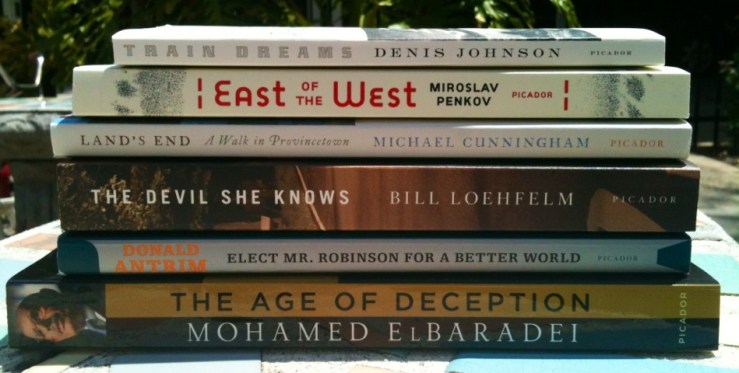
Nice little batch from the good folks at Picador, including Bill Loehfelm’s thriller The Devil She Knows, Mohamed ElBarardei’s The Age of Deception, an analysis of nuclear politics, and Michael Cunningham’s Land’s End, which I assume is a novelization of the clothing catalog.
Also in the batch: Denis Johnson’s novella Train Dreams, which I read in one sitting this Sunday. It’s a perfect novella, its pathos balanced with humor, its realism tempered in something of the mythic spirit of the American frontier. Full review forthcoming.
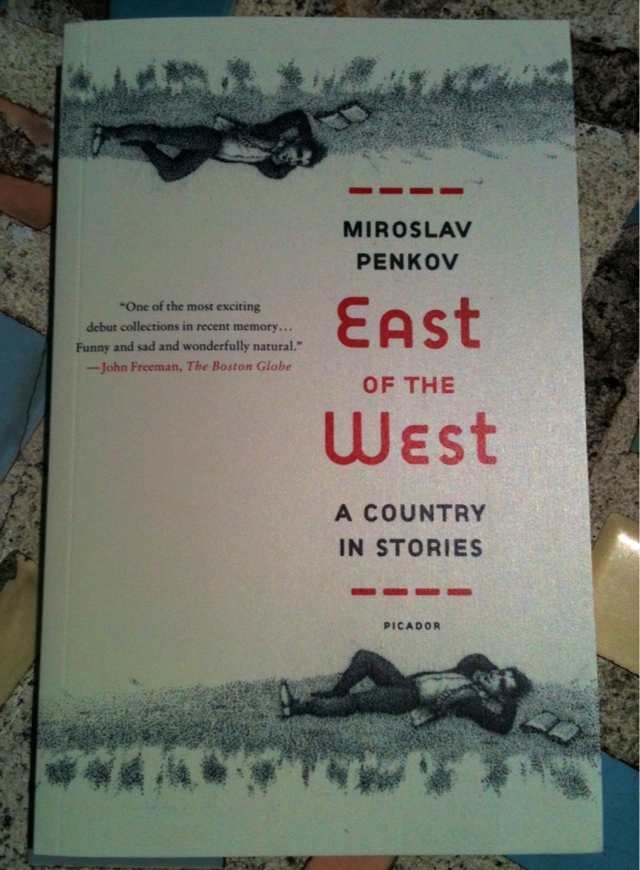
Miroslav Penkov’s collection East of the West looks pretty cool.
Here’s a description from his website:
A grandson tries to buy the corpse of Lenin on eBay for his Communist grandfather. A failed wunderkind steals a golden cross from an Orthodox church. A boy meets his cousin (the love of his life) once every five years in the river that divides their village into east and west. These are Miroslav Penkov’s strange, unexpectedly moving visions of his home country, Bulgaria, and they are the stories that make up his charming, deeply felt debut collection.
Donald Antrim’s debut Elect Mr. Robinson for a Better World has also been reissued with a new intro by Jeffrey Eugenides. Here’s an excerpt of the novel:
It was Friday, the day of the big theriomorphism workshop Rotary luncheon out at the Holiday Inn. My wife, Meredith, and I and a crowd of red-faced Rotarians and their well-dressed wives (Rotary Anns) sat around hotel banquet tables and listened to a visiting anthropology professor at the junior college say, “Pick an animal, any animal, fish, fowl, beast. Concentrate on aspects of the animal. Is it big? Small? Cute? Does it eat other animals? What color fur? If the animal is a bird, what color are its feathers? What song does it sing?”
“This is stupid,” I whispered to Meredith.
“It’s your fault we’re here, Pete. Why don’t you give it a chance?”
The anthropologist said, “Why don’t we all think about it for a minute? Okay, everybody got one?”
“Yes,” “No,” “Wait,” people said. Meredith whispered, “What’s yours?”
“I don’t know, what’s yours?”
“Coelacanth.”
“The prehistoric fish?”
“I need a volunteer,” declared the professor. Meredith raised her hand, and the man at the podium said, “Yes, back there. Tell us your name and the name of the animal you’ve chosen to become today.”
“Meredith Robinson. Coelacanth. It’s a kind of fish that scientists believed extinct until one was caught off the coast of Africa.”
“Excellent. Come forward. Sit here. Would someone please dim the lights?” I watched Rotary guys watch my wife. Bill Nixon, Tom Thompson, Abraham de Leon, Dick Morton, Terry Heinemann, Robert Isaac—all the usuals, plus others. Jerry and his wife, Rita, sat up front. The professor soothingly said, “Close your eyes, breathe deeply, and tell us about the coelacanth. Everybody else, let’s all breathe deeply too, and be thinking about our own animals. Go ahead, Meredith.”
“Well, it’s four feet long, deep slate blue, with bony, protruding fins and big jaws with scary teeth. It goes back seventy million years. It moves slowly, it dwells in dark water.” The professor nodded. Audience members inched forward in their seats. Meredith said, “At night it swims upside down with its head pointed to the sea bottom, bobbing along.”
“A feeding technique?”
“Maybe.”
“How’s the water?” I could see Meredith’s head settle forward as she softly answered, “Cold.”
“Feel the cold. Breathe that cold. Inhale that water. What do you feel?”
There are odder things than sacraphobia, said Elvira Campos, especially if you consider that we’re in Mexico and religion has always been a problem here. In fact, I’d say all Mexicans are essentially sacraphobes. Or take gephyrophobia, a classic fear. Eots of people suffer from it. What’s gephyrophobia? asked Juan de Dios Martinez. The fear of crossing bridges. That’s right, I knew someone once, well, it was a boy, really, who was afraid that when he crossed a bridge it would collapse, so he’d run across it, which was much more dangerous. A classic, said Elvira Campos. Another classic: claustrophobia. Fear of confined spaces. And another: agoraphobia. Fear of open spaces. I’ve heard of those, said Juan de Dios Martinez. And one more: necrophobia. Fear of the dead, said Juan de Dios Martinez, I’ve known people like that. It’s a handicap for a policeman. Then there’s hemophobia, fear of blood. That’s right, said Juan de Dios Martinez. And peccatophobia, fear of comitting sins. But there are other, rarer, fears. For instance, clinophobia. Do you know what that is? No idea, said Juan de Dios Martinez. Fear of beds. Can anyone really fear beds, or hate them? Actually, yes, there are people who do. But they can deal with the problem by sleeping on the floor and never going into a bedroom. And then there’s tricophobia, or fear of hair. That’s a little more complicated, isn’t it? Yes, very much so. There are cases of tricophobia that end in suicide. And there’s verbophobia, fear of words. Which must mean it’s best not to speak, said Juan de Dios Martinez. There’s more to it than that, because words are everywhere, even in silence, which is never complete silence, is it? And then we have vestiphobia, which is fear of clothes. It sounds strange but it’s much more widespread than you’d expect. And this one is relatively common: iatrophobia, or fear of doctors. Or gynophobia, which is fear of women, and naturally afflicts only men. Very widespread in Mexico, although it manifests itself in different ways. Isn’t that a slight exaggeration? Not a bit: almost all Mexican men are afraid of women. I don’t know what to say to that, said Juan de DiosMartinez. Then there are two fears that are really very romantic: ombrophobia and thalassophobia, or fear of rain and fear of the sea. And two others with a touch of the romantic: anthophobia, or fear of flowers, and dendrophobia, fear of trees. Some Mexican men may be gynophobes, said Juan de DiosMartinez, but not all of them, it can’t be that bad. What do you think optophobia is? asked the director. Opto, opto, something to do with the eyes, my God, fear of the eyes? Even worse: fear of opening the eyes. In a figurative sense, that’s an answer to what you just said about gynophobia. In a literal sense, it leads to violent attacks, loss of consciousness, visual and auditory hallucinations, and generally aggressive behavior. I know, though not personally, of course, of two cases in which the patient went so far as to mutilate himself. He put his eyes out? With his fingers, the nails, said the director. Good God, said Juan de Dios Martinez. Then we have pedophobia, of course, which is fear of children, and ballistophobia, fear of bullets. That’s my phobia, said Juan de Dios Martinez. Yes, I suppose it’s only common sense, said the director. And another phobia, this one on the rise: tropophobia, or the fear of making changes or moving. Which can be aggravated if it becomes agyrophobia, fear of streets or crossing the street. Not to forget chromophobia, which is fear of certain colors, or nyctophobia, fear of night, or ergophobia, fear of work. A common complaint is decidophobia, the fear of making decisions. And there’s a fear that’s just beginning to spread, which is anthrophobia, or fear of people. Some Indians suffer from a heightened form of astrophobia, which is fear of meteorological phenomena like thunder and lightning. But the worst phobias, in my opinion, are pantophobia, which is fear of everything, and phobophobia, fear of fear itself. If you had to suffer from one of the two, which would you choose? Phobophobia, said Juan de Dios Martinez. Think carefully, it has its drawbacks, said the director. Between being afraid of everything and being afraid of my own fear, I’d take the latter. Don’t forget I’m a policeman and if I was scared of everything I couldn’t work. But if you’re afraid of your own fears, you’re forced to live in constant contemplation of them, and if they materialize, what you have is a system that feeds on itself, a vicious cycle, said the director.
From “The Part About the Crimes,” 2666 by Roberto Bolaño.
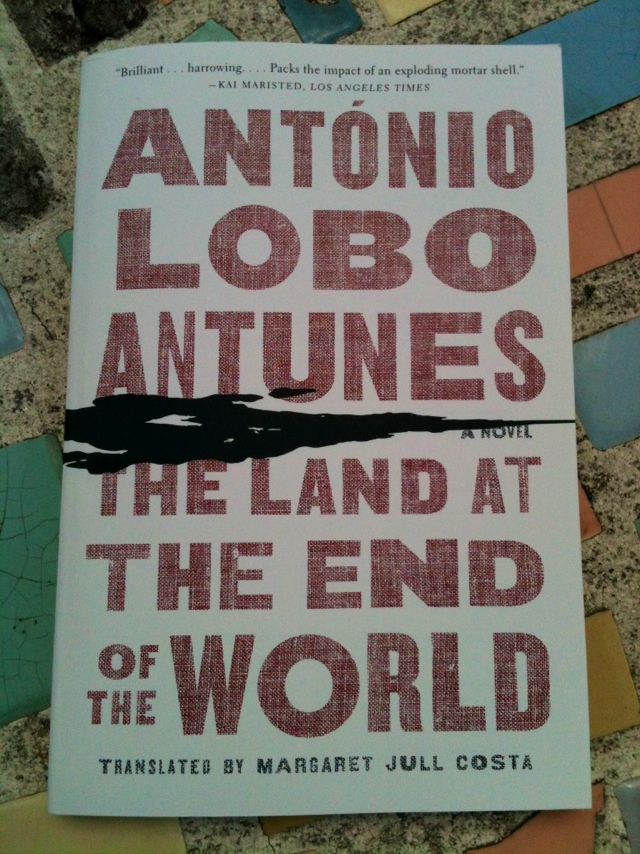
I’ve never read anything by Portuguese author António Lobo Antunes, so I was psyched when his novel The Land at the End of the World showed up in paperback. Here’s an excerpt from Larry Rohter’s review at the NTY:
Combat experiences are like Tolstoy’s unhappy families: no two are alike, which may be why they often make for great novels, as Tolstoy also knew. The cause need not even be noble, since a hopeless situation and senseless violence can actually fortify a work of fiction. Certainly that is the case with António Lobo Antunes’s “Land at the End of the World,” set in Angola in the early 1970s, as Portugal’s ludicrous effort to preserve its African empire was meandering to an inglorious end. . . .
“The Land at the End of the World,” newly translated by Margaret Jull Costa, was originally published in 1979, four years after Portugal’s withdrawal from Africa and the final collapse of America’s intervention in Vietnam. At that time it was interpreted as a comment on the inherent futility of those recent Western adventures in the third world. But read at more than 30 years’ remove from those events much of this account of what Mr. Lobo Antunes’s narrator calls a “painful apprenticeship in dying” would no doubt make sense to survivors of the Iraq and Afghanistan wars.
Morality is the adjustment of matter to its environment—the natural arrangement of molecules. More especially it may be considered as dealing with organic molecules. Conventionally it is the science of reconciling the animal Homo (more or less) sapiens to the forces and conditions with which he is surrounded. It is linked with religion only so far as the natural elements it deals with are deified and personified. Morality antedated the Christian religion, and has many times risen superior to coexistent religions. It has powerful support from very non-religious human impulses. Personally, I am intensely moral and intensely irreligious. My morality can be traced to two distinct sources, scientific and aesthetic. My love of truth is outraged by the flagrant disturbance of sociological relations involved in so-called wrong; whilst my aesthetic sense is outraged and disgusted with the violations of taste and harmony thereupon attendant. But to me the question presents no ground for connexion with the grovelling instinct of religion. However—you may exclude me from the argument, if you will. I am unduly secluded though unavoidably so. We will deal only with materials that may presumably lie within my feeble reach. Only one more touch of ego. I am not at all passive or indifferent in my zeal for a high morality. But I cannot consider morality the essence of religion, as you seem to. In discussing religion, the whole fabric must bear examination before the uses or purposes are considered. We must investigate the cause as well as alleged effects if we are to define the relation between the two, and the reality of the former. And more, granting that the phenomenon of faith is indeed the true cause of the observed moral effects; the absolute basis of that phenomenon remains to be examined. The issue between theists and atheists is certainly not, as you seem to think, the mere question of whether religion is useful or detrimental.
— From H.P. Lovecraft’s 1918 letter to his friend Maurice W. Moe; the letter is collected in The Portable Atheist (ed. Christopher Hitchens).
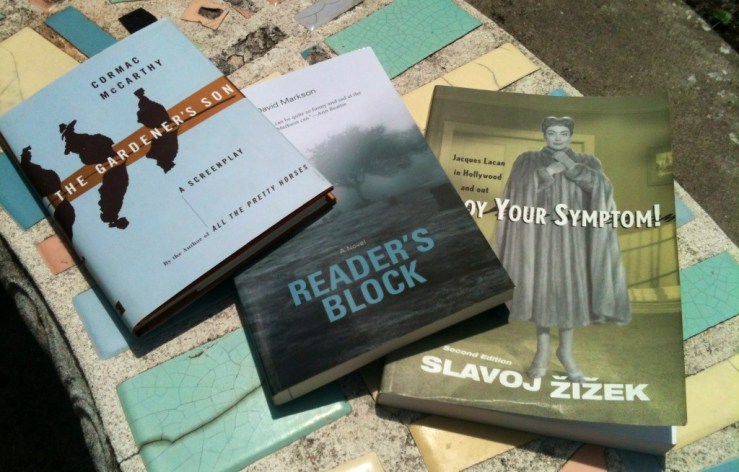
I orderedDavid Markson’s Reader’s Block from my local book shop, and intended to get it—and only it—this Saturday. Somehow I took a detour through the film section and picked up the Žižek and didn’t put it back; in the same section I also picked up McCarthy’s screenplay The Gardener’s Son, which is the only thing I haven’t read by him to date, so I picked it up too. So there you go.
I think it’s an important book—but more than that I think it’s an engrossing, good, excellent book, an enlarging book, a bewildering book, a depressing book, an intelligent book, an extraordinarily affecting book.
I reviewed The Rings of Saturn and you can read that review if you feel the urge for me to support those claims in greater detail.
Better yet, read Sebald’s book.
Whatever you do, please don’t use Grant Gee’s new documentary Patience (After Sebald) as a substitution for actually reading Sebald. It’s not that Gee’s film doesn’t lovingly attempt to approximate the spirit of Saturn. No, Gee and his cast of writers, architects, historians, and other Sebaldians clearly attempt to match the rhythms and moods and content of Saturn—and herein lies the film’s failure.
In an essay on Virginia Woolf—a writer who shows up in both Sebald and in Patience—literary critic (and Sebald champion) James Wood notes the anxiety of influence always at work between the artistic subject and the would-be critic: “The competition is registered verbally. The writer-critic is always showing a little plumage to the writer under discussion.” Wood here is specifically calling attention to Woolf’s own critical powers—of her ability to transcend merely reviewing a work, of her status as a poet-critic—but I think he gives us a simple little rubric for evaluating critical work in general: the truly excellent stuff goes its own route. Gee’s film so dutifully commits to visually and aurally replicating the melancholy and erudite mood of Saturn that it often seems cartoonish or clumsy—or, even worse, dreadfully boring.
It’s not fair to put down one filmmaker for not being more like another, but I wish Gee had taken a page out of, say Errol Morris’s book. Morris’s style is, in a sense, to remove style, to eliminate the aesthetic shield between the subject and the camera/audience. In contrast, Patience is overstylized to an almost embarrassing degree. The film veers between lethargic, numbing black and white shots of the places that Sebald visited on his walking tour in Saturn, occasional archival footage, and slippery impositions of text, maps, documents, and talking heads—sometimes delivered in a bizarre, agitated pace. Perhaps the tone I’ve just described may seem appropriate to any critical measurement of Saturn; in my review of Sebald’s novel, I noted that one element of saturnine melancholy is “sluggishness and moroseness, paradoxically paired with an eagerness for action” — but Gee’s lack of restraint here is bad art school stuff. It’s as if he doesn’t trust the viewer to simply listen to (let alone watch) a talking head for a minute.
A few notes on those talking heads:
There are some very smart people here saying some really cool things about Sebald—writers like Rick Moody and Iain Sinclair, lit critic Barbara Hui (if you’re a Sebald fan you might’ve already seen her maps of his walks), some historians and architects and so on. There are also excerpts of Michael Silverblatt’s Bookworm interview with Sebald woven into the film, sometimes to great effect. Especially interesting are remarks from Christopher MacLehose, Sebald’s publisher, who recounts the time he asked the author which genre his book belonged to. Sebald replied, “Oh, I like all of the categories.”
Gee’s technique with his band of experts is to mostly cast their voices over cold landscape shots, occasionally superimposing a head for a few seconds in a ghostly mishmash that dissolves—along with the voice—into another shot or another voice. Sometimes this is really frustrating because, hey, maybe we’re missing some enlightening remarks, but more often than not it’s frustrating in its sloppiness. Film editing that constantly calls attention to itself is tiresome. The film is at its best when it it stops trying to honor/compete with Saturn and instead imparts some meaningful information about the man and his work. When Patience relaxes enough to simply show archival footage of RAF training flights, it’s a welcome moment from the film’s earnest, torpid buzz.
I realize “torpid buzz” is an oxymoron, but I think it fits Patience. In fact, it might be exactly what Gee was going for. There’s an oppressiveness about the film that belies the often gorgeous and expansive and empty shots of Suffolk, and yes, to be clear, there’s often a similar oppressiveness in Sebald’s book—an oppression of history, of self, of other—but this paradox does not translate well into film.
Sebald makes ample room for his reader; we get to go on this excursion with him. He lets us puzzle out his themes, connect all his strange dots (or not, if we so choose, or, perhaps just as likely, find ourselves unable). The gaps in clear meaning make Saturn such a strange, engrossing book, the kind of book that you return to again and again, the kind of book you press on others (I’ve given away two copies to date). In contrast to the breathing room that Sebald allows his readers, Patience feels somehow stifling and simultaneously small. There’s a brickishness to it, a forceful inclination to fill in all those marvelous Sebaldian gaps. And while yes, some of these people have some really keen insights about Sebald and Saturn, over the film’s interminable 80 minutes these opinions and insights and back stories start to torture meaning out of the text. Any potential reader has had much of her intellectual work removed at this point.
But perhaps I’ve been harsh without illustrating enough. Here’s psychoanalytic critic Adam Phillips who probably gets more voice time than anyone else in Patience; throughout the film he repeatedly over-explains Sebald’s project. I’ll shut up and let him talk (these are a few clips strung together, if my memory is sussing this out right):
Did you watch it? I watched it too—and it seems pretty cool at under four minutes, I’ll admit. But over the course of the film the heavy, “arty” edits, the overexplaining, well . . . it’s too much.
Admittedly, only ten minutes into the film I asked myself who the film was for. As a fan of the book I’d much prefer to just spend 80 minutes of my time rereading parts of it. Or, alternately, a straightforwardish biography would be nice too. And I suppose there are many, many people who will love what Gee’s done (the film has gotten plenty of rave reviews, including one by A.O. Scott at the Times). I also suppose many folks will commend Gee for trying out his own hybrid, for showing a little plumage. This is another way of saying that I think that Gee has turned in the film he intended to make—it just wasn’t for me.









 Biblioklept