“Half Horse Half Alligator” — I Review Charles Olson’s Inimitable Melville Study, Call Me Ishmael

20120616-141629.jpg

The classical Greeks understood that literature is a form of competition. The eminent literary critic Harold Bloom folded a bit of Freudian psychology into this insight, describing the “anxiety of influence” that lurks beneath the impetus to write, the motivation to enter into an agon with the history of letters, to Oedipally assassinate—or at least assimilate—one’s literary forebears. To put this another way: What does it take to write after, say, The Odyssey? How does one answer to The Book of Job? The gall to write after Don Quixote, after Shakespeare, after Dostoevsky, after George Eliot . . .

What about Moby-Dick? What are the possibilities of even writing about Moby-Dick? (One thinks here of Ishmael’s own futile attempts to measure whales). How could Melville write after Job? After Lear? After Moby-Dick? How did Melville assimilate the texts that presented the strongest anxieties of influence in his opus? Could Melville survive the wreckage of The Pequod? These are the questions that poet-critic Charles Olson tackles—sometimes directly, sometimes obliquely, and always with brisk, sharp language—in Call Me Ishmael, his study of Melville and Moby-Dick.

Here’s one answer to my list of questions. It comes early in Olson’s book:

The man made a mess of things. He got all balled up in Christ. He made a white marriage. He had one son die of tuberculosis, the other shoot himself. He only rode his own space once—Moby-Dick. He had to go fast, like an American, or he was all torpor. Half horse half alligator.

Melville took an awful licking. He was bound to. He was an original, aboriginal. A beginner. It happens that way to the dreaming men it takes to discover America . . . Melville had a way of reaching back through time until he got history pushed back so far he turned time into space. He was like a migrant backtrailing to Asia, some Inca trying to find a lost home.

We are the last “first” people. We forget that. We act big, misuse our land, ourselves. We lose our own primary.

Melville went back, to discover us, to come forward. He got as far as Moby-Dick.

This passage illustrates Olson’s forceful, often blunt prose, the kind of language that cracks directly at Melville’s own impossible prose in Moby-Dick. I think here of the critic James Wood’s notation in his essay “Virginia Woolf’s Mysticism” that

The writer-critic, or poet-critic, has a competitive proximity to the writers she discusses. The competition is registered verbally. The writer-critic is always showing a little plumage to the writer under discussion. If the writer-critic appears to generalize, it is because literature is what she does, and one is always generalizing about oneself.

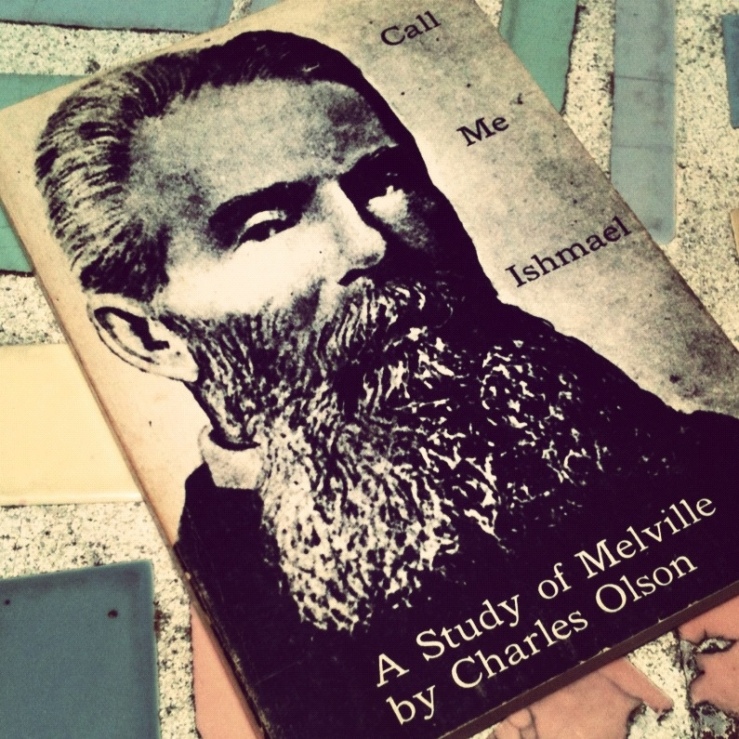
Olson may generalize as he shows a little plumage to master Melville, cutting through huge swaths of history and making poetic leaps into strange similes, but Call Me Ishmael is ultimately keenly attenuated to detail, to the processes of Melville’s constructions at the historical, economic, psychological, religious, and, yes, literary level. Although a slim 119 pages in my 1947 City Lights edition, Call Me Ishmael nevertheless vividly conveys the sources Melville synthesized to create Moby-Dick.

The book begins with an unsourced account of the whaleship Essex, attacked and destroyed by a sperm whale in the Pacific in 1820, a year after Melville’s birth. Olson trusts his readers to connect The Essex to The Pequod. Unlike so much literary scholarship, Olson’s Ishmael doesn’t torture every element of the text into overwrought explications. He provides an overview of the importance of whaling-industry-as-world’s-fuel source in a chapter that reads more like a prose poem than a stuffy history book, and then, in a chapter appropriately titled “Usufruct,” offers up entries from Melville’s own journals as primary evidence of the material that led to Moby-Dick. Olson rarely sticks his nose in here, letting the reader synthesize the selections.

Olson then plumbs Moby-Dick’s literary roots, delving into Shakespeare, particularly Lear and Antony and Cleopatra. He attends to Melville’s own annotations to Shakespeare, and then points out Melville’s literary/political condensation:

As the strongest force Shakespeare caused Melville to approach tragedy in terms of the drama. As the strongest social force America caused him to approach tragedy in terms of democracy.

It was not difficult for Melville to reconcile the two. Because of his perception of America: Ahab . . .

Ahab is the FACT, the Crew the IDEA. The Crew is where what America stands for got into Moby-Dick. They’re what we imagine democracy to be. They’re Melville’s addition to tragedy as he took it from Shakespeare. He had to do more with the people than offstage shouts in a Julius Caesar. This was the difference a Declaration of Independence made.

The Shakespeare section of Call Me Ishmael marvels: Olson’s perceptive powers simultaneously enlighten and make seemingly-familiar territory dark, strange. He then moves into a discussion of post-Moby Melville, a man perhaps crushed by his own achievement—not by any financial success, no, definitely no, but the metaphysical success. Like a Moses, Melville had found the god he so desperately needed:

Melville wanted a god. Space was the First, before time, earth, man. Melville sought it: “Polar eternities” behind “Saturn’s gray chaos.” Christ, a Holy Ghost, Jehovah never satisfied him. When he knew peaces it was with a god of Prime. His dream was Daniel’s: the Ancient of Days, garment white as snow, hair like the pure wool. Space was the paradise Melville was exile of.

When he made his whale he made his god. Ishmael once comes to the bones a Sperm whale pitched up on land. They are massive, and his struck with horror at the “antemosaic unsourced existence of the unspeakable terrors of the whale.”

When Moby-Dick is first seen he swims a snow-hill on the sea. To Ishmael he is the white bull Jupiter swimming to Crete with ravished Europa on his horns: a prime, lovely, malignant white.

Olson agrees with an 1856 journal entry by Nathaniel Hawthorne that he cites at length: Melville “can neither believe, nor be comfortable in his unbelief.” In Olson’s analysis, after having found god-in-the-whale, Melville plummets into an existential crisis. He gives over to his inner-alligator, torpid, enervated, numb, but still fierce and potent and monstrous. “He denied himself in Christianity,” writes Olson, linking the downward spiral of Melville’s career and family life to this religion.

To this end, Olson is too dismissive of Melville’s later work; when he can find nothing of the “old Melville” to praise in Benito Cereno, Bartleby, or Billy Budd, it’s almost as if he’s willfully ignoring evidence that contradicts his thesis. These are marvelous books, and if they can’t win a contest against Moby-Dick, it’s worth pointing out that little of what’s been written after that book can.

And yet we can write after Melville; we can even write on Melville. The will and vitality of Olson’s forceful, intelligent prose opens a way, or at least exemplifies a way. At the same time, paradoxically, a reading of Call Me Ishmael seems to foreclose the need, if not the possibility, of reading another study of Moby-Dick. This statement is not meant to be a knock against Melville scholarship. Here’s the thing though: life is short, time is limited, and if one plans to read a book about Moby-Dick, it should be Olson’s Call Me Ishmael. It’s great, grand stuff.

Woman Reading (1953) — Pablo Picasso

“They Passed in Review” (Mark Twain Illustration)

Image by Daniel Carter Beard for Twain’s 1897 volume Following the Equator.
Despair/Food (Books Acquired 6.08.2012)

20120611-150115.jpg

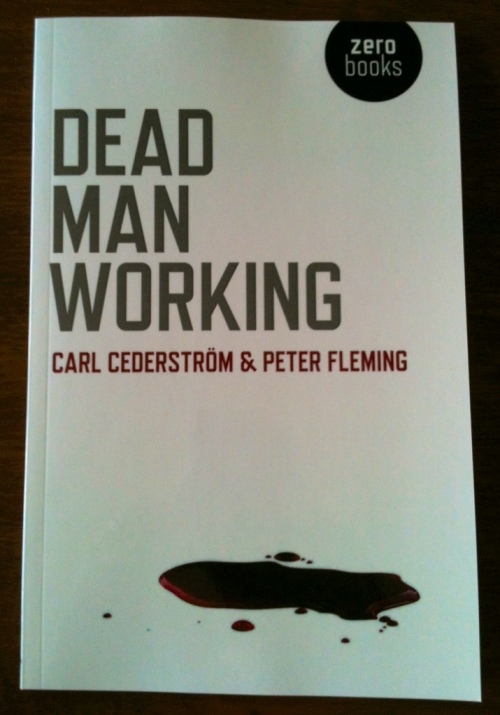
 Dead Man Working is the latest from Carl Cederström (whose discussions with Simon Critchley became How to Stop Living and Start Worrying) and Peter Fleming. The book explores the existential despair of workers in our post-capitalist age. (It’s funnier than that description might suggest). Publisher Zer0’s blurb:

Capitalism has become strange. Ironically, while the ‘age of work’ seems to have come to an end, working has assumed a total presence – a ‘worker’s society’ in the worst sense of the term – where everyone finds themselves obsessed with it. So what does the worker tell us today? ‘I feel drained, empty – dead’; This book tells the story of the dead man working. It follows this figure through the daily tedium of the office, to the humiliating mandatory team building exercise, to awkward encounters with the funky boss who pretends to hate capitalism and tells you to be authentic. In this society, the experience of work is not of dying…but neither of living. It is one of a living death. And yet, the dead man working is nevertheless compelled to wear the exterior signs of life, to throw a pretty smile, feign enthusiasm and make a half-baked joke. When the corporation has colonized life itself, even our dreams, the question of escape becomes ever more pressing, ever more desperate.

Full review on deck.

20120611-150100.jpg

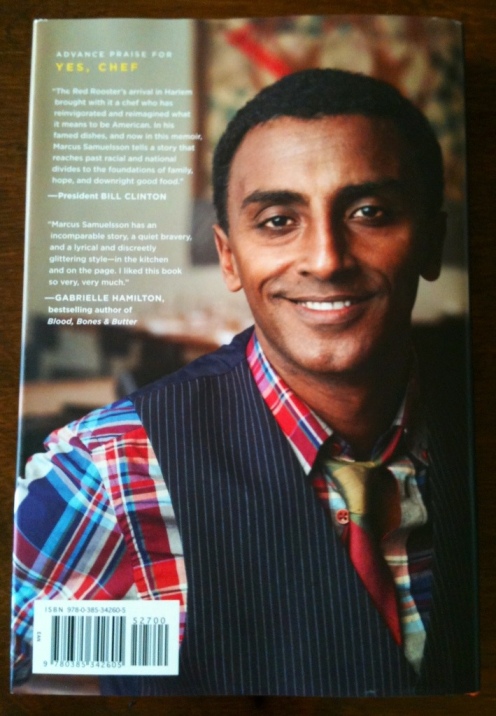
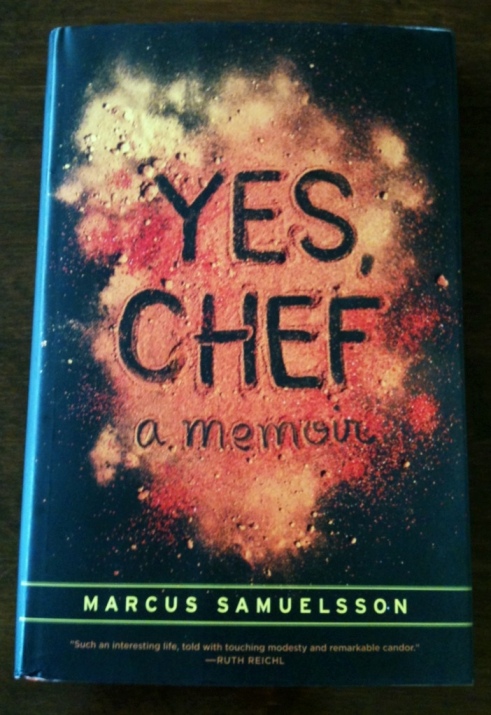
Yes, Chef is Marcus Samuelsson’s memoir. If that name sounds familiar, you might recognize his face:

20120611-150108.jpg

Publisher Random House’s blurb:

Marcus Samuelsson was only three years old when he, his mother, and his sister—all battling tuberculosis—walked seventy-five miles to a hospital in the Ethiopian capital city of Addis Adaba. Tragically, his mother succumbed to the disease shortly after she arrived, but Marcus and his sister recovered, and one year later they were welcomed into a loving middle-class white family in Göteborg, Sweden. It was there that Marcus’s new grandmother, Helga, sparked in him a lifelong passion for food and cooking with her pan-fried herring, her freshly baked bread, and her signature roast chicken. From a very early age, there was little question what Marcus was going to be when he grew up.

Yes, Chef chronicles Marcus Samuelsson’s remarkable journey from Helga’s humble kitchen to some of the most demanding and cutthroat restaurants in Switzerland and France, from his grueling stints on cruise ships to his arrival in New York City, where his outsize talent and ambition finally come together at Aquavit, earning him a coveted New York Times three-star rating at the age of twenty-four. But Samuelsson’s career of  “chasing flavors,” as he calls it, had only just begun—in the intervening years, there have been White House state dinners, career crises, reality show triumphs and, most important, the opening of the beloved Red Rooster in Harlem. At Red Rooster, Samuelsson has fufilled his dream of creating a truly diverse, multiracial dining room—a place where presidents and prime ministers rub elbows with jazz musicians, aspiring artists, bus drivers, and nurses. It is a place where an orphan from Ethiopia, raised in Sweden, living in America, can feel at home.

With disarming honesty and intimacy, Samuelsson also opens up about his failures—the price of ambition, in human terms—and recounts his emotional journey, as a grown man, to meet the father he never knew. Yes, Chef is a tale of personal discovery, unshakable determination, and the passionate, playful pursuit of flavors—one man’s struggle to find a place for himself in the kitchen, and in the world.

Josh Henkin Talks to Biblioklept About His New Novel, The World Without You

Joshua Henkin’s new novel, The World Without You, tells the story of the Frankels, a large Jewish American family who gather over the Fourth of July weekend to mourn the death of their son Leo, a journalist who was kidnapped and then murdered in Iraq. The World Without You is Henkin’s third novel after Matrimony and Swimming Across the Hudson. Henkin directs the MFA program in Fiction Writing at Brooklyn College. The World Without You is new in hardback from Pantheon. You can learn more about Henkin at his website. He was gracious enough to talk to me over a series of emails about writing, teaching, verb tense, sympathy, and his new novel.

Biblioklept: There’s a lot going on in The World Without You, but it seems to be essentially a novel about a family—what it means to be a family, what it means to be in a family, what it means to be in conflict with a family—where did the Frankels come from?

Josh Henkin: The most simple answer is, My imagination.  The Frankels aren’t based on anyone I know, and like all characters in fiction (at least the kind of fiction I write), they developed slowly over time; I discovered them in the writing process over the course of quite a number of years.  What I would say is that I think that in the same way that people speak of “rebound relationships,” I think of my novels as “rebound novels.”  Matrimony took place over twenty years and focuses on a small cast of characters, and I wanted to write something different this time.  So, whether consciously or not, I set out to write a book that was more compressed, on one hand (it takes place over 72 hours instead of over 20 years), and more spacious, on the other hand (there are many more characters, and we go into many points of view).  If you’re asking where the inspiration for the book came from, I’d say it came mostly from the following.  I had a first cousin who died of Hodgkin’s disease when he was in his late twenties. I was only a toddler at the time, but his death hung over my extended family for years. At a family reunion nearly thirty years later, my aunt, updating everyone on what was happening in her life, began by saying, “I have two sons….” Well, she’d once had two sons, but her older son had been dead for thirty years at that point. It was clear to everyone in that room that the pain was still raw for her and that it would continue to be raw for her for the rest of her life. By contrast, my cousin’s widow eventually remarried and had a family. This got me thinking how when someone loses a spouse, as awful as that is, the surviving spouse eventually moves on; but when a parent loses a child they almost never move on. That idea was the seed from which The World Without You grew. Although there are many tensions in the novel (between siblings, between couples, between parents and children), the original tension was between mother-in-law and daughter-in law, caused by the gulf between their two losses, by the different ways they grieve.

Biblioklept: You mention the compression of The World Without You, which here strikes me as form of realism. The book takes place over the July 4th holiday—why did you choose this setting? Was the Independence Day setting always part of your design?

JH: I knew I wanted a compressed period of time–mostly because Matrimony took place over twenty years and I think of books like relationships:  one book is a rebound from the previous one.  I also knew that I wanted the book to be told in many points of view; this, too, makes it different from Matrimony, which was told only in Julian and Mia’s points of view.  In terms of Independence Day, I think that was a little more unconscious, though probably intentional as well.  Part of the issue was a practical one:  how do you get a large, disperse family together in one place?  You need an occasion for the telling, and a holiday like July 4th provides one.  Though of course the real occasion for the telling is Leo’s memorial.  But I think even there Independence Day is relevant because although the book is obviously about the specific characters (I think all fiction worth its salt is always first and foremost about the particular, not the general), I do think this novel in its own indirect way is a novel about America more broadly, and certainly about a certain segment of America, of which I consider myself a part.  The Frankels are a political family, with strong opinions about Bush and about the Iraq War, but they’re also privileged.  They’ve really known no one who has fought in the war, have been insulated from it in their day-to-day lives–and then, with Leo’s death, it comes and touches them in the most horrific and personal way.  And I wondered what that’s like–to be mourning while the rest of the country is celebrating, to be commemorating the independence of a country that has sent its young men and women to war, a country that’s responsible for their son and brother’s death.

Biblioklept: You mention the Frankels’s privileged background. They are, for the most part, liberal, secular, refined. Leo dies in Iraq, but, significantly, he’s a journalist, not a soldier. Do you worry that not all readers will connect to these characters? How do you make your characters sympathetic—or does sympathy even matter in fiction?

JH: My feeling is that people are people, and they merit as little or as much sympathy as they merit whether they’re rich or poor, healthy or sick, beautiful or ugly.  There’s a strand of anti-elitism in American culture  (one can see it every day, tirelessly, in our politics), and one sees it, too, in certain attitudes toward literature–the idea being that only the humble, the uneducated are worthy of our fiction.  But I find the idea pretentious; it smacks of a kind of reverse snobbery.  And tell it, in any case, to Fitzgerald, or Cheever, or Yates.  One of the things good literature does is it humanizes people we might not otherwise be drawn to.  And (this is at least as important) it allows us to enjoy the company of people on the page whose company we might not enjoy off the page.  Which is another way of saying that sympathy doesn’t matter in fiction, at least not sympathy narrowly construed.  In fiction, as in life, some people are likable and some people aren’t likable, and the world would be boring if everyone were likable.  The fiction writer’s job is to make his characters complex, interesting, fully human, not (or at least not necessarily) likable.

Biblioklept: The World Without You is conveyed in the present tense. I’m curious what led you to compose in the present tense, or if you drafted parts of the novel in the past tense—what advantages can the present tense offer the writer and reader? What are its limitations?

JH: I think about tense a lot, probably because I teach fiction writing and, more specifically, because I direct Brooklyn College’s Fiction MFA program, and so I end up reading 500 application manuscripts a year, a good number of which are written in the present tense.  It’s said that present tense makes the story feel more immediate, yet year after year I notice among our graduate applications that the present-tense stories are usually the least immediate, most inert stories in the bunch.  Why is that?  I think it’s because some writers use present tense as a substitute for narrative, as a way of hiding that nothing is happening in their stories.  They think that if they write in present tense their stories will feel immediate.

I also think that present tense is deceptive because it’s easy in present tense to slip out of scene and into general/habitual time.  In the past tense, you would write “She went to the store on Tuesday” to suggest that the character is going to the store at a specific time.  If, on the other hand, you wanted to indicate repeated or habitual action, you would write, “She would go to the store on Tuesday.”  But in the present tense there generally isn’t such a distinction between the specific and the habitual.  “She goes to the store on Tuesday” can mean either that she’s going to the store right now on Tuesday or that she’s a habitual store-goer on Tuesdays.  I think what happens in present tense is that a lot of writers end up slipping into the habitual, and so what seems immediate is actually not at all immediate.

The other thing I’d say is that it’s very hard to write a present-tense novel that takes place over ten years because it’s likely to feel artificial for all that time to be in present tense.  Present tense works best, then, in novels and stories told in compressed time.

The World Without You simply came to me in present tense.  That was the tense that felt right for the book.  This may be true, in part, because I’d been influenced by Richard Ford’s Independence Day, another novel told over a single July 4th holiday that’s told in present tense.  But I think it’s more than that.  The World Without You takes place over 72 hours, so it’s ideally suited for present tense, and it’s also told in confined space; most of the book is situated in the Frankel family home and the streets that surround it in Lenox, Mass.  One thing I was trying to do was balance the sprawling quality of the book (there are many characters and lots of different points of view) with the more focused time and space that I just mentioned, and I think present tense allowed me to do that.  But all this is post-facto, a case of me looking back at what I did.  I proceeded intuitively, which is what I always do, and present tense simply felt right (it was the right sound, the right voice) for this book.

Biblioklept: You bring up your position as Brooklyn College’s MFA fiction program director—I’m curious if reading so many manuscripts affects your own writing.

JH: I love teaching, and that’s in large part because I get to teach some of the most talented young writers out there.  In the last few months alone, five of our recent MFA graduates have gotten book contracts.  There are writers who wouldn’t know how to teach; for them, writing is an intuitive process and they aren’t fully conscious of what they’re doing.  For me, it was the opposite.  I could read someone else’s short story and figure out what wasn’t working long before I could make things work in my own stories.  I needed to learn how to become a more intuitive writer, and critiquing other people’s stories helped me do that; it still helps me.  I’ve been at this process longer than my students have, but we’re all struggling with the same thing—how to write convincing stories; how to make our characters comes so deeply to life they feel as real as, even realer than, the actual people in our own lives; how to use language in a way that’s precise and beautiful and utterly true.  That never changes.  So in a way, even though I’m the instructor, we’re all students in the room.  Also, I’m a fairly social person, and writing is incredibly solitary, so teaching gives me the chance to be with other people and to talk about the work I love.

Biblioklept: Are there manuscripts that come in where you just kind of slap your forehead and go, “Not another story about ______ again!”

JH: Absolutely.  Many of my graduate students are in their mid-twenties, and so they write about the concerns of people in their mid-twenties.  How to find love in the big city, that kind of thing.  That’s okay.  If it’s done well, just about any subject matter can make for compelling fiction, and in any case, my students won’t be in their mid-twenties forever.  That’s one of the nice things about being a writer.  You mature; you get better over time.  Writing is different from figure skating.  It’s even different from playing the violin.  You can be in your late forties and still be a young writer.  At least that’s what I like to tell myself!

Often it’s less a similarity of subject matter that I see than a similarity of voice or sensibility.  For a time I saw a lot of Lorrie Moore imitators.  Then I saw a lot of George Saunders imitators.  If you’re going to imitate someone, those are two pretty good choices, though in a lot of ways Moore and Saunders are inimitable.  But that’s fine.  Imitation is part of the maturing process.  It’s how a writer achieves her own voice.

Biblioklept: Do you have any upcoming writing projects? What are you working on next?

JH: My most immediate project is a trip to Hawaii! Writing a novel takes a lot out of you. Right now, I’m trying to figure out what comes next. I promised myself I would go back to writing short stories. It’s weird, I’ve spent the last nearly twenty years writing novels, when in so many ways I think of myself as a short-story writer. It was certainly my first love, and because I teach MFA students, I spend a lot of time reading and thinking about short stories. So last fall, when I finished the final draft of The World Without You, I immediately sat down to write a short story, and what happened? The draft I wrote was 113 pages along! And then the second short story I wrote was over 200 pages long! I still think I’m capable of writing a regular old twenty-to-thirty-page short story, but we’ll have to see. In the meantime, I’m tossing around some ideas for a new novel, but it’s still in the very early, incubating stages, so I’m not saying anything more than that.

Biblioklept: Have you ever stolen a book?

JH: Alas, I have not.  But I’m working on it.

Philosopher Reading — Rembrandt

Portrait of Rembrandt’s Father — Rembrandt

Portrait of the Artist’s Father — Gustave Courbet

Portrait of My Father — Frida Kahlo

Portrait of the Artist’s Father — Marcel Duchamp

Max Ernst Showing a Young Girl the Head of his Father — Max Ernst

The Painter’s Father — Lucian Freud

Portrait of My Father (1925) — Salvador Dali

Albrecht Dürer’s Father — Albrecht Dürer

Book Shelves #25, 6.17.2012

20120616-143021.jpg

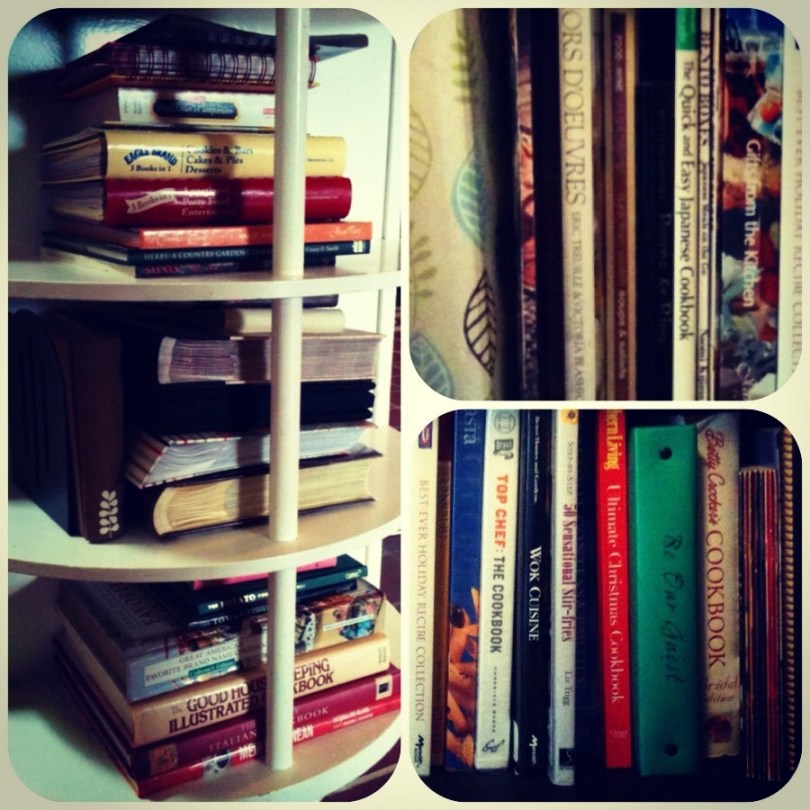
Book shelves series #25, twenty-fifth Sunday of 2012: Cookbooks and some photo albums.

We’ve moved out of the living room and looped into the kitchen/eat-in dining room. Cookbooks and photo albums occupy a little-built in under the eat-in counter.

There’s a shelf of cookbooks at the bottom of a buffet-thing. In the good old days it held vinyl LPs.

Escher’s Father — M.C. Escher

“The Son Never Asked to Be Born” — Roberto Bolaño’s Parenting Advice

Roberto Bolaño, from an interview with Eliseo Álvarez, republished this month in Melville House’s Roberto Bolaño: The Last Interview:

I suppose that within his brutality and his courage–he is a very courageous man–my father loved me as I love my son. In the end, one could talk for hours about the relationship between a father and a son. The only clear thing is that a father has to be willing to be spat upon by his son as many times as the son wishes to do it. Even still the father will not have paid a tenth of what he owes because the son never asked to be born. If you brought him into this world, the least you can do is put up with whatever insult he wants to offer.

Okay, so sons didn’t ask to be born, but what about daughters? How did Bolaño feel about his daughter?

I won’t say anymore. I’ll start to cry. The only explanation I could give would be to cry. It’s beyond the beyond.

Reading these quotes, I thought about two of my favorite depictions of fathers and children in Bolaño’s work. First, there’s Bolaño as the son, “B,” in the title track from the collection Last Evenings on Earth. The story is a strange mix of sinister and funny, with the (perhaps overly literary) son fearing for his dad, a boxer who, at least in the son-narrator’s view, doesn’t seem to be paying attention to just how bad things seem to be turning on the pair’s vacation to Acapulco. Then there’s (possibly) Bolaño as parent, this time in the form of Oscar Amalfitano in 2666. If Bolaño would cry for his daughter’s safety, for anxiety and wariness of a cruel world, then Amalfitano becomes a literary center for those fears. And, if you’ve read that book, you know his paranoia is justified. In any case, it’s clear that Bolaño loved his children deeply. In another of the the book’s interviews–literally, “The Last Interview,” Bolaño, the exile who lived everywhere said, “my only country is my two children.” He even asked that his masterpiece 2666 be divvied up into five parts in the hopes that it would provide steady income for his son and daughter.