This Steely Dan Documentary Is Worth Your Time Even If You Don’t Like Steely Dan

Even if you don’t like Steely Dan, this 1999 documentary about the making of their 1977 album Aja is fantastic. First off, it’s fucking hilarious—Walter Becker and Donald Fagen come across as the smartest, most venomous guys in the room—a wicked mixture of witty and cruel—-and watching them discuss each track, and each part of each track is fascinating (especially when they pick apart failed guitar solos). The film also features a marvelous supporting cast, including braggart percussionist Bernard Purdie (of “The Purdie Shuffle” fame), and poor old Michael McDonald, who struggled to nail his background parts on “Peg.” What might be most fascinating though is seeing how Fagen and Becker pieced the instrumental tracks of Aja together, bringing in different session musicians—entirely different bands—from day to day. And if you’re still not convinced, here’s a sample (of a sample):


Barry Hannah on Southern Literature

From The Paris Review’s interview with Barry Hannah

INTERVIEWER

Do you think you can still say there is a Southern literature? That people aren’t just hanging onto something that no longer really exists?

HANNAH

Yes. Remember that the South—and this is what people forget—the South is sixteen states and it’s the biggest region. It and the West are enormous country. Of the sixteen states, from Texas on up to Virginia, there is a stamp that means love of language and stories. But that might be the extent of the similarities. Texas lit is nothing like Virginia lit. The Tidelands is nothing like Appalachian. We’re talking about an enormous nation. We’re talking about people who love blacks more than Northerners. We’re talking about people who deeply hate them more than anybody in the world. So, yes, that’s Southern lit but that’s like saying—oh, let us say German lit. Heavily philosophic is what we usually think.

But the Germans also command that you have fun. So we can say certain things about Germans but there are huge varieties, and Germany’s much smaller than the South.


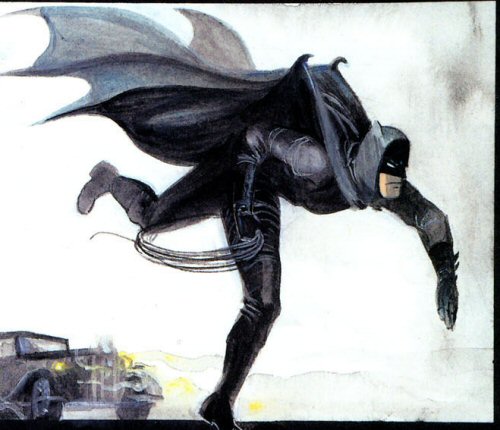
Batman — Eddie Campbell

eddie_campbell_BatmanTheOrderofBeasts24

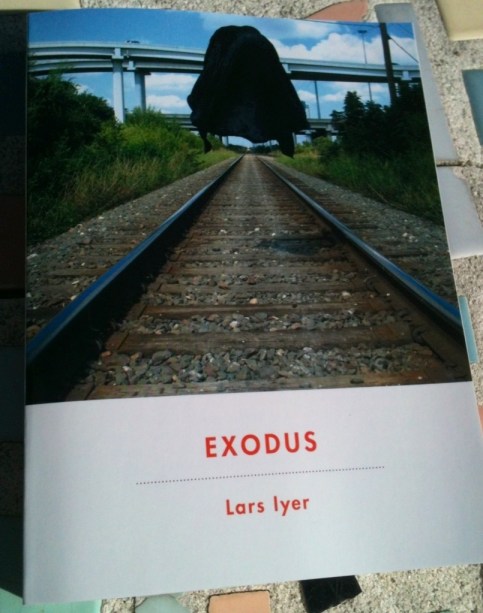
Lars Iyer’s Exodus (Book Acquired, 1.15.2013)

20130120-173952.jpg

Lars Iyer’s latest, Exodus presumably concludes the trilogy that began with Spurious and DogmaExodus picks up the adventures/failures of our tragicomic (anti)heroes Lars and W. Here’s publisher Melville House’s description:

With philosophy professors being moved to badminton departments and gin in short supply — although not short enough—the two hapless intellectuals embark on a relentless mission. Well, several relentless missions. For one, they must help gear a guerrilla philosophy movement — conducted outside the academy, perhaps under bridges — that will save the study of philosophy after the long intellectual desert known as the early 21st-century.

For another, they must save themselves, perhaps by learning to play badminton after all. Gin isn’t free, you know.

Exodus is on deck in my reading stack.  I talked to Lars a few years ago about Spurious (and other stuff), and he brought up the idea of “exodus” (as in the concept, not the book) early on:

As someone who had made some progress as an academic – a journey which implies valuable training as well as compromise and despair – I thought a kind of exodus was necessary, from existing forms of published writing. Leave it all behind!, I told myself. Leave the Egypt of introductory books and academic journals and edited collections behind. Leave the slave-drivers behind, and the sense you have of being a slave. Leave capitalism and capitalist relations behind. Leave behind any sense of the importance of career and advancement. Leave behind those relationships that are modeled on investment and return.

I love the cover on this one.


Remedios Varo Wearing a Mask by Leonora Carrington and Kati Horna

Remedios+Varo,+wearing+a+mask+made+by+Leonora+Carrington+and+Kati+Horna,+1957+(Kati+Horna)

The Cut Pig — Isaac van Ostade

“Beyond the Door” — Philip K. Dick

“Beyond the Door” by Philip K. Dick

Larry Thomas bought a cuckoo clock for his wife—without knowing the price he would have to pay.

That night at the dinner table he brought it out and set it down beside her plate. Doris stared at it, her hand to her mouth. “My God, what is it?” She looked up at him, bright-eyed.

“Well, open it.”

Doris tore the ribbon and paper from the square package with her sharp nails, her bosom rising and falling. Larry stood watching her as she lifted the lid. He lit a cigarette and leaned against the wall.

“A cuckoo clock!” Doris cried. “A real old cuckoo clock like my mother had.” She turned the clock over and over. “Just like my mother had, when Pete was still alive.” Her eyes sparkled with tears.

“It’s made in Germany,” Larry said. After a moment he added, “Carl got it for me wholesale. He knows some guy in the clock business. Otherwise I wouldn’t have—” He stopped.

Doris made a funny little sound.

“I mean, otherwise I wouldn’t have been able to afford it.” He scowled. “What’s the matter with you? You’ve got your clock, haven’t you? Isn’t that what you want?”

Doris sat holding onto the clock, her fingers pressed against the brown wood.

“Well,” Larry said, “what’s the matter?”

He watched in amazement as she leaped up and ran from the room, still clutching the clock. He shook his head. “Never satisfied. They’re all that way. Never get enough.”

He sat down at the table and finished his meal.

The cuckoo clock was not very large. It was hand-made, however, and there were countless frets on it, little indentations and ornaments scored in the soft wood. Doris sat on the bed drying her eyes and winding the clock. She set the hands by her wristwatch. Presently she carefully moved the hands to two minutes of ten. She carried the clock over to the dresser and propped it up.

Then she sat waiting, her hands twisted together in her lap—waiting for the cuckoo to come out, for the hour to strike.

As she sat she thought about Larry and what he had said. And what she had said, too, for that matter—not that she could be blamed for any of it. After all, she couldn’t keep listening to him forever without defending herself; you had to blow your own trumpet in the world. Continue reading ““Beyond the Door” — Philip K. Dick”

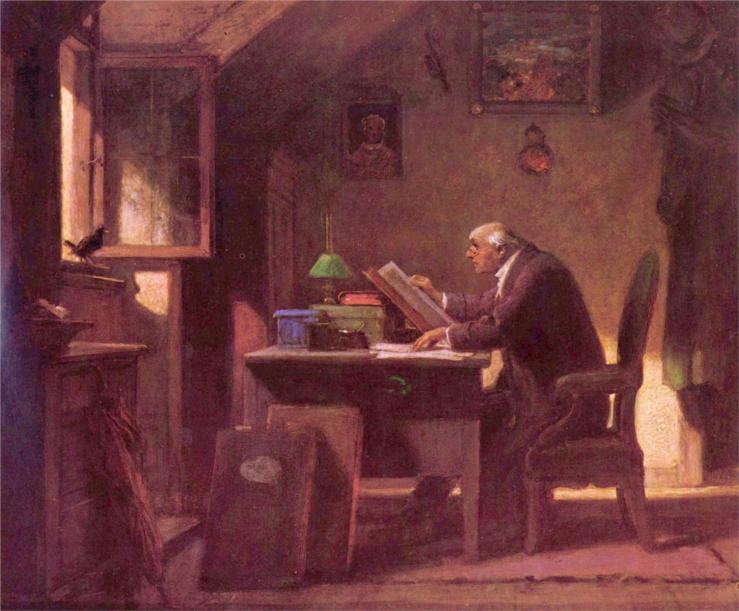
A Visit — Carl Spitzweg

a-visit.jpg!HD