Before mp3s, we used to buy these things called seven-inches, small disks of vinyl, usually played at 45rpm, usually offering an a-side with the band or singer’s single, and backed with (b/w) a b-side offering a song (or songs!) that probably wouldn’t be on the album. A lot of times, 7″s would consist of songs that wouldn’t be on any album. Or that would be it for the band—just the one 7″. I bought many, many of these little disks between 1992 and 1999, and I still have three boxes full of them gathering dust in a utility room.
Anyway, new feature: I’ll pull out one each Sunday, listen to it, photograph it, share some thoughts on it, etc.
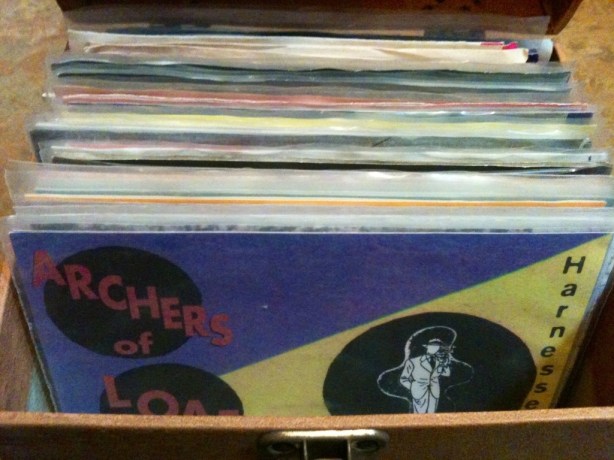
For this week, I pulled out the closest box and then pulled out the first 7″ in the stack: Archers of Loaf’s 1995 single for “Harnessed in Slums,” b/w “Telepathic Traffic.”
“Harnessed in Slums” is the second track from the band’s second album, 1996’s album Vee Vee.
Vee Vee came out shortly after the 1995 EP Vs. the Greatest of All Time, which I think might be the Archers’ best work—or at least, that’s how I remember it. Anyway, I loved this early arc of the band’s career, which kicked off with Icky Mettle, a basically perfect glob of nineties indie rock.
I haven’t listened to Archers of Loaf in years. I lost interest in what the band was doing by the late nineties, and like many of the albums I listened to thousands of times in my teens, I find their music too intertwined in intense memories and feelings to listen to again. I have a hard time extricating the psychic detritus of my youth from certain albums.
The crunchy warbled opening of “Harnessed in Slums” brought back a strange rush of the past. I remembered seeing the band—on a school night!—in support of Icky Mettle. My friend Wayne brought a paper headband to the show and guitarist Eric Johnson wore it through most of the set. They gave us the set list (on a paper plate) and autographed stuff. I wonder if they thought it was weird that we wanted their autographs—I think it’s weird now. (By the time I was 17 I had almost no interest in talking to anyone in a band, let alone getting an autograph).
“Harnessed in Slums” is a perfect Archers track, poppy, proggy, fake-sloppy, a punk anthem channeled through the crunchy trademark sound of the 1990s NC Triangle. Weirder and darker than Superchunk, tighter and more metallic than Pavement, Archers of Loaf hit a not-too-sweet spot somewhere between prog virtuosity and DIY punk aesthetic. The lyrics are bizarre, maybe meaningless, a shout-along that could have come from a Burroughs cut up (“I want waste / We want waste / They want waste / Slaves want waste”; “Strip the color from the meat of my eye”).
The b-side is “Telepathic Traffic,” a jam that swells with acoustic guitars and snaky, snarly guitar lines—there’s almost something crime noir about the song. It’s sinister anyway. Eric Bachmann’s opening barks are almost comical, as if he’s imitating some British post-punk hero, before clustering into a pogoing chorus. “Telepathic Traffic” bears a few too many conventions that can become tiresome over an album—the track slows and speeds up unnecessarily when it should plow straight ahead (or perhaps just get faster).
Listening to these tracks again doesn’t make me want to pull out Icky Mettle as much as it makes me want to check out Erich Bachmann’s latest stuff. Has he mellowed out? Added more/different instrumentation? Complicated or simplified his sound? I remember being perplexed by his 1995 solo album Barry Black, which I recall having chamber arrangements. Maybe I should check it out.
André Brink’s Philida is new in handsome trade paperback from Vintage. Love the cover on this one, and the story seems intriguing. From the Man Booker Prize site (the book was longlisted last year):
The year is 1832 and the Cape is rife with rumours about the liberation of the slaves. Philida made a pact for freedom with Francois Brink, the son of her master, but he has reneged on his promise to set her free. Deciding to take matters into her own hands, Philida risks her life by setting off on foot for distant Stellenbosch, in a journey that begins with the small act of saying no.
And from The Guardian’s favorable review:
In order to underline the multiplicity of experiences, Philida hops from one narrator to another, interspersed with third-person, quasi-historical material; each chapter begins with what is to follow in précis (“In which Philida and Ouma Petronella travel to the Caab where they encounter a woman who farms with slaves”), gesturing towards the conventions of both the picaresque novel and the folk-tales that [one of the characters] relates. Unsurprisingly, given the strength of her story, Philida’s voice dominates. If she can occasionally feel like a mouthpiece for a rather overworked metaphor (“What happen to me will always be what others want to happen. I am a piece of knitting that is knitted by somebody else.”), she can also be brilliantly irreverent and almost ribald. “That’s what the old goat make us listen to every night at prayers,” she reflects on Cornelis’s fondness for Bible stories of a sexual nature. “And almost every time it is a woman who get it in her sticky parts.”
Il n’y a de livres que ceux où un écrivain s’est raconté lui-même en racontant les mœurs de ses contemporains—leurs rêves, leurs vanités, leurs amours, et leurs folies.— Remy de Gourmont.
De Gourmont uses this sentence in writing of the incontestable superiority of “Madame Bovary,” “L’Éducation Sentimentale” and “Bouvard et Pécuchet” to “Salammbô” and “La Tentation de St. Antoine.” A casual thought convinces one that it is true for all prose. Is it true also for poetry? One may give latitude to the interpretation of rêves; the gross public would have the poet write little else, but De Gourmont keeps a proportion. The vision should have its place in due setting if we are to believe its reality.
The few poems which Mr. Eliot has given us maintain this proportion, as they maintain other proportions of art. After much contemporary work that is merely factitious, much that is good in intention but impotently unfinished and incomplete; much whose flaws are due to sheer ignorance which a year’s study or thought might have remedied, it is a comfort to come upon complete art, naïve despite its intellectual subtlety, lacking all pretense.
It is quite safe to compare Mr. Eliot’s work with anything written in French, English or American since the death of Jules Laforgue. The reader will find nothing better, and he will be extremely fortunate if he finds much half as good.
The necessity, or at least the advisability of comparing English or American work with French work is not readily granted by the usual English or American writer. If you suggest it, the Englishman answers that he has not thought about it—he does not see why he should bother himself about what goes on south of the channel; the American replies by stating that you are “no longer American.” This is the bitterest jibe in his vocabulary. The net result is that it is extremely difficult to read one’s contemporaries. After a time one tires of “promise.” Continue reading ““T.S. Eliot” — Ezra Pound”→







 Biblioklept