I spent most of this day—Sunday that is—swamping out my garden shed, recently rat-infested. Big wood rats, or river rats as we sometimes call them here, some of us.
This meant sterilizing the whole deal, spraying a bleach solution, wearing appropriate eye and nose and mouth protection, because getting older and having kids I now seem to care about my oh-so-important sensory organs more than I did in my twenties. This meant removing rat feces and a few dead rats. Just fucking gross, really.
I don’t know.
2. Point 1 has almost nothing to do with Ben Marcus’s novel The Flame Alphabet. It’s just that I told myself I’d finally write about it here, after finishing it a few weeks ago and all. The farther out it gets, the harder it is to write about.
3. But really, there is some kind of corollary between my rat business and The Flame Alphabet: Both were repellent experiences. Now, to be fair, the rat purging dealie was wholly repellent and in no way intriguing, whereas Marcus’s book was simultaneously attractive and repellent. The novel’s ugliness hit me hard sometimes, and the final chapters were a sludgy slog.
4. Maybe you’re just like, Hey, c’mon, cut it out with the rats, nobody came here for that, get with the program, tell us the plot:
Okay:
So, language becomes toxic. First in kids, who hold an immunity of some kind, but the toxicity spreads to all elements of language and just kills people and makes them sick &c. In this mix our (reliably unreliable) narrator Sam kinda sorta tries to protect/save/help his family, wife Claire and daughter Esther. He undertakes home experiments, his “smallwork,” and keeps up the old time religion of the forest Jews (you’ll have to read the book for clues to this mysticism; I am too exhausted from rat-swamping to further explicate).
Society falls apart, sort of. (This is one of the major maybe-problems with The Flame Alphabet: There’s this hideous apocalypse underway but there also seems to be authority somewhere, external to the narrative, a government or scientific cadre or just really a they who keep the system moving, bread baking, electricity crackling &c).
There’s our narrator’s nemesis LeBov (the name undoubtedly borrowed from William Labov, who you learned about in your linguistics classes, I’m sure).
Midway through the novel our feckless hero starts new smallwork for Labov. LeBov is my favorite character—whenever he shows up the novel is alchemically invigorated.
Other stuff happens.
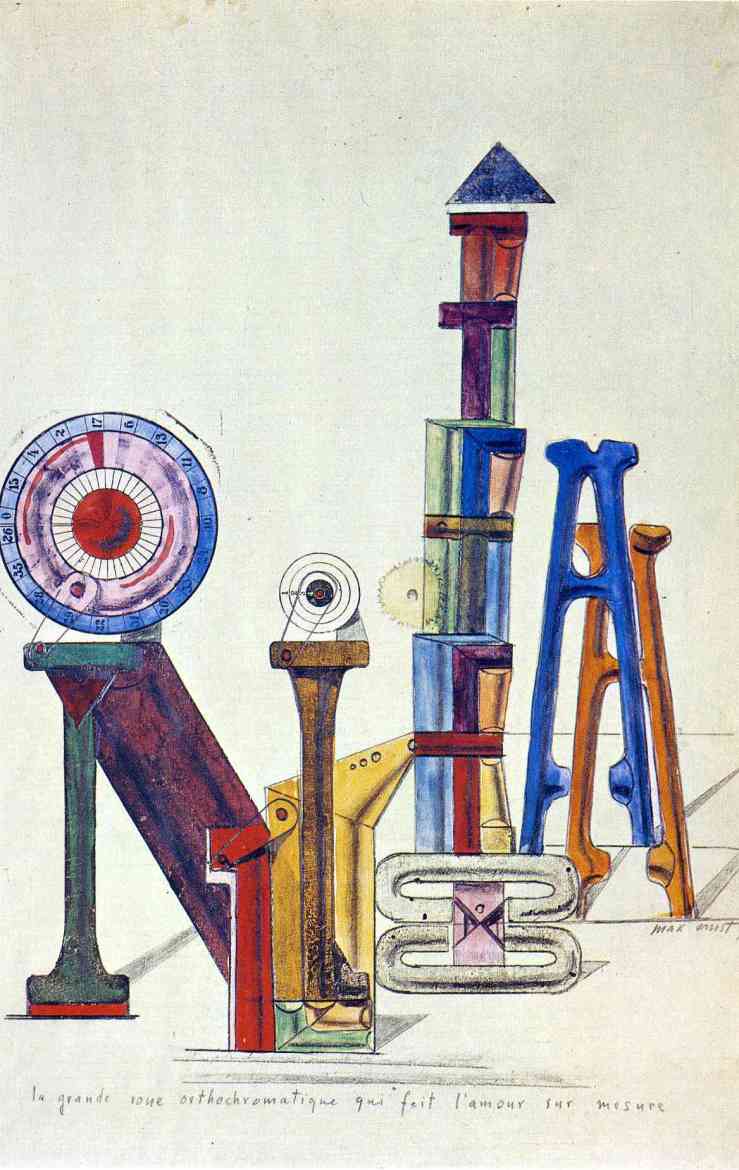
La Grande Roue Orthochromatique…, Max Ernst
5. Really though, The Flame Alphabet is an apocalypse novel, filled with mounds of salt and despair and isolation and probably madness, rarely energized by action, but hardly ponderous.
6. (Here’s a paltry criticism for me to critically make: I wish The Flame Alphabet was shorter. Like significantly shorter. Maybe a novella. Maybe a long short story).
7. Finishing the novel, I sketched out a list, which hey why not just cut and paste here:
Joseph Cornell’s boxes.
Much of J.G. Ballard, especially the stuff in the ’70s and ’80s.
The Residents.
The films of the Brothers Quay.
Charles Burns’s stuff.
Wm. Burroughs, or the idea of Wm. Burroughs.
Joseph Beuys and his goddamn fat and felt.
This is the stuff that The Flame Alphabet reminded me of—this and David Cronenberg’s films, which Jesus, how did they not make the list?
8. I mean, really, I think Ben Marcus has given us a sort of lost Cronenberg film here. Maybe what the book most reminded me of, language plot aside, was Cronenberg’s underrated icky 1999 effort eXistenZ, a film that seems to take place in several worlds at once (including the imaginations of the protagonist and the viewer).
9. Actually, comparing Marcus’s novel to a film is stupid.
Really, I think what The Flame Alphabet most resembles—its best parts, I mean—are directions to some kind of far-out art installation.
Which may be a way of saying The Flame Alphabet is best—or really, I like The Flame Alphabet best—when it recalls Ben Marcus’s older, more “experimental” stuff.
10. To wit:
The practice of language smoking originates in Bolivia but quickly travels north. In Mexico City it is perfected. Words and sentences tested by a delegate in a smoke-filled tube, at the end of which is stationed a sacrificial listener called, for unknown reasons, the bell.
The bell’s brain, when he dies, is pulled and separated into loaves. The loaves are tagged and named. Only drawings survive.
11. Or maybe you want some textual evidence of TFA’s Cronenbergian contours:
Ruptured mattresses littered the floor, sleeping bags with the bottoms kicked through. A brittle pillow bore the facial welt of the last patient who slept here. A man’s work shirt had been chewed, swallowed, spit up in a glaze of bile.
Mesh baggies of hair hung from the ceiling, repelling flies. Possibly the hair attracted them instead.
The Pack, Joseph Beuys
12. Or a Joseph Beuys moment. Our narrator in his language lab:
To test this I created white text on white paper, gray on gray, froze water into text-like shapes and allowed it to melt on select surfaces—slate, wood, felt—which it scarred so gently, you’d need a magnifying glass to spot the writing.
13. And a passage that showcases our narrator’s smallwork as an act of love (of sorts):
On Esther’s final birthday in our house I went to the kitchen to get to work on the cake. There wasn’t much food left in the cupboard, just some pancake mix and a blend of baking powders I’d dumped into a bag. From the meaty, mineral smell I figured this would give a lift to the cake, at least if I got the batter down to room temperature and shocked it into a hot oven so it might have some spring.
For liquids I had an egg and some buttermilk, the custardy sludge from the bottom of the carton.
I could boil the buttermilk to kill off bacteria, then flash freeze it before dumping it into the batter. The egg, too, would need flame, because it was likely spoiled by now.
I broke it into a pan, stifled a gag, then whisked it over a simmer until it frothed up, sputtered, and grew clear again. Mostly it did not congeal. The hardened parts were easy to flick out. When the pan cooled I slid it into the freezer, went to work on sifting the powders.
For sugar I reduced the last of the orange juice until it thickened into a syrup, then whipped in a thread of honey. This would have to do, because I needed the last of the sugar for frosting. I liked to feather it on lightly, then comb it up while hardening it with the medical cold blower, as if the cake had a fright wig.
The frosting I colored silver with a bead of food-grade aluminum.
14. These are all great fragments. Let’s keep going:
15. Desire—need—predicates language:
Presumably if you wanted nothing, you’d have no occasion to speak.
16. And Beckett:
“Failures have their place in our work,” he admitted, after hearing me out. “I’ve had my flirtations with failure. There is a small allure there. I commend you for seeking out failure so aggressively. But this idea people have of failing on purpose, failing better? Look at who says that. Just look at them. Look at them very carefully.”
17. Failure: Failure to imagine (better):
The linguist held forth, smugly dismissing an idea that had recently come into its own. It interested me that the linguist’s inability to imagine something constituted a sound rejection of its possibility.
Hotel Eden, Joseph Cornell
18. And:
We kept believing it couldn’t get any worse, as if our imaginations held sway in the natural world. We should have known that whatever we couldn’t imagine was exactly what was coming next.
19. I think I’ve shared a nice slice of Marcus’s prose. Dude can sling it. Seriously. I think he’s a great writer. I just wish more was stripped away from The Flame Alphabet. Feels overtly novelly at times—I mean, yes, it’s a novel, but this seems to be its biggest weakness: Marcus’s concessions to the form.
20. ( Let me parenthetically insert here what might be my biggest problem with The Flame Alphabet: I felt the ghost of Sam Lipsyte working under its contours. And I love Lipsyte’s stuff, seriously—but I often felt like Marcus was copping Lipsyte’s syntax, rhythms etc. as a means to a more, I dunno, normal narrative.
And while I’m here, in these parentheses, maybe I should direct you to a good and proper and real review. David Winters does a marvelous job at The Millions. And he brings up the Lipsyte thing that I just brought up, but he does a better job parsing the two styles than I.
21. The biggest tussle I had with TFA though is undoubtedly my agon (look how I make myself protagonist!) with its confounding reading rules.
The novel’s overtly parricidal/infantical scope, its estranging metaphors of language and extinctions, its remote anxieties of parenting—all of these pop up like red flags.
I wanted to—no, I set out to––deny the book as an allegory. I sought to resist metaphor, symbolism, analogy. But it’s hard, you know?
22. “Mythology is the lowest temptation,” our narrator tells us at one point.
And then Marcus wedges fairy tales and fables into the mixology.
23. And then our narrator:
I grew so alert to its obvious meanings that they sickened me, leading me to secondary, ironic intentions, disguises of rhetoric I would not normally notice. But soon these, too, felt fraudulent and then I returned to the literal meanings, which had gained more force now that I’d spurned them. That, however, did not last, and by the end the words had shucked their meaning entirely and evolved into a language of groaning, beyond interpretation. Or susceptible to the most obvious interpretation of all.
Language! Language! The problem of language!
24. And hence, what I take to be the book’s thesis, a two-sentence manifesto:
Explanations of any kind, in fact, were simply extinct.
Among the many rhetorical modes that had perished.
25. Does The Flame Alphabet enact its own holocaust, its own perishing; does it self-immolate? I don’t think so—although maybe that’s not what it sets out to do, maybe that’s just what I think it should do. I see a stronger book writhing there under the language, eager to consume some of the unnecessary pages, paragraphs, sentences, words. A book that would consume itself. (This is a silly metaphysical conceit; please move on).
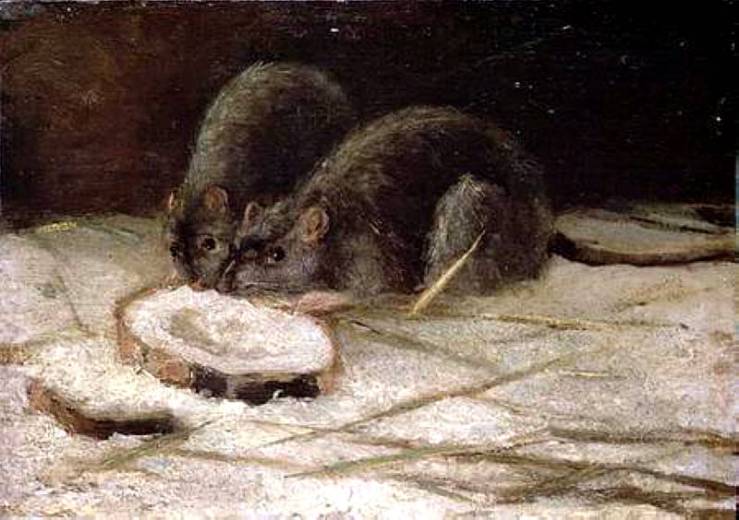
Two Rats, Vincent van Gogh
26. So maybe I’ve knocked on the book a bit, rated it low even, you may perceive, dear reader: Let me be clear then: The Flame Alphabet is the sort of burning ugly vibrant affecting blazing grueling confounding bizarre novels that we need more of. It’s stronger than most of the contemporary stuff out there, definitely the stuff coming from the major houses. And if I seem to pick at it, it’s only because I see in it concessions to a so-called reading public; I wished to see Marcus pull publishing and readers closer to him.
I won’t forget cleaning the dead rats from the shed anytime soon; neither will I forget reading The Flame Alphabet.
Tao Lin was born in Flagstaff, AZ. He had a very busy childhood that involved practicing the piano a lot. When he was 5, Tao remembers writing little books and selling them to his mother for 50¢. When Tao was small, his neighbor had a rabbit farm and sold them for money. Being near that changed Tao, and, because of it, he talks less shit about people publicly and makes fewer grand pronouncements.
Growing up, Tao played kickball and baseball and basketball in the neighborhood, but not at school. When he was 10, he was playing poker with his neighbor and bet his entire coin collection. The neighbor won and Tao picked up his coin collection and ran back to his house and locked the door. The neighbor knocked a lot and said things like this: “Just give me half. I won’t be angry.”
Tao kept practicing the piano until he no longer owned a piano that worked. Then, at New York University, he studied journalism, but he would have studied creative writing if there had been a program. His sophomore year, he broke up with his girlfriend and then decided to focus really hard on writing. After that, Tao wrote and published a few books. As Tao has noted in interviews, his writing expresses crippling loneliness, severe depression, and the arbitrary nature of the universe. Also, Tao enjoys repeatedly looking at Statcounter, Sales Rank Express, Facebook, Gmail, Twitter, and Tumblr. When a number changes, he feels like something has happened. His job is to promote himself to ensure money will come to him 2-3 years from now, and then even after that.
Everything is just something Tao does. It can be either good or bad depending on the way he thinks about it. Once, Tao thought about peeing in an empty FYXX energy drink bottle and selling it on eBay. Another time, after he ran out of money, Tao sold 10% shares of his second novel to six different people for $2,000 per share. He will never get another real job for the rest of his life. Tomorrow, Tao would like to eat only raw vegan foods.
Update : Tao published some more books. He also married Megan Boyle and they later separated.
“Tao Lin” is part of Michael Kimball’s new book Michael Kimball Writes Your Life Story (On a Postcard), which is new from Mud Luscious Press. Interview and review forthcoming. This piece is republished with the kind permission of the author.
Because the soul is progressive, it never quite repeats itself, but in every act attempts the production of a new and fairer whole. This appears in works both of the useful and the fine arts, if we employ the popular distinction of works according to their aim either at use or beauty. Thus in our fine arts, not imitation but creation is the aim. In landscapes the painter should give the suggestion of a fairer creation than we know. The details, the prose of nature he should omit and give us only the spirit and splendor. He should know that the landscape has beauty for his eye because it expresses a thought which is to him good; and this because the same power which sees through his eyes is seen in that spectacle; and he will come to value the expression of nature and not nature itself, and so exalt in his copy the features that please him. He will give the gloom of gloom and the sunshine of sunshine. In a portrait he must inscribe the character and not the features, and must esteem the man who sits to him as himself only an imperfect picture or likeness of the aspiring original within.
What is that abridgment and selection we observe in all spiritual activity, but itself the creative impulse? for it is the inlet of that higher illumination which teaches to convey a larger sense by simpler symbols. What is a man but nature’s finer success in self-explication? What is a man but a finer and compacter landscape than the horizon figures,—nature’s eclecticism? and what is his speech, his love of painting, love of nature, but a still finer success,—all the weary miles and tons of space and bulk left out, and the spirit or moral of it contracted into a musical word, or the most cunning stroke of the pencil?
But the artist must employ the symbols in use in his day and nation to convey his enlarged sense to his fellow-men. Thus the new in art is always formed out of the old. The Genius of the Hour sets his ineffaceable seal on the work and gives it an inexpressible charm for the imagination. As far as the spiritual character of the period overpowers the artist and finds expression in his work, so far it will retain a certain grandeur, and will represent to future beholders the Unknown, the Inevitable, the Divine. No man can quite exclude this element of Necessity from his labor. No man can quite emancipate himself from his age and country, or produce a model in which the education, the religion, the politics, usages and arts of his times shall have no share. Though he were never so original, never so wilful and fantastic, he cannot wipe out of his work every trace of the thoughts amidst which it grew. The very avoidance betrays the usage he avoids. Above his will and out of his sight he is necessitated by the air he breathes and the idea on which he and his contemporaries live and toil, to share the manner of his times, without knowing what that manner is. Now that which is inevitable in the work has a higher charm than individual talent can ever give, inasmuch as the artist’s pen or chisel seems to have been held and guided by a gigantic hand to inscribe a line in the history of the human race. This circumstance gives a value to the Egyptian hieroglyphics, to the Indian, Chinese and Mexican idols, however gross and shapeless. They denote the height of the human soul in that hour, and were not fantastic, but sprung from a necessity as deep as the world. Shall I now add that the whole extant product of the plastic arts has herein its highest value, as history; as a stroke drawn in the portrait of that fate, perfect and beautiful, according to whose ordinations all beings advance to their beatitude? Continue reading ““Art” — Ralph Waldo Emerson”→




 Biblioklept