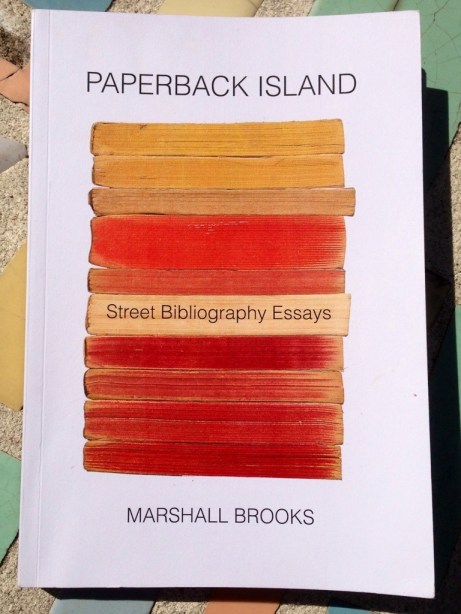
There’s something gently elegiac about Marshall Brooks’s Paperback Island, which collects over a dozen essays on reading. While Brooks’s essays on books, libraries, publishers, and the friendships that hold all of them together are never dour, they nevertheless evoke a world now shifting into the realm of memory alone.
It’s fitting then that the starting point for the book is beat legend Tuli Kupferberg’s funeral. Here, Brooks runs into Susanna Cuyler, who lends him her apartment in New York just so he can read her book Not Just Another Voice there: “There was no overlooking the fact that her apartment and her book are virtually one,” writes Brooks. This early detail hooked me, encapsulating so much of the themes of time, place, and friendship that Paperback Island emphasizes.
The lead essay in the collection is “Paperback Island.” Here, Brooks relates an adolescent friendship codified in books: “Besides symbolizing the excitement of what books can mean to people, especially young people who are in the process of formulating their own world, these books are all that remain to me of this once close friendship.” Brooks renders the transformative power that this bookswapping friendship had on him, set against the backdrop of the culture shift of the late sixties and early seventies:
Informationally, and in other ways as well, the early 1970s prefigured the Internet. Vast amounts of information, heretofore beyond the reach of the masses, became available. The visually compartmentalized newsprint portions of Harper’s Magazine and the encyclopedic paperbound Whole Earth Catalog come immediately to mind, as does the collectively-produced—via the Boston Women’s Health Collective—1970 paperback, Our Bodies, Ourselves. Design-wise, they all accelerated the absorption of information from off the printed page in completely innovative ways, which today’s web pages perforce echo. In conjunction with FM radio, foreign films, Super 8 film, Swinger cameras, stereo records, tape cassettes , early video, offset printing, the 1976 Freedom of Information Act, and such empowering movements as Women’s Lib, etc. , they revolutionized the lives of everyone, and youth culture in particular.
It would perhaps be easy for Brooks to have crammed his book with anecdotes illustrating the effects of these changes, but instead Paperback Island focuses on something much more personal, following the tone of its eponymous essay. There are memory-essays for Tuli Kupferberg, James T. Farrell, and Sidney Bernard, whose rogue journalism collection This Way to the Apocalypse I am now on the lookout for. In the background of all of this looms Harry Smith, the poet-publisher and founder of The Smith, where Brooks cut his teeth in the seventies. Smith’s influence on Brooks resonates in loving passages like this one:
A legendary figure in the American small press movement, Harry more than fulfilled the role of patron-protector for countless contributors to his press. He impressively looked the role, too, nowhere more so than when he grandly made the circuit at small press fair . . . The Smith published scores of unknown and neglected writers . . . The press resembled nothing else in the publishing world large or small partly for this reason. I had always assumed that a place exactly like it existed, somewhere. That it had to. (Why else write, really?) A place where poetry counted for everything. Fate, in its greatness, encouragingly provided for its existence, and Harry Smith supplied that place.
It’s that sense of place that comes through so strongly in Paperback Island, whether Brooks is describing the offices of The Smith or the hotels that James T. Farrell adored. Brooks also captures the strange ways that microlibraries evolve from place, time, and friendship (he inherited many of Farrell’s paperbacks). I think most bibliophiles will instantly understand Brooks’s impulse to collect, catalog, keep the tomes.
And of course there are the bookshops, the wanderings, the meanderings, the notes on books and how we find them. A late riff on visiting a Boston Barnes & Noble finds Brooks picking up a Nook and reading a passage from Austen’s Pride & Prejudice—his first time with an e-reader. The moment is not couched in resentment or alienation but simply experience—encountering an old book in a new way.
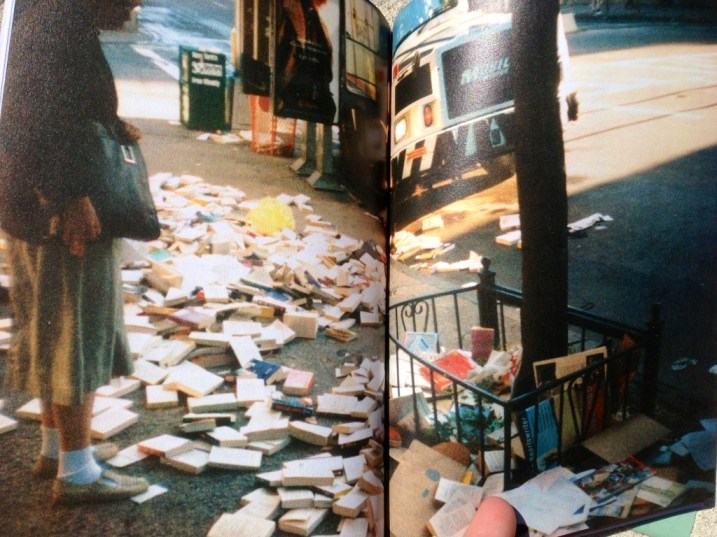
I should point out that Brooks has illustrated Paperback Island with photographs—of people, places, books—the things that make the book. (Books are made out of other books, some writer said). The photos are printed in rich color and add a documentary dimension to the book. Here’s a striking image of the closing of the Upper West Side branch of Shakespeare & Company—an image that perhaps captures more of the elegiac underpinnings of Paperback Island than I can do in words:
Paperback Island is shot-through with bibliophilia, a love of books that encompasses writers, readers, libraries, and publishers, yes—but also the mechanics of the book, the physical properties. It’s a love letter to books and the people who make them—and not just the writers and publishers, but the readers who make them, preserve them—and the friends who pass them on, make sure that others read them.
In a latter essay, “Physical Allure of the Book,” Brooks writes, “My friend Roger Skillings became a writer on account of picking up a Penguin edition of James Joyce’s Dubliners in a train station in Rome.” I’ll end this write-up in what I take to be the spirit of Brooks’s book, sharing a little anecdote of my own about a book I can’t part with.
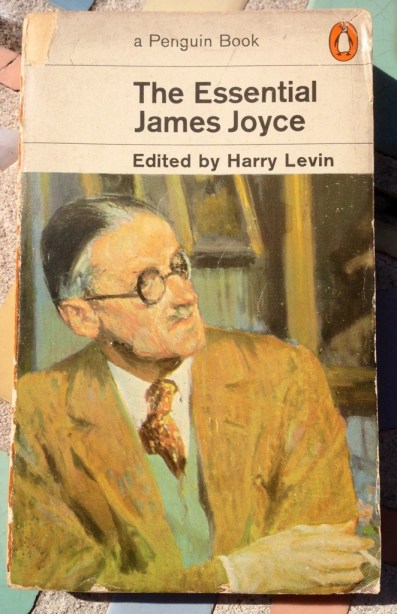
In 2002 I was wandering Jimbocho, an area of Tokyo crammed with nearly 200 bookshops. I found, lying in the gutter but unsullied, a paperback Penguin Book — The Essential James Joyce, edited by Harry Levin. I glanced around, trying to see if the book was somehow connected to a nearby vendor, but it didn’t seem to be for sale. In any case, I surreptitiously slipped the book into my bag and walked on. I read “The Dead” on the train ride home. I’ve kept the book to this day, even though I have no need of a Joyce digest. I can’t help it. I love it.



 Biblioklept