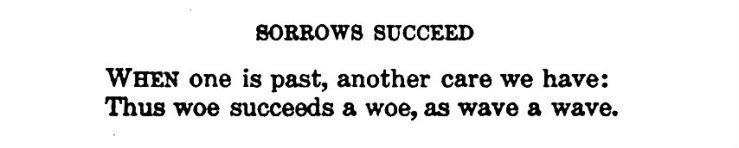
No matter what life you lead
the virgin is a lovely number:
cheeks as fragile as cigarette paper,
arms and legs made of Limoges,
lips like Vin Du Rhône,
rolling her china-blue doll eyes
open and shut.
Open to say,
Good Day Mama,
and shut for the thrust
of the unicorn.
She is unsoiled.
She is as white as a bonefish.
Once there was a lovely virgin
called Snow White.
Say she was thirteen.
Her stepmother,
a beauty in her own right,
though eaten, of course, by age,
would hear of no beauty surpassing her own.
Beauty is a simple passion,
but, oh my friends, in the end
you will dance the fire dance in iron shoes.
The stepmother had a mirror to which she referred-
something like the weather forecast-
a mirror that proclaimed
the one beauty of the land.
She would ask,
Looking glass upon the wall,
who is fairest of us all?
And the mirror would reply,
You are the fairest of us all.
Pride pumped in her like poison. Continue reading ““Snow White and the Seven Dwarfs” — Anne Sexton”→
RIP to James Gandolfini, who brought sensitivity and depth to the roles he played. I don’t think The Sopranos could have existed without him. He made me laugh and cry so often in that role, never more than at the end of The Sopranos, where I experienced what I could only describe as catharsis.
I probably first got to know Kim Thompson’s name through the editorial and letters pages of Dave Sim’s long-running black and white comic Cerebus. Sim had this marvelous agon with Thompson and partner Gary Groth, who were, like, the voice of comix (as opposed to, y’know, comics). Their outlet for that voice was The Comics Journal, the often ornery (and often-sued) magazine that maintained the critical and artistic traditions of cartooning against the venal backdrop of superhero comics. Thompson was also instrumental in the vision and quality of Fantagraphics Books, where he edited books by Chris Ware, Peter Bagge, and Joe Sacco, among, many many others. I still have all my issues of his anthology comic Zero Zero, which was instrumental in warping my young mind. I think I’ll dig them out now.
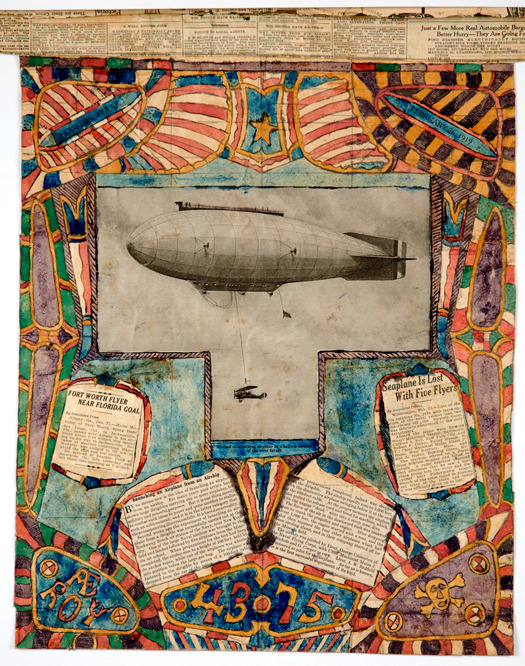
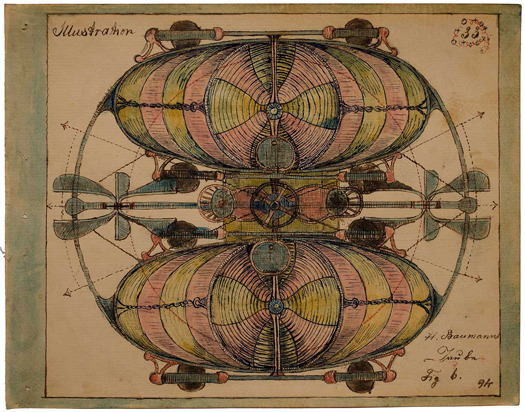
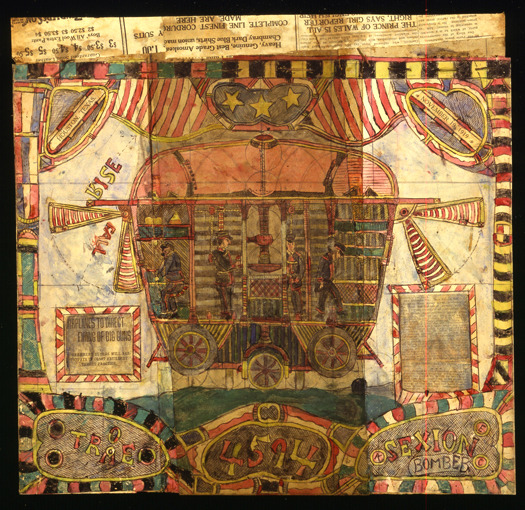
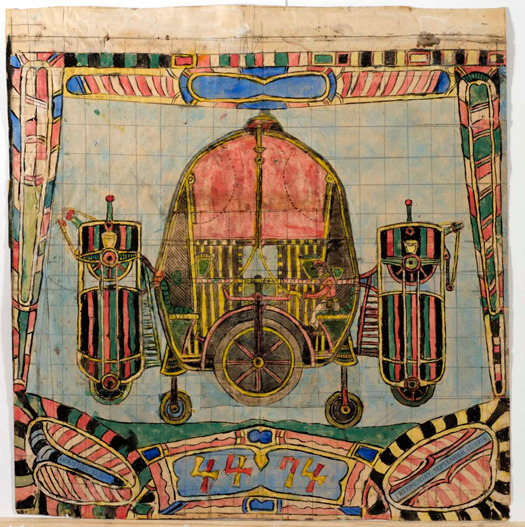
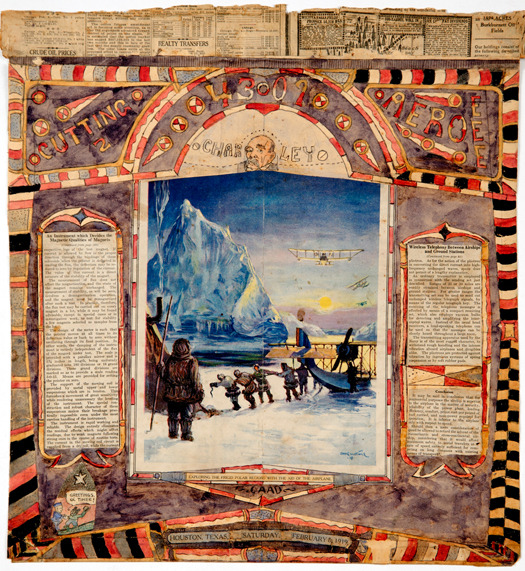
I was looking for an image to accompany a riff I wrote on Thomas Pynchon’s novel Against the Day. The riff circles around the skyship adventurers The Chums of Chance, characters who are both “real” in the novel and also “literary” — that is, they are the stars of dime novels that other characters in the novel read. I was hoping that maybe some creative soul had created a Chums of Chance book cover that I could use with the post. Through a few basic searches and a Metafilter board, I found my way to something far more intriguing—the strange watercolor and collage pieces of Charles August Albert Dellschau.
It turns out that the drawings/watercolors were the work of one Charles August Albert Dellschau (1830 – 1923). Dellschau was a butcher for most of his life and only after his retirement in 1899 did he begin his incredible career as a self-taught artist. He began with three books entitled Recollections which purported to describe a secret organization called the Sonora Aero Club. Dellschau described his duties in the club as that of the draftsman. Within his collaged watercolors were newspaper clippings (he called them “press blooms”) of early attempts at flight overlapped with his own fantastic drawings of airships of all kind. Powered by a secret formula he cryptically referred to as “NB Gas” or “Suppa” — the “aeros” (as Dellscahu called them) were steampunk like contraptions with multiple propellers, wheels, viewing decks and secret compartments. Though highly personal, autobiographical (perhaps!), and idiosyncratic, these artworks could cross-pollinate with the fiction of Jules Verne, Willy Wonka and the Wizard of Oz. The works were completed in a furiously creative period from 1899 to 1923, when air travel was still looked at by most people as almost magical. Newspapers of that period were full of stories about air travel feats and the acrobatic aerial dogfights of WWI were legend.
Verne, Oz, and steampunk are all clear comparisons. I’d add to them the manic spirit of Kurt Schwitters’s collages, the buzzing claustrophobia of Joseph Cornell’s boxes, and the cartoony contours of turn-of-the-century comics.It also reminds me of Luigi Serafini’s surreal cryptoencyclopedia, Codex Seraphinianus. And of course, Dellschau’s work resonates strongly with Pynchon’s novel Against the Day, more ludic than lunatic. His work shows an obsession fueled by science and science fiction alike, as well as a frankly adolescent sense of line, proportion and color. I love it. See more here and here.
He had brought with him a dime novel, one of the Chums of Chance series, The Chums of Chance at the Ends of the Earth, and for a while each night he sat in the firelight and read to himself but soon found he was reading out loud to his father’s corpse, like a bedtime story, something to ease Webb’s passage into the dreamland of his death.
Reef had had the book for years. He’d come across it, already dog-eared, scribbled in, torn and stained from a number of sources, including blood, while languishing in the county lockup at Socorro, New Mexico, on a charge of running a game of chance without a license. The cover showed an athletic young man (it seemed to be the fearless Lindsay Noseworth) hanging off a ballast line of an ascending airship of futuristic design, trading shots with a bestially rendered gang of Eskimos below. Reef began to read, and soon, whatever “soon” meant, became aware that he was reading in the dark, lights-out having occurred sometime, near as he could tell, between the North Cape and Franz Josef Land. As soon as he noticed the absence of light, of course, he could no longer see to read and, reluctantly, having marked his place, turned in for the night without considering any of this too odd. For the next couple of days he enjoyed a sort of dual existence, both in Socorro and at the Pole. Cellmates came and went, the Sheriff looked in from time to time, perplexed.
At odd moments, now, he found himself looking at the sky, as if trying to locate somewhere in it the great airship. As if those boys might be agents of a kind of extrahuman justice, who could shepherd Webb through whatever waited for him, even pass on to Reef wise advice, though he might not always be able to make sense of it. And sometimes in the sky, when the light was funny enough, he thought he saw something familiar. Never lasting more than a couple of watch ticks, but persistent. “It’s them, Pa,” he nodded back over his shoulder. “They’re watching us, all right. And tonight I’ll read you some more of that story. You’ll see.”
Riding out of Cortez in the morning, he checked the high end of the Sleeping Ute and saw cloud on the peak. “Be rainin later in the day, Pa.”
“Is that Reef? Where am I? Reef, I don’t know where the hell I am—”
“Steady, Pa. We’re outside of Cortez, headin up to Telluride, be there pretty soon—”
“No. That’s not where this is. Everthin is unhitched. Nothin stays the same. Somethin has happened to my eyes. . . .”
“It’s O.K.”
“Hell it is.”
—From Thomas Pynchon’s novel Against the Day (215).
1. There’s so much I like about this passage.
2. First, Pynchon explicitly ties together two groups of his characters here. Pynchon connects the Traverses of Colorado with those champions of the ether, The Chums of Chance.
And he does it through a novel, which I’ll get to in a minute.
3. I’ve already remarked on the adventurous, even light-hearted tone of the Chums of Chance episodes, which often buoy the narrative out of its byzantine winding.
4. The Chums passages contrast strongly with the Colorado episodes featuring the Traverses.
While Pynchon is not really known for his pathos or the depth of his characters, the Traverse story line is genuinely moving. We see the family disintegrate against the greed of the Colorado mining rush. Patriarch Webb cannot hold his family together, and he gives over to a deep bitterness; his union becomes his raison d’etre, and he undertakes dangerous secret missions to fight the forces of capitalism. It’s worth giving Webb’s opinion at length:
“Here. The most precious thing I own.” He took his union card from his wallet and showed them, one by one. “These words right here”—pointing to the slogan on the back of the card— “is what it all comes down to, you won’t hear it in school, maybe the Gettysburg Address, Declaration of Independence and so forth, but if you learn nothing else, learn this by heart, what it says here—‘Labor produces all wealth. Wealth belongs to the producer thereof.’ Straight talk. No doubletalking you like the plutes do, ’cause with them what you always have to be listening for is the opposite of what they say. ‘Freedom,’ then’s the time to watch your back in particular—start telling you how free you are, somethin’s up, next thing you know the gates have slammed shut and there’s the Captain givin you them looks. ‘Reform’? More new snouts at the trough. ‘Compassion’ means the population of starving, homeless, and dead is about to take another jump. So forth. Why, you could write a whole foreign phrase book just on what Republicans have to say.”
5. It’s also worth pointing out that Webb is likley the Kieselguhr Kid: He has a secret identity and secret powers, like many of the characters who inhabit Against the Day.
6. The Traverse passages recall the social realism of Steinbeck at times, with a dose of the moralizing we might find in Upton Sinclair. There’s also a heavy dash of Ambrose Bierce’s cynicism, and something of Bret Harte’s milieu here.
A kind of ballast for Pynchon’s flightier whims? Not sure.
7. Returning to our initial citation:
As prodigal son Reef Traverse moves his father’s corpse across Colorado, he reads from The Chums of Chance at the Ends of the Earth. We learn that he’s had the dime novel for years and we learn of its physical condition — “dogeared, scribbled in, torn and stained from a number of sources, including blood.” The book is a kind of abject survivor, a physical totem with powers of endurance, which, in turn, grants metaphysical powers on its user-reader.
8. (Parenthetical (i.e. unexplored) aside: The cover of The Chums of Chance at the Ends of the Earth features handsome, uptight Lindsay Noseworth facing off against a “bestially rendered gang of Eskimos.” Here is our Manifest Destiny; here is our White Man’s Burden).
9. The Chums of Chance at the Ends of the Earth allows Reef brief transcendence of time (“whatever ‘soon’ meant”) and space (it provides him escape from his jail cell).
10. Also: The Chums of Chance at the Ends of the Earth grants its reader the power to read in the dark. There is something of a huge in-joke here that all late-night readers will appreciate.
Also: the major motif of At the End of the Day is darkness and light. The Chums of Chance at the Ends of the Earth works as a kind of self-illuminating object outside the confines of the physical world, but only when the user is not conscious of this power (“As soon as he noticed the absence of light, of course, he could no longer see to read”).
11. The Chums of Chance at the Ends of the Earth bestows upon Reef, its operator, “a sort of dual existence, both in Socorro and at the Pole.” This relationship, again, won’t be unfamiliar to voracious readers. Hell, many of us chase that transcendent space the rest of our lives. The older we get, the harder it is to get back to Dickensian London or Rivendell or Crusoe’s island or Narnia or Thornfield Hall or wherever it was that we got to live out part of our dual existence.
Here Reef, a grown-ass man, gets to be one of the Chums and traverse an alien frontier.
12. And the biggie: Somehow this dime novel wakes the dead.
Now, it’s easy to say that Webb doesn’t really talk to Reef, just as we can easily say that Reef doesn’t really head to the pole with the Chums, doesn’t really transcend time and space, etc. We could look for simple answers in psychology—Reef has internalized his father’s voice; Reef is going mad.
But I think Pynchon’s presentation of the scene suggests something more—but something I don’t know how to name or describe, only a fifth of the way into this book. Something to look for in any case.
And so thus end with Webb’s line: “Somethin has happened to my eyes.”







 Biblioklept