Trailer and Posters for Hayao Miyazaki’s Next Film, The Wind Rises

miya

I don’t know how I missed this—the teaser came out a few weeks ago—but a new Miyazaki is always promising. The Wind Rises is out in Japan in two weeks, out in the rest of the world, who knows when…but I’ve never minded watching his films sans subtitles or dubbing. Read more about The Wind Rises here; read my review of Ponyo, the last Studio Ghibli film that Miyazaki directed.

Kaze-Tachinu-610x859


Eine Kleine Nachtmusik — Dorothea Tanning

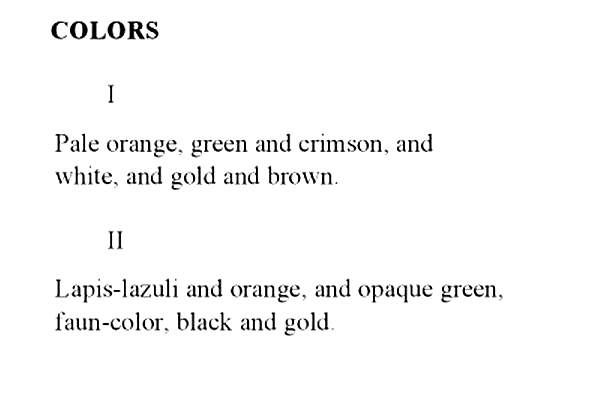
“Colors” — Wallace Stevens

colors

Aftermath (Book Acquired, 7.08.2013)

20130709-141450.jpg

When a review copy of Rachel Cusk’s memoir Aftermath: On Marriage and Separation (new in trade paperback from Picador) showed up the other day, a dim bulb went off—where did I know Cusk’s name? I’m not generally a fan of the memoir, so I doubt I’d read it. And then! Aha! Yes—it was a review of Cusk’s memoir that won Camilla Long this year’s “Hatchet Job of the Year” award.

From Long’s review (originally published in The Sunday Times):

The book is crammed with mad, flowery metaphors and hifalutin creative-writing experiments. There are hectic passages on Greek tragedy and the Christian concept of family, as well as fragments of ghost stories, references to the Anglo-Saxon heptarchy, and heavy Freudian symbolism, including a long description of the removal of a molar, “a large tooth,” she writes portentously, “of great…personal significance”. The final chapter is an out-of-body experience — her situation seen through the eyes of her pill-popping Eastern European au pair. Oddly, I read the whole thing in a Bulgarian accent.

I don’t know, that sounds pretty weird. Kinda intrigues me.


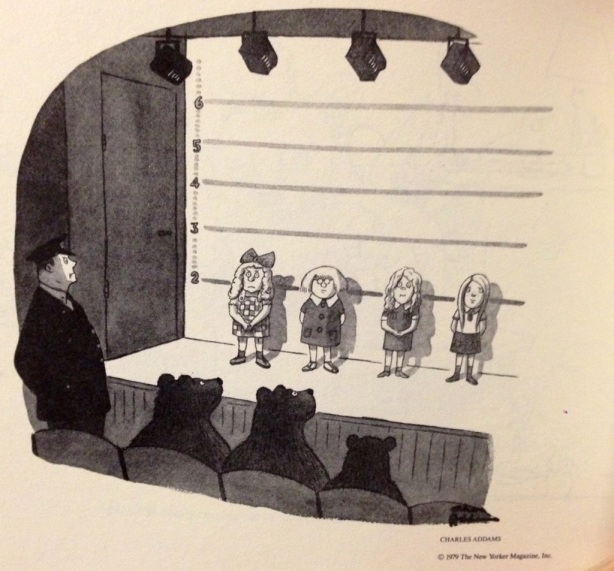
Goldilocks Lineup (Charles Addams)

20130601-101339.jpg

“Maybe there’s something wrong with our notion of paradise” — Slavoj Žižek

In an essay published today at the LRB, Slavoj Žižek addresses the current, disparate waves of protest around the globe and explores the

difference between a reformist and a revolutionary period: in a reformist period, global revolution remains a dream which, if it does anything, merely lends weight to attempts to change things locally; in a revolutionary period, it becomes clear that nothing will improve without radical global change.

Žižek continues:

Where do we stand today with respect to this difference? Are the problems and protests of the last few years signs of an approaching global crisis, or are they just minor obstacles that can be dealt with by means of local interventions? The most remarkable thing about the eruptions is that they are taking place not only, or even primarily, at the weak points in the system, but in places which were until now perceived as success stories. We know why people are protesting in Greece or Spain; but why is there trouble in such prosperous or fast-developing countries as Turkey, Sweden or Brazil? With hindsight, we might see the Khomeini revolution of 1979 as the original ‘trouble in paradise’, given that it happened in a country that was on the fast-track of pro-Western modernisation, and the West’s staunchest ally in the region. Maybe there’s something wrong with our notion of paradise.

If the examples in the above paragraph seem too concrete for a Žižekian riff, don’t worry. Our philosopher addresses what he takes to be the ideological underpinnings of protest:

It is also important to recognise that the protesters aren’t pursuing any identifiable ‘real’ goal. The protests are not ‘really’ against global capitalism, ‘really’ against religious fundamentalism, ‘really’ for civil freedoms and democracy, or ‘really’ about any one thing in particular. What the majority of those who have participated in the protests are aware of is a fluid feeling of unease and discontent that sustains and unites various specific demands. The struggle to understand the protests is not just an epistemological one, with journalists and theorists trying to explain their true content; it is also an ontological struggle over the thing itself, which is taking place within the protests themselves. Is this just a struggle against corrupt city administration? Is it a struggle against authoritarian Islamist rule? Is it a struggle against the privatisation of public space? The question is open, and how it is answered will depend on the result of an ongoing political process.

And an answer, perhaps, to some of these questions:

Only a politics that fully takes into account the complexity of overdetermination deserves to be called a strategy. When we join a specific struggle, the key question is: how will our engagement in it or disengagement from it affect other struggles? The general rule is that when a revolt against an oppressive half-democratic regime begins, as with the Middle East in 2011, it is easy to mobilise large crowds with slogans – for democracy, against corruption etc. But we are soon faced with more difficult choices. When the revolt succeeds in its initial goal, we come to realise that what is really bothering us (our lack of freedom, our humiliation, corruption, poor prospects) persists in a new guise, so that we are forced to recognise that there was a flaw in the goal itself. This may mean coming to see that democracy can itself be a form of un-freedom, or that we must demand more than merely political democracy: social and economic life must be democratised too. In short, what we first took as a failure fully to apply a noble principle (democratic freedom) is in fact a failure inherent in the principle itself. This realisation – that failure may be inherent in the principle we’re fighting for – is a big step in a political education.

“The study of life not to be neglected for the sake of books” — Samuel Johnson

“The study of life not to be neglected for the sake of books” by Samuel Johnson

 On life, on morals, be thy thoughts employ’d;
Leave to the schools their atoms and their void.

IT is somewhere related by Le Clerc, that a wealthy trader of good understanding, having the common ambition to breed his son a scholar, carried him to an university, resolving to use his own judgment in the choice of a tutor. He had been taught, by whatever intelligence, the nearest way to the heart of an academick, and at his arrival entertained all who came about him with such profusion, that the professors were lured by the smell of his table from their books, and flocked round him with all the cringes of awkward complaisance. This eagerness answered the merchant’s purpose: he glutted them with delicacies, and softened them with caresses, till he prevailed upon one after another to open his bosom, and make a discovery of his competitions, jealousies, and resentments. Having thus learned each man’s character, partly from himself, and partly from his acquaintances, he resolved to find some other education for his son, and went away convinced, that a scholastick life has no other tendency than to vitiate the morals and contract the understanding: nor would he afterwards hear with patience the praises of the ancient authors, being persuaded that scholars of all ages must have been the same, and that Xenophon and Cicero were professors of some former university, and therefore mean and selfish, ignorant and servile, like those whom he had lately visited and forsaken.

Envy, curiosity, and a sense of the imperfection of our present state, incline us to estimate the advantages which are in the possession of others above their real value. Every one must have remarked, what powers and prerogatives the vulgar imagine to be conferred by learning. A man of science is expected to excel the unlettered and unenlightened even on occasions where literature is of no use, and among weak minds, loses part of his reverence, by discovering no superiority in those parts of life, in which all are unavoidably equal; as when a monarch makes a progress to the remoter provinces, the rustics are said sometimes to wonder that they find him of the same size with themselves. Continue reading ““The study of life not to be neglected for the sake of books” — Samuel Johnson”

Smithers — Aubrey Beardsley