Mother Daughter Me (Book Acquired, 7.08.2013)

20130709-141434.jpg

Mother Daughter Me is Katie Hafner’s memoir, new in hardback from Random House. Their blurb:

The complex, deeply binding relationship between mothers and daughters is brought vividly to life in Katie Hafner’s remarkable memoir, an exploration of the year she and her mother, Helen, spent working through, and triumphing over, a lifetime of unresolved emotions.

Dreaming of a “year in Provence” with her mother, Katie urges Helen to move to San Francisco to live with her and Zoë, Katie’s teenage daughter. Katie and Zoë had become a mother-daughter team, strong enough, Katie thought, to absorb the arrival of a seventy-seven-year-old woman set in her ways.

Filled with fairy-tale hope that she and her mother would become friends, and that Helen would grow close to her exceptional granddaughter, Katie embarked on an experiment in intergenerational living that she would soon discover was filled with land mines: memories of her parents’ painful divorce, of her mother’s drinking, of dislocating moves back and forth across the country,  and of Katie’s own widowhood and bumpy recovery. Helen, for her part, was also holding difficult issues at bay.

How these three women from such different generations learn to navigate their challenging, turbulent, and ultimately healing journey together makes for riveting reading. By turns heartbreaking and funny—and always insightful—Katie Hafner’s brave and loving book answers questions about the universal truths of family that are central to the lives of so many.

Bell Jar Malady — Ruby Osorio

“Elegy with Surrealist Proverbs as Refrain” — Dana Gioia

“Elegy with Surrealist Proverbs as Refrain” by Dana Gioia—

“Poetry must lead somewhere,” declared Breton.
He carried a rose inside his coat each day
to give a beautiful stranger—“Better to die of love
than love without regret.” And those who loved him
soon learned regret. “The simplest surreal act
is running through the street with a revolver
firing at random.” Old and famous, he seemed démodé.
There is always a skeleton on the buffet.

Wounded Apollinaire wore a small steel plate
inserted in his skull. “I so loved art,” he smiled,
“I joined the artillery.” His friends were asked to wait
while his widow laid a crucifix across his chest.
Picasso hated death. The funeral left him so distressed
he painted a self-portrait. “It’s always other people,”
remarked Duchamp, “who do the dying.”
I came. I sat down. I went away.

Dali dreamed of Hitler as a white-skinned girl—
impossibly pale, luminous and lifeless as the moon.
Wealthy Roussel taught his poodle to smoke a pipe.
“When I write, I am surrounded by radiance.
My glory is like a great bomb waiting to explode.”
When his valet refused to slash his wrists,
the bankrupt writer took an overdose of pills.
There is always a skeleton on the buffet.

Breton considered suicide the truest art,
though life seemed hardly worth the trouble to discard.
The German colonels strolled the Île de la Cité—
some to the Louvre, some to the Place Pigalle.
“The loneliness of poets has been erased,” cried Éluard,
in praise of Stalin. “Burn all the books,” said dying Hugo Ball.
There is always a skeleton on the buffet.
I came. I sat down. I went away.

Young Girl Reading — Henri Martin

Portrait of H.P. Lovecraft — Mike Mignola

mignola

(Via).

Plagiarism

It was an icy day.

Pierre Pinoncelli damaged two of the eight copies of Fountain by Marcel Duchamp with a hammer.

The attacks were separated by 13 years: The latest on January 4, 2006 at Centre Pompidou in Paris.

And in Nîmes in 1993.

Where he also urinated into it before using the hammer.

Accordingly, in our Mongolian age all change has been only reformatory or ameliorative, not destructive or consuming and annihilating.

The substance, the object, remains.

All our assiduity was only the activity of ants and the hopping of fleas, jugglers’ tricks on the immovable tight-rope of the objective, corvée -service under the leadership of the unchangeable or “eternal.”

I have seen

The old gods go

And the new gods come.

The Stone Breakers (FrenchLes Casseurs de pierres) was an 1849–50 painting by the French painter Gustave Courbet.

It was a work of social realism, depicting two peasants, a young man and an old man, breaking rocks.

The painting was first exhibited at the Paris Salon of 1850. It was destroyed during World War II, along with 154 other pictures, when a transport vehicle moving the pictures to the castle of Königstein, near Dresden, was bombed by Allied forces in February 1945.

Day by day

And year by year

The idols fall

And the idols rise.

Damage then recovery, damage then recovery.

We buried the cat,

then took her box

and set fire to it

in the back yard.

Even to his death, Duchamp retained a sense of humor.

The evening of 1 October 1968 had been a pleasant one, dinning at home with his friends Man Ray and Robert Lebel. Shortly after his guests had left, it happened suddenly and peacefully. Just before retiring at 1:05 A.M. his heart simply stopped beating.

Those fleas that escaped

earth and fire

died by the cold.

Courbet died, age 58, in La Tour-de-Peilz,Switzerland, of a liver disease aggravated by heavy drinking.

But he hammered his poor heart to death, Lord, Lord,
    He hammered his poor heart to death.

“D’ailleurs, c’est toujours les autres qui meurent;” or “Besides, it’s always the others who die”.

Today

I worship the hammer.

Another Trailer for Wong Kar Wai’s New Film The Grandmasters

Not too different from the one that came out last fall…except some English intertitles. Excited for this one. Maybe this actioner moves Wong Kar Wai one step closer to directing the new Star Wars films?

TheGrandMaster_01

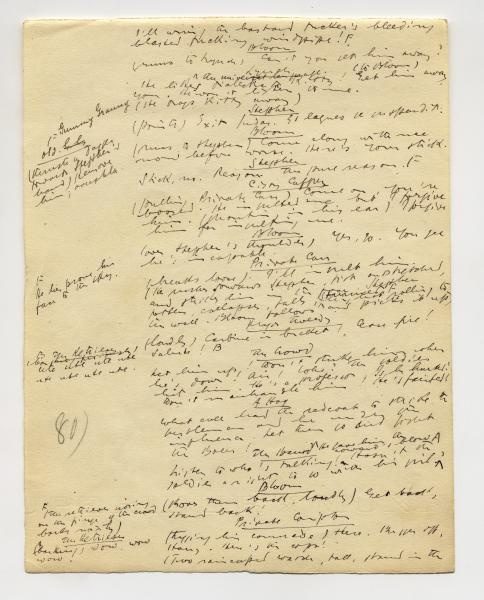
Handwritten Fragment of James Joyce’s Ulysses

ulysses

A fragment from the “Circe” episode of James Joyce’s Ulysses. Via/more.

Illustration from A Week of Kindness — Max Ernst

Nine Notes from Nathaniel Hawthorne’s Note-Books

  1. The elephant is not particularly sagacious in the wild state, but becomes so when tamed. The fox directly the contrary, and likewise the wolf.
  2. A modern Jewish adage,–“Let a man clothe himself beneath his ability, his children according to his ability, and his wife above his ability.”
  3. It is said of the eagle, that, in however long a flight, he is never seen to clap his wings to his sides. He seems to govern his movements by the inclination of his wings and tail to the wind, as a ship is propelled by the action of the wind on her sails.
  4. In old country-houses in England, instead of glass for windows, they used wicker, or fine strips of oak disposed checkerwise. Horn was also used. The windows of princes and great noblemen were of crystal; those of Studley Castle, Holinshed says, of beryl. There were seldom chimneys; and they cooked their meats by a fire made against an iron back in the great hall. Houses, often of gentry, were built of a heavy timber frame, filled up with lath and plaster. People slept on rough mats or straw pallets, with a round log for a pillow; seldom better beds than a mattress, with a sack of chaff for a pillow.
  5. In this dismal chamber FAME was won. (Salem, Union Street.)
  6. Those who are very difficult in choosing wives seem as if they would take none of Nature’s ready-made works, but want a woman manufactured particularly to their order.
  7. A council of the passengers in a street: called by somebody to decide upon some points important to him.
  8. Every individual has a place to fill in the world, and is important, in some respects, whether he chooses to be so or not.
  9. Merry, “in merry England,” does not mean mirthful; but is corrupted from an old Teutonic word signifying famous or renowned.

Notations from Nathaniel Hawthorne’s American Note-Books

Madame Monet Reading — Pierre-Auguste Renoir

Saturn Devouring One of His Sons (After Goya) — Vik Muniz

MUNIZ_05

“Dick Around/This Town Ain’t Big Enough for the Both of Us” (Live) — Sparks

Tintoretto’s Abduction of the Body of St. Mark / Kid Jesus the Hellraiser (Thomas Pynchon)

One day, strolling in the Piazzetta, Hunter motioned her under the arcade and into the Library, and pointed up at Tintoretto’s Abduction of the Body of St. Mark. She gazed for some time. “Well, if that ain’t the spookiest damned thing,” she whispered at last. “What’s going on?” she gestured nervously into those old Alexandrian shadows, where ghostly witnesses, up far too late, forever fled indoors before an unholy offense.

“It’s as if these Venetian painters saw things we can’t see anymore,” Hunter said. “A world of presences. Phantoms. History kept sweeping through, Napoleon, the Austrians, a hundred forms of bourgeois literalism, leading to its ultimate embodiment, the tourist—how beleaguered they must have felt. But stay in this town awhile, keep your senses open, reject nothing, and now and then you’ll see them.”

A few days later, at the Accademia, as if continuing the thought, he said, “The body, it’s another way to get past the body.”

“To the spirit behind it—” “But not to deny the body—to reimagine it. Even”—nodding over at the Titian on the far wall—“if it’s ‘really’ just different kinds of greased mud smeared on cloth—to reimagine it as light.”

“More perfect.”

“Not necessarily. Sometimes more terrible—mortal, in pain, misshapen, even taken apart, broken down into geometrical surfaces, but each time somehow, when the process is working, gone beyond. . . .”

Beyond her, she guessed. She was trying to keep up, but Hunter didn’t make it easy. One day he told her a story she had actually already heard, as a sort of bedtime story, from Merle, who regarded this as a parable, maybe the first on record, about alchemy. It was from the Infancy Gospel of Thomas, one of many pieces of Scripture that early church politics had kept from being included in the New Testament.

“Jesus was sort of a hellraiser as a kid,” as Merle had told it, “the kind of wayward youth I’m always finding you keepin company with, in fact, not that I’m objecting,” as she had sat up in bed and looked for something to assault him with, “used to go around town pulling these adolescent pranks, making little critters out of clay, bringing them to life, birds that could fly, rabbits that talked, and like that, driving his parents crazy, not to mention most of the local adults, who were always coming by to complain—‘You better tell ’at Jesus to watch it.’ One day he’s out with some friends looking for trouble to get into, and they happen to go by the dyer’s shop, where there’s all these pots with different colors of dye and piles of clothes next to them, all sorted and each pile ready to be dyed a different color, Jesus says, ‘Watch this,’ and grabs up all the clothes in one big bundle, the dyer’s yelling, ‘Hey Jesus, what’d I tell you last time?’ drops what he’s doing and goes chasing after the kid, but Jesus is too fast for him, and before anybody can stop him he runs over to the biggest pot, the one with red dye in it, and dumps all the clothes in, and runs away laughing. The dyer is screaming bloody murder, tearing his beard, thrashing around on the ground, he sees his whole livelihood destroyed, even Jesus’s lowlife friends think this time he’s gone a little too far, but here comes Jesus with his hand up in the air just like in the paintings, calm as anything—‘Settle down, everybody,’ and he starts pulling the clothes out of that pot again, and what do you know, each one comes out just the color it’s supposed to be, not only that but the exact shade of that color, too, no more housewives hollerin ‘hey I wanted lime green not Kelly green, you colorblind or something,’ no this time each item is the perfect color it was meant to be.”

“Not a heck of a lot different,” it had always seemed to Dally, “in fact, from that Pentecost story in Acts of the Apostles, which did get in the Bible, not colors this time but languages, Apostles are meeting in a house in Jerusalem, you’ll recall, Holy Ghost comes down like a mighty wind, tongues of fire and all, the fellas come out and start talking to the crowd outside, who’ve all been jabbering away in different tongues, there’s Romans and Jews, Egyptians and Arabians, Mesopotamians and Cappadocians and folks from east Texas, all expecting to hear just the same old Galilean dialect—but instead this time each one is amazed to hear those Apostles speaking to him in his own language.”

Hunter saw her point. “Yes, well it’s redemption, isn’t it, you expect chaos, you get order instead. Unmet expectations. Miracles.”


Another amazing passage from Thomas Pynchon’s novel Against the Day.


Bride of New France (Book Acquired, 7.09.2013)

20130709-141512.jpg

Bride of New France, an historical novel by Suzanne Desrochers, was a hit in Canada, where it was published by Penguin. Norton is publishing it in the States in trade paperback. Their blurb:

A Canadian bestseller, this richly imagined novel is about a young French woman sent to settle in the New World.

Transporting readers from cosmopolitan seventeenth-century Paris to the Canadian frontier, this vibrant debut tells of the struggle to survive in a brutal time and place. Laure Beausejour has been taken from her destitute family and raised in an infamous orphanage to be trained as a lace maker. Striking and willful, she dreams of becoming a seamstress and catching the eye of a nobleman. But after complaining about her living conditions, she is sent to Canada as a fille du roi, expected to marry a French farmer there. Laure is shocked by the primitive state of the colony and the mingling of the settlers with the native tribes. When her ill-matched husband leaves her alone in their derelict hut for the winter, she must rely on her wits and her clandestine relationship with an Iroquois man for survival.


Auvers Town Hall in 14 July 1890 — Vincent van Gogh

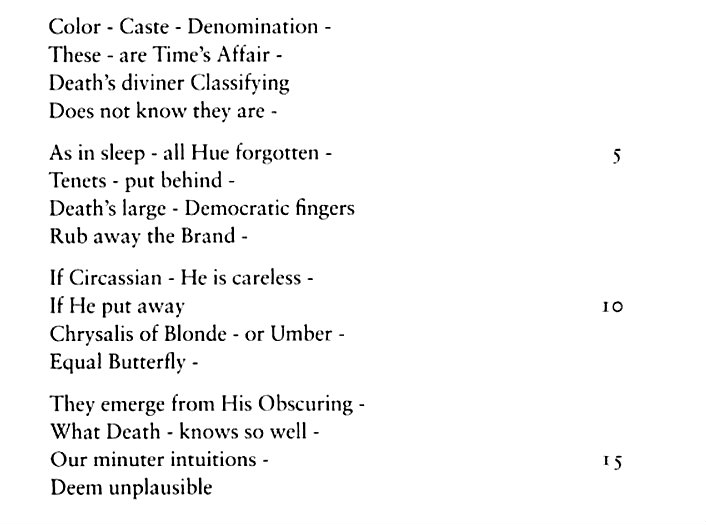
“Color — Caste — Denomination — ” — Emily Dickinson

ccd