“The White Tribe” — Lydia Davis

ld

Meal with Bread and Sweetmeats — Georg Flegel

“The Satirist” — Robert Louis Stevenson

“The Satirist” by Robert Louis Stevenson

My companion enjoyed a cheap reputation for wit and insight. He was by habit and repute a satirist. If he did occasionally condemn anything or anybody who richly deserved it, and whose demerits had hitherto escaped, it was simply because he condemned everything and everybody. While I was with him he disposed of St. Paul with an epigram, shook my reverence for Shakespeare in a neat antithesis, and fell foul of the Almighty Himself, on the score of one or two out of the ten commandments. Nothing escaped his blighting censure. At every sentence he overthrew an idol, or lowered my estimation of a friend. I saw everything with new eyes, and could only marvel at my former blindness. How was it possible that I had not before observed A’s false hair, B’s selfishness, or C’s boorish manners? I and my companion, methought, walked the streets like a couple of gods among a swarm of vermin; for every one we saw seemed to bear openly upon his brow the mark of the apocalyptic beast. I half expected that these miserable beings, like the people of Lystra, would recognise their betters and force us to the altar; in which case, warned by the fate of Paul and Barnabas, I do not know that my modesty would have prevailed upon me to decline. But there was no need for such churlish virtue. More blinded than the Lycaonians, the people saw no divinity in our gait; and as our temporary godhead lay more in the way of observing than healing their infirmities, we were content to pass them by in scorn.

I could not leave my companion, not from regard or even from interest, but from a very natural feeling, inseparable from the case. To understand it, let us take a simile. Suppose yourself walking down the street with a man who continues to sprinkle the crowd out of a flask of vitriol. You would be much diverted with the grimaces and contortions of his victims; and at the same time you would fear to leave his arm until his bottle was empty, knowing that, when once among the crowd, you would run a good chance yourself of baptism with his biting liquor. Now my companion’s vitriol was inexhaustible.

It was perhaps the consciousness of this, the knowledge that I was being anointed already out of the vials of his wrath, that made me fall to criticising the critic, whenever we had parted.

After all, I thought, our satirist has just gone far enough into his neighbours to find that the outside is false, without caring to go farther and discover what is really true. He is content to find that things are not what they seem, and broadly generalises from it that they do not exist at all. He sees our virtues are not what they pretend they are; and, on the strength of that, he denies us the possession of virtue altogether. He has learnt the first lesson, that no man is wholly good; but he has not even suspected that there is another equally true, to wit, that no man is wholly bad. Like the inmate of a coloured star, he has eyes for one colour alone. He has a keen scent after evil, but his nostrils are plugged against all good, as people plugged their nostrils before going about the streets of the plague-struck city.

Why does he do this? It is most unreasonable to flee the knowledge of good like the infection of a horrible disease, and batten and grow fat in the real atmosphere of a lazar-house. This was my first thought; but my second was not like unto it, and I saw that our satirist was wise, wise in his generation, like the unjust steward. He does not want light, because the darkness is more pleasant. He does not wish to see the good, because he is happier without it. I recollect that when I walked with him, I was in a state of divine exaltation, such as Adam and Eve must have enjoyed when the savour of the fruit was still unfaded between their lips; and I recognise that this must be the man’s habitual state. He has the forbidden fruit in his waistcoat pocket, and can make himself a god as often and as long as he likes. He has raised himself upon a glorious pedestal above his fellows; he has touched the summit of ambition; and he envies neither King nor Kaiser, Prophet nor Priest, content in an elevation as high as theirs, and much more easily attained. Yes, certes, much more easily attained. He has not risen by climbing himself, but by pushing others down. He has grown great in his own estimation, not by blowing himself out, and risking the fate of Æsop’s frog, but simply by the habitual use of a diminishing glass on everybody else. And I think altogether that his is a better, a safer, and a surer recipe than most others.

After all, however, looking back on what I have written, I detect a spirit suspiciously like his own. All through, I have been comparing myself with our satirist, and all through, I have had the best of the comparison. Well, well, contagion is as often mental as physical; and I do not think my readers, who have all been under his lash, will blame me very much for giving the headsman a mouthful of his own sawdust.

Man Reading — Eduard von Gebhardt

New Refrigerator — Antonio López García

Summer Afternoon on a Lake — Jean-Leon Gerome

Gente del Po, Michaelangelo Antonioni’s Short Film on the People of the Po Valley

Peter Doig’s Studio Film Club Posters

From Peter Doig’s piece for Frieze Magazine’s Life in Film series:

When I moved to Port of Spain in Trinidad five years ago, there was a small Caribbean film festival on, which I went to see. They showed a documentary, A Hard Road To Travel(2001, directed by Chris Browne), on the making of The Harder they Come (1972, directed by Perry Henzell, Browne’s uncle), the classic film starring Jimmy Cliff. I realized that many people of a younger generation in Port of Spain had never seen The Harder They Come. As there’s no cinema in town that shows old films, I decided to screen it. It was a one-off idea, but it was popular, so we started the StudioFilmClub. I now run it with a Trinidadian artist, Che Lovelace. Initially we wanted to show films that we thought were appropriate to a Trinidadian audience, where the narrative might have some connection to the place, but in the end we realized that was somehow patronizing; instead, we decided to show films that we simply liked or thought important or interesting – we only do one film a week and jump around between genres and countries and directors, covering the spectrum from art-house to mainstream. For example, the second film we showed was Agnès Varda’s The Gleaners and I (2000), and after that Jim Jarmusch’s Ghost Dog: The Way of the Samurai (1999). I don’t think we’ve ever put on a bad film.

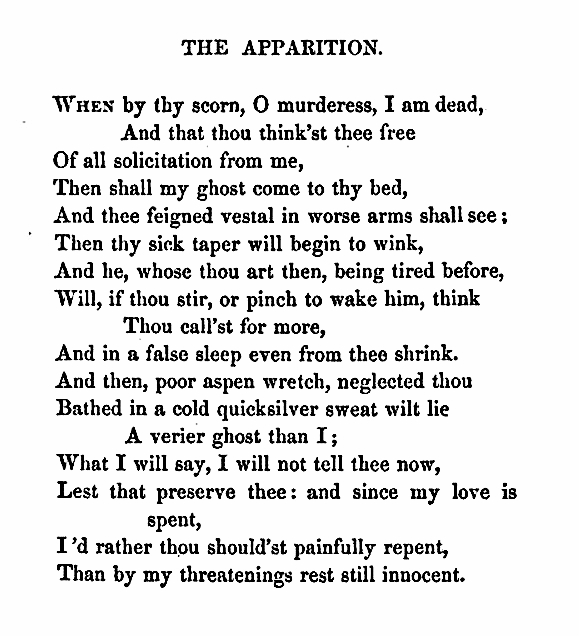
“The Apparition” — John Donne

jd

“The Bookkeeper’s Wife” — Willa Cather

“The Bookkeeper’s Wife” by Willa Cather

Nobody but the janitor was stirring about the offices of the Remsen Paper Company, and still Percy Bixby sat at his desk, crouched on his high stool and staring out at the tops of the tall buildings flushed with the winter sunset, at the hundreds of windows, so many rectangles of white electric light, flashing against the broad waves of violet that ebbed across the sky. His ledgers were all in their places, his desk was in order, his office coat on its peg, and yet Percy’s smooth, thin face wore the look of anxiety and strain which usually meant that he was behind in his work. He was trying to persuade himself to accept a loan from the company without the company’s knowledge. As a matter of fact, he had already accepted it. His books were fixed, the money, in a black-leather bill-book, was already inside his waistcoat pocket.

He had still time to change his mind, to rectify the false figures in his ledger, and to tell Stella Brown that they couldn’t possibly get married next month. There he always halted in his reasoning, and went back to the beginning.

The Remsen Paper Company was a very wealthy concern, with easy, old-fashioned working methods. They did a longtime credit business with safe customers, who never thought of paying up very close on their large indebtedness. From the payments on these large accounts Percy had taken a hundred dollars here and two hundred there until he had made up the thousand he needed. So long as he stayed by the books himself and attended to the mail-orders he couldn’t possibly be found out. He could move these little shortages about from account to account indefinitely. He could have all the time he needed to pay back the deficit, and more time than he needed. Continue reading ““The Bookkeeper’s Wife” — Willa Cather”

Portrait of E.G. Mamontova Reading — Ilya Repin

The Cabinet of Dr. Caligari

“Helen” — H.D.

“Helen” by H.D.—

All Greece hates
the still eyes in the white face,
the lustre as of olives
where she stands,
and the white hands.

All Greece reviles
the wan face when she smiles,
hating it deeper still
when it grows wan and white,
remembering past enchantments
and past ills.

Greece sees, unmoved,
God’s daughter, born of love,
the beauty of cool feet
and slenderest knees,
could love indeed the maid,
only if she were laid,
white ash amid funereal cypresses.

Wild and Primitive (Fletcher Hanks)

20130809-123851.jpg

“The Coffee-House of Surat” — Leo Tolstoy

“THE COFFEE-HOUSE OF SURAT” by Leo Tolstoy

(After Bernardin de Saint-Pierre)

In the town of Surat, in India, was a coffee-house where many travellers and foreigners from all parts of the world met and conversed.

One day a learned Persian theologian visited this coffee-house. He was a man who had spent his life studying the nature of the Deity, and reading and writing books upon the subject. He had thought, read, and written so much about God, that eventually he lost his wits, became quite confused, and ceased even to believe in the existence of a God. The Shah, hearing of this, had banished him from Persia.

After having argued all his life about the First Cause, this unfortunate theologian had ended by quite perplexing himself, and instead of understanding that he had lost his own reason, he began to think that there was no higher Reason controlling the universe.

This man had an African slave who followed him everywhere. When the theologian entered the coffee-house, the slave remained outside, near the door, sitting on a stone in the glare of the sun, and driving away the flies that buzzed around him. The Persian having settled down on a divan in the coffee-house, ordered himself a cup of opium. When he had drunk it and the opium had begun to quicken the workings of his brain, he addressed his slave through the open door:

“Tell me, wretched slave,” said he, “do you think there is a God, or not?”

“Of course there is,” said the slave, and immediately drew from under his girdle a small idol of wood.

“There,” said he, “that is the God who has guarded me from the day of my birth. Every one in our country worships the fetish tree, from the wood of which this God was made.”

This conversation between the theologian and his slave was listened to with surprise by the other guests in the coffee-house. They were astonished at the master’s question, and yet more so at the slave’s reply.

One of them, a Brahmin, on hearing the words spoken by the slave, turned to him and said:

“Miserable fool! Is it possible you believe that God can be carried under a man’s girdle? There is one God—Brahma, and he is greater than the whole world, for he created it. Brahma is the One, the mighty God, and in His honour are built the temples on the Ganges’ banks, where his true priests, the Brahmins, worship him. They know the true God, and none but they. A thousand score of years have passed, and yet through revolution after revolution these priests have held their sway, because Brahma, the one true God, has protected them.” Continue reading ““The Coffee-House of Surat” — Leo Tolstoy”

A Lady Reading a Newspaper — Carl Larsson

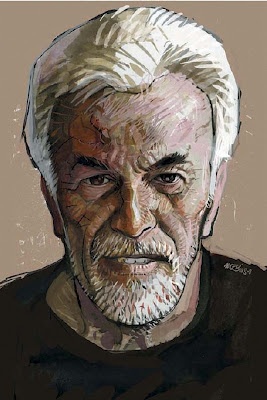
Portrait of Alejandro Jodorowsky — Moebius

jodorowsky moebius