“A Nice Gathering, Isn’t It?” (Orson Welles, Robert Bresson, and Andrei Tarkovsky in Fancy Dress)

“Toys” — Roland Barthes

“Toys”

by

Roland Barthes

(From Mythologies. Translation by Annette Lavers)

French toys: one could not find a better illustration of the fact that the adult Frenchman sees the child as another self. All the toys one commonly sees are essentially a microcosm of the adult world; they are all reduced copies of human objects, as if in the eyes of the public the child was, all told, nothing but a smaller man, a homunculus to whom must be supplied objects of his own size.

Invented forms are very rare: a few sets of blocks, which appeal to the spirit of do-it-yourself, are the only ones which offer dynamic forms. As for the others, French toys always mean something, and this something is always entirely socialized, constituted by the myths or the techniques of modern adult life: the Army, Broadcasting, the Post Office, Medicine (miniature instrument-cases, operating theaters for dolls), School, Hair-Styling (driers for permanent-waving), the Air Force (Parachutists), Transport (trains, Citroens, Vedettes, Vespas, petrol-stations), Science (Martian toys).

The fact that French toys literally prefigure the world of adult functions obviously cannot but prepare the child to accept them all, by constituting for him, even before he can think about it, the alibi of a Nature which has at all times created soldiers, postmen and Vespas. Toys here reveal the list of all the things the adult does not find unusual: war, bureaucracy, ugliness, Martians, etc. It is not so much, in fact, the imitation which is the sign of an abdication, as its literalness: French toys are like a Jivaro head, in which one recognizes, shrunken to the size of an apple, the wrinkles and hair of an adult. There exist, for instance, dolls which urinate; they have an oesophagus, one gives them a bottle, they wet their nappies; soon, no doubt, milk will turn to water in their stomachs. This is meant to prepare the little girl for the causality of house-keeping, to ‘condition’ her to her future role as mother. However, faced with this world of faithful and complicated objects, the child can only identify himself as owner, as user, never as creator; he does not invent the world, he uses it: there are, prepared for him, actions without adventure, without wonder, without joy. He is turned into a little stay-at-home householder who does not even have to invent the mainsprings of adult causality; they are supplied to him ready-made: he has only to help himself, he is never allowed to discover anything from start to finish. The merest set of blocks, provided it is not too refined, implies a very different learning of the world: then, the child does not in any way create meaningful objects, it matters little to him whether they have an adult name; the actions he performs are not those of a user but those of a demiurge. He creates forms which walk, which roll, he creates life, not property: objects now act by themselves, they are no longer an inert and complicated material in the palm of his hand. But such toys are rather rare: French toys are usually based on imitation, they are meant to produce children who are users, not creators.

The bourgeois status of toys can be recognized not only in their forms, which are all functional, but also in their substances. Current toys are made of a graceless material, the product of chemistry, not of nature. Many are now moulded from complicated mixtures; the plastic material of which they are made has an appearance at once gross and hygienic, it destroys all the pleasure, the sweetness, the humanity of touch. A sign which fills one with consternation is the gradual disappearance of wood, in spite of its being an ideal material because of its firmness and its softness, and the natural warmth of its touch. Wood removes, from all the forms which it supports, the wounding quality of angles which are too sharp, the chemical coldness of metal. When the child handles it and knocks it, it neither vibrates nor grates, it has a sound at once muffled and sharp. It is a familiar and poetic substance, which does not sever the child from close contact with the tree, the table, the floor. Wood does not wound or break down; it does not shatter, it wears out, it can last a long time, live with the child, alter little by little the relations between the object and the hand. If it dies, it is in dwindling, not in swelling out like those mechanical toys which disappear behind the hernia of a broken spring. Wood makes essential objects, objects for all time. Yet there hardly remain any of these wooden toys from the Vosges, these fretwork farms with their animals, which were only possible, it is true, in the days of the craftsman. Henceforth, toys are chemical in substance and color; their very material introduces one to a coenaesthesis of use, not pleasure. These toys die in fact very quickly, and once dead, they have no posthumous life for the child.

The Death of Caesar — Jean-Leon Gerome

Ides of March — Cy Twombly

Beware

beware

An Idle Afternoon — Julius LeBlanc Stewart

“Nouns” — Tom Clark

nouns

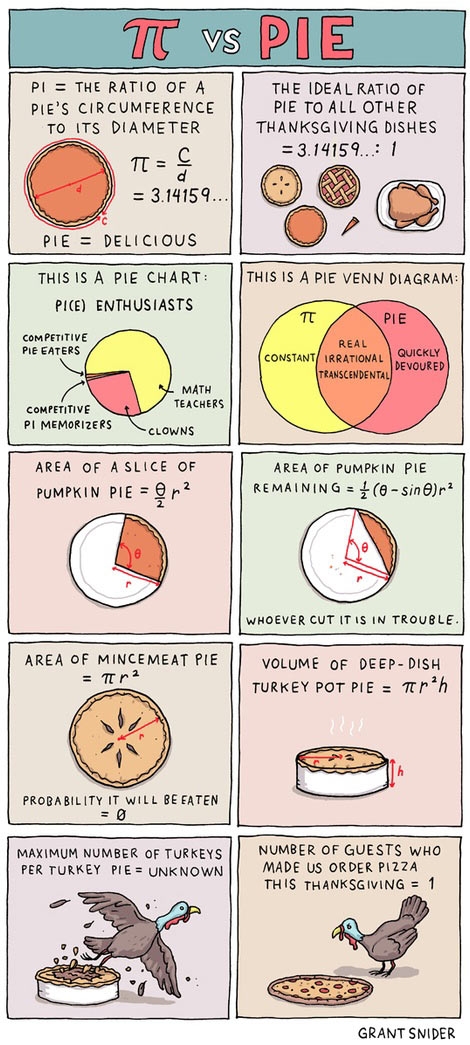
Pi vs. Pie — Grant Snider

4120130019170

Cherry Pie — Pierre Bonnard

“Form the habit of taking some of your solitude with you into society” (Schopenhauer)

When you find human society disagreeable and feel yourself justified in flying to solitude, you can be so constituted as to be unable to bear the depression of it for any length of time, which will probably be the case if you are young. Let me advise you, then, to form the habit of taking some of your solitude with you into society, to learn to be to some extent alone even though you are in company; not to say at once what you think, and, on the other hand, not to attach too precise a meaning to what others say; rather, not to expect much of them, either morally or intellectually, and to strengthen yourself in the feeling of indifference to their opinion, which is the surest way of always practicing a praiseworthy toleration. If you do that, you will not live so much with other people, though you may appear to move amongst them: your relation to them will be of a purely objective character. This precaution will keep you from too close contact with society, and therefore secure you against being contaminated or even outraged by it. Society is in this respect like a fire—the wise man warming himself at a proper distance from it; not coming too close, like the fool, who, on getting scorched, runs away and shivers in solitude, loud in his complaint that the fire burns.

From Counsels and Maxims by Arthur Schopenhauer (translation by T. Bailey Saunders).


The Poet Mazin — Marc Chagall

“How to recognize a work of art” (Roberto Bolaño on translation)

How to recognize a work of art? How to separate it, even if just for a moment, from its critical apparatus, its exegetes, its tireless plagiarizers, its belittlers, its final lonely fate? Easy. Let it be translated. Let its translator be far from brilliant. Rip pages from it at random. Leave it lying in an attic. If after all of this a kid comes along and reads it, and after reading makes it his own, and is faithful to it (or unfaithful, whichever) and reinterprets it and accompanies it on its  voyage to the edge, and both are enriched and the kid adds an ounce of value to its original value, then we have something before us, a machine or a book, capable of speaking to all human beings; not a plowed field but a mountain, not the image of a dark forest but the dark forest, not a flock of birds but the Nightingale.

From Roberto Bolaño’s essay “Translation Is an Anvil” (collected in Between Parentheses).

Jim O’Rourke Plays “Women of the World” (Live on Christmas Day, 2013)

Yeah I know it’s upwards of 66% the back of some young dude’s head at times, shot on some smartphone (?) but lord I love this.

New in Translation from New Vessel Press (Books Acquired Some Time Earlier This Month)

20140313-175305.jpg

Some handsome titles from indie New Vessel Press:

First, Marek Hlasko’s Killing the Second Dog (translation by Tomaasz Mirkowicz). Blurb:

Robert and Jacob are two down-and-out Polish con men living in Israel in the early 1960s. They’re planning to run a scam on an American widow visiting the country. Robert, who masterminds the scheme, and Jacob who acts it out, are tough, desperate men, exiled from their native land and adrift in the hot, nasty underworld of Tel Aviv. Robert arranges for Jacob to run into the woman, who has enough trouble with her young son to keep her occupied all day. Her heart is open though, and the men are hoping her wallet is too. What follows is a story of love, deception, cruelty and shame, as Jacob pretends to fall in love with the American. But it’s not just Jacob who seems to be performing a role; nearly all the characters are actors in an ugly story, complete with parts for murder and suicide. Hlasko’s writing combines brutal realism with smoky, hardboiled dialogue, in a bleak world where violence is the norm and love is often only an act.

I’m gonna crack into this one next week.

The Good Life Elsewhere by Vladimir Lorchenkov (translation by Ross Ufberg):

The Good Life Elsewhere is a very funny book. It is also a very sad one. Moldovan writer Vladimir Lorchenkov tells the story of a group of villagers and their tragicomic efforts, against all odds and at any cost, to emigrate from Europe’s most impoverished nation to Italy for work. This is a book with wild imagination and heartbreaking honesty, grim appraisals alongside optimistic commentary about the nature of human striving. In Lorchenkov’s uproarious tale, an Orthodox priest is deserted by his wife for an art-dealing atheist; a rookie curling team makes it to an international competition; a mechanic redesigns his tractor for travel by air and sea; thousands of villagers take to the road on a modern-day religious crusade to make it to the promised land of Italy; meanwhile, politicians remain politicians. Like many great satirists from Voltaire to Gogol to Vonnegut, Lorchenkov makes use of the grotesque to both horrify us and help us laugh. It is not often that stories from forgotten countries such as Moldova reach us in the English-speaking world. A country where 25 percent of its population works abroad, where remittances make up nearly 40 percent of the GDP, where alcohol consumption per capita is the highest in the world, and which has the lowest per capita income in all of Europe – this is a country that surely has its problems. But, as Lorchenkov vividly shows, it’s a country whose residents don’t easily give up.

A Sufi Sage (After Melancholia) — Farrukh Beg

“I Am in Danger—Sir—” — Adrienne Rich

“I Am in Danger—Sir—” by Adrienne Rich

“Half-cracked” to Higginson, living,
afterward famous in garbled versions,
your hoard of dazzling scraps a battlefield,
now your old snood

mothballed at Harvard
and you in your variorum monument
equivocal to the end—
who are you?

you, woman, masculine
in single-mindedness,
for whom the word was more
than a symptom—

a condition of being.
Till the air buzzing with spoiled language
sang in your ears
of Perjury

and in your half-cracked way you chose
silence for entertainment,
chose to have it out at last
on your own premises.