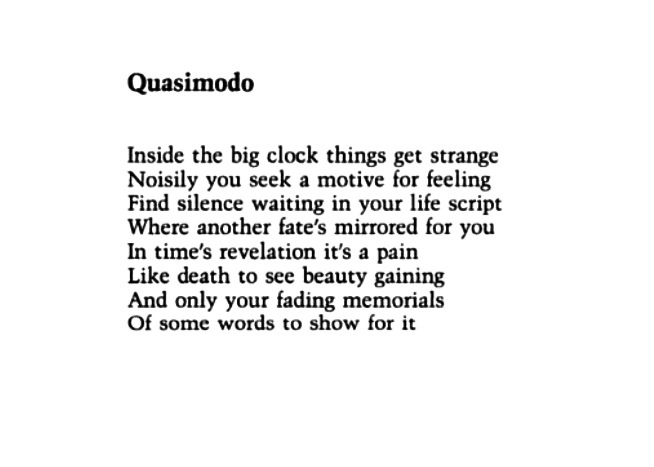
“Quasimodo” — Tom Clark

20140623-182727-66447266.jpg

Film Poster for Wong Kar Wai’s The Grandmaster — Vania Zouravliov

filmz.ru

Books Acquired (Second Week of June, 2014)

20140621-192932-70172308.jpg

Two historicalish fictions.

First, Merivel: A Man of His Time by Rose Tremain, which is new in trade paperback; the hardback received good reviews last year. Pub’s blurb:

The wonderful new historical novel set in seventeenth-century England from Rose Tremain, author of Restoration (shortlisted for the Booker Prize), The Road Home (winner of the Orange Prize) and Trespass (a Richard & Judy pick). Merivel has been called ‘wonderfully entertaining’ (Guardian Books of the Year) and ‘an unadulterated delight’ (Independent) and has been shortlisted for the Walter Scott Prize for Historical Fiction.

The gaudy years of the Restoration are long gone and Robert Merivel, physician and courtier to King Charles II, sets off for the French court in search of a fresh start. But royal life at the Palace of Versailles – all glitter in front and squalor behind – leaves him in despair, until a chance encounter with the seductive Madame de Flamanville, allows him to dream of a different future.
But will that future ever be his? Summoned home urgently to attend to the ailing King, Merivel finds his loyalty and skill tested to their limits.

20140621-192930-70170223.jpg

Also: Peter Tremayne’s The Seventh Trumpet:

When a murdered corpse of an unknown young noble is discovered, Fidelma of Cashel is brought in to investigate, in Peter Tremayne’s The Seventh Trumpet

Ireland, AD 670. When the body of a murdered young noble is discovered not far from Cashel, the King calls upon his sister, Fidelma, and her companion Eadulf to investigate. Fidelma, in addition to being the sister of the king, is a dailaigh—an advocate of the Brehon Law Courts—and has a particular talent for resolving the thorniest of mysteries.

But this time, Fidelma and Eadulf have very little to work with—the only clue to the noble’s identity is an emblem originating from the nearby kingdom of Laign. Could the murder be somehow related to the wave of violence erupting in the western lands of the kingdom? The turmoil there is being stirred up by an unknown fanatical figure who claims to have been summoned by “the seventh angel” to remove the “impure of faith.” Fidelma and Eadulf, once again grappling with a tangled skein of murder and intrigue, must somehow learn what connects the dead noble, a murdered alcoholic priest, and an abbot who has turned his monastery into a military fortress. When it appears that things cannot get more complex, Fidelma herself is abducted, and Eadulf must rescue her before the mystery can be solved.

Automat (I) — Michaël Borremans

“A Seventeenth-Century Story” — A. A. Milne

“A Seventeenth-Century Story”

by

A. A. Milne 

There is a story in every name in that first column of The Times- -Births, Marriages, and Deaths—down which we glance each morning, but, unless the name is known to us, we do not bother about the stories of other people. They are those not very interesting people, our contemporaries. But in a country churchyard a name on an old tombstone will set us wondering a little. What sort of life came to an end there a hundred years ago?

In the parish register we shall find the whole history of them; when they were born, when they were married, how many children they had, when they died—a skeleton of their lives which we can clothe with our fancies and make living again. Simple lives, we make them, in that pleasant countryside; “Man comes and tills the field and lies beneath”; that is all. Simple work, simple pleasures, and a simple death.

Of course we are wrong. There were passions and pains in those lives; tragedies perhaps. The tombstones and the registers say nothing of them; or, if they say it, it is in a cypher to which we have not the key. Yet sometimes the key is almost in our hands. Here is a story from the register of a village church— four entries only, but they hide a tragedy which with a little imagination we can almost piece together for ourselves. Continue reading ““A Seventeenth-Century Story” — A. A. Milne”

Self Portrait with Charlie Brown — Chris Ware

ware brown