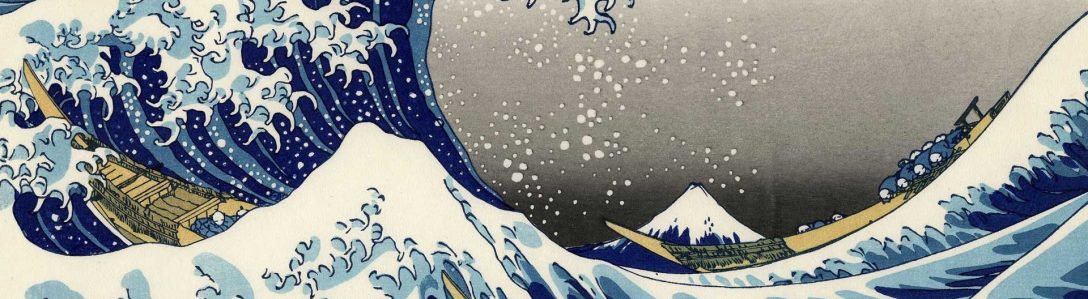
- All the dead that had ever been drowned in a certain lake to arise.
- Character of a man who, in himself and his external circumstances, shall be equally and totally false: his fortune resting on baseless credit,–his patriotism assumed,–his domestic affections, his honor and honesty, all a sham. His own misery in the midst of it,–it making the whole universe, heaven and earth alike, an unsubstantial mockery to him.
- Dr. Johnson’s penance in Uttoxeter Market. A man who does penance in what might appear to lookers-on the most glorious and triumphal circumstance of his life. Each circumstance of the career of an apparently successful man to be a penance and torture to him on account of some fundamental error in early life.
- A person to catch fire-flies, and try to kindle his household fire with them. It would be symbolical of something.
- Thanksgiving at the Worcester Lunatic Asylum. A ball and dance of the inmates in the evening,–a furious lunatic dancing with the principal’s wife. Thanksgiving in an almshouse might make a better sketch.
Month: September 2014
Beak, Claw, Hand, Brush #1 — Clive Smith

Portrait of Charles Burns in the Style of Nitnit

Charles Schulz is the only writer I’ve continually been reading since I was a kid (Chris Ware)
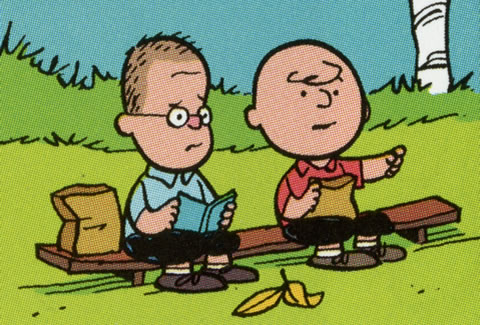
It was the Peanuts collections in my grandfather’s basement office that really stayed with me through childhood and into college. Charlie Brown, Linus, Snoopy, and Lucy all felt like real people to me. I even felt so sorry for Charlie Brown at one point that I wrote him a valentine and sent it to the newspaper, hoping he’d get it. I’ve said it many times before, but Charles Schulz is the only writer I’ve continually been reading since I was a kid. And I know I’m not alone. He touched millions of people and introduced empathy to comics, an important step in their transition from a mass medium to an artistic and literary one.
My Father Fallen — Vincent Desiderio

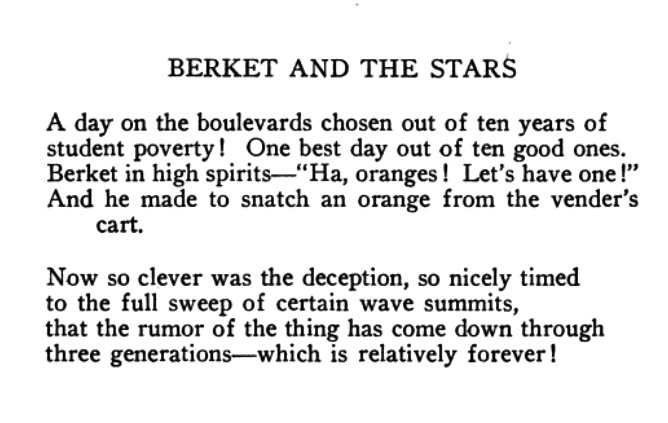
“Berket and the Stars” — William Carlos Williams
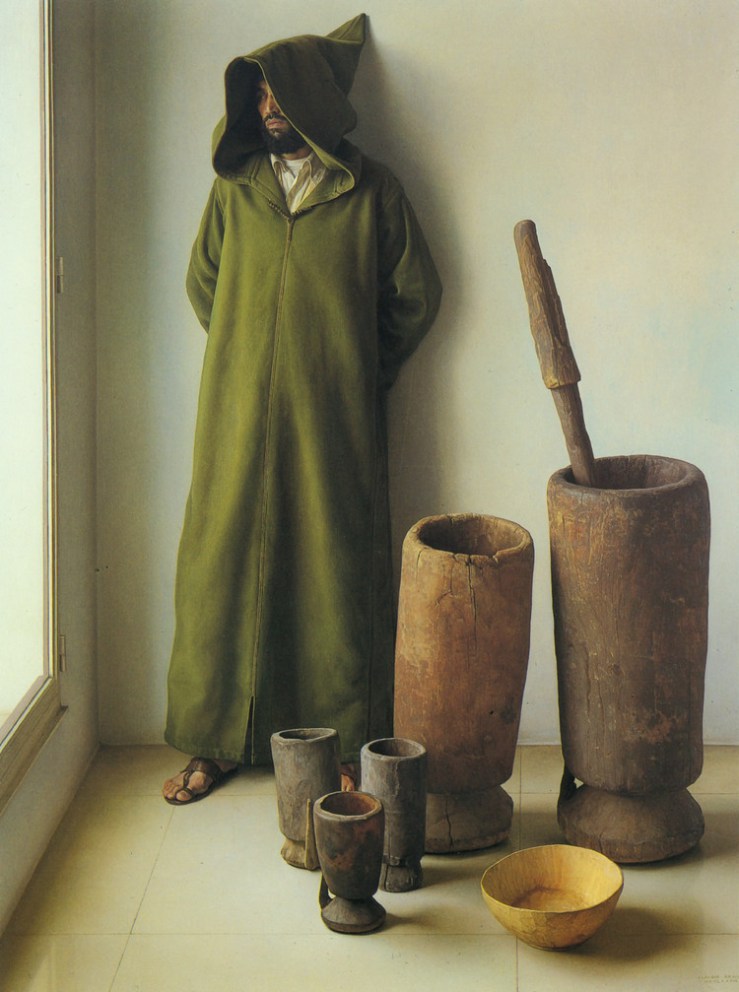
Green Moorish Robe — Claudio Bravo
Silence Has No Wings — Kazuo Kuroki (Full Film)

The Bus — Paul Kirchner

Diptych — Mark Tansey

Three Can Keep a Secret (Book Acquired Some Time in August, 2014)
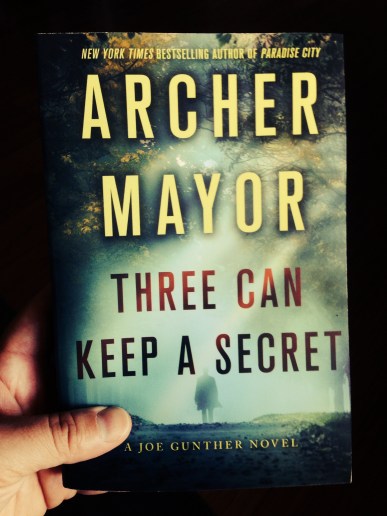
Archer Mayor’s Three Can Keep a Secret is, the press materials assure me, the 24th in a series of Joe Gunther mysteries. Holy cow! Publisher Macmillan/Tor’s blurb:
Joe Gunther and his team—the Vermont Bureau of Investigation (VBI)—are usually called in on major cases by local Vermont enforcement whenever they need expertise and back-up. But after the state is devastated by Hurricane Irene, the police from one end of the state are taxed to their limits, leaving Joe Gunther involved in an odd, seemingly unrelated series of cases. In the wake of the hurricane, a seventeen year old gravesite is exposed, revealing a coffin that had been filled with rocks instead of the expected remains.
At the same time, an old, retired state politician turns up dead at his high-end nursing home, in circumstances that leave investigators unsure that he wasn’t murdered. And a patient who calls herself The Governor has walked away from a state mental facility during the post-hurricane flood. It turns out that she was indeed once “Governor for a Day,” over forty years ago, but that she might have also been falsely committed and drugged to keep her from revealing something that she saw all those years ago. Amidst the turmoil and the disaster relief, it’s up to Joe Gunther and his team to learn what really happened with the two corpses—one missing—and what secret “The Governor” might have still locked in her brain that links them all.
Cheever holds my attention more than any other writer (Matthew Weiner)
INTERVIEWER
Who are your favorite writers?
WEINER
I don’t make lists or rank writers. I can only say which ones are relevant to me. Salinger holds my attention, Yates holds my attention. John O’Hara doesn’t, I don’t know why—it’s the same environment, but he doesn’t. Cheever holds my attention more than any other writer. He is in every aspect of Mad Men, starting with the fact that Don lives in Ossining on Bullet Park Road—the children are ignored, people have talents they can’t capitalize on, everyone is selfish to some degree or in some kind of delusion. I have to say, Cheever’s stories work like TV episodes, where you don’t get to repeat information about the characters. He grabs you from the beginning.
Poems have always held my attention, but they’re denser and smaller. It’s funny because poetry is considered harder to read. It wasn’t harder for me. Close reading, that is. Milton, Chaucer, Dante—I could handle those for some reason, but not fiction. From ninth grade on, I wrote poetry compulsively, and pushed myself to do iambic pentameter and rhymes because free verse was cheating—anybody could do that. But I was such a terrible student. I couldn’t sustain anything.
Fascinating interview with Mad Men creator Matthew Weiner in The Paris Review. I would’ve predicted the Yates and the Cheever (and Updike too, whom he doesn’t name), but not the poetry (Weiner goes on to detail his years writing poetry). My wife and I have been, uh, binge watching I think is the phrase the kids are supposed to be saying, although I don’t think the kids say it, I think culture reporters made it up—anyway, my wife and I watched the first season of Mad Men this week (hadn’t watched nary a rerun since it aired). It holds up pretty well, despite some soapy moments, cliches, and broad strokes.
The Physician — Gerrit Dou

Hamlet and the Gravedigger — Camille Corot

“All art constantly aspires towards the condition of music”
Backdrop for a Seasonal Revelation (Palimpsest #19) — Kamrooz Aram

The Purchase (Book Acquired, 9.03.2014)
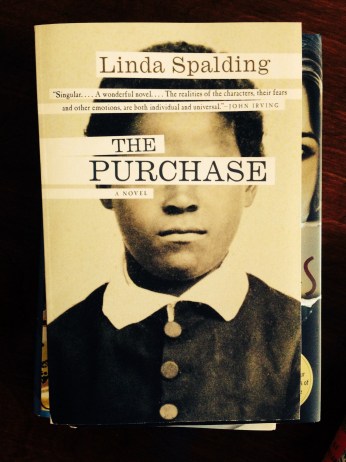
Linda Spalding’s novel The Purchase is new in trade paperback from Random House. Their blurb:
Pennsylvania, 1798. Daniel Dickinson, a devout Quaker, has just lost his wife. When he marries a fifteen-year-old Methodist orphan to help with his five small children, his fellow Quakers disown him for his impropriety. Forced out of the only community he’s ever known, Daniel moves his family to the Virginia frontier. He has in hand a few land warrants, with which he plans to establish his new homestead.
Although determined to hold to his Quaker belief in abolitionism, Daniel is now in a slave state, and he soon finds himself the owner of a young boy named Onesimus. This fatal purchase sets in motion a twisted chain of events that will forever change his children’s lives—and his own. An unforgettable story of sacrifice and redemption, The Purchase powerfully explores questions of fate, faith, loyalty, and conscience.
 Biblioklept