No. 2, Main Control Panel, Nerve Center of Ship — Jacob Lawrence

Letter to Nathaniel Hawthorne, November 1851 — Herman Melville

My Dear Hawthorne, — People think that if a man has undergone any hardship, he should have a reward; but for my part, if I have done the hardest possible day’s work, and then come to sit down in a corner and eat my supper comfortably — why, then I don’t think I deserve any reward for my hard day’s work — for am I not now at peace? Is not my supper good? My peace and my supper are my reward, my dear Hawthorne. So your joy-giving and exultation-breeding letter is not my reward for my ditcher’s work with that book, but is the good goddess’s bonus over and above what was stipulated — for for not one man in five cycles, who is wise, will expect appreciative recognition from his fellows, or any one of them. Appreciation! Recognition! Is love appreciated? Why, ever since Adam, who has got to the meaning of this great allegory — the world? Then we pygmies must be content to have our paper allegories but ill comprehended. I say your appreciation is my glorious gratuity. In my proud, humble way, — a shepherd-king, — I was lord of a little vale in the solitary Crimea; but you have now given me the crown of India. But on trying it on my head, I found it fell down on my ears, notwithstanding their asinine length — for it’s only such ears that sustain such crowns.

Your letter was handed me last night on the road going to Mr. Morewood’s, and I read it there. Had I been at home, I would have sat down at once and answered it. In me divine maganimities are spontaneous and instantaneous — catch them while you can. The world goes round, and the other side comes up. So now I can’t write what I felt. But I felt pantheistic then — your heart beat in my ribs and mine in yours, and both in God’s. A sense of unspeakable security is in me this moment, on account of your having understood the book. I have written a wicked book, and feel spotless as the lamb. Ineffable socialities are in me. I would sit down and dine with you and all the gods in old Rome’s Pantheon. It is a strange feeling — no hopefulness is in it, no despair. Content — that is it; and irresponsibility; but without licentious inclination. I speak now of my profoundest sense of being, not of an incidental feeling.

Whence come you, Hawthorne? By what right do you drink from my flagon of life? And when I put it to my lips — lo, they are yours and not mine. I feel that the Godhead is broken up like the bread at the Supper, and that we are the pieces. Hence this infinite fraternity of feeling. Now, sympathizing with the paper, my angel turns over another page. you did not care a penny for the book. But, now and then as you read, you understood the pervading thought that impelled the book — and that you praised. Was it not so? You were archangel enough to despise the imperfect body, and embrace the soul. Once you hugged the ugly Socrates because you saw the flame in the mouth, and heard the rushing of the demon, — the familiar, — and recognized the sound; for you have heard it in your own solitudes.

My dear Hawthorne, the atmospheric skepticisms steal into me now, and make me doubtful of my sanity in writing you thus. But, believe me, I am not mad, most noble Festus! But truth is ever incoherent, and when the big hearts strike together, the concussion is a little stunning. Farewell. Don’t write a word about the book. That would be robbing me of my miserly delight. I am heartily sorry I ever wrote anything about you — it was paltry. Lord, when shall we be done growing? As long as we have anything more to do, we have done nothing. So,now, let us add Moby Dick to our blessing, and step from that. Leviathan is not the biggest fish; — I have heard if Krakens.

This is a long letter, but you are not at all bound to answer it. Possibly, if you do answer it, and direct it to Herman Melville, you will missend it — for the very fingers that now guide this pen are not precisely the same that just took it up and put it on this paper. Lord, when shall we be done changing? Ah! it’s a long stage, and no inn in sight, and night coming, and the body cold. But with you for a passenger, I am content and can be happy. I shall leave the world, I feel, with more satisfaction for having come to know you. Knowing you persuades me more than the Bible of our immortality.

What a pity, that, for your plain, bluff letter, you should get such gibberish! Mention me to Mrs. Hawthorne and to the children, and so, good-by to you, with my blessing.

Herman.

P.S. I can’t stop yet. If the world was entirely made up of Magians, I’ll tell you what I should do. I should have a paper-mill established at one end of the house, and so have an endless riband of foolscap rolling in upon my desk; and upon that endless riband I should write a thousand — a million — billion thoughts, all under the form of a letter to you. The divine magnet is on you, and my magnet responds. Which is the biggest? A foolish question — they are One.

H.

P.P.S. Don’t think that by writing me a letter, you shall always be bored with an immediate reply to it — and so keep both of us delving over a writing-desk eternally. No such thing! I sh’n’t always answer your letters, and you may do just as you please.

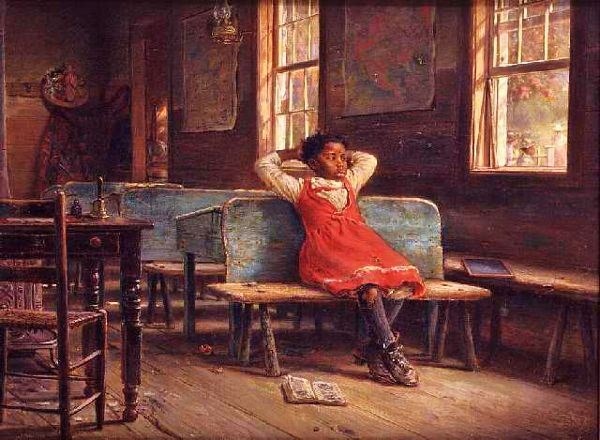
Kept In — Edward Lamson Henry

Edward Lamson Henry (American artist, 1841-1913) Kept In

Irish Woman on a Bed — Lucian Freud

Swing You Sinners!

Five Story Ideas from Nathaniel Hawthorne’s Note-Books

  1. All the dead that had ever been drowned in a certain lake to arise.
  2. Character of a man who, in himself and his external circumstances, shall be equally and totally false: his fortune resting on baseless credit,–his patriotism assumed,–his domestic affections, his honor and honesty, all a sham. His own misery in the midst of it,–it making the whole universe, heaven and earth alike, an unsubstantial mockery to him.
  3. Dr. Johnson’s penance in Uttoxeter Market. A man who does penance in what might appear to lookers-on the most glorious and triumphal circumstance of his life. Each circumstance of the career of an apparently successful man to be a penance and torture to him on account of some fundamental error in early life.
  4. A person to catch fire-flies, and try to kindle his household fire with them. It would be symbolical of something.
  5. Thanksgiving at the Worcester Lunatic Asylum. A ball and dance of the inmates in the evening,–a furious lunatic dancing with the principal’s wife. Thanksgiving in an almshouse might make a better sketch.

From Nathaniel Hawthorne’s American Note-Books.

Beak, Claw, Hand, Brush #1 — Clive Smith

Portrait of Charles Burns in the Style of Nitnit

burns

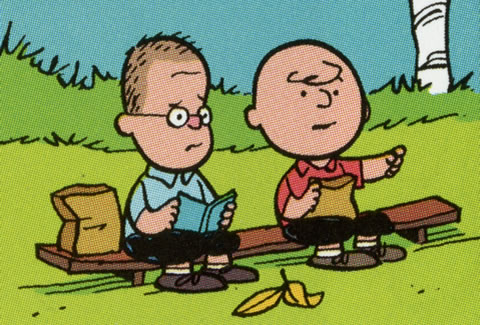
Charles Schulz is the only writer I’ve continually been reading since I was a kid (Chris Ware)

It was the Peanuts collections in my grandfather’s basement office that really stayed with me through childhood and into college. Charlie Brown, Linus, Snoopy, and Lucy all felt like real people to me. I even felt so sorry for Charlie Brown at one point that I wrote him a valentine and sent it to the newspaper, hoping he’d get it. I’ve said it many times before, but Charles Schulz is the only writer I’ve continually been reading since I was a kid. And I know I’m not alone. He touched millions of people and introduced empathy to comics, an important step in their transition from a mass medium to an artistic and literary one.

From Chris Ware’s new interview with The Paris Review.

My Father Fallen — Vincent Desiderio

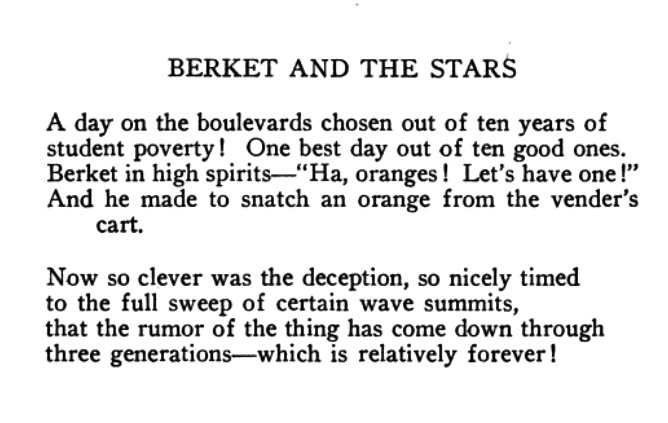
“Berket and the Stars” — William Carlos Williams

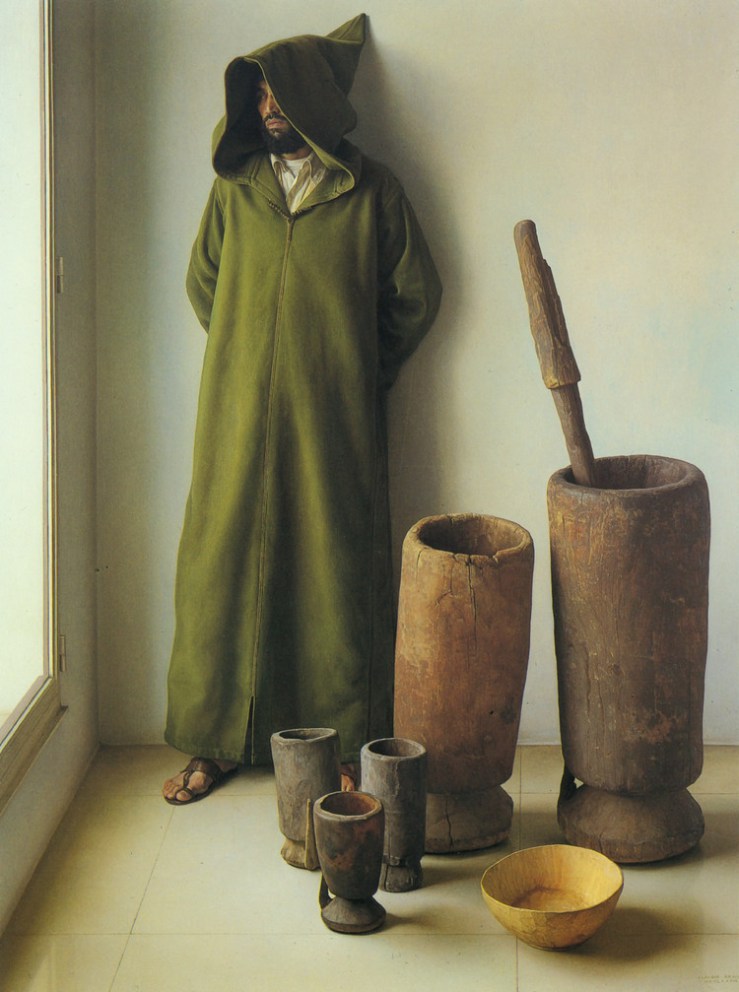
Green Moorish Robe — Claudio Bravo

green moorish robes

Silence Has No Wings — Kazuo Kuroki (Full Film)

The Bus — Paul Kirchner

Three Can Keep a Secret (Book Acquired Some Time in August, 2014)

IMG_3119.JPG

Archer Mayor’s Three Can Keep a Secret is, the press materials assure me, the 24th in a series of Joe Gunther mysteries. Holy cow! Publisher Macmillan/Tor’s blurb:

Joe Gunther and his team—the Vermont Bureau of Investigation (VBI)—are usually called in on major cases by local Vermont enforcement whenever they need expertise and back-up.  But after the state is devastated by Hurricane Irene, the police from one end of the state are taxed to their limits, leaving Joe Gunther involved in an odd, seemingly unrelated series of cases. In the wake of the hurricane, a seventeen year old gravesite is exposed, revealing a coffin that had been filled with rocks instead of the expected remains.

At the same time, an old, retired state politician turns up dead at his high-end nursing home, in circumstances that leave investigators unsure that he wasn’t murdered.  And a patient who calls herself The Governor has walked away from a state mental facility during the post-hurricane flood. It turns out that she was indeed once “Governor for a Day,” over forty years ago, but that she might have also been falsely committed and drugged to keep her from revealing something that she saw all those years ago.  Amidst the turmoil and the disaster relief, it’s up to Joe Gunther and his team to learn what really happened with the two corpses—one missing—and what secret “The Governor” might have still locked in her brain that links them all.


Cheever holds my attention more than any other writer (Matthew Weiner)

INTERVIEWER

Who are your favorite writers?

WEINER

I don’t make lists or rank writers. I can only say which ones are relevant to me. Salinger holds my attention, Yates holds my attention. John O’Hara doesn’t, I don’t know why—it’s the same environment, but he doesn’t. Cheever holds my attention more than any other writer. He is in every aspect of Mad Men, starting with the fact that Don lives in Ossining on Bullet Park Road—the children are ignored, people have talents they can’t capitalize on, everyone is selfish to some degree or in some kind of delusion. I have to say, Cheever’s stories work like TV episodes, where you don’t get to repeat information about the characters. He grabs you from the beginning.

Poems have always held my attention, but they’re denser and smaller. It’s funny because poetry is considered harder to read. It wasn’t harder for me. Close reading, that is. Milton, Chaucer, Dante—I could handle those for some reason, but not fiction. From ninth grade on, I wrote poetry compulsively, and pushed myself to do iambic pentameter and rhymes because free verse was cheating—anybody could do that. But I was such a terrible student. I couldn’t sustain anything.

Fascinating interview with Mad Men creator Matthew Weiner in The Paris Review. I would’ve predicted the Yates and the Cheever (and Updike too, whom he doesn’t name), but not the poetry (Weiner goes on to detail his years writing poetry). My wife and I have been, uh, binge watching I think is the phrase the kids are supposed to be saying, although I don’t think the kids say it, I think culture reporters made it up—anyway, my wife and I watched the first season of Mad Men this week (hadn’t watched nary a rerun since it aired). It holds up pretty well, despite some soapy moments, cliches, and broad strokes.