A Clip from The Kidnapping Of Michel Houellebecq

Michel Houellebecq is always performing Michel Houellebecq.

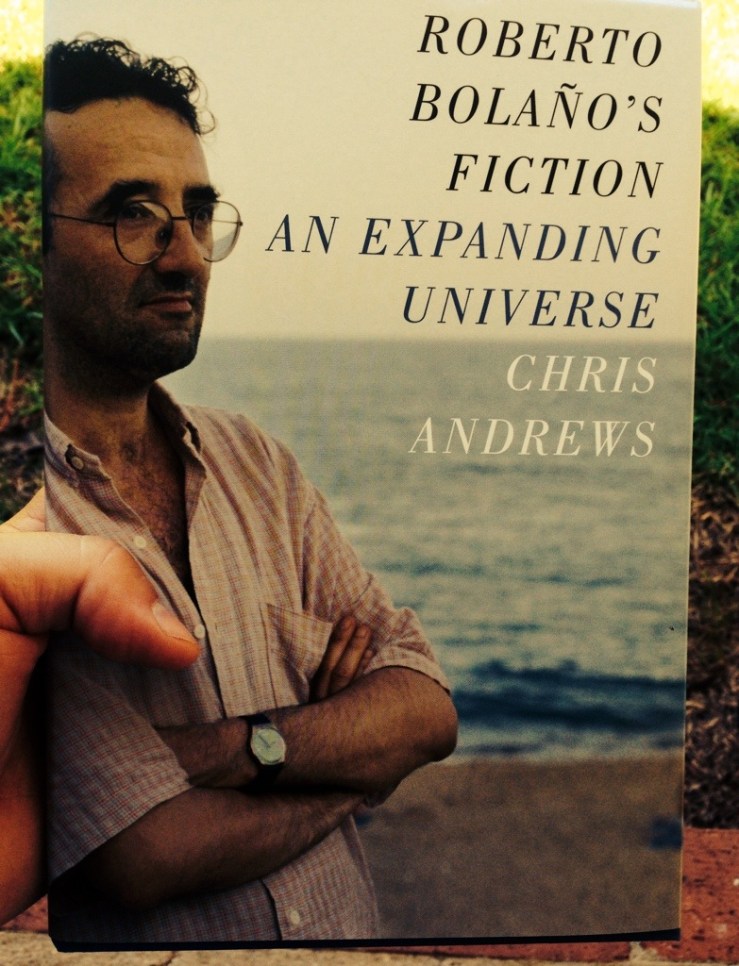
Roberto Bolaño’s Fiction (Book Acquired, 07.24.2014)

20140728-123758-45478204.jpg
So of course I’ve been eating up Roberto Bolaño’s Fiction: An Expanding Universe, a new critical study by Bolaño’s translator Chris Andrews. I’ve read the introduction and the first three chapters so far, and the study, far from being dry and academic, compels me to dig deeper.

The book really starts with the second chapter, with Andrews simply trying to situate Bolaño-as-publishing-phenomenon in the first chapter. The introduction—which you can read at publisher Columbia UP’s site—offers a clear overview of what Andrews aims to do.

Andrews writes that:

…the interconnected series of narratives that begins with Nazi Literatures in the Americas (originally published in 1996) and ends with the stories that appeared posthumously in The Secret of Evil … can be regarded as forming a single, openly structured edifice whose two sustaining pillars are The Savage Detectives and 2666, and for which Woes of the True Policeman served as a preparatory model.

Andrews’s description recalls Javier Moreno’s geometry of Bolaño’s fictions:
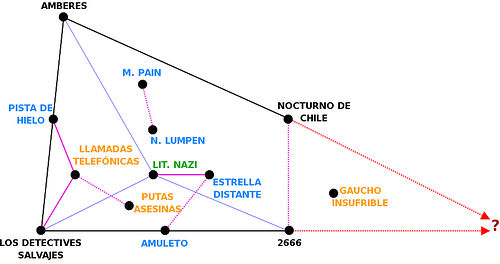
moreno

This model has greatly influenced my own reading of Bolaño over the years, leading to my conceptualization of Bolaño’s later work existing in a self-creating, self-deconstructing Bolañoverse.

Andrews’s description of the Bolañoverse (he doesn’t use the term):

Bolaño expanded or “exploded” his own published texts, blowing them up by adding new characters and episodes as well as circumstantial details. He also allowed characters to circulate or migrate from text to text, sometimes altering their names and properties. Within his novels and stories, he inclded representations of imagined texts and artworks, that is, metarepresentations. Finally, some of his characters and narrators are over-interpreters: they seize on details, invest them with significance, and invent stories to connect and explain them. 

More to come; for now, the publisher’s blurb:

Since the publication of The Savage Detectives in 2007, the work of Roberto Bolaño (1953–2003) has achieved an acclaim rarely enjoyed by literature in translation. Chris Andrews, a leading translator of Bolaño’s work into English, explores the singular achievements of the author’s oeuvre, engaging with its distinct style and key thematic concerns, incorporating his novels and stories into the larger history of Latin American and global literary fiction.

Andrews provides new readings and interpretations of Bolaño’s novels, including 2666, The Savage Detectives, and By Night in Chile, while at the same time examining the ideas and narrative strategies that unify his work. He begins with a consideration of the reception of Bolaño’s fiction in English translation, examining the reasons behind its popularity. Subsequent chapters explore aspects of Bolaño’s fictional universe and the political, ethical, and aesthetic values that shape it. Bolaño emerges as the inventor of a prodigiously effective “fiction-making system,” a subtle handler of suspense, a chronicler of aimlessness, a celebrator of courage, an anatomist of evil, and a proponent of youthful openness. Written in a clear and engaging style, Roberto Bolano’s Fiction offers an invaluable understanding of one of the most important authors of the last thirty years.

Woman with Mandolin in Yellow and Red — Max Beckmann

The final test of truth is ridicule (H.L. Mencken)

The final test of truth is ridicule. Very few religious dogmas have ever faced it and survived. Huxley laughed the devils out of the Gadarene swine. Dowie’s whiskers broke the back of Dowieism. Not the laws of the United States but the mother-in-law joke brought the Mormons to compromise and surrender. Not the horror of it but the absurdity of it killed the doctrine of infant damnation…. But the razor edge of ridicule is turned by the tough hide of truth. How loudly the barber-surgeons laughed at Harvey—and how vainly! What clown ever brought down the house like Galileo? Or Columbus? Or Jenner? Or Lincoln? Or Darwin?… They are laughing at Nietzsche yet…

From H.L. Mencken’s Damn! A Book of Calumny.


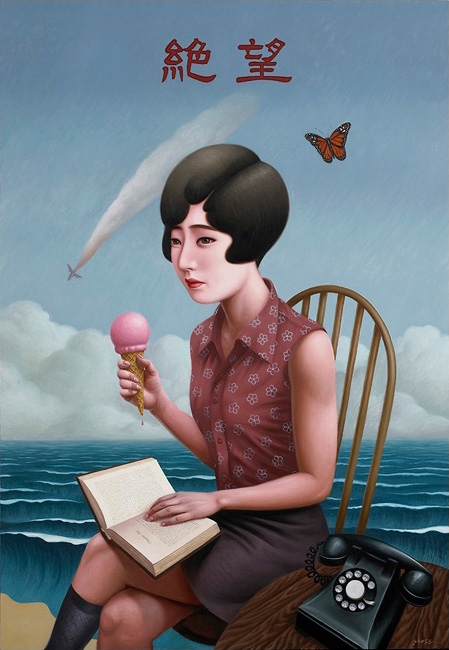
Ice Cream Cone (Despair) — Alex Gross

alex_gross_3

The Mysterious Barricades — René Magritte

“The Brawl” — Michelangelo Antonioni

20140716-162722-59242537.jpg

Dan McPharlin’s Miniatures

416065792_65f1783f12_o 253931431_68d402d800_o 422914358_3b8ee814af_o 2987819208_01e09a4855_o 3887819123_ecea97c74a_o

More.

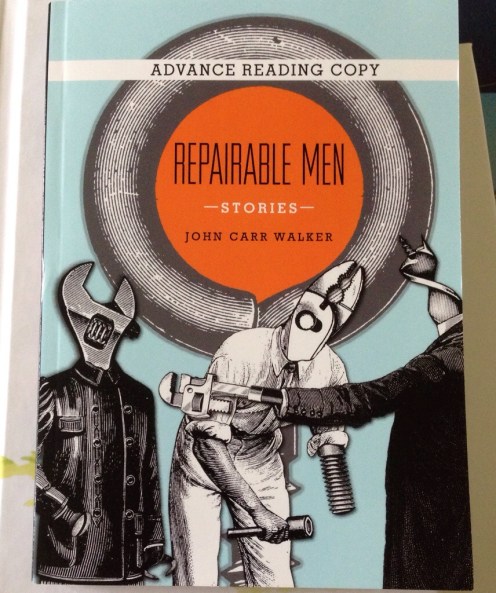
Repairable Men (Book Acquired, 7.21.2014)

20140728-123800-45480214.jpg

John Carr Walker’s collection Repairable Men is new from Sunnyoutside. Blurb from the author’s website:

The stories in Repairable Men look at the small towns and rural farms where families stay for generations and newcomers never quite feel at home. Whether trapped by dead-end work, hostile relatives, or the troubling legacies of their forebears, John Carr Walker’s characters are seeking escape, forgiveness, and redemption in the dusty corners of the new American West.

Read his story “Candelario.”


Speedway — Sybil Andrews

“A Fugue” — William H. Gass

My dad wouldn’t let me have a dog. A dog? A dog we don’t need. My mom made the neighbor’s spitz her pal by poisoning it with the gin she sprinkled on the table scraps. Feed it somewhere else, my dad said. A dog we don’t need. My dad wouldn’t let me have a dog. Our neighbor’s spitz–that mutt–he shits in the flower beds. Dog doo we don’t need. At least feed it somewhere else, my dad said. My mom made the table scraps tasty for her pal, the neighbor’s spitz– that mutt–by sprinkling them with gin. You’re poisoning Pal, my dad said, but never mind, we don’t need that mutt. My mom thought anything tasted better with a little gin to salt it up. That way my mom made the neighbor’s spitz her pal, and maddened dad who wouldn’t let me have a dog. He always said we didn’t need one, they crapped on the carpet and put dirty paws on the pant’s leg of guests and yapped at cats or anyone who came to the door. A dog? A dog we don’t need. We don’t need chewed shoes and dog hairs on the sofa, fleas in the rug, dirty bowls in every corner of the kitchen, dog stink on our clothes. But my mom made the neighbor’s spitz her pal anyway by poisoning it with the gin she sprinkled on the table scraps like she was baptising bones. At least feed it somewhere else, my dad said. My dad wouldn’t let me have a pal. Who will have to walk that pal, he said. I will. And it’s going to be snowing or it’s going to be raining and who will be waiting by the vacant lot at the corner in the cold wet wind, waiting for the damn dog to do his business? Not you, Billy boy Christ, you can’t even be counted on to bring in the garbage cans or mow the lawn. So no dog. A mutt we don’t need, we don’t need dog doo in the flower beds, chewed shoes, fleas; what we need is the yard raked, like I said this morning. No damn dog. No mutt for your mother either even if she tries to get around me by feeding it when my back is turned, when I’m away at work earning her gin money so the sick thing can shit in a stream on the flower seeds; at least she should feed it somewhere else; it’s always hanging around; is it a light string in the hall or a cloth on the table to be always hanging around? No. Chewed shoes, fleas, muddy paws and yappy daddle, bowser odor: a dog we don’t need. Suppose it bites the postman: do you get sued? No. I am the one waiting at the corner vacant lot in the rain, the snow, the cold wet wind, waiting for the dog to do his damn business, and I get sued. You don’t. Christ, you can’t even be counted on to clip the hedge. You know: snicksnack. So no dog, my dad said. Though we had a dog nevertheless. That is, my mom made the neighbor’s pal her mutt, and didn’t let me have him for mine, either, because it just followed her around–yip nip–wanting to lap gin and nose its grease-sogged bread. So we did have a dog in the house, even though it just visited, and it would rest its white head in my mother’s lap and whimper and my father would throw down his paper and say shit! and I would walk out of the house and neglect to mow or rake the yard, or snicksnack the hedge or bring the garbage cans around. My dad wouldn’t let me have a dog. A dog? A dog we don’t need, he said. So I was damned if I would fetch.

From William H. Gass’s novel The Tunnel.

Portrait of a Woman with a Book — Paolo Zacchia il Vecchio the Elder

1c Paolo Zacchia il Vecchio (the elder) (1519-1561) Portrait of a Woman with a Book

Akira — Katsuhiro Ōtomo (Full Film)

Fishblood — Gustav Klimt

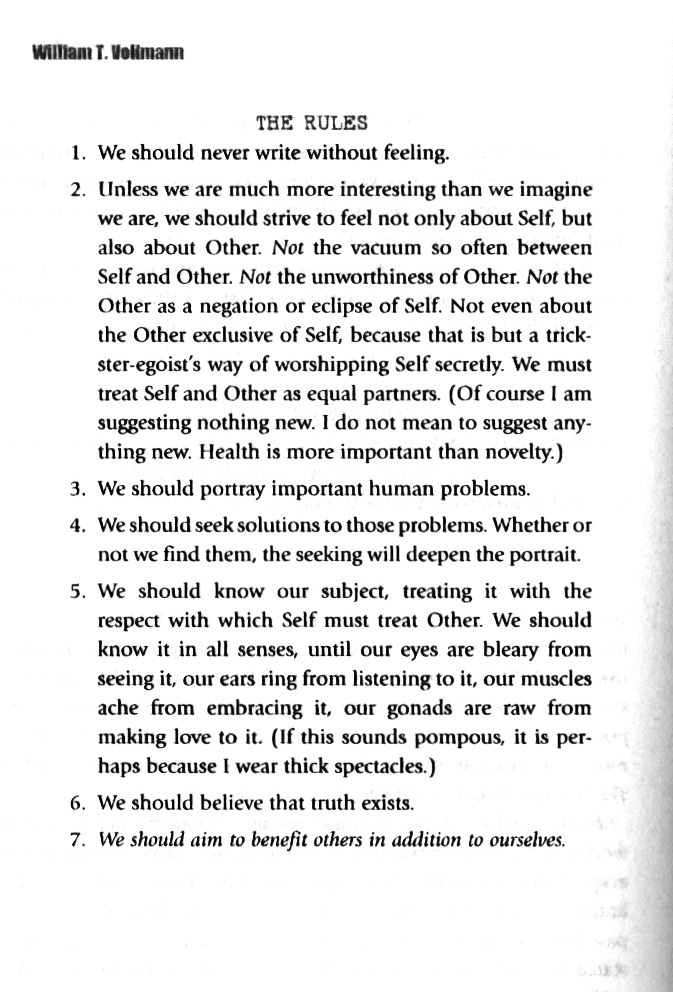
We should never write without feeling (William T. Vollmann)

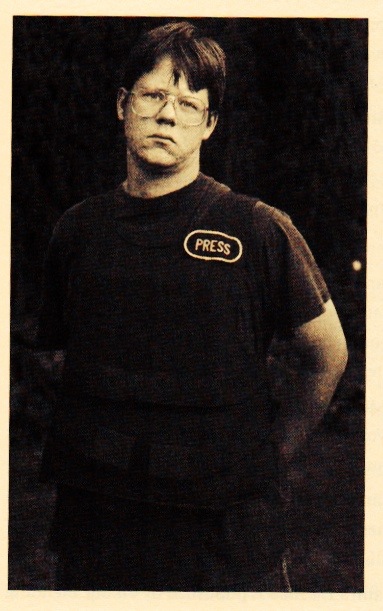
20140727-150921-54561555.jpg 20140727-150921-54561934.jpg From “American Writing Today: A Diagnosis of the Disease,” a manifesto William T. Vollmann published in the Spring ’90 issue of Conjunctions. The image here, along with the image of Vollmann in his press flak jacket (1992), are from the anthology Expelled from Eden.

Kuro-kamikiri — Shigeru Mizuki

yokai_daizukai_2

Competent and informative novels (Doris Lessing’s The Golden Notebook)

During that period of three months when I wrote reviews, reading ten or more books a week, I made a discovery: that the interest with which I read these books had nothing to do with what I feel when I read-let’s say—Thomas Mann, the last of the writers in the old sense, who used the novel for philosophical statements about life. The point is, that the function of the novel seems to be changing; it has become an outpost of journalism; we read novels for information about areas of life we don’t know-Nigeria, South Africa, the American army, a coal-mining village, coteries in Chelsea, etc. We read to find out what is going on. One novel in five hundred or a thousand has the quality a novel should have to make it a novel—the quality of philosophy. I find that I read with the same kind of curiosity most novels, and a book of reportage. Most novels, if they are successful at all, are original in the sense that they report the existence of an area of society, a type of person, not yet admitted to the general literate consciousness. The novel has become a function of the fragmented society, the fragmented consciousness. Human beings are so divided, are becoming more and more divided, and more subdivided in themselves, reflecting the world, that they reach out desperately, not knowing they do it, for information about other groups inside their own country, let alone about groups in other countries. It is a blind grasping out for their own wholeness, and the novel-report is a means towards it. Inside this country, Britain, the middle-class has no knowledge of the lives of the working-people, and vice-versa; and reports and articles and novels are sold across the frontiers, are read as if savage tribes were being investigated. Those fishermen in Scotland were a different species from the coalminers I stayed with in Yorkshire; and both come from a different world than the housing estate outside London. Yet I am incapable of writing the only kind of novel which interests me: a book powered with an intellectual or moral passion strong enough to create order, to create a new way of looking at life. It is because I am too diffused. I have decided never to write another novel. I have fifty ‘subjects’ I could write about; and they would be competent enough. If there is one thing we can be sure of, it is that competent and informative novels will continue to pour from the publishing houses. I have only one, and the least important of the qualities necessary to write at all, and that is curiosity. It is the curiosity of the journalist. I suffer torments of dissatisfaction and incompletion because of my inability to enter those areas of life my way of living, education, sex, politics, class bar me from. It is the malady of some of the best people of this time; some can stand the pressure of it; others crack under it; it is a new sensibility, a half-unconscious attempt towards a new imaginative comprehension. But it is fatal to art.

From Doris Lessing’s The Golden Notebook.