
George Boorujy’s work is on exhibit in The Baker Museum in Naples, Florida, through the end of this week.

“Please,” the sailor said. “Go on now. You don’t want to stay here.” She looked in her purse, found a ten and a single, gave him the ten. “I’ll spend it on booze,” he said.
“Remember your friends,” said the arthritic, watching the ten.
“Bitch,” said the sailor. “Why didn’t you wait till he was gone?”
Oedipa watched him make adjustments so he’d fit easier against the mattress. That stuffed memory. Register A . . .
“Give me a cigarette, Ramírez,” the sailor said. “I know you got one.”
Would it be today? “Ramírez,” she cried. The arthritic looked around on his rusty neck. “He’s going to die,” she said.
“Who isn’t?” said Ramírez.
She remembered John Nefastis, talking about his Machine, and massive destructions of information. So when this mattress flared up around the sailor, in his Viking’s funeral: the stored, coded years of uselessness, early death, self-harrowing, the sure decay of hope, the set of all men who had slept on it, whatever their lives had been, would truly cease to be, forever, when the mattress burned. She stared at it in wonder. It was as if she had just discovered the irreversible process. It astonished her to think that so much could be lost, even the quantity of hallucination belonging just to the sailor that the world would bear no further trace of. She knew, because she had held him, that he suffered DT’s. Behind the initials was a metaphor, a delirium tremens, a trembling unfurrowing of the mind’s plowshare. The saint whose water can light lamps, the clairvoyant whose lapse in recall is the breath of God, the true paranoid for whom all is organized in spheres joyful or threatening about the central pulse of himself, the dreamer whose puns probe ancient fetid shafts and tunnels of truth all act in the same special relevance to the word, or whatever it is the word is there, buffering, to protect us from. The act of metaphor then was a thrust at truth and a lie, depending where you were: inside, safe, or outside, lost. Oedipa did not know where she was. Trembling, unfurrowed, she slipped sidewise, screeching back across grooves of years, to hear again the earnest, high voice of her second or third collegiate love Ray Glozing bitching among “uhs” and the syncopated tonguing of a cavity, about his freshman calculus; “dt,” God help this old tattooed man, meant also a time differential, a vanishingly small instant in which change had to be confronted at last for what it was, where it could no longer disguise itself as something innocuous like an average rate; where velocity dwelled in the projectile though the projectile be frozen in midflight, where death dwelled in the cell though the cell be looked in on at its most quick. She knew that the sailor had seen worlds no other man had seen if only because there was that high magic to low puns, because DT’s must give access to dt’s of spectra beyond the known sun, music made purely of Antarctic loneliness and fright. But nothing she knew of would preserve them, or him.
From Thomas Pynchon’s novel The Crying of Lot 49.
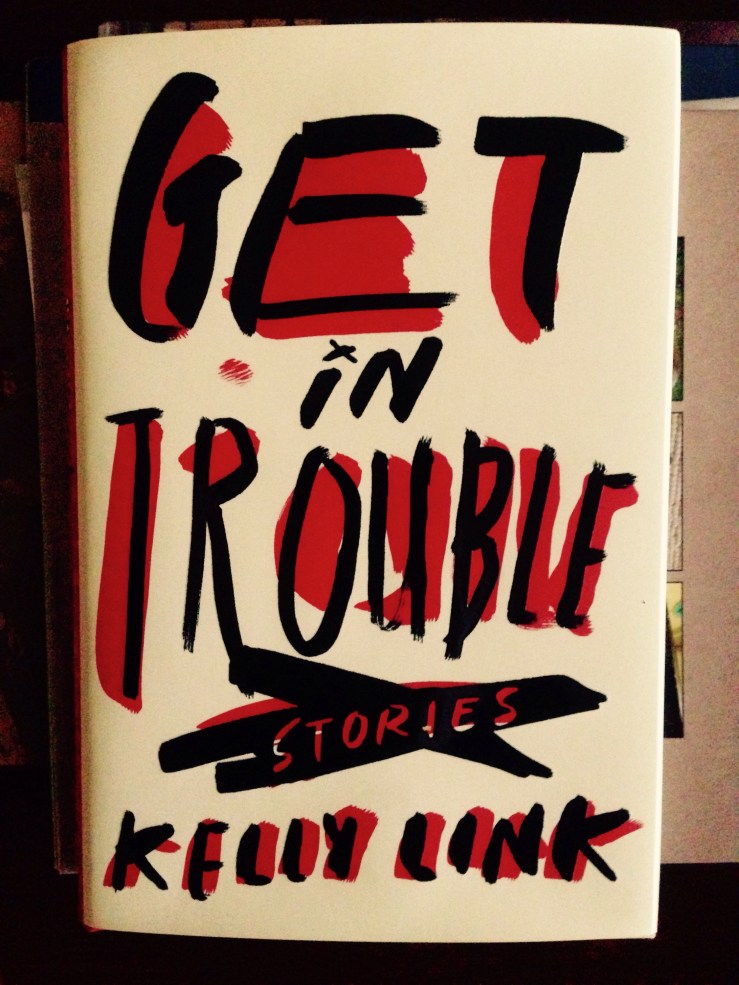
Kelly Link’s new collection Get In Trouble is forthcoming from Random House in hardback. Their blurb:
She has been hailed by Michael Chabon as “the most darkly playful voice in American fiction” and by Neil Gaiman as “a national treasure.” Now Kelly Link’s eagerly awaited new collection—her first for adult readers in a decade—proves indelibly that this bewitchingly original writer is among the finest we have.
Link has won an ardent following for her ability, with each new short story, to take readers deeply into an unforgettable, brilliantly constructed fictional universe. The nine exquisite examples in this collection show her in full command of her formidable powers. In “The Summer People,” a young girl in rural North Carolina serves as uneasy caretaker to the mysterious, never-quite-glimpsed visitors who inhabit the cottage behind her house. In “I Can See Right Through You,” a middle-aged movie star makes a disturbing trip to the Florida swamp where his former on- and off-screen love interest is shooting a ghost-hunting reality show. In “The New Boyfriend,” a suburban slumber party takes an unusual turn, and a teenage friendship is tested, when the spoiled birthday girl opens her big present: a life-size animated doll.
Hurricanes, astronauts, evil twins, bootleggers, Ouija boards, iguanas, The Wizard of Oz, superheroes, the Pyramids . . . These are just some of the talismans of an imagination as capacious and as full of wonder as that of any writer today. But as fantastical as these stories can be, they are always grounded by sly humor and an innate generosity of feeling for the frailty—and the hidden strengths—of human beings. In Get in Trouble, this one-of-a-kind talent expands the boundaries of what short fiction can do


“You don’t understand,” getting mad. “You guys, you’re like Puritans are about the Bible. So hung up with words, words. You know where that play exists, not in that file cabinet, not in any paperback you’re looking for, but—” a hand emerged from the veil of shower-steam to indicate his suspended head—“in here. That’s what I’m for. To give the spirit flesh. The words, who cares? They’re rote noises to hold line bashes with, to get past the bone barriers around an actor’s memory, right? But the reality is in this head. Mine. I’m the projector at the planetarium, all the closed little universe visible in the circle of that stage is coming out of my mouth, eyes, sometimes other orifices also.”
A favorite little riff from Pynchon’s novel The Crying of Lot 49.

Among the first of my fellow-passengers of whom I took any particular notice was a tall, broad-shouldered, almost gigantic, colored man. His dark-brown face was clean-shaven; he was well-dressed and bore a decidedly distinguished air. In fact, if he was not handsome, he at least compelled admiration for his fine physical proportions. He attracted general attention as he strode the deck in a sort of majestic loneliness. I became curious to know who he was and determined to strike up an acquaintance with him at the first opportune moment. The chance came a day or two later. He was sitting in the smoking-room, with a cigar, which had gone out, in his mouth, reading a novel. I sat down beside him and, offering him a fresh cigar, said: “You don’t mind my telling you something unpleasant, do you?” He looked at me with a smile, accepted the proffered cigar, and replied in a voice which comported perfectly with his size and appearance: “I think my curiosity overcomes any objections I might have.” “Well,” I said, “have you noticed that the man who sat at your right in the saloon during the first meal has not sat there since?” He frowned slightly without answering my question. “Well,” I continued, “he asked the steward to remove him; and not only that, he attempted to persuade a number of the passengers to protest against your presence in the dining-saloon.” The big man at my side took a long draw from his cigar, threw his head back, and slowly blew a great cloud of smoke toward the ceiling. Then turning to me he said: “Do you know, I don’t object to anyone’s having prejudices so long as those prejudices don’t interfere with my personal liberty. Now, the man you are speaking of had a perfect right to change his seat if I in any way interfered with his appetite or his digestion. I should have no reason to complain if he removed to the farthest corner of the saloon, or even if he got off the ship; but when his prejudice attempts to move me one foot, one inch, out of the place where I am comfortably located, then I object.” On the word “object” he brought his great fist down on the table in front of us with such a crash that everyone in the room turned to look. We both covered up the slight embarrassment with a laugh and strolled out on the deck.
We walked the deck for an hour or more, discussing different phases of the Negro question. In referring to the race I used the personal pronoun “we”; my companion made no comment about it, nor evinced any surprise, except to raise his eyebrows slightly the first time he caught the significance of the word. He was the broadest-minded colored man I have ever talked with on the Negro question. He even went so far as to sympathize with and offer excuses for some white Southern points of view. I asked him what were his main reasons for being so hopeful. He replied: “In spite of all that is written, said, and done, this great, big, incontrovertible fact stands out—the Negro is progressing, and that disproves all the arguments in the world that he is incapable of progress. I was born in slavery, and at emancipation was set adrift a ragged, penniless bit of humanity. I have seen the Negro in every grade, and I know what I am talking about. Our detractors point to the increase of crime as evidence against us; certainly we have progressed in crime as in other things; what less could be expected? And yet, in this respect, we are far from the point which has been reached by the more highly civilized white race. As we continue to progress, crime among us will gradually lose much of its brutal, vulgar, I might say healthy, aspect, and become more delicate, refined, and subtle. Then it will be less shocking and noticeable, although more dangerous to society.” Then dropping his tone of irony, he continued with some show of eloquence: “But, above all, when I am discouraged and disheartened, I have this to fall back on: if there is a principle of right in the world, which finally prevails, and I believe that there is; if there is a merciful but justice-loving God in heaven, and I believe that there is, we shall win; for we have right on our side, while those who oppose us can defend themselves by nothing in the moral law, nor even by anything in the enlightened thought of the present age.” Continue reading “Chapter X of James Weldon Johnson’s Masterpiece, The Autobiography of an Ex-Colored Man”

Literature is a point outside of our hodiernal circle through which a new one may be described. The use of literature is to afford us a platform whence we may command a view of our present life, a purchase by which we may move it. We fill ourselves with ancient learning, install ourselves the best we can in Greek, in Punic, in Roman houses, only that we may wiselier see French, English and American houses and modes of living. In like manner we see literature best from the midst of wild nature, or from the din of affairs, or from a high religion. The field cannot be well seen from within the field. The astronomer must have his diameter of the earth’s orbit as a base to find the parallax of any star.
Therefore we value the poet. All the argument and all the wisdom is not in the encyclopaedia, or the treatise on metaphysics, or the Body of Divinity, but in the sonnet or the play. In my daily work I incline to repeat my old steps, and do not believe in remedial force, in the power of change and reform. But some Petrarch or Ariosto, filled with the new wine of his imagination, writes me an ode or a brisk romance, full of daring thought and action. He smites and arouses me with his shrill tones, breaks up my whole chain of habits, and I open my eye on my own possibilities. He claps wings to the sides of all the solid old lumber of the world, and I am capable once more of choosing a straight path in theory and practice.
From Ralph Waldo Emerson’s essay “Circles.”



 Biblioklept