Riff on the end/beginning of Gravity’s Rainbow

Well: “A screaming comes across the sky. It has happened before [—]”

□ □ □ □ □ □ □

So. Okay. So I finished Gravity’s Rainbow on Friday night, and reread the opening section (and more than the opening section) on Saturday morning, resisting a compulsion to immediately return to the beginning.

□ □ □ □ □ □ □

So: Okay: Right?

The ending of Gravity’s Rainbow cycles back to the beginning (like Finnegans Wake): Blicero’s rocket, screaming across the sky—yes? no?—to invade the dreams (?) of psychic Pirate Prentice? The book: a loop, a Möbius strip, a film, its reels discombobulated, jostled, scattered

□ □ □ □ □ □ □

“…it’s all theatre,” we learn on the book’s first page (page 3); the book ends in a theater—the Orpheus Theater!—where maybe scattered Slothrop is the leading man, scattered, we find ourselves in him, parts of him—where the audience demands, on the book’s last page: “Start-the-show!”

□ □ □ □ □ □ □

“You’re putting response before stimulus,” Spectro shakes his head at Pointsman, early in “Beyond the Zero,” the first section of Gravity’s Rainbow—does this describe the beginning/end of the novel? (“It has happened before”).

□ □ □ □ □ □ □

Or, a bit earlier even, at the seance, (page 32), Gloaming describes one kind of plot: “…we should get something like a straight line” — but then gives us another kind of plot — “…however we’ve data that suggest the curves for certain —conditions, well they’re actually quite different—schizophrenics for example tend to run a bit flatter in the upper part then progressively steeper—a sort of bow shape … classical paranoiac—” Is this the shape of Gravity’s Rainbow?

□ □ □ □ □ □ □

—but right this moment it’s that final dash that intrigues me—this in a novel full of dashes, this in a novel that name-checks Emily Dickinson, Eternal Empress of Dashes—the fragmented conclusion is full of dashes, lines obliterated by more perfect, straight lines, simultaneously connecting and disconnecting—like the novel’s final line:

“Now everybody—“

□ □ □ □ □ □ □ Continue reading “Riff on the end/beginning of Gravity’s Rainbow”

The Blessed Guillaume de Toulouse Tormented by Demons — Ambroise Frédeau

tumblr_ltprof64JM1r1dpd5o1_1280

“I find this disgusting, but I can’t help myself” (eXistenZ)

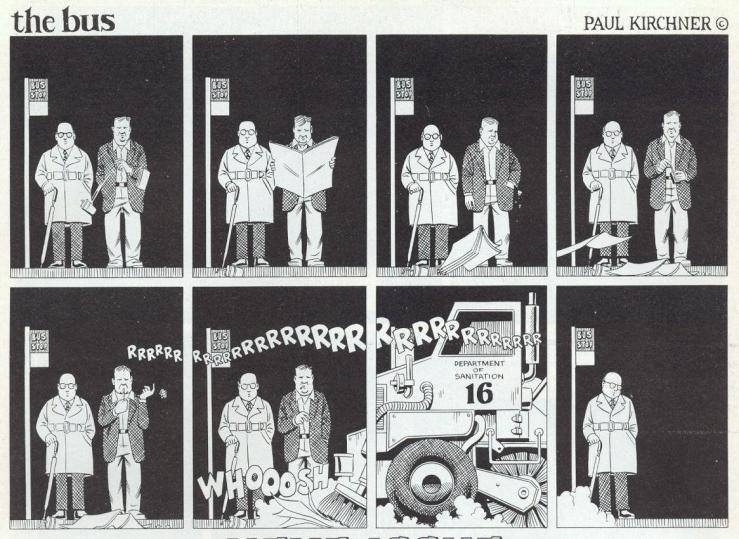
The Bus — Paul Kirchner

U6iKNJX - Imgur

Read “Tony and the Beetles,” an early short story by Philip K. Dick

illus

“Tony and the Beetles”

by

Philip K. Dick

Reddish-yellow sunlight filtered through the thick quartz windows into the sleep-compartment. Tony Rossi yawned, stirred a little, then opened his black eyes and sat up quickly. With one motion he tossed the covers back and slid to the warm metal floor. He clicked off his alarm clock and hurried to the closet.

It looked like a nice day. The landscape outside was motionless, undisturbed by winds or dust-shift. The boy’s heart pounded excitedly. He pulled his trousers on, zipped up the reinforced mesh, struggled into his heavy canvas shirt, and then sat down on the edge of the cot to tug on his boots. He closed the seams around their tops and then did the same with his gloves. Next he adjusted the pressure on his pump unit and strapped it between his shoulder blades. He grabbed his helmet from the dresser, and he was ready for the day.

In the dining-compartment his mother and father had finished breakfast. Their voices drifted to him as he clattered down the ramp. A disturbed murmur; he paused to listen. What were they talking about? Had he done something wrong, again?

And then he caught it. Behind their voices was another voice. Static and crackling pops. The all-system audio signal from Rigel IV. They had it turned up full blast; the dull thunder of the monitor’s voice boomed loudly. The war. Always the war. He sighed, and stepped out into the dining-compartment.

“Morning,” his father muttered.

“Good morning, dear,” his mother said absently. She sat with her head turned to one side, wrinkles of concentration webbing her forehead. Her thin lips were drawn together in a tight line of concern. His father had pushed his dirty dishes back and was smoking, elbows on the table, dark hairy arms bare and muscular. He was scowling, intent on the jumbled roar from the speaker above the sink.

“How’s it going?” Tony asked. He slid into his chair and reached automatically for the ersatz grapefruit. “Any news from Orion?”

Neither of them answered. They didn’t hear him. He began to eat his grapefruit. Outside, beyond the little metal and plastic housing unit, sounds of activity grew. Shouts and muffled crashes, as rural merchants and their trucks rumbled along the highway toward Karnet. The reddish daylight swelled; Betelgeuse was rising quietly and majestically. Continue reading “Read “Tony and the Beetles,” an early short story by Philip K. Dick”