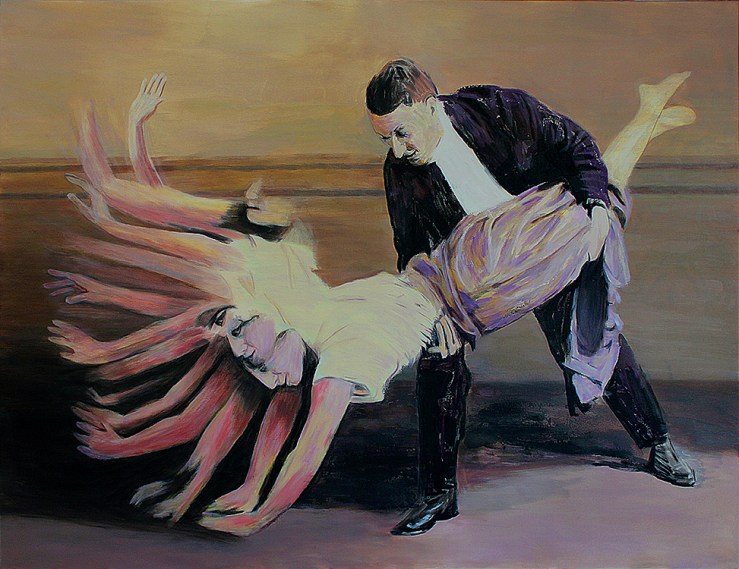
Haunted City — Michael Sowa

Jeffrey Rotter’s The Only Words That Are Worth Remembering (Book acquired, 4.14.2015)

Jeffrey Rotter’s novel The Only Words That Are Worth Remembering  is new in hardback from Henry Holt. Their blurb:

A darkly comic, wildly original novel of a family in flight from the law, set in a near-future America — a Clockwork Orange with a Huck Finn heart.

In a not-so-distant future, astronomy has become a fairy tale, Copernicus is forgotten, and the Earth has resumed its lonely spot in the center of the universe. But when an ancient bunker containing a preserved space vehicle is discovered beneath the ruins of Cape Canaveral, it has the power to turn this retrograde world inside out.Enter the Van Zandt clan, whose run-ins with the law leave them with a no-win choice: test-pilot the rocket together as a family or be sent separately to prison for life. Their decision sets off an antic and heartbreaking search for human solace in a world bent on isolation, as the Van Zandts embark on an unforgettable road trip across the ass-end of an America only slightly more dissolute than our own. Uniquely tying an absurdist future to gut-bucket wit, The Only Words That Are Worth Remembering hauls our dark humanity into the light and shows us the precious places where it gleams.

Short Leash — Kelly Reemsten

kelly-reemtsen-short-leash

“Gloria” — Bonnie ‘Prince’ Billy

Leonora Carrington in the LRB

 spaw01_3708_04

The Temptation of St. Antony, Leonora Carrington

Nice piece by Alice Sprawls on Leonora Carrington (whose work is now on display in the Tate) in The London Review of Books today. Excerpt:

Domesticity in Carrington’s paintings and stories is the scene of Ovidian and spiritual transformations; cooking was a sort of alchemy, like painting, and she began increasingly to use egg tempera – influenced by paintings she had seen in Siena but also by its almost culinary processes (separating the egg yolk, adding wine or vinegar then water and pigment). She refused to explain her personal symbolism, but called reading The White Goddess ‘the greatest revelation of my life’. The figure of the muse, Robert Graves’s ‘Mother of all Living, the ancient power of fright and lust’, became less burdensome as manifested in The Giantess (c.1950), whose colossal central figure towers over the scene like a Madonna della Misericordia. She cradles an egg; geese fly out from beneath her pallium; her golden hair is a field of wheat. Around her feet a hunt is taking place – Uccello’s Hunt in the Forest but with a sylph instead of a stag – while the sea behind is teeming with boats, whales, crabs and bizarre creatures like monsters on a medieval map.

From 1950 the paintings become even more fantastical. Many are dominated by bald, spectral white figures: the Sidhe of Irish legends her grandmother told her. In Darvault(1950), Carrington’s two sons by Weisz, Pablo and Gabriel, stand in a de Chirico-esque courtyard, pale and cloaked with small plants growing from their heads. Is Carrington the feline figure in the apron with the elaborate white headdress and whiskers? InDown Below Carrington had described the worldview of her madness – ‘the father was the planet Cosmos, represented by the planet Saturn: the son was the Sun and I the Moon, an essential element of the Trinity, with a microscopic knowledge of the earth’ – and in Mexico she incorporated more and more elements of myth and occultism into her works; not just the Catholicism and Celtic stories of her childhood but astrological and Egyptian imagery, cabbala, Tibetan Buddhism, tarot.

I write only for myself (Dostoevsky)

Every man has reminiscences which he would not tell to every one, but only to his friends. He has other matters in his mind which he would not reveal even to his friends, but only to himself, and that in secret. But there are other things which a man is afraid to tell even to himself, and every decent man has a number of such things stored away in his mind. The more decent he is, the greater the number of such things in his mind. Anyway, I have only lately determined to remember some of my early adventures. Till now I have always avoided them, even with a certain uneasiness. Now, when I am not only recalling them, but have actually decided to write an account of them, I want to try the experiment whether one can, even with oneself, be perfectly open and not take fright at the whole truth. I will observe, in parenthesis, that Heine says that a true autobiography is almost an impossibility, and that man is bound to lie about himself. He considers that Rousseau certainly told lies about himself in his confessions, and even intentionally lied, out of vanity. I am convinced that Heine is right; I quite understand how sometimes one may, out of sheer vanity, attribute regular crimes to oneself, and indeed I can very well conceive that kind of vanity. But Heine judged of people who made their confessions to the public. I write only for myself, and I wish to declare once and for all that if I write as though I were addressing readers, that is simply because it is easier for me to write in that form. It is a form, an empty form—I shall never have readers. I have made this plain already….

From Fyodor Dostoevsky’s novel Notes from Underground. English translation by Constance Garnett.

“All art constantly aspires towards the condition of something or other”

Water. The Bather. — Frantisek Kupka

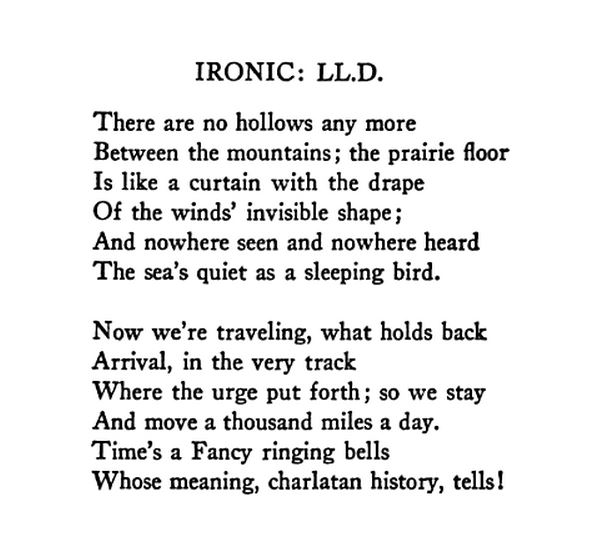
“Ironic: LL.D” — William Stanley Braithwaite

Capture

“How Nuth Would Have Practised His Art upon the Gnoles” — Lord Dunsany

“How Nuth Would Have Practised His Art upon the Gnoles”

by

Lord Dunsany

Despite the advertisements of rival firms, it is probable that every tradesman knows that nobody in business at the present time has a position equal to that of Mr. Nuth. To those outside the magic circle of business, his name is scarcely known; he does not need to advertise, he is consummate. He is superior even to modern competition, and, whatever claims they boast, his rivals know it. His terms are moderate, so much cash down when the goods are delivered, so much in blackmail afterwards. He consults your convenience. His skill may be counted upon; I have seen a shadow on a windy night move more noisily than Nuth, for Nuth is a burglar by trade. Men have been known to stay in country houses and to send a dealer afterwards to bargain for a piece of tapestry that they saw there—some article of furniture, some picture. This is bad taste: but those whose culture is more elegant invariably send Nuth a night or two after their visit. He has a way with tapestry; you would scarcely notice that the edges had been cut. And often when I see some huge, new house full of old furniture and portraits from other ages, I say to myself, “These mouldering chairs, these full-length ancestors and carved mahogany are the produce of the incomparable Nuth.”

It may be urged against my use of the word incomparable that in the burglary business the name of Slith stands paramount and alone; and of this I am not ignorant; but Slith is a classic, and lived long ago, and knew nothing at all of modern competition; besides which the surprising nature of his doom has possibly cast a glamour upon Slith that exaggerates in our eyes his undoubted merits. Continue reading ““How Nuth Would Have Practised His Art upon the Gnoles” — Lord Dunsany”

Hemingway died one day and Pynchon was born the next (DeLillo on Pynchon)

It was as though, in some odd quantum stroke, Hemingway died one day and Pynchon was born the next. One literature bends into another. Pynchon has made American writing a broader and stronger force. He found whispers and apparitions at the edge of modern awareness but did not lessen our sense of the physicality of American prose, the shotgun vigor, the street humor, the body fluids, the put-on.

I was writing ads for Sears truck tires when a friend gave me a copy of V. in paperback. I read it and thought, Where did this come from?

The scale of his work, large in geography and unafraid of major subjects, helped us locate our fiction not only in small anonymous corners, human and ever-essential, but out there as well, in the sprawl of high imagination and collective dreams.

Don DeLillo on Thomas Pynchon. From the Summer 2005 issue of Bookforum.

“Greville Fane” — Henry James


“Greville Fane”

by

Henry James

Coming in to dress for dinner, I found a telegram: “Mrs. Stormer dying; can you give us half a column for to-morrow evening?  Let her off easy, but not too easy.”  I was late; I was in a hurry; I had very little time to think, but at a venture I dispatched a reply: “Will do what I can.”  It was not till I had dressed and was rolling away to dinner that, in the hansom, I bethought myself of the difficulty of the condition attached.  The difficulty was not of course in letting her off easy but in qualifying that indulgence.  “I simply won’t qualify it,” I said to myself.  I didn’t admire her, but I liked her, and I had known her so long that I almost felt heartless in sitting down at such an hour to a feast of indifference.  I must have seemed abstracted, for the early years of my acquaintance with her came back to me.  I spoke of her to the lady I had taken down, but the lady I had taken down had never heard of Greville Fane.  I tried my other neighbour, who pronounced her books “too vile.”  I had never thought them very good, but I should let her off easier than that.

I came away early, for the express purpose of driving to ask about her.  The journey took time, for she lived in the north-west district, in the neighbourhood of Primrose Hill.  My apprehension that I should be too late was justified in a fuller sense than I had attached to it—I had only feared that the house would be shut up.  There were lights in the windows, and the temperate tinkle of my bell brought a servant immediately to the door, but poor Mrs. Stormer had passed into a state in which the resonance of no earthly knocker was to be feared.  A lady, in the hall, hovering behind the servant, came forward when she heard my voice.  I recognised Lady Luard, but she had mistaken me for the doctor.

“Excuse my appearing at such an hour,” I said; “it was the first possible moment after I heard.”

“It’s all over,” Lady Luard replied.  “Dearest mamma!”

She stood there under the lamp with her eyes on me; she was very tall, very stiff, very cold, and always looked as if these things, and some others beside, in her dress, her manner and even her name, were an implication that she was very admirable.  I had never been able to follow the argument, but that is a detail.  I expressed briefly and frankly what I felt, while the little mottled maidservant flattened herself against the wall of the narrow passage and tried to look detached without looking indifferent.  It was not a moment to make a visit, and I was on the point of retreating when Lady Luard arrested me with a queer, casual, drawling “Would you—a—would you, perhaps, be writing something?”  I felt for the instant like an interviewer, which I was not.  But I pleaded guilty to this intention, on which she rejoined: “I’m so very glad—but I think my brother would like to see you.”  I detested her brother, but it wasn’t an occasion to act this out; so I suffered myself to be inducted, to my surprise, into a small back room which I immediately recognised as the scene, during the later years, of Mrs. Stormer’s imperturbable industry.  Her table was there, the battered and blotted accessory to innumerable literary lapses, with its contracted space for the arms (she wrote only from the elbow down) and the confusion of scrappy, scribbled sheets which had already become literary remains.  Leolin was also there, smoking a cigarette before the fire and looking impudent even in his grief, sincere as it well might have been. Continue reading ““Greville Fane” — Henry James”

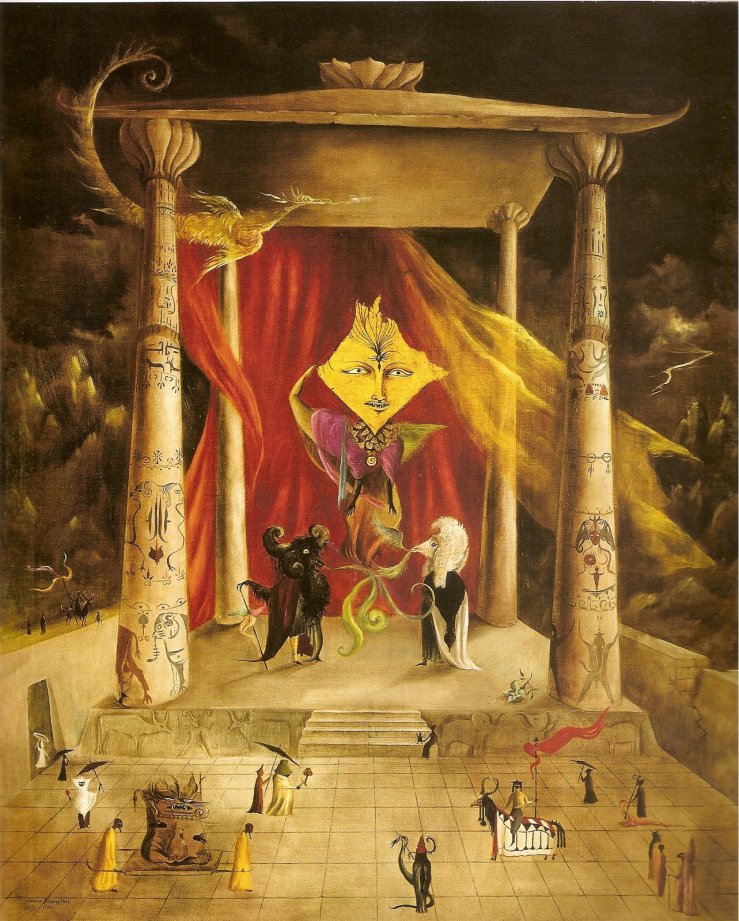
Temple of the World — Leonora Carrington

leonora-carrington_2

Uncle Piacsek in Front of the Black Sideboard — Jozsef Rippl-Ronai