Dragonfish (Book acquired, 6.20.2015)

IMG_7132

Vu Tran’s novel Dragonfish is forthcoming in hardback from W.W. Norton. Their blurb:

Robert, an Oakland cop, still can’t let go of Suzy, the enigmatic Vietnamese wife who left him two years ago. Now she’s disappeared from her new husband, Sonny, a violent Vietnamese smuggler and gambler who’s blackmailing Robert into finding her for him. As he pursues her through the sleek and seamy gambling dens of Las Vegas, shadowed by Sonny’s sadistic son, “Junior,” and assisted by unexpected and reluctant allies, Robert learns more about his ex-wife than he ever did during their marriage. He finds himself chasing the ghosts of her past, one that reaches back to a refugee camp in Malaysia after the fall of Saigon, as his investigation soon uncovers the existence of an elusive packet of her secret letters to someone she left behind long ago. Although Robert starts illuminating the dark corners of Suzy’s life, the legacy of her sins threatens to immolate them all.

Vu Tran has written a thrilling and cinematic work of sophisticated suspense and haunting lyricism, set in motion by characters who can neither trust each other nor trust themselves. This remarkable debut is a noir page-turner resonant with the lasting reverberations of lives lost and lives remade a generation ago.

The Finery of the Storm — Rene Magritte

“The Midsummer Fires” (from Sir James George Frazer’s The Golden Bough)

“The Midsummer Fires”by Sir James George Frazerfrom The Golden BoughBUT THE SEASON at which these firefestivals have been most generally held all over Europe is the summer solstice, that is Midsummer Eve (the twenty-third of June) or Midsummer day (the twenty-fourth of June). A faint tinge of Christianity has been given to them by naming Midsummer Day after St. John the Baptist, but we cannot doubt that the celebration dates from a time long before the beginning of our era. The summer solstice, or Midsummer Day, is the great turning-point in the sun’s career, when, after climbing higher and higher day by day in the sky, the luminary stops and thenceforth retraces his steps down the heavenly road. Such a moment could not but be regarded with anxiety by primitive man so soon as he began to observe and ponder the courses of the great lights across the celestial vault; and having still to learn his own powerlessness in face of the vast cyclic changes of nature, he may have fancied that he could help the sun in his seeming decline—could prop his failing steps and rekindle the sinking flame of the red lamp in his feeble hand. In some such thoughts as these the midsummer festivals of our European peasantry may perhaps have taken their rise. Whatever their origin, they have prevailed all over this quarter of the globe, from Ireland on the west to Russia on the east, and from Norway and Sweden on the north to Spain and Greece on the south. According to a mediæval writer, the three great features of the midsummer celebration were the bonfires, the procession with torches round the fields, and the custom of rolling a wheel. He tells us that boys burned bones and filth of various kinds to make a foul smoke, and that the smoke drove away certain noxious dragons which at this time, excited by the summer heat, copulated in the air and poisoned the wells and rivers by dropping their seed into them; and he explains the custom of trundling a wheel to mean that the sun, having now reached the highest point in the ecliptic, begins thenceforward to descend.

The main features of the midsummer fire-festival resemble those which we have found to characterise the vernal festivals of fire. The similarity of the two sets of ceremonies will plainly appear from the following examples.

A writer of the first half of the sixteenth century informs us that in almost every village and town of Germany public bonfires were kindled on the Eve of St. John, and young and old, of both sexes, gathered about them and passed the time in dancing and singing. People on this occasion wore chaplets of mugwort and vervain, and they looked at the fire through bunches of larkspur which they held in their hands, believing that this would preserve their eyes in a healthy state throughout the year. As each departed, he threw the mugwort and vervain into the fire, saying, “May all my ill-luck depart and be burnt up with these.” At Lower Konz, a village situated on a hillside overlooking the Moselle, the midsummer festival used to be celebrated as follows. A quantity of straw was collected on the top of the steep Stromberg Hill. Every inhabitant, or at least every householder, had to contribute his share of straw to the pile. At nightfall the whole male population, men and boys, mustered on the top of the hill; the women and girls were not allowed to join them, but had to take up their position at a certain spring half-way down the slope. On the summit stood a huge wheel completely encased in some of the straw which had been jointly contributed by the villagers; the rest of the straw was made into torches. From each side of the wheel the axle-tree projected about three feet, thus furnishing handles to the lads who were to guide it in its descent. The mayor of the neighbouring town of Sierck, who always received a basket of cherries for his services, gave the signal; a lighted torch was applied to the wheel, and as it burst into flame, two young fellows, strong-limbed and swift of foot, seized the handles and began running with it down the slope. A great shout went up. Every man and boy waved a blazing torch in the air, and took care to keep it alight so long as the wheel was trundling down the hill. The great object of the young men who guided the wheel was to plunge it blazing into the water of the Moselle; but they rarely succeeded in their efforts, for the vineyards which cover the greater part of the declivity impeded their progress, and the wheel was often burned out before it reached the river. As it rolled past the women and girls at the spring, they raised cries of joy which were answered by the men on the top of the mountain; and the shouts were echoed by the inhabitants of neighbouring villages who watched the spectacle from their hills on the opposite bank of the Moselle. If the fiery wheel was successfully conveyed to the bank of the river and extinguished in the water, the people looked for an abundant vintage that year, and the inhabitants of Konz had the right to exact a waggon-load of white wine from the surrounding vineyards. On the other hand, they believed that, if they neglected to perform the ceremony, the cattle would be attacked by giddiness and convulsions and would dance in their stalls.    Continue reading ““The Midsummer Fires” (from Sir James George Frazer’s The Golden Bough)”

The Creation of the World and the Expulsion from Paradise — Giovanni di Paolo

Have you met a typical nonperson lately? (William H. Gass)

Have you met met a typical nonperson lately? Then say hello, now, to your neighbor. He may be male, but his facial expressions have been put on like lipstick and eyelashes. His greeting is inevitable; so is his interest in the weather. He always smiles; he speaks only in cliches; and his opinions (as bland as Cream of Wheat, as undefined, and—when sugared—just as sweet) are drearily predictable. He has nothing but good to say of people; he collects his wisdom like dung from a Digest; he likes to share his experiences with “folks,” and recite the plots of movies. He is working up this saccharine soulside manner as part of his preparation for the ministry.

These are the “good” people. “Bad” people are unreal in the same way.

Nonpersons unperson persons. They kill. For them no one is human. Like cash registers, everyone’s the same: all will go ding and their cash drawers slide out when you strike the right key.

So I don’t think that it’s the message of a work of art that gives it any lasting social value. On the contrary, insisting on this replaces the work with its interpretation, another way of robbing it of reality. How would you like to be replaced by your medical dossier, your analysts’s notes? 

–More from William H. Gass’s essay “The Artist and Society” (1968). Collected in Fiction and the Figures of Life.

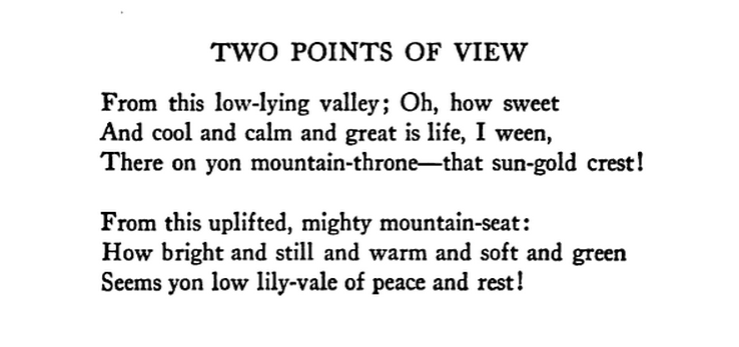
“Two Points of View” — Lucian B. Watkins

Screenshot 2015-06-22 at 5.22.04 PM

Pretty Is (Book acquired, 6.20.2015)

IMG_7124

Maggie Mitchell’s novel Pretty Is is new in hardback from Henry Holt. Their blurb:

The summer precocious Lois and pretty Carly May were twelve years old, they were kidnapped, driven across the country, and held in a cabin in the woods for two months by a charismatic stranger. Nearly twenty years later, Lois has become a professor, teaching British literature at a small college in upstate New York, and Carly May is an actress in Los Angeles, drinking too much and struggling to revive her career. When a movie with a shockingly familiar plot draws the two women together once more, they must face the public exposure of their secret history and confront the dark longings and unspeakable truths that haunt them still. Maggie Mitchell’s Pretty Is beautifully defies ripped-from-the-headlines crime story expectations and announces the debut of a masterful new storytelling talent.

“IIIIIIIIII.” — Gertrude Stein

“IIIIIIIIII.”
by
Gertrude Stein
from Geography and Plays (1922)

INCLINE.

Clinch, melody, hurry, spoon, special, dumb, cake, forrester. Fine, cane, carpet, incline, spread, gate, light, labor.

BANKING.

Coffee, cough, glass, spoon, white, singing. Choose, selection, visible, lightning, garden, conversation, ink, spending, light space, morning, celebration, invisible, reception, hour, glass, curving, summons, sparkle, suffering the minisection, sanctioning the widening, less than the wireless, more certain. All the change. Any counselling non consuming and split splendor.

Forward and a rapidity and no resemblance no more utterly. Safe light, more safes no more safe for the separation.

M—N H—.

A cook. A cook can see. Pointedly in uniform, exertion in a medium. A cook can see.

Clark which is awful, clark which is shameful, clark and order.

A pin is a plump point and pecking and combined and more much more is in fine.

Rats is, rats is oaken. Robber. Height, age, miles, plaster, pedal, more order.

Bake, a barn has cause and more late oat-cake specially.

Spend rubber, holder and coal, high, careful, in a pointed collar. A hideous south west is always a climb in aged seldom succeeded flavoring untimely, necessity white, hour in a glaze.

Break, sky blue light, obliquely, in a cut carpet, in the pack. A sound.

COO—GE.

Press in the ink and stare and cheese. Pick in the faint and feather and white. White in the plume.

M—N H—.

No noon back. No noon settler, no sun in the slant and carpet utterly surrounded.

No pressed plaster. None.

No pressing pan and pan cake. Not related exactly. Not related.

Matter in the center of single sand and slide in the hut.

No account of gibberish. No sky lark utterly.

Perfect lemon and cutting a central black. Not such clouding. A sugar, a lame sugar, certainly. No sobriety no silver ash tray. Continue reading ““IIIIIIIIII.” — Gertrude Stein”

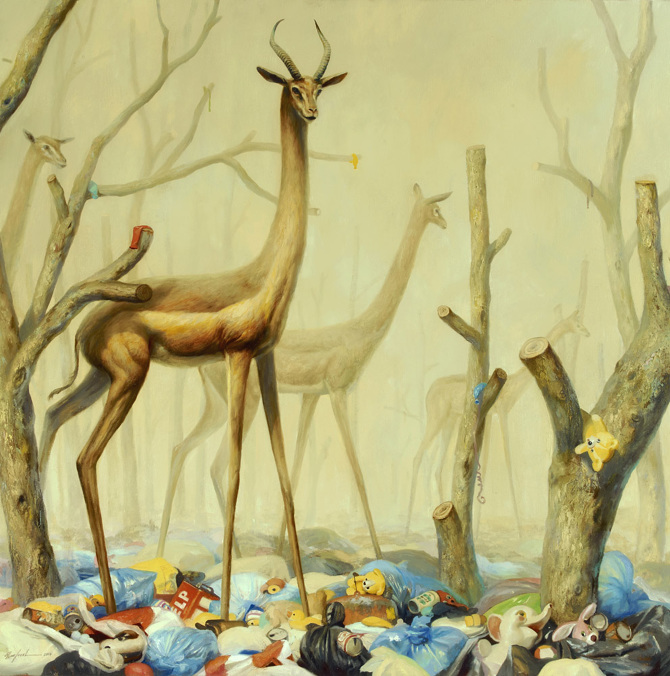
Stilts (Adaptation) — Martin Wittfooth

stilts_web

A Midsummer Night’s Dream — Giovanni Boldini

Why are works of art so socially important? (William H. Gass)

Why are works of art so socially important? Not for the messages they may contain, not because they expose slavery or cry hurrah for the worker, although such messages in their place and time might be important, but because they insist more than most on their own reality; because of the absolute way in which they exist. Certainly, images exist, shadows and reflections, fakes exist and hypocrites, there are counterfeits (quite real) and grand illusions – but it is simply not true for the copies are as real as their originals, that they meet all of the tests which I suggested earlier. Soybean steak, by God, is soybean steak, and a pious fraud is a fraud. Reality is not a matter of fact, it is an achievement; and it is rare – rarer, let me say – than an undefeated football season. We live, most of us, amidst lies, deceit, and confusions. A work of art may not utter the truth, but it must be honest. It may champion a cause we deplore, but like Milton’s Satan, it must in itself be noble; it must be all there. Works of art confront us the way few people dare to: completely, openly, at once. They construct, they comprise, our experience; they do not deny or destroy it; and they shame us, we fall so short of the quality of their Being. We live in Lafayette or Rutland – true. We take our breaths. We fornicate and feed. But Hamlet has his history in the heart and none of us will ever be as real as vital, as complex and living as he is – a total creature of the stage. 

–More from William H. Gass’s essay “The Artist and Society” (1968). Collected in Fiction and the Figures of Life.

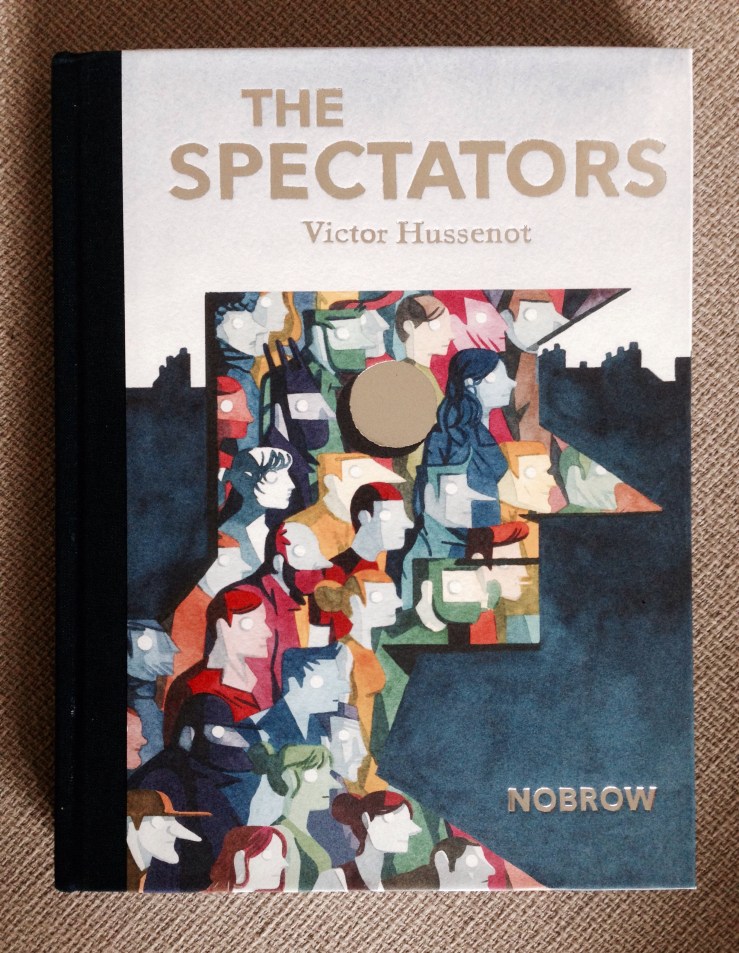
The Spectators (Beautiful book acquried 6.11.2015)

image

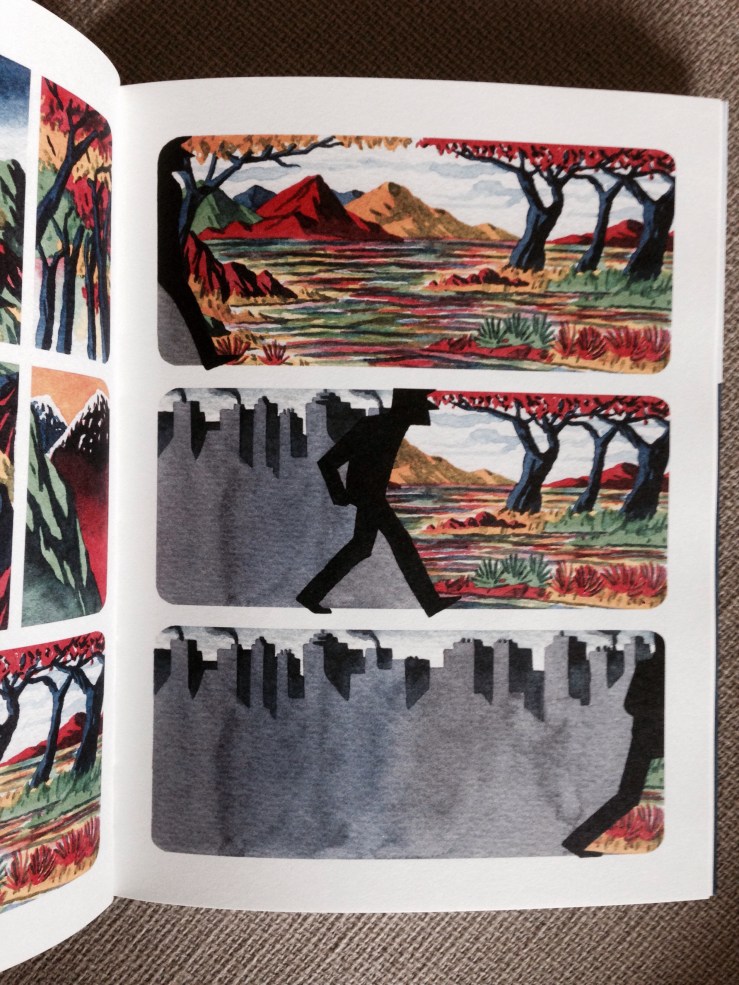
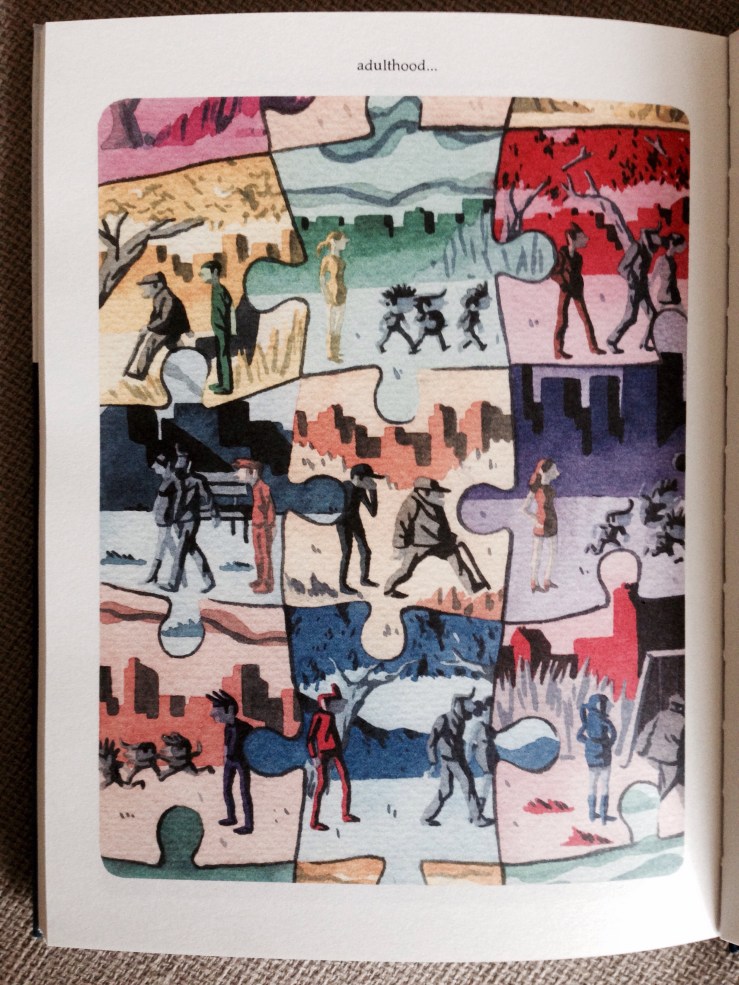
Victor Hussenot’s The Spectators is a gorgeous new graphic novel from Nobrow. I’ve read it twice now (“read” as a verb seems inadequate but—), and will get to a proper review later this week. Excellent stuff. Nobrow’s blurb:

What if we are merely shadows, our characters defined by a simple inflection of light? The realm of possibilities opens up, because in our world we are nothing but spectators.

The Spectators unfolds as a poetic and philosophical introspection on the nature of man. Victor Hussenot‘s palette is awash with subtle colour, gently carrying the narrative and allowing the reader to envelop themselves in the lyricism of the work. Reminiscent of French New Wave cinema with its clipped dialogue, gentle pacing and departure from a classic narrative structure, The Spectators is an exciting new graphic novel.

image image

Portrait of the Artist’s Father

Repin

Degas

Escher

Freud

Continue reading “Portrait of the Artist’s Father”

The Bus — Paul Kirchner

l3MHMNS - Imgur

Happy Father’s Day!

We create insanities (William H. Gass)

Put yourself in a public place, at a banquet—one perhaps at which awards are made. Your fork is pushing crumbs about upon you plate while someone is receiving silver in a bowler’s shape amid the social warmth of clapping hands. How would you feel if at this moment a beautiful lady in a soft pink nightie should lead among the tables a handsome poodle who puddled under them, and there was a conspiracy among the rest of us not to notice? Suppose we sat quietly; our expressions did not change; we looked straight through her, herself as well as her nightie, toward the fascinating figure of the speaker; suppose, leaving, we stepped heedlessly in the pools and afterward we did not even shake our shoes. And if you gave a cry, if you warned, explained, cajoled, implored; and we regarded you then with amazement, rejected with amusement, contempt, or scorn every one of your efforts, I think you would begin to doubt your senses and your very sanity. Well, that’s the idea: with the weight of our numbers, our percentile normality, we create insanities: yours, as you progressively doubt more and more of your experience, hide it from others to avoid the shame, saying “There’s that woman and her damn dog again,” but now saying it silently, for your experience, you think, is private; and ours, as we begin to believe our own lies, and the lady and her nightie, the lady and her poodle, the lady and the poodle’s puddles, all do disappear, expunged from consciousness like a stenographer’s mistake. 

–From William H. Gass’s essay “The Artist and Society” (1968). Collected in Fiction and the Figures of Life. I shared the paragraphs preceding this one yesterday.