Slightly Open Clam Shell — Georgia O’Keeffe

“Dialogue Between Franklin and the Gout” — Benjamin Franklin

“Dialogue Between Franklin and the Gout”

by

Benjamin Franklin


Midnight, 22 October, 1780.

FRANKLIN. Eh! Oh! eh! What have I done to merit these cruel sufferings?

GOUT. Many things; you have ate and drank too freely, and too much indulged those legs of yours in their indolence.

FRANKLIN. Who is it that accuses me?

GOUT. It is I, even I, the Gout.

FRANKLIN. What! my enemy in person?

GOUT. No, not your enemy.

FRANKLIN. I repeat it, my enemy; for you would not only torment my body to death, but ruin my good name; you reproach me as a glutton and a tippler; now all the world, that knows me, will allow that I am neither the one nor the other.

GOUT. The world may think as it pleases; it is always very complaisant to itself, and sometimes to its friends; but I very well know that the quantity of meat and drink proper for a man, who takes a reasonable degree of exercise, would be too much for another, who never takes any.

FRANKLIN. I take—eh! oh!—as much exercise—eh!—as I can, Madam Gout. You know my sedentary state, and on that account, it would seem, Madam Gout, as if you might spare me a little, seeing it is not altogether my own fault. Continue reading ““Dialogue Between Franklin and the Gout” — Benjamin Franklin”

RIP Ornette Coleman

claxtoncolemanl

RIP Ornette Coleman, 1930-2015

RIP Christopher Lee

Christopher-Lee-christopher-lee-17378721-440-560

RIP Christopher Lee, 1922-2015

The Muscles of the Sky — Rene Magritte

Irony-free zone (Infinite Jest)

The thing is it has to be the truth to really go over, here. It can’t be a calculated crowd-pleaser, and it has to be the truth unslanted, unfortified. And maximally unironic. An ironist in a Boston AA meeting is a witch in church. Irony-free zone. Same with sly disingenuous manipulative pseudo-sincerity. Sincerity with an ulterior motive is something these tough ravaged people know and fear, all of them trained to remember the coyly sincere, ironic, self-presenting fortifications they’d had to construct in order to carry on Out There, under the ceaseless neon bottle.


From David Foster Wallace’s novel Infinite Jest

Lady Macbeth Seizing the Daggers — Henry Fuseli

“After the Race” — James Joyce

“After the Race” by James Joyce


THE cars came scudding in towards Dublin, running evenly like pellets in the groove of the Naas Road. At the crest of the hill at Inchicore sightseers had gathered in clumps to watch the cars careering homeward and through this channel of poverty and inaction the Continent sped its wealth and industry. Now and again the clumps of people raised the cheer of the gratefully oppressed. Their sympathy, however, was for the blue cars—the cars of their friends, the French.

The French, moreover, were virtual victors. Their team had finished solidly; they had been placed second and third and the driver of the winning German car was reported a Belgian. Each blue car, therefore, received a double measure of welcome as it topped the crest of the hill and each cheer of welcome was acknowledged with smiles and nods by those in the car. In one of these trimly built cars was a party of four young men whose spirits seemed to be at present well above the level of successful Gallicism: in fact, these four young men were almost hilarious. They were Charles Segouin, the owner of the car; Andre Riviere, a young electrician of Canadian birth; a huge Hungarian named Villona and a neatly groomed young man named Doyle. Segouin was in good humour because he had unexpectedly received some orders in advance (he was about to start a motor establishment in Paris) and Riviere was in good humour because he was to be appointed manager of the establishment; these two young men (who were cousins) were also in good humour because of the success of the French cars. Villona was in good humour because he had had a very satisfactory luncheon; and besides he was an optimist by nature. The fourth member of the party, however, was too excited to be genuinely happy. Continue reading ““After the Race” — James Joyce”

On further inquiry, the snake is described as plaided with brown and black (Hawthorne’s diary, June 9, 1853)

June 9th.–Cleaning the attic to-day, here at the Wayside, the woman found an immense snake, flat and outrageously fierce, thrusting out its tongue. Ellen, the cook, killed it. She called it an adder, but it appears to have been a striped snake. It seems a fiend, haunting the house. On further inquiry, the snake is described as plaided with brown and black.

From Nathaniel Hawthorne’s American Note-Books.

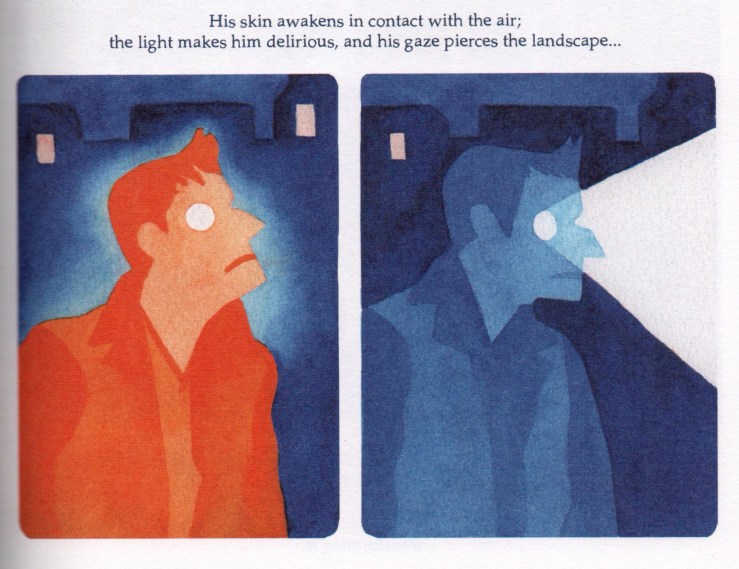
His skin awakens in contact with the air — Victor Hussenot

image

“It’s almost sexual” | Brian Wilson talks about the theremin in “Good Vibrations”

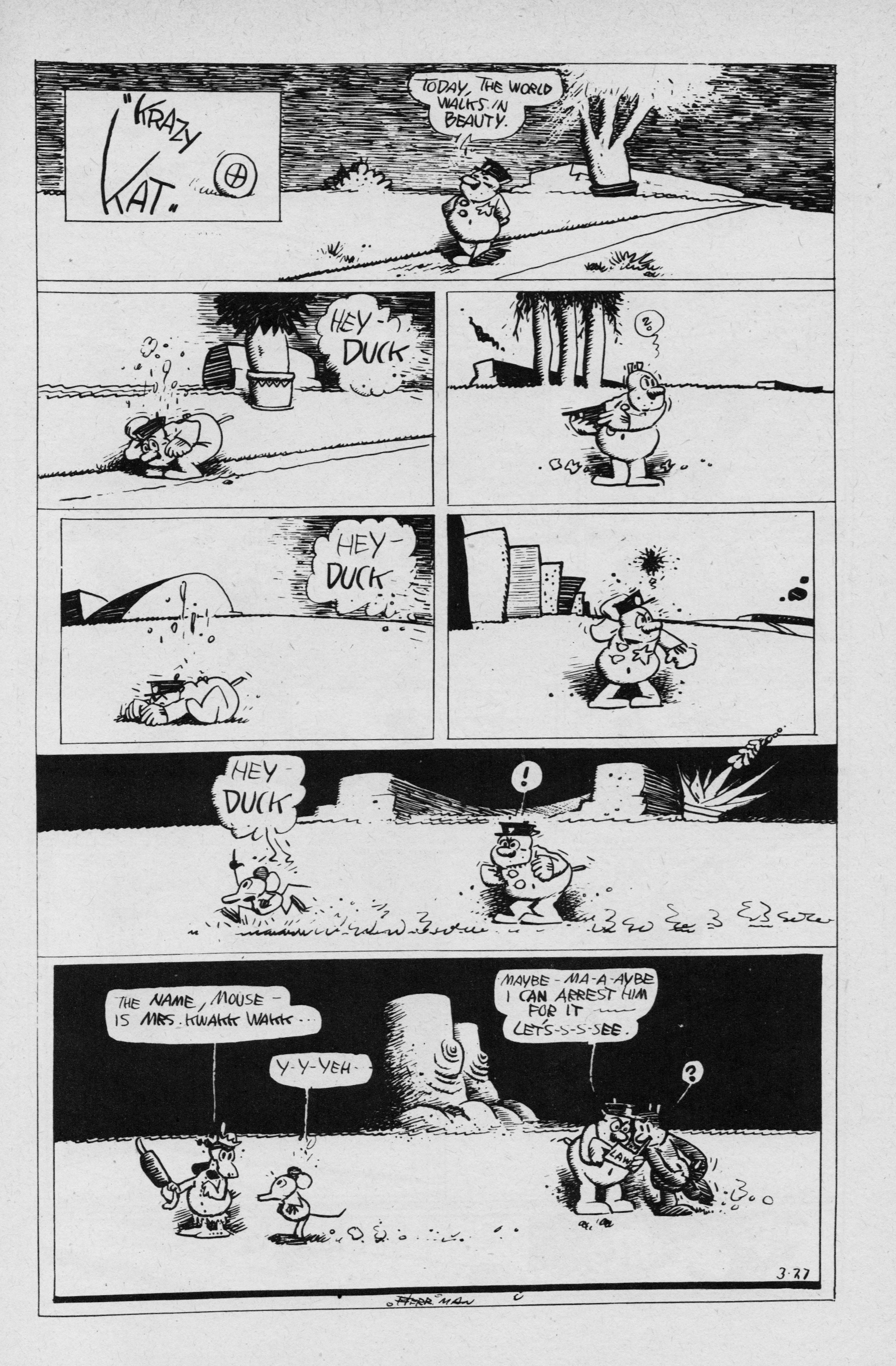
Hey — Duck (Krazy Kat)

image

A U.S.A. that would die for the so-called perfect Entertainment (Infinite Jest)


The sky of U.S.A.’s desert was clotted with blue stars. Now it was deep at night. Only above the U.S.A. city was the sky blank of stars; its color was pearly and blank. Marathe shrugged. ‘Perhaps in you is the sense that citizens of Canada are not involved in the real root of the threat.’

Steeply shook the head in seeming annoyance. ‘What’s that supposed to mean?’ he said. The lurid wig of him slipped when he moved the head with any abrupt force.

The first way Marathe betrayed anything of emotion was to smooth rather too fussily at the blanket on his lap. ‘It is meaning that it will not of finality be Québecers making this kick to l’aine des Etats Unis. Look: the facts of the situation speak loudly. What is known. This is a U.S.A. production, this Entertainment cartridge. Made by an American man in the U.S.A. The appetite for the appeal of it: this also is U.S.A. The U.S.A. drive for spectation, which your culture teaches. This I was saying: this is why choosing is everything. When I say to you choose with great care in loving and you make ridicule it is why I look and say: can I believe this man is saying this thing of ridicule?’ Marathe leaned slightly forward on his stumps, leaving the machine pistol to use both his hands in saying. Steeply could tell this was important to Marathe; he really believed it.

Marathe made small emphatic circles and cuts in the air while he spoke: ‘These facts of situation, which speak so loudly of your Bureau’s fear of this samizdat: now is what has happened when a people choose nothing over themselves to love, each one. A U.S.A. that would die — and let its children die, each one — for the so-called perfect Entertainment, this film. Who would die for this chance to be fed this death of pleasure with spoons, in their warm homes, alone, unmoving: Hugh Steeply, in complete seriousness as a citizen of your neighbor I say to you: forget for a moment the Entertainment, and think instead about a U.S.A. where such a thing could be possible enough for your Office to fear: can such a U.S.A. hope to survive for a much longer time? To survive as a nation of peoples? To much less exercise dominion over other nations of other peoples? If these are other peoples who still know what it is to choose? who will die for something larger? who will sacrifice the warm home, the loved woman at home, their legs, their life even, for something more than their own wishes of sentiment? who would choose not to die for pleasure, alone?’

From David Foster Wallace’s novel Infinite Jest.


Silent Interior — Carlos Schwabe

The Straw Manikin — Francisco Goya

The artist must not become a storyteller (Balthus)

…the artist must not become a storyteller. The anecdote should not exist in painting. A picture or subject imposes itself, and it alone knows how profound and vertiginous it is. Nothing happens in a picture, it simply is; it exists by essence or does not exist at all. Baudelaire said a poem is there before it is there. Otherwise, it would be akin to something narrative, something inflected, willed into being by the artist. A picture or poem escapes these contingencies, with terrifying freedom and fiercely self-sufficient violence. In this sense, the artists is a mere link in a chain that began long ago. At Lascaux, for example, and even before Lascaux. There is no hierarchy, and Chardin is not better than Lascaux. All these creative connections belong to the same earthly song, from the ancient source of the world that I know nothing about, but which sends me a few messages by flashes of sun—or starlight. The artist constantly seeks to rediscover the illuminating fire, the hearth where sparks are made.

From Balthus’ memoir Vanished Splendors.