“A Human World” — Charlotte Perkins Gilman

“A Human World”

by

Charlotte Perkins Gilman

(from Our Androcentric Culutre; or, The Man Made World)


In the change from the dominance of one sex to the equal power of two, to what may we look forward? What effect upon civilization is to be expected from the equality of womanhood in the human race?

To put the most natural question first—what will men lose by it? Many men are genuinely concerned about this; fearing some new position of subservience and disrespect. Others laugh at the very idea of change in their position, relying as always on the heavier fist. So long as fighting was the determining process, the best fighter must needs win; but in the rearrangement of processes which marks our age, superior physical strength does not make the poorer wealthy, nor even the soldier a general.

The major processes of life to-day are quite within the powers of women; women are fulfilling their new relations more and more successfully; gathering new strength, new knowledge, new ideals. The change is upon us; what will it do to men?

No harm.

As we are a monogamous race, there will be no such drastic and cruel selection among competing males as would eliminate the vast majority as unfit. Even though some be considered unfit for fatherhood, all human life remains open to them. Perhaps the most important feature of this change comes in right here; along this old line of sex-selection, replacing that power in the right hands, and using it for the good of the race.

The woman, free at last, intelligent, recognizing her real place and responsibility in life as a human being, will be not less, but more, efficient as a mother. She will understand that, in the line of physical evolution, motherhood is the highest process; and that her work, as a contribution to an improved race, must always involve this great function. She will see that right parentage is the purpose of the whole scheme of sex-relationship, and act accordingly.

In our time, his human faculties being sufficiently developed, civilized man can look over and around his sex limitations, and begin to see what are the true purposes and methods of human life. Continue reading ““A Human World” — Charlotte Perkins Gilman”

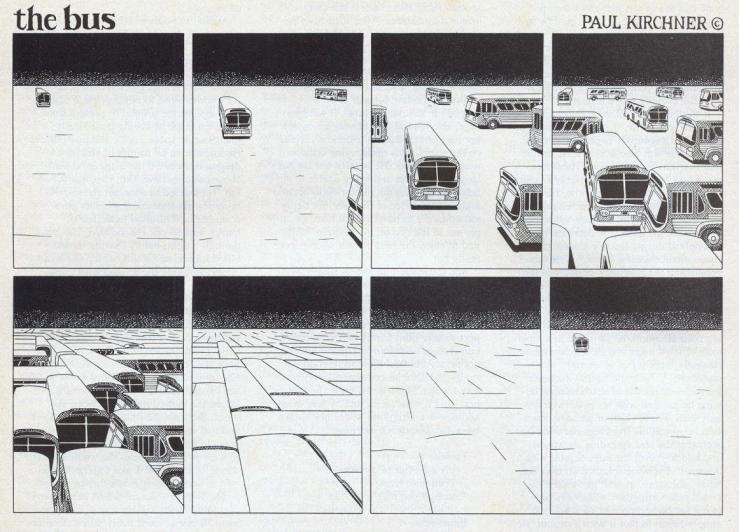
The Bus — Paul Kirchner

WQlfiuH - Imgur

Chicago — Harry Callahan

callahan_chicago_1951-web

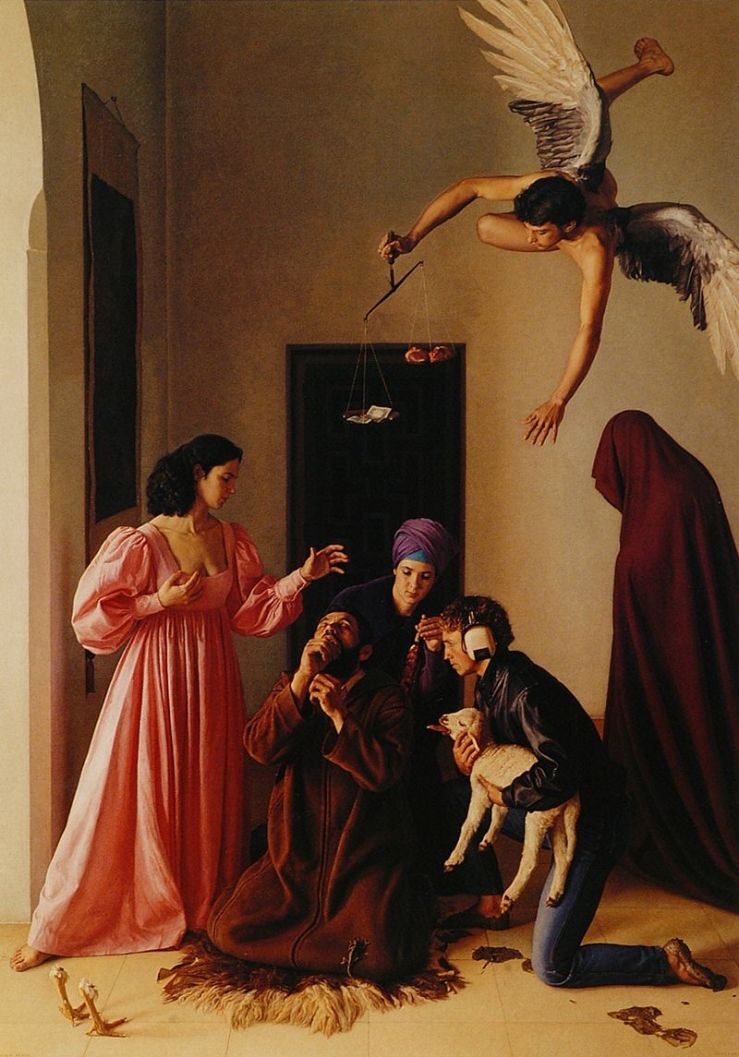
Temptation of St. Anthony — Claudio Bravo

cb

Selections from One-Star Amazon Reviews of J.R.R. Tolkien’s The Hobbit

[Editorial note: The following citations come from one-star Amazon reviews J.R.R. Tolkien’s novel The Hobbit (a book I’ve always loved)I’ve preserved the reviewers’ original punctuation and spelling. More one-star Amazon reviews.].

Dwarves.

The Hobbit stinks.

It is just so boreing.

“DEATH TO HOBBITS!”

This is such a horrible book.

Gandalf the wizard is a bogus

Swoar, lil’ fools wack for REALL.

And what’s this thing about hairy feet?

Crying because the story will NOT END!

my mom liked it (what’s wrong with her? )

Spend your money on Harry Potter instead.

I dought we will ever finish this horrible book.

No offense, but the suspense was not at all amusing

I know for a fact that there are several of Hobbit fans.

Bilbo is a Hobbit who seems not to do much in the story.

it was as if a ten year old coul’ve made up these characters.

forget about all the other reviews. they just think bilbo the bimbo is hot.

This is a dangerous book and is an extremely bad influence on adolescents.

Not only that, it is also more boring than having tea with nan and the relatives.

There is no action and Bilbo Baggins is the biggest a$$ in a fantasy novel ever.

This is a prime example of what happens when Star Trek and Star Wars dorks pick up a book.

No originality whatsoever is involved and the pages make me wish I was not even in existence.

After reading literary masterpieces by Robert Jordan, and Aurther C. Clark, books like these seem pointless.

The book is about a young hobit that goes on an adventurer to get rid of a ring that if you w where it you turn e ebook

One more things on the dwarves. They are useless characters and this story makes me want to vomit.

This book is a story of your everyday savior (supposedly Bilbo) having adventures and slaying a dragon.

The ending of the story is horrible and it seems that Tolkien wasted his POOR and SENSELESS usage of his brain.

They also don’t fit the spirit of dwarves, but then again after time they evolved into the grumpy alchoholics fantasy tends to portray them as.

I sit there reading every single word of it, but I think about something else. I read “Bilbo blah blah blah,” but think “Oh what am I gonna do today after school?”

Bilbo is not exactly the character which you would find addicted to. He stammers and is basically a coward.

This yogurt tastes awful! This is the worst yogurt I have ever tasted!

And like all stories, there are monsters and strange happenings.

What was I drinking when I decided to read this piece of junk?

:-( Boo! :-( Boo! :-( Boo! :-( Boo! :-( Boo!:-(

I despise and loathe this series tremendously.

I’m just glad this guy’s dead. :)

Bilbo reminds me of a pig.

“DIE HOBBITS, DIE!”

Idiotic and Irritating.

to many characters!

this is some butt

Agghhh!

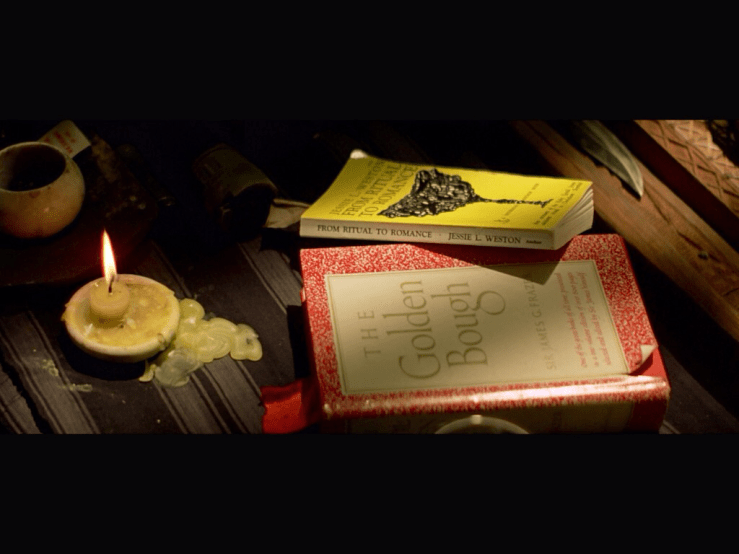
Colonel Walter E. Kurtz’s bedside reading

IMG_0280

From Apocalypse Now (1979); dir. Francis Ford Coppola with cinematography by Vittorio Storaro.

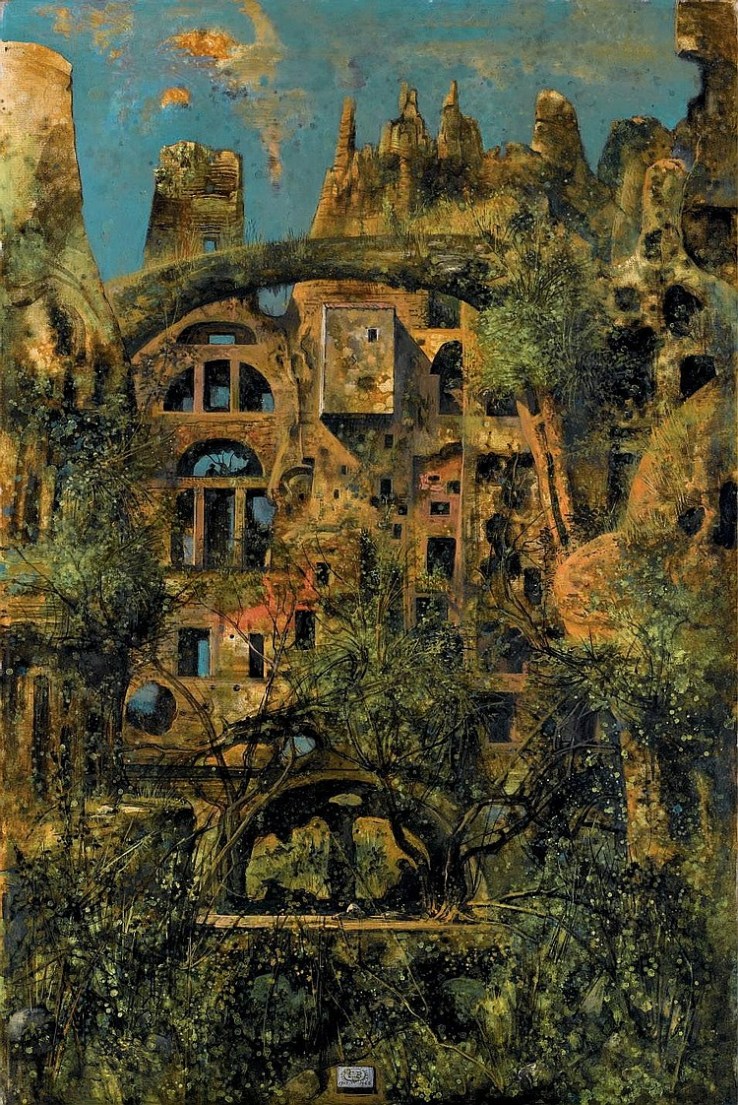
Imaginary Rock City — Eugene Berman

H0027-L15658157

Is there any value that has value? (Donald Barthelme)

I asked the Cardinal questions, we had a conversation.

“I am thinking of a happy island more beautiful than can be imagined,” I said.

“I am thinking of a golden mountain which does not exist,” he said.

“Upon what does the world rest?” I asked.

“Upon an elephant,” he said.

“Upon what does the elephant rest?”

“Upon a tortoise.”

“Upon what does the tortoise rest?”

“Upon a red lawnmower.”

I wrote in my book, playful.

“Is there any value that has value?” I asked.

“If there is any value that has value, then it must lie outside the whole sphere of what happens and is the case, for all that happens and is the case is accidental.” He was not serious. I wrote in my book, knows the drill.

From Donald Barthelme’s story “See the Moon?”

The Conjurer — Hieronymus Bosch

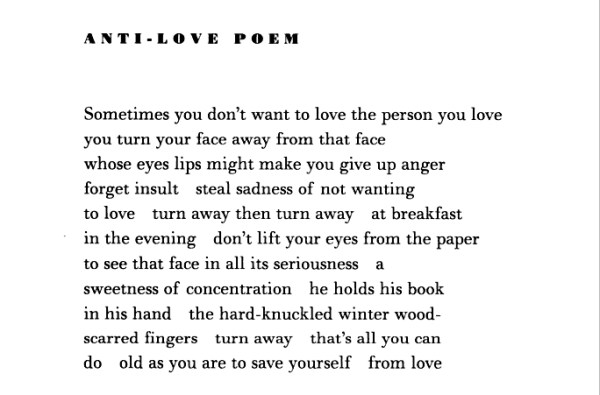
“Anti-Love Poem” — Grace Paley

Screenshot 2015-07-10 at 9

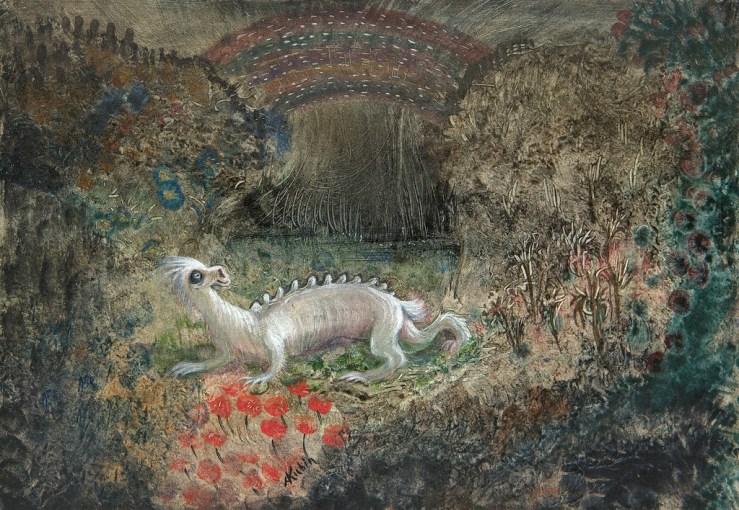
Mythical Animal — Alfred Kubin

kubin animal

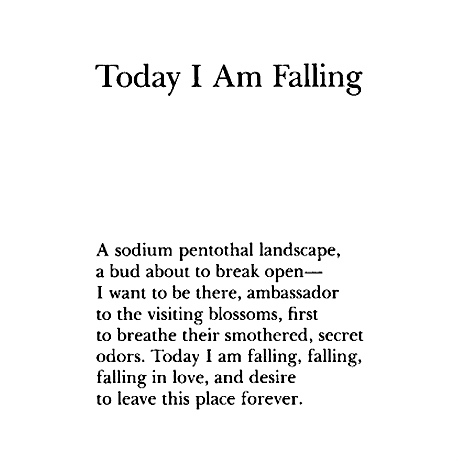
“Today I Am Falling” — James Tate

Screenshot 2015-07-09 at 2

“July Stories” — Roberto Bolaño

July has been a strange month. The other day I went to the beach and I saw a woman of about thirty, pretty, wearing a black bikini, who was reading standing up. At first I thought she was about to lie down on her towel, but when I looked again she was still standing, and after that I didn’t take my eyes off her. For two hours, more or less, she read standing up, walked over to the water, didn’t go in, let the waves lap her shins, went back to her spot, kept reading, occasionally put the book down while still standing, leaned over a few times and took a big bottle of Pepsi out of a bag and drank, then picked up the book again, and, finally, without ever bending a knee, put her things away and left. Earlier the same day, I saw three girls, all in thongs, gorgeous, one of them had a tattoo on one buttock, they were having a lively conversation, and every once in a while they got in the water and swam and then they would lie down again on their mats, basically a completely normal scene, until all of a sudden, a cell phone rang, I heard it and thought it was mine until I realized it had been a while since I had a cell phone, and then I knew the phone belonged to one of them. I heard them talking. All I can say is that they weren’t speaking Catalan or Spanish. But they sounded deadly serious. Then I watched two of them get up, like zombies, and walk toward some rocks. I got up too and pretended to brush the sand off my trunks. On the rocks, I watched them talk to a huge, hideously ugly man covered in hair, in fact one of the hairiest men I’ve ever seen in my life. They knelt before him and listened attentively without saying a word, and then they went back to where their friend was waiting for them and everything went on as before, as if nothing had happened. Who are these women? I asked myself once it was dark and I had showered and dressed. One drank Pepsi. The others bowed down to a bear. I know who they are. But I don’t really know.

From Roberto Bolaño’s Between Parentheses: Essays, Articles and Speeches, 1998-2003.

RIP James Tate

james-tate

RIP the great James Tate (1943-2015).

Daphne Spencer — Stanley Spencer

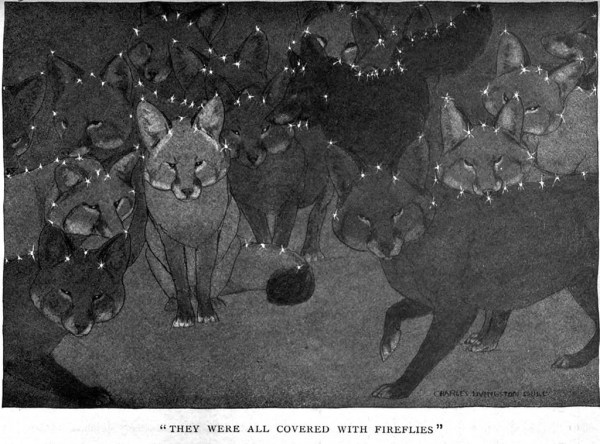
They Were All Covered with Fireflies — Charles Livingston Bull

tumblr_ll5pp8DLJk1qb7dheo1_1280

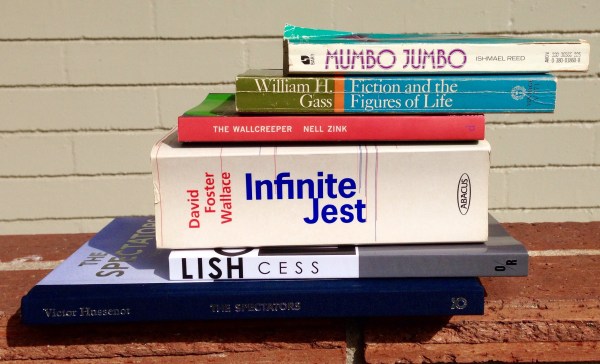
Reading/Have Read/Should Write About

IMG_7603

From top to bottom:

Mumbo Jumbo, Ishmael Reed

Last summer, I read Alasdair Gray’s novel Lanark and never mustered a review (Florida heat; Fourth of July fireworks; booze; other excuses). I’ve thought about Lanark all the time though. I’m afraid Mumbo Jumbo is gonna fall in the same slot as Lanark—too much to handle in one read. I need to go back and reread Mumbo Jumbo—just fantastic stuff—conspiracy theories, hoodoo, music, art theft—I owe it more than I seem to be able to register here.

Fiction and the Figures of Life, William H. Gass

So I read a handful of essays in Gass’s earliest essay collection interspersed with Infinite Jest, and I actually did write a bit about one of them here, in conjunction with IJ. Perfect sentences. (Gass’s sentences. Not mine). I wisely shelved the thing (Gass’s “review” of a Donald Barthelme collection almost paralyzed me), leaving more pieces to return to later.

The Wallcreeper, Nell Zink

I started Zink’s first novel The Wallcreeper this afternoon and only put it down when I had to go pick my kids up from day camp. Then I picked it up again. I just put it down again, at a break, of sorts, on page 77, to write this. Every sentence makes me want to read the next sentence (“I felt almost nostalgic toward socially acceptable horrors with larger meanings related to reproduction,” our narrator quips; a bit later: “My life was like falling off a log comfortably located somewhere light-years above the earth”). It’s about this young married couple living in Bern, Switzerland—also sex, birdwatching, music, etc. I was kinda worried that any novel I picked up after Infinite Jest (see below) might suffer, but nah. The Wallcreeper is fantastic so far.

Infinite Jest, David Foster Wallace

Okay, so I mustered a few riffs on rereading Infinite Jest, including a thing about the first 299 pages and a thing for first-time readers—but I finished the novel yesterday, and this is how I felt:

Twitter was the easiest way to try to bottle the feeling of finishing the novel, which is a feeling that I wanted to bottle because didn’t record the feeling of finishing IJ the first time, back in 2001. But I remember finishing it, very, very late at night/early in the morning, and going back through it, rereading that first chapter, trying to figure out What Happened. So what I mean is I felt enthusiasm and energy—it was the opposite of the reread, which was deflationary, I suppose—richer and sadder. And I hate to write this, but it’s impossible not to reread Infinite Jest through the lens of Wallace’s suicide. Just too many suicides in the novel…and then this late passage, from Hal’s narration (elisions and emphasis mine):

…the old specimen’s horrified face as the boy sobs into the chartreuse satin and shrieks ‘Murderer! Murderer!’ over and over, so that almost a third of Accomplice!’s total length is devoted to the racked repetition of this word — way, way longer than is needed for the audience to absorb the twist and all its possible implications and meanings. This was just the sort of issue Mario and I argued about. As I see it, even though the cartridge’s end has both characters emoting out of every pore, Accomplice!’sessential project remains abstract and self-reflexive; we end up feeling and thinking not about the characters but about the cartridge itself. By the time the final repetitive image darkens to a silhouette and the credits roll against it and the old man’s face stops spasming in horror and the boy shuts up, the cartridge’s real tension becomes the question: Did Himself subject us to 500 seconds of the repeated cry ‘Murderer!’ for some reason, i.e. is the puzzlement and then boredom and then impatience and then excruciation and then near-rage aroused in the film’s audience by the static repetitive final 1⁄3 of the film aroused for some theoretical-aesthetic end, or is Himself simply an amazingly shitty editor of his own stuff?

It was only after Himself’s death that critics and theorists started to treat this question as potentially important. A woman at U. Cal–Irvine had earned tenure with an essay arguing that the reason-versus-no-reason debate about what was unentertaining in Himself’s work illuminated the central conundra of millennial après-garde film, most of which, in the teleputer age of home-only entertainment, involved the question why so much aesthetically ambitious film was so boring and why so much shitty reductive commercial entertainment was so much fun. The essay was turgid to the point of being unreadable, besides using reference as a verb and pluralizing conundrum as conundra.

From my horizontal position on the bedroom floor…

There’s hero Hal horizontal, psychic parallel to Don Gately, the hero of stasis, to borrow Hal’s own term…

I’ll try to muster more.

Cess, Gordon Lish

AKA Gordon Lish does whatever the fuck he wants. I read this in one alarmed sitting, and I’m not sure if I read it “correctly,” whatever that means.

The Spectators,Victor Hussenot

Another beautiful book from Nobrow—not a graphic novel, but something closer to a colorful illustrated tone poem, a meditation, a feeling. Excellent review at Loser City, which I made the mistake of reading before I composed my own.