Boring (John Berryman)

Los Entering the Grave — William Blake

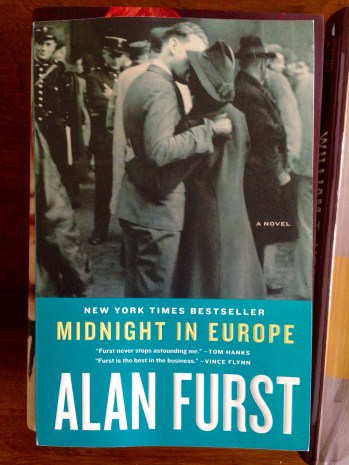
Midnight in Europe (Book acquired, some time in February 2015)

IMG_5139

Alan Furst’s Midnight in Europe is out next week in paperback from Random House. Their blurb:

Paris, 1938. As the shadow of war darkens Europe, democratic forces on the Continent struggle against fascism and communism, while in Spain the war has already begun. Alan Furst, whom Vince Flynn has called “the most talented espionage novelist of our generation,” now gives us a taut, suspenseful, romantic, and richly rendered novel of spies and secret operatives in Paris and New York, in Warsaw and Odessa, on the eve of World War II.

Cristián Ferrar, a brilliant and handsome Spanish émigré, is a lawyer in the Paris office of a prestigious international law firm. Ferrar is approached by the embassy of the Spanish Republic and asked to help a clandestine agency trying desperately to supply weapons to the Republic’s beleaguered army—an effort that puts his life at risk in the battle against fascism.

Joining Ferrar in this mission is a group of unlikely men and women: idealists and gangsters, arms traders and aristocrats and spies. From shady Paris nightclubs to white-shoe New York law firms, from brothels in Istanbul to the dockyards of Poland, Ferrar and his allies battle the secret agents of Hitler and Franco. And what allies they are: there’s Max de Lyon, a former arms merchant now hunted by the Gestapo; the Marquesa Maria Cristina, a beautiful aristocrat with a taste for danger; and the Macedonian Stavros, who grew up “fighting Bulgarian bandits. After that, being a gangster was easy.” Then there is Eileen Moore, the American woman Ferrar could never forget.

In Midnight in Europe, Alan Furst paints a spellbinding portrait of a continent marching into a nightmare—and the heroes and heroines who fought back against the darkness.

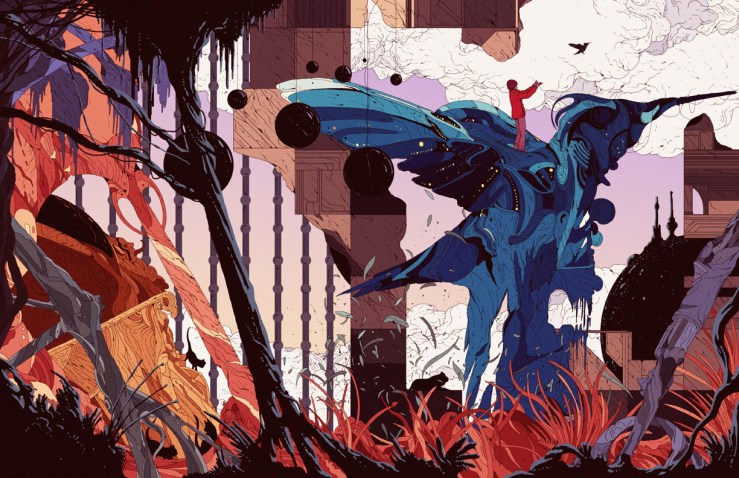
“All art constantly aspires towards the condition of a man playing a conch inside a nuclear cooling tower”

Via.

Newton’s Diary — Amy Judd

amy_judd_large_17

Portrait of a Man with an Arrow — Hans Memling

The official lie (Gravity’s Rainbow)

What did Caesar really whisper to his protégé as he fell? Et tu, Brute, the official lie, is about what you’d expect to get from them—it says exactly nothing. The moment of assassination is the moment when power and the ignorance of power come together, with Death as validator. When one speaks to the other then it is not to pass the time of day with et-tu-Brutes. What passes is a truth so terrible that history—at best a conspiracy, not always among gentlemen, to defraud—will never admit it. The truth will be repressed or in ages of particular elegance be disguised as something else. What will Rathenau, past the moment, years into a new otherside existence, have to say about the old dispensation? Probably nothing as incredible as what he might have said just as the shock flashed his mortal nerves, as the Angel swooped in…

From Thomas Pynchon’s novel Gravity’s Rainbow.

I know Leopold Bloom better than I know my own father (Umberto Eco)

It has been said that fictional characters are underdetermined that is, we know only a few of their properties while real individuals are completely determined, and we should be able to predicate of them each of their known attributes. But although this is true from an ontological point of view, from an epistemological one it is exactly the opposite: nobody can assert all the properties of a given individual or of a given species, which are potentially infinite, while the properties of fictional characters are severely limited by the narrative text and only those attributes mentioned by the text count for the identification of the character.

In fact, I know Leopold Bloom better than I know my own father. Who can say how many episodes of my father’s life are unknown to me, how many thoughts my father never disclosed, how many times he concealed his sorrows, his quandaries, his weaknesses? Now that he is gone, I shall probably never discover those secret and perhaps fundamental aspects of his being. Like the historians described by Dumas, I muse and muse in vain about that dear ghost, lost to me forever. In contrast, I know everything about Leopold Bloom that I need to know—and each time I reread Ulysses I discover something more about him.

From Umberto Eco’s essay “Some Remarks on Fictional Characters,” collected in Confessions of a Young Novelist.

Deckard Reading (Blade Runner)


Spoons — Margaret Bourke-White

bourke_spoons

The Martyrdom of St. Sebastian — Hans Memling

Paris Red (Book acquired some time in February, 2015)

IMG_5138

Maureen Gibbon’s novel Paris Red is forthcoming (April 2015) in hardback from W.W. Norton. Their blurb:

For readers of Girl with a Pearl Earring, a luminous and evocative novel of Édouard Manet’s muse.

Paris, 1862. A young girl in a threadbare dress and green boots, hungry for experience, meets the mysterious and wealthy artist Édouard Manet. The encounter will change her—and the art world—forever.

At seventeen, Victorine Meurent abandons her old life to become immersed in the Parisian society of dance halls and cafés, meeting writers and artists like Baudelaire and Alfred Stevens. As Manet’s model, Victorine explores a world of new possibilities and stirs the artist to push the boundaries of painting in his infamous portrait Olympia, which scandalizes even the most cosmopolitan city.

Manet becomes himself because of Victorine. But who does she become, that figure on the divan?

Intense, erotic, and beautifully wrought, Paris Red evokes the unconventional love story of a painter and his muse that changed the history of art.

“Aunt Zézé’s Tears,” a short story by Carmen Dolores

“Aunt Zézé’s Tears”

by

Carmen Dolores

Translated from the Portuguese by Isaac Goldberg

From Brazilian Tales

Pale and thin, for eighteen years she had lived with her youngest sister, who had married very early and now possessed five children: two young ladies of marriageable age, a third still in short dresses, and two little boys.

Maria-José, whose nickname was Zézé, had never been beautiful or winning. Upon her father’s death it was thought best that she should go to live with her sister Engracigna’s family. Here she led a monotonous existence, helping to bring up her nephews and nieces, who were born in that young and happy household with a regularity that brooked small intervals between the births.

A long, pointed nose disfigured her face, and her lips, extremely thin, looked like a pale crack. Her thoughtful gaze alone possessed a certain melancholy attractiveness. But even here, her eyes, protruding too far for the harmony of the lines upon her face seemed always to be red, and her brows narrow and sparse.

Of late, an intricate network of wrinkles as fine as hairs, had formed at the corner of her eyes. From her nose, likewise, two furrows ran along the transparent delicacy of her skin and reached either side of her mouth. When she smiled, these wrinkles would cover her countenance with a mask of premature age, and threatened soon to disfigure her entirely. And yet, from habit, and through passive obedience to routine, Maria-José continued to dress like a young girl of eighteen, in brightly colored gowns, thin waists and white hats that ill became her frail and oldish face. Continue reading ““Aunt Zézé’s Tears,” a short story by Carmen Dolores”

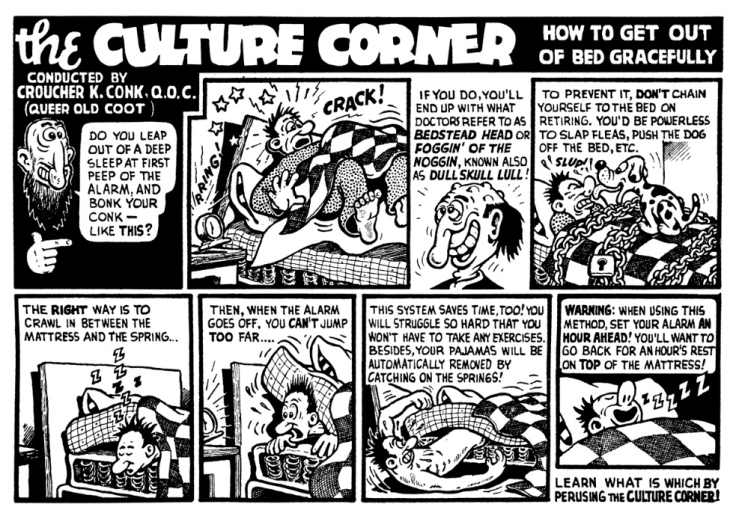
“How to Get Out of Bed Gracefully” — Basil Wolverton

IMG_0178


“All art constantly aspires towards the condition of music”

Spirit of Heron Maiden –Taniguchi Kokyo

Taniguchi_Kokyo-No_Series-Spirit_Of_The_Heron_Maiden-00036089-070707-F12