Campamento y Madrigales — Julio Larraz

unnamed-2

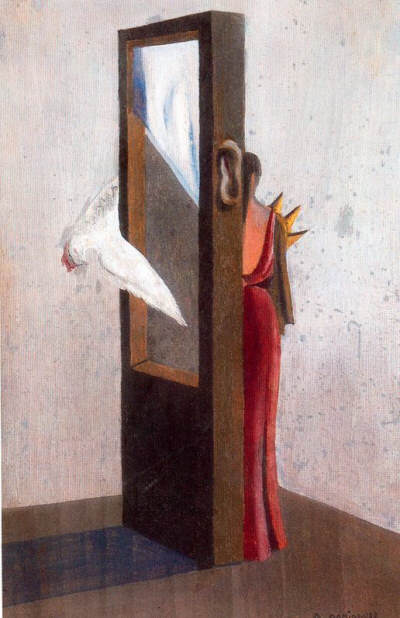
Campamento y Madrigales, 2015 by Julio Larraz (b. 1944)

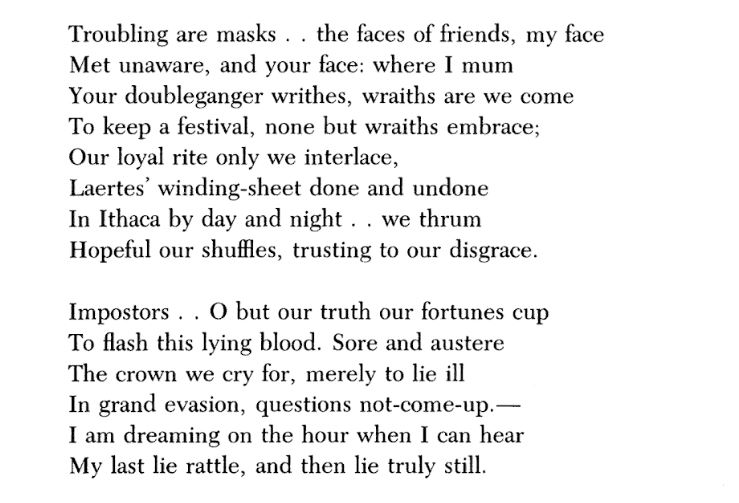
“Troubling are masks . . the faces of friends, my face” — John Berryman

Capture

From Early Italian Poets — Eduardo Paolozzi

From Early Italian Poets 1974-6 by Sir Eduardo Paolozzi 1924-2005

From Early Italian Poets 1974–6 by Eduardo Paolozzi (1924–2005)

No gnomon | Nathaniel Hawthorne’s journal entry for March 7th, 1855

March 7th.–J—– and I walked to Tranmere, and passed an old house which I suppose to be Tranmere Hall. Our way to it was up a hollow lane, with a bank and hedge on each side, and with a few thatched stone cottages, centuries old, their ridge-poles crooked and the stones time-worn, scattered along. At one point there was a wide, deep well, hewn out of the solid red freestone, and with steps, also hewn in solid rock, leading down to it. These steps were much hollowed by the feet of those who had come to the well; and they reach beneath the water, which is very high. The well probably supplied water to the old cotters and retainers of Tranmere Hall five hundred years ago. The Hall stands on the verge of a long hill which stretches behind Tranmere and as far as Birkenhead.

It is an old gray stone edifice, with a good many gables, and windows with mullions, and some of them extending the whole breadth of the gable. In some parts of the house, the windows seem to have been built up; probably in the days when daylight was taxed. The form of the Hall is multiplex, the roofs sloping down and intersecting one another, so as to make the general result indescribable. There were two sundials on different sides of the house, both the dial-plates of which were of stone; and on one the figures, so far as I could see, were quite worn off, but the gnomon still cast a shadow over it in such a way that I could judge that it was about noon. The other dial had some half-worn hour-marks, but no gnomon. The chinks of the stones of the house were very weedy, and the building looked quaint and venerable; but it is now converted into a farm-house, with the farm-yard and outbuildings closely appended. A village, too, has grown up about it, so that it seems out of place among modern stuccoed dwellings, such as are erected for tradesmen and other moderate people who have their residences in the neighborhood of a great city. Among these there are a few thatched cottages, the homeliest domiciles that ever mortals lived in, belonging to the old estate. Directly across the street is a Wayside Inn, “licensed to sell wine, spirits, ale, and tobacco.” The street itself has been laid out since the land grew valuable by the increase of Liverpool and Birkenhead; for the old Hall would never have been built on the verge of a public way.

Nathaniel Hawthorne’s journal entry for March 7th, 1855. From Passages from the English Note-Books.

The Fountains — Agnes Lawrence Pelton

large_2730ced075780266daa35173a72e331b

The Fountains by Agnes Lawrence Pelton (1881-1961)

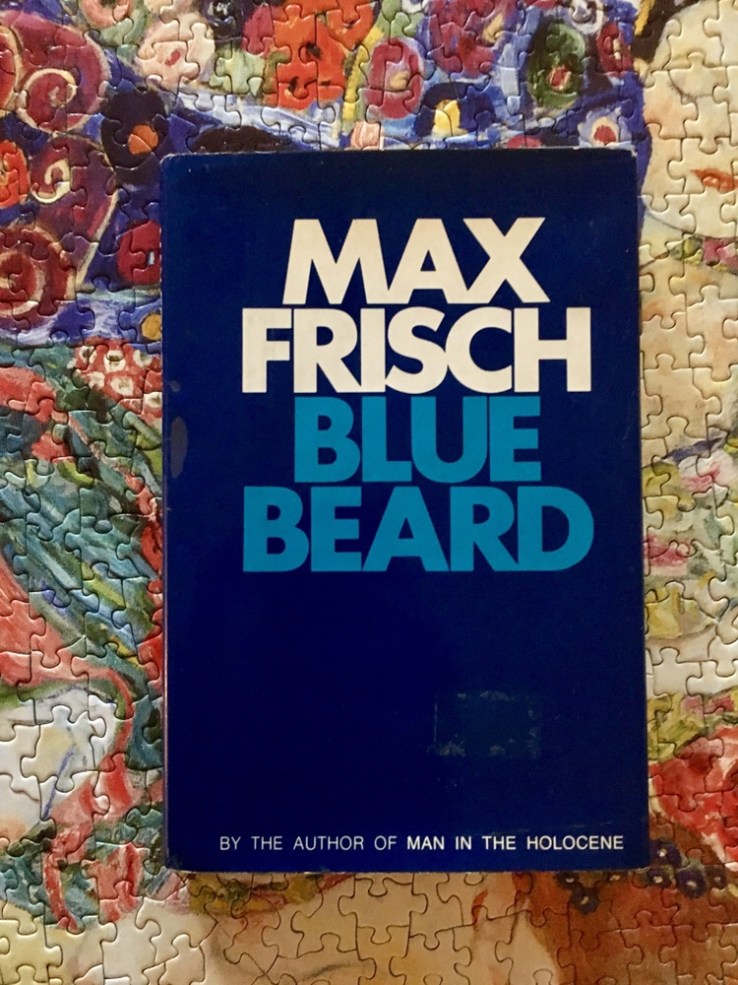
Max Frisch’s Bluebeard (Book acquired, 3 March 2018)

img_9131

When I saw a hardback copy of Max Frisch’s 1982 novel Bluebeard (in English translation by Geoffrey Skeleton) the other week at my favorite used bookstore, I picked it up and started reading. I loved the cover and was attracted by its slimness—under 150 pages and written almost entirely in Beckettian dialog—but more than anything it was the title. Is it creepy to admit that I have a slight obsession with the Bluebeard narrative? Yes? Chalk it up to a formative memory: When I was around five, a cousin, ten years older than I am, read an illustrated book of Charles Perrault fairy tales to me to tuck me in one night. He read read a few before getting to “Bluebeard,” a story both he and I were unfamiliar with. I know he didn’t know the story because I can vividly recall the shock it produced in him as it progressed, the sense of horror. I remember that he kept going through the story even after the awful violent secret at its core was revealed, simply in the hope that some kind of justice might happen. I remember him telling me, “That wasn’t a children’s story.” He’s right, of course—sample a few paragraphs from Andrew Lang’s translation of Perrault’s version:

Having come to the closet door, she made a stop for some time, thinking about her husband’s orders, and considering what unhappiness might attend her if she was disobedient; but the temptation was so strong that she could not overcome it. She then took the little key, and opened it, trembling. At first she could not see anything plainly, because the windows were shut. After some moments she began to perceive that the floor was all covered over with clotted blood, on which lay the bodies of several dead women, ranged against the walls. (These were all the wives whom Blue Beard had married and murdered, one after another.) She thought she should have died for fear, and the key, which she, pulled out of the lock, fell out of her hand.

After having somewhat recovered her surprise, she picked up the key, locked the door, and went upstairs into her chamber to recover; but she could not, so much was she frightened. Having observed that the key to the closet was stained with blood, she tried two or three times to wipe it off; but the blood would not come out; in vain did she wash it, and even rub it with soap and sand. The blood still remained, for the key was magical and she could never make it quite clean; when the blood was gone off from one side, it came again on the other.

It wasn’t so much the story but an older person’s reaction to the story that impacted me so much. I’m not sure if the book included an illustration that pertains to the images above, but I know that I remember an image of the scene, perhaps one I conjured all by myself—of a closet full of corpses.

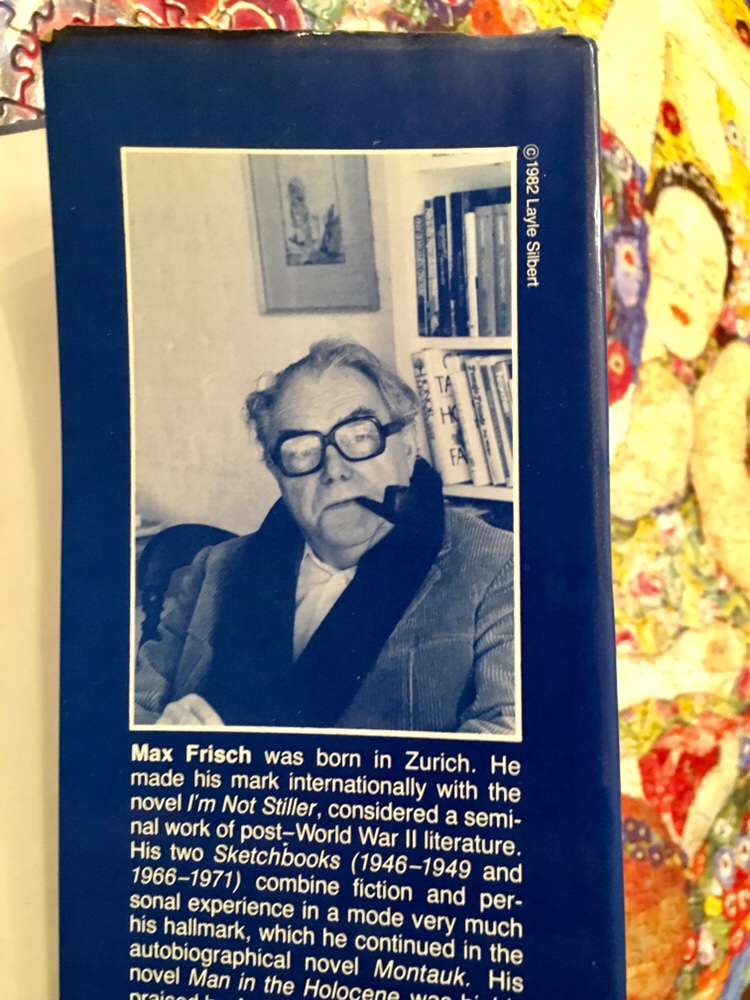
The Bluebeard story seems to have largely fallen out of the canon of children’s “fairy tales”; it’s one of those stories that I remember trying to bring up to others as a reference point when I was young. The reference never seemed to land. My students have no knowledge of it. And yet it’s still soaked into the culture—the recent film Ex Machina was a take on Bluebeard, and elements of HBO’s Westworld also allude to the tale. Over the years I’ve read plenty of versions of the story: Kurt Vonnegut’s Bluebeard, Donald Barthelme’s “Bluebeard,” Edna St. Vincent Millay’s “Bluebeard,” Anne Sexton’s “The Golden Key,” Angela Carter’s “The Bloody Chamber,” Margaret Atwood’s “Bluebeard’s Egg” — but I’d never heard of Max Frisch’s until I saw it in the store the other day. I didn’t pick it up then—I was committed to getting and reading Iris Murdoch’s The Bell, and I didn’t want to pile up too many books—but the blue cover wormed around in the back of my brain and I gave in the other day. Plus, dig this author photo:

Instead of the blurb, here are a few paragraphs from Richard Gilman’s contemporary review in The New York Times:

“Bluebeard” is an extremely short “tale,” as Mr. Frisch calls it, even shorter than “Man in the Holocene.” Like Samuel Beckett, Mr. Frisch seems to be paring away his stock of expressiveness, moving toward a purer means as he nears his mid-70’s. The book is made up in large part of remembered excerpts from the transcript of a fictional murder trial, interspersed with remarks, comments and reflections by the accused man.

He is a 54-year old Zurich physician named Felix Schaad, who was charged with strangling one of his former wives with a necktie. She had been the sixth of his seven wives, and after their divorce, she had become a high-priced call girl whom he would sometimes visit, although apparently not for sexual purposes. At the time of her murder, Schaad had been married for a year to his seventh wife, and it was she who gave him the nickname Bluebeard, as a term of endearment. “He once said that he already had six wives in the cellar,” she said on the witness stand.

The press had siezed on this bit of testimony. The doctor remembers the headlines – “NO ALIBI FOR SCHAAD/BLUEBEARD IN COURT/DOCTOR’S SEVEN MARRIAGES” – and recalls how “I looked it up in the library: the tale of the knight who had killed his seven wives and concealed their corpses in the cellar was written by a Frenchman, Charles Perrault, in the seventeenth century.”

Film Poster for The Big Lebowski — Andrzej Krajewski

Polish Poster

Boy Between Balloons — Robin F. Williams

boy20between20balloons_2008_48x48

Boy Between Balloons, 2008 by Robin F. Williams (b. 1984)

“Rebecca,” a very short story by Donald Barthleme

“Rebecca”

by

Donald Barthelme


Rebecca Lizard was trying to change her ugly, reptilian, thoroughly unacceptable last name.

“Lizard,” said the judge. “Lizard, Lizard, Lizard, Lizard. There’s nothing wrong with it if you say it enough times. You can’t clutter up the court’s calendar with trivial little minor irritations. And there have been far too many people changing their names lately.

Changing your name countervails the best interest of the telephone comany, the electric company, and the United States goverment. Motion denied.”

Lizard in tears.

Lizard led from the courtroom. A chrysanthemum of Kleenex held under her nose.

“Shaky lady,” said a man, “are you a schoolteacher?”

Of course she’s a schoolteacher, you idiot. Can’t you see the poor woman’s all upset? Why don’t you leave her alone?

“Are you a homosexual lesbian? Is that why you never married?”

Christ, yes, she’s a homosexual lesbian, as you put it. Would you please shut your face?

Rebecca went to the damned dermatologist (a new damned dermatologist), but he said the same thing the others had said. “Greenish,” he said, “slight greenishness, genetic anomaly, nothing to be done, I’m afraid, Mrs. Lizard.”

“Miss Lizard.”

“Nothing to be done, Miss Lizard.”

“Thank you, Doctor. Can I give you a little something for your trouble?”

“Fifty dollars.”

When Rebecca got home the retroactive rent increase was waiting for her, coiled in her mailbox like a pupil about to strike.

Must get some more Kleenex. Or a Ph.D. No other way.

She thought about sticking her head in the oven. But it was an electric oven.

Rebecca’s lover, Hilda, came home late.

“How’d it go?” Hilda asked, referring to the day.

“Lousy.”

“Hmmm,” Hilda said, and quietly mixed strong drinks of busthead for the two of them.

Hilda is a very good-looking woman. So is Rebecca. They love each other–an incredibly dangerous and delicate business, as we know. Hilda has long blond hair and is perhaps a shade the more beautiful. Of course Rebecca has a classic and sexual figure which attracts huge admiration from every beholder.

“You’re late,” Rebecca said. “Where were you?”

“I had a drink with Stephanie.”

“Why did you have a drink with Stephanie?”

“She stopped by my office and said let’s have a drink.”

“Where did you go?”

“The Barclay.”

“How is Stephanie?”

“She’s fine.”

“Why did you have to have a drink with Stephanie?”

“I was ready for a drink.”

“Stephanie doesn’t have a slight greenishness, is that it? Nice, pink Stephanie?”

Hilda rose and put an excellent C & W album on the record player. It was David Rogers’s

“Farewell to the Ryman,” Atlantic SD 7283. It contains such favorites as “Blue Moon of Kentucky,” “Great Speckled Bird,” “I’m Movin’ On,” and “Walking the Floor Over You.” Many great Nashville personnel appear on this record.

“Pinkness is not everything,” Hilda said. “And Stephanie is a little bit boring. You know that.” “Not so boring that you don’t go out for drinks with her.”

“I am not interested in Stephanie.”

“As I was leaving the courthouse,” Rebecca said, “a man unzipped my zipper.”

David Rogers was singing “Oh please release me, let me go.”

“What were you wearing?”

“What I’m wearing now.”

“So he had good taste,” Hilda said, “for a creep.” She hugged Rebecca, on the sofa. “I love you,” she said.

“Screw that,” Rebecca said plainly, and pushed Hilda away. “Go hang out with Stephanie Sasser.”

“I am not interested in Stephanie Sasser,” Hilda said for the second time.

Very often one “pushes away” the very thing that one most wants to grab, like a lover. This is a common, although distressing, psychological mechanism, having to do (in my opinion) with the fact that what is presented is not presented “purely,” that there is a tiny little canker or grim place in it somewhere. However, worse things can happen.

“Rebecca,” said Hilda, “I really don’t like your slight greenishness.”

The term “lizard” also includes geckos, iguanas, chameleons, slowworms, and monitors. Twenty existing families make up the order, according to the Larousse Encyclopedia of Animal Life, and four others are known only from fossils. There are about twenty-five hundred species, and they display adaptations for walking, running, climbing, creeping, or burrowing. Many have interesting names, such as the Bearded Lizard, the Collared Lizard, the Flap-Footed Lizard, the Frilled Lizard, the Girdle-Tailed Lizard, and the Wall Lizard.

“I have been overlooking it for these several years, because I love you, but I really don’t like it so much,” Hilda said. “It’s slightly–”

“Knew it,” said Rebecca.
Rebecca went into the bedroom. The color television set was turned on, for some reason.

In a greenish glow, a film called Green Hill was unfolding.

I’m ill, I’m ill.
I will become a farmer.
Our love, our sexual love, our ordinary love!

Hilda entered the bedroom and said, “Supper is ready.”

“What is it?”

“Pork with red cabbage.”

“I’m drunk,” Rebecca said.

Too many of our citizens are drunk at times when they should be sober–suppertime, for example. Drunkenness leads to forgetting where you have put your watch, keys, or money clip, and to a decreased sensitivity to the needs and desires and calm good health of others. The causes of overuse of alcohol are not as clear as the results. Psychiatrists feel in general that alcoholism is a serious problem but treatable, in some cases. AA is said to be both popular and effective. At base, the question is one of willpower.

“Get up,” Hilda said. “I’m sorry I said that.”

“You told the truth,” said Rebecca.

“Yes, it was the truth,” Hilda admitted.

“You didn’t tell me the truth in the beginning. In the beginning, you said it was beautiful.”

“I was telling you the truth, in the beginning. I did think it was beautiful. Then.”

This “then,” the ultimate word in Hilda’s series of three brief sentences, is one of the most pain-inducing words in the human vocabulary, when used in this sense. Departed time! And the former conditions that went with it! How is human pain to be measured? But remember that Hilda, too… It is correct to feel for Rebecca in this situation, but, reader, neither can Hilda’s position be considered an enviable one, for truth, as Bergson knew, is a hard apple, whether one is throwing it or catching it.

“What remains?” Rebecca said stonily.

“I can love you in spite of–”

Do I want to be loved in spite of? Do you? Does anyone? But aren’t we all, to some degree?

Aren’t there important parts of all of us which must be, so to say, gazed past? I turn a blind eye to that aspect of you, and you turn a blind eye to that aspect of me, and with these blind eyes eyeball-to-eyeball, to use an expression from the early 1960s, we continue our starched and fragrant lives. Of course it’s also called “making the best of things,” which I have always considered a rather soggy idea for an Americal ideal. But my criticisms of this idea must be tested against those of others–the late President McKinley, for example, who maintained that maintaining a good, in not necessarily sunny, disposition was the one valuable and proper course.

Hilda placed her hands on Rebecca’s head.

“The snow is coming,” she said. “Soon it will be snow time. Together then as in other snow times. Drinking the busthead ’round the fire. Truth is a locked room that we knock the lock off from time to time, and then board up again. Tomorrow you will hurt me, and I will inform you that you have done so, and so on and so on. To hell with it. Come, viridian friend, come and sup with me.”

They sit down together. The pork with red cabbage steams before them. They speak quietly about the McKinley Administration, which is being revised by revisionist historians. The story ends. It was written for several reasons. Nine of them are secrets. The tenth is that one should never cease considering human love, which remains as grisly and golden as ever, no matter what is tattooed upon the warm tympanic page.

(Via)
Airport — Carol Rhodes

Airport 1995 by Carol Rhodes born 1959

Airport, 1995 by Carol Rhodes (b. 1959)

Hell is the place we don’t know we’re in (Don DeLillo)

“Singh remarked to me once, his conspiratorial aspect, fixing those flat heavy eyes on me, ‘Hell is the place we don’t know we’re in.’ I wasn’t sure how to take the remark. Was he saying that he and I were in hell or that everyone else was? Everyone in rooms, houses, chairs with armrests. Is hell a lack of awareness? Once you know you’re there, is this your escape? Or is hell the one place in the world we don’t see for what it is, the one place we can never know? Is that what he meant? Is hell what we say to each other or what we can’t say, what is beyond our reach? The sentence defeated me. I was afraid of the desert but drawn to it, drawn to the contradiction. Men will come to fill this empty place. This place is empty in order that men may rush in to fill it.”

From Don DeLillo’s novel The Names.

Portrait of Stefan Glass — Stanisław Ignacy Witkiewicz

img_9141

Portrait of Stefan Glass, 1929 by Stanisław Ignacy Witkiewicz (1885-1939).

From Narcotics, Twisted Spoon Press, 2018.

Witkiewicz’s notes indicate that he painted his portrait of the poet Stefan Glass while on mescaline, vodka, and cocaine.

“In other words, I stole from a kid” | Don DeLillo and Atticus Lish

Like ”Ratner’s Star,” a book in which Mr. DeLillo says he tried to ”produce a piece of mathematics,” ”The Names” is complexly structured and layered. It concludes with an excerpt from a novel in progress by Axton’s 9-year-old son, Tap. Inspiration for the ending came from Atticus Lish, the young son of Mr. DeLillo’s friend Gordon Lish, an editor.

”At first,” Mr. DeLillo says, ”I had no intention of using excerpts from Tap’s novel. But as the novel drew to a close I simply could not resist. It seemed to insist on being used. Rather than totally invent a piece of writing that a 9-year-old boy might do, I looked at some of the work that Atticus had done when he was 9. And I used it. I used half a dozen sentences from Atticus’s work. More important, the simple exuberance of his work helped me to do the last pages of the novel. In other words, I stole from a kid.”

Young Atticus is given ample credit in the book’s acknowledgments, but creative borrowing from life is not a new technique for Mr. DeLillo, who has been praised for his ear for dialogue. ”The interesting thing about trying to set down dialogue realistically,” he says, ”is that if you get it right it sounds stylized. Why is it so difficult to see clearly and to hear clearly? I don’t know. But it is, and in ‘Players’ I listened very carefully to people around me. People in buses. People in the street. And in many parts of the book I used sentences that I heard literally, word for word. Yet it didn’t sound as realistic as one might expect. It sounded over-refined even.”

From a 1982 profile of Don DeLillo in The New York Times

Atticus Lish’s 2014 novel Preparation for the Next Life was one of the best novels I read last year, and one of the best contemporary American novels I’ve read in ages.

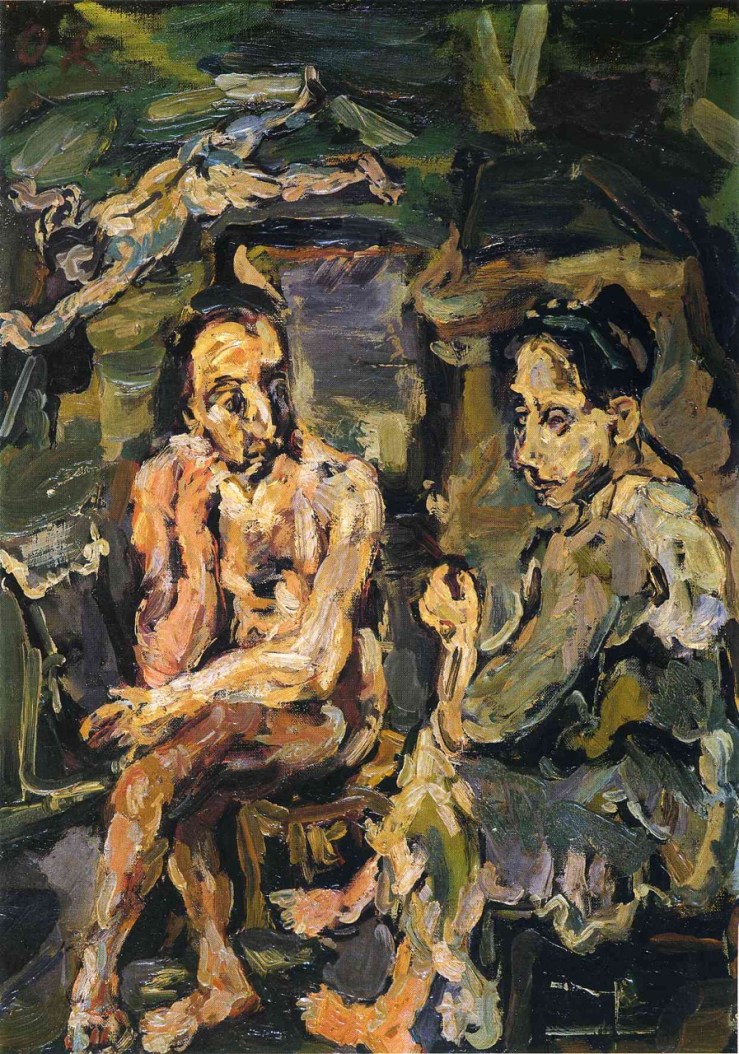
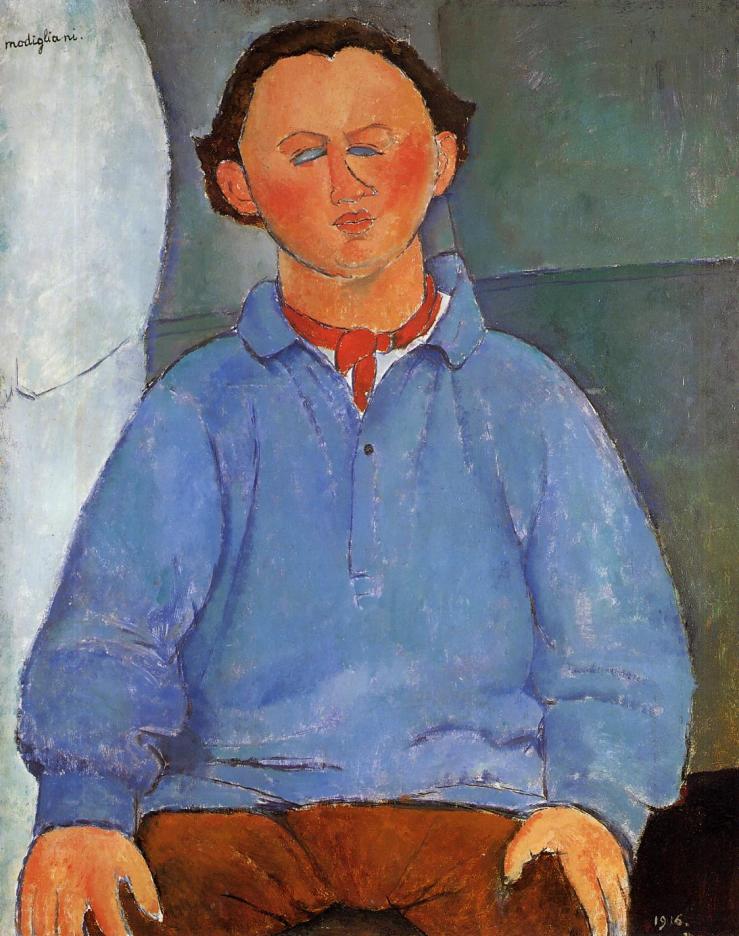
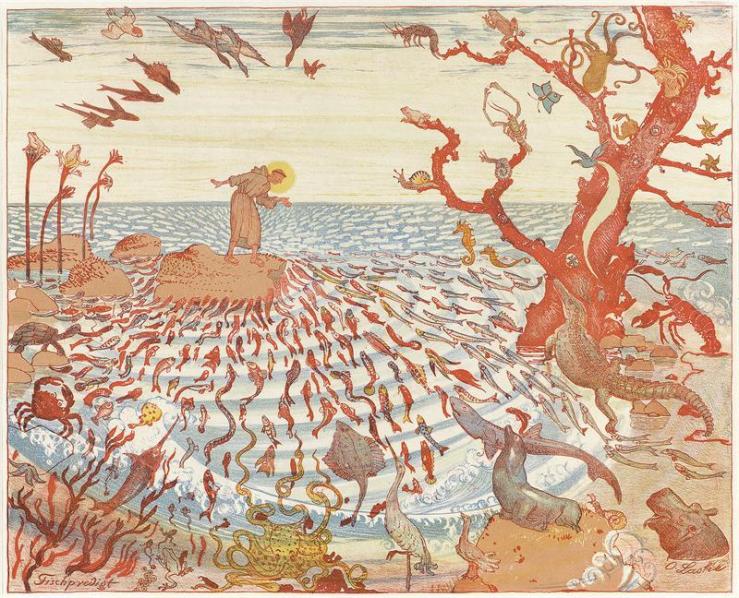
Other Oscars

portrait-of-oscar-wilde-1895
Portrait of Oscar Wilde, 1895 by Henri de Toulouse-Lautrec
sur_9c
The Guillotine, 1938 by Oscar Dominguez
ok
Orpheus and Eurydice, 1917 by Oskar Kokoschka
portrait-of-oscar-miestchanioff-1916
Portrait of Oscar Miestchanioff, 1916 Amedeo Modigliani
w1siziisije3mdm5ocjdlfsiccisimnvbnzlcnqilcitcmvzaxplidewmjr4mtaynfx1mdazzsjdxq
Bauhaus Stairway, 1932 by Oskar Schlemmer
120679-sgsg-42082_l
Fish Sermon, 1919 by Oskar Laske
Posted in Art

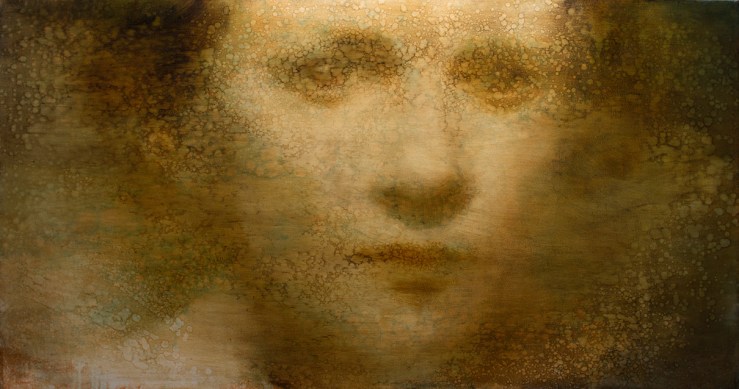
Iris, Dust — Maya Kulenovic

kulenovic_iris_dust_1

Iris, Dust, 2016 by Maya Kulenovic (b. 1975)

Air travel reminds us who we are. It’s the means by which we recognize ourselves as modern (Don DeLillo)

In this vast space, which seems like nothing so much as a container for emptiness, we sit with our documents always ready, wondering if someone will appear and demand to know who we are, someone in authority, and to be unprepared is to risk serious things.

The terminal at each end is full of categories of inspection to which we must submit, impelling us toward a sense of inwardness, a sense of smallness, a self-exposure we are never prepared for no matter how often we take this journey, the buried journey through categories and definitions and foreign languages, not the other, the sunlit trip to the east which we thought we’d decided to make. The decision we’d unwittingly arrived at is the one that brings us through passport control, through the security check and customs, the one that presents to us the magnetic metal detector, the baggage x-ray machine, the currency declaration, the customs declaration, the cards for embarkation and disembarkation, the flight number, the seat number, the times of departure and arrival.

It does no good to say, as I’ve done a hundred times, it’s just another plane trip, I’ve made a hundred. It’s just another terminal, another country, the same floating seats, the documents of admission, the proofs and identifications.

Air travel reminds us who we are. It’s the means by which we recognize ourselves as modern. The process removes us from the world and sets us apart from each other. We wander in the ambient noise, checking one more time for the flight coupon, the boarding pass, the visa. The process convinces us that at any moment we may have to submit to the force that is implied in all this, the unknown authority behind it, behind the categories, the languages we don’t understand. This vast terminal has been erected to examine souls.

It is not surprising, therefore, to see men with submachine guns, to see vultures squatting on the baggage vehicles set at the end of the tarmac in the airport in Bombay when one arrives after a night flight from Athens.

All of this we choose to forget. We devise a counter-system of elaborate forgetfulness. We agree on this together. And out in the street we see how easy it is, once we’re immersed in the thick crowded paint of things, the bright clothes and massed brown faces. But the experience is no less deep because we’ve agreed to forget it.

From Don DeLillo’s novel The Names.

The Mothers — Jenny Saville

cd7645e5bf9925dca7f0174bc9125b19

The Mothers, 2011 by Jenny Saville (b. 1970)